

ASTM D8466-22
(Guide)Standard Guide for Recovered Carbon Black-Carbon Black Test Methods for Testing rCB
General Information
- Abstract
SIGNIFICANCE AND USE
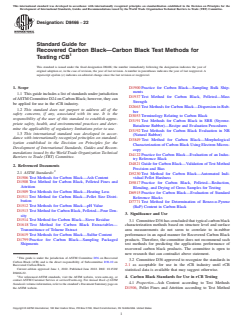
3.1 Committee D36 has concluded that typical carbon black characterization methods based on structure level and surface area measurements do not seem to correlate to in-rubber performance in an equal manner for Recovered Carbon Black products. Therefore, the committee does not recommend such test methods for predicting the applications performance of recovered carbon black products. The committee is open to new research that can contradict above statement.
3.2 Committee D36 approved to recognize the standards in 2.1 as acceptable for use in the rCB industry until rCB statistical data is available that may suggest otherwise.
SCOPE
1.1 This guide includes a list of standards under jurisdiction of ASTM Committee D24 on Carbon Black; however, they can be applied for use in the rCB industry.
1.2 This standard does not purport to address all of the safety concerns, if any, associated with its use. It is the responsibility of the user of this standard to establish appropriate safety, health, and environmental practices and determine the applicability of regulatory limitations prior to use.
1.3 This international standard was developed in accordance with internationally recognized principles on standardization established in the Decision on Principles for the Development of International Standards, Guides and Recommendations issued by the World Trade Organization Technical Barriers to Trade (TBT) Committee.
- Status
- Published
- Publication Date
- 31-May-2022
- Technical Committee
- D36 - Recovered Carbon Black (rCB)
- Drafting Committee
- D36.10 - Recovered Carbon Black


Overview
ASTM D8466-22 is a key international standard guide developed by ASTM International for the testing of recovered carbon black (rCB) using established carbon black test methods. Issued under the jurisdiction of ASTM Committee D36 on Recovered Carbon Black, this document provides critical guidance for applying a variety of well-recognized ASTM standards-originally developed for traditional carbon black-to recovered carbon black products typically sourced from end-of-life tires and similar recycled materials.
The standard addresses the unique challenges associated with characterizing rCB, recognizing that established carbon black structure and surface area metrics do not consistently predict in-rubber performance for rCB materials. As such, it encourages adherence to existing test methods for comparative and quality control purposes, while also remaining open to future research that might yield more relevant or predictive approaches.
Key Topics
- Applicable ASTM Test Methods: ASTM D8466-22 compiles an authoritative list of ASTM standards commonly used for evaluating carbon black properties, including ash content (D1506), pellet fines (D1508), heating loss (D1509), pellet size distribution (D1511), pH value (D1512), pour density (D1513), sieve residue (D1514), sulfur content (D1619), and many more.
- Sampling and Preparation: The guide prescribes best practices for sampling both packaged (D1799) and bulk shipments (D1900), as well as procedures for reduction, blending, and drying of gross samples for testing (D5817).
- Reference Materials and Statistical Validation: Recommendations include the use of industry reference blacks (D4122), validation of test method precision and bias (D4821), and the evaluation of standard reference blacks (D6915).
- Morphological Characterization: For characterization by electron microscopy, the standard references ASTM D3849, while cautioning against direct equivalency claims due to the complex, multi-grade nature of rCB.
- Terminology and Reference Compounds: Establishes shared vocabulary for the industry (D3053) and suggests test methods for carbon black’s performance in rubber compounds (D3191 for SBR; D3192 for NR).
Applications
The ASTM D8466-22 guide is crucial for:
- Quality Control in rCB Production: Enables manufacturers and processors to implement standardized testing protocols, ensuring consistent batch analysis and product quality.
- Comparative Evaluation: Provides a recognized framework for evaluating rCB properties in alignment with conventional carbon black standards, fostering comparability and industry acceptance.
- Safe Laboratory and Industrial Practices: Highlights user responsibility for safety, health, and environmental protocols when conducting tests, in line with regulatory and site-specific requirements.
- Sustainable Materials Management: Assists tire recyclers, rubber compounders, and sustainability-focused organizations in integrating rCB into their processes, contributing to circular economy objectives.
Related Standards
Professionals applying ASTM D8466-22 should also be familiar with the following related ASTM standards:
- ASTM D1506: Test Methods for Carbon Black-Ash Content
- ASTM D1799 / D1900: Practices for Sampling Carbon Black
- ASTM D3053: Terminology Relating to Carbon Black
- ASTM D3191 / D3192: Carbon Black in SBR and NR Rubber Compounds
- ASTM D3849: Morphological Characterization Using Electron Microscopy
- ASTM D5817: Practice for Sample Preparation
- ASTM D6915: Evaluation of Standard Reference Blacks
By following the guidance provided in ASTM D8466-22, industry participants are equipped to produce valid, reliable, and comparable data for recovered carbon black products, supporting both product development and regulatory compliance.
Relations
- Effective Date
- 15-Dec-2023
- Refers
ASTM D1618-23 - Standard Test Method for Carbon Black Extractables-Transmittance of Toluene Extract - Effective Date
- 01-Nov-2023
- Effective Date
- 01-Jun-2020
- Refers
ASTM D3192-09(2019) - Standard Test Methods for Carbon Black Evaluation in NR (Natural Rubber) - Effective Date
- 01-May-2019
- Effective Date
- 01-Jun-2018
- Effective Date
- 01-Jun-2018
- Effective Date
- 01-Dec-2017
- Effective Date
- 01-Dec-2017
- Effective Date
- 01-Oct-2017
- Effective Date
- 01-Aug-2017
- Refers
ASTM D6915-17 - Standard Practice for Carbon Black—Evaluation of Standard Reference Blacks - Effective Date
- 01-May-2017
- Refers
ASTM D4122-17 - Standard Practice for Carbon Black—Evaluation of an Industry Reference Black - Effective Date
- 01-Jan-2017
- Effective Date
- 01-Jan-2017
- Effective Date
- 01-Jan-2016
- Effective Date
- 15-Dec-2015
Get Certified
Connect with accredited certification bodies for this standard

DIN CERTCO
DIN Group product certification.

Smithers Quality Assessments
US management systems and product certification.
Sponsored listings
Frequently Asked Questions
ASTM D8466-22 is a guide published by ASTM International. Its full title is "Standard Guide for Recovered Carbon Black-Carbon Black Test Methods for Testing rCB". This standard covers: SIGNIFICANCE AND USE 3.1 Committee D36 has concluded that typical carbon black characterization methods based on structure level and surface area measurements do not seem to correlate to in-rubber performance in an equal manner for Recovered Carbon Black products. Therefore, the committee does not recommend such test methods for predicting the applications performance of recovered carbon black products. The committee is open to new research that can contradict above statement. 3.2 Committee D36 approved to recognize the standards in 2.1 as acceptable for use in the rCB industry until rCB statistical data is available that may suggest otherwise. SCOPE 1.1 This guide includes a list of standards under jurisdiction of ASTM Committee D24 on Carbon Black; however, they can be applied for use in the rCB industry. 1.2 This standard does not purport to address all of the safety concerns, if any, associated with its use. It is the responsibility of the user of this standard to establish appropriate safety, health, and environmental practices and determine the applicability of regulatory limitations prior to use. 1.3 This international standard was developed in accordance with internationally recognized principles on standardization established in the Decision on Principles for the Development of International Standards, Guides and Recommendations issued by the World Trade Organization Technical Barriers to Trade (TBT) Committee.
SIGNIFICANCE AND USE 3.1 Committee D36 has concluded that typical carbon black characterization methods based on structure level and surface area measurements do not seem to correlate to in-rubber performance in an equal manner for Recovered Carbon Black products. Therefore, the committee does not recommend such test methods for predicting the applications performance of recovered carbon black products. The committee is open to new research that can contradict above statement. 3.2 Committee D36 approved to recognize the standards in 2.1 as acceptable for use in the rCB industry until rCB statistical data is available that may suggest otherwise. SCOPE 1.1 This guide includes a list of standards under jurisdiction of ASTM Committee D24 on Carbon Black; however, they can be applied for use in the rCB industry. 1.2 This standard does not purport to address all of the safety concerns, if any, associated with its use. It is the responsibility of the user of this standard to establish appropriate safety, health, and environmental practices and determine the applicability of regulatory limitations prior to use. 1.3 This international standard was developed in accordance with internationally recognized principles on standardization established in the Decision on Principles for the Development of International Standards, Guides and Recommendations issued by the World Trade Organization Technical Barriers to Trade (TBT) Committee.
ASTM D8466-22 is classified under the following ICS (International Classification for Standards) categories: 83.040.20 - Rubber compounding ingredients. The ICS classification helps identify the subject area and facilitates finding related standards.
ASTM D8466-22 has the following relationships with other standards: It is inter standard links to ASTM D3053-23a, ASTM D1618-23, ASTM D3191-10(2020), ASTM D3192-09(2019), ASTM D3053-18, ASTM D1618-18, ASTM D3053-17a, ASTM D3053-17ae1, ASTM D3053-17, ASTM D1618-17, ASTM D6915-17, ASTM D4122-17, ASTM D7771-17, ASTM D1619-16, ASTM D3053-15. Understanding these relationships helps ensure you are using the most current and applicable version of the standard.
ASTM D8466-22 is available in PDF format for immediate download after purchase. The document can be added to your cart and obtained through the secure checkout process. Digital delivery ensures instant access to the complete standard document.
Standards Content (Sample)
This international standard was developed in accordance with internationally recognized principles on standardization established in the Decision on Principles for the
Development of International Standards, Guides and Recommendations issued by the World Trade Organization Technical Barriers to Trade (TBT) Committee.
Designation: D8466 − 22
Standard Guide for
Recovered Carbon Black—Carbon Black Test Methods for
Testing rCB
This standard is issued under the fixed designation D8466; the number immediately following the designation indicates the year of
original adoption or, in the case of revision, the year of last revision. A number in parentheses indicates the year of last reapproval. A
superscript epsilon (´) indicates an editorial change since the last revision or reapproval.
1. Scope D1900 Practice for Carbon Black—Sampling Bulk Ship-
ments
1.1 This guide includes a list of standards under jurisdiction
D1937 Test Method for Carbon Black, Pelleted—Mass
ofASTM Committee D24 on Carbon Black; however, they can
Strength
be applied for use in the rCB industry.
D2663 Test Methods for Carbon Black—Dispersion in Rub-
1.2 This standard does not purport to address all of the
ber
safety concerns, if any, associated with its use. It is the
D3053 Terminology Relating to Carbon Black
responsibility of the user of this standard to establish appro-
D3191 Test Methods for Carbon Black in SBR (Styrene-
priate safety, health, and environmental practices and deter-
Butadiene Rubber)—Recipe and Evaluation Procedures
mine the applicability of regulatory limitations prior to use.
D3192 Test Methods for Carbon Black Evaluation in NR
1.3 This international standard was developed in accor-
(Natural Rubber)
dance with internationally recognized principles on standard-
D3849 Test Method for Carbon Black—Morphological
ization established in the Decision on Principles for the
Characterization of Carbon Black Using Electron Micros-
Development of International Standards, Guides and Recom-
copy
mendations issued by the World Trade Organization Technical
D4122 Practice for Carbon Black—Evaluation of an Indus-
Barriers to Trade (TBT) Committee.
try Reference Black
D4821 Guide for Carbon Black—Validation of Test Method
2. Referenced Documents
Precision and Bias
2.1 ASTM Standards:
D5230 Test Method for Carbon Black—Automated Indi-
D1506 Test Methods for Carbon Black—Ash Content
vidual Pellet Hardness
D1508 Test Method for Carbon Black, Pelleted Fines and
D5817 Practice for Carbon Black, Pelleted—Reduction,
Attrition
Blending, and Drying of Gross Samples for Testing
D1509 Test Methods for Carbon Black—Heating Loss
D6915 Practice for Carbon Black—Evaluation of Standard
D1511 Test Method for Carbon Black—Pellet Size Distri-
Reference Blacks
bution
D7771 Test Method for Determination of Benzo-α-Pyrene
D1512 Test Methods for Carbon Black—pH Value
(BaP) Content in Carbon Black
D1513 Test Method for Carbon Black, Pelleted—Pour Den-
3. Significance and Use
sity
D1514 Test Method for Carbon Black—Sieve Residue 3.1 Committee D36 has concluded that typical carbon black
D1618 Test Method for Carbon Black Extractables— characterization methods based on structure level and surface
Transmittance of Toluene Extract area measurements do not seem to correlate to in-rubber
D1619 Test Methods for Carbon Black—Sulfur Content performance in an equal manner for Recovered Carbon Black
D1799 Practice for Carbon Black—Sampling Packaged products. Therefore, the committee does not recommend such
Shipments test methods for predicting the applications performance of
recovered carbon black products. The committee is open to
new research that can contradict above statement.
This guide is under the jurisdiction of ASTM Committee D36 on Recovered
3.2 Committee D36 approved to recognize the standards in
Carbon Black (rCB) and is the direct responsibility of Subcommittee D36.10 on
2.1 as acceptable for use in the rCB industry until rCB
Recovered Carbon Black.
Current edition approved June 1, 2022. Published June 2022. DOI: 10.1520/
statistical data is available that may suggest otherwise.
D8466-22.
For referenced ASTM standards, visit the ASTM website, www.astm.org, or
4. Carbon
...