

ASTM D1765-23b
(Classification)Standard Classification System for Carbon Blacks Used in Rubber Products
General Information
- Abstract
SCOPE
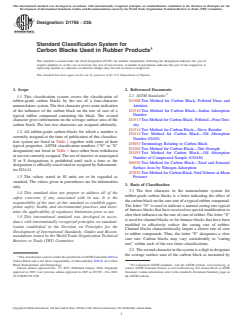
1.1 This classification system covers the classification of rubber-grade carbon blacks by the use of a four-character nomenclature system. The first character gives some indication of the influence of the carbon black on the rate of cure of a typical rubber compound containing the black. The second character gives information on the average surface area of the carbon black. The last two characters are assigned arbitrarily.
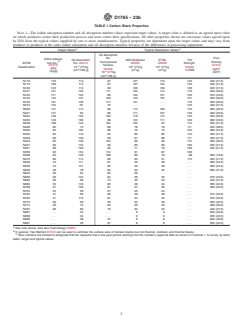
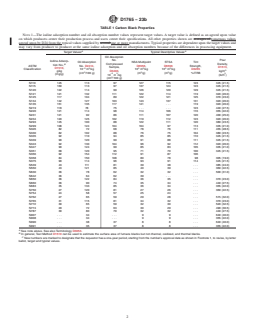
1.2 All rubber-grade carbon blacks for which a number is currently assigned at the time of publication of this classification system are listed in Table 1 together with some of their typical properties. ASTM classification numbers (“N” or “S” designation) not listed in Table 1 have either been withdrawn or are not currently assigned. The use of inactive or unassigned N or S designations is prohibited until such a time as the designation is officially reactivated or assigned by Subcommittee D24.41
1.3 The values stated in SI units are to be regarded as standard. The values given in parentheses are for information only.
1.4 This standard does not purport to address all of the safety concerns, if any, associated with its use. It is the responsibility of the user of this standard to establish appropriate safety, health, and environmental practices and determine the applicability of regulatory limitations prior to use.
1.5 This international standard was developed in accordance with internationally recognized principles on standardization established in the Decision on Principles for the Development of International Standards, Guides and Recommendations issued by the World Trade Organization Technical Barriers to Trade (TBT) Committee.
- Status
- Published
- Publication Date
- 14-Dec-2023
- Technical Committee
- D24 - Carbon Black
- Drafting Committee
- D24.41 - Carbon Black Nomenclature and Terminology
Overview
ASTM D1765-23b: Standard Classification System for Carbon Blacks Used in Rubber Products establishes a systematic approach for classifying rubber-grade carbon blacks. This standard, maintained by ASTM International, defines a four-character nomenclature system that provides information about the impact of carbon black on rubber curing rates and its average surface area. It is widely referenced throughout the rubber industry, facilitating consistency in procurement, quality control, and research.
Key Topics
Nomenclature System
- The first character (N or S) denotes the effect on the cure rate of a typical rubber compound:
- "N" indicates a normal cure rate, typical of furnace blacks.
- "S" indicates a slower cure rate, characteristic of channel blacks or modified furnace blacks.
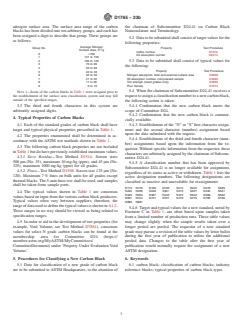
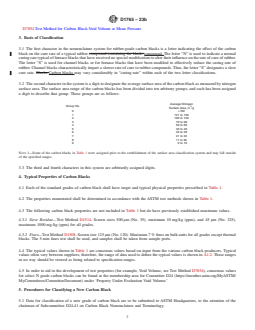
- The second character, a digit, refers to the average nitrogen surface area, grouped as:
- 0: >150 m²/g
- 1: 121–150 m²/g
- 2: 100–120 m²/g
- 3: 70–99 m²/g
- 4: 50–69 m²/g
- 5: 40–49 m²/g
- 6: 33–39 m²/g
- 7: 21–32 m²/g
- 8: 11–20 m²/g
- 9: 0–10 m²/g
- The last two characters are arbitrarily assigned for unique identification.
- The first character (N or S) denotes the effect on the cure rate of a typical rubber compound:
Classification Numbers
- Only numbers listed in the standard (Table 1) are valid for use. Withdrawn or unassigned numbers may not be used until officially reactivated.
Typical Properties
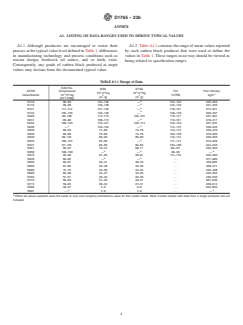
- The standard provides typical and target values for each grade of carbon black, including iodine adsorption number, oil absorption number, surface area, tint strength, and density. These inform purchasing and usage requirements.
Safety and Compliance
- Users are responsible for implementing appropriate safety, health, and environmental practices, and ensuring regulatory compliance.
International Principles
- The standard is developed in line with WTO Technical Barriers to Trade (TBT) principles, ensuring international applicability.
Applications
Rubber Product Manufacturing
- The classification is essential in tire production, hoses, belts, and other rubber goods to ensure performance consistency and optimize properties such as abrasion resistance, tensile strength, and cure kinetics.
Material Selection and Quality Control
- Helps manufacturers and suppliers specify and certify the correct type of carbon black for rubber compounding applications, ensuring repeatable performance.
Research and Development
- Standardized nomenclature enables researchers to compare results reliably and fosters innovation by providing a common language for rubber-grade carbon blacks.
Supply Chain Communication
- Provides clarity between producers, compounders, and end users regarding the specific attributes of each carbon black, reducing the risk of miscommunication or material mismatch.
Related Standards
- ASTM D1508 - Test Method for Carbon Black, Pelleted Fines and Attrition
- ASTM D1510 - Test Method for Carbon Black- Iodine Adsorption Number
- ASTM D1513 - Test Method for Carbon Black, Pelleted-Pour Density
- ASTM D1514 - Test Method for Carbon Black-Sieve Residue
- ASTM D2414 - Test Method for Carbon Black-Oil Absorption Number (OAN)
- ASTM D3053 - Terminology Relating to Carbon Black
- ASTM D3265 - Test Method for Carbon Black-Tint Strength
- ASTM D3493 - Test Method for Carbon Black-Oil Absorption Number of Compressed Sample (COAN)
- ASTM D6556 - Test Method for Carbon Black-Total and External Surface Area by Nitrogen Adsorption
- ASTM D7854 - Test Method for Carbon Black-Void Volume at Mean Pressure
Keywords: ASTM D1765, carbon black classification, rubber-grade carbon black, carbon black properties, rubber product standards, curing rate, surface area, ASTM standards for rubber, quality control in rubber manufacturing, international standards.
Relations
- Effective Date
- 15-Dec-2023
- Effective Date
- 01-Jan-2024
- Effective Date
- 01-Jan-2024
- Effective Date
- 01-Nov-2023
- Effective Date
- 01-Nov-2023
- Effective Date
- 01-Feb-2023
- Effective Date
- 15-Dec-2023
- Effective Date
- 15-Dec-2023
- Effective Date
- 15-Dec-2023
- Effective Date
- 15-Dec-2023
- Referred By
ASTM E1136-19 - Standard Specification for P195/75R14 Radial Standard Reference Test Tire - Effective Date
- 15-Dec-2023
- Referred By
ASTM D4821-20 - Standard Guide for Carbon Black-Validation of Test Method Precision and Bias - Effective Date
- 15-Dec-2023
- Effective Date
- 15-Dec-2023
Get Certified
Connect with accredited certification bodies for this standard

DIN CERTCO
DIN Group product certification.

Smithers Quality Assessments
US management systems and product certification.
Sponsored listings
Frequently Asked Questions
ASTM D1765-23b is a standard published by ASTM International. Its full title is "Standard Classification System for Carbon Blacks Used in Rubber Products". This standard covers: SCOPE 1.1 This classification system covers the classification of rubber-grade carbon blacks by the use of a four-character nomenclature system. The first character gives some indication of the influence of the carbon black on the rate of cure of a typical rubber compound containing the black. The second character gives information on the average surface area of the carbon black. The last two characters are assigned arbitrarily. 1.2 All rubber-grade carbon blacks for which a number is currently assigned at the time of publication of this classification system are listed in Table 1 together with some of their typical properties. ASTM classification numbers (“N” or “S” designation) not listed in Table 1 have either been withdrawn or are not currently assigned. The use of inactive or unassigned N or S designations is prohibited until such a time as the designation is officially reactivated or assigned by Subcommittee D24.41 1.3 The values stated in SI units are to be regarded as standard. The values given in parentheses are for information only. 1.4 This standard does not purport to address all of the safety concerns, if any, associated with its use. It is the responsibility of the user of this standard to establish appropriate safety, health, and environmental practices and determine the applicability of regulatory limitations prior to use. 1.5 This international standard was developed in accordance with internationally recognized principles on standardization established in the Decision on Principles for the Development of International Standards, Guides and Recommendations issued by the World Trade Organization Technical Barriers to Trade (TBT) Committee.
SCOPE 1.1 This classification system covers the classification of rubber-grade carbon blacks by the use of a four-character nomenclature system. The first character gives some indication of the influence of the carbon black on the rate of cure of a typical rubber compound containing the black. The second character gives information on the average surface area of the carbon black. The last two characters are assigned arbitrarily. 1.2 All rubber-grade carbon blacks for which a number is currently assigned at the time of publication of this classification system are listed in Table 1 together with some of their typical properties. ASTM classification numbers (“N” or “S” designation) not listed in Table 1 have either been withdrawn or are not currently assigned. The use of inactive or unassigned N or S designations is prohibited until such a time as the designation is officially reactivated or assigned by Subcommittee D24.41 1.3 The values stated in SI units are to be regarded as standard. The values given in parentheses are for information only. 1.4 This standard does not purport to address all of the safety concerns, if any, associated with its use. It is the responsibility of the user of this standard to establish appropriate safety, health, and environmental practices and determine the applicability of regulatory limitations prior to use. 1.5 This international standard was developed in accordance with internationally recognized principles on standardization established in the Decision on Principles for the Development of International Standards, Guides and Recommendations issued by the World Trade Organization Technical Barriers to Trade (TBT) Committee.
ASTM D1765-23b is classified under the following ICS (International Classification for Standards) categories: 83.040.20 - Rubber compounding ingredients. The ICS classification helps identify the subject area and facilitates finding related standards.
ASTM D1765-23b has the following relationships with other standards: It is inter standard links to ASTM D1765-23a, ASTM D1510-24, ASTM D3265-24, ASTM D3265-23a, ASTM D1510-23a, ASTM D3053-23, ASTM D3493-21, ASTM D2414-23a, ASTM D4583-21, ASTM D3053-23a, ASTM E1136-19, ASTM D4821-20, ASTM D5817-20. Understanding these relationships helps ensure you are using the most current and applicable version of the standard.
ASTM D1765-23b is available in PDF format for immediate download after purchase. The document can be added to your cart and obtained through the secure checkout process. Digital delivery ensures instant access to the complete standard document.
Standards Content (Sample)
This international standard was developed in accordance with internationally recognized principles on standardization established in the Decision on Principles for the
Development of International Standards, Guides and Recommendations issued by the World Trade Organization Technical Barriers to Trade (TBT) Committee.
Designation: D1765 − 23b
Standard Classification System for
Carbon Blacks Used in Rubber Products
This standard is issued under the fixed designation D1765; the number immediately following the designation indicates the year of
original adoption or, in the case of revision, the year of last revision. A number in parentheses indicates the year of last reapproval. A
superscript epsilon (´) indicates an editorial change since the last revision or reapproval.
This standard has been approved for use by agencies of the U.S. Department of Defense.
1. Scope 2. Referenced Documents
2.1 ASTM Standards:
1.1 This classification system covers the classification of
D1508 Test Method for Carbon Black, Pelleted Fines and
rubber-grade carbon blacks by the use of a four-character
Attrition
nomenclature system. The first character gives some indication
D1510 Test Method for Carbon Black—Iodine Adsorption
of the influence of the carbon black on the rate of cure of a
Number
typical rubber compound containing the black. The second
D1513 Test Method for Carbon Black, Pelleted—Pour Den-
character gives information on the average surface area of the
sity
carbon black. The last two characters are assigned arbitrarily.
D1514 Test Method for Carbon Black—Sieve Residue
1.2 All rubber-grade carbon blacks for which a number is
D2414 Test Method for Carbon Black—Oil Absorption
currently assigned at the time of publication of this classifica-
Number (OAN)
tion system are listed in Table 1 together with some of their
D3053 Terminology Relating to Carbon Black
typical properties. ASTM classification numbers (“N” or “S”
D3265 Test Method for Carbon Black—Tint Strength
designation) not listed in Table 1 have either been withdrawn
D3493 Test Method for Carbon Black—Oil Absorption
or are not currently assigned. The use of inactive or unassigned
Number of Compressed Sample (COAN)
N or S designations is prohibited until such a time as the
D6556 Test Method for Carbon Black—Total and External
designation is officially reactivated or assigned by Subcommit-
Surface Area by Nitrogen Adsorption
tee D24.41
D7854 Test Method for Carbon Black-Void Volume at Mean
1.3 The values stated in SI units are to be regarded as
Pressure
standard. The values given in parentheses are for information
3. Basis of Classification
only.
3.1 The first character in the nomenclature system for
1.4 This standard does not purport to address all of the
rubber-grade carbon blacks is a letter indicating the effect of
safety concerns, if any, associated with its use. It is the
the carbon black on the cure rate of a typical rubber compound.
responsibility of the user of this standard to establish appro-
The letter “N” is used to indicate a normal curing rate typical
priate safety, health, and environmental practices and deter-
of furnace blacks that have received no special modification to
mine the applicability of regulatory limitations prior to use.
alter their influence on the rate of cure of rubber. The letter “S”
1.5 This international standard was developed in accor-
is used for channel blacks or for furnace blacks that have been
dance with internationally recognized principles on standard-
modified to effectively reduce the curing rate of rubber.
ization established in the Decision on Principles for the
Channel blacks characteristically impart a slower rate of cure
Development of International Standards, Guides and Recom-
to rubber compounds. Thus, the letter “S” designates a slow
mendations issued by the World Trade Organization Technical
cure rate. Carbon blacks may vary considerably in “curing
Barriers to Trade (TBT) Committee.
rate” within each of the two letter classifications.
3.2 The second character in the system is a digit to designate
the average surface area of the carbon black as measured by
This classification system is under the jurisdiction of ASTM Committee D24 on
Carbon Black and is the direct responsibility of Subcommittee D24.41 on Carbon
Black Nomenclature and Terminology. For referenced ASTM standards, visit the ASTM website, www.astm.org, or
Current edition approved Dec. 15, 2023. Published January 2024. Originally contact ASTM Customer Service at service@astm.org. For Annual Book of ASTM
approved in 1965. Last previous edition approved in 2023 as D1765 – 23a. DOI: Standards volume information, refer to the standard’s Document Summary page on
10.1520/D1765-23B.
the ASTM website.
Copyright © ASTM International, 100 Barr Harbor Drive, PO Box C700, West Conshohocken, PA 19428-2959. United States
D1765 − 23b
TABLE 1 Carbon Black Properties
NOTE 1—The iodine adsorption number and oil absorption number values represent target values. A target value is defined as an agreed upon value
on which producers center their production process and users center their specifications. All other properties shown are consensus values agreed upon
by D24 from the typical values supplied by one or more manufacturers. Typical properties are dependent upon the target values and may vary from
producer to producer at the same iodine adsorption and oil absorption numbers because of the differences in processing equipment.
A A
Target Values Typical Descriptive Values
Oil Absorption
No. Pour
Iodine Adsorp-
Oil Absorption NSA Multipoint STSA Tint
B Compressed Density,
tion No.,
ASTM No. D2414, D6556, D6556 Strength,
D1510, Sample, D1513,
–5 3 3 2 3 2
Classification 10 m /kg 10 m /kg 10 m /kg D3265
g/kg
D3493, kg/m
3 2 2
(cm /100 g) (m /g) (m /g) %ITRB
(mg/g) –5 3 3
10 m /kg (lb/ft )
(cm /100 g)
N110 145 113 97 127 115 123 345 (21.5)
N115 160 113 97 137 124 123 345 (21.5)
N120 122 114 99 126 120 129 345 (21.5)
N121 121 132 111 122 114 119 320 (20.0)
N125 117 104 89 122 121 125 370 (23.0)
N134 142 127 103 143 137 131 320 (20.0)
N135 151 135 117 141 . . . 119 320 (20.0)
N219 118 78 75 . . . . . . 123 440 (27.5)
N220 121 114 98 114 106 116 355 (22.0)
N231 121 92 86 111 107 120 400 (25.0)
N234 120 125 102 119 112 123 320 (20.0)
N293 145 100 88 122 111 120 380 (23.5)
N299 108 124 104 104 97 113 335 (21.0)
N326 82 72 68 78 76 111 455 (28.5)
N330 82 102 88 76 75 104 380 (23.5)
N335 92 110 94 85 85 110 345 (21.5)
N339 90 120 99 91 88 111 345 (21.5)
N343 92 130 104 96 92 112 320 (20.0)
N347 90 124 99 85 83 105 335 (21.0)
N351 68 120 95 71 70 100 345 (21.5)
N356 92 154 112 91 87 106
N358 84 150 108 80 78 98 305 (19.0)
N375 90 114 96 93 91 114 345 (21.5)
N539 43 111 81 39 38 . . . 385 (24.0)
N550 43 121 85 40 39 . . . 360 (22.5)
N630 36 78 62 32 32 . . . 500 (31.0)
N642 36 64 62 39 . . . . . .
N650 36 122 84 36 35 . . . 370 (23.0)
N660 36 90 74 35 34 . . . 440 (27.5)
N683 35 133 85 36 34 . . . 355 (22.0)
N750 27 120 81 27 26 . . . 360 (22.5)
N754 24 58 57 25 24 . . .
N762 27 65 59 29 28 . . . 515 (32.0)
N765 31 115 81 34 32 . . . 370 (23.0)
N772 30 65 59 32 30 . . . 520 (32.5)
N774 29 72 63 30 29 . . . 490 (30.5)
N787 30 80 70 32 32 . . . 440 (27.5)
N907 . . . 34 . . . 9 9 . . . 640 (40.0)
N908 . . . 34 . . . 9 9 . . . 355 (22.0)
N990 . . . 38 37 8 8 . . . 640 (40.0)
N991 . . . 35 37 8 8 . . . 355 (22.0)
A
See note above. See also Terminology D3053.
B
In general, Test Method D1510 can be used to estimate the surface area of furnace blacks but not channel, oxidized, and thermal blacks.
C
New numbers are marked to designate that the requestor has a one-year period, starting from the number’s approval date as shown in Footnote 1, to revise, by letter
ballot, target and typical values.
D1765 − 23b
nitrogen surface area. The surface area range of the carbon the chairman of Subcommittee D24.41 on Carbon Black
blacks has been divided into ten arbitrary groups, and each has Nomenclat
...
This document is not an ASTM standard and is intended only to provide the user of an ASTM standard an indication of what changes have been made to the previous version. Because
it may not be technically possible to adequately depict all changes accurately, ASTM recommends that users consult prior editions as appropriate. In all cases only the current version
of the standard as published by ASTM is to be considered the official document.
Designation: D1765 − 23a D1765 − 23b
Standard Classification System for
Carbon Blacks Used in Rubber Products
This standard is issued under the fixed designation D1765; the number immediately following the designation indicates the year of
original adoption or, in the case of revision, the year of last revision. A number in parentheses indicates the year of last reapproval. A
superscript epsilon (´) indicates an editorial change since the last revision or reapproval.
This standard has been approved for use by agencies of the U.S. Department of Defense.
1. Scope
1.1 This classification system covers the classification of rubber-grade carbon blacks by the use of a four-character nomenclature
system. The first character gives some indication of the influence of the carbon black on the rate of cure of a typical rubber
compound containing the black. The second character gives information on the average surface area of the carbon black. The last
two characters are assigned arbitrarily.
1.2 All rubber-grade carbon blacks for which a number is currently assigned at the time of publication of this classification system
are listed in Table 1 together with some of their typical properties. ASTM classification numbers (“N” or “S” designation) not listed
in Table 1 have either been withdrawn or are not currently assigned. The use of inactive or unassigned N or S designations is
prohibited until such a time as the designation is officially reactivated or assigned by Subcommittee D24.41
1.3 The values stated in SI units are to be regarded as standard. The values given in parentheses are for information only.
1.4 This standard does not purport to address all of the safety concerns, if any, associated with its use. It is the responsibility
of the user of this standard to establish appropriate safety, health, and environmental practices and determine the applicability of
regulatory limitations prior to use.
1.5 This international standard was developed in accordance with internationally recognized principles on standardization
established in the Decision on Principles for the Development of International Standards, Guides and Recommendations issued
by the World Trade Organization Technical Barriers to Trade (TBT) Committee.
2. Referenced Documents
2.1 ASTM Standards:
D1508 Test Method for Carbon Black, Pelleted Fines and Attrition
D1510 Test Method for Carbon Black—Iodine Adsorption Number
D1513 Test Method for Carbon Black, Pelleted—Pour Density
D1514 Test Method for Carbon Black—Sieve Residue
D2414 Test Method for Carbon Black—Oil Absorption Number (OAN)
D3053 Terminology Relating to Carbon Black
D3265 Test Method for Carbon Black—Tint Strength
D3493 Test Method for Carbon Black—Oil Absorption Number of Compressed Sample (COAN)
D6556 Test Method for Carbon Black—Total and External Surface Area by Nitrogen Adsorption
This classification system is under the jurisdiction of ASTM Committee D24 on Carbon Black and is the direct responsibility of Subcommittee D24.41 on Carbon Black
Nomenclature and Terminology.
Current edition approved April 1, 2023Dec. 15, 2023. Published April 2023January 2024. Originally approved in 1965. Last previous edition approved in 2023 as
D1765 – 23.D1765 – 23a. DOI: 10.1520/D1765-23A.10.1520/D1765-23B.
For referenced ASTM standards, visit the ASTM website, www.astm.org, or contact ASTM Customer Service at service@astm.org. For Annual Book of ASTM Standards
volume information, refer to the standard’s Document Summary page on the ASTM website.
Copyright © ASTM International, 100 Barr Harbor Drive, PO Box C700, West Conshohocken, PA 19428-2959. United States
D1765 − 23b
TABLE 1 Carbon Black Properties
NOTE 1—The iodine adsorption number and oil absorption number values represent target values. A target value is defined as an agreed upon value
on which producers center their production process and users center their specifications. All other properties shown are averages of consensus values
agreed upon by D24 from the typical values supplied by several one or more manufacturers. Typical properties are dependent upon the target values and
may vary from producer to producer at the same iodine adsorption and oil absorption numbers because of the differences in processing equipment.
A A
Target Values Typical Descriptive Values
Oil Absorption
No. Pour
Iodine Adsorp-
Oil Absorption NSA Multipoint STSA Tint
B Compressed Density,
tion No.,
ASTM No. D2414, D6556, D6556 Strength,
Sample, D1513,
D1510, –5 3 3 2 3 2
Classification 10 m /kg 10 m /kg 10 m /kg D3265
g/kg D3493, kg/m
3 2 2
(cm /100 g) (m /g) (m /g) %ITRB
–5 3 3
(mg/g)
10 m /kg (lb/ft )
(cm /100 g)
N110 145 113 97 127 115 123 345 (21.5)
N115 160 113 97 137 124 123 345 (21.5)
N120 122 114 99 126 120 129 345 (21.5)
N121 121 132 111 122 114 119 320 (20.0)
N125 117 104 89 122 121 125 370 (23.0)
N134 142 127 103 143 137 131 320 (20.0)
N135 151 135 117 141 . . . 119 320 (20.0)
N219 118 78 75 . . . . . . 123 440 (27.5)
N220 121 114 98 114 106 116 355 (22.0)
N231 121 92 86 111 107 120 400 (25.0)
N234 120 125 102 119 112 123 320 (20.0)
N293 145 100 88 122 111 120 380 (23.5)
N299 108 124 104 104 97 113 335 (21.0)
N326 82 72 68 78 76 111 455 (28.5)
N330 82 102 88 76 75 104 380 (23.5)
N335 92 110 94 85 85 110 345 (21.5)
N339 90 120 99 91 88 111 345 (21.5)
N343 92 130 104 96 92 112 320 (20.0)
N347 90 124 99 85 83 105 335 (21.0)
N351 68 120 95 71 70 100 345 (21.5)
N356 92 154 112 91 87 106
N358 84 150 108 80 78 98 305 (19.0)
N375 90 114 96 93 91 114 345 (21.5)
N539 43 111 81 39 38 . . . 385 (24.0)
N550 43 121 85 40 39 . . . 360 (22.5)
N630 36 78 62 32 32 . . . 500 (31.0)
N642 36 64 62 39 . . . . . .
N650 36 122 84 36 35 . . . 370 (23.0)
N660 36 90 74 35 34 . . . 440 (27.5)
N683 35 133 85 36 34 . . . 355 (22.0)
N750 27 120 81 27 26 . . . 360 (22.5)
N754 24 58 57 25 24 . . .
N762 27 65 59 29 28 . . . 515 (32.0)
N765 31 115 81 34 32 . . . 370 (23.0)
N772 30 65 59 32 30 . . . 520 (32.5)
N774 29 72 63 30 29 . . . 490 (30.5)
N787 30 80 70 32 32 . . . 440 (27.5)
N907 . . . 34 . . . 9 9 . . . 640 (40.0)
N908 . . . 34 . . . 9 9 . . . 355 (22.0)
N990 . . . 38 37 8 8 . . . 640 (40.0)
N991 . . . 35 37 8 8 . . . 355 (22.0)
A
See note above. See also Terminology D3053.
B
In general, Test Method D1510 can be used to estimate the surface area of furnace blacks but not channel, oxidized, and thermal blacks.
C
New numbers are marked to designate that the requestor has a one-year period, starting from the number’s approval date as shown in Footnote 1, to revise, by letter
ballot, target and typical values.
D1765 − 23b
D7854 Test Method for Carbon Black-Void Volume at Mean Pressure
3. Basis of Classification
3.1 The first character in the nomenclature system for rubber-grade carbon blacks is a letter indicating the effect of the carbon
black on the cure rate of a typical rubber compound containing the black. compound. The letter “N” is used to indicate a normal
curing rate typical of furnace blacks that have received no special modification to alter their influence on the rate of cure of rubber.
The letter “S” is used for channel blacks or for furnace blacks that have been modified to effectively reduce the curing rate of
rubber. Channel blacks characteristically impart a slower rate of cure to rubber compounds. Thus, the letter “S” designates a slow
cure rate. Blacks Carbon blacks may vary considerably in “curing rate” within each of the two letter classifications.
3.2 The second character in the system is a digit to designate the average surface area of the carbon black as measured by nitrogen
surface area. The surface area range of the carbon blacks has been divided into ten arbitrary groups, and each has been assigned
a digit to describe that group. These groups are as follows:
Average Nitrogen
Group No.
Surface Area, m /g
0 >150
1 121 to 150
2 100 to 120
...