

ASTM D4839-03(2024)
(Test Method)Standard Test Method for Total Carbon and Organic Carbon in Water by Ultraviolet, or Persulfate Oxidation, or Both, and Infrared Detection
General Information
- Abstract
SIGNIFICANCE AND USE
5.1 This test method is used for determination of the carbon content of water from a variety of natural, domestic, and industrial sources. In its most common form, this test method is used to measure organic carbon as a means of monitoring organic pollutants in industrial wastewater. These measurements are also used in monitoring waste treatment processes.
5.2 The relationship of TOC to other water quality parameters such as chemical oxygen demand (COD) and total oxygen demand (TOD) is described in the literature.4
SCOPE
1.1 This test method covers the determination of total carbon (TC), inorganic carbon (IC), and total organic carbon (TOC) in water, wastewater, and seawater in the range from 0.1 mg/L to 4000 mg/L of carbon.
1.2 This test method was used successfully with reagent water spiked with sodium carbonate, acetic acid, and pyridine. It is the user's responsibility to ensure the validity of this test method for waters of untested matrices.
1.3 This test method is applicable only to carbonaceous matter in the sample that can be introduced into the reaction zone. The syringe needle or injector opening size generally limit the maximum size of particles that can be so introduced.
1.4 In addition to laboratory analyses, this test method may be applied to stream monitoring.
1.5 The values stated in SI units are to be regarded as standard. No other units of measurement are included in this standard.
1.6 This standard does not purport to address all of the safety concerns, if any, associated with its use. It is the responsibility of the user of this standard to establish appropriate safety, health, and environmental practices and determine the applicability of regulatory limitations prior to use.
1.7 This international standard was developed in accordance with internationally recognized principles on standardization established in the Decision on Principles for the Development of International Standards, Guides and Recommendations issued by the World Trade Organization Technical Barriers to Trade (TBT) Committee.
- Status
- Published
- Publication Date
- 31-Mar-2024
- Technical Committee
- D19 - Water
- Drafting Committee
- D19.06 - Methods for Analysis for Organic Substances in Water
Overview
ASTM D4839-03(2024) is a standard test method developed by ASTM International for determining the total carbon (TC), inorganic carbon (IC), and total organic carbon (TOC) in water, wastewater, and seawater. This method utilizes ultraviolet (UV) or persulfate oxidation, or both, in conjunction with infrared detection to quantify carbon content in a wide concentration range (0.1 mg/L to 4000 mg/L). It is extensively used for environmental monitoring and water quality assessment, especially for detecting and tracking organic pollutants in various water sources.
Key Topics
Test Scope and Applicability
- Measures TC, IC, and TOC in natural, domestic, and industrial waters, including wastewaters and seawaters.
- Applicable for water with carbon content from 0.1 mg/L up to 4000 mg/L.
- Designed for both laboratory analysis and field/stream monitoring.
Methodology
- Removal of inorganic carbon (IC) via acidification and sparging with carbon-free gas if desired.
- Conversion of remaining carbon to carbon dioxide (CO₂) using persulfate oxidation aided by heat or UV radiation.
- Detection of evolved CO₂ using a non-dispersive infrared (NDIR) detector.
- Calculation of TOC either by direct measurement or by difference (TC-IC).
Significance and Use
- Monitoring organic carbon as an indicator of organic pollution in industrial effluents.
- Assessing efficiency of wastewater treatment processes.
- Used in correlation with other water quality parameters such as Chemical Oxygen Demand (COD) and Total Oxygen Demand (TOD).
Quality Assurance
- Emphasizes sample preservation, calibration protocols, and regular quality control checks.
- Recommends use of laboratory control samples, method blanks, matrix spikes, and duplicate analysis for reliable results.
Applications
Environmental Compliance
- Regular monitoring of rivers, lakes, and marine environments to track organic pollutants and ensure compliance with environmental regulations.
Industrial Wastewater Management
- Direct measurement and continuous monitoring of organic carbon content in effluents help optimize treatment processes and comply with discharge permits.
Drinking Water Quality
- Detection of organic contaminants assists utilities in maintaining safe water quality and addressing potential health concerns.
Process Control in Water Treatment
- Used to evaluate the performance of biological and chemical oxidation processes for removing organic matter.
Research and Development
- Facilitates scientific studies relating to natural organic matter dynamics, pollutant transport, and the development of advanced water treatment methods.
Related Standards
ASTM D1129: Terminology Relating to Water
Standardizes water-related terminology for clarity and consistency.ASTM D1193: Specification for Reagent Water
Defines requirements for water purity used in laboratory analysis.ASTM D3370: Practices for Sampling Water from Flowing Process Streams
Provides protocols for representative water sampling.ASTM D4129: Test Method for Total and Organic Carbon in Water by High Temperature Oxidation and Coulometric Detection
Alternative method using high-temperature oxidation for carbon determination.ASTM D5847: Practice for Writing Quality Control Specifications for Standard Test Methods for Water Analysis
Guidance on quality control procedures in water analysis.
Practical Value
This ASTM standard provides a robust and flexible method for measuring carbon-based contaminants in water. By utilizing UV or persulfate oxidation and precise infrared detection, it ensures sensitive, accurate, and reliable monitoring of water quality for multiple applications. Adhering to the procedures and quality control measures in ASTM D4839-03(2024) enables labs and industries to achieve consistent results, meet regulatory requirements, and safeguard both environmental and public health.
Keywords: total organic carbon, TOC, total carbon, inorganic carbon, water analysis, wastewater, UV oxidation, persulfate oxidation, infrared detection, ASTM D4839, water quality, environmental monitoring.
Relations
- Effective Date
- 01-Apr-2024
- Referred By
ASTM D6908-06(2017) - Standard Practice for Integrity Testing of Water Filtration Membrane Systems - Effective Date
- 01-Apr-2024
- Effective Date
- 01-Apr-2024
- Effective Date
- 01-Apr-2024
- Effective Date
- 01-Apr-2024
Get Certified
Connect with accredited certification bodies for this standard

ECOCERT
Organic and sustainability certification.

Eurofins Food Testing Global
Global leader in food, environment, and pharmaceutical product testing.

Intertek Bangladesh
Intertek certification and testing services in Bangladesh.
Sponsored listings
Frequently Asked Questions
ASTM D4839-03(2024) is a standard published by ASTM International. Its full title is "Standard Test Method for Total Carbon and Organic Carbon in Water by Ultraviolet, or Persulfate Oxidation, or Both, and Infrared Detection". This standard covers: SIGNIFICANCE AND USE 5.1 This test method is used for determination of the carbon content of water from a variety of natural, domestic, and industrial sources. In its most common form, this test method is used to measure organic carbon as a means of monitoring organic pollutants in industrial wastewater. These measurements are also used in monitoring waste treatment processes. 5.2 The relationship of TOC to other water quality parameters such as chemical oxygen demand (COD) and total oxygen demand (TOD) is described in the literature.4 SCOPE 1.1 This test method covers the determination of total carbon (TC), inorganic carbon (IC), and total organic carbon (TOC) in water, wastewater, and seawater in the range from 0.1 mg/L to 4000 mg/L of carbon. 1.2 This test method was used successfully with reagent water spiked with sodium carbonate, acetic acid, and pyridine. It is the user's responsibility to ensure the validity of this test method for waters of untested matrices. 1.3 This test method is applicable only to carbonaceous matter in the sample that can be introduced into the reaction zone. The syringe needle or injector opening size generally limit the maximum size of particles that can be so introduced. 1.4 In addition to laboratory analyses, this test method may be applied to stream monitoring. 1.5 The values stated in SI units are to be regarded as standard. No other units of measurement are included in this standard. 1.6 This standard does not purport to address all of the safety concerns, if any, associated with its use. It is the responsibility of the user of this standard to establish appropriate safety, health, and environmental practices and determine the applicability of regulatory limitations prior to use. 1.7 This international standard was developed in accordance with internationally recognized principles on standardization established in the Decision on Principles for the Development of International Standards, Guides and Recommendations issued by the World Trade Organization Technical Barriers to Trade (TBT) Committee.
SIGNIFICANCE AND USE 5.1 This test method is used for determination of the carbon content of water from a variety of natural, domestic, and industrial sources. In its most common form, this test method is used to measure organic carbon as a means of monitoring organic pollutants in industrial wastewater. These measurements are also used in monitoring waste treatment processes. 5.2 The relationship of TOC to other water quality parameters such as chemical oxygen demand (COD) and total oxygen demand (TOD) is described in the literature.4 SCOPE 1.1 This test method covers the determination of total carbon (TC), inorganic carbon (IC), and total organic carbon (TOC) in water, wastewater, and seawater in the range from 0.1 mg/L to 4000 mg/L of carbon. 1.2 This test method was used successfully with reagent water spiked with sodium carbonate, acetic acid, and pyridine. It is the user's responsibility to ensure the validity of this test method for waters of untested matrices. 1.3 This test method is applicable only to carbonaceous matter in the sample that can be introduced into the reaction zone. The syringe needle or injector opening size generally limit the maximum size of particles that can be so introduced. 1.4 In addition to laboratory analyses, this test method may be applied to stream monitoring. 1.5 The values stated in SI units are to be regarded as standard. No other units of measurement are included in this standard. 1.6 This standard does not purport to address all of the safety concerns, if any, associated with its use. It is the responsibility of the user of this standard to establish appropriate safety, health, and environmental practices and determine the applicability of regulatory limitations prior to use. 1.7 This international standard was developed in accordance with internationally recognized principles on standardization established in the Decision on Principles for the Development of International Standards, Guides and Recommendations issued by the World Trade Organization Technical Barriers to Trade (TBT) Committee.
ASTM D4839-03(2024) is classified under the following ICS (International Classification for Standards) categories: 71.060.10 - Chemical elements. The ICS classification helps identify the subject area and facilitates finding related standards.
ASTM D4839-03(2024) has the following relationships with other standards: It is inter standard links to ASTM D4839-03(2017), ASTM D6908-06(2017), ASTM D3694-96(2024), ASTM E2656-16, ASTM D5173-15(2023). Understanding these relationships helps ensure you are using the most current and applicable version of the standard.
ASTM D4839-03(2024) is available in PDF format for immediate download after purchase. The document can be added to your cart and obtained through the secure checkout process. Digital delivery ensures instant access to the complete standard document.
Standards Content (Sample)
This international standard was developed in accordance with internationally recognized principles on standardization established in the Decision on Principles for the
Development of International Standards, Guides and Recommendations issued by the World Trade Organization Technical Barriers to Trade (TBT) Committee.
Designation: D4839 − 03 (Reapproved 2024)
Standard Test Method for
Total Carbon and Organic Carbon in Water by Ultraviolet, or
Persulfate Oxidation, or Both, and Infrared Detection
This standard is issued under the fixed designation D4839; the number immediately following the designation indicates the year of
original adoption or, in the case of revision, the year of last revision. A number in parentheses indicates the year of last reapproval. A
superscript epsilon (´) indicates an editorial change since the last revision or reapproval.
1. Scope 2. Referenced Documents
1.1 This test method covers the determination of total
2.1 ASTM Standards:
carbon (TC), inorganic carbon (IC), and total organic carbon
D1129 Terminology Relating to Water
(TOC) in water, wastewater, and seawater in the range from
D1192 Guide for Equipment for Sampling Water and Steam
0.1 mg ⁄L to 4000 mg ⁄L of carbon.
in Closed Conduits (Withdrawn 2003)
D1193 Specification for Reagent Water
1.2 This test method was used successfully with reagent
D2777 Practice for Determination of Precision and Bias of
water spiked with sodium carbonate, acetic acid, and pyridine.
Applicable Test Methods of Committee D19 on Water
It is the user’s responsibility to ensure the validity of this test
D3370 Practices for Sampling Water from Flowing Process
method for waters of untested matrices.
Streams
1.3 This test method is applicable only to carbonaceous
D4129 Test Method for Total and Organic Carbon in Water
matter in the sample that can be introduced into the reaction
by High Temperature Oxidation and by Coulometric
zone. The syringe needle or injector opening size generally
Detection
limit the maximum size of particles that can be so introduced.
D5847 Practice for Writing Quality Control Specifications
1.4 In addition to laboratory analyses, this test method may
for Standard Test Methods for Water Analysis
be applied to stream monitoring.
3. Terminology
1.5 The values stated in SI units are to be regarded as
standard. No other units of measurement are included in this
3.1 Definitions:
standard.
3.1.1 For definitions of terms used in this standard, refer to
1.6 This standard does not purport to address all of the
Terminology D1129.
safety concerns, if any, associated with its use. It is the
3.2 Definitions of Terms Specific to This Standard:
responsibility of the user of this standard to establish appro-
3.2.1 inorganic carbon (IC), n—carbon in the form of
priate safety, health, and environmental practices and deter-
carbon dioxide, carbonate ion, or bicarbonate ion.
mine the applicability of regulatory limitations prior to use.
1.7 This international standard was developed in accor-
3.2.2 refractory material, n—that which cannot be oxidized
dance with internationally recognized principles on standard-
completely under the test method conditions.
ization established in the Decision on Principles for the
3.2.3 total carbon (TC), n—the sum of IC and TOC.
Development of International Standards, Guides and Recom-
mendations issued by the World Trade Organization Technical 3.2.4 total organic carbon (TOC), n—carbon in the form of
Barriers to Trade (TBT) Committee. organic compounds.
1 2
This test method is under the jurisdiction of ASTM Committee D19 on Water For referenced ASTM standards, visit the ASTM website, www.astm.org, or
and is the direct responsibility of Subcommittee D19.06 on Methods for Analysis for contact ASTM Customer Service at service@astm.org. For Annual Book of ASTM
Organic Substances in Water. Standards volume information, refer to the standard’s Document Summary page on
Current edition approved April 1, 2024. Published April 2024. Originally the ASTM website.
approved in 1988. Last previous edition approved in 2017 as D4839 – 03 (2017). The last approved version of this historical standard is referenced on
DOI: 10.1520/D4839-03R24. www.astm.org.
Copyright © ASTM International, 100 Barr Harbor Drive, PO Box C700, West Conshohocken, PA 19428-2959. United States
D4839 − 03 (2024)
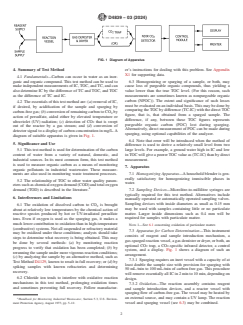
FIG. 1 Diagram of Apparatus
4. Summary of Test Method er’s instructions for dealing with this problem. See Appendix
X1 for supporting data.
4.1 Fundamentals—Carbon can occur in water as an inor-
ganic and organic compound. This test method can be used to 6.3 Homogenizing or sparging of a sample, or both, may
make independent measurements of IC, TOC, and TC, and can cause loss of purgeable organic compounds, thus yielding a
also determine IC by the difference of TC and TOC, and TOC value lower than the true TOC level. (For this reason, such
as the difference of TC and IC. measurements are sometimes known as nonpurgeable organic
carbon (NPOC)). The extent and significance of such losses
4.2 The essentials of this test method are: (a) removal of IC,
must be evaluated on an individual basis. This may be done by
if desired, by acidification of the sample and sparging by
comparing the TOC by difference (TC-IC) with the direct TOC
carbon-free gas; (b) conversion of remaining carbon to CO by
figure, that is, that obtained from a sparged sample. The
action of persulfate, aided either by elevated temperature or
difference, if any, between these TOC figures represents
ultraviolet (UV) radiation; (c) detection of CO that is swept
purgeable organic carbon (POC) lost during sparging.
out of the reactor by a gas stream; and (d) conversion of
Alternatively, direct measurement of POC can be made during
detector signal to a display of carbon concentration in mg/L. A
sparging, using optional capabilities of the analyzer.
diagram of suitable apparatus is given in Fig. 1.
6.4 Note that error will be introduced when the method of
5. Significance and Use
difference is used to derive a relatively small level from two
large levels. For example, a ground water high in IC and low
5.1 This test method is used for determination of the carbon
content of water from a variety of natural, domestic, and in TOC will give a poorer TOC value as (TC-IC) than by direct
measurement.
industrial sources. In its most common form, this test method
is used to measure organic carbon as a means of monitoring
7. Apparatus
organic pollutants in industrial wastewater. These measure-
7.1 Homogenizing Apparatus—A household blender is gen-
ments are also used in monitoring waste treatment processes.
erally satisfactory for homogenizing immiscible phases in
5.2 The relationship of TOC to other water quality param-
water.
eters such as chemical oxygen demand (COD) and total oxygen
7.2 Sampling Devices—Microlitre-to-millilitre syringes are
demand (TOD) is described in the literature.
typically required for this test method. Alternatives include
6. Interferences and Limitations
manually operated or automatically operated sampling valves.
Sampling devices with inside diameters as small as 0.15 mm
6.1 The oxidation of dissolved carbon to CO is brought
may be used with samples containing little or no particulate
about at relatively low temperatures by the chemical action of
matter. Larger inside dimensions such as 0.4 mm will be
reactive species produced by hot or UV-irradiated persulfate
required for samples with particulate matter.
ions. Even if oxygen is used as the sparging gas, it makes a
much lower contribution to oxidation than in high-temperature
NOTE 1—See 6.1 concerning oxidation of particulate matter.
(combustive) systems. Not all suspended or refractory material
7.3 Apparatus for Carbon Determination—This instrument
may be oxidized under these conditions; analysts should take
consists of reagent and sample introduction mechanism, a
steps to determine what recovery is being obtained. This may
gas-sparged reaction vessel, a gas demister or dryer, or both, an
be done by several methods: (a) by monitoring reaction
optional CO trap, a CO -specific infrared detector, a control
2 2
progress to verify that oxidation has been completed; (b) by
system, and a display. Fig. 1 shows a diagram of such an
rerunning the sample under more vigorous reaction conditions;
arrangement.
(c) by analyzing the sample by an alternative method, such as
7.3.1 Sparging requires an inert vessel with a capacity of at
Test Method D4129, known to result in full recovery; or (d) by
least double the sample size with provision for sparging with
spiking samples with known refractories and determining
50 mL ⁄min to 100 mL ⁄min of carbon free gas. This procedure
recovery.
will remove essentially all IC in 2 min to 10 min, depending on
6.2 Chloride ion tends to interfere with oxidative reaction
design.
mechanisms in this test method, prolonging oxidation times
7.3.2 Oxidation—The reaction assembly contains reagent
and sometimes preventing full recovery. Follow manufactur-
and sample introduction devices, and a reactor vessel with
sparging flow of carbon-free gas. The vessel may be heated by
an external source, and may contain a UV lamp. The reaction
Handbook for Monitoring Industrial Wastewater, Section 5.3, U.S. Environ-
ment Protection Agency, August 1973, pp. 5–12. vessel and sparging vessel (see 6.3) may be combined.
D4839 − 03 (2024)
7.3.3 Gas Conditioning—The gas passing from the reactor This stock solution, or dilutions of it, may be used to calibrate
is dried, and the CO produced is either trapped and later and test performance of the carbon analyzer.
released to the detector, or routed directly to the detector
8.5 Persulfate Solution—Prepare by dissolving the appro-
through a chlorine-removing scrubber.
priate weight of potassium or sodium persulfate in 1 L of water,
7.3.4 Detector—The CO in the gas stream is detected by a
to produce the concentration specified by the instrument
CO -specific nondispersive infrared (NDIR) detector.
manufacturer. If specified, add 1 mL of phosphoric acid (sp gr
7.3.5 Presentation of Results—The NDIR detector output is
1.69) and mix well. Store in a cool, dark place. Recipes for this
related to stored calibration data and then displayed as milli-
reagent solution may be modified by manufacturers to meet the
grams of carbon per litre.
needs of specific applications, for example, high chloride
samples.
8. Reagents and Materials
8.6 Gas Supply—A gas free of CO and of organic matter is
8.1 Purity of Reagents—Reagent grade chemicals shall be
required. Use a purity as specified by the equipment manufac-
used in all tests. Unless otherwise indicated, it is intended that
turer. The use of oxygen is preferred for the UV-persulfate
all reagents conform to the specifications of the Committee on
method, and nitrogen or helium is preferred if a CO trap is
Analytical Reagents of the American Chemical Society, where
used between reactor and detector.
such specifications are available. Other grades may be used,
provided it is first ascertained that the reagent is of sufficient
9. Sampling and Sample Preservation
purity to permit its use without lessening the accuracy of the
determination.
9.1 Collect the sample in accordance with Guide D1192 and
8.2 Purity of Water—Unless otherwise indicated, references
Practices D3370.
to water shall be understood to mean reagent water conforming
9.2 To preserve samples for this analysis, store samples in
to Specification D1193, Type I or Type II. The indicated
glass at 4 °C. To aid preservation, acidify the samples to a pH
specification does not actually specify inorganic carbon or
of 2. It should be noted that acidification will enhance loss of
organic carbon levels. These levels can affect the results of this
inorganic carbon. If the purgeable organic fraction is important,
test method, especially at progressively lower levels of the
fill the sample bottles to overflowing with a minimum of
carbon content in the samples to be measured. Where inorganic
turbulence and cap them using a fluoropolymer-lined cap,
carbon in reagent water is significant, CO -free water may be
without headspace.
prepared from reagent water by acidifying to pH 2, then
sparging with fritted-glass sparger using CO -free gas (time
9.3 For monitoring of waters containing solids or immis-
will depend on volume and gas flow rate, and should be
cible liquids that are to be injected into the reaction zone, use
determined by test). Alternatively, if the carbon contribution of
a mechanical homogenizer or ultrasonic disintegrator. Filtering
the reagent water is known accurately, its effect may be
or screening may be necessary after homogenization to reject
allowed for in preparation of standards and other solutions.
particle sizes that are too large for injection. Volatile organics
CO -free water should be protected from atmospheric contami-
may be lost. See 6.3.
nation. Glass containers are required for storage of water and
9.4 For wastewater streams where carbon concentrations are
standard solutions.
greater than the desired range of instrument operation, dilute
8.3 Acid—Various concentrated acids may be used for
the samples as necessary.
acidification of samples and of the oxidizing reagent. Acids
such as phosphoric (sp gr 1.69), nitric (sp gr 1.42), or sulfuric
10. Instrument Operation
(sp gr 1.84) are suitable for most applications. Sulfuric acid
10.1 Follow the manufacturer’s instructions for instrument
should be used in the form of a 1 + 1 dilution, for safety
warm-up, gas flows, and liquid flows.
reasons. Hydrochloric acid is not recommended.
8.4 Organic Carbon, Standard Solution (2000 mg/L)—
11. Calibration
Choose a water-soluble, stable reagent grade compound, such
as benzoic acid or anhydrous potassium hydrogen phthalate
11.1 Use the stock solution of 2000 mg/L of carbon, and
(KHC H O ). Calculate the weight of compoun
...