

ASTM D6908-06(2017)
(Practice)Standard Practice for Integrity Testing of Water Filtration Membrane Systems
General Information
- Abstract
SIGNIFICANCE AND USE
4.1 The integrity test methods described are used to determine the integrity of membrane systems, and are applicable to systems containing membrane module configurations of both hollow fiber and flat sheet; such as, spiral-wound configuration. In all cases the practices apply to membranes in the RO, NF, and UF membrane classes. However, the TOC and Dye Test practices do not apply to membranes in the MF range or the upper end of the UF pore size range (0.01 μm and larger pore sizes) due to insignificant or inconsistent removal of TOC material by these membranes.
4.2 These methods may be used to identify relative changes in the integrity of a system, or used in conjunction with the equations described in 9.4, to provide a means of estimating the integrity in terms of log reduction value. For critical applications, estimated log reductions using these equations should be confirmed by experiment for the particular membrane and system configuration used.
4.3 The ability of the methods to detect any given defect is affected by the size of the system or portion of the system tested. Selecting smaller portions of the system to test will increase the sensitivity of the test to defects. When determining the size that can be tested as a discrete unit, use the guidelines supplied by the system manufacturer or the general guidelines provided in this practice.
4.4 The applicability of the tests is largely independent of system size when measured in terms of the impact of defects on the treated water quality (that is, the system LRV). This is because the bypass flow from any given defect is diluted in proportion to the systems total flowrate. For example, a 10-module system with a single defect will produce the same water quality as a 100-module system with ten of the same size defects.
SCOPE
1.1 This practice covers the determination of the integrity of water filtration membrane elements and systems using air based tests (pressure decay and vacuum hold), soluble dye, continuous monitoring particulate light scatter techniques, and TOC monitoring tests for the purpose of rejecting particles and microbes. The tests are applicable to systems with membranes that have a nominal pore size less than about 1 µm. The TOC, and Dye, tests are generally applicable to NF and RO class membranes only.
1.2 This practice does not purport to cover all available methods of integrity testing.
1.3 The values stated in SI units are to be regarded as standard. No other units of measurement are included in this standard.
1.4 This standard does not purport to address all of the safety concerns, if any, associated with its use. It is the responsibility of the user of this standard to establish appropriate safety, health, and environmental practices and determine the applicability of regulatory limitations prior to use.
1.5 This international standard was developed in accordance with internationally recognized principles on standardization established in the Decision on Principles for the Development of International Standards, Guides and Recommendations issued by the World Trade Organization Technical Barriers to Trade (TBT) Committee.
- Status
- Published
- Publication Date
- 30-Nov-2017
- Technical Committee
- D19 - Water
- Drafting Committee
- D19.08 - Membranes and Ion Exchange Materials
Overview
ASTM D6908-06(2017), Standard Practice for Integrity Testing of Water Filtration Membrane Systems, is a key international standard developed by ASTM International. This practice defines reliable methods for assessing the integrity of water filtration membrane systems with nominal pore sizes less than about 1 µm-particularly those used in reverse osmosis (RO), nanofiltration (NF), and ultrafiltration (UF) applications. Ensuring membrane system integrity is critical for the rejection of particles and microbes and maintaining water treatment effectiveness and safety.
This standard applies to systems containing both hollow fiber and flat sheet membrane configurations, such as spiral-wound modules. It provides detailed instructions for air-based testing (pressure decay and vacuum hold), soluble dye testing, continuous particulate light scatter monitoring, and total organic carbon (TOC) monitoring. These methods are widely used for critical water treatment processes in municipal, industrial, and commercial settings.
Key Topics
Integrity Testing Methods:
- Air-based tests (Pressure Decay Test, Vacuum Decay Test)
- Soluble dye tests
- Continuous monitoring using particulate light scattering techniques
- Total Organic Carbon (TOC) monitoring
Applicable Membrane Types:
- Reverse Osmosis (RO)
- Nanofiltration (NF)
- Ultrafiltration (UF)
- Not recommended for Microfiltration (MF) or larger UF (>0.01 µm) for TOC and dye testing
System Configurations:
- Hollow fiber
- Flat sheet
- Spiral-wound modules
Sensitivity and Defect Detection:
- Test sensitivity increases with smaller test portions
- System flow and defect dilution taken into account for scalability and water quality assurance
Log Reduction Value (LRV):
- Quantifies the removal efficiency of the membrane system
- Calculated based on the ratio of particle concentrations before and after filtration
Limitations and Safety:
- Standard does not cover all possible integrity testing methods
- Users must address relevant safety, health, and regulatory aspects
Applications
- Drinking Water Treatment: Critical for municipal water plants, safeguarding against pathogen and particulate ingress.
- Industrial Water Purification: Ensures high-purity water for manufacturing, electronics, pharmaceuticals, and food processing.
- Wastewater Reuse: Validates the integrity of membranes for advanced water reclamation, protecting public and environmental health.
- Desalination Plants: Checks ongoing performance and leak detection in RO and NF systems, essential for potable and industrial water supply.
In any of these applications, regular integrity testing as outlined in ASTM D6908 can help:
- Identify system failures quickly
- Optimize maintenance schedules
- Document compliance with water quality regulations
- Validate membrane performance and risk management programs
Related Standards
- ASTM D3923: Practices for Detecting Leaks in Reverse Osmosis and Nanofiltration Devices
- ASTM D4839: Test Method for Total Carbon and Organic Carbon in Water
- ASTM D5173 & D5997: Methods for On-Line Monitoring of Total Organic Carbon in Water
- ASTM D6161: Terminology for Microfiltration, Ultrafiltration, Nanofiltration, and Reverse Osmosis Membrane Processes
- ASTM D3370: Practice for Sampling Water from Closed Conduits
- ASTM D6698: Test Method for On-Line Measurement of Turbidity in Water
These standards, along with ASTM D6908, form a comprehensive toolkit for validating, monitoring, and optimizing membrane filtration systems across a range of water treatment and purification contexts.
Adhering to ASTM D6908-06(2017) supports water utilities, industrial operators, and engineering consultants in ensuring membrane system reliability, regulatory compliance, and ultimately, protection of public health and product quality.
Relations
- Replaces
ASTM D6908-06(2010) - Standard Practice for Integrity Testing of Water Filtration Membrane Systems - Effective Date
- 01-Dec-2017
- Effective Date
- 01-Apr-2024
- Effective Date
- 01-Apr-2024
- Effective Date
- 01-May-2020
- Effective Date
- 01-Nov-2019
- Effective Date
- 01-Jul-2019
- Effective Date
- 01-Feb-2017
- Effective Date
- 15-Jun-2012
- Refers
ASTM D6698-12 - Standard Test Method for On-Line Measurement of Turbidity Below 5 NTU in Water - Effective Date
- 01-Jun-2012
- Effective Date
- 01-Oct-2011
- Effective Date
- 01-May-2011
- Effective Date
- 01-Dec-2010
- Effective Date
- 01-Mar-2010
- Effective Date
- 01-Feb-2010
- Effective Date
- 01-Oct-2009
Get Certified
Connect with accredited certification bodies for this standard

CIS Institut d.o.o.
Personal Protective Equipment (PPE) certification body. Notified Body NB-2890 for EU Regulation 2016/425 PPE.

Kiwa BDA Testing
Building and construction product certification.
Kmetijski inštitut Slovenije
Agricultural Institute of Slovenia. Soil testing, plant health, agricultural product analysis.
Sponsored listings
Frequently Asked Questions
ASTM D6908-06(2017) is a standard published by ASTM International. Its full title is "Standard Practice for Integrity Testing of Water Filtration Membrane Systems". This standard covers: SIGNIFICANCE AND USE 4.1 The integrity test methods described are used to determine the integrity of membrane systems, and are applicable to systems containing membrane module configurations of both hollow fiber and flat sheet; such as, spiral-wound configuration. In all cases the practices apply to membranes in the RO, NF, and UF membrane classes. However, the TOC and Dye Test practices do not apply to membranes in the MF range or the upper end of the UF pore size range (0.01 μm and larger pore sizes) due to insignificant or inconsistent removal of TOC material by these membranes. 4.2 These methods may be used to identify relative changes in the integrity of a system, or used in conjunction with the equations described in 9.4, to provide a means of estimating the integrity in terms of log reduction value. For critical applications, estimated log reductions using these equations should be confirmed by experiment for the particular membrane and system configuration used. 4.3 The ability of the methods to detect any given defect is affected by the size of the system or portion of the system tested. Selecting smaller portions of the system to test will increase the sensitivity of the test to defects. When determining the size that can be tested as a discrete unit, use the guidelines supplied by the system manufacturer or the general guidelines provided in this practice. 4.4 The applicability of the tests is largely independent of system size when measured in terms of the impact of defects on the treated water quality (that is, the system LRV). This is because the bypass flow from any given defect is diluted in proportion to the systems total flowrate. For example, a 10-module system with a single defect will produce the same water quality as a 100-module system with ten of the same size defects. SCOPE 1.1 This practice covers the determination of the integrity of water filtration membrane elements and systems using air based tests (pressure decay and vacuum hold), soluble dye, continuous monitoring particulate light scatter techniques, and TOC monitoring tests for the purpose of rejecting particles and microbes. The tests are applicable to systems with membranes that have a nominal pore size less than about 1 µm. The TOC, and Dye, tests are generally applicable to NF and RO class membranes only. 1.2 This practice does not purport to cover all available methods of integrity testing. 1.3 The values stated in SI units are to be regarded as standard. No other units of measurement are included in this standard. 1.4 This standard does not purport to address all of the safety concerns, if any, associated with its use. It is the responsibility of the user of this standard to establish appropriate safety, health, and environmental practices and determine the applicability of regulatory limitations prior to use. 1.5 This international standard was developed in accordance with internationally recognized principles on standardization established in the Decision on Principles for the Development of International Standards, Guides and Recommendations issued by the World Trade Organization Technical Barriers to Trade (TBT) Committee.
SIGNIFICANCE AND USE 4.1 The integrity test methods described are used to determine the integrity of membrane systems, and are applicable to systems containing membrane module configurations of both hollow fiber and flat sheet; such as, spiral-wound configuration. In all cases the practices apply to membranes in the RO, NF, and UF membrane classes. However, the TOC and Dye Test practices do not apply to membranes in the MF range or the upper end of the UF pore size range (0.01 μm and larger pore sizes) due to insignificant or inconsistent removal of TOC material by these membranes. 4.2 These methods may be used to identify relative changes in the integrity of a system, or used in conjunction with the equations described in 9.4, to provide a means of estimating the integrity in terms of log reduction value. For critical applications, estimated log reductions using these equations should be confirmed by experiment for the particular membrane and system configuration used. 4.3 The ability of the methods to detect any given defect is affected by the size of the system or portion of the system tested. Selecting smaller portions of the system to test will increase the sensitivity of the test to defects. When determining the size that can be tested as a discrete unit, use the guidelines supplied by the system manufacturer or the general guidelines provided in this practice. 4.4 The applicability of the tests is largely independent of system size when measured in terms of the impact of defects on the treated water quality (that is, the system LRV). This is because the bypass flow from any given defect is diluted in proportion to the systems total flowrate. For example, a 10-module system with a single defect will produce the same water quality as a 100-module system with ten of the same size defects. SCOPE 1.1 This practice covers the determination of the integrity of water filtration membrane elements and systems using air based tests (pressure decay and vacuum hold), soluble dye, continuous monitoring particulate light scatter techniques, and TOC monitoring tests for the purpose of rejecting particles and microbes. The tests are applicable to systems with membranes that have a nominal pore size less than about 1 µm. The TOC, and Dye, tests are generally applicable to NF and RO class membranes only. 1.2 This practice does not purport to cover all available methods of integrity testing. 1.3 The values stated in SI units are to be regarded as standard. No other units of measurement are included in this standard. 1.4 This standard does not purport to address all of the safety concerns, if any, associated with its use. It is the responsibility of the user of this standard to establish appropriate safety, health, and environmental practices and determine the applicability of regulatory limitations prior to use. 1.5 This international standard was developed in accordance with internationally recognized principles on standardization established in the Decision on Principles for the Development of International Standards, Guides and Recommendations issued by the World Trade Organization Technical Barriers to Trade (TBT) Committee.
ASTM D6908-06(2017) is classified under the following ICS (International Classification for Standards) categories: 13.060.01 - Water quality in general. The ICS classification helps identify the subject area and facilitates finding related standards.
ASTM D6908-06(2017) has the following relationships with other standards: It is inter standard links to ASTM D6908-06(2010), ASTM D4839-03(2024), ASTM D5904-02(2024), ASTM D1129-13(2020)e2, ASTM E128-99(2019), ASTM D6161-19, ASTM D5904-02(2017), ASTM D2777-12, ASTM D6698-12, ASTM E128-99(2011), ASTM D4839-03(2011), ASTM D3370-10, ASTM D1129-10, ASTM D6161-10, ASTM D5997-96(2009). Understanding these relationships helps ensure you are using the most current and applicable version of the standard.
ASTM D6908-06(2017) is available in PDF format for immediate download after purchase. The document can be added to your cart and obtained through the secure checkout process. Digital delivery ensures instant access to the complete standard document.
Standards Content (Sample)
This international standard was developed in accordance with internationally recognized principles on standardization established in the Decision on Principles for the
Development of International Standards, Guides and Recommendations issued by the World Trade Organization Technical Barriers to Trade (TBT) Committee.
Designation: D6908 − 06 (Reapproved 2017)
Standard Practice for
Integrity Testing of Water Filtration Membrane Systems
This standard is issued under the fixed designation D6908; the number immediately following the designation indicates the year of
original adoption or, in the case of revision, the year of last revision.Anumber in parentheses indicates the year of last reapproval.A
superscript epsilon (´) indicates an editorial change since the last revision or reapproval.
1. Scope D3864Guide for On-Line Monitoring Systems for Water
Analysis
1.1 Thispracticecoversthedeterminationoftheintegrityof
D3923Practices for Detecting Leaks in Reverse Osmosis
water filtration membrane elements and systems using air
and Nanofiltration Devices
based tests (pressure decay and vacuum hold), soluble dye,
D4839TestMethodforTotalCarbonandOrganicCarbonin
continuous monitoring particulate light scatter techniques, and
WaterbyUltraviolet,orPersulfateOxidation,orBoth,and
TOCmonitoringtestsforthepurposeofrejectingparticlesand
Infrared Detection
microbes. The tests are applicable to systems with membranes
D5173Guide for On-Line Monitoring of Total Organic
that have a nominal pore size less than about 1 µm. The TOC,
Carbon inWater by Oxidation and Detection of Resulting
and Dye, tests are generally applicable to NF and RO class
Carbon Dioxide
membranes only.
D5904TestMethodforTotalCarbon,InorganicCarbon,and
1.2 This practice does not purport to cover all available
Organic Carbon in Water by Ultraviolet, Persulfate
methods of integrity testing.
Oxidation, and Membrane Conductivity Detection
D5997 Test Method for On-Line Monitoring of Total
1.3 The values stated in SI units are to be regarded as
standard. No other units of measurement are included in this Carbon,InorganicCarboninWaterbyUltraviolet,Persul-
fate Oxidation, and Membrane Conductivity Detection
standard.
D6161TerminologyUsedforMicrofiltration,Ultrafiltration,
1.4 This standard does not purport to address all of the
Nanofiltration and Reverse Osmosis Membrane Processes
safety concerns, if any, associated with its use. It is the
D6698Test Method for On-Line Measurement of Turbidity
responsibility of the user of this standard to establish appro-
Below 5 NTU in Water
priate safety, health, and environmental practices and deter-
E20Practice for Particle Size Analysis of Particulate Sub-
mine the applicability of regulatory limitations prior to use.
stances in the Range of 0.2 to 75 Micrometres by Optical
1.5 This international standard was developed in accor-
Microscopy (Withdrawn 1994)
dance with internationally recognized principles on standard-
E128Test Method for Maximum Pore Diameter and Perme-
ization established in the Decision on Principles for the
ability of Rigid Porous Filters for Laboratory Use
Development of International Standards, Guides and Recom-
F658Practice for Calibration of a Liquid-Borne Particle
mendations issued by the World Trade Organization Technical
Counter Using an Optical System Based Upon Light
Barriers to Trade (TBT) Committee.
Extinction (Withdrawn 2007)
2. Referenced Documents
3. Terminology
2.1 ASTM Standards:
3.1 Definitions:
D1129Terminology Relating to Water
3.1.1 For definitions of terms used in this standard, refer to
D2777Practice for Determination of Precision and Bias of
Terminologies D6161 and D1129.
Applicable Test Methods of Committee D19 on Water
3.1.2 For description of terms relating to cross flow mem-
D3370Practices for Sampling Water from Closed Conduits
brane systems, refer to Terminology D6161.
3.1.3 For definition of terms relating to dissolved carbon
1 and carbon analyzers, refer to Guide D5173 and Test Methods
This practice is under the jurisdiction ofASTM Committee D19 on Water and
is the direct responsibility of Subcommittee D19.08 on Membranes and Ion
D5904 and D5997.
Exchange Materials.
3.2 Definitions of Terms Specific to This Standard:
Current edition approved Dec. 1, 2017. Published December 2017. Originally
3.2.1 bubble point, n—when the pores of a membrane are
approved in 2003. Last previous edition approved in 2010 as D6908–06 (2010).
filled with liquid and air pressure is applied to one side of the
DOI: 10.1520/D6908-06R17.
For referenced ASTM standards, visit the ASTM website, www.astm.org, or
contact ASTM Customer Service at service@astm.org. For Annual Book of ASTM
Standards volume information, refer to the standard’s Document Summary page on The last approved version of this historical standard is referenced on
the ASTM website. www.astm.org.
Copyright © ASTM International, 100 Barr Harbor Drive, PO Box C700, West Conshohocken, PA 19428-2959. United States
D6908 − 06 (2017)
membrane, surface tension prevents the liquid in the pores 4. Significance and Use
from being blown out by air pressure below a minimum
4.1 The integrity test methods described are used to deter-
pressure known as the bubble point.
mine the integrity of membrane systems, and are applicable to
systems containing membrane module configurations of both
3.2.2 equivalent diameter, n—the diameter of a pore or
hollowfiberandflatsheet;suchas,spiral-woundconfiguration.
defect calculated from its bubble point using Eq 1 (see 9.3).
In all cases the practices apply to membranes in the RO, NF,
This is not necessarily the same as the physical dimensions of
and UF membrane classes. However, the TOC and Dye Test
the defect(s).
practices do not apply to membranes in the MF range or the
3.2.3 integrity, n—measure of the degree to which a mem-
upper end of the UF pore size range (0.01 µm and larger pore
brane system rejects particles of interest. Usually expressed as
sizes) due to insignificant or inconsistent removal of TOC
a log reduction value (LRV).
material by these membranes.
3.2.4 log reduction value (LRV), n—a measure of the
4.2 These methods may be used to identify relative changes
particle removal efficiency of the membrane system expressed in the integrity of a system, or used in conjunction with the
equationsdescribedin9.4,toprovideameansofestimatingthe
as the log of the ratio of the particle concentration in the
integrity in terms of log reduction value. For critical
untreatedandtreatedfluid.Forexample,a10-foldreductionin
applications, estimated log reductions using these equations
particle concentration is an LRV of 1. The definition of LRV
should be confirmed by experiment for the particular mem-
within this practice is one of many definitions that are used
brane and system configuration used.
withintheindustry.Theuserofthispracticeshouldusecareas
not to interchange this definition with other definitions that
4.3 The ability of the methods to detect any given defect is
potentially exist. The U.S. EPA applies the LRV definition to
affected by the size of the system or portion of the system
pathogens only.
tested. Selecting smaller portions of the system to test will
increasethesensitivityofthetesttodefects.Whendetermining
3.2.5 membrane system, n—refers to the membrane hard-
the size that can be tested as a discrete unit, use the guidelines
ware installation including the membrane, membrane
supplied by the system manufacturer or the general guidelines
housings, interconnecting plumbing, seals and valves. The
provided in this practice.
membrane can be any membrane with a pore size less than
4.4 The applicability of the tests is largely independent of
about 1 µm.
systemsizewhenmeasuredintermsoftheimpactofdefectson
3.2.6 multiplexing, v—the sharing of a common set of
the treated water quality (that is, the system LRV). This is
physical, optical, and/or electrical components across multiple
because the bypass flow from any given defect is diluted in
system sample points. Two approaches of multiplexing are
proportion to the systems total flowrate. For example, a
considered in this practice: sensor multiplexing and liquid
10-module system with a single defect will produce the same
multiplexing. Sensor multiplexing monitors a unique sample
waterqualityasa100-modulesystemwithtenofthesamesize
with a dedicated sensor. Sensors are linked to a centralized
defects.
location, where data processing and the determinative mea-
surement is performed. Liquid multiplexing uses a common 5. Reagents and Materials
instrument to measure multiple process sample streams in a
5.1 Reagents—As specified for the TOC analyzer in ques-
sequential manor. Samples are fed to the common analyzer via
tion. Guide D5173 lists requirements for a variety of instru-
a system of a manifold, valves, and tubing.
ments.
3.2.7 relative standard deviation (RSD), n—a generic con-
5.2 SolubleDyeSolution—UseFD&Correagentgradedyes
tinuous monitoring parameter used to quantify the fluctuation
such as FD&C Red #40, dissolved in RO permeate, or in
of the particulate light scatter baseline from a laser-based
ASTM Reagent Grade Type IV water.
incident light source. As an example, the RSD may be
5.3 Light Scatter Standards—See Test Method D6698 for
calculated as the standard deviation divided by the average for
the selection of appropriate turbidity standards. In addition,
a defined set of measurements that are acquired over a short
polystyrene latex standards of a defined size and concentration
period of time. The result is multiplied by 100 to express the
may be used in place of a turbidity standard as long as count
value as a percentage and is then reported as %RSD. The
concentration is correlated to instrument response.
sample monitoring frequency is typically in the range of 0.1 to
5.4 Light Obscuration Standards—Standards that are used
60 seconds. The RSD parameter is specific for laser-based
for the calibration of particle counters, namely polystyrene
particulate light-scatter techniques which includes particle
latex spheres should be used. Consult the instrument manufac-
counters and laser turbidimeters. The RSD is can be treated as
turer for the appropriate type and size diameter of standards to
an independent monitoring parameter. Other methods for RSD
be used.
calculations may also be used.
6. Precision and Bias
3.2.8 UCL, n—a generic term to represent the aggregate
quantity of material that causes an incident light beam to be 6.1 Neitherprecisionnorbiasdatacanbeobtainedforthese
scattered. The value can be correlated to either turbidity or to
test methods because they are composed of continuous deter-
specific particle count levels of a defined size. minations specific to the equipment being tested. No suitable
D6908 − 06 (2017)
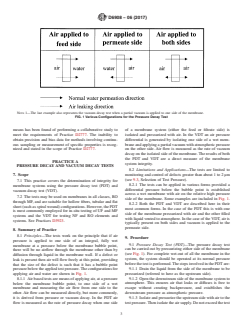
NOTE 1—The last example also represents the vacuum decay test when a partial vacuum is applied to one side of the membrane.
FIG. 1 Various Configurations for the Pressure Decay Test
means has been found of performing a collaborative study to of a membrane system (either the feed or filtrate side) is
meet the requirements of Practice D2777. The inability to isolated and pressurized with air. In the VDT an air pressure
obtain precision and bias data for methods involving continu- differential is generated by isolating one side of a wet mem-
ous sampling or measurement of specific properties is recog- braneandapplyingapartialvacuumwithatmosphericpressure
nized and stated in the scope of Practice D2777. on the other side. Air flow is measured as the rate of vacuum
decayontheisolatedsideofthemembrane.Theresultsofboth
the PDT and VDT are a direct measure of the membrane
PRACTICE A
system integrity.
PRESSURE DECAY AND VACUUM DECAY TESTS
8.2 Limitations and Applications—The tests are limited to
7. Scope
monitoring and control of defects greater than about 1 to 2 µm
(see 9.3, Selection of Test Pressure).
7.1 This practice covers the determination of integrity for
8.2.1 The tests can be applied in various forms provided a
membrane systems using the pressure decay test (PDT) and
differential pressure below the bubble point is established
vacuum decay test (VDT).
across a wet membrane with air on the relative high pressure
7.2 The tests may be used on membranes in all classes, RO
side of the membrane. Some examples are included in Fig. 1.
through MF, and are suitable for hollow fibers, tubular and flat
8.2.2 Both the PDT and VDT are described here in their
sheet(suchasspiralwound)configurations.However,thePDT
most common forms. In the case of the PDT this is with one
is most commonly employed for in-situ testing of UF and MF
side of the membrane pressurized with air and the other filled
systems and the VDT for testing NF and RO elements and
withliquidventedtoatmosphere.InthecaseoftheVDT,airis
systems. See Practices D3923.
typically present on both sides and vacuum is applied to the
permeate side.
8. Summary of Practice
8.1 Principles—The tests work on the principle that if air
9. Procedure
pressure is applied to one side of an integral, fully wet
9.1 Pressure Decay Test (PDT)—The pressure decay test
membrane at a pressure below the membrane bubble point,
can be carried out by pressurizing either side of the membrane
there will be no airflow through the membrane other than by
(see Fig. 1). For complete wet-out of all the membrane in the
diffusion through liquid in the membrane wall. If a defect or
system, the system should be operated at its normal pressure
leak is present then air will flow freely at this point, providing
beforethetestisperformed.ThestepsinvolvedinthePDTare:
that the size of the defect is such that it has a bubble point
9.1.1 Drain the liquid from the side of the membrane to be
pressurebelowtheappliedtestpressure.Theconfigurationsfor
pressurized (referred to here as the upstream side).
applying air and water are shown in Fig. 1.
9.1.2 Openthedownstreamsideofthemembranesystemto
8.1.1 Airbasedtestsaremeansofapplyingair,atapressure
atmosphere. This ensures air that leaks or diffuses is free to
below the membrane bubble point, to one side of a wet
escape without creating backpressure, and establishes the
membrane and measuring the air flow from one side to the
downstream pressure as atmospheric pressure.
other.Air flow can be measured directly, but more commonly,
it is derived from pressure or vacuum decay. In the PDT air 9.1.3 Isolateandpressurizetheupstreamsidewithairtothe
flow is measured as the rate of pressure decay when one side testpressure.Thenisolatetheairsupply.Donotexceedthetest
D6908 − 06 (2017)
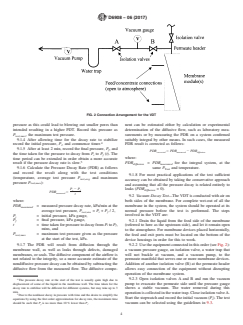
FIG. 2 Connection Arrangement for the VDT
pressure as this could lead to blowing out smaller pores than nent can be estimated either by calculation or experimental
intended resulting in a higher PDT. Record this pressure as determination of the diffusive flow, such as laboratory mea-
P , the maximum test pressure. surements or by measuring the PDR on a system confirmed
test,max
9.1.4 After allowing time for the decay rate to stabilize suitably integral by other means. In such cases, the measured
record the initial pressure, P, and commence timer. PDR result is corrected as follows:
i
9.1.5 After at least 2 min, record the final pressure, P, and
f
PDR 5 PDR 2 PDR
corrected measured diffusion
the time taken for the pressure to decay from P to P (t). The
i f
where:
time period can be extended in order obtain a more accurate
result if the pressure decay rate is slow. PDR = PDR for the integral system, at the
diffusion measured
same P and temperature.
9.1.6 Calculate the Pressure Decay Rate (PDR) as follows
Test
and record the result along with the test conditions
9.1.8 For most practical applications of the test sufficient
(temperature, average test pressure P and maximum
test,avg
accuracy can be obtained by taking the conservative approach
pressure P ):
test,max
and assuming that all the pressure decay is related entirely to
P 2 P
i f leaks (PDR = 0).
diffusion
PDR 5
measured
t
9.2 Vacuum Decay Test—TheVDTis conducted with air on
where:
both sides of the membrane. For complete wet-out of all the
membrane in the system, the system should be operated at its
PDR = measured pressure decay rate, kPa/min at the
measured
normal pressure before the test is performed. The steps
average test pressure, P = P + P /2,
test,ave i f
P = initial pressure, kPa gauge, involved in the VDT are:
i
P = final pressure, kPa gauge,
f 9.2.1 Drain the liquid from the feed side of the membrane
t = timetakenforpressuretodecayfrom P to P,
i f (referred to here as the upstream side), and let it remain open
mins, and
to the atmosphere. For membrane devices placed horizontally,
P = maximum test pressure given as the pressure
test,max
the feed and exit ports must be located on the bottom of the
at the start of the test, kPa.
device housings in order for this to work.
9.1.7 The PDR will result from diffusion through the 9.2.2 Usetheequipmentconnectedinthisorder(seeFig.2):
membrane wall, as well as leaks through defects, damaged a vacuum pressure gauge, an isolation valve, a water trap that
membranes,orseals.Thediffusivecomponentoftheairflowis will not buckle at vacuum, and a vacuum pump, to the
not related to the integrity, so a more accurate estimate of the permeate manifold that serves one or more membrane devices.
nondiffusive pressure decay can be obtained by subtracting the Addition of another isolation valve (B) at the permeate header
diffusive flow from the measured flow. The diffusive compo- allows easy connection of the equipment without disrupting
operation of the membrane system.
4 9.2.3 Open isolation valves A and B and run the vacuum
The pressure decay rate at the start of the test is usually quite high due to
pump to evacuate the permeate side until the pressure gauge
displacement of some of the liquid in the membrane wall. The time taken for the
decay rate to stabilize will be different for different systems, but may take up to 3
shows a stable vacuum. The water removed during this
min.
operationiscollectedinthewatertrap.CloseisolationvalveA.
Due to the nonlinear decay in pressure with time and the desire to simplify the
Start the stopwatch and record the initial vacuum (P).The test
equations by using the first order approximation for decay rate, the maximum time i
should be such that P is no more than 10% lower than P. vacuum can be selected using the guidelines in 9.3.
f i
D6908 − 06 (2017)
9.2.4 After the determined time (60 s is a typical time, 120, where:
180 or 300 s will yield a more sensitive test) record the final
∆P = the maximum differential test pressure applied
test,max
pressure (P) and the time (t) for reaching this value.
across the membrane. This is the P re-
f
test,max
corded during the test corrected for any static
9.2.5 Calculate the Vacuum Decay Rate (VDR) as follows:
head contribution,
P 2 P
f i
γ = surface tension at the air-liquid interface,
VDR 5
measured
t
θ = liquid-membrane contact angle, and
d = equivalent diameter of the smallest defect in-
where:
cluded in the test.
VDR = measured vacuum decay rate, kPa/min at the
measured
average test pressure, P = P + P /2,
test,ave i f 9.3.1 For the theoretical case of a perfectly hydrophilic
P = initial vacuum, kPa gauge,
i membrane, the contact angle is zero, and assuming water at
P = final vacuum, kPa gauge,
f
25°C (surface tension 72 dynes/cm), Eq 1 simplifies to Eq 2,
t = timetakenforvacuumtodecayfrom P to P,
i f
with d in micrometres and P in kilopascal:
test,max
mins, and
P = maximum test vacuum given as the pressure
test,max
d 5 (2)
∆P
test,max
at the start of the test, kPa.
9.3.2 Fig. 3 shows the relationship between test pressure
9.2.6 The VDR will result from diffusion through the
and equivalent defect diameter expressed by Eq 1 and assum-
membrane wall, as well as leaks through defects, damaged
ing a surface tension of 72 dynes/cm.The solid line represents
membranes,orseals.Thediffusivecomponentoftheairflowis
Eq 2; that is, the conservative situation of cosθ = 1. In practice
not related to the integrity, so a more accurate estimate of the
most membranes used in water treatment have a contact angle
nondiffusive vacuum decay can be obtained by subtracting the
greater than zero, which is represented by the shaded region
diffusive flow from the measured flow. The diffusive compo-
under the solid line in Fig. 3. If the contact angle is known or
nent can be estimated either by calculation or experimental
can be determined, Eq 1 may be used. However, if the contact
determination of the diffusive flow, such as laboratory mea-
angleisnotknown,aconservativeestimateofthetestpressure
surements or by measuring the VDR on a system confirmed
required can be made by applying Eq 2.
suitably integral by other means. In such cases, the measured
9.3.3 The test pressure is usually selected to ensure that the
VDR result is corrected as follows:
minimum defect diameter picked up by the test is smaller than
VDR 5 VDR 2 VDR
corrected measured diffusion
contaminates or particles of interest. For example, Eq 2
indicates that a test pressure of 100 kPa would include all
where:
defectslargerthanorequalto3µm.Alowerpressurecouldbe
VDR = VDR for the integral system, at the
diffusion measured
used for less hydrophilic membranes. For example, if the
same P and temperature.
test
contact angle is 60 degrees (typical for polypropylene,
If VDR is unknown, the conservative approach is to
polysulfone, or PVdF) Eq 1 indicates that defects of 3 µm
diffusion
set VDR =0.
would be included at a test pressure of 50 kPa.An even lower
diffusion
test pressure may be used for larger defects, such as for
9.3 Selection of Test Pressure—The test pressure selected
example detection of broken fibers in a hollow fiber system.
determines the minimum equivalent diameter of a defect that
9.3.4 Inpracticetheappliedtestpressureisrarelymorethan
can contribute to the pressure or vacuum decay rate. The
300 kPa, which is usually sufficient to include defects smaller
relationshipbetweenthetestpressureandtheequivalentdefect
than most pathogens of interest. At this pressure limit the test
diameterisgivenbyEq1.Defectssmallerthanthiswillbetoo
is not suitable for direct validation of virus rejection as these
small for the bubble point to be overcome and thus will not
particles are very small (typically less than 0.01 µm) with a
contribute to airflow. Larger defects will allow airflow as the
corresponding test pressure of several thousand kilopascals.
bubble point will be exceeded by the applied test pressure.
9.4 Interpreting PDR and VDR Results as Log Reduction
Details on the derivation of this equation and its use in
Values—Both the PDR and the VDR are measurements of the
determining maximum pore size for membranes can be found
airflow from one side of the membrane to the other under a
in Test Method E128.
known set of test conditions (temperature and pressure). This
4γcosθ
information can be used to estimate the flow of liquid through
d 5 (1)
∆P
test,max
the same defects during filtration conditions. This provides an
estimate of the membrane bypass flow and thereby an estimate
of the log removal of particles for the system. One approach is
Eq 1 is often modified to include a correction factor referred to as the pore
based on the Hagen-Poiseuille law, which assumes laminar
shape factor or the Bechold Constant. This is a value <1 and takes into account the
flowthroughcylindricaldefects.Whilstthismethodprovidesa
irregularshapeofmembranepores.Forthepurposeofthispracticetheshapefactor
useful estimate, its applicability is limited to small fibers (<
is assumed to be 1 as this is the most conservative position, and the shape of any
particular defect detected by these tests is not known. 400µmID)wherethecriteriaforlaminarflowaremoreclosely
D6908 − 06 (2017)
NOTE 1—The solid line represents Eq 2.
FIG. 3 The Relationship Between Test Pressure and Equivalent Defect Diameter (Eq 1, Water at 25°C)
2 2
approximated. The method is described in 9.4.1 and a detailed
ƒ = pressurecorrectionfactor=P −P /2P
2 u,test d,test atm
derivation,alongwiththeassumptionsrequired,iscontainedin
TMP,
Appendix X1. An alternative method is to experimentally
Q = filtrate flowrate (m /s),
filt
measure the relationship between liquid and air flows for the P = upstream pressure during the PDT or VDT =
u,test
worst case failure mode. This is typically a broken fiber at the
P forPDTand P forVDT,(kPaabsolute),
test,avg atm
P = downstream pressure during the PDT or VDT =
pot for most hollow fiber MF or UF systems. This approach,
d,test
described in 9.4.3, assumes that all the measured gas flow is P forPDTand P forVDT,(kPaabsolute),
atm test,avg
P = atmospheric pressure (kPa absolute),
due to “worst case” failures and so provides a conservative
atm
CF = concentration factor. This represents the increase
estimate of bypass flow and LRV for the system. While these
in the contaminant concentration that could occur
approaches have been applied in practice, data covering a
on the upstream side of the membrane relative to
range of different membrane configurations, test conditions,
the feed water concentration due to the operating
and fiber diameters are not yet available. Regardless of the
mode. This would typically be equal to 1 for
chosen method the relationship between integrity test results
dead-end systems, but could be higher for cross
and LRV should be verified by experiment in the field on the
flow or feed and bleed modes,
particular membrane and configuration used.
PDR = pressure decay rate (kPa/s),
9.4.1 The Laminar Flow Approach Using the Hagen-
VDR = vacuum decay rate (kPa/s),
Poiseuille (H-P) Law—This approach assumes laminar flow
TMP = transmembrane pressure during filtration (kPa),
through cylindrical defects and is most suitable for small
V = volume pressurised (or under vacuum) during test
system
diameter fibers (200 to 400 µm lumen diameter). A detailed
(m ),
derivation along with key assumptions is contained in Appen-
µ = the viscosity of the liquid during filtration (Pa·s),
water
dix X1. The equations required to convert the PDR and VDR
µ = the viscosity of the air during the test (Pa·s), and
air
results obtained using the method described here to a log
LRV = estimated log reduction value.
e
reduction value, are given below as Eq 3 and 4 respectively:
9.4.2 Example Calculation of the Log Reduction of Par-
For PDR:
ticles from the PDT Using the H-P Approach—Estimate the
Q P
filt atm
LRV 5log ƒ ƒ (3)
S D LRV for a membrane system operating at a filtrate flowrate of
e 10 1 2
CF·PDT·V
system
50 L/s and a transmembrane pressure of 70 kPa. The water
and for VDR:
temperatureis20°C,andthePDRforthesystemis2.5kPa/min
at 100 kPa test pressure and 27°C. The system is operating in
Q P
filt atm
LRV 5log ƒ ƒ (4)
S D
e 10 1 2
dead-end mode so CF = 1. The viscosity of water at 20°C is
CF·VDT·V
system
-3 -5
1.00 × 10 Pa·s and air at 27°C is 1.84 × 10 Pa·s. The
where:
pressurized system volume during the PDT is 400 L.
ƒ = viscosity correction factor = µ /µ ,
1 water air
First calculate ƒ and ƒ :
1 2
D6908 − 06 (2017)
FIG. 4 PDR Values
µ 1.00 310 (3)Evaluate the system LRV using the following:
water
ƒ 5 5 554.35
µ 1.84 310
(a)Measure the PDR (orVDR) for the system. Calculate
air
2 2 2 2
P 2 P 201.3kPa 2 101.3kPa
~ ! ~ !
u,test d,test thegasflowusingEq5(forPDT)orEq6(forVDT).Notethat
ƒ 5 5 52.13
2P TMP 2·101.3kPa·70kPa
atm these are the equations derived as Eq X1.4 and X1.5 in
Appendix X1.
Estimate the LRV from Eq 3 as follows:
V
Q P system
filt atm
Q 5 PDR (5)
LRV 5log ƒ ƒ G,atm
S D
e 10 1 2 P
atm
CF·PDT·V
system
23 3
50 310 m /s·101.3kPa
V
system
5log ·54.35·2.13
S D
10 23 3 Q 5 VDR (6)
G,atm
1·2.5/60kPa/s·400 310 m
P
atm
54.5
(b) Calculate the equivalent number of broken fibers for
the system (see Fig. 4) as:
Note that from Eq 2 the test pressure of 100 kPa equates to
aminimumdefectsizeof2.9µm(conservatively).SotheLRV
Q
G,atm
N 5 (7)
equivalent
of 4.5 calculated above is the minimum LRV for particles
Q
G,atm,fiber
greater than 2.9 µm diameter.
(c) Calculate the liquid bypass flow, Q by multiply-
bypass
9.4.3 Experimental Approach to Correlating Test Results
ingtheequivalentnumberofbrokenfibersbytheflowperfiber
and System LRV Using Equivalent Number of Broken Fibers—
at the operating TMP (from the data generated in step 2):
Thisapproachreliesonmeasuringtherelationshipbetweengas
Q 5 N 3Q (8)
bypass equivalent L,fiber
flow and bypass flow for “worst case” defects for hollow fiber
systems, and assuming that all bypass will be through such
Eq 5 can be written for an individual fibre as Q =
G,atm,fiber
defects. This approach provides a conservative estimate of
PDR V / P where PDR isthepressuredecayrate
fiber system atm fiber
LRV that can be applied to most membrane diameters and
correspondingto Q .CombiningwithEq7and8gives:
G,atm,fiber
configurations. For hollow fiber membrane systems the worst
PDR
case failure will usually be a fiber that is cut cleanly at the corrected
Q 5 ·Q (9)
bypass L,fiber
PDR
fiber-pot interface. This provides the shortest bypass path and fiber
the largest possible diameter. The steps involved are:
(d) Calculate the estimated LRV using Eq 10 (also Eq
(1)Experimentallydeterminethegasflowthroughasingle
X1.2):
fiber, cut at the pot, at the selected test pressure (call this
Q
Q ).Preferablythisiscarriedoutinfieldtestsusingone
filt
G,atm,fiber
LRV 5log (10)
S D
e 10
Q
or more modules of the full-scale design, or alternatively in a
bypass
laboratory using the same membrane fiber and potting materi-
Substituting Eq 9 into Eq 10:
als.
PDR ·Q
(2)For the same configuration determine the water flow
fiber filt
LRV 5log (11)
S D
e 10
PDR ·Q
through the lumen (Q ) at a range of pressures to establish
L,fiber corrected L,fiber
the bypass flow vs TMP curve for a single fiber. This can be
A similar derivation for VDT gives:
doneexperimentallyusingshortfiberlengthsinthelaboratory,
VDR ·Q
or by theoretical calculation combined with experimental
fiber filt
LRV 5log (12)
S D
e 10
determination of friction factor (for turbulent flow). VDR ·Q
corrected L,fiber
D6908 − 06 (2017)
Thevaluesfor Q and Q canbecalculatedusing Step 3. Calculate the Relationship Between PDR and By-
G,atm,fiber L,fiber
known hydraulic formulae (such the Darcy-Weisbach equa- pass Flowrate—Using Eq 11 gives:
tions) including consideration of entrance and exit losses,
PDR ·Q
fiber filt
LRV 5log
however for nonlaminar flow situations solving these requires S D
e 10
PDR ·Q
corrected L,fiber
an iterative approach as well as establishing values for surface
0.0702 3120000L/h
5log
S D
roughness which must be experimentally determined. When 10
PDR 30.095L/h
corrected
using theoretical calculation of Q , consideration should
L,fiber
5log
S D
also be given to flow through the free end of the cut fiber as 10
PDR
corrected
well as the pot, although in most cases this will be small
54.95 2log PDR
~ !
10 corrected
compared to the flow through the pot.
54.95 2log ~PDR 20.72!
10 measured
9.4.4 Example of the Experimental Method Using the
The estimated LRV’s using the above equation are tabulated
Equivalent Number of Broken Fibers—The following example
below for varying numbers of cut fibes. The LRV’s calculated
is taken from data presented in Kothari and St. Peter (1). The
according to the H-P method (as described in 9.4.1) are also
filtration unit is a hollow fiber microfilter using membranes
included for comparison. The difference between the two
with an internal diameter of 250 µm. Results from a study
methodsofestimatingtheLRVissmallinthiscase(0.05to0.1
looking at the impact on PDR of cutting fibers are presented.
log). As the fiber diameter increases the limitations of the
Fibers were cut near the pot, giving a cut fiber length of
assumptions involved in the H-P method will become greater,
approximately125mm,withthelongendofthefiberapproxi-
andtheexperimentalapproachmightbemoresuitable.Particle
mately 1035 mm.Temperature is assumed to be 5°C (viscosity
-3 count data are also included to indicate the difficulty of using
1.62 × 10 Pa·s), with a filtrate flow of 120000 L/h. Data up
conventional water quality methods to verify integrity at these
to 400 cut fibers is presented, although only the data up to 40
levels.
cut fibers is used here as the test pressure was reasonably
LRV
e
constant between tests at an average of 100 kPa.
Total
PDT Equivalent LRV
e
No. of Particle
Number of PDR PDR Starting
(kPa/ Broken Fibers H-P Method
Cut Fibers Count
Cut Fibers (kPa/min) Pressure (kPa)
min) Method (see (see 9.4.1)
(counts/mL)
0 0.69 101.8
9.4.3)
1 0.76 101.7
0 0.69 1.40
2 0.90 101.6
1 0.76 6.37 6.47 1.07
6 1.10 100.9
2 0.90 5.70 5.80 7.50
12 1.58 100.3 6 1.10 5.37 5.46 2.60
24 2.41 98.4
12 1.58 5.01 5.10 3.00
40 3.51 95.8 24 2.41 4.72 4.79 1.30
40 3.51 4.50 4.55 2.30
Step 1. Determine the Relationship Between Gas Flow and
Fibers Cut at the Pot—In order to do this the above PDR
values are plotted producing the graph shown in Fig. 4. The
PRACTICE B
slope of the line of best fit represents the change in pressure
USE OF TOTAL ORGANIC CARBON ANALYZERS
decay for each cut fiber, and the intercept represents the gas
FOR MONITORING INTEGRITY OF REVERSE
flowduetodiffusiononly(at100kPatestpressure).Thiscould
OSMOSIS OR NANOFILTRATION MEMBRANE
be converted to a gas flow using Eq 5, however for this
SYSTEMS
example it is more useful to leave it as a PDR per cut fiber.
Step 2. Determine the Liquid Flowrate Through a Single 10. Scope
Broken Fiber at the Pot—In this case we will calculate the
10.1 Thispracticeisapplicablewherethemembranesystem
flowrate from theory, although it could also be determined by
and water source will allow the monitoring of TOC both
laboratory measurement. Using Eq X1.7 for laminar flow in
upstream and downstream of the system, and at least order of
hollow cylinders at a filtration TMP of 50 kPa, including
magnitude difference from the feed can be measured in the
allowance for both ends of the cut fiber, gives:
permeate (product) water. See Test Method D4839.
πd TMP
Q 5
L,fiber
11. Summary of Practice
128Lµ
26 4 3
π 250 310 m ·50 310 Pa 1000 L 3600s
~ !
11.1 Carbon Analysis Summary—There are two processes
5 · ·
23 3
128·1.62 310 Pa·s m h
involvedinTOCanalysis—firstdissolvedcarbonisoxidizedto
1 1
CO and then the concentration of CO is detected and the
· 1 50.095L/h 2 2
S D
0.125m 1.035m
result is interpreted using a customized calibration curve. To
eliminate interference from inorganic carbon (carbonate,
Checking Reynolds number confirms this is laminar flow
bicarbonate, and dissolved CO ) the sample is split into two
andhencetheequationisvalid.Anallowanceforentranceand 2
streams.Bothstreamsareacidifiedtoconvertinorganiccarbon
exit losses could be made, however, given the low Reynolds
(IC) to CO , and one stream is treated further to oxidize the
number this correction will be minor and the value as calcu-
organic carbon to CO . The samples are sent to separate CO
lated above is conservative.
2 2
detectors—one for IC and one for Total Carbon (TC). TOC is
thedifferencebetweentheTCandICresults.GuideD5173and
The boldface numbers in parentheses refer to a list of references at the end of
this standard. Test Method D5997 give detailed descriptions of the various
D6908 − 06 (2017)
techniques used to perform on-line monitoring of carbon 12.1.2 Thesizeofthesystemasmeasuredbypermeateflow,
compounds in water. Instruments using these methods require and
approximately six minutes to analyze one sample.
12.1.3 The change in permeate TOC concentration that
corresponds to a significant leak.
11.2 Sampling from the Permeate Stream—Practices D3370
12.2 TOC analyzers are affected by conditions outlined
describes standard practices for sampling water from closed
conduits. A side stream from the permeate line is diverted to below.Forinterferencespecifictoaparticularanalyzer,contact
the manufacturer. A baseline permeate TOC level must be
theTOC analyzer.The length of this line should be as short as
possible. Most analyzers have a flushing cycle between established within the limits of the instrument that is still
significantly different from the challenge or average feed
samples and by-pass during analysis, which is diverted to
drain. The volume of sample is very small compared to the concentration by one order of magnitude.
by-passflow(aslittleas0.35mL/minversus30to220mL/min
12.3 The size of the system monitored by one sample point
for flush).
should be determined using a risk/cost analysis.The risk is the
potential for harm or legal action if there is a leak in the
11.3 Establishing Baseline Data—When the system has
system. The cost is the price of additional sample points or
stabilized after start-up, the feed, permeate and concentrate
additional analyzers.
streams are analyzed for TOC concentration. If the instrument
used can handle the range in concentrations, with different
12.4 The change in permeate TOC concentration corre-
calibration curves, then it is best to use the same instrument as
sponding to a significant leak (as defined by the risk/cost
will be used for integrity monitoring. The instrument can be
analysis) will depend on the volume of permeate produced by
usedofflineingrabsamplemodeforthesetests.Itisimportant
intact membrane in the monitored unit.
toperformenoughrepeatsampleanalysestoensurethesample
12.5 When determining the size that can be tested as a
lines are completely filled with the test solution. Testing the
discrete unit, consider the change in TOC concentration
permeate sample first will make this task easier. Sample size
expected from a leak that should initiate action. The change
should be large enough to reflect normal variations due to
should be greater than 3 standard deviations of the average
temperature and time of day.
product concentration measured for that system. Fig. 5 shows
11.4 Concentrate Sampling—The concentrate stream is
change in permeate TOC concentration in an RO system with
tested to determine the system’s mass-balance. It may be that
different types of damage. The feed and concentrate concen-
organic carbon is adsorbing to the membrane. If so, there may
trations were approximately 5 and 10 mg/L, respectively.
bebreak-throughlateronwhenalladsorptionsitesaretakenup
and a new permeate baseline will be necessary.
13. Interferences
11.5 TOC Monitoring—Follow instructions for the particu-
13.1 Changes in Inorganic Carbon Concentration—
lar TOC analyzer in service. Be sure to keep the power on,
Instability in the pretreatment acidification process can cause
chemicalsfresh,pre-filterscleanandUVorIRsourcesingood
fluctuations in the inorganic carbon concentration of the
working order. Become familiar with the data output for your
permeate stream. If adjustment is not made in the acidification
analyzer.Itshouldprovidethetime,alarms,causeofthealarm,
process to drive off excess IC, then the TOC results will be
alerts when analysis conditions have been changed and a
high.
description of the new conditions. View permeate TOC con-
13.2 Changes in Background Conductivity—Changes in
centration on a graph with the feed and permeate baseline
sample background conductivity will corrupt the comparison
concentrations marked.
of CO conductivity with the calibration curve. Since TOC
11.5.1 Decision Point—A decision point must be estab-
analyzers can be much more sensitive than conductivity
lished for your particular process depending on the degree of
sensors, breaches in integrity should be detected due to
risk associated with a breach of integrity.
increase in TOC concentration before there is a significant
11.5.2 Variability—Process fluctuations, temperature,
change in permeate conductivity (2).
changes in chemical cartridges, fouling of the TOC analyzer
13.3 Particulates—Particles suspended in the water stream
inletpre-filter,changesinflowtotheanalyzercanallaffectthe
may cause blockage in the monitor over time.
TOCanalysis.Thedegreeofvariabilitydependsontheprocess
andoperationoftheanalyzer.Thedecisionpointshouldnotbe
14. Apparatus
reached due to normal process variability.
14.1 GuideD5173showsblockdiagramsofseveraldesigns
12. Significance and Use
of on-line TOC analyzers that have been introduced success-
fully.
12.1 TOC Monitoring can be used effectively when the
difference between average feed and product TOC concentra-
15. Interpretation of Results
tion is at least one order of magnitude. TOC monitoring, as a
tool for monitoring integrity, is used to identify relative
15.1 Permeateandfeed(oraverageoffeedandconcentrate)
changes in the integrity of a system. The sensitivity of the
TOC concentrations should be plotted over time. Using the
method is dependent on:
feed concentration will provide the more conservative bench-
12.1.1 The capabilities of TOC instrument, mark and simplify the procedure.
D6908 − 06 (2017)
TOC concentration during damage events. TOC does detect damage reliably. Value for damage event B is from one sample.
NOTE 1—Error bars indicate 3 standard deviations from the average (Chapman and Linton, (2)).
FIG. 5 Change in TOC Concentration with Different Types of Damage
15.2 Whenthesystemhasstabilizedafterstart-up,calculate second wavelength. A leak, or loss of integrity, will be
the standard deviation of the permeate and feed TOC concen- indicated by increased dye passage, as measured by a critical
trations. If permeate concentration exceeds three standard percent increase in the permeate concentration.The membrane
deviationsfromtheaverage,checkthesystemtodeterminethe or system supplier may have a specific dye passage specifica-
cause (see Fig. 6). tion that indicates loss of integrity—consult the supplier. For
ROsystemstestedwithFD&CRedDye#40,apassagegreater
than0.2%ofthefeedconcentrationisknowntoindicatealoss
PRACTICE C 8
ofintegrity. Alternatively,calculatetheLRVfromthefeedand
SOLUBLE DYE TEST
permeate dye values (as described in Section 21), to assure the
required removal is achieved.
16. Scope
17.3 Plumbing connections and operational considerations
16.1 This guide is applicable to RO and NF membrane
should allow the system to be run 30 min in recirculation
systems, including those with spiral, tubular or flat sheet
mode,oralternatelywithcontinuousliquiddyeinjectionforup
configuration elements. The guide describes the application of
30 min and when introduction of a soluble dye will not
two soluble dyes, Red Dye # 40 and Rhodamine WT. Both
interfere with operation of the system for its application. The
dyes have a molecular weight of approximately 500. See
dye chosen must be rejected (retained) by the intact membrane
Practices D3923.
in the system.
17. Summary of Practice
18. Apparatus
17.1 This test works on the principle that a dissolved dye
18.1 Feed Tank—For batch (recirculation) tests, a feed tank
that is nearly completely rejected by an intact membrane
element will pass through a membrane or seal defect into the of sufficient volume relative to the system size to allow
operation in recirculation mode, such as the system’s clean-in-
permeate at an increased rate that indicates a leak that is
capable of passing significant amounts of microbial material. place (CIP) tank connected to the feed and outlet piping
system. Alternately, for flow-through tests, a system with a
17.2 Asolutionofcontrolledconcentrationofadye,known
chemicalfeedpumpcalibratedtoallowacontrolledamountof
to be rejected at a rate of 99.0% or greater (≥2 log) by the
dye plumbed in prior to the high pressure pump can be used.
membrane, is circulated through the system under standard
operating conditions as recommended by the manufacturer.
The concentration of the dye in the permeate and in the feed is
Chapman and Linton (2) found that a response greater than 0.53 µg/L was
measured with a spectrophotometer for dyes that adsorb light
significant and could be differentiated from the baseline. Therefore, a feed
maximally at a specific wavelength or with a fluorometer for
concentration of 5 mg/Land a permeate concentration of 5 µg/Lwould correspond
fluorescing dyes that adsorb at one wavelength and emit at a to a 3 log reduction (LRV) of dye.
D6908 − 06 (2017)
FIG. 6 Process Monitoring Chart Displaying Upper Control Limits Plotted with Monitoring Data During a Fiber Cutting Study
18.2 Spectrophotometer—The spectrophotometer must be with recycle, the dye concentration in the concentrate stream
capable of measuring at a wavelength best for the absorption shouldbecalculatedassuming100%dyerejectionandusedto
spectra for the dye of interest. recalculate the required dye concentration in the raw feed.
19.1.4 Calibration
...