

ASTM D8456-22
(Test Method)Standard Test Method for Determination of Nitrosamines in Water by Liquid Chromatography Tandem Mass Spectrometry (LC-MS/MS)
General Information
- Abstract
SIGNIFICANCE AND USE
5.1 Nitrosamines are a class of nitrogen-containing compounds with a known occurrence in wastewater. They may also be created in deionization and are a potential contaminant in water for reuse. The World Health Organization has issued a guideline for NDMA in drinking water at 0.1 µg/L. NDMA may occur in chlorinated effluents and other wastewaters. Other methods for nitrosamines employ solid phase extraction, which may not be applicable to wastewaters that contain particulate matter or a high organic load. This method analyses nitrosamines directly using LC-MS/MS.
SCOPE
1.1 This test method covers the liquid chromatography tandem mass spectrometry (LC-MS/MS) detection and quantitation of N-nitrosamines after direct injection. It has been validated for groundwater, surface water, wastewater influents, and wastewater effluents. This test method is not limited to these aqueous matrices; however, the applicability of this test method to other aqueous matrices must be demonstrated.
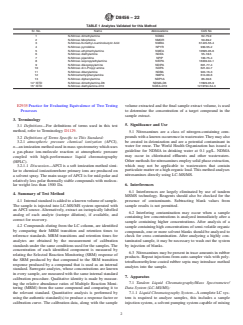
1.2 This test method is applicable to nitrosamines that can be chromatographed and detected using a mass spectrometry procedure. Table 1 lists the compounds that have been validated for this test method. This test method is not limited to the compounds listed in Table 1; however, the applicability of the test method to other compounds must be demonstrated.
1.3 Analyte concentrations from 0.05 µg/L up to approximately 5 µg/L may be determined without dilution of the sample. Analytes with insufficient sensitivity will not be detected, but they can be measured with acceptable accuracy and precision when present in sufficient amounts. In addition, newer instruments, or instruments of improved sensitivity may be used to lower detection limits.
1.4 Analytes that are not separated chromatographically, but that have different mass spectra and noninterfering quantitation ions, can be identified and measured in the same calibration mixture or water sample. Analytes that have very similar product ions cannot be individually identified and measured in the same calibration mixture or water sample unless they have different retention times.
1.5 It is the responsibility of the user to ensure the validity of this test method for untested matrices.
1.6 This test method is restricted to use by or under the supervision of analysts experienced in the use of a liquid chromatograph with tandem mass spectrometry (LC-MS/MS).
1.7 Depending on data usage, you may modify this test method but limit to modifications that improve performance while still meeting method quality acceptance criteria. Shortening the chromatographic run simply to save time is not allowed. Use Practice E2935 or similar statistical tests to confirm that modifications produce equivalent results on non-interfering samples. In addition, use Guide E2857 or equivalent statistics to re-validate the modified test.
1.8 The values stated in SI units are to be regarded as standard. No other units of measurement are included in this standard.
1.9 This standard does not purport to address all of the safety concerns, if any, associated with its use. It is the responsibility of the user of this standard to establish appropriate safety, health, and environmental practices and determine the applicability of regulatory limitations prior to use.
1.10 This international standard was developed in accordance with internationally recognized principles on standardization established in the Decision on Principles for the Development of International Standards, Guides and Recommendations issued by the World Trade Organization Technical Barriers to Trade (TBT) Committee.
- Status
- Published
- Publication Date
- 30-Apr-2022
- Technical Committee
- D19 - Water
- Drafting Committee
- D19.06 - Methods for Analysis for Organic Substances in Water
Overview
ASTM D8456-22 is the internationally recognized standard test method for the determination of nitrosamines in water using liquid chromatography tandem mass spectrometry (LC-MS/MS). Issued by ASTM International, this standard enables direct detection and quantitative analysis of a broad range of N-nitrosamines, contaminants of concern due to their potential carcinogenicity. Nitrosamines frequently occur in wastewater, deionized water, and chlorinated effluents and present challenges for laboratories and water utilities seeking accurate water quality assessments.
This method is particularly valued for bypassing complexities associated with solid-phase extraction, making it suitable for samples containing high organic content or particulates. The standard is applicable across multiple matrices, including but not limited to, groundwater, surface water, wastewater influents, and wastewater effluents.
Key Topics
- Nitrosamines Monitoring in Water: Covers detection of compounds such as NDMA, NMOR, NPYR, NDEA, NDIPA, and others.
- Direct LC-MS/MS Analysis: Employs direct injection methods, enhancing efficiency and accuracy over traditional extraction-based techniques.
- Applicable Matrices: Validated for groundwater, surface water, and both influent and effluent wastewater samples.
- Sensitivities and Detection Ranges: Quantifies nitrosamines from as low as 0.05 µg/L up to 5 µg/L without dilution; newer instruments may further lower detection limits.
- Calibration and Quality Control: Focuses on calibration standards, continuing calibration checks, standard additions, and spiking protocols to ensure data integrity.
- Data Integrity and Reporting: Details procedures for maintaining reporting accuracy, including use of internal standards, duplicate analyses, matrix spikes, and rigorous quality control measures.
- Health and Safety Considerations: Recommends best practices for handling nitrosamine compounds, which are classified as probable human carcinogens.
Applications
ASTM D8456-22 provides significant value in several practical applications where accurate monitoring of nitrosamines is essential:
- Environmental Monitoring: Supports regulatory compliance and routine surveillance in public water systems, wastewater treatment plants, and industrial discharge monitoring.
- Water Reuse and Reclamation: Facilitates the detection of nitrosamines in treated municipal wastewater, a growing priority as water reuse initiatives expand.
- Validation of Water Treatment Processes: Assists in process optimization and validation, especially for advanced oxidation, chlorination, and deionization systems.
- Field and Laboratory Analysis: Offers a reliable methodology for both on-site field blanks and laboratory analysis, ensuring sample integrity from collection through analysis.
- Research and Risk Assessment: Provides researchers and risk assessors with robust, standardized methods for evaluating human exposure scenarios and supporting global regulatory bodies’ guidelines, such as the World Health Organization’s guideline for NDMA in drinking water.
Related Standards
ASTM D8456-22 references and works alongside several other key ASTM water analysis standards to ensure comprehensive water quality assessment:
- ASTM D1129 – Terminology Relating to Water
- ASTM D1193 – Specification for Reagent Water
- ASTM D2777 – Practice for Determination of Precision and Bias of Applicable Test Methods of Committee D19 on Water
- ASTM D3370 – Practices for Sampling Water from Flowing Process Streams
- ASTM D4448 – Guide for Sampling Ground-Water Monitoring Wells
- ASTM D6089 – Guide for Documenting a Groundwater Sampling Event
- ASTM D6538 – Guide for Sampling Wastewater With Automatic Samplers
- ASTM D6759 – Practice for Sampling Liquids Using Grab and Discrete Depth Samplers
- ASTM E2857 – Guide for Validating Analytical Methods
- ASTM E2935 – Practice for Evaluating Equivalence of Two Testing Processes
Summary
ASTM D8456-22 sets industry-best practices for the reliable, sensitive, and efficient determination of nitrosamines in water by LC-MS/MS. Laboratories, regulatory authorities, and water utilities can depend on this method for comprehensive nitrosamine analysis, supporting water safety, public health, and regulatory compliance. For environmental laboratories and water treatment operations, adopting this standard ensures state-of-the-art analytical performance and robust quality assurance.
Relations
- Effective Date
- 01-Nov-2023
- Effective Date
- 01-May-2020
- Effective Date
- 01-Sep-2019
- Effective Date
- 01-Aug-2019
- Effective Date
- 01-Feb-2019
- Refers
ASTM E2935-17 - Standard Practice for Conducting Equivalence Testing in Laboratory Applications - Effective Date
- 01-Oct-2017
- Refers
ASTM E2935-16 - Standard Practice for Conducting Equivalence Testing in Laboratory Applications - Effective Date
- 15-Nov-2016
- Effective Date
- 15-Oct-2016
- Refers
ASTM E2935-15 - Standard Practice for Conducting Equivalence Testing in Laboratory Applications - Effective Date
- 01-Oct-2015
- Effective Date
- 01-Mar-2015
- Refers
ASTM E2935-14 - Standard Practice for Conducting Equivalence Testing in Laboratory Applications - Effective Date
- 01-Oct-2014
- Refers
ASTM E2935-13 - Standard Practice for Conducting Equivalence Testing in Laboratory Applications - Effective Date
- 01-Aug-2013
- Effective Date
- 01-Apr-2013
- Effective Date
- 01-Sep-2012
- Effective Date
- 15-Jun-2012
Get Certified
Connect with accredited certification bodies for this standard

CIS Institut d.o.o.
Personal Protective Equipment (PPE) certification body. Notified Body NB-2890 for EU Regulation 2016/425 PPE.

Kiwa BDA Testing
Building and construction product certification.
Kmetijski inštitut Slovenije
Agricultural Institute of Slovenia. Soil testing, plant health, agricultural product analysis.
Sponsored listings
Frequently Asked Questions
ASTM D8456-22 is a standard published by ASTM International. Its full title is "Standard Test Method for Determination of Nitrosamines in Water by Liquid Chromatography Tandem Mass Spectrometry (LC-MS/MS)". This standard covers: SIGNIFICANCE AND USE 5.1 Nitrosamines are a class of nitrogen-containing compounds with a known occurrence in wastewater. They may also be created in deionization and are a potential contaminant in water for reuse. The World Health Organization has issued a guideline for NDMA in drinking water at 0.1 µg/L. NDMA may occur in chlorinated effluents and other wastewaters. Other methods for nitrosamines employ solid phase extraction, which may not be applicable to wastewaters that contain particulate matter or a high organic load. This method analyses nitrosamines directly using LC-MS/MS. SCOPE 1.1 This test method covers the liquid chromatography tandem mass spectrometry (LC-MS/MS) detection and quantitation of N-nitrosamines after direct injection. It has been validated for groundwater, surface water, wastewater influents, and wastewater effluents. This test method is not limited to these aqueous matrices; however, the applicability of this test method to other aqueous matrices must be demonstrated. 1.2 This test method is applicable to nitrosamines that can be chromatographed and detected using a mass spectrometry procedure. Table 1 lists the compounds that have been validated for this test method. This test method is not limited to the compounds listed in Table 1; however, the applicability of the test method to other compounds must be demonstrated. 1.3 Analyte concentrations from 0.05 µg/L up to approximately 5 µg/L may be determined without dilution of the sample. Analytes with insufficient sensitivity will not be detected, but they can be measured with acceptable accuracy and precision when present in sufficient amounts. In addition, newer instruments, or instruments of improved sensitivity may be used to lower detection limits. 1.4 Analytes that are not separated chromatographically, but that have different mass spectra and noninterfering quantitation ions, can be identified and measured in the same calibration mixture or water sample. Analytes that have very similar product ions cannot be individually identified and measured in the same calibration mixture or water sample unless they have different retention times. 1.5 It is the responsibility of the user to ensure the validity of this test method for untested matrices. 1.6 This test method is restricted to use by or under the supervision of analysts experienced in the use of a liquid chromatograph with tandem mass spectrometry (LC-MS/MS). 1.7 Depending on data usage, you may modify this test method but limit to modifications that improve performance while still meeting method quality acceptance criteria. Shortening the chromatographic run simply to save time is not allowed. Use Practice E2935 or similar statistical tests to confirm that modifications produce equivalent results on non-interfering samples. In addition, use Guide E2857 or equivalent statistics to re-validate the modified test. 1.8 The values stated in SI units are to be regarded as standard. No other units of measurement are included in this standard. 1.9 This standard does not purport to address all of the safety concerns, if any, associated with its use. It is the responsibility of the user of this standard to establish appropriate safety, health, and environmental practices and determine the applicability of regulatory limitations prior to use. 1.10 This international standard was developed in accordance with internationally recognized principles on standardization established in the Decision on Principles for the Development of International Standards, Guides and Recommendations issued by the World Trade Organization Technical Barriers to Trade (TBT) Committee.
SIGNIFICANCE AND USE 5.1 Nitrosamines are a class of nitrogen-containing compounds with a known occurrence in wastewater. They may also be created in deionization and are a potential contaminant in water for reuse. The World Health Organization has issued a guideline for NDMA in drinking water at 0.1 µg/L. NDMA may occur in chlorinated effluents and other wastewaters. Other methods for nitrosamines employ solid phase extraction, which may not be applicable to wastewaters that contain particulate matter or a high organic load. This method analyses nitrosamines directly using LC-MS/MS. SCOPE 1.1 This test method covers the liquid chromatography tandem mass spectrometry (LC-MS/MS) detection and quantitation of N-nitrosamines after direct injection. It has been validated for groundwater, surface water, wastewater influents, and wastewater effluents. This test method is not limited to these aqueous matrices; however, the applicability of this test method to other aqueous matrices must be demonstrated. 1.2 This test method is applicable to nitrosamines that can be chromatographed and detected using a mass spectrometry procedure. Table 1 lists the compounds that have been validated for this test method. This test method is not limited to the compounds listed in Table 1; however, the applicability of the test method to other compounds must be demonstrated. 1.3 Analyte concentrations from 0.05 µg/L up to approximately 5 µg/L may be determined without dilution of the sample. Analytes with insufficient sensitivity will not be detected, but they can be measured with acceptable accuracy and precision when present in sufficient amounts. In addition, newer instruments, or instruments of improved sensitivity may be used to lower detection limits. 1.4 Analytes that are not separated chromatographically, but that have different mass spectra and noninterfering quantitation ions, can be identified and measured in the same calibration mixture or water sample. Analytes that have very similar product ions cannot be individually identified and measured in the same calibration mixture or water sample unless they have different retention times. 1.5 It is the responsibility of the user to ensure the validity of this test method for untested matrices. 1.6 This test method is restricted to use by or under the supervision of analysts experienced in the use of a liquid chromatograph with tandem mass spectrometry (LC-MS/MS). 1.7 Depending on data usage, you may modify this test method but limit to modifications that improve performance while still meeting method quality acceptance criteria. Shortening the chromatographic run simply to save time is not allowed. Use Practice E2935 or similar statistical tests to confirm that modifications produce equivalent results on non-interfering samples. In addition, use Guide E2857 or equivalent statistics to re-validate the modified test. 1.8 The values stated in SI units are to be regarded as standard. No other units of measurement are included in this standard. 1.9 This standard does not purport to address all of the safety concerns, if any, associated with its use. It is the responsibility of the user of this standard to establish appropriate safety, health, and environmental practices and determine the applicability of regulatory limitations prior to use. 1.10 This international standard was developed in accordance with internationally recognized principles on standardization established in the Decision on Principles for the Development of International Standards, Guides and Recommendations issued by the World Trade Organization Technical Barriers to Trade (TBT) Committee.
ASTM D8456-22 is classified under the following ICS (International Classification for Standards) categories: 13.060.01 - Water quality in general. The ICS classification helps identify the subject area and facilitates finding related standards.
ASTM D8456-22 has the following relationships with other standards: It is inter standard links to ASTM D6089-19(2023), ASTM D1129-13(2020)e2, ASTM D6538-12(2019), ASTM D6089-19, ASTM D4448-01(2019), ASTM E2935-17, ASTM E2935-16, ASTM D6759-16, ASTM E2935-15, ASTM D6089-15, ASTM E2935-14, ASTM E2935-13, ASTM D4448-01(2013), ASTM D6538-12, ASTM D2777-12. Understanding these relationships helps ensure you are using the most current and applicable version of the standard.
ASTM D8456-22 is available in PDF format for immediate download after purchase. The document can be added to your cart and obtained through the secure checkout process. Digital delivery ensures instant access to the complete standard document.
Standards Content (Sample)
This international standard was developed in accordance with internationally recognized principles on standardization established in the Decision on Principles for the
Development of International Standards, Guides and Recommendations issued by the World Trade Organization Technical Barriers to Trade (TBT) Committee.
Designation: D8456 − 22
Standard Test Method for
Determination of Nitrosamines in Water by Liquid
Chromatography Tandem Mass Spectrometry (LC-MS/MS)
This standard is issued under the fixed designation D8456; the number immediately following the designation indicates the year of
original adoption or, in the case of revision, the year of last revision.Anumber in parentheses indicates the year of last reapproval.A
superscript epsilon (´) indicates an editorial change since the last revision or reapproval.
1. Scope while still meeting method quality acceptance criteria. Short-
ening the chromatographic run simply to save time is not
1.1 This test method covers the liquid chromatography
allowed. Use Practice E2935 or similar statistical tests to
tandem mass spectrometry (LC-MS/MS) detection and quan-
confirm that modifications produce equivalent results on non-
titation of N-nitrosamines after direct injection. It has been
interferingsamples.Inaddition,useGuideE2857orequivalent
validated for groundwater, surface water, wastewater influents,
statistics to re-validate the modified test.
and wastewater effluents. This test method is not limited to
these aqueous matrices; however, the applicability of this test 1.8 The values stated in SI units are to be regarded as
method to other aqueous matrices must be demonstrated. standard. No other units of measurement are included in this
standard.
1.2 This test method is applicable to nitrosamines that can
1.9 This standard does not purport to address all of the
be chromatographed and detected using a mass spectrometry
safety concerns, if any, associated with its use. It is the
procedure. Table 1 lists the compounds that have been vali-
responsibility of the user of this standard to establish appro-
datedforthistestmethod.Thistestmethodisnotlimitedtothe
priate safety, health, and environmental practices and deter-
compounds listed in Table 1; however, the applicability of the
mine the applicability of regulatory limitations prior to use.
test method to other compounds must be demonstrated.
1.10 This international standard was developed in accor-
1.3 Analyte concentrations from 0.05 µg/L up to approxi-
dance with internationally recognized principles on standard-
mately 5 µg/L may be determined without dilution of the
ization established in the Decision on Principles for the
sample. Analytes with insufficient sensitivity will not be
Development of International Standards, Guides and Recom-
detected, but they can be measured with acceptable accuracy
mendations issued by the World Trade Organization Technical
and precision when present in sufficient amounts. In addition,
Barriers to Trade (TBT) Committee.
newer instruments, or instruments of improved sensitivity may
be used to lower detection limits.
2. Referenced Documents
1.4 Analytesthatarenotseparatedchromatographically,but 2
2.1 ASTM Standards:
thathavedifferentmassspectraandnoninterferingquantitation
D1129Terminology Relating to Water
ions, can be identified and measured in the same calibration
D1193Specification for Reagent Water
mixture or water sample. Analytes that have very similar
D2777Practice for Determination of Precision and Bias of
product ions cannot be individually identified and measured in
Applicable Test Methods of Committee D19 on Water
the same calibration mixture or water sample unless they have
D3370Practices for Sampling Water from Flowing Process
different retention times.
Streams
1.5 It is the responsibility of the user to ensure the validity
D4448GuideforSamplingGround-WaterMonitoringWells
of this test method for untested matrices. D6089Guide for Documenting a Groundwater Sampling
Event
1.6 This test method is restricted to use by or under the
D6538Guide for Sampling Wastewater With Automatic
supervision of analysts experienced in the use of a liquid
Samplers
chromatograph with tandem mass spectrometry (LC-MS/MS).
D6759Practice for Sampling Liquids Using Grab and Dis-
1.7 Depending on data usage, you may modify this test
crete Depth Samplers
method but limit to modifications that improve performance
E2857Guide for Validating Analytical Methods
This test method is under the jurisdiction ofASTM Committee D19 on Water
andisthedirectresponsibilityofSubcommitteeD19.06onMethodsforAnalysisfor For referenced ASTM standards, visit the ASTM website, www.astm.org, or
Organic Substances in Water. contact ASTM Customer Service at service@astm.org. For Annual Book of ASTM
Current edition approved May 1, 2022. Published July 2022. DOI: 10.1520/ Standards volume information, refer to the standard’s Document Summary page on
D8456-22. the ASTM website.
Copyright © ASTM International, 100 Barr Harbor Drive, PO Box C700, West Conshohocken, PA 19428-2959. United States
D8456 − 22
TABLE 1 Analytes Validated for this Method
Sr. No. Name Abbrevations CAS No
1 N-Nitroso dimethylamine NDMA 62-75-9
2 N-Nitroso Morpholine NMOR 59-89-2
3 N-Nitroso-N-methyl-4-aminobutyric Acid NMBA 61445-55-4
4 N-Nitroso pyrrolidine NPYR 930-55-2
5 N-Nitroso ethylmethylamine NMEA 10595-95-6
6 N-Nitroso diethylamine NDEA 55-18-5
7 N-Nitroso piperidine NPIP 100-75-4
8 N-Nitroso isopropylethylamine NEIPA 16339-04-1
9 N-Nitroso diisopropylamine NDIPA 601-77-4
10 N-Nitroso di n-Propyl amine NDPA 621-64-7
11 N-Nitroso dibutylamine NDBA 924-16-3
12 N-Nitrosmethylphenylamine NMPA 614-00-6
13 N-Nitroso diphenylamine NDPhA 86-30-6
14* ISTD N-Nitroso dimethylamine-D6 NDMA-D6 17829-05-9
15* ISTD N-Nitroso diethylamine-D10 NDEA-D10 1219794-54-3
E2935Practice for Evaluating Equivalence of Two Testing volume extracted and the final sample extract volume, is used
Processes to determine the concentration of a target compound in the
sample extract.
3. Terminology
5. Significance and Use
3.1 Definitions—For definitions of terms used in this test
method, refer to Terminology D1129.
5.1 Nitrosamines are a class of nitrogen-containing com-
poundswithaknownoccurrenceinwastewater.Theymayalso
3.2 Definitions of Terms Specific to This Standard:
be created in deionization and are a potential contaminant in
3.2.1 atmospheric pressure chemical ionization (APCI),
water for reuse. The World Health Organization has issued a
n—anionizationmethodusedinmassspectrometrywhichuses
guideline for NDMA in drinking water at 0.1 µg/L. NDMA
a gas-phase ion-molecule reaction at atmospheric pressure
may occur in chlorinated effluents and other wastewaters.
coupled with high-performance liquid chromatography
Othermethodsfornitrosaminesemploysolidphaseextraction,
(HPLC).
which may not be applicable to wastewaters that contain
3.2.1.1 Discussion—APCI is a soft ionization method simi-
particulatematterorahighorganicload.Thismethodanalyses
lar to chemical ionizationwhere primary ions are produced on
nitrosamines directly using LC-MS/MS.
a solvent spray. The main usage ofAPCI is for mid-polar and
relatively less polar thermally stable compounds with molecu-
6. Interferences
lar weight less than 1500 Da.
6.1 Interferences are largely eliminated by use of tandem
4. Summary of Test Method
MSMS technology. Reagents should also be checked for the
4.1 Internalstandardisaddedtoaknownvolumeofsample. presence of contaminants. Subtracting blank values from
The sample is injected into LC-MS/MS system operated with sample results is not permitted.
an APCI source. Alternatively, extract an isotopically labelled
6.2 Interfering contamination may occur when a sample
analog of each analyte (isotope dilution), if available, and
containing low concentrations is analyzed immediately after a
correct for recovery.
sample containing higher concentrations. After analysis of a
4.2 Compounds eluting from the LC column, are identified
samplecontaininghighconcentrationsofsemi-volatileorganic
by comparing their MRM transition and retention times to
compounds, one or more solvent blanks should be analyzed to
reference standards. MRM transitions and retention times for
check for cross contamination. After analyzing a highly con-
analytes are obtained by the measurement of calibration
taminated sample, it may be necessary to wash out the system
standards under the same conditions used for the samples.The
by injection of blanks.
concentration of each identified component is measured by
6.3 Nitrosamines may be present in trace amounts in rubber
relating the Selected Reaction Monitoring (SRM) response of
products. Repeat injections from auto-sampler vials with poly-
the SRM produced by that compound to the SRM transition
tetrafluoroethylene coated rubber septa may introduce method
response produced by a compound that is used as an internal
analytes into the sample.
standard. Surrogate analytes, whose concentrations are known
in every sample, are measured with the same internal standard
7. Apparatus
calibration procedure. Qualitative identity is made by measur-
7.1 Tandem Liquid Chromatography/Mass Spectrometer/
ing the relative abundance ratios of Multiple Reaction Moni-
Data System (LC-MS/MS):
toring (MRM) from the same compound and comparing it to
the relevant standard. Quantitative analysis is performed by 7.1.1 Liquid Chromatography System—Acomplete LC sys-
using the authentic standard(s) to produce a response factor or tem is required to analyze samples, this includes a sample
calibration curve. The calibration data, along with the sample injection system, a solvent pumping system capable of mixing
D8456 − 22
solvents, a sample compartment capable of maintaining re- 8.2 Purity of Water—Unless otherwise indicated, references
quired temperature and a temperature-controlled column com- towatershallbeunderstoodtomeanreagentwaterconforming
partment. to Specification D1193, Type I or Type II.
7.1.2 Liquid Chromatography Column—Any column that
8.3 Nebulizing gas—Nitrogen (99.9%).
meets the performance specifications of this test method may
8.4 Standard Solutions, Stock—Standardsthataretobeused
be used. Separations of the calibration mixture must be
for calibration shall be Certified Reference Materials (CRMs),
equivalentorbetterthanthosedescribedinthistestmethod.As
where available. If a CRM is not available, then the standards
examples, the following columns have been found to be
shall be Reference Materials (RMs). If a CRM and/or an RM
suitable:
is not available, the standard shall be manufactured under the
7.1.3 Column 1—C18 150 mm × 4.6 mm, 5 microns.
requirements of ISO Guide 34.
7.1.4 LC-MS/MS Interface—Any interface that meets the
requirements of the method may be used.
8.5 Standard Solutions, secondary dilution standards—Use
7.1.5 Tandem Mass Spectrometer System—A MS/MS sys-
stockstandardsolutionstopreparesecondarydilutionstandard
tem capable of multiple reaction monitoring (MRM) analysis
solutions that contain the analytes in reagent water. The
or any system that can perform at the requirements in this test
secondary solutions should be prepared at concentrations that
method shall be used. The mass spectrometer should be
can be easily diluted to calibration standards that will bracket
capable of operating in APCI positive mode and acquiring up
the calibration range, such as 100µg⁄L, 10µg⁄L, and 1µg⁄L.
to 4 MRM per target with dwell times long enough for 10 or
8.6 Standard Solutions, secondary dilution for the internal
more data points during the elution of each LC peak.
standards (ISTD)—Prepare a dilution at 100 µg/L each. For
7.1.6 Aninterfaceddatasystemisrequiredtoacquire,store,
isotope dilution, lower the concentration of each labelled
reduce, and output mass spectral data. The computer software
standardtoapproximatetheestimatedanalyteconcentrationof
shall have the capability of processing stored LC-MS/MS data
native analyte in the samples.
by recognizing a LC peak within any given retention time
window, comparing the MRM transition from the LC peak
8.7 Standard Solutions, Calibration Standards—Prepare
with spectral data in a user-created database, and generating a
standardsfrom0.02µg/Lto2µg/LwithanISTDconcentration
list of tentatively identified compounds with their retention
of2µg/Ltobrackettheexpectedrangeoftargetanalytesinthe
times. The software must allow integration of the ion abun-
samples according to Table 2.
dance of any specific ion between specified time or scan
8.8 Mobile Phase A (0.1% formic acid)—Add1mLof
number limits. The software must also allow calculation of
formic acid to 500 mL of reagent water in a 1000 mL
response factors or construction of a second order regression
volumetric flask. Dilute to the mark with reagent water and
calibration curve, calculation of response factor statistics, and
mix.
calculation of concentrations of analytes using either the
calibration curve or the equation in 12.6.4.
8.9 Mobile Phase B(0.1%formicacidinmethanol)—Add1
mL of formic acid to 500 mL of methanol in a 1000 mL
NOTE1—Insteadofanitrogengenerator,anultra-purenitrogencylinder
volumetric flask. Dilute to the mark with methanol and mix.
(Purity: >99.9) was employed. It was observed the considerable reduction
in baseline especially for NDMA (MRM: 75→43) transition. Liquid
8.10 Rinsing solvent(water:methanol)—(1:1)v/vwaterand
nitrogen can also be used as an alternative to a nitrogen generator to
methanol.
minimize a high NDMA baseline.
8.11 Syringe (5mL to 10mL Luer lock)and 0.2 µm filters.
8. Reagents and Materials
8.12 Vials, 5 mL plastic vial or test tube, nitrosamine-free.
8.1 Purity of Reagents—Reagent grade chemicals shall be
used in all tests. Unless otherwise indicated, it is intended that
9. Hazards
all reagents shall conform to the specifications of the Commit-
tee onAnalytical Reagents of theAmerican Chemical Society, 9.1 Precaution—The toxicity or carcinogenicity of chemi-
where such specifications are available. Other grades may be cals used in this test method has not been precisely defined;
used, providing it is pure enough to be used without lessening
each chemical should be treated as a potential health hazard,
the accuracy of the determination. and exposure to these chemicals should be minimized. Each
TABLE 2 Example Preparation of Calibration Standards
Concentration Stock conc. Vol. of stock ISTD conc. ISTD Vol. Diluent Final Vol.
Sr.No.
(µg/L) (µg/L) (µL) (µg/L) (µL) (µL) (µL)
1 0.05 1 150 100 60 2790 3000
2 0.10 1 300 100 60 2640 3000
3 0.20 10 60 100 60 2880 3000
4 0.50 10 150 100 60 2790 3000
5 1.00 10 300 100 60 2640 3000
6 2.00 100 60 100 60 2880 3000
7 5.00 100 150 100 60 2790 3000
D8456 − 22
TABLE 3 Example Analytical Conditions (may vary by
laboratory is responsible for maintaining awareness of OSHA
manufacturer)
regulations regarding safe handling of chemicals used in this
HPLC Column C18 (150 mm × 4.6 mm, 5 micron)
test method.
Column Temperature 40 °C
Flow Rate 0.7 mL/min
9.2 Warning—The compound analytes in this test method
Mobile Phase A 0.1% formic acid in water
have been classified as known or suspected human or mam-
Mobile Phase B 0.1% formic acid in methanol
malian carcinogens. Pure standards and stock solutions should
Gradient Program Time (Min) A% B%
0.01 85 15
be handled in a hood or glovebox.
1.00 85 15
3.50 30 70
10. Sample Collection, Preservation, and Storage
11.00 10 90
11.10 85 15
10.1 Sample Collection, Dechlorination, and Preservation:
15.00 STOP
Injection Volume 300 µL
10.1.1 Collectallchlorinatedsamplesin40mLamberglass
Autosampler Temp. 15 °C
bottles containing ~3 mg of sodium thiosulfate crystals. If
collecting more sample, use more sodium thiosulfate as appro-
priate. Unchlorinated samples do not require sodium thiosul-
11.1.3 Rinse needle with a rinsing solvent volume of
fate.
1000µL (8.8) for 2s before and after each injection. Follow
10.1.2 Collect non-chlorinated, non-tap water samples in
the instrument manufacturer’s instructions.
accordance with Practices D3370, Guide D4448, Guide
11.1.4 Diverter valve settings—See Table 4.
D6538,orPracticeD6759.Documentfieldactivitiesaccording
11.2 Mass Spectrometer Parameters:
to Guide D6089.
11.2.1 To acquire the maximum number of data points per
10.1.3 The samples must be chilled to above freezing but
MRM channel while maintaining adequate sensitivity, opti-
not to exceed 6°C on the day of collection and must be
mize the tune parameters according to the manufacturer’s
maintained at that temperature until analysis. Field samples
instructions. Each peak should have at least 10 scans per peak
that will not be received at the laboratory on the day of
for adequate quantitation. MRM quantifier, and qualifier tran-
collection must be packaged for shipment with sufficient ice to
sitions are shown in Table 5. Mass spectrometer parameters
ensure that they will be at≤6°C on arrival at the laboratory.
used in the development of this method are listed in Table 6.
10.2 Sample Storage:
See Fig. 1 for an example chromatogram.
10.2.1 Store samples at above freezing to 6°C until analy-
sis.
12. Calibration and Standardization
10.2.2 Analyze all samples within 14 days of collection.
12.1 The mass spectrometer shall be calibrated as in accor-
dance with manufacturer’s specifications before analysis.Ana-
10.3 Field Blanks and Duplicates:
lytical values satisfying test method criteria have been
10.3.1 Fieldblanksamplesmustbehandledalongwitheach
achieved using the following procedures.
sample set, which is composed of the reagent water collected
from the same general sample site at approximately the same
12.2 To calibrate the instrument, analyze at least five
time. At the laboratory, fill field blank sample bottles with
calibration levels when using a linear calibration curve and six
water, seal, and ship to the sampling site along with empty
calibration levels when using a quadratic calibration curve.
sample bottles. Using the same methodology as the samples
Weighted fits (1/x or 1/x ) are preferred. Avoid using un-
taken, samplers will transfer the reagent water to a sample
weighted curves since they tend to result in unacceptable error
bottle at the site and then ship back to the laboratory with all
at the lower end of the curve.
the filled sample bottles. For maximum value, collect field
12.3 Analyze a second source verification standard near the
blanks under the worst contamination conditions in the field.
midpoint of the calibration range immediately after each
10.3.2 Collectafieldduplicatewitheachsamplingevent,or
calibration. Results shall be within 630 % o
...