

ASTM D8332-20
(Practice)Standard Practice for Collection of Water Samples with High, Medium, or Low Suspended Solids for Identification and Quantification of Microplastic Particles and Fibers
General Information
- Abstract
SIGNIFICANCE AND USE
5.1 When significant quantities of inorganic or organic material are present in water samples (high suspended solids), microplastic particles/fibers can be masked and the ability to conduct reliable identification and quantification analyses of the plastic particles/fibers can be impeded.
5.2 In order to quantify the occurrence of microplastic particles/fibers in wastewater influent (high suspended solids), the sampling procedure must be able to reliably collect samples at a constant flow over the desired 24-hour interval to reflect changes in diurnal flow. For wastewater influent the capture flow rate should be no less than 1 GPM over the 24-hour interval (approximately 1440 gal or 5450 L total) to minimize the problem with heterogeneity of the suspended solids and to reduce the standard error (the larger the sample size, the smaller the standard error).
5.3 In order to quantify the occurrence of microplastic particles/fibers in all other water samples with a lower content of inorganic or organic material present addressed by this practice (low to medium suspended solids), a minimum volume of 1500 L (approximately 400 gal) should be filtered through the appropriate filters or sieves to minimize potential issues with heterogeneity of suspended solids and to reduce the standard error (the larger the sample size, the smaller the standard error).
5.4 Microplastic particles/fibers retained on the sieves are suitable for characterization in terms of size, shape, quantity, and composition (polymer type), dependent upon the chosen analytical method.
SCOPE
1.1 This practice provides for the collection of water samples with high, medium, or low suspended solids to determine the presence, count, polymer type, and physical characteristics of microplastic particles and fibers. This collection practice has been validated for the collection of samples from drinking water, surface waters, wastewater influent and effluent (secondary and tertiary), and marine waters. This practice is not limited to these particular water matrices; however, the applicability of this practice to other aqueous matrices must be demonstrated.
1.2 Water samples are passed through filters or sieves of adequate mesh size to enable capture of the smallest desired particle size. For waters with high or medium suspended solids content, a series of sieves with increasingly smaller mesh size should be used to prevent clogging and allow for the collection of desired particle size fractions.
1.3 Subsequent sample preparation followed by analysis utilizing either Pyrolysis gas chromatography/mass spectrometry (Py-GC/MS), IR spectroscopy, or Raman spectroscopy may be used to identify the quantity (mass or number count) and composition (polymer type) of microplastic particles/fibers. The spectroscopic methods can provide a count of the number of particles and fibers present in a sample, and Py-GC/MS can provide the mass present in a sample. When desired, microplastic particle/fiber size, shape and surface characteristics can be ascertained with appropriate instruments such as a scanning electron microscope (SEM).
1.4 Units—The values stated in SI units are to be regarded as the standard except where standard U.S. equipment is specified in imperial units, for example, inches and gallons. No other units of measurement are included in this standard.
1.5 Standard Practice—This practice offers a set of instructions for performing one or more specific operations. This practice cannot replace education or experience and should be used in conjunction with professional judgment. Not all aspects of this practice may be applicable in all circumstances. This practice is not intended to represent or replace the standard of care by which the adequacy of a given professional service must be judged, nor should this practice be applied without consideration of a project’s many unique aspects.
1.6 This standard does not purport to addre...
- Status
- Published
- Publication Date
- 14-Jul-2020
- Technical Committee
- D19 - Water
- Drafting Committee
- D19.06 - Methods for Analysis for Organic Substances in Water
Overview
ASTM D8332-20 is a standard practice developed by ASTM International for the collection of water samples with high, medium, or low suspended solids to identify and quantify microplastic particles and fibers. Microplastic pollution in water is an emerging environmental concern, requiring precise and reproducible methods for sampling and analysis. This standard supports sampling from a variety of water matrices, including drinking water, surface waters, wastewater (influent and effluent), and marine waters, enabling effective detection and characterization of microplastics.
Key Topics
Sample Collection Across Varied Water Qualities
The standard provides protocols for collecting samples from water with different levels of suspended solids, ensuring that microplastic particles and fibers are efficiently retained for analysis.Minimizing Sampling Error
Large-volume, representative sampling is emphasized to minimize heterogeneity and standard error in quantifying microplastics, particularly for influent wastewater (high suspended solids) and other water types.Filtration and Sieving
Sampled water is passed through a series of filters or sieves with appropriate mesh sizes. For samples with high or medium suspended solids, a cascading system of sieves is recommended to prevent clogging and facilitate collection of all relevant particle size fractions.Analytical Compatibility
The practice supports downstream analysis using techniques such as pyrolysis gas chromatography/mass spectrometry (Py-GC/MS), infrared (IR) spectroscopy, and Raman spectroscopy to determine microplastic count and polymer composition. Optional analysis of physical characteristics, such as size and shape, can be conducted with scanning electron microscopy (SEM).Data Standardization
The method ensures that results, whether reported as particle count per unit volume or mass per unit volume, are based on standardized, reproducible sampling procedures.
Applications
Environmental Monitoring
Facilitates reliable monitoring of microplastic contamination in drinking water, rivers, lakes, wastewater treatment plant effluents, and marine environments.Regulatory Compliance and Research
Supports organizations and researchers in meeting global regulatory expectations and provides a technical basis for scientific studies on microplastic pollution in various water systems.Water Treatment Assessment
Assists utilities and laboratories in evaluating the effectiveness of water treatment processes in removing microplastics.Quality Assurance in Sampling
Enhances analytical quality assurance and quality control (QA/QC) for microplastic determination, reducing variability and increasing reliability of environmental laboratory data.Public Health and Safety
Contributes to risk assessment and mitigation strategies regarding microplastic exposure through water supplies.
Related Standards
- ASTM D883 - Terminology Relating to Plastics
- ASTM D1193 - Specification for Reagent Water
- ASTM D4411 - Guide for Sampling Fluvial Sediment in Motion
- ASTM D5810 - Guide for Spiking into Aqueous Samples
- ASTM D6538 - Guide for Sampling Wastewater with Automatic Samplers
- ASTM D5907 - Test Methods for Filterable and Nonfilterable Matter in Water
- ASTM E1402 - Guide for Sampling Design
Practical Value
Utilizing ASTM D8332-20 provides a scientifically validated and internationally recognized approach to the collection and subsequent analysis of microplastics in water. By standardizing sampling practices, it enables consistent, comparable microplastic data across studies and regions, aiding in environmental assessments, policy development, and pollution mitigation efforts. This standard is an essential resource for environmental laboratories, regulatory agencies, water utilities, and researchers working on microplastic pollution characterization and water quality management.
Relations
- Effective Date
- 01-Feb-2024
- Effective Date
- 01-Nov-2023
- Effective Date
- 01-Jan-2020
- Effective Date
- 01-Aug-2019
- Effective Date
- 15-Apr-2019
- Effective Date
- 01-Feb-2019
- Effective Date
- 01-Dec-2018
- Effective Date
- 01-Nov-2018
- Effective Date
- 15-Aug-2017
- Effective Date
- 15-Nov-2012
- Effective Date
- 15-May-2011
- Effective Date
- 01-Mar-2008
- Effective Date
- 01-May-2007
- Effective Date
- 01-Mar-2006
- Effective Date
- 10-Aug-2000
Get Certified
Connect with accredited certification bodies for this standard

DIN CERTCO
DIN Group product certification.
CIS Institut d.o.o.
Personal Protective Equipment (PPE) certification body. Notified Body NB-2890 for EU Regulation 2016/425 PPE.

Kiwa BDA Testing
Building and construction product certification.
Sponsored listings
Frequently Asked Questions
ASTM D8332-20 is a standard published by ASTM International. Its full title is "Standard Practice for Collection of Water Samples with High, Medium, or Low Suspended Solids for Identification and Quantification of Microplastic Particles and Fibers". This standard covers: SIGNIFICANCE AND USE 5.1 When significant quantities of inorganic or organic material are present in water samples (high suspended solids), microplastic particles/fibers can be masked and the ability to conduct reliable identification and quantification analyses of the plastic particles/fibers can be impeded. 5.2 In order to quantify the occurrence of microplastic particles/fibers in wastewater influent (high suspended solids), the sampling procedure must be able to reliably collect samples at a constant flow over the desired 24-hour interval to reflect changes in diurnal flow. For wastewater influent the capture flow rate should be no less than 1 GPM over the 24-hour interval (approximately 1440 gal or 5450 L total) to minimize the problem with heterogeneity of the suspended solids and to reduce the standard error (the larger the sample size, the smaller the standard error). 5.3 In order to quantify the occurrence of microplastic particles/fibers in all other water samples with a lower content of inorganic or organic material present addressed by this practice (low to medium suspended solids), a minimum volume of 1500 L (approximately 400 gal) should be filtered through the appropriate filters or sieves to minimize potential issues with heterogeneity of suspended solids and to reduce the standard error (the larger the sample size, the smaller the standard error). 5.4 Microplastic particles/fibers retained on the sieves are suitable for characterization in terms of size, shape, quantity, and composition (polymer type), dependent upon the chosen analytical method. SCOPE 1.1 This practice provides for the collection of water samples with high, medium, or low suspended solids to determine the presence, count, polymer type, and physical characteristics of microplastic particles and fibers. This collection practice has been validated for the collection of samples from drinking water, surface waters, wastewater influent and effluent (secondary and tertiary), and marine waters. This practice is not limited to these particular water matrices; however, the applicability of this practice to other aqueous matrices must be demonstrated. 1.2 Water samples are passed through filters or sieves of adequate mesh size to enable capture of the smallest desired particle size. For waters with high or medium suspended solids content, a series of sieves with increasingly smaller mesh size should be used to prevent clogging and allow for the collection of desired particle size fractions. 1.3 Subsequent sample preparation followed by analysis utilizing either Pyrolysis gas chromatography/mass spectrometry (Py-GC/MS), IR spectroscopy, or Raman spectroscopy may be used to identify the quantity (mass or number count) and composition (polymer type) of microplastic particles/fibers. The spectroscopic methods can provide a count of the number of particles and fibers present in a sample, and Py-GC/MS can provide the mass present in a sample. When desired, microplastic particle/fiber size, shape and surface characteristics can be ascertained with appropriate instruments such as a scanning electron microscope (SEM). 1.4 Units—The values stated in SI units are to be regarded as the standard except where standard U.S. equipment is specified in imperial units, for example, inches and gallons. No other units of measurement are included in this standard. 1.5 Standard Practice—This practice offers a set of instructions for performing one or more specific operations. This practice cannot replace education or experience and should be used in conjunction with professional judgment. Not all aspects of this practice may be applicable in all circumstances. This practice is not intended to represent or replace the standard of care by which the adequacy of a given professional service must be judged, nor should this practice be applied without consideration of a project’s many unique aspects. 1.6 This standard does not purport to addre...
SIGNIFICANCE AND USE 5.1 When significant quantities of inorganic or organic material are present in water samples (high suspended solids), microplastic particles/fibers can be masked and the ability to conduct reliable identification and quantification analyses of the plastic particles/fibers can be impeded. 5.2 In order to quantify the occurrence of microplastic particles/fibers in wastewater influent (high suspended solids), the sampling procedure must be able to reliably collect samples at a constant flow over the desired 24-hour interval to reflect changes in diurnal flow. For wastewater influent the capture flow rate should be no less than 1 GPM over the 24-hour interval (approximately 1440 gal or 5450 L total) to minimize the problem with heterogeneity of the suspended solids and to reduce the standard error (the larger the sample size, the smaller the standard error). 5.3 In order to quantify the occurrence of microplastic particles/fibers in all other water samples with a lower content of inorganic or organic material present addressed by this practice (low to medium suspended solids), a minimum volume of 1500 L (approximately 400 gal) should be filtered through the appropriate filters or sieves to minimize potential issues with heterogeneity of suspended solids and to reduce the standard error (the larger the sample size, the smaller the standard error). 5.4 Microplastic particles/fibers retained on the sieves are suitable for characterization in terms of size, shape, quantity, and composition (polymer type), dependent upon the chosen analytical method. SCOPE 1.1 This practice provides for the collection of water samples with high, medium, or low suspended solids to determine the presence, count, polymer type, and physical characteristics of microplastic particles and fibers. This collection practice has been validated for the collection of samples from drinking water, surface waters, wastewater influent and effluent (secondary and tertiary), and marine waters. This practice is not limited to these particular water matrices; however, the applicability of this practice to other aqueous matrices must be demonstrated. 1.2 Water samples are passed through filters or sieves of adequate mesh size to enable capture of the smallest desired particle size. For waters with high or medium suspended solids content, a series of sieves with increasingly smaller mesh size should be used to prevent clogging and allow for the collection of desired particle size fractions. 1.3 Subsequent sample preparation followed by analysis utilizing either Pyrolysis gas chromatography/mass spectrometry (Py-GC/MS), IR spectroscopy, or Raman spectroscopy may be used to identify the quantity (mass or number count) and composition (polymer type) of microplastic particles/fibers. The spectroscopic methods can provide a count of the number of particles and fibers present in a sample, and Py-GC/MS can provide the mass present in a sample. When desired, microplastic particle/fiber size, shape and surface characteristics can be ascertained with appropriate instruments such as a scanning electron microscope (SEM). 1.4 Units—The values stated in SI units are to be regarded as the standard except where standard U.S. equipment is specified in imperial units, for example, inches and gallons. No other units of measurement are included in this standard. 1.5 Standard Practice—This practice offers a set of instructions for performing one or more specific operations. This practice cannot replace education or experience and should be used in conjunction with professional judgment. Not all aspects of this practice may be applicable in all circumstances. This practice is not intended to represent or replace the standard of care by which the adequacy of a given professional service must be judged, nor should this practice be applied without consideration of a project’s many unique aspects. 1.6 This standard does not purport to addre...
ASTM D8332-20 is classified under the following ICS (International Classification for Standards) categories: 13.060.01 - Water quality in general; 83.080.01 - Plastics in general. The ICS classification helps identify the subject area and facilitates finding related standards.
ASTM D8332-20 has the following relationships with other standards: It is inter standard links to ASTM D883-24, ASTM D883-23, ASTM D883-20, ASTM D883-19c, ASTM D883-19a, ASTM D883-19, ASTM D883-18a, ASTM D883-18, ASTM D883-17, ASTM D883-12e1, ASTM D883-11, ASTM D883-08, ASTM D883-07, ASTM D1193-06, ASTM D883-00. Understanding these relationships helps ensure you are using the most current and applicable version of the standard.
ASTM D8332-20 is available in PDF format for immediate download after purchase. The document can be added to your cart and obtained through the secure checkout process. Digital delivery ensures instant access to the complete standard document.
Standards Content (Sample)
This international standard was developed in accordance with internationally recognized principles on standardization established in the Decision on Principles for the
Development of International Standards, Guides and Recommendations issued by the World Trade Organization Technical Barriers to Trade (TBT) Committee.
Designation:D8332 −20
Standard Practice for
Collection of Water Samples with High, Medium, or Low
Suspended Solids for Identification and Quantification of
Microplastic Particles and Fibers
This standard is issued under the fixed designation D8332; the number immediately following the designation indicates the year of
original adoption or, in the case of revision, the year of last revision. A number in parentheses indicates the year of last reapproval. A
superscript epsilon (´) indicates an editorial change since the last revision or reapproval.
1. Scope practice cannot replace education or experience and should be
usedinconjunctionwithprofessionaljudgment.Notallaspects
1.1 This practice provides for the collection of water
of this practice may be applicable in all circumstances. This
samples with high, medium, or low suspended solids to
practice is not intended to represent or replace the standard of
determine the presence, count, polymer type, and physical
care by which the adequacy of a given professional service
characteristics of microplastic particles and fibers. This collec-
must be judged, nor should this practice be applied without
tion practice has been validated for the collection of samples
consideration of a project’s many unique aspects.
from drinking water, surface waters, wastewater influent and
1.6 This standard does not purport to address all of the
effluent (secondary and tertiary), and marine waters. This
safety concerns, if any, associated with its use. It is the
practice is not limited to these particular water matrices;
responsibility of the user of this standard to establish appro-
however, the applicability of this practice to other aqueous
priate safety, health, and environmental practices and deter-
matrices must be demonstrated.
mine the applicability of regulatory limitations prior to use.
1.2 Water samples are passed through filters or sieves of
1.7 This international standard was developed in accor-
adequate mesh size to enable capture of the smallest desired
dance with internationally recognized principles on standard-
particle size. For waters with high or medium suspended solids
ization established in the Decision on Principles for the
content, a series of sieves with increasingly smaller mesh size
Development of International Standards, Guides and Recom-
should be used to prevent clogging and allow for the collection
mendations issued by the World Trade Organization Technical
of desired particle size fractions.
Barriers to Trade (TBT) Committee.
1.3 Subsequent sample preparation followed by analysis
utilizing either Pyrolysis gas chromatography/mass spectrom-
2. Referenced Documents
etry (Py-GC/MS), IR spectroscopy, or Raman spectroscopy 2
2.1 ASTM Standards:
may be used to identify the quantity (mass or number count)
D883 Terminology Relating to Plastics
and composition (polymer type) of microplastic particles/
D1193 Specification for Reagent Water
fibers. The spectroscopic methods can provide a count of the
number of particles and fibers present in a sample, and
3. Terminology
Py-GC/MS can provide the mass present in a sample. When
3.1 Definitions:
desired, microplastic particle/fiber size, shape and surface
3.1.1 For definitions of terms used in this standard, refer to
characteristics can be ascertained with appropriate instruments
Terminology D883.
such as a scanning electron microscope (SEM).
3.2 Definitions of Terms Specific to This Standard:
1.4 Units—The values stated in SI units are to be regarded
3.2.1 effluent, n—any stage of treated wastewater.
as the standard except where standard U.S. equipment is
3.2.2 influent, n—raw sewage entering a wastewater treat-
specified in imperial units, for example, inches and gallons. No
ment facility.
other units of measurement are included in this standard.
3.2.3 microplastic, n—any solid, synthetic organic poly-
1.5 Standard Practice—This practice offers a set of instruc-
meric material to which chemical additives or other substances
tions for performing one or more specific operations. This
may have been added, which are particles <5 mm in their
This practice is under the jurisdiction of ASTM Committee D19 on Water and
is the direct responsibility of Subcommittee D19.06 on Methods for Analysis for For referenced ASTM standards, visit the ASTM website, www.astm.org, or
Organic Substances in Water. contact ASTM Customer Service at service@astm.org. For Annual Book of ASTM
Current edition approved July 15, 2020. Published August 2020. DOI: 10.1520/ Standards volume information, refer to the standard’s Document Summary page on
D8332-20. the ASTM website.
Copyright © ASTM International, 100 Barr Harbor Drive, PO Box C700, West Conshohocken, PA 19428-2959. United States
D8332−20
largest dimension, and fibers no longer than 15 mm in length issues with heterogeneity of suspended solids and to reduce the
with an aspect ratio of at least 30:1 and <500 µm in its smallest standard error (the larger the sample size, the smaller the
dimension. standard error).
3.2.4 surface waters, n—a water body with its surface in
5.4 Microplastic particles/fibers retained on the sieves are
contact with the ambient atmosphere, examples which include
suitable for characterization in terms of size, shape, quantity,
lakes, rivers, and streams.
and composition (polymer type), dependent upon the chosen
analytical method.
3.2.5 suspended solids, n—refers to all matter which remain
in suspension in water media and that are removed by a 0.45
6. Equipment, Reagents, and Materials
µm filter.
6.1 References to purity of water – unless otherwise indi-
4. Summary of Practice
cated–shallbeunderstoodtomeanreagentwaterasdefinedby
4.1 This practice is suitable for sampling of most water Type IV of Specification D1193.
qualities from low to high suspended solids content dependent
6.2 A 5-gal metal container to hold the assembled sieve
upon project goals. It consists of processing water samples
stack with either (1) a spigot valve at the bottom and
through filters or sieves of adequate mesh size to enable
non-plastic spacers to raise the sieves above the bottom
capture of the smallest desired particle or fiber size. For waters
surface, or (2) a series of 20 at ⁄8 in. holes drilled through the
with high to medium suspended solids content, a series of
bottom, allowing the processed water to flow through unim-
sieves with increasingly smaller mesh size should be used to
peded.
prevent clogging and allow for the collection of desired
6.3 Stainless steel tubing for use in conveying the flow of
particle/fiber size fractions.
sample water from the pump (non-pressurized system) or
4.2 All particulates less than 5 mm in the largest dimension
sampling tap/spigot (pressurized system) to the sieve stack.
and fibers less than 15 mm in length should be retained for
6.4 Several 4 in. glass petri dishes.
preparation and analysis.
6.5 High Suspended Solids Water Samples — Wastewater
4.3 Water flowing through the sieves must be metered to
record the total volume, to enable calculations of “numbers of Influent (Fig. 1):
particles/fibers per unit volume” or “mass per unit volume.”
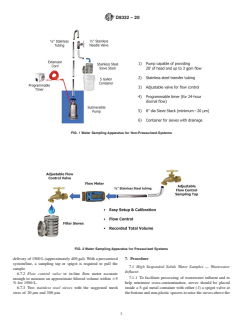
6.5.1 Stainless steel submersible pumpcapableofdelivering
The flow rate of water with high suspended solids across the approximately1.0galperminutewhenpulling24-hourdiurnal
sieves must be observed and appropriately regulated to avoid
wastewater influent samples from a non-pressurized system.
blinding (obstruction) of the sieve perforations. Flow volume
6.5.2 Aseries of 8 in. diameter stainless steel stacked sieves
must be throttled-back and recorded when blinding occurs.
with the suggested following mesh sizes: 20 µm, 50 µm, 150
µm, 300 µm, 500 µm, 1000 µm, and 5000 µm.
4.4 Wastewater influent (high suspended solids) sampling
6.5.3 Flow control valve (or in-line flow meter if water
should include 24 consecutive hours of flow collection to
quality conditions permit) capable of achieving a nominal
ensure capture of peak diurnal flow concentrations.
flowrate of 1.0 gal per minute, accurate enough to measure an
approximate filtered volume within 65%,or 672 gal out of
5. Significance and Use
1440 gal (approximately 5450 L) total per 24 hours.
5.1 When significant quantities of inorganic or organic
6.5.4 Digital outdoor timer.
material are present in water samples (high suspended solids),
microplastic particles/fibers can be masked and the ability to 6.6 Low to Medium Suspended Solids Water Samples —
conduct reliable identification and quantification analyses of Surface Water and Secondary-Treated Wastewater Effluent
the plastic particles/fibers can be impeded.
(Fig. 1 or Fig. 2):
6.6.1 Stainless steel submersible pump capable of pulling
5.2 In order to quantify the occurrence of microplastic
samples from a non-pressurized system or ambient surface
particles/fibers in wastewater influent (high suspended solids),
water as needed, to enable delivery of 1500 L (approximately
thesamplingproceduremustbeabletoreliablycollectsamples
400 gal). With a pressurized system/line, a sampling tap or
at a constant flow over the desired 24-hour interval to reflect
spigot is required to pull the sample.
changes in diurnal flow. For wastewater influent the capture
6.6.2 Flow control valve or in-line flow meter accurate
flow rate should be no less than 1 GPM over the 24-hour
enough to measure an approximate filtered volume within 65
interval (approximately 1440 gal or 5450 L total) to minimize
% for 1500 L.
the problem with heterogeneity of the suspended solids and to
6.6.3 A series of stacked stainless-steel sieves with the
reduce the standard error (the larger the sample size, the
suggested following mesh sizes: 20 µm, 150 µm, 500 µm, and
...