

ASTM D5173-15(2023)
(Guide)Standard Guide for On-Line Monitoring of Total Organic Carbon in Water by Oxidation and Detection of Resulting Carbon Dioxide
General Information
- Abstract
SIGNIFICANCE AND USE
5.1 Accurate measurement of organic carbon in water at low and very low levels is of particular interest to the electronic, life sciences, and steam power generation industries.
5.2 Elevated levels of organics in raw water tend to degrade ion exchange resin capacity. Elevated levels of organics in high purity water tend to support biological growth and, in some cases, are directly detrimental to the processes that require high purity water.
5.3 In power generation, naturally occurring organics can become degraded to CO2 and low molecular weight organic acids that, in turn, are corrosive to the process equipment. Their effect on conductivity may also cause water chemistry operating parameters to be exceeded, calling for plant shutdown. Halogenated and sulfonated organics may not be detectable by conductivity but at boiler temperatures will release highly corrosive chlorides, sulfates, etc.
5.4 In process water in other industries, organic carbon can signify in-leakage of substances through damaged piping and components, or an unacceptable level of product loss.
5.5 In wastewater treatment, organic carbon measurement of influent and process water can help optimize treatment schemes. Measurement of organic carbon at discharge may contribute to regulatory compliance.
5.6 In life sciences, control of organic carbon is necessary to demonstrate compliance with regulatory limits for some types of waters.
SCOPE
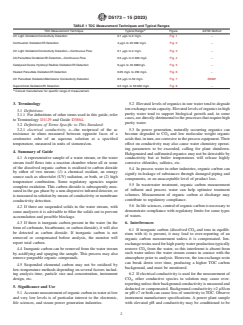
1.1 This guide covers the selection, establishment, and application of monitoring systems for carbon and carbon compounds by on-line, automatic analysis, and recording or otherwise signaling of output data. The system chosen will depend on the purpose for which it is intended (for example, regulatory compliance, process monitoring, or to alert the user to adverse trends) and on the type of water to be monitored (low purity or high purity, with or without suspended particulates, purgeable organics, or inorganic carbon). If it is to be used for regulatory compliance, the test method published or referenced in the regulations should be used in conjunction with this guide and other ASTM test methods. This guide covers carbon concentrations of 0.05 µg/L to 50 000 mg/L. Low end sensitivity and quantitative results may vary among instruments. This guide covers the on-line measurement techniques listed in Table 1. Additional laboratory test methods are available: Test Methods D4129, D4839, D5904, D6317, and D7573.
1.2 The values stated in SI units are to be regarded as standard. No other units of measurement are included in this standard.
1.3 This standard does not purport to address all of the safety concerns, if any, associated with its use. It is the responsibility of the user of this standard to establish appropriate safety, health, and environmental practices and determine the applicability of regulatory limitations prior to use. For specific hazard statements, see Section 9.
1.4 This international standard was developed in accordance with internationally recognized principles on standardization established in the Decision on Principles for the Development of International Standards, Guides and Recommendations issued by the World Trade Organization Technical Barriers to Trade (TBT) Committee.
- Status
- Published
- Publication Date
- 31-Mar-2023
- Technical Committee
- D19 - Water
Overview
ASTM D5173-15(2023), Standard Guide for On-Line Monitoring of Total Organic Carbon in Water by Oxidation and Detection of Resulting Carbon Dioxide, provides comprehensive guidance on selecting, establishing, and applying continuous monitoring systems for the determination of total organic carbon (TOC) in water. This standard, developed by ASTM Committee D19, is vital for industries where water purity and process control are critical, including electronics manufacturing, life sciences, and steam power generation.
The guide covers a wide range of water types and carbon concentrations, addressing both low and high purity water, and considers various oxidation and detection techniques. It emphasizes the significance of accurate, real-time TOC monitoring for regulatory compliance, process optimization, environmental protection, and quality assurance.
Key Topics
Purpose and Scope
- Methods for automatic, on-line analysis and recording of TOC in water.
- Suitable for monitoring carbon compounds in water with concentrations from as low as 0.05 μg/L up to 50,000 mg/L.
- Applicable to a variety of water types, from pure to industrial process water, with and without particulates or purgeable organics.
Measurement Techniques
- Covers multiple oxidation and detection methods, such as:
- UV light oxidation combined with conductivity detection
- Combustion oxidation with infrared detection
- Persulfate oxidation with IR or membrane conductivity detection
- Catalyzed ozone hydroxyl radical oxidation
- Supercritical oxidation with IR detection
- Covers multiple oxidation and detection methods, such as:
Significance and Use
- Ensures optimal performance of water treatment and process systems.
- Identifies sources of contamination or product loss in industrial processes.
- Assists in meeting regulatory requirements for water discharge and quality, especially in sensitive applications.
Technical Considerations
- Importance of selecting the correct monitoring technique for intended water quality and measurement objectives.
- Need to compensate for inorganic carbon, interferences, and particulate matter in samples.
- Calibration requirements and sample system design for representative and reliable results.
Applications
Electronics and Semiconductor Manufacturing
- Monitoring TOC at ultra-low levels in process and rinse waters to prevent defects and maintain product quality.
- Avoids degradation of ion exchange resins in ultrapure water systems.
Life Sciences and Pharmaceuticals
- Demonstrates compliance with regulatory limits for water used in drug production, laboratory testing, and biological research.
- Controls biological growth in high-purity water used for sensitive applications.
Steam and Power Generation
- Detects natural organic contaminants that can degrade to carbon dioxide and organic acids, leading to corrosion and operational shutdowns.
- Prevents the accumulation of halogenated or sulfonated organics that become highly corrosive at boiler temperatures.
Industrial and Process Water
- Detects leaks, in-leakage, and unacceptable product loss by monitoring increases in organic carbon.
- Provides trends and alerts for process optimization and equipment protection.
Wastewater Treatment
- Optimizes treatment schemes and supports compliance with environmental discharge limits.
- Identifies sources of organic pollution and improves overall operational efficiency.
Related Standards
For comprehensive TOC analysis, ASTM D5173-15(2023) references and is complemented by several related standards:
- ASTM D1129 - Terminology Relating to Water
- ASTM D1193 - Specification for Reagent Water
- ASTM D2777 - Practice for Determination of Precision and Bias of Applicable Test Methods of Committee D19 on Water
- ASTM D3370 - Practices for Sampling Water from Flowing Process Streams
- ASTM D3694 - Practices for Preparation of Sample Containers and Preservation of Organic Constituents
- ASTM D3864 - Guide for On-Line Monitoring Systems for Water Analysis
- ASTM D4129, D4839, D5904, D6317, D7573 - Various test methods for carbon content in water via specific oxidation and detection techniques
- EN 1484 - European guidelines for the determination of TOC and dissolved organic carbon (DOC) in water
Keywords: total organic carbon, TOC monitoring, water quality, on-line analysis, water oxidation, carbon dioxide detection, industrial water, wastewater treatment, ASTM D5173, regulatory compliance, power generation, life sciences, semiconductor water, environmental monitoring.
Relations
- Effective Date
- 01-Apr-2024
- Effective Date
- 01-Apr-2024
- Effective Date
- 01-Apr-2024
- Effective Date
- 01-May-2020
- Effective Date
- 01-Jan-2020
- Effective Date
- 15-Dec-2018
- Effective Date
- 01-Aug-2018
- Effective Date
- 01-Feb-2017
- Effective Date
- 01-Feb-2017
- Effective Date
- 01-Feb-2017
- Effective Date
- 15-Feb-2016
- Effective Date
- 01-May-2015
- Effective Date
- 15-Jun-2012
- Effective Date
- 01-May-2011
- Effective Date
- 01-May-2011
Get Certified
Connect with accredited certification bodies for this standard

CIS Institut d.o.o.
Personal Protective Equipment (PPE) certification body. Notified Body NB-2890 for EU Regulation 2016/425 PPE.

Kiwa BDA Testing
Building and construction product certification.
Kmetijski inštitut Slovenije
Agricultural Institute of Slovenia. Soil testing, plant health, agricultural product analysis.
Sponsored listings
Frequently Asked Questions
ASTM D5173-15(2023) is a guide published by ASTM International. Its full title is "Standard Guide for On-Line Monitoring of Total Organic Carbon in Water by Oxidation and Detection of Resulting Carbon Dioxide". This standard covers: SIGNIFICANCE AND USE 5.1 Accurate measurement of organic carbon in water at low and very low levels is of particular interest to the electronic, life sciences, and steam power generation industries. 5.2 Elevated levels of organics in raw water tend to degrade ion exchange resin capacity. Elevated levels of organics in high purity water tend to support biological growth and, in some cases, are directly detrimental to the processes that require high purity water. 5.3 In power generation, naturally occurring organics can become degraded to CO2 and low molecular weight organic acids that, in turn, are corrosive to the process equipment. Their effect on conductivity may also cause water chemistry operating parameters to be exceeded, calling for plant shutdown. Halogenated and sulfonated organics may not be detectable by conductivity but at boiler temperatures will release highly corrosive chlorides, sulfates, etc. 5.4 In process water in other industries, organic carbon can signify in-leakage of substances through damaged piping and components, or an unacceptable level of product loss. 5.5 In wastewater treatment, organic carbon measurement of influent and process water can help optimize treatment schemes. Measurement of organic carbon at discharge may contribute to regulatory compliance. 5.6 In life sciences, control of organic carbon is necessary to demonstrate compliance with regulatory limits for some types of waters. SCOPE 1.1 This guide covers the selection, establishment, and application of monitoring systems for carbon and carbon compounds by on-line, automatic analysis, and recording or otherwise signaling of output data. The system chosen will depend on the purpose for which it is intended (for example, regulatory compliance, process monitoring, or to alert the user to adverse trends) and on the type of water to be monitored (low purity or high purity, with or without suspended particulates, purgeable organics, or inorganic carbon). If it is to be used for regulatory compliance, the test method published or referenced in the regulations should be used in conjunction with this guide and other ASTM test methods. This guide covers carbon concentrations of 0.05 µg/L to 50 000 mg/L. Low end sensitivity and quantitative results may vary among instruments. This guide covers the on-line measurement techniques listed in Table 1. Additional laboratory test methods are available: Test Methods D4129, D4839, D5904, D6317, and D7573. 1.2 The values stated in SI units are to be regarded as standard. No other units of measurement are included in this standard. 1.3 This standard does not purport to address all of the safety concerns, if any, associated with its use. It is the responsibility of the user of this standard to establish appropriate safety, health, and environmental practices and determine the applicability of regulatory limitations prior to use. For specific hazard statements, see Section 9. 1.4 This international standard was developed in accordance with internationally recognized principles on standardization established in the Decision on Principles for the Development of International Standards, Guides and Recommendations issued by the World Trade Organization Technical Barriers to Trade (TBT) Committee.
SIGNIFICANCE AND USE 5.1 Accurate measurement of organic carbon in water at low and very low levels is of particular interest to the electronic, life sciences, and steam power generation industries. 5.2 Elevated levels of organics in raw water tend to degrade ion exchange resin capacity. Elevated levels of organics in high purity water tend to support biological growth and, in some cases, are directly detrimental to the processes that require high purity water. 5.3 In power generation, naturally occurring organics can become degraded to CO2 and low molecular weight organic acids that, in turn, are corrosive to the process equipment. Their effect on conductivity may also cause water chemistry operating parameters to be exceeded, calling for plant shutdown. Halogenated and sulfonated organics may not be detectable by conductivity but at boiler temperatures will release highly corrosive chlorides, sulfates, etc. 5.4 In process water in other industries, organic carbon can signify in-leakage of substances through damaged piping and components, or an unacceptable level of product loss. 5.5 In wastewater treatment, organic carbon measurement of influent and process water can help optimize treatment schemes. Measurement of organic carbon at discharge may contribute to regulatory compliance. 5.6 In life sciences, control of organic carbon is necessary to demonstrate compliance with regulatory limits for some types of waters. SCOPE 1.1 This guide covers the selection, establishment, and application of monitoring systems for carbon and carbon compounds by on-line, automatic analysis, and recording or otherwise signaling of output data. The system chosen will depend on the purpose for which it is intended (for example, regulatory compliance, process monitoring, or to alert the user to adverse trends) and on the type of water to be monitored (low purity or high purity, with or without suspended particulates, purgeable organics, or inorganic carbon). If it is to be used for regulatory compliance, the test method published or referenced in the regulations should be used in conjunction with this guide and other ASTM test methods. This guide covers carbon concentrations of 0.05 µg/L to 50 000 mg/L. Low end sensitivity and quantitative results may vary among instruments. This guide covers the on-line measurement techniques listed in Table 1. Additional laboratory test methods are available: Test Methods D4129, D4839, D5904, D6317, and D7573. 1.2 The values stated in SI units are to be regarded as standard. No other units of measurement are included in this standard. 1.3 This standard does not purport to address all of the safety concerns, if any, associated with its use. It is the responsibility of the user of this standard to establish appropriate safety, health, and environmental practices and determine the applicability of regulatory limitations prior to use. For specific hazard statements, see Section 9. 1.4 This international standard was developed in accordance with internationally recognized principles on standardization established in the Decision on Principles for the Development of International Standards, Guides and Recommendations issued by the World Trade Organization Technical Barriers to Trade (TBT) Committee.
ASTM D5173-15(2023) is classified under the following ICS (International Classification for Standards) categories: 13.060.50 - Examination of water for chemical substances. The ICS classification helps identify the subject area and facilitates finding related standards.
ASTM D5173-15(2023) has the following relationships with other standards: It is inter standard links to ASTM D5904-02(2024), ASTM D3694-96(2024), ASTM D4839-03(2024), ASTM D1129-13(2020)e2, ASTM D4129-05(2020), ASTM D7573-18a, ASTM D7573-18, ASTM D5904-02(2017), ASTM D4453-17, ASTM D7573-09(2017), ASTM D4453-16, ASTM D6317-15, ASTM D2777-12, ASTM D4839-03(2011), ASTM D3694-96(2011). Understanding these relationships helps ensure you are using the most current and applicable version of the standard.
ASTM D5173-15(2023) is available in PDF format for immediate download after purchase. The document can be added to your cart and obtained through the secure checkout process. Digital delivery ensures instant access to the complete standard document.
Standards Content (Sample)
This international standard was developed in accordance with internationally recognized principles on standardization established in the Decision on Principles for the
Development of International Standards, Guides and Recommendations issued by the World Trade Organization Technical Barriers to Trade (TBT) Committee.
Designation: D5173 − 15 (Reapproved 2023)
Standard Guide for
On-Line Monitoring of Total Organic Carbon in Water by
Oxidation and Detection of Resulting Carbon Dioxide
This standard is issued under the fixed designation D5173; the number immediately following the designation indicates the year of
original adoption or, in the case of revision, the year of last revision. A number in parentheses indicates the year of last reapproval. A
superscript epsilon (´) indicates an editorial change since the last revision or reapproval.
1. Scope 2. Referenced Documents
1.1 This guide covers the selection, establishment, and 2.1 ASTM Standards:
application of monitoring systems for carbon and carbon D1129 Terminology Relating to Water
compounds by on-line, automatic analysis, and recording or D1193 Specification for Reagent Water
otherwise signaling of output data. The system chosen will D2777 Practice for Determination of Precision and Bias of
depend on the purpose for which it is intended (for example, Applicable Test Methods of Committee D19 on Water
regulatory compliance, process monitoring, or to alert the user D3370 Practices for Sampling Water from Flowing Process
to adverse trends) and on the type of water to be monitored Streams
(low purity or high purity, with or without suspended D3694 Practices for Preparation of Sample Containers and
particulates, purgeable organics, or inorganic carbon). If it is to for Preservation of Organic Constituents
be used for regulatory compliance, the test method published D3864 Guide for On-Line Monitoring Systems for Water
or referenced in the regulations should be used in conjunction Analysis
with this guide and other ASTM test methods. This guide D4129 Test Method for Total and Organic Carbon in Water
covers carbon concentrations of 0.05 μg/L to 50 000 mg/L. by High Temperature Oxidation and by Coulometric
Low end sensitivity and quantitative results may vary among Detection
instruments. This guide covers the on-line measurement tech- D4453 Practice for Handling of High Purity Water Samples
niques listed in Table 1. Additional laboratory test methods are D4839 Test Method for Total Carbon and Organic Carbon in
available: Test Methods D4129, D4839, D5904, D6317, and Water by Ultraviolet, or Persulfate Oxidation, or Both, and
D7573. Infrared Detection
D5904 Test Method for Total Carbon, Inorganic Carbon, and
1.2 The values stated in SI units are to be regarded as
Organic Carbon in Water by Ultraviolet, Persulfate
standard. No other units of measurement are included in this
Oxidation, and Membrane Conductivity Detection
standard.
D5997 Test Method for On-Line Monitoring of Total
1.3 This standard does not purport to address all of the
Carbon, Inorganic Carbon in Water by Ultraviolet, Persul-
safety concerns, if any, associated with its use. It is the
fate Oxidation, and Membrane Conductivity Detection
responsibility of the user of this standard to establish appro-
D6317 Test Method for Low Level Determination of Total
priate safety, health, and environmental practices and deter-
Carbon, Inorganic Carbon and Organic Carbon in Water
mine the applicability of regulatory limitations prior to use.
by Ultraviolet, Persulfate Oxidation, and Membrane Con-
For specific hazard statements, see Section 9.
ductivity Detection
1.4 This international standard was developed in accor-
D7573 Test Method for Total Carbon and Organic Carbon in
dance with internationally recognized principles on standard-
Water by High Temperature Catalytic Combustion and
ization established in the Decision on Principles for the
Infrared Detection
Development of International Standards, Guides and Recom-
2.2 Other Standards:
mendations issued by the World Trade Organization Technical
EN1484 European Standard Water Analysis Guidelines for
Barriers to Trade (TBT) Committee.
the Determination of Total Organic Carbon (TOC) and
Dissolved Organic Carbon (DOC)
This guide is under the jurisdiction of ASTM Committee D19 on Water and is
the direct responsibility of Subcommittee D19.03 on Sampling Water and Water- For referenced ASTM standards, visit the ASTM website, www.astm.org, or
Formed Deposits, Analysis of Water for Power Generation and Process Use, contact ASTM Customer Service at service@astm.org. For Annual Book of ASTM
On-Line Water Analysis, and Surveillance of Water. Standards volume information, refer to the standard’s Document Summary page on
Current edition approved April 1, 2023. Published April 2023. Originally the ASTM website.
approved in 1991. Last previous edition approved in 2015 as D5173 – 15. DOI: Available from European Committee for Standardization (CEN), Avenue
10.1520/D5173-15R23. Marnix 17, B-1000, Brussels, Belgium, http://www.cen.eu.
Copyright © ASTM International, 100 Barr Harbor Drive, PO Box C700, West Conshohocken, PA 19428-2959. United States
D5173 − 15 (2023)
TABLE 1 TOC Measurement Techniques and Typical Ranges
A
TOC Measurement Technique Typical Range Figure ASTM Method
UV Light Oxidation/Conductivity Detection 0.1 μg/L to 2 mg/L Fig. 1 .
Combustion Oxidation/IR Detection 4 μg/L to 20 000 mg/L Fig. 2 .
UV Light Oxidation/Conductivity Detection—Continuous Flow 0.1 μg/L to 2 mg/L Fig. 3 .
UV-Persulfate Oxidation/IR Detection—Continuous Flow 0.5 μg/L to 3 000 mg/L Fig. 4 .
Catalyzed Ozone Hydroxyl Radical Oxidation/IR Detection 6 μg/L to 40 000mg/L Fig. 5 .
Heated Persulfate Oxidation/IR Detection 0.05 mg/L to 250 mg/L Fig. 6 .
UV Persulfate Oxidation/Membrane Conductivity Detection 0.5 μg/L to 50 mg/L Fig. 7 D5997
Supercritical Oxidation/IR Detection 0.5 mg/L to 50 000 mg/L Fig. 8 .
A
Consult manufacturer for specific range of measurement.
3. Terminology 5.2 Elevated levels of organics in raw water tend to degrade
ion exchange resin capacity. Elevated levels of organics in high
3.1 Definitions:
purity water tend to support biological growth and, in some
3.1.1 For definitions of other terms used in this guide, refer
cases, are directly detrimental to the processes that require high
to Terminology D1129 and Guide D3864.
purity water.
3.2 Definitions of Terms Specific to This Standard:
3.2.1 electrical conductivity, n—the reciprocal of the ac 5.3 In power generation, naturally occurring organics can
resistance in ohms measured between opposite faces of a become degraded to CO and low molecular weight organic
centimetre cube of an aqueous solution at a specified acids that, in turn, are corrosive to the process equipment. Their
temperature, measured in units of siemens/cm. effect on conductivity may also cause water chemistry operat-
ing parameters to be exceeded, calling for plant shutdown.
4. Summary of Guide
Halogenated and sulfonated organics may not be detectable by
4.1 A representative sample of a water stream, or the water
conductivity but at boiler temperatures will release highly
stream itself flows into a reaction chamber where all or some corrosive chlorides, sulfates, etc.
of the dissolved organic carbon is oxidized to carbon dioxide
5.4 In process water in other industries, organic carbon can
by either of two means: (1) a chemical oxidant, an energy
signify in-leakage of substances through damaged piping and
source such as ultraviolet (UV) radiation, or both, or (2) high
components, or an unacceptable level of product loss.
temperature combustion. Some regulatory agencies require
5.5 In wastewater treatment, organic carbon measurement
complete oxidation. This carbon dioxide is subsequently mea-
of influent and process water can help optimize treatment
sured in the gas phase by a non-dispersive infrared detector, or
schemes. Measurement of organic carbon at discharge may
is measured in solution by means of conductivity or membrane
contribute to regulatory compliance.
conductivity detection.
5.6 In life sciences, control of organic carbon is necessary to
4.2 If there are suspended solids in the water stream, with
demonstrate compliance with regulatory limits for some types
some analyzers it is advisable to filter the solids out to prevent
of waters.
accumulation and possible blockage.
4.3 If there is inorganic carbon present in the water (in the 6. Interferences
form of carbonate, bicarbonate, or carbon dioxide), it will also
6.1 If inorganic carbon (dissolved CO and ions in equilib-
be detected as carbon dioxide. If inorganic carbon is not
rium with it) is present, it may lead to over-reporting of an
removed or compensated before analysis, the monitor will
organic carbon measurement unless it is compensated. Ion-
report total carbon.
exchange resins used for high purity water production typically
remove CO from the water, so this interferent is absent from
4.4 Inorganic carbon can be removed from the water stream
such water unless the water stream comes in contact with the
by acidifying and sparging the sample. This process may also
atmosphere prior to analysis. However, the ion-exchange resin
remove purgeable organic compounds.
can break down over time, producing a higher TOC carbon
4.5 Suspended elemental carbon may not be oxidized by
background, and must be monitored.
low-temperature methods depending on several factors includ-
6.2 If electrical conductivity is used for the measurement of
ing analysis time, particle size and concentration, instrument
design, etc. CO , other conductive species in solution may cause over-
reporting unless their background conductivity is measured and
5. Significance and Use
deducted or compensated. Background conductivity >2 μS/cm
5.1 Accurate measurement of organic carbon in water at low or pH >7 or both can cause loss of sensitivity to TOC. Observe
and very low levels is of particular interest to the electronic, instrument manufacturer specifications. A power plant sample
life sciences, and steam power generation industries. with elevated pH and conductivity may be conditioned to be
D5173 − 15 (2023)
within acceptable pH and conductivity ranges by continuously 8. Reagents and Materials
passing the sample through a cation exchange cartridge. The
8.1 Purity of Reagents—Reagent grade chemicals shall be
resulting TOC measurement will not include organic cations
used in all tests. Unless otherwise indicated, all reagents should
such as amines.
conform to the specifications of the Committee on Analytical
6.3 With electrical conductivity detection systems, Reagents of the American Chemical Society. Other grades
halogen-, sulfur-, nitrogen- and phosphorus-containing organic may be used, provided it is first ascertained that the reagent is
compounds can result in interference with the TOC measure- of sufficient purity to permit its use without decreasing the
ment. If problems are anticipated, the method of detection must accuracy of the determinations.
be modified or the water itself must be treated to reduce the
8.2 Purity of Water:
interfering background sufficiently to meet accuracy require-
8.2.1 Unless otherwise stated, references to water shall be
ments.
understood to mean water meeting the quantitative require-
6.4 If particulates are suspended in the water stream, they ments of Specification D1193, Type II. The carbon content of
may cause blockage in some analyzers over a period of time, this water should be measured regularly by a suitably sensitive
and may also be hard to oxidize. If problems are anticipated, test method.
the water stream should be appropriately filtered upstream of 8.2.2 Water as free as possible of organics relative to the
the monitor and it must be recognized that results will not carbon levels being measured is required when establishing the
include solid organics. If the filter used is rated to 0.45 μm then test method blank.
the parameter measured will be dissolved organic carbon
8.3 Amber glass, HDPE, and TFE fluorocarbon bottles
(DOC) as defined by EN1484.
should be used to store water, organic-free water, and standard
6.5 Non-dispersive infrared detectors tuned to CO absor- solutions. The bottles should be dedicated to their respective
bance are sensitive to water vapor, which may therefore give a types of solution and should not interfere with the chosen
positive interference unless the water vapor is removed. measurement technique. Practices D3370, D3694, and D4453
address handling of water samples.
6.6 The membrane conductivity detection technique may
8.3.1 Clean bottles according to Practice D4453.
experience positive interference in the presence of low mo-
8.3.2 Follow the cleaning procedure before each re-use of
lecular weight, reduced, inorganic acid species such as H S or
the bottles.
HNO . Such interferences can be eliminated by oxidation or
removal. 8.4 Gas Supply—Use a gas free of CO and organic matter,
of purity specified by the equipment manufacturer.
7. Apparatus
8.5 Organic Carbon Solution, Standard:
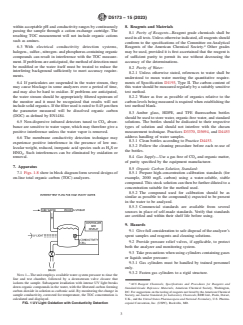
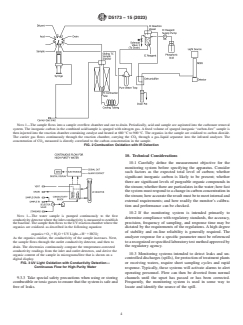
7.1 Figs. 1-8 show in block diagram form several designs of
8.5.1 Prepare high-concentration calibration standards (for
on-line total organic carbon (TOC) analyzers.
example, 2000 mg/L carbon) using a water-soluble, stable
compound. This stock solution can then be further diluted to a
concentration suitable for the method used.
8.5.2 The compound used for calibration should be as
similar as possible to the compound(s) expected to be present
in the water to be analyzed.
8.5.3 Commercial standards are available from several
sources in place of self-made standards. Verify that standards
are certified and within their shelf life before using.
9. Hazards
9.1 Give full consideration to safe disposal of the analyzer’s
spent samples and reagents and cleaning solutions.
9.2 Provide pressure relief valves, if applicable, to protect
both the analyzer and monitoring system.
9.3 Take precautions when using cylinders containing gases
or liquids under pressure:
9.3.1 Gas cylinders must be handled by trained personnel
only.
9.3.2 Fasten gas cylinders to a rigid structure.
NOTE 1—The unit employs available water system pressure to rinse the
line and test chamber, followed by a downstream valve closure that
isolates the sample. Subsequent irradiation with intense UV light breaks 4
ACS Reagent Chemicals, Specifications and Procedures for Reagents and
down organic compounds in the water, with the liberated carbon forming
Standard-Grade Reference Materials, American Chemical Society, Washington,
carbon dioxide in solution as carbonic acid. By monitoring the change in
DC. For suggestions on the testing of reagents not listed by the American Chemical
sample conductivity, corrected for temperature, the TOC concentration is
Society, see Analar Standards for Laboratory Chemicals, BDH Ltd., Poole, Dorset,
calculated and displayed.
U.K., and the United States Pharmacopeia
...