

ASTM D7854-21
(Test Method)Standard Test Method for Carbon Black-Void Volume at Mean Pressure
General Information
- Abstract
SIGNIFICANCE AND USE
5.1 The greater a carbon black resists compression by having substantial aggregate irregularity and non-sphericity, the greater the compressed volume and void volume. Also, the more that a carbon black resists compression, the greater the energy required to compress the sample per unit void volume.
5.2 Structure is a property that strongly influences the physical properties developed in carbon black-elastomer compounds for use in tires, mechanical rubber goods, and other manufactured rubber products. Structure by void volume is based on compression while structure measurements by OAN (Test Method D2414) and COAN (Test Method D3493) are based on oil absorption.
SCOPE
1.1 This test method covers a procedure to measure a carbon black structure property by Void Volume at mean pressure. Compressed void volumes are obtained by measuring the compressed volume of a weighed sample in a cylindrical chamber as a function of pressure exerted by a movable piston. A profile of void volume as a function of pressure provides a means to assess carbon black structure at varying levels of density and aggregate reduction. For the purposes of standardized testing a single value of void volume is reported at 50 MPa mean pressure.
1.2 The values stated in SI units are to be regarded as standard. No other units of measurement are included in this standard.
1.3 This standard does not purport to address all of the safety concerns, if any, associated with its use. It is the responsibility of the user of this standard to establish appropriate safety, health, and environmental practices and determine the applicability of regulatory limitations prior to use.
1.4 This international standard was developed in accordance with internationally recognized principles on standardization established in the Decision on Principles for the Development of International Standards, Guides and Recommendations issued by the World Trade Organization Technical Barriers to Trade (TBT) Committee.
- Status
- Published
- Publication Date
- 31-May-2021
- Technical Committee
- D24 - Carbon Black
- Drafting Committee
- D24.11 - Carbon Black Structure

Overview
ASTM D7854-21: Standard Test Method for Carbon Black-Void Volume at Mean Pressure is a globally recognized procedure established by ASTM International. This test method specifies a standardized approach to determine a key structure property of carbon black: its void volume under compression at mean pressure. By measuring the compressed volume of a weighed carbon black sample in a controlled environment, manufacturers and researchers can better assess carbon black’s physical characteristics, especially its resistance to compression and the intra-aggregate void space.
This standard is crucial for industries relying on carbon black, such as rubber manufacturing and tire production, as it provides a consistent basis for evaluating structure-dependent properties that impact performance in end-use applications.
Key Topics
- Void Volume Measurement: Quantifies the intra-aggregate void space within carbon black by compressing a sample at defined pressures using a calibrated instrument.
- Mean Pressure Reporting: Provides a profile of void volume as a function of pressure, with a standardized report at 50 MPa mean pressure, allowing for consistent comparison between materials.
- Sample Preparation and Testing: Details the drying, weighing, and testing procedure to ensure reproducible and accurate results.
- Normalization and Calibration: Describes procedures using Standard Reference Blacks (SRBs) and instrument calibration, enhancing inter-laboratory consistency.
- Precision and Reproducibility: Outlines rigorous statistical evaluations for repeatability and reproducibility, supporting quality assurance in manufacturing environments.
- Significance of Structure Measurement: Explains the relevance of carbon black structure properties, such as aggregate irregularity and non-sphericity, in the development of rubber compounds.
Applications
ASTM D7854-21 is widely applicable in the following areas:
- Tire Manufacturing: Accurate measurement of carbon black void volume supports the optimization of tire properties, such as durability, wear resistance, and rolling resistance.
- Mechanical Rubber Goods: Used by manufacturers of hoses, belts, and seals where consistent material structure enhances mechanical performance.
- Quality Control and Research: Useful for laboratories performing comparative studies of carbon black from different sources or production batches.
- Material Development: Informs the selection of carbon black grades for specialty rubber compounds, impacting electrical conductivity, reinforcement, and processing characteristics.
The test method’s rigorous normalization and calibration process ensures that results are reliable, repeatable, and traceable across different laboratories and production sites, making it a critical tool for both quality assurance and product development.
Related Standards
To provide comprehensive analysis and ensure best practices, ASTM D7854-21 is used alongside several related standards:
- ASTM D1799: Practice for Carbon Black-Sampling Packaged Shipments
- ASTM D1900: Practice for Carbon Black-Sampling Bulk Shipments
- ASTM D2414: Test Method for Carbon Black-Oil Absorption Number (OAN), which measures structure based on oil absorption rather than compression
- ASTM D3493: Test Method for Carbon Black-Oil Absorption Number of Compressed Sample (COAN)
- ASTM D4483: Practice for Evaluating Precision for Test Method Standards in the Rubber and Carbon Black Manufacturing Industries
These related standards enable a comprehensive assessment of carbon black material properties, supporting quality control and innovation in the rubber industry.
Keywords: ASTM D7854, carbon black, void volume, mean pressure, rubber manufacturing, tire production, structure measurement, quality control, ASTM International.
Relations
- Effective Date
- 01-Nov-2023
- Effective Date
- 01-Dec-2018
- Effective Date
- 01-Dec-2018
- Effective Date
- 01-Jul-2018
- Effective Date
- 01-Jan-2016
- Effective Date
- 01-Jan-2016
- Effective Date
- 01-Jan-2016
- Effective Date
- 01-Nov-2015
- Effective Date
- 01-Jul-2014
- Effective Date
- 01-Jun-2014
- Effective Date
- 01-Nov-2013
- Effective Date
- 01-Jul-2013
- Effective Date
- 01-Jul-2013
- Effective Date
- 01-Jul-2012
- Effective Date
- 01-Nov-2011
Get Certified
Connect with accredited certification bodies for this standard

ECOCERT
Organic and sustainability certification.

Eurofins Food Testing Global
Global leader in food, environment, and pharmaceutical product testing.

Intertek Bangladesh
Intertek certification and testing services in Bangladesh.
Sponsored listings
Frequently Asked Questions
ASTM D7854-21 is a standard published by ASTM International. Its full title is "Standard Test Method for Carbon Black-Void Volume at Mean Pressure". This standard covers: SIGNIFICANCE AND USE 5.1 The greater a carbon black resists compression by having substantial aggregate irregularity and non-sphericity, the greater the compressed volume and void volume. Also, the more that a carbon black resists compression, the greater the energy required to compress the sample per unit void volume. 5.2 Structure is a property that strongly influences the physical properties developed in carbon black-elastomer compounds for use in tires, mechanical rubber goods, and other manufactured rubber products. Structure by void volume is based on compression while structure measurements by OAN (Test Method D2414) and COAN (Test Method D3493) are based on oil absorption. SCOPE 1.1 This test method covers a procedure to measure a carbon black structure property by Void Volume at mean pressure. Compressed void volumes are obtained by measuring the compressed volume of a weighed sample in a cylindrical chamber as a function of pressure exerted by a movable piston. A profile of void volume as a function of pressure provides a means to assess carbon black structure at varying levels of density and aggregate reduction. For the purposes of standardized testing a single value of void volume is reported at 50 MPa mean pressure. 1.2 The values stated in SI units are to be regarded as standard. No other units of measurement are included in this standard. 1.3 This standard does not purport to address all of the safety concerns, if any, associated with its use. It is the responsibility of the user of this standard to establish appropriate safety, health, and environmental practices and determine the applicability of regulatory limitations prior to use. 1.4 This international standard was developed in accordance with internationally recognized principles on standardization established in the Decision on Principles for the Development of International Standards, Guides and Recommendations issued by the World Trade Organization Technical Barriers to Trade (TBT) Committee.
SIGNIFICANCE AND USE 5.1 The greater a carbon black resists compression by having substantial aggregate irregularity and non-sphericity, the greater the compressed volume and void volume. Also, the more that a carbon black resists compression, the greater the energy required to compress the sample per unit void volume. 5.2 Structure is a property that strongly influences the physical properties developed in carbon black-elastomer compounds for use in tires, mechanical rubber goods, and other manufactured rubber products. Structure by void volume is based on compression while structure measurements by OAN (Test Method D2414) and COAN (Test Method D3493) are based on oil absorption. SCOPE 1.1 This test method covers a procedure to measure a carbon black structure property by Void Volume at mean pressure. Compressed void volumes are obtained by measuring the compressed volume of a weighed sample in a cylindrical chamber as a function of pressure exerted by a movable piston. A profile of void volume as a function of pressure provides a means to assess carbon black structure at varying levels of density and aggregate reduction. For the purposes of standardized testing a single value of void volume is reported at 50 MPa mean pressure. 1.2 The values stated in SI units are to be regarded as standard. No other units of measurement are included in this standard. 1.3 This standard does not purport to address all of the safety concerns, if any, associated with its use. It is the responsibility of the user of this standard to establish appropriate safety, health, and environmental practices and determine the applicability of regulatory limitations prior to use. 1.4 This international standard was developed in accordance with internationally recognized principles on standardization established in the Decision on Principles for the Development of International Standards, Guides and Recommendations issued by the World Trade Organization Technical Barriers to Trade (TBT) Committee.
ASTM D7854-21 is classified under the following ICS (International Classification for Standards) categories: 71.060.10 - Chemical elements. The ICS classification helps identify the subject area and facilitates finding related standards.
ASTM D7854-21 has the following relationships with other standards: It is inter standard links to ASTM D2414-23a, ASTM D2414-18a, ASTM D3493-18a, ASTM D3493-18, ASTM D2414-16e1, ASTM D2414-16, ASTM D3493-16, ASTM D1900-06(2015), ASTM D2414-14, ASTM D1799-03a(2014), ASTM D2414-13a, ASTM D2414-13, ASTM D3493-13, ASTM D2414-12, ASTM D2414-11. Understanding these relationships helps ensure you are using the most current and applicable version of the standard.
ASTM D7854-21 is available in PDF format for immediate download after purchase. The document can be added to your cart and obtained through the secure checkout process. Digital delivery ensures instant access to the complete standard document.
Standards Content (Sample)
This international standard was developed in accordance with internationally recognized principles on standardization established in the Decision on Principles for the
Development of International Standards, Guides and Recommendations issued by the World Trade Organization Technical Barriers to Trade (TBT) Committee.
Designation: D7854 − 21
Standard Test Method for
Carbon Black-Void Volume at Mean Pressure
This standard is issued under the fixed designation D7854; the number immediately following the designation indicates the year of
original adoption or, in the case of revision, the year of last revision. A number in parentheses indicates the year of last reapproval. A
superscript epsilon (´) indicates an editorial change since the last revision or reapproval.
1. Scope D3493 Test Method for Carbon Black—Oil Absorption
Number of Compressed Sample (COAN)
1.1 Thistestmethodcoversaproceduretomeasureacarbon
D4483 Practice for Evaluating Precision for Test Method
black structure property by Void Volume at mean pressure.
Standards in the Rubber and Carbon Black Manufacturing
Compressed void volumes are obtained by measuring the
Industries
compressed volume of a weighed sample in a cylindrical
chamber as a function of pressure exerted by a movable piston.
3. Terminology
A profile of void volume as a function of pressure provides a
means to assess carbon black structure at varying levels of
3.1 Refer to Sections 4 and 9 for a more complete under-
density and aggregate reduction. For the purposes of standard-
standing of the use of these terms in this test method.
izedtestingasinglevalueofvoidvolumeisreportedat50MPa
3.2 Definitions of Terms Specific to This Standard:
mean pressure.
3.2.1 applied pressure, n—the pressure exerted on a sample
1.2 The values stated in SI units are to be regarded as
mass by a movable piston in a cylindrical chamber, where the
standard. No other units of measurement are included in this
load cell or force measuring system is in contact with the
standard.
movable piston.
1.3 This standard does not purport to address all of the
3.2.2 transmitted pressure, n—the resulting pressure trans-
safety concerns, if any, associated with its use. It is the
mitted through a sample in a cylindrical chamber, where the
responsibility of the user of this standard to establish appro-
load cell or force measuring system is in contact with the
priate safety, health, and environmental practices and deter-
sample opposite the movable piston, typically via a stationary
mine the applicability of regulatory limitations prior to use.
second piston.
1.4 This international standard was developed in accor-
3.2.3 compressed volume (carbon black), n—the apparent
dance with internationally recognized principles on standard-
volume that a specified mass of carbon black occupies when it
ization established in the Decision on Principles for the
is contained in a specified cylindrical chamber and subjected to
Development of International Standards, Guides and Recom-
a single uniaxial compression at a specified pressure by means
mendations issued by the World Trade Organization Technical
of a movable piston.
Barriers to Trade (TBT) Committee.
3.2.4 geometric mean pressure, n—the geometric mean of
2. Referenced Documents
the applied and transmitted pressures at a specific void volume;
2.1 ASTM Standards:
the geometric mean pressure is defined in Eq 1:
D1799 Practice for Carbon Black—Sampling Packaged
0.5
Geometric Mean P 5 P 3 P (1)
~ !
GM a t
Shipments
3.2.5 theoretical volume (carbon black), n—the volume that
D1900 Practice for Carbon Black—Sampling Bulk Ship-
a specific mass of carbon black would occupy if there were no
ments
void space within the carbon black, and is given by the ratio of
D2414 Test Method for Carbon Black—Oil Absorption
mass to skeletal density, where the skeletal density is deter-
Number (OAN)
mined by an accepted test method.
This test method is under the jurisdiction ofASTM Committee D24 on Carbon
3.2.6 void volume (carbon black), n—a measure of the
Black and is the direct responsibility of Subcommittee D24.11 on Carbon Black
intra-aggregate void space or occluded volume within the
Structure.
primary structure of carbon black, characterized by the irregu-
CurrenteditionapprovedJune1,2021.PublishedJuly2021.Originallyapproved
ε1
larity and non-sphericity of carbon black aggregate particles,
in 2013. Last previous edition approved in 2018 as D7854 – 18c . DOI: 10.1520/
D7854-21.
and expressed as the difference (compressed volume minus
For referenced ASTM standards, visit the ASTM website, www.astm.org, or
theoretical volume) as a function of specified uniaxial com-
contact ASTM Customer Service at service@astm.org. For Annual Book of ASTM
pression pressure, and normalized to 100 g mass. pressure, and
Standards volume information, refer to the standard’s Document Summary page on
the ASTM website. normalized to 100 g mass. The void volume of a carbon black
Copyright © ASTM International, 100 Barr Harbor Drive, PO Box C700, West Conshohocken, PA 19428-2959. United States
D7854 − 21
expressed as a function of geometric mean pressure, VV, is a 6. Apparatus
carbon black structure property.
6.1 Analytical Balance,orequivalent,capableofaweighing
3.2.6.1 Discussion—Carbon blacks resist packing,
sensitivity of 0.1 mg.
compression, and fracture due to aggregate irregularities and
6.2 Gravity Convection Drying, Oven, capable of maintain-
entanglements, size distribution, and aggregate strength result-
ing 125 6 5°C.
ing from particle to-particle necks within aggregate branches.
6.3 Weighing Dish, Camel Hair or Similar Brush,to be used
Compressed void volume is also affected by reacting forces to
for weighing and transferring samples.
the cylinder wall and the piston tip, which in turn depend on
factors including sample shape (that is, the ratio of sample
6.4 Void Volume Instrument, to be used to measure the
height to cylinder diameter) or interfacial area, which can compressed volume (apparent volume) of carbon blacks as a
influence the uniformity of the compaction density. Since function of applied pressure, from which the void volume is
calculated at specified intervals of geometric mean pressure
compressed void volumes as a function of applied pressure are
(that is, geometric mean of applied and transmitted pressures).
known to be specific to sample mass and cylinder geometry,
The void volume instrument or device shall conform to the
such a compressed void volume is biased due to error in the
following generic specifications and be capable of operating as
applied pressure relationship. The applied pressure bias is a
outlined in Section 9.
result of force losses due to friction between the sample and
6.4.1 The instrument shall have a rigid framework that
cylinder wall interface. There is presently no known technique
contains a cylindrical sample chamber. Hysteresis and elastic-
to properly correct applied pressure measurements for an
ity in the framework under the range of applied forces should
instrument design using a single load cell since friction
be accounted for in the displacement measurement.
coefficients (µ) are not constant for carbon black products or
6.4.2 The cylinder shall have a uniform diameter.
applied pressures. For this reason, the most useful technique
6.4.3 By means of a suitable mechanism with sufficient
for comparing compressed void volumes is based on a numeri-
power for the compression forces as required for testing, the
cal technique known as mean compaction force or mean
pistonshallbecapableofbeingmovedtocompressthesample.
pressure. The mean pressure technique requires an instrument
A device to record the movement of the piston and measure
design consisting of two load cells to enable the measurement
displacement shall be provided. The compressed volume of
of compressed void volume as a function of applied and
any sample is determined by the distance from the end of the
transmitted force or pressure. Such a design allows the com-
pistontotheendofthecylinder;thisisdesignatedasa“height”
putation of void volumes at mean pressures, a method which
in the calculations discussed in Section 11. The sample height
has been demonstrated to minimize the effects of carbon black
and cylinder diameter are used to calculate an apparent sample
sample mass and cylinder geometry.
volume.
6.4.4 Load cells or other suitable force or pressure measure-
4. Summary of Test Method
ment devices are used to measure the applied and transmitted
4.1 The measured compressed volume (apparent volume) of pressures.
a weighed dry test sample is obtained in a void volume 6.4.5 The instrument design shall provide continuous com-
pression at a controlled and constant rate thereby allowing
instrument as a function of specified pressure. The instrument
consists of an apparatus which can apply uniaxial compression continuous measurements of apparent volume and pressures at
specified data intervals.
to a test sample in a cylindrical sample chamber where applied
6.4.6 The instrument uses an electric motor or hydraulic
and transmitted forces (or pressures) are measured. The com-
fluid to operate a linear actuator attached to a piston.
pressed void volume is obtained by subtracting the theoretical
6.4.7 The instrument incorporates two load cells to directly
volume from the apparent volume, then expressing the result
measure applied and transmitted forces or pressures.
unitized to 100 g mass, as a function of specified mean
6.4.8 The instrument design shall provide a means to save
pressure.
and store the compression data up to a minimum of 50 MPa
geometric mean pressure for subsequent analysis.
5. Significance and Use
5.1 The greater a carbon black resists compression by
7. Sampling
having substantial aggregate irregularity and non-sphericity,
7.1 Samples of candidate carbon blacks shall be taken in
the greater the compressed volume and void volume.Also, the
accordance with Practice D1799 or D1900.
more that a carbon black resists compression, the greater the
energy required to compress the sample per unit void volume.
8. Calibration
5.2 Structure is a property that strongly influences the
8.1 Calibration—The manufacturer will typ
...
This document is not an ASTM standard and is intended only to provide the user of an ASTM standard an indication of what changes have been made to the previous version. Because
it may not be technically possible to adequately depict all changes accurately, ASTM recommends that users consult prior editions as appropriate. In all cases only the current version
of the standard as published by ASTM is to be considered the official document.
´1
Designation: D7854 − 18c D7854 − 21
Standard Test Method for
Carbon Black-Void Volume at Mean Pressure
This standard is issued under the fixed designation D7854; the number immediately following the designation indicates the year of
original adoption or, in the case of revision, the year of last revision. A number in parentheses indicates the year of last reapproval. A
superscript epsilon (´) indicates an editorial change since the last revision or reapproval.
ε NOTE—Corrected 12.1.2 and Table 1 editorially in May 2020.
1. Scope
1.1 This test method covers a procedure to measure a carbon black structure property by Void Volume at mean pressure.
Compressed void volumes are obtained by measuring the compressed volume of a weighed sample in a cylindrical chamber as a
function of pressure exerted by a movable piston. A profile of void volume as a function of pressure provides a means to assess
carbon black structure at varying levels of density and aggregate reduction. For the purposes of standardized testing a single value
of void volume is reported at 50 MPa mean pressure.
1.2 The values stated in SI units are to be regarded as standard. No other units of measurement are included in this standard.
1.3 This standard does not purport to address all of the safety concerns, if any, associated with its use. It is the responsibility
of the user of this standard to establish appropriate safety, health, and environmental practices and determine the applicability of
regulatory limitations prior to use.
1.4 This international standard was developed in accordance with internationally recognized principles on standardization
established in the Decision on Principles for the Development of International Standards, Guides and Recommendations issued
by the World Trade Organization Technical Barriers to Trade (TBT) Committee.
2. Referenced Documents
2.1 ASTM Standards:
D1799 Practice for Carbon Black—Sampling Packaged Shipments
D1900 Practice for Carbon Black—Sampling Bulk Shipments
D2414 Test Method for Carbon Black—Oil Absorption Number (OAN)
D3493 Test Method for Carbon Black—Oil Absorption Number of Compressed Sample (COAN)
D4483 Practice for Evaluating Precision for Test Method Standards in the Rubber and Carbon Black Manufacturing Industries
3. Terminology
3.1 Refer to Sections 4 and 9 for a more complete understanding of the use of these terms in this test method.
3.2 Definitions of Terms Specific to This Standard:
3.2.1 applied pressure, n—the pressure exerted on a sample mass by a movable piston in a cylindrical chamber, where the load
cell or force measuring system is in contact with the movable piston.
This test method is under the jurisdiction of ASTM Committee D24 on Carbon Black and is the direct responsibility of Subcommittee D24.11 on Carbon Black Structure.
Current edition approved Dec. 1, 2018June 1, 2021. Published January 2019July 2021. Originally approved in 2013. Last previous edition approved in 2018 as
ε1
D7854 – 18b.D7854 – 18c . DOI: 10.1520/D7854-18CE01.10.1520/D7854-21.
For referenced ASTM standards, visit the ASTM website, www.astm.org, or contact ASTM Customer Service at service@astm.org. For Annual Book of ASTM Standards
volume information, refer to the standard’s Document Summary page on the ASTM website.
Copyright © ASTM International, 100 Barr Harbor Drive, PO Box C700, West Conshohocken, PA 19428-2959. United States
D7854 − 21
3.2.2 transmitted pressure, n—the resulting pressure transmitted through a sample in a cylindrical chamber, where the load cell
or force measuring system is in contact with the sample opposite the movable piston, typically via a stationary second piston.
3.2.3 compressed volume (carbon black), n—the apparent volume that a specified mass of carbon black occupies when it is
contained in a specified cylindrical chamber and subjected to a single uniaxial compression at a specified pressure by means of
a movable piston.
3.2.4 geometric mean pressure, n—the geometric mean of the applied and transmitted pressures at a specific void volume; the
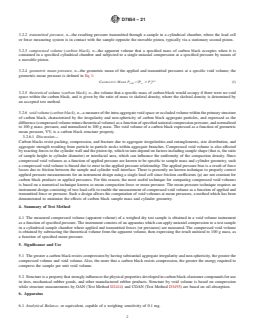
geometric mean pressure is defined in Eq 1:
0.5
Geometric Mean P 5 ~P 3 P ! (1)
GM a t
3.2.5 theoretical volume (carbon black), n—the volume that a specific mass of carbon black would occupy if there were no void
space within the carbon black, and is given by the ratio of mass to skeletal density, where the skeletal density is determined by
an accepted test method.
3.2.6 void volume (carbon black), n—a measure of the intra-aggregate void space or occluded volume within the primary structure
of carbon black, characterized by the irregularity and non-sphericity of carbon black aggregate particles, and expressed as the
difference (compressed volume minus theoretical volume) as a function of specified uniaxial compression pressure, and normalized
to 100 g mass. pressure, and normalized to 100 g mass. The void volume of a carbon black expressed as a function of geometric
mean pressure, VV, is a carbon black structure property.
3.2.6.1 Discussion—
Carbon blacks resist packing, compression, and fracture due to aggregate irregularities and entanglements, size distribution, and
aggregate strength resulting from particle to-particle necks within aggregate branches. Compressed void volume is also affected
by reacting forces to the cylinder wall and the piston tip, which in turn depend on factors including sample shape (that is, the ratio
of sample height to cylinder diameter) or interfacial area, which can influence the uniformity of the compaction density. Since
compressed void volumes as a function of applied pressure are known to be specific to sample mass and cylinder geometry, such
a compressed void volume is biased due to error in the applied pressure relationship. The applied pressure bias is a result of force
losses due to friction between the sample and cylinder wall interface. There is presently no known technique to properly correct
applied pressure measurements for an instrument design using a single load cell since friction coefficients (μ) are not constant for
carbon black products or applied pressures. For this reason, the most useful technique for comparing compressed void volumes
is based on a numerical technique known as mean compaction force or mean pressure. The mean pressure technique requires an
instrument design consisting of two load cells to enable the measurement of compressed void volume as a function of applied and
transmitted force or pressure. Such a design allows the computation of void volumes at mean pressures, a method which has been
demonstrated to minimize the effects of carbon black sample mass and cylinder geometry.
4. Summary of Test Method
4.1 The measured compressed volume (apparent volume) of a weighed dry test sample is obtained in a void volume instrument
as a function of specified pressure. The instrument consists of an apparatus which can apply uniaxial compression to a test sample
in a cylindrical sample chamber where applied and transmitted forces (or pressures) are measured. The compressed void volume
is obtained by subtracting the theoretical volume from the apparent volume, then expressing the result unitized to 100 g mass, as
a function of specified mean pressure.
5. Significance and Use
5.1 The greater a carbon black resists compression by having substantial aggregate irregularity and non-sphericity, the greater the
compressed volume and void volume. Also, the more that a carbon black resists compression, the greater the energy required to
compress the sample per unit void volume.
5.2 Structure is a property that strongly influences the physical properties developed in carbon black-elastomer compounds for use
in tires, mechanical rubber goods, and other manufactured rubber products. Structure by void volume is based on compression
while structure measurements by OAN (Test Method D2414) and COAN (Test Method D3493) are based on oil absorption.
6. Apparatus
6.1 Analytical Balance, or equivalent, capable of a weighing sensitivity of 0.1 mg.
D7854 − 21
6.2 Gravity Convection Drying, Oven, capable of maintaining 125 6 5°C.
6.3 Weighing Dish, Camel Hair or Similar Brush, to be used for weighing and transferring samples.
6.4 Void Volume Instrument, to be used to measure the compressed volume (apparent volume) of carbon blacks as a function of
applied pressure, from which the void volume is calculated at specified intervals of geometric mean pressure (that is, geometric
mean of applied and transmitted pressures). The void volume instrument or device shall conform to the following generic
specifications and be capable of operating as outlined in Section 9.
6.4.1 The instrument shall have a rigid framework that contains a cylindrical sample chamber. Hysteresis and elasticity in the
framework under the range of applied forces should be accounted for in the displacement measurement.
6.4.2 The cylinder shall have a uniform diameter.
6.4.3 By means of a suitable mechanism with sufficient power for the compression forces as required for testing, the piston shall
be capable of being moved to compress the sample. A device to record the movement of the piston and measure displacement shall
be provided. The compressed volume of any sample is determined by the distance from the end of the piston to the end of the
cylinder; this is designated as a “height” in the calculations discussed in Section 11. The sample height and cylinder diameter are
used to calculate an apparent sample volume.
6.4.4 Load cells or other suitable force or pressure measurement devices are used to measure the applied and transmitted pressures.
6.4.5 The instrument design shall provide continuous compression at a controlled and constant rate thereby allowing continuous
measurements of apparent volume and pressures at specified data intervals.
6.4.6 The instrument uses an electric motor or hydraulic fluid to operate a linear actuator attached to a piston.
6.4.7 The instrument incorporates two load cells to directly measure applied and transmitted forces or pressures.
6.4.8 The instrument design shall provide a means to save and store the compression data up to a minimum of 50 MPa geometric
mean pressure for subsequent analysis.
7. Sampling
7.1 Samples of candidate carbon blacks shall be taken in accordance with Practice D1799 or D1900.
8. Calibration
8.1 Calibration—The manufacturer will typically calibrate the instrument measurement systems. The height measurement system
is typically calibrated using a physical standard such as a calibrated steel plug. Load cells are typically calibrated or verified using
a reference load cell. Traceability is recommended for all calibration devices. Follow the manufacturer’s recommendations for
calibration frequency and verification.
9. Procedure
9.1 Sample Preparation—Dry an adequate sample of the carbon black for at least 1 h in a gravity-convection oven set at 125 6
5°C, in an open container of suitable dimensions, so that the depth of black is no more than 10 mm. Cool to room temperature
in a desiccator before use.
9.2 Weigh a mass of sample specified by the instrument manufacturer, typically 1.
...