

ASTM E2281-15(2020)
(Practice)Standard Practice for Process Capability and Performance Measurement
General Information
- Abstract
ABSTRACT
This practice provides guidance for determining process capability and performance under several common scenarios of use including: normal distribution-based capability and performance indices such as Cp, Cpk, Pp, and Ppk; process capability using attribute data for non-conforming units and non-conformities per unit type variables; and additional methods in working with process capability or performance.
SIGNIFICANCE AND USE
4.1 Process Capability—Process capability can be defined as the natural or inherent behavior of a stable process that is in a state of statistical control (1).4 A “state of statistical control” is achieved when the process exhibits no detectable patterns or trends, such that the variation seen in the data is believed to be random and inherent to the process. Process capability is linked to the use of control charts and the state of statistical control. A process must be studied to evaluate its state of control before evaluating process capability.
4.2 Process Control—There are many ways to implement control charts, but the most popular choice is to achieve a state of statistical control for the process under study. Special causes are identified by a set of rules based on probability theory. The process is investigated whenever the chart signals the occurrence of special causes. Taking appropriate actions to eliminate identified special causes and preventing their reappearance will ultimately obtain a state of statistical control. In this state, a minimum level of variation may be reached, which is referred to as common cause or inherent variation. For the purpose of this standard, this variation is a measure of the uniformity of process output, typically a product characteristic.
4.3 Process Capability Indices—The behavior of a process (as related to inherent variability) in the state of statistical control is used to describe its capability. To compare a process with customer requirements (or specifications), it is common practice to think of capability in terms of the proportion of the process output that is within product specifications or tolerances. The metric of this proportion is the percentage of the process spread used up by the specification. This comparison becomes the essence of all process capability measures. The manner in which these measures are calculated defines the different types of capability indices and their use. Two process capability i...
SCOPE
1.1 This practice provides guidance for determining process capability and performance under several common scenarios of use including: (a) normal distribution based capability and performance indices such as Cp, Cpk, Pp, and Ppk; (b) process capability using attribute data for non-conforming units and non-conformities per unit type variables, and (c) additional methods in working with process capability or performance.
1.2 This international standard was developed in accordance with internationally recognized principles on standardization established in the Decision on Principles for the Development of International Standards, Guides and Recommendations issued by the World Trade Organization Technical Barriers to Trade (TBT) Committee.
- Status
- Published
- Publication Date
- 30-Sep-2020
- Technical Committee
- E11 - Quality and Statistics
- Drafting Committee
- E11.30 - Statistical Quality Control
Overview
ASTM E2281-15(2020), Standard Practice for Process Capability and Performance Measurement, provides comprehensive guidance on evaluating process capability and performance. Developed by ASTM, this international standard covers common scenarios using both variable and attribute data to assess whether a manufacturing or production process meets customer specifications and quality requirements. The standard plays a pivotal role in process improvement, quality assurance, and data-driven decision making by offering globally recognized methods for process characterization.
Key Topics
- Process Capability (PC): Describes the inherent or natural behavior of a stable process that is in statistical control, evaluating how consistently a process can produce within specified limits.
- Process Performance (PP): Measures the actual behavior of a process, including variation due to special causes, over a long period, even if the process is not under statistical control.
- Capability Indices (Cp, Cpk): Indices that quantify how well a process can meet specification limits when in control, with consideration for process centering (Cpk).
- Performance Indices (Pp, Ppk): Parallel indices to Cp and Cpk, but based on long-term process performance, used when the process may not be in control.
- Short-term and Long-term Variability: Short-term variation is assessed when a process is stable; long-term includes all sources of variability over extended production.
- Attribute Data Applications: Includes methods for using non-conforming unit counts (defects per unit, DPU) and non-conformities to measure process capability when variable data are not available.
- Rolled Throughput Yield (RTY): A method to measure yield performance across multiple process steps, often used in Six Sigma and quality management.
- Confidence Bounds: Approaches for reporting lower confidence limits on capability and performance indices, supporting more reliable quality claims.
Applications
ASTM E2281 is widely used in various industries to ensure products or services meet quality standards consistently. Practical applications include:
- Manufacturing Quality Control: Evaluate and monitor if a process consistently produces parts within tolerance, identifying opportunities for quality improvement.
- Supplier Assessment: Compare process capability indices (Cp, Cpk) across different suppliers to ensure uniform product quality and reduce risk.
- Process Improvement Initiatives: Use performance indices (Pp, Ppk) and RTY to drive Six Sigma projects and reduce process variation.
- Quality Auditing: Implement standardized metrics for internal and external audits by leveraging capability and performance analysis.
- Conformance to Customer Requirements: Quantitatively demonstrate a process’s ability to meet customer specifications, supporting contract compliance.
- Nonconformance Analysis: Apply attribute data methods when evaluating defect rates and implementing corrective actions.
Related Standards
For comprehensive process capability and performance measurement, ASTM E2281 should be used in conjunction with related standards, including:
- ASTM E456 – Terminology Relating to Quality and Statistics: Provides definitions and fundamental terminology for quality and statistical practices.
- ASTM E2334 – Practice for Setting an Upper Confidence Bound for Non-Conforming Items or Rates of Occurrence: Offers methods for calculating upper confidence bounds, especially when no defects are observed in a sample.
- ASTM MNL 7 – Manual on Presentation of Data and Control Chart Analysis: Supports control chart selection, data analysis, and calculation of key factors for capability studies.
Practical Value
Implementing ASTM E2281-15(2020) enables organizations to:
- Ensure Reliable Product Quality through statistically-driven assessments.
- Identify and Eliminate Special Causes of variation to stabilize processes.
- Benchmark Performance to drive continuous improvement.
- Support Data-Driven Decisions in quality management, compliance, and process optimization.
Keywords: process capability, process performance, quality control, Cp, Cpk, Pp, Ppk, attribute data, process variation, control charts, ASTM E2281, rolled throughput yield, confidence bounds, production quality, statistical process control.
Relations
- Effective Date
- 01-Apr-2022
- Effective Date
- 01-Oct-2017
- Effective Date
- 01-Oct-2017
- Effective Date
- 15-Nov-2013
- Effective Date
- 15-Nov-2013
- Effective Date
- 15-Nov-2013
- Effective Date
- 15-Nov-2013
- Effective Date
- 15-Aug-2013
- Effective Date
- 01-Apr-2013
- Effective Date
- 01-Apr-2013
- Effective Date
- 01-Apr-2013
- Effective Date
- 01-May-2012
- Effective Date
- 01-May-2012
- Effective Date
- 01-Nov-2009
- Effective Date
- 15-Oct-2008
Get Certified
Connect with accredited certification bodies for this standard

DVS-ZERT GmbH
German welding certification society.
CARES (UK Certification Authority for Reinforcing Steels)
UK certification for reinforcing steels and construction.
EWF/IIW (European/International Welding Federation)
International welding personnel certification.
Sponsored listings
Frequently Asked Questions
ASTM E2281-15(2020) is a standard published by ASTM International. Its full title is "Standard Practice for Process Capability and Performance Measurement". This standard covers: ABSTRACT This practice provides guidance for determining process capability and performance under several common scenarios of use including: normal distribution-based capability and performance indices such as Cp, Cpk, Pp, and Ppk; process capability using attribute data for non-conforming units and non-conformities per unit type variables; and additional methods in working with process capability or performance. SIGNIFICANCE AND USE 4.1 Process Capability—Process capability can be defined as the natural or inherent behavior of a stable process that is in a state of statistical control (1).4 A “state of statistical control” is achieved when the process exhibits no detectable patterns or trends, such that the variation seen in the data is believed to be random and inherent to the process. Process capability is linked to the use of control charts and the state of statistical control. A process must be studied to evaluate its state of control before evaluating process capability. 4.2 Process Control—There are many ways to implement control charts, but the most popular choice is to achieve a state of statistical control for the process under study. Special causes are identified by a set of rules based on probability theory. The process is investigated whenever the chart signals the occurrence of special causes. Taking appropriate actions to eliminate identified special causes and preventing their reappearance will ultimately obtain a state of statistical control. In this state, a minimum level of variation may be reached, which is referred to as common cause or inherent variation. For the purpose of this standard, this variation is a measure of the uniformity of process output, typically a product characteristic. 4.3 Process Capability Indices—The behavior of a process (as related to inherent variability) in the state of statistical control is used to describe its capability. To compare a process with customer requirements (or specifications), it is common practice to think of capability in terms of the proportion of the process output that is within product specifications or tolerances. The metric of this proportion is the percentage of the process spread used up by the specification. This comparison becomes the essence of all process capability measures. The manner in which these measures are calculated defines the different types of capability indices and their use. Two process capability i... SCOPE 1.1 This practice provides guidance for determining process capability and performance under several common scenarios of use including: (a) normal distribution based capability and performance indices such as Cp, Cpk, Pp, and Ppk; (b) process capability using attribute data for non-conforming units and non-conformities per unit type variables, and (c) additional methods in working with process capability or performance. 1.2 This international standard was developed in accordance with internationally recognized principles on standardization established in the Decision on Principles for the Development of International Standards, Guides and Recommendations issued by the World Trade Organization Technical Barriers to Trade (TBT) Committee.
ABSTRACT This practice provides guidance for determining process capability and performance under several common scenarios of use including: normal distribution-based capability and performance indices such as Cp, Cpk, Pp, and Ppk; process capability using attribute data for non-conforming units and non-conformities per unit type variables; and additional methods in working with process capability or performance. SIGNIFICANCE AND USE 4.1 Process Capability—Process capability can be defined as the natural or inherent behavior of a stable process that is in a state of statistical control (1).4 A “state of statistical control” is achieved when the process exhibits no detectable patterns or trends, such that the variation seen in the data is believed to be random and inherent to the process. Process capability is linked to the use of control charts and the state of statistical control. A process must be studied to evaluate its state of control before evaluating process capability. 4.2 Process Control—There are many ways to implement control charts, but the most popular choice is to achieve a state of statistical control for the process under study. Special causes are identified by a set of rules based on probability theory. The process is investigated whenever the chart signals the occurrence of special causes. Taking appropriate actions to eliminate identified special causes and preventing their reappearance will ultimately obtain a state of statistical control. In this state, a minimum level of variation may be reached, which is referred to as common cause or inherent variation. For the purpose of this standard, this variation is a measure of the uniformity of process output, typically a product characteristic. 4.3 Process Capability Indices—The behavior of a process (as related to inherent variability) in the state of statistical control is used to describe its capability. To compare a process with customer requirements (or specifications), it is common practice to think of capability in terms of the proportion of the process output that is within product specifications or tolerances. The metric of this proportion is the percentage of the process spread used up by the specification. This comparison becomes the essence of all process capability measures. The manner in which these measures are calculated defines the different types of capability indices and their use. Two process capability i... SCOPE 1.1 This practice provides guidance for determining process capability and performance under several common scenarios of use including: (a) normal distribution based capability and performance indices such as Cp, Cpk, Pp, and Ppk; (b) process capability using attribute data for non-conforming units and non-conformities per unit type variables, and (c) additional methods in working with process capability or performance. 1.2 This international standard was developed in accordance with internationally recognized principles on standardization established in the Decision on Principles for the Development of International Standards, Guides and Recommendations issued by the World Trade Organization Technical Barriers to Trade (TBT) Committee.
ASTM E2281-15(2020) is classified under the following ICS (International Classification for Standards) categories: 25.040.40 - Industrial process measurement and control. The ICS classification helps identify the subject area and facilitates finding related standards.
ASTM E2281-15(2020) has the following relationships with other standards: It is inter standard links to ASTM E456-13a(2022)e1, ASTM E456-13A(2017)e1, ASTM E456-13A(2017)e3, ASTM E456-13a, ASTM E456-13ae2, ASTM E456-13ae3, ASTM E456-13ae1, ASTM E456-13, ASTM E2334-09(2013), ASTM E2334-09(2013)e1, ASTM E2334-09(2013)e2, ASTM E456-12e1, ASTM E456-12, ASTM E2334-09, ASTM E2334-08. Understanding these relationships helps ensure you are using the most current and applicable version of the standard.
ASTM E2281-15(2020) is available in PDF format for immediate download after purchase. The document can be added to your cart and obtained through the secure checkout process. Digital delivery ensures instant access to the complete standard document.
Standards Content (Sample)
This international standard was developed in accordance with internationally recognized principles on standardization established in the Decision on Principles for the
Development of International Standards, Guides and Recommendations issued by the World Trade Organization Technical Barriers to Trade (TBT) Committee.
Designation: E2281 − 15 (Reapproved 2020) An American National Standard
Standard Practice for
Process Capability and Performance Measurement
This standard is issued under the fixed designation E2281; the number immediately following the designation indicates the year of
original adoption or, in the case of revision, the year of last revision.Anumber in parentheses indicates the year of last reapproval.A
superscript epsilon (´) indicates an editorial change since the last revision or reapproval.
1. Scope 3.1.1.1 Discussion—A long period of time may be defined
as shifts, weeks, or months, etc.
1.1 Thispracticeprovidesguidancefordeterminingprocess
capabilityandperformanceunderseveralcommonscenariosof 3.1.2 process capability, PC, n—statistical estimate of the
use including: (a) normal distribution based capability and
outcome of a characteristic from a process that has been
performance indices such as C , C , P , and P ;(b) process demonstrated to be in a state of statistical control.
p pk p pk
capability using attribute data for non-conforming units and
3.1.3 process capability index, C,n—an index describing
p
non-conformities per unit type variables, and (c) additional
process capability in relation to specified tolerance.
methods in working with process capability or performance.
3.1.4 process performance, PP, n—statisticalmeasureofthe
1.2 This international standard was developed in accor-
outcome of a characteristic from a process that may not have
dance with internationally recognized principles on standard-
been demonstrated to be in a state of statistical control.
ization established in the Decision on Principles for the
3.1.5 process performance index, P,n—index describing
Development of International Standards, Guides and Recom- p
process performance in relation to specified tolerance.
mendations issued by the World Trade Organization Technical
Barriers to Trade (TBT) Committee.
3.1.6 short term standard deviation, σ ,n—the inherent
ST
variation present when a process is operating in a state of
2. Referenced Documents
statistical control, expressed in terms of standard deviation.
2.1 ASTM Standards:
3.1.6.1 Discussion—This may also be stated as the inherent
E456Terminology Relating to Quality and Statistics
process variation.
E2334PracticeforSettinganUpperConfidenceBoundfora
3.1.7 stable process, n—process in a state of statistical
Fraction or Number of Non-Conforming items, or a Rate
control; process condition when all special causes of variation
of Occurrence for Non-Conformities, Using Attribute
have been removed.
Data, When There is a Zero Response in the Sample
3.1.7.1 Discussion—Observed variation can then be attrib-
2.2 Other Document:
uted to random (common) causes. Such a process will gener-
MNL 7Manual on Presentation of Data and Control Chart
ally behave as though the results are simple random samples
Analysis
from the same population.
3. Terminology
3.1.7.2 Discussion—This state does not imply that the
random variation is large or small, within or outside of
3.1 Definitions—Unlessotherwisenotedinthisstandard,all
specification, but rather that the variation is predictable using
terms relating to quality and statistics are defined in Terminol-
statistical techniques.
ogy E456.
3.1.7.3 Discussion—The process capability of a stable pro-
3.1.1 long term standard deviation,σ ,n—samplestandard
LT
deviation of all individual (observed) values taken over a long cess is usually improved by fundamental changes that reduce
or remove some of the random causes present or adjusting the
period of time.
mean towards the preferred value, or both.
1 3.1.7.4 Discussion—Continual adjustment of a stable pro-
ThispracticeisunderthejurisdictionofASTMCommitteeE11onQualityand
Statistics and is the direct responsibility of Subcommittee E11.30 on Statistical
cess will increase variation.
Quality Control.
3.2 Definitions of Terms Specific to This Standard:
Current edition approved Oct. 1, 2020. Published October 2020. Originally
approved in 2003. Last previous edition approved in 2015 as E2281–15. DOI:
3.2.1 lower process capability index, C ,n—indexdescrib-
pkl
10.1520/E2281-15R20.
ing process capability in relation to the lower specification
For referenced ASTM standards, visit the ASTM website, www.astm.org, or
limit.
contact ASTM Customer Service at service@astm.org. For Annual Book of ASTM
Standards volume information, refer to the standard’s Document Summary page on
3.2.2 lower process performance index, P ,n—index de-
pkl
the ASTM website.
3 scribing process performance in relation to the lower specifi-
Available from ASTM Headquarters, 100 Barr Harbor Drive, W.
Conshohocken, PA 19428. cation limit.
Copyright © ASTM International, 100 Barr Harbor Drive, PO Box C700, West Conshohocken, PA 19428-2959. United States
E2281 − 15 (2020)
3.2.3 minimum process capability index, C ,n—smaller of ances. The metric of this proportion is the percentage of the
pk
the upper process capability index and the lower process process spread used up by the specification. This comparison
capability index.
becomes the essence of all process capability measures. The
manner in which these measures are calculated defines the
3.2.4 minimum process performance index, P ,n—smaller
pk
different types of capability indices and their use.Two process
of the upper process performance index and the lower process
capability indices are defined in 5.2 and 5.3. In practice, these
performance index.
indices are used to drive process improvement through con-
3.2.5 special cause, n—variation in a process coming from
tinuous improvement efforts. These indices may be used to
source(s) outside that which may be expected due to chance
identify the need for management actions required to reduce
causes (or random causes).
common cause variation, compare products from different
3.2.5.1 Discussion—Sometimes “special cause” is taken to
sources, and to compare processes.
be synonymous with “assignable cause.” However, a distinc-
tion should be recognized. A special cause is assignable only
4.4 Process Performance Indices—Whenaprocessisnotin
whenitisspecificallyidentified.Also,acommoncausemaybe
a state of statistical control, the process is subject to special
assignable.
cause variation, which can manifest itself in various ways on
3.2.5.2 Discussion—A special cause arises because of spe-
the process variability. Special causes can give rise to changes
cificcircumstanceswhicharenotalwayspresent.Assuch,ina
in the short-term variability of the process or can cause
process subject to special causes, the magnitude of the varia-
long-term shifts or drifts of the process mean. Special causes
tion from time to time is unpredictable.
can also create transient shifts or spikes in the process mean.
3.2.6 upper process capability index, C ,n—index de- Eveninsuchcases,theremaybeaneedtoassessthelong-term
pku
scribingprocesscapabilityinrelationtotheupperspecification
variability of the process against customer specifications using
limit.
process performance indices, which are defined in 6.2 and 6.3.
These indices are similar to those for capability indices and
3.2.7 upper process performance index, P ,n—index
pku
differonlyintheestimateofvariabilityusedinthecalculation.
describing process performance in relation to the upper speci-
This estimated variability includes additional components of
fication limit.
variation due to special causes. Since process performance
4. Significance and Use indices have additional components of variation, process per-
formanceusuallyhasawiderspreadthantheprocesscapability
4.1 Process Capability—Process capability can be defined
spread. These measures are useful in determining the role of
as the natural or inherent behavior of a stable process that is in
4 measurement and sampling variability when compared to
a state of statistical control (1). A“state of statistical control”
product uniformity.
is achieved when the process exhibits no detectable patterns or
trends, such that the variation seen in the data is believed to be
4.5 Attribute capability applications occur where attribute
randomandinherenttotheprocess.Processcapabilityislinked
dataarebeingusedtoassessaprocessandmayinvolvetheuse
to the use of control charts and the state of statistical control.
of non-conforming units or non-conformities per unit.
Aprocessmustbestudiedtoevaluateitsstateofcontrolbefore
4.6 Additional measures and methodology to process as-
evaluating process capability.
sessments include the index C , which incorporates a target
pm
4.2 Process Control—There are many ways to implement
parameter for variable data, and the calculation of Rolled
controlcharts,butthemostpopularchoiceistoachieveastate
Throughput Yield (RTY), that measures how good a series of
ofstatisticalcontrolfortheprocessunderstudy.Specialcauses
process steps are.
are identified by a set of rules based on probability theory.The
process is investigated whenever the chart signals the occur-
5. Process Capability Analysis
renceofspecialcauses.Takingappropriateactionstoeliminate
identifiedspecialcausesandpreventingtheirreappearancewill
5.1 It is common practice to define process behavior in
ultimately obtain a state of statistical control. In this state, a
terms of its variability. Process capability, PC, is calculated as:
minimum level of variation may be reached, which is referred
PC 56σ (1)
ST
to as common cause or inherent variation. For the purpose of
this standard, this variation is a measure of the uniformity of
where σ is the inherent variability of a controlled process
ST
process output, typically a product characteristic.
(2, 3). Since control charts can be used to achieve and verify
control for many different types of processes, the assumption
4.3 Process Capability Indices—The behavior of a process
of a normal distribution is not necessary to affect control, but
(as related to inherent variability) in the state of statistical
complete control is required to establish the capability of a
control is used to describe its capability.To compare a process
process (2). Thus, what is required is a process in control with
with customer requirements (or specifications), it is common
respect to its measures of location and spread. Once this is
practice to think of capability in terms of the proportion of the
achieved, the inherent variability of the process can be esti-
process output that is within product specifications or toler-
mated from the control charts. The estimate obtained is an
estimate of variability over a short time interval (minutes,
4 hours, or a few batches). From control charts, σ may be
Theboldfacenumbersinparenthesesrefertothelistofreferencesattheendof ST
this standard. estimated from the short-term variation within subgroups
E2281 − 15 (2020)
depending on the type of control chart deployed, for example, 5.2.3 From these examples, one can see that any process
¯ ¯
average-range (X − R) or individual-moving range (X − MR). with a C < 1 is not as capable of meeting customer
p
The estimate is: requirements (as indicated by % defectives) as a process with
values of C ≥ 1. Values of C progressively greater than 1
p p
¯ ¯
R MR
indicate more capable processes. The current focus of modern
σˆ 5 or (2)
ST
d d
2 2
quality is on process improvement with a goal of increasing
¯
¯ product uniformity about a target. The implementation of this
where, R is the average range, MR is the average moving
focus is to create processes with C > 1. Some industries
range, d is a factor dependent on the subgroup size, n,ofthe
p
consider C = 1.33 (an 8σ specification tolerance) a mini-
control chart (see ASTM MNL 7, Part 3). If an average- p ST
¯
mumwitha C =1.66preferred (4).Improvementof C should
standard deviation (X − s) chart is used, the estimate becomes:
p p
dependonacompany’squalityfocus,marketingplan,andtheir
s¯
competitor’s achievements, etc.
σˆ 5 (3)
ST
c
5.3 Process Capability Indices Adjusted For Process Shift,
where s¯ is the arithmetic average of the sample standard
C :
pk
deviations, and c is a factor dependent on the subgroup size,
4 5.3.1 The above examples depict process capability for a
n, of the control chart (see ASTM MNL 7, Part 3).
process centered within its specification tolerance. Process
5.1.1 Therefore, PC is estimated by:
centering is not a requirement since process capability is
independentofanyspecificationsthatmaybeappliedtoit.The
¯
6R 6s¯
6 σˆ 5 or (4)
amount of shift present in a process depends on how far the
ST
d c
2 4
process average is from the center of the specification spread.
5.2 Process Capability Index, C :
P
Inthelastpartoftheaboveexample(C >1),supposethatthe
p
5.2.1 The process capability index relates the process capa-
processisactuallycenteredabovetheUSL.The C hasavalue
p
bility to the customer’s specification tolerance. The process
>1, but clearly this process is not producing as much conform-
capability index, C , is:
p
ing product as it would have if it were centered on target.
SpecificationTolerance USL 2 LSL 5.3.2 For those cases where the process is not centered,
C 5 5 (5)
p
ProcessCapability 6σ deliberately run off-center for economic reasons, or only a
ST
single specification limit is involved, C is not the appropriate
p
where USL = upper specification limit and LSL = lower
process capability index. For these situations, the C index is
pk
specification limit. For a process that is centered with an
used. C is a process capability index that considers the
pk
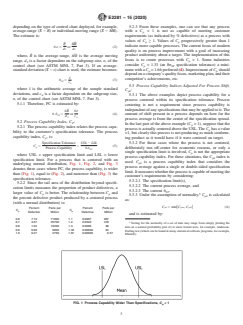
underlying normal distribution, Fig. 1, Fig. 2, and Fig. 3
process average against a single or double-sided specification
denotes three cases where PC, the process capability, is wider
limit.Itmeasureswhethertheprocessiscapableofmeetingthe
than (Fig. 1), equal to (Fig. 2), and narrower than (Fig. 3) the
customer’s requirements by considering:
specification tolerance.
5.3.2.1 The specification limit(s),
5.2.2 Since the tail area of the distribution beyond specifi-
5.3.2.2 The current process average, and
cation limits measures the proportion of product defectives, a
5.3.2.3 The current σˆ .
ST
larger value of C is better. The relationship between C and
p p 5
5.3.3 Under the assumption of normality, C is calculated
pk
the percent defective product produced by a centered process
as:
(with a normal distribution) is:
C 5min@C , C # (6)
pk pku pkl
Percent Parts per Percent Parts per
C C
p p
Defective Million Defective Million
and is estimated by:
0.6 7.19 71900 1.1 0.0967 967
0.7 3.57 35700 1.2 0.0320 318
Testing for the normality of a set of data may range from simply plotting the
0.8 1.64 16400 1.3 0.0096 96
data on a normal probability plot (2) to more formal tests, for example,Anderson-
0.9 0.69 6900 1.33 0.00636 64
Darlingtest(whichcanbefoundinmanystatisticalsoftwareprograms,forexample,
1.0 0.27 2700 1.67 0.00006 0.57
Minitab).
FIG. 1 Process Capability Wider Than Specifications, C <1
p
E2281 − 15 (2020)
FIG. 2 Process Capability Equal to Specification Tolerance, C =1
p
FIG. 3 Process Capability Narrower Than Specifications, C >1
p
ˆ ˆ ˆ 5.3.5.1 C can be equal to but never larger than C ,
C 5min@ C , C # (7) pk p
pk pku pkl
5.3.5.2 C and C are equal only when the process is
p pk
where the estimated upper process capability index is
centered on target,
defined as:
5.3.5.3 If C is larger than C , then the process is not
p pk
¯
centered on target,
USL 2 X
ˆ
C 5 (8)
pku
5.3.5.4 Ifboth C and C are>1,theprocessiscapableand
3 σˆ
p pk
ST
performing within the specifications,
and the estimated lower process capability index is defined
5.3.5.5 If both C and C are <1, the process is not capable
p pk
as:
and not performing within the specifications, and
¯
X 2 LSL 5.3.5.6 If C is >1 and C is <1, the process is capable, but
p pk
ˆ
C 5 (9)
pkl
not centered and not performing within the specifications.
3 σˆ
ST
5.4 Caveats on the Practical Use of Process Capability
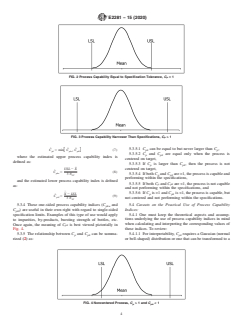
5.3.4 These one-sided process capability indices (C and
pku
Indices:
C ) are useful in their own right with regard to single-sided
pkl
5.4.1 One must keep the theoretical aspects and assump-
specification limits. Examples of this type of use would apply
to impurities, by-products, bursting strength of bottles, etc. tions underlying the use of process capability indices in mind
when calculating and interpreting the corresponding values of
Once again, the meaning of C is best viewed pictorially in
pk
Fig. 4. these indices. To review:
5.3.5 The relationship between C and C can be summa- 5.4.1.1 For interpretability, C requires a Gaussian (normal
p pk pk
rized (2) as: or bell-shaped) distribution or one that can be transformed to a
FIG. 4 Noncentered Process, C > 1 and C <1
p pk
E2281 − 15 (2020)
normal. Definition of C requires a normal distribution with a SpecificationTolerance
pk
P 5 (12)
p
spread of three standard deviations on either side of the mean ProcessPerformance
(2, 5).
andisestimatedby:
5.4.1.2 The process must be in a state of statistical control
(stable over time with constant short-term variability).
USL 2 LSL
5.4.1.3 Large sample sizes (preferably >200 or a minimum
6 σˆ
LT
of 100) are required to estimate C with a high level of
pk
6.2.2 The interpretation of P is similar to that of C . That
confidence (at least 95%). p p
is, a P ≥ 1 represents a process that has no trouble meeting
p
5.4.1.4 C and C are affected by sampling procedures,
p pk
customer requirements in the long term.Aprocess with P <1
p
sampling error, and measurement variability. These effects
cannot meet specifications all the time. In either case, there is
have a direct bearing on the magnitude of the estimate for
no assumption that the process is in the state of statistical
inherent process variability, the main component in estimating
control or centered.
these indices.
5.4.1.5 C and C are statistics and as such are subject to 6.3 Process Performance Indices Adjusted For Process
p pk
uncertainty (variability) as found in any statistic. Shift:
5.4.2 For additional information about process capability 6.3.1 For those cases where the process is not centered,
and process capability indices, see Refs (2, 5, 6). deliberately run off-center for economic reasons, or only a
single specification limit is involved, P is the appropriate
pk
processperformanceindex. P isaprocessperformanceindex
6. Process Performance Analysis
pk
adjusted for location (process average). It measures whether
6.1 Process Performance:
theprocessisactuallymeetingthecustomer’srequirementsby
6.1.1 Process performance represents the actual distribution
considering:
of product and measurement variability over a long period of
6.3.1.1 The specification limit(s),
time, such as weeks or months. In process performance, the
6.3.1.2 The current process average, and
actualperformanceleveloftheprocessisestimatedratherthan
6.3.1.3 The current value of σˆ .
LT
its capability when it is in control.
6.3.2 Under the assumption of normality, P is calculated
pk
6.1.2 As in the case of process capability, it is important to
as:
estimate correctly the process variability. For process
P 5min P , P (13)
@ #
performance, the long-term variation, σ , (2, 3) is estimated.
pk pku pkl
LT
Thus, the accumulated individual production measurements
and is estimated by:
from a process over a long time period, X , X , …, X , has an
1 2 n
ˆ ˆ ˆ
P 5min@ P , P # (14)
overall sample standard deviation estimated as:
pk pku pkl
where:
¯
Σ~X 2 X!
i
σˆ 5Œ (10)
¯
LT
USL 2 X
n 21
ˆ
P 5 (15)
pku
3 σˆ
LT
6.1.3 This standard deviation contains the following “com-
and
ponents” of variability: (6)
6.1.3.1 Lot-to-lot variability over the long term,
¯
X 2 LSL
ˆ
P 5 (16)
6.1.3.2 Within-lot variability over the short term,
pkl
3 σˆ
LT
6.1.3.3 Measurement system variability over the long term,
which are the estimates of the one-sided process perfor-
and
mance indices.
6.1.3.4 Measurement system variability over the short term.
6.3.3 Values of P have an interpretation similar to those
pk
6.1.4 If the process were in the state of statistical control,
for C .Thedifferenceisthat P representshowtheprocessis
pk pk
one would expect the estimate of σ , σˆ , to be very close to
LT LT
runningwithrespecttocustomerrequirementsoveraspecified
the estimate of σ , σˆ . One would expect that the two
ST ST
longtimeperiod.Oneinterpretationisthat P representswhat
pk
estimateswouldbealmostidenticalifaperfectstateofcontrol
theproducer makesand C representswhattheproducer could
pk
were achieved. According to Ott, Schilling, and Neubauer (2)
make if its process were in a state of statistical control. The
and Gunter (5), this perfect state of control is unrealistic since
relationship between P and P are also similar to that of C
p pk p
control charts may not de
...