

ASTM D4861-23
(Practice)Standard Practice for Sampling and Selection of Analytical Techniques for Pesticides and Polychlorinated Biphenyls in Air
General Information
- Abstract
SIGNIFICANCE AND USE
5.1 This practice is recommended for use primarily for non-occupational exposure monitoring in domiciles, public access buildings, and offices.
5.2 The methods described in this practice have been successfully applied to measurement of pesticides and PCBs in outdoor air and for personal respiratory exposure monitoring.
5.3 A broad spectrum of pesticides are commonly used in and around the house and for insect control in public and commercial buildings. Other semivolatile organic chemicals, such as PCBs, are also often present in indoor air, particularly in large office buildings. This practice promotes needed precision and bias in the determination of many of these airborne chemicals.
SCOPE
1.1 This practice covers the sampling of air for a variety of common pesticides and polychlorinated biphenyls (PCBs) and provides guidance on the selection of appropriate analytical measurement methods. Other compounds such as polychlorinated dibenzodioxins/furans, polybrominated biphenyls, polybrominated diphenyl ethers, polycyclic aromatic hydrocarbons, and polychlorinated naphthalenes may be efficiently collected from air by this practice, but guidance on their analytical determination is not covered by this practice.
1.2 The sampling and analysis of PCBs in air can be more complicated than sampling PCBs in solid media (for example, soils, building materials) or liquids (for example, transformer fluids). PCBs in solid or liquid material are typically analyzed using Aroclor2 distillation groups in chromatograms. In contrast, recent research has shown that analysis of PCBs in air samples by GC-ECD has also been found to exhibit potential uncertainties due to changes in the PCB patterns, differences in responses in distillation groups, peak co-elutions and differences in response factors within a homolog group (1, 2).3 As such it is recommended that PCBs in air not be quantified using AroclorTM distillation groups. In addition, it is recommended that analysis of PCBs in air be done using GC-MS rather than GC-ECD. Any mention, to outdated practices for “Aroclor” and GC-ECD analysis of PCBs herein are retained solely for historical perspective.
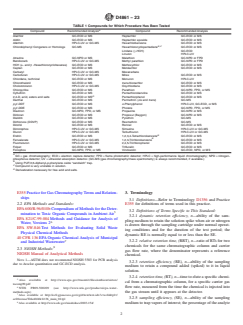
1.3 A complete listing of pesticides and other semivolatile organic chemicals for which this practice has been tested is shown in Table 1.
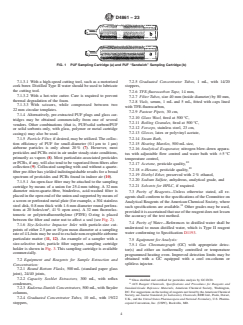
1.4 This practice is based on the collection of chemicals from air onto polyurethane foam (PUF) or a combination of PUF and granular sorbent (for example, diphenyl oxide, styrene-divinylbenzene), or a granular sorbent alone.
1.5 This practice is applicable to multicomponent atmospheres, 0.001 μg/m3 to 50 μg/m3 concentrations, and 4 h to 24 h sampling periods. The limit of detection will depend on the nature of the analyte and the length of the sampling period.
1.6 The analytical method(s) recommended will depend on the specific chemical(s) sought, the concentration level, and the degree of specificity required.
1.7 The values stated in SI units are to be regarded as standard. No other units of measurement are included in this standard.
1.8 This standard does not purport to address all of the safety concerns, if any, associated with its use. It is the responsibility of the user of this standard to establish appropriate safety, health, and environmental practices and determine the applicability of regulatory limitations prior to use. For specific hazards statements, see 10.24 and A1.1.
1.9 This international standard was developed in accordance with internationally recognized principles on standardization established in the Decision on Principles for the Development of International Standards, Guides and Recommendations issued by the World Trade Organization Technical Barriers to Trade (TBT) Committee.
- Status
- Published
- Publication Date
- 31-Aug-2023
- Technical Committee
- D22 - Air Quality
- Drafting Committee
- D22.05 - Indoor Air
Overview
ASTM D4861-23 is the internationally recognized standard practice developed by ASTM for the sampling and selection of analytical techniques for pesticides and polychlorinated biphenyls (PCBs) in air. This document provides comprehensive guidance for collecting air samples and determining which analytical methods should be used when testing for the presence of pesticides and PCBs in both indoor and outdoor environments.
The standard is primarily intended to support non-occupational exposure monitoring in homes, offices, and public access buildings but is also applicable for outdoor air quality assessments and personal exposure monitoring. By providing standardized approaches for air sampling and analytical method selection, ASTM D4861-23 helps ensure the reliability, accuracy, and comparability of test results, which is critical for public health and regulatory compliance.
Key Topics
- Air Sampling Procedures: The standard details procedures for collecting common pesticides and PCBs in air using polyurethane foam (PUF), granular sorbents, or a combination of both.
- Analytical Method Selection: Offers guidance on choosing the right analytical technique depending on the compound(s) present, expected concentration levels, and required specificity.
- Recommends gas chromatography-mass spectrometry (GC-MS) for PCBs in air, as opposed to older Aroclor and GC-ECD methods.
- Provides a comprehensive list of pesticides and the suggested analysis methods such as GC-ECD, GC-MS, HPLC-UV, NPD, and others.
- Compound Spectrum: While focused on pesticides and PCBs, the practice notes the applicability for collecting other semi-volatile organic chemicals (SVOCs) in air, including polychlorinated dibenzodioxins/furans, polybrominated biphenyls, and more.
- Limits of Detection and Sampling Duration: Applicable to multicomponent atmospheres with concentrations between 0.001 μg/m³ to 50 μg/m³ and sampling periods ranging from 4 to 24 hours.
- Precision and Bias: Emphasizes the need for precision and bias minimization in determinations to ensure reliable monitoring of airborne contaminants.
Applications
- Indoor Air Quality Monitoring: Essential for evaluating the non-occupational exposure risks in homes, offices, and public buildings, where pesticides and PCBs may be present due to indoor sources or infiltration from outside.
- Regulatory Compliance: Supports public health protection and regulatory requirements by providing a validated approach for air pollution monitoring.
- Personal Exposure Assessment: Can be used for personal air sampling, helping to evaluate individual exposure to pesticides and PCBs in various environments.
- Environmental Studies: Valuable for environmental scientists and consultants conducting air quality assessments, pesticide drift studies, and remediation verification.
- Facility Risk Management: Assists facility managers in identifying and controlling indoor air pollutants potentially arising from building materials or pest control activities.
Related Standards
For comprehensive assessments, ASTM D4861-23 references several related standards and regulatory methods, including:
- ASTM D1193: Specification for Reagent Water
- ASTM D1356: Terminology Relating to Sampling and Analysis of Atmospheres
- ASTM D3686/D3687: Practices for sampling and analyzing organic compound vapors
- U.S. EPA Methods: Such as EPA 600/R-96/010b, EPA SW-846, and methods specified in 40 CFR 136 for organic chemical analysis
- NIOSH Manual of Analytical Methods
Other practices covering analytical approaches, such as gas chromatography or high-performance liquid chromatography (HPLC), are also referenced to ensure consistency with internationally accepted methodologies.
Practical Value
Adoption of ASTM D4861-23 enables organizations and laboratories to:
- Obtain accurate and comparable air monitoring results for pesticides and PCBs
- Select optimal sampling media and analytical techniques tailored to the target compounds
- Ensure results meet regulatory and public health requirements
- Minimize uncertainties and improve decision-making for environmental health and safety
With its broad applicability and rigorous methodology, ASTM D4861-23 is a critical reference for professionals involved in air quality assurance, environmental monitoring, and public health protection.
Relations
- Effective Date
- 01-Sep-2023
- Effective Date
- 01-Sep-2020
- Effective Date
- 15-Mar-2020
- Effective Date
- 01-Mar-2020
- Effective Date
- 01-Mar-2017
- Effective Date
- 15-Oct-2015
- Effective Date
- 01-Jul-2015
- Effective Date
- 01-Dec-2014
- Effective Date
- 01-May-2014
- Effective Date
- 15-Jan-2014
- Effective Date
- 01-Apr-2013
- Effective Date
- 01-Apr-2012
- Effective Date
- 01-Oct-2011
- Effective Date
- 01-Apr-2010
- Effective Date
- 15-Dec-2008
Frequently Asked Questions
ASTM D4861-23 is a standard published by ASTM International. Its full title is "Standard Practice for Sampling and Selection of Analytical Techniques for Pesticides and Polychlorinated Biphenyls in Air". This standard covers: SIGNIFICANCE AND USE 5.1 This practice is recommended for use primarily for non-occupational exposure monitoring in domiciles, public access buildings, and offices. 5.2 The methods described in this practice have been successfully applied to measurement of pesticides and PCBs in outdoor air and for personal respiratory exposure monitoring. 5.3 A broad spectrum of pesticides are commonly used in and around the house and for insect control in public and commercial buildings. Other semivolatile organic chemicals, such as PCBs, are also often present in indoor air, particularly in large office buildings. This practice promotes needed precision and bias in the determination of many of these airborne chemicals. SCOPE 1.1 This practice covers the sampling of air for a variety of common pesticides and polychlorinated biphenyls (PCBs) and provides guidance on the selection of appropriate analytical measurement methods. Other compounds such as polychlorinated dibenzodioxins/furans, polybrominated biphenyls, polybrominated diphenyl ethers, polycyclic aromatic hydrocarbons, and polychlorinated naphthalenes may be efficiently collected from air by this practice, but guidance on their analytical determination is not covered by this practice. 1.2 The sampling and analysis of PCBs in air can be more complicated than sampling PCBs in solid media (for example, soils, building materials) or liquids (for example, transformer fluids). PCBs in solid or liquid material are typically analyzed using Aroclor2 distillation groups in chromatograms. In contrast, recent research has shown that analysis of PCBs in air samples by GC-ECD has also been found to exhibit potential uncertainties due to changes in the PCB patterns, differences in responses in distillation groups, peak co-elutions and differences in response factors within a homolog group (1, 2).3 As such it is recommended that PCBs in air not be quantified using AroclorTM distillation groups. In addition, it is recommended that analysis of PCBs in air be done using GC-MS rather than GC-ECD. Any mention, to outdated practices for “Aroclor” and GC-ECD analysis of PCBs herein are retained solely for historical perspective. 1.3 A complete listing of pesticides and other semivolatile organic chemicals for which this practice has been tested is shown in Table 1. 1.4 This practice is based on the collection of chemicals from air onto polyurethane foam (PUF) or a combination of PUF and granular sorbent (for example, diphenyl oxide, styrene-divinylbenzene), or a granular sorbent alone. 1.5 This practice is applicable to multicomponent atmospheres, 0.001 μg/m3 to 50 μg/m3 concentrations, and 4 h to 24 h sampling periods. The limit of detection will depend on the nature of the analyte and the length of the sampling period. 1.6 The analytical method(s) recommended will depend on the specific chemical(s) sought, the concentration level, and the degree of specificity required. 1.7 The values stated in SI units are to be regarded as standard. No other units of measurement are included in this standard. 1.8 This standard does not purport to address all of the safety concerns, if any, associated with its use. It is the responsibility of the user of this standard to establish appropriate safety, health, and environmental practices and determine the applicability of regulatory limitations prior to use. For specific hazards statements, see 10.24 and A1.1. 1.9 This international standard was developed in accordance with internationally recognized principles on standardization established in the Decision on Principles for the Development of International Standards, Guides and Recommendations issued by the World Trade Organization Technical Barriers to Trade (TBT) Committee.
SIGNIFICANCE AND USE 5.1 This practice is recommended for use primarily for non-occupational exposure monitoring in domiciles, public access buildings, and offices. 5.2 The methods described in this practice have been successfully applied to measurement of pesticides and PCBs in outdoor air and for personal respiratory exposure monitoring. 5.3 A broad spectrum of pesticides are commonly used in and around the house and for insect control in public and commercial buildings. Other semivolatile organic chemicals, such as PCBs, are also often present in indoor air, particularly in large office buildings. This practice promotes needed precision and bias in the determination of many of these airborne chemicals. SCOPE 1.1 This practice covers the sampling of air for a variety of common pesticides and polychlorinated biphenyls (PCBs) and provides guidance on the selection of appropriate analytical measurement methods. Other compounds such as polychlorinated dibenzodioxins/furans, polybrominated biphenyls, polybrominated diphenyl ethers, polycyclic aromatic hydrocarbons, and polychlorinated naphthalenes may be efficiently collected from air by this practice, but guidance on their analytical determination is not covered by this practice. 1.2 The sampling and analysis of PCBs in air can be more complicated than sampling PCBs in solid media (for example, soils, building materials) or liquids (for example, transformer fluids). PCBs in solid or liquid material are typically analyzed using Aroclor2 distillation groups in chromatograms. In contrast, recent research has shown that analysis of PCBs in air samples by GC-ECD has also been found to exhibit potential uncertainties due to changes in the PCB patterns, differences in responses in distillation groups, peak co-elutions and differences in response factors within a homolog group (1, 2).3 As such it is recommended that PCBs in air not be quantified using AroclorTM distillation groups. In addition, it is recommended that analysis of PCBs in air be done using GC-MS rather than GC-ECD. Any mention, to outdated practices for “Aroclor” and GC-ECD analysis of PCBs herein are retained solely for historical perspective. 1.3 A complete listing of pesticides and other semivolatile organic chemicals for which this practice has been tested is shown in Table 1. 1.4 This practice is based on the collection of chemicals from air onto polyurethane foam (PUF) or a combination of PUF and granular sorbent (for example, diphenyl oxide, styrene-divinylbenzene), or a granular sorbent alone. 1.5 This practice is applicable to multicomponent atmospheres, 0.001 μg/m3 to 50 μg/m3 concentrations, and 4 h to 24 h sampling periods. The limit of detection will depend on the nature of the analyte and the length of the sampling period. 1.6 The analytical method(s) recommended will depend on the specific chemical(s) sought, the concentration level, and the degree of specificity required. 1.7 The values stated in SI units are to be regarded as standard. No other units of measurement are included in this standard. 1.8 This standard does not purport to address all of the safety concerns, if any, associated with its use. It is the responsibility of the user of this standard to establish appropriate safety, health, and environmental practices and determine the applicability of regulatory limitations prior to use. For specific hazards statements, see 10.24 and A1.1. 1.9 This international standard was developed in accordance with internationally recognized principles on standardization established in the Decision on Principles for the Development of International Standards, Guides and Recommendations issued by the World Trade Organization Technical Barriers to Trade (TBT) Committee.
ASTM D4861-23 has the following relationships with other standards: It is inter standard links to ASTM D4185-23, ASTM D1356-20a, ASTM D1356-20, ASTM D3686-20, ASTM D4185-17, ASTM D1356-15a, ASTM D1356-15, ASTM D1356-14b, ASTM D1356-14a, ASTM D1356-14, ASTM D3686-13, ASTM D3687-07(2012), ASTM D4185-06(2011), ASTM D1356-05(2010), ASTM D3686-08. Understanding these relationships helps ensure you are using the most current and applicable version of the standard.
ASTM D4861-23 is available in PDF format for immediate download after purchase. The document can be added to your cart and obtained through the secure checkout process. Digital delivery ensures instant access to the complete standard document.
Standards Content (Sample)
This international standard was developed in accordance with internationally recognized principles on standardization established in the Decision on Principles for the
Development of International Standards, Guides and Recommendations issued by the World Trade Organization Technical Barriers to Trade (TBT) Committee.
Designation: D4861 − 23
Standard Practice for
Sampling and Selection of Analytical Techniques for
Pesticides and Polychlorinated Biphenyls in Air
This standard is issued under the fixed designation D4861; the number immediately following the designation indicates the year of
original adoption or, in the case of revision, the year of last revision. A number in parentheses indicates the year of last reapproval. A
superscript epsilon (´) indicates an editorial change since the last revision or reapproval.
1. Scope 1.5 This practice is applicable to multicomponent
3 3
atmospheres, 0.001 μg ⁄m to 50 μg ⁄m concentrations, and 4 h
1.1 This practice covers the sampling of air for a variety of
to 24 h sampling periods. The limit of detection will depend on
common pesticides and polychlorinated biphenyls (PCBs) and
the nature of the analyte and the length of the sampling period.
provides guidance on the selection of appropriate analytical
measurement methods. Other compounds such as polychlori- 1.6 The analytical method(s) recommended will depend on
nated dibenzodioxins/furans, polybrominated biphenyls, poly- the specific chemical(s) sought, the concentration level, and the
brominated diphenyl ethers, polycyclic aromatic hydrocarbons, degree of specificity required.
and polychlorinated naphthalenes may be efficiently collected
1.7 The values stated in SI units are to be regarded as
from air by this practice, but guidance on their analytical
standard. No other units of measurement are included in this
determination is not covered by this practice.
standard.
1.2 The sampling and analysis of PCBs in air can be more
1.8 This standard does not purport to address all of the
complicated than sampling PCBs in solid media (for example,
safety concerns, if any, associated with its use. It is the
soils, building materials) or liquids (for example, transformer
responsibility of the user of this standard to establish appro-
fluids). PCBs in solid or liquid material are typically analyzed
priate safety, health, and environmental practices and deter-
using Aroclor distillation groups in chromatograms. In
mine the applicability of regulatory limitations prior to use.
contrast, recent research has shown that analysis of PCBs in air
For specific hazards statements, see 10.24 and A1.1.
samples by GC-ECD has also been found to exhibit potential
1.9 This international standard was developed in accor-
uncertainties due to changes in the PCB patterns, differences in
dance with internationally recognized principles on standard-
responses in distillation groups, peak co-elutions and differ-
ization established in the Decision on Principles for the
ences in response factors within a homolog group (1, 2). As
Development of International Standards, Guides and Recom-
such it is recommended that PCBs in air not be quantified using
mendations issued by the World Trade Organization Technical
AroclorTM distillation groups. In addition, it is recommended
Barriers to Trade (TBT) Committee.
that analysis of PCBs in air be done using GC-MS rather than
GC-ECD. Any mention, to outdated practices for “Aroclor” 2. Referenced Documents
and GC-ECD analysis of PCBs herein are retained solely for 4
2.1 ASTM Standards:
historical perspective.
D1193 Specification for Reagent Water
1.3 A complete listing of pesticides and other semivolatile D1356 Terminology Relating to Sampling and Analysis of
organic chemicals for which this practice has been tested is Atmospheres
shown in Table 1. D3686 Practice for Sampling Atmospheres to Collect Or-
ganic Compound Vapors (Activated Charcoal Tube Ad-
1.4 This practice is based on the collection of chemicals
sorption Method)
from air onto polyurethane foam (PUF) or a combination of
D3687 Test Method for Analysis of Organic Compound
PUF and granular sorbent (for example, diphenyl oxide,
Vapors Collected by the Activated Charcoal Tube Adsorp-
styrene-divinylbenzene), or a granular sorbent alone.
tion Method
D4185 Test Method for Measurement of Metals in Work-
This practice is under the jurisdiction of ASTM Committee D22 on Air Quality
place Atmospheres by Flame Atomic Absorption Spectro-
and is the direct responsibility of Subcommittee D22.05 on Indoor Air.
photometry
Current edition approved Sept. 1, 2023. Published September 2023. Originally
approved in 1991. Last previous edition approved in 2017 as D4861 – 17 which was
withdrawn September 2021 and reinstated in September 2023. DOI: 10.1520/
D4861-23. For referenced ASTM standards, visit the ASTM website, www.astm.org, or
A trade name formerly used by Monsanto Corporation, Creve Coeur, MO. contact ASTM Customer Service at service@astm.org. For Annual Book of ASTM
The boldface numbers in parentheses refer to the list of references at the end of Standards volume information, refer to the standard’s Document Summary page on
this standard. the ASTM website.
Copyright © ASTM International, 100 Barr Harbor Drive, PO Box C700, West Conshohocken, PA 19428-2959. United States
D4861 − 23
TABLE 1 Compounds for Which Procedure Has Been Tested
A
Compound Recommended Analysis Compound Recommended Analysis
Alachlor GC-ECD or MS Heptachlor GC-ECD or MS
Aldrin GC-ECD or MS Heptachlor epoxide GC-ECD or MS
Allethrin HPLC-UV or GC-MS Hexachlorbenzene GC-ECD or MS
B,C
Chlorobiphenyl Congeners or Homologs GC-MS Hexachlorocyclopentadiene GC-ECD or MS
Lindane (γ-HCH) GC-ECD
Linuron HPLC-UV
Atrazine GC-NPD or MS Malathion GC-NPD or FPD
Bendiocarb HPLC-UV or GC-MS Methyl parathion GC-NPD or FPD
HCH (α- and β -Hexachlorocyclohexanes) GC-ECD or MS Methoxychlor GC-ECD or MS
Captan GC-ECD or MS Metolachlor GC-ECD or MS
Carbaryl HPLC-UV or GC-MS Mexacarbate
Carbofuran HPLC-UV or GC-MS Mirex GC-ECD or MS
Chlordane, technical GC-ECD or MS Monuron HPLC-UV
Chlorothalonil GC-ECD or MS trans-Nonachlor GC-ECD or MS
Cholorotoluron HPLC-UV or GC-MS Oxychlordane GC-ECD or MS
Chlorpyrifos GC-ECD or MS Parathion GC-NPD, FPD, or MS
Cyfluthrin GC-ECD or MS Pentachlorobenzine GC-ECD or MS
D
2,4-D, acid, esters and salts GC-ECD or MS Pentachlorphenol GC-ECD or MS
Dacthal GC-ECD or MS Permethrin (cis and trans) GC-MS
p,p’-DDT GC-ECD or MS o-Phenylphenol HPLC-UV, GC-ECD, or MS
p,p’-DDE GC-ECD or MS Phorate GC-NPD, FPD, or MS
Diazinon GC-NPD, FPD, or MS Propazine GC-NPD or MS
Dicloran GC-ECD or MS Propoxur (Baygon) GC-NPD or MS
Dieldrin GC-ECD or MS Pyrethrin GC-MS
Dichlorvos (DDVP) GC-ECD or MS Resmethrin GC-MS
Dicofol GC-ECD or MS Ronnel GC-ECD or MS
Dicrotophos HPLC-UV or GC-MS Simazine HPLC-UV or GC-MS
Diuron HPLC-UV or GC-MS Terbuthiuron HPLC-UV or GC-MS
B
Endrin GC-ECD or MS 1,2,3,4-Tetrachlorobenzene GC-ECD or MS
B
Fenvalerate HPLC-UV or GC-MS 1,2,3-Trichlorobenzene GC-ECD or MS
Fluometuron HPLC-UV or GC-MS 2,4,5-Trichlorophenol GC-ECD or MS
Folpet GC-ECD or MS Trifluralin GC-ECD or MS
Fonophos GC-NPD, FPD, or MS Vinclozolin GC-ECD, NPD, or MS
A
GC = gas chromatography; ECD = electron capture detector; FPD = flame photometric detector; HPLC = high-performance liquid chromatography; NPD = nitrogen-
phosphorus detector; UV = ultraviolet absorption detector. (GC-MS (gas chromatography/mass spectrometry) is always recommended, if available.)
B
Using PUF/2,6-diphenyl-p-phenylene oxide “sandwich” trap.
C
Compound is very unstable in solution.
D
Derivatization necessary for free acid and salts.
E355 Practice for Gas Chromatography Terms and Relation- 3. Terminology
ships
3.1 Definitions—Refer to Terminology D1356 and Practice
2.2 EPA Methods and Standards:
E355 for definitions of terms used in this practice.
EPA 600/R-96/010b Compendium of Methods for the Deter-
3.2 Definitions of Terms Specific to This Standard:
mination to Toxic Organic Compounds in Ambient Air
3.2.1 dynamic retention effıciency, n—ability of the sam-
EPA 821/C-99-004 Methods and Guidance for Analysis of
pling medium to retain the solution spike when air or nitrogen
Water, Versions 2
is drawn through the sampling cartridge under normal operat-
EPA SW-846 Test Methods for Evaluating Solid Waste
ing conditions and for the duration of the test period; the
Physical Chemical Methods
dynamic RE is normally equal to or less than the SE.
40 CFR 136 EPA Organic Chemical Analysis of Municipal
3.2.2 relative retention time, (RRT), n—ratio of RTs for two
and Industrial Wastewater
chemicals for the same chromatographic column and carrier
2.3 NIOSH Methods:
gas flow rate, where the denominator represents a reference
NIOSH Manual of Analytical Methods
chemical.
NOTE 1—ASTM does not recommend NIOSH 5503 for PCB analysis
3.2.3 retention effıciency, (RE), n—ability of the sampling
due to Aroclor quantitation and GC-ECD analysis.
medium to retain a compound added (spiked) to it in liquid
solution.
3.2.4 retention time, (RT), n—time to elute a specific chemi-
Also available at http://www.epa.gov/ttnamti1/files/ambient/airtox/
cal from a chromatographic column, for a specific carrier gas
tocomp99.pdf
flow rate, measured from the time the chemical is injected into
NTIS PB99-500209 (see http://www.ntis.gov/products/epa-water-
methods.aspx)
the gas stream until it appears at the detector.
Also available at http://ecfr.gpoaccess.gov/cgi/t/text/text-idx?c=ecfr&tpl=/
3.2.5 sampling effıciency, (SE), n—ability of the sampling
ecfrbrowse/Title40/40cfr136_main_02.tpl
Also available at http://www.cdc.gov/niosh/docs/2003-154/ medium to trap vapors of interest; the percentage of the analyte
D4861 − 23
of interest collected and retained by the sampling medium 6.1.1 Selectivity may be further enhanced by use of a MS in
when it is introduced as a vapor in air or nitrogen into the air a selected ion monitoring (SIM) mode as the GC detector. In
sampler and the sampler is operated under normal conditions this mode, coeluting compounds can often be determined.
for a period of time equal to or greater than that required for the
6.2 The ECD responds to a wide variety of organic com-
intended use is indicated by % SE.
pounds. It is likely that such compounds will be encountered as
3.2.6 static retention effıciency, n—ability of the sampling
interferences during GC-ECD analysis. The NPD, FPD, and
medium to retain the solution spike when the sampling
HECD detectors are element specific, but are still subject to
cartridge is stored under clean, quiescent conditions for the
interferences. UV detectors for HPLC are nearly universal and
duration of the test period.
the electrochemical detector may also respond to a variety of
chemicals. Mass spectrometric analyses will generally provide
4. Summary of Practice
for positive identification of specific compounds.
4.1 A low-volume (1 L ⁄min to 5 L ⁄min) sampler is used to
6.3 PCBs and certain organochlorine pesticides (for
collect vapors on a sorbent cartridge containing PUF or PUF in
example, chlordane) are complex mixtures of individual
combination with another solid sorbent, or another solid
compounds, which can cause difficulty in accurately quantify-
sorbent alone. Airborne particles may also be collected, but the
ing a particular formulation in a multiple component mixture.
sampling efficiency is not known. The method is adopted from
PCBs may also interfere with the determination of pesticides.
Ref (3) and is the basis of EPA 600/R-96/010b, Method
The analysis of PCBs in air samples by GC-ECD is not
TO-10A.
recommended.
4.2 Pesticides and other chemicals are extracted from the
6.4 Contamination of glassware and sampling apparatus
sorbent cartridge with 5 % diethyl ether in hexane and may be
with traces of pesticides or PCBs can be a major source of
determined by gas-liquid chromatography (GC) coupled with
error, particularly at lower analyte concentrations. Careful
an electron capture detector (ECD), nitrogen-phosphorus de-
attention to cleaning and handling procedures is required in all
tector (NPD), flame photometric detector (FPD), Hall electro-
steps of the sampling and analysis to minimize this source of
lytic conductivity detector (HECD), or a mass spectrometer
error.
(MS). For some pesticides, high-performance liquid chroma-
6.5 General approaches that can be followed to minimize
tography (HPLC) coupled with an ultraviolet (UV) detector or
interferences are as follows:
electrochemical detector may be preferable. For PCBs, MS
6.5.1 Polar compounds, including certain pesticides (for
detection is the recommended detector with congener or
example, organophosphorus and carbamate classes) can be
homolog based quantitation.
removed by column chromatography on alumina. This sample
4.3 Interferences resulting from analytes having similar RTs
cleanup will permit the analysis of most organochlorine pesti-
during GC are resolved by improving the resolution or
cides and PCBs (4).
separation, such as by changing the chromatographic column
6.5.2 PCBs may be separated from organochlorine pesti-
or operating parameters, or by fractionating the sample by
cides by column chromatography on silicic acid. See Refs (5)
column chromatography, or by mass spectrometric analysis.
and (6).
6.5.3 Many pesticides can be fractionated into groups by
5. Significance and Use
column chromatography on Florisil (6).
5.1 This practice is recommended for use primarily for
non-occupational exposure monitoring in domiciles, public
7. Apparatus
access buildings, and offices.
7.1 Air Sampler:
5.2 The methods described in this practice have been
7.1.1 Sampling Pump, with a flow rate of 1 L ⁄min to
successfully applied to measurement of pesticides and PCBs in
5 L ⁄min. The pump should provide a constant air flow
outdoor air and for personal respiratory exposure monitoring.
(≤65 %) and be quiet and unobtrusive.
7.1.2 Sampling Cartridge, constructed from a 20 mm (in-
5.3 A broad spectrum of pesticides are commonly used in
side diameter) by 10 cm borosilicate glass tube drawn down to
and around the house and for insect control in public and
a 7 mm (outside diameter) open connection for attachment to
commercial buildings. Other semivolatile organic chemicals,
the pump by way of flexible tubing (see Fig. 1).
such as PCBs, are also often present in indoor air, particularly
7.1.3 Sorbent, PUF, cut into a cylinder 22 mm in diameter
in large office buildings. This practice promotes needed preci-
and 7.6 cm long, and fitted under slight compression inside the
sion and bias in the determination of many of these airborne
cartridge. The PUF should be of the polyether type, density
chemicals.
0.022 g/cm . This is the type of foam used for furniture
6. Interferences upholstery, pillows, and mattresses. The PUF cylinders (plugs)
should be cut slightly larger in diameter than the internal
6.1 Any gas or liquid chromatographic separation of com-
diameter of the cartridge. They may be cut by one of the
plex mixtures of organic chemicals is subject to serious
following means:
interference problems due to coelutions of two or more
compounds. The use of capillary or microbore columns with
superior resolution or two columns of different polarity will
Florisil is a trademark of the U.S Silica Co., Berkeley Springs, WV. It is a
frequently eliminate these problems. natural magnesium silicate and is available from several commercial suppliers.
D4861 − 23
FIG. 1 PUF Sampling Cartridge (a) and PUF “Sandwich” Sampling Cartridge (b)
7.1.3.1 With a high-speed cutting tool, such as a motorized 7.2.5 Graduated Concentrator Tubes, 1 mL, with 14/20
cork borer. Distilled Type II water should be used to lubricate stoppers,
the cutting tool.
7.2.6 TFE-fluorocarbon Tape, 14 mm,
7.1.3.2 With a hot-wire cutter. Care is required to prevent
7.2.7 Filter Tubes, size 40 mm (inside diameter) by 80 mm,
thermal degradation of the foam.
7.2.8 Vials, serum, 1 mL and 5 mL, fitted with caps lined
7.1.3.3 With scissors, while compressed between two
with TFE-fluorocarbon,
22 mm circular templates.
7.2.9 Pasteur Pipets, 30 cm,
7.1.4 Alternatively, pre-extracted PUF plugs and glass car-
7.2.10 Glass Wool, fired at 500 °C,
tridges may be obtained commercially from one of several
7.2.11 Boiling Granules, fired at 500 °C,
vendors. Other combinations (that is, PUF/solid sorbent/PUF
7.2.12 Forceps, stainless steel, 23 cm,
or solid sorbents only, with glass, polymer or metal cartridge
7.2.13 Gloves, latex or polyvinyl acetate,
casings) may also be used.
7.1.5 Particle Filter, if desired, may be utilized. The collec- 7.2.14 Steam Bath,
tion efficiency of PUF for small-diameter (0.1 μm to 1 μm)
7.2.15 Heating Mantles, 500 mL size,
airborne particles is only about 20 % (7). However, most
7.2.16 Analytical Evaporator, nitrogen blow-down appara-
pesticides and PCBs exist in air under steady-state conditions,
tus with adjustable flow control and water bath with 65 °C
primarily as vapors (8). Most particulate-associated pesticides
temperature control,
or PCBs, if any, will also tend to be vaporized from filters after 10
7.2.17 Acetone, pesticide quality,
collection (9). Collocated sampling with and without a quartz-
7.2.18 n-Hexane, pesticide quality,
fiber pre-filter has yielded indistinguishable results for a broad
7.2.19 Diethyl Ether, preserved with 2 % ethanol,
spectrum of pesticides and PCBs found in indoor air (10).
7.2.20 Sodium Sulfate, anhydrous, analytical grade, and
7.1.5.1 An open-face filter may be attached to the sampling
7.2.21 Solvents for HPLC, if required.
cartridge by means of a union for 25.4 mm tubing. A 32 mm
diameter micro-quartz-fibre, binderless, acid-washed filter is
7.3 Purity of Reagents—Unless otherwise stated, all re-
placed in the open end of the union and supported by means of
agents shall conform to the specifications of the Committee on
a screen or perforated metal plate (for example, a 304 stainless
Analytical Reagents of the American Chemical Society, where
steel disk, 0.8 mm thick with 1.6 mm diameter round perfora-
such specifications are available. Other grades may be used,
tions at 20 holes/cm , 41 % open area). A 32 mm fluoroelas-
provided it is ascertained that use of the reagent does not lessen
tomeric or polytetrafluoroethylene (PTFE) O-ring is placed
the accuracy of the test method.
between the filter and outer nut to affect a seal (see Fig. 2).
7.4 Purity of Water—References to distilled water shall be
7.1.6 Size-Selective Impactor Inlet with particle-size cut-
understood to mean distilled water, which is Type II reagent
points of either 2.5 μm or 10 μm mean diameter at a sampling
water conforming to Specification D1193.
rate of 4 L/min may be used to exclude non-respirable airborne
particulate matter (11, 12). An example of a sampler with a
7.5 Equipment for Analysis:
size-selective inlet, particle filter support, sampling cartridge
7.5.1 Gas Chromatograph (GC) with appropriate detec-
holder is shown in Fig. 3. This sampling cartridge is available
tor(s) and either an isothermally controlled or temperature
commercially.
programmed heating oven. Improved detection limits may be
obtained with a GC equipped with a cool on-column or
7.2 Equipment and Reagents for Sample Extraction and
splitless injector.
Concentration:
7.2.1 Round Bottom Flasks, 500 mL (standard paper glass
joint), 24/40 joints,
7.2.2 Capacity Soxhlet Extractors, 300 mL, with reflux 10
Glass distilled and certified for pesticides analysis by GC-ECD.
condensers,
ACS Reagent Chemicals, Specifications and Procedures for Reagents and
Standard-Grade Reference Materials, American Chemical Society, Washington,
7.2.3 Kuderna-Danish Concentrators, 500 mL, with Snyder
DC. For suggestions on the testing of reagents not listed by the American Chemical
columns,
Society, see Analar Standards for Laboratory Chemicals, BDH Ltd., Poole, Dorset,
7.2.4 Graduated Concentrator Tubes, 10 mL, with 19/22
U.K., and the United States Pharmacopeia and National Formulary, U.S. Pharma-
stoppers, copeial Convention, Inc. (USPC), Rockville, MD.
D4861 − 23
FIG. 2 Open-Face Filter Assembly: (a) Sampling Cartridge, (b) Inner Nut, (c) Back Ferrule, (d) Front Ferrule, (e) Union, (f) Front
Ferrule, (g) Filter Support, (h) Filter, (i) Fluoroelastomeric or PTFE O-ring, (j) Outer Nut
FIG. 3 Air Sampling Assembly with Size-selective Inlet, Particle Filter, and Glass Sorbent Cartridge
7.5.2 Gas Chromatographic Columns, such as a 0.25 mm or 8.2.1 Place the PUF plug into a labeled glass sampling
0.32 mm (inside diameter) by 30 m poly(5 %-diphenyl-95 %- cartridge using gloves (see 7.2.13) and forceps. Wrap the
12 13
dimethylsiloxane), (50 %-phenyl)-methylpolysilozane cartridge with hexane-rinsed aluminum foil and place in glass
fused-silica, and others are commercially available. jars fitted with TFE-fluorocarbon-lined caps. The foil wrapping
7.5.3 HPLC Column, such as a 4.6 mm by 15 cm reversed- may also be marked for identification using a blunt probe.
phase octadecyldimethylsilane (C-18) or porous silica gel.
8.3 Granular sorbents may be combined with PUF to extend
Other columns may also provide acceptable results.
the range of use to compounds with saturation vapor pressures
7.5.4 Microsyringes, 5 μL volume or other appropriate –4
greater than 10 kPa (3). A useful combination trap can be
sizes.
assembled by “sandwiching” a layer of granular polymeric
sorbent, such as 2,6-diphenyl-p-phenylene oxide or styrene-
8. Sampling Procedure
divinylbenzene polymer beads, between two 22 mm (diameter)
8.1 For initial cleanup place the PUF plug in a Soxhlet
by 3.8 cm pre-cleaned PUF plugs, as shown in Fig. 1, Cartridge
extractor and extract with acetone for 14 h to 24 h at 4 cycles ⁄h
b. The granular sorbent should be pre-extracted in accordance
to 6 cycles ⁄h. (If commercially pre-extracted PUF plugs are
with 8.1. This trap may be extracted, vacuum dried, and
used, extraction with acetone is not required.) Follow with a
removed without unloading it.
16 h Soxhlet extraction with 5 % diethyl ether in n-hexane.
8.4 Analyze at least one assembled cartridge from each
When cartridges are reused, 5 % ether in n-hexane can be used
batch as a laboratory blank before the batch is considered
as the cleanup solvent.
acceptable for use. A blank level of <10 ng/plug for single
8.2 Place the extracted PUF plugs in a vacuum oven
compounds is considered to be acceptable. For multiple com-
connected to a water aspirator and dry at room temperature for
ponent mixtures (for example, PCBs) the blank level should be
2 h to 4 h (until no solvent odor is detected). Alternatively, they
<100 ng/plug.
may be dried at room temperature in an air-tight container with
8.5 After the sampling system has been assembled and
circulating nitrogen (zero grade).
calibrated in accordance with Section 9, it can be used to
collect air samples as follows:
This column is available from several commercial sources under such trade
8.5.1 Sampling cartridges should be used within 30 days of
names as DB-5, SPB-5, Rtx-5, HP-5, OV-5, BP-5, and others.
loading.
This column is available from several commercial sources under such trade
8.5.2 Sampling cartridges should be handled only with
names as DB-17, DB-608, SPB-17, SPB-608, HP-17, HP-608, OV-17, Rtx-50, and
others. clean latex or polyvinyl acetate plastic gloves.
D4861 − 23
8.5.3 Carefully remove aluminum foil wrappings from car- biphenyl can be used together to ensure recovery of early and
tridges and return foil to jars for later use. late eluting compounds. For organophosphate pesticides,
8.5.4 Attach cartridge to pump with flexible tubing and tributylphosphate or triphenylphosphate may be employed.
orient intake downward or in a horizontal position. The surrogate solution should be prepared so that addition of
8.5.5 Locate sampler in an unobstructed area at least 30 cm 100 μL into the PUF plug results in an extract containing the
from any obstacle to air flow. surrogate compound at the high end of the instrument’s
8.5.6 Position cartridge intake 1 m to 2 m above the floor or calibration range.
ground. 14
10.4 Prepare 5 % diethyl ether in n-hexane by case lot of
8.5.7 For outdoor applications, the pump and sampling
hexane. Remove 1900 mL of hexane from the freshly opened
cartridges should be sheltered from adverse weather condi-
4 L bottle and add 100 mL of freshly opened ethyl ether
tions.
(preserved with ethanol) to the flask.
8.5.8 For personal exposure monitoring, the cartridge
10.5 Rinse condenser towers with 5 % diethyl ether/hexane.
should be attached (inlet downward) to the clothing near the
breathing zone by means of a suitable fastener and the pump 10.6 Wipe off bench in hood with 5 % diethyl ether/hexane.
may be attached to a waist belt.
10.7 Add 300 mL of 5 % diethyl ether/hexane to 500 mL
8.5.8.1 Alternatively, the entire sampling system may be
round bottom boiling flask and add up to three boiling
carried about by placing the pump in a camera bag or other
granules.
suitable carrier with the inlet of the cartridge exposed.
10.8 Rinse a large sheet of aluminum foil with 5 % diethyl
8.5.8.2 An activity log should be maintained to show the
ether/hexane. Be sure to use waste rinse container. Place foil,
monitored individual’s location throughout the sampling pe-
rinsed side up, on bench for holding forceps and glassware.
riod.
Rinse forceps with 5 % diethyl ether/hexane.
8.5.9 Record air temperature(s) and barometric pressure(s)
periodically during the sampling period for correction of
10.9 With gloved hands (see 7.2.13) remove sampling
sampling data.
cartridge from jar and unwrap aluminum foil. Handle cartridge
8.5.10 At the end of the sampling period, remove the
minimally, placing it on its own aluminum foil wrapping.
cartridge, wrap with the original foil, and return to sealed,
10.10 With pre-rinsed forceps, carefully remove the foam
labeled containers for transport to the laboratory.
plug from the sampling cartridge and place in a 300 mL
8.5.11 At least one field blank should be taken to the
Soxhlet extractor. If the “sandwich” trap is used, carefully
sampling site and returned to the laboratory with each group of
clean outside walls of cartridge with cotton swabs or laboratory
samples.
tissues, wetted with hexane or other suitable pesticide-quality
solvent (discard the wipes—do not add to sample extract),
9. Calibration of Pump
before placing the cartridge into the extractor. If cartridge Type
9.1 All air sampling pumps must be calibrated in the
B (Fig. 1) is used, place it with the intake (large end)
laboratory before use. For accurate calibration, attach the
downward.
sampling cartridge in-line during calibration. Vinyl bubble
10.11 Add 100 μL of spiking solution dropwise to the top of
tubing or other means (for example, rubber stopper or glass
the PUF plug (or into the small end of the glass cartridge Type
joint) may be used to connect the large end of the cartridge to
B).
the calibration system. Refer to Practice D3686 or D4185,
Annexes on Methods for Calibration of Small Volume Air
10.12 Connect the Soxhlet extractor to the 500 mL boiling
Pumps.
flask. Wet the joint with 5 % diethyl ether/hexane for a good
seal. Place the forceps on the aluminum foil wrapping.
10. Sample Extraction Procedure
10.13 Taking the pre-rinsed forceps, adjust the PUF plug in
10.1 All samples should be extracted within one week after
the Soxhlet to wedge it midway along the length of the siphon.
collection. If possible, samples should be stored at −10 °C or
Rinse the inside of the glass sampling cartridge with 5 %
below until analyzed.
diethyl ether/hexane into the Soxhlet. Place the forceps on the
10.2 Wash all glassware with laboratory detergent; rinse
aluminum foil sheet. Dispose of the aluminum foil wrapping
with tap water, followed with deionized water, then with a
and place the glass cartridge aside for washing and recycling.
suitable pesticide-quality solvent such as acetone or methanol.
10.14 Connect the Soxhlet to the condenser, wetting the
Dry in a vacuum oven or explosion-proof convection oven.
glass joint with 5 % diethyl ether/hexane for a good seal.
(Warning—If an unvented oven is used, perform in a properly
10.15 Repeat 10.9 – 10.14 for all samples, being sure to
ventilated fume hood.)
include a solvent blank and a control sample, if they exist.
10.3 Prepare a spiking solution for determination of extrac-
10.16 Check water flow to condenser towers and turn on the
tion efficiency. The spiking solution should contain one or
heating unit.
more surrogate compounds that have chemical structures and
properties similar to those of the analytes of interest. Octachlo-
ronaphthalene and dibutylchlorendate have been used for
determination of organochlorine pesticides by GC with elec-
Six percent and 10 % mixtures of diethyl ether in hexane have been used
tron capture detection. Tetrachloro-m-xylene and decachloro- without apparent effect on method performance.
D4861 − 23
10.17 As samples begin to boil, check Soxhlet extractors to may be found in EPA 821/C-97/001, 40 CFR 136 (for example,
make sure that they are filling and siphoning properly (4 cy- 680, 1668c), and EPA SW-846 (for example, 8270).
cles ⁄h to 6 cycles ⁄h). Allow samples to cycle overnight or for
11.2 Organochlorine pesticides, PCBs, and many non-
a minimum of 16 h.
chlorinated pesticides are responsive to electron capture detec-
10.18 Turn off heating units and allow samples to cool to tion (see Table 1). Most of these compounds can be analyzed
room temperature. at concentrations of 1 ng ⁄mL to 50 ng ⁄mL by GC-ECD.
Reference methods include 40 CFR 136 (EPA Methods 608
10.19 Set up Kuderna-Danish (K-D) concentrators with
and 625) and EPA SW 846. The following procedure is
concentrator tubes. Rinse and add one boiling granule to each
generally appropriate:
concentrator tube.
NOTE 4—Analysis by GC-MS is the recommended analytical method
NOTE 2—Microprocessor-controlled concentrators that provide auto-
for PCBs in air samples.
mated sample evaporation under mild thermal conditions (for example,
TurboVap ) may be used in place of K-D concentrators.
11.2.1 Select GC column (for example, 0.25 mm by 30 m
NOTE 3—Rotary evaporators may be used if the user is careful to assure
poly-5 %-diphenyl-95 %-dimethylsiloxane column with
that the flask does not approach dryness and that a suitable recovery
0.25 μm film thickness ) and appropriate GC conditions to
surrogate with a vapor pressure equal to or higher than that of the most
separate the target analytes. Typical operating parameters for
volatile target analytes is added prior to concentration.
this column with splitless injection are: Carrier gas-
10.20 Pack lower ends of filter tubes with glass wool and fill
chromatography grade helium at a flow rate of 1 mL ⁄min to
each tube with anhydrous sodium sulfate to a depth of about
2 mL ⁄min and a column head pressure of 48 kPa to 60 kPa;
40 mm. Place the tube in the neck of K-D.
injector temperature of 250 °C; detector temperature of
10.21 Carefully remove Soxhlet extractors and boiling
350 °C; initial oven temperature of 50 °C, held for 2.0 min,
flasks from condenser towers, and drain remaining solvent into
ramped at 15 °C ⁄min to 150 °C for 8 min, ramped at 10 °C ⁄min
each boiling flask.
to 295 °C then held for 5 min; purge time of 1.0 min. A typical
injection volume is 2 μL to 3 μL.
10.22 Carefully pour each sample through a filter tube into
11.2.2 Remove the sample extract from the freezer and
K-D. Rinse each boiling flask three times with hexane, swirling
allow to warm to room temperature.
hexane along sides of boiling flask. Once sample has drained,
11.2.3 Prepare standard solution from reference materials of
rinse down filter tube with hexane.
known purity. Analytically pure standards of organochlorine
10.23 Attach each Snyder column to the K-D and rinse
pesticides and PCBs congeners are available from several
Snyder column to wet joint.
commercial sources.
10.24 Place each K-D on steam bath and evaporate sample
11.2.4 Use the standard solutions of the various organochlo-
to approximately 5 mL. (Warning—Do not let sample go to
rine compounds of interest to determine RRTs to an internal
dryness.)
standard such as octachloronaphthalene. Use 1 μL to 3 μL
injections or other appropriate volumes.
10.25 Remove sample from steam bath and rinse Snyder
11.2.5 Determine detector linearity by injecting standard
column with a minimum of hexane. Allow sample to cool.
solutions of three different concentrations that bracket the
10.26 Adjust volume in concentrator tube to 10 mL, add
required range of analyses.
glass stopper, and wrap joint with TFE-fluorocarbon tape.
11.2.6 Calibrate the system daily with a minimum of three
Alternatively, the sample may be quantitatively transferred
injections of calibration standards.
(with rinsing of concentrator tube) to pre-scored vials and
11.2.7 Inject 1 μL to 3 μL of sample extract using the
made to final volume.
solvent flush technique. (see appropriate paragraphs of Practice
10.27 Store concentrated extracts at −10 °C or lower tem-
D3687, Calculation Section). Record volume injected to the
peratures until analyzed. Analyze within two weeks of
nearest 0.05 μL.
extraction, if possible. If longer storage times are necessary,
11.2.8 If the respons
...