


ASTM E1663-22
(Classification)Standard Classification for Serviceability of an Office Facility for Typical Office Information Technology
Standard Classification for Serviceability of an Office Facility for Typical Office Information Technology
SIGNIFICANCE AND USE
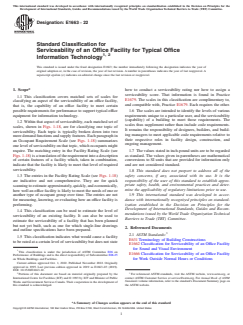
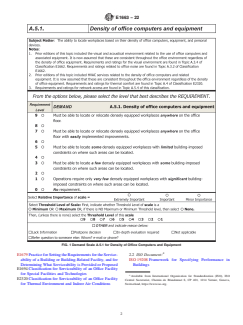
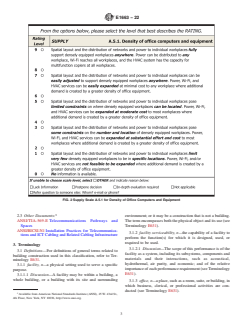
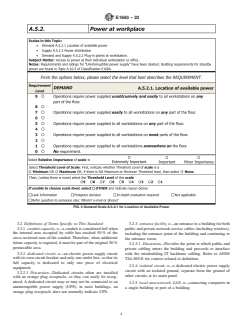
4.1 Each Facility Rating Scale (see Figs. 1-18) in this classification provides a means to estimate the level of serviceability of a building or facility for one topic of serviceability and to compare that level against the level of any other building or facility.
4.2 This classification can be used for comparing how well different buildings or facilities meet a particular requirement for serviceability. It is applicable despite differences such as location, structure, mechanical systems, age, and building shape. Further information may be found in ISO 19208.
4.3 This classification can be used to estimate the amount of variance of serviceability from target or from requirement, for a single office facility, or within a group of office facilities.
4.4 This classification can be used to estimate the following:
4.4.1 Serviceability of an existing facility for uses other than its present use.
4.4.2 Serviceability (potential) of a facility that has been planned but not yet built.
4.4.3 Serviceability (potential) of a facility for which remodeling has been planned.
4.5 Use of this classification does not result in building evaluation or diagnosis. Building evaluation or diagnosis generally requires a special expertise in building engineering or technology and the use of instruments, tools, or measurements.
4.6 This classification applies only to facilities that are building constructions, or parts thereof. (While this classification may be useful in rating the serviceability of facilities that are not building constructions, such facilities are outside the scope of this classification.)
4.7 This classification is not intended for, and is not suitable for, use for regulatory purposes, nor for fire hazard assessment nor for fire risk assessment.
SCOPE
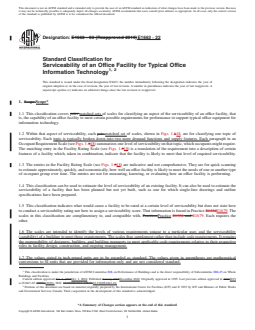
1.1 This classification covers matched sets of scales for classifying an aspect of the serviceability of an office facility, that is, the capability of an office facility to meet certain possible requirements for performance to support typical office equipment for information technology.
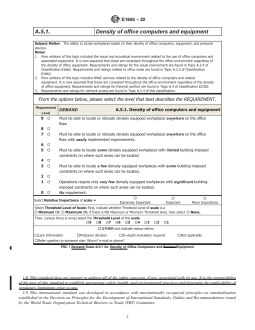
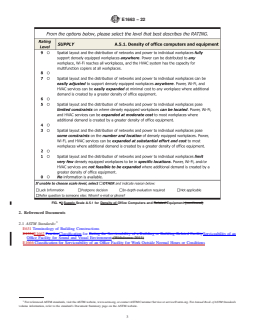
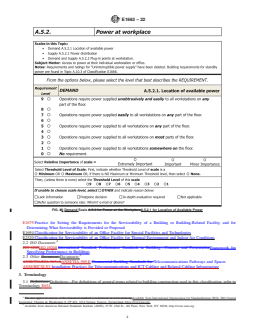
1.2 Within that aspect of serviceability, each matched set of scales, shown in Figs. 1-18, are for classifying one topic of serviceability. Each topic is typically broken down into two more demand functions and supply features. Each paragraph in an Occupant Requirement Scale (see Figs. 1-18) summarizes one level of serviceability on that topic, which occupants might require. The matching entry in the Facility Rating Scale (see Figs. 1-18) is a translation of the requirement into a description of certain features of a facility which, taken in combination, indicate that the facility is likely to meet that level of required serviceability.
FIG. 1 Demand Scale A.5.1 for Density of Office Computers and Equipment
FIG. 2 Supply Scale A.5.1 for Density of Office Computers and Equipment
FIG. 3 Demand Scale A.5.2.1 for Location of Available Power
FIG. 4 Supply Scale A.5.2.1 for Power Distribution
FIG. 5 Demand Scale A.5.2.2 for Plug-in Points at Workstation
FIG. 6 Supply Scale A.5.2.2 for Plug-in Points per Workstation
FIG. 7 Demand Scale A.5.3 for Reliability and Quality of Supply
FIG. 8 Supply Scale A.5.3 for Reliability and Quality of Supply
FIG. 9 Demand Scale A.5.4.1 for Horizontal Distribution
FIG. 10 Supply Scale A.5.4.1 for Horizontal Distribution
FIG. 11 Demand Scale A.5.4.2 for Risers
FIG. 12 Supply Scale A.5.4.2 for Risers
FIG. 13 Demand Scale A.5.4.3 for Entrance Facility
FIG. 14 Supply Scale A.5.4.3 for Entrance Facility
FIG. 15 Demand Scale A.5.4.4 for Service to the Site
FIG. 16 Supply Scale A.5.4.4 for Service to the Site
FIG. 17 Demand Scale A.5.5 for Cable Plant
FIG. 18 Supply Scale A.5.5 for Cable Plant
1.3 The entries in the Facility Rating Scale (see Figs. 1-18) are indicative and not comprehensive. They are for quick scanning to estimate approximately, quickly, and economically, how well ...
General Information
- Status
- Published
- Publication Date
- 30-Sep-2022
- Technical Committee
- E06 - Performance of Buildings
- Drafting Committee
- E06.25 - Whole Buildings and Facilities
Relations
- Effective Date
- 15-Nov-2019
- Effective Date
- 01-Mar-2018
- Effective Date
- 01-Mar-2018
- Effective Date
- 01-Mar-2018
- Effective Date
- 01-Mar-2015
- Effective Date
- 01-Nov-2014
- Effective Date
- 01-Oct-2013
- Effective Date
- 01-Apr-2012
- Effective Date
- 01-Apr-2012
- Effective Date
- 01-Apr-2012
- Effective Date
- 01-Apr-2012
- Effective Date
- 01-Apr-2012
- Effective Date
- 01-Jun-2006
- Effective Date
- 01-May-2005
- Effective Date
- 01-May-2005
Overview
ASTM E1663-22 is the Standard Classification for Serviceability of an Office Facility for Typical Office Information Technology, published by ASTM International. This standard offers a structured approach for classifying the serviceability of office facilities in supporting typical office information technology requirements. Serviceability, in this context, refers to how well a physical office environment meets occupant needs regarding the deployment and functioning of IT equipment and infrastructure.
The classification employs matched sets of scales-demand and supply-to assess and compare various aspects of serviceability across different buildings. The standard is versatile, useful for evaluating existing facilities, planned constructions, and potential remodels. It enables quick estimates on how office environments measure up against occupants’ requirements, supporting efficient decision-making for facility managers, building owners, and tenants.
Key Topics
ASTM E1663-22 covers essential factors impacting the suitability of office facilities for information technology:
Serviceability Scales: Offers paired demand (occupant requirements) and supply (facility features) scales for 18 critical topics, including:
- Density of office computers and equipment
- Location and availability of power sources
- Number of plug-in points at workstations
- Power distribution and supply reliability
- Horizontal and vertical cabling distribution (risers)
- Entrance facility for network services
- Serviceability of cable plant infrastructure
Applicability: The standard is valid for buildings regardless of location, age, structure, mechanical system, or shape, making it broadly useful for comparative evaluation.
Non-evaluative Role: While it provides structured classification, ASTM E1663-22 is not intended for building code compliance, fire hazard, or risk evaluation. Formal evaluation and diagnosis remain the domain of specialized engineering expertise.
Comprehensiveness: The classification does not cover code or regulatory requirements but is designed to supplement those, helping identify individual user needs and facility capabilities.
Applications
Practical uses of ASTM E1663-22 include:
Comparative Analysis: Facility managers and designers can compare the serviceability levels of different office environments using consistent criteria, supporting efficient selection or improvement strategies.
Design and Planning: Architects and planners can leverage the standard during the design phase of new office buildings or renovations to ensure that IT infrastructure requirements are met effectively.
Facility Assessment: Organizations can quickly assess the suitability of prospective office spaces or benchmark existing facilities as needs evolve, especially for IT-dependent operations.
Future Flexibility: By identifying gaps between demand and supply for IT serviceability, the standard supports planning for upgrades or modifications, ensuring office environments remain adaptable over time.
Tenant Communication: The classification scales provide a shared language and framework for discussing facility capabilities with potential users and stakeholders.
Related Standards
ASTM E1663-22 is complemented by other key standards that address specific aspects of office facility performance and IT infrastructure, including:
- ASTM E1334 and E1679: Practices for rating and setting serviceability requirements.
- ASTM E1666: Classification for serviceability under non-standard hours.
- ASTM E1694: Serviceability for special facilities and technologies.
- ASTM E2320: Thermal environment and indoor air conditions.
- ANSI/TIA-569-E: Commercial building standards for telecommunications pathways and spaces.
- ISO 19208: Framework for specifying performance in buildings.
Conclusion
Adopting ASTM E1663-22 provides valuable benefits for facility professionals assessing, comparing, and improving the IT serviceability of office buildings. By offering a repeatable and structured classification system, the standard enhances office planning, design, and ongoing management, ensuring workspaces are well-equipped to support evolving information technology needs.
Buy Documents
ASTM E1663-22 - Standard Classification for Serviceability of an Office Facility for Typical Office Information Technology
REDLINE ASTM E1663-22 - Standard Classification for Serviceability of an Office Facility for Typical Office Information Technology
Get Certified
Connect with accredited certification bodies for this standard

BSI Group
BSI (British Standards Institution) is the business standards company that helps organizations make excellence a habit.

NYCE
Mexican standards and certification body.
Sponsored listings
Frequently Asked Questions
ASTM E1663-22 is a standard published by ASTM International. Its full title is "Standard Classification for Serviceability of an Office Facility for Typical Office Information Technology". This standard covers: SIGNIFICANCE AND USE 4.1 Each Facility Rating Scale (see Figs. 1-18) in this classification provides a means to estimate the level of serviceability of a building or facility for one topic of serviceability and to compare that level against the level of any other building or facility. 4.2 This classification can be used for comparing how well different buildings or facilities meet a particular requirement for serviceability. It is applicable despite differences such as location, structure, mechanical systems, age, and building shape. Further information may be found in ISO 19208. 4.3 This classification can be used to estimate the amount of variance of serviceability from target or from requirement, for a single office facility, or within a group of office facilities. 4.4 This classification can be used to estimate the following: 4.4.1 Serviceability of an existing facility for uses other than its present use. 4.4.2 Serviceability (potential) of a facility that has been planned but not yet built. 4.4.3 Serviceability (potential) of a facility for which remodeling has been planned. 4.5 Use of this classification does not result in building evaluation or diagnosis. Building evaluation or diagnosis generally requires a special expertise in building engineering or technology and the use of instruments, tools, or measurements. 4.6 This classification applies only to facilities that are building constructions, or parts thereof. (While this classification may be useful in rating the serviceability of facilities that are not building constructions, such facilities are outside the scope of this classification.) 4.7 This classification is not intended for, and is not suitable for, use for regulatory purposes, nor for fire hazard assessment nor for fire risk assessment. SCOPE 1.1 This classification covers matched sets of scales for classifying an aspect of the serviceability of an office facility, that is, the capability of an office facility to meet certain possible requirements for performance to support typical office equipment for information technology. 1.2 Within that aspect of serviceability, each matched set of scales, shown in Figs. 1-18, are for classifying one topic of serviceability. Each topic is typically broken down into two more demand functions and supply features. Each paragraph in an Occupant Requirement Scale (see Figs. 1-18) summarizes one level of serviceability on that topic, which occupants might require. The matching entry in the Facility Rating Scale (see Figs. 1-18) is a translation of the requirement into a description of certain features of a facility which, taken in combination, indicate that the facility is likely to meet that level of required serviceability. FIG. 1 Demand Scale A.5.1 for Density of Office Computers and Equipment FIG. 2 Supply Scale A.5.1 for Density of Office Computers and Equipment FIG. 3 Demand Scale A.5.2.1 for Location of Available Power FIG. 4 Supply Scale A.5.2.1 for Power Distribution FIG. 5 Demand Scale A.5.2.2 for Plug-in Points at Workstation FIG. 6 Supply Scale A.5.2.2 for Plug-in Points per Workstation FIG. 7 Demand Scale A.5.3 for Reliability and Quality of Supply FIG. 8 Supply Scale A.5.3 for Reliability and Quality of Supply FIG. 9 Demand Scale A.5.4.1 for Horizontal Distribution FIG. 10 Supply Scale A.5.4.1 for Horizontal Distribution FIG. 11 Demand Scale A.5.4.2 for Risers FIG. 12 Supply Scale A.5.4.2 for Risers FIG. 13 Demand Scale A.5.4.3 for Entrance Facility FIG. 14 Supply Scale A.5.4.3 for Entrance Facility FIG. 15 Demand Scale A.5.4.4 for Service to the Site FIG. 16 Supply Scale A.5.4.4 for Service to the Site FIG. 17 Demand Scale A.5.5 for Cable Plant FIG. 18 Supply Scale A.5.5 for Cable Plant 1.3 The entries in the Facility Rating Scale (see Figs. 1-18) are indicative and not comprehensive. They are for quick scanning to estimate approximately, quickly, and economically, how well ...
SIGNIFICANCE AND USE 4.1 Each Facility Rating Scale (see Figs. 1-18) in this classification provides a means to estimate the level of serviceability of a building or facility for one topic of serviceability and to compare that level against the level of any other building or facility. 4.2 This classification can be used for comparing how well different buildings or facilities meet a particular requirement for serviceability. It is applicable despite differences such as location, structure, mechanical systems, age, and building shape. Further information may be found in ISO 19208. 4.3 This classification can be used to estimate the amount of variance of serviceability from target or from requirement, for a single office facility, or within a group of office facilities. 4.4 This classification can be used to estimate the following: 4.4.1 Serviceability of an existing facility for uses other than its present use. 4.4.2 Serviceability (potential) of a facility that has been planned but not yet built. 4.4.3 Serviceability (potential) of a facility for which remodeling has been planned. 4.5 Use of this classification does not result in building evaluation or diagnosis. Building evaluation or diagnosis generally requires a special expertise in building engineering or technology and the use of instruments, tools, or measurements. 4.6 This classification applies only to facilities that are building constructions, or parts thereof. (While this classification may be useful in rating the serviceability of facilities that are not building constructions, such facilities are outside the scope of this classification.) 4.7 This classification is not intended for, and is not suitable for, use for regulatory purposes, nor for fire hazard assessment nor for fire risk assessment. SCOPE 1.1 This classification covers matched sets of scales for classifying an aspect of the serviceability of an office facility, that is, the capability of an office facility to meet certain possible requirements for performance to support typical office equipment for information technology. 1.2 Within that aspect of serviceability, each matched set of scales, shown in Figs. 1-18, are for classifying one topic of serviceability. Each topic is typically broken down into two more demand functions and supply features. Each paragraph in an Occupant Requirement Scale (see Figs. 1-18) summarizes one level of serviceability on that topic, which occupants might require. The matching entry in the Facility Rating Scale (see Figs. 1-18) is a translation of the requirement into a description of certain features of a facility which, taken in combination, indicate that the facility is likely to meet that level of required serviceability. FIG. 1 Demand Scale A.5.1 for Density of Office Computers and Equipment FIG. 2 Supply Scale A.5.1 for Density of Office Computers and Equipment FIG. 3 Demand Scale A.5.2.1 for Location of Available Power FIG. 4 Supply Scale A.5.2.1 for Power Distribution FIG. 5 Demand Scale A.5.2.2 for Plug-in Points at Workstation FIG. 6 Supply Scale A.5.2.2 for Plug-in Points per Workstation FIG. 7 Demand Scale A.5.3 for Reliability and Quality of Supply FIG. 8 Supply Scale A.5.3 for Reliability and Quality of Supply FIG. 9 Demand Scale A.5.4.1 for Horizontal Distribution FIG. 10 Supply Scale A.5.4.1 for Horizontal Distribution FIG. 11 Demand Scale A.5.4.2 for Risers FIG. 12 Supply Scale A.5.4.2 for Risers FIG. 13 Demand Scale A.5.4.3 for Entrance Facility FIG. 14 Supply Scale A.5.4.3 for Entrance Facility FIG. 15 Demand Scale A.5.4.4 for Service to the Site FIG. 16 Supply Scale A.5.4.4 for Service to the Site FIG. 17 Demand Scale A.5.5 for Cable Plant FIG. 18 Supply Scale A.5.5 for Cable Plant 1.3 The entries in the Facility Rating Scale (see Figs. 1-18) are indicative and not comprehensive. They are for quick scanning to estimate approximately, quickly, and economically, how well ...
ASTM E1663-22 is classified under the following ICS (International Classification for Standards) categories: 35.260 - Office machines. The ICS classification helps identify the subject area and facilitates finding related standards.
ASTM E1663-22 has the following relationships with other standards: It is inter standard links to ASTM E2320-19, ASTM E1662-95a(2018), ASTM E1666-95a(2018), ASTM E2320-04(2018), ASTM E631-15, ASTM E631-14, ASTM E1679-13, ASTM E1666-95a(2012), ASTM E1679-95(2012), ASTM E1662-95a(2012), ASTM E1694-95a(2012), ASTM E2320-04(2012), ASTM E631-06, ASTM E1666-95a(2005), ASTM E1694-95a(2005). Understanding these relationships helps ensure you are using the most current and applicable version of the standard.
ASTM E1663-22 is available in PDF format for immediate download after purchase. The document can be added to your cart and obtained through the secure checkout process. Digital delivery ensures instant access to the complete standard document.
Standards Content (Sample)
This international standard was developed in accordance with internationally recognized principles on standardization established in the Decision on Principles for the
Development of International Standards, Guides and Recommendations issued by the World Trade Organization Technical Barriers to Trade (TBT) Committee.
Designation:E1663 −22
Standard Classification for
Serviceability of an Office Facility for Typical Office
1, 2
Information Technology
This standard is issued under the fixed designation E1663; the number immediately following the designation indicates the year of
original adoption or, in the case of revision, the year of last revision. A number in parentheses indicates the year of last reapproval. A
superscript epsilon (´) indicates an editorial change since the last revision or reapproval.
1. Scope* how to conduct a serviceability rating nor how to assign a
serviceability score. That information is found in Practice
1.1 This classification covers matched sets of scales for
E1679. The scales in this classification are complimentary to,
classifying an aspect of the serviceability of an office facility,
and compatible with, Practice E1679. Each requires the other.
that is, the capability of an office facility to meet certain
possible requirements for performance to support typical office 1.6 The scales are intended to identify the levels of various
equipment for information technology. requirements unique to a particular user, and the serviceability
(capability) of a building to meet those requirements. The
1.2 Within that aspect of serviceability, each matched set of
scales thus supplement rather than include code requirements.
scales, shown in Figs. 1-18, are for classifying one topic of
It remains the responsibility of designers, builders, and build-
serviceability. Each topic is typically broken down into two
ing managers to meet applicable code requirements relative to
more demand functions and supply features. Each paragraph in
their respective roles in facility design, construction, and
an Occupant Requirement Scale (see Figs. 1-18) summarizes
ongoing management.
onelevelofserviceabilityonthattopic,whichoccupantsmight
require. The matching entry in the Facility Rating Scale (see 1.7 The values stated in inch-pound units are to be regarded
Figs.1-18)isatranslationoftherequirementintoadescription as standard. The values given in parentheses are mathematical
of certain features of a facility which, taken in combination, conversions to SI units that are provided for information only
indicate that the facility is likely to meet that level of required and are not considered standard.
serviceability.
1.8 This standard does not purport to address all of the
safety concerns, if any, associated with its use. It is the
1.3 The entries in the Facility Rating Scale (see Figs. 1-18)
responsibility of the user of this standard to establish appro-
are indicative and not comprehensive. They are for quick
priate safety, health, and environmental practices and deter-
scanningtoestimateapproximately,quickly,andeconomically,
mine the applicability of regulatory limitations prior to use.
how well an office facility is likely to meet the needs of one or
1.9 This international standard was developed in accor-
another type of occupant group over time. The entries are not
dance with internationally recognized principles on standard-
for measuring, knowing, or evaluating how an office facility is
ization established in the Decision on Principles for the
performing.
Development of International Standards, Guides and Recom-
1.4 This classification can be used to estimate the level of
mendations issued by the World Trade Organization Technical
serviceability of an existing facility. It can also be used to
Barriers to Trade (TBT) Committee.
estimate the serviceability of a facility that has been planned
but not yet built, such as one for which single-line drawings
2. Referenced Documents
and outline specifications have been prepared.
2.1 ASTM Standards:
1.5 This classification indicates what would cause a facility
E631 Terminology of Building Constructions
to be rated at a certain level of serviceability but does not state
E1662 Classification for Serviceability of an Office Facility
for Sound and Visual Environment
This classification is under the jurisdiction of ASTM Committee E06 on
E1666 Classification for Serviceability of an Office Facility
Performance of Buildings and is the direct responsibility of Subcommittee E06.25
for Work Outside Normal Hours or Conditions
on Whole Buildings and Facilities.
Current edition approved Oct. 1, 2022. Published November 2022. Originally
approved in 1995. Last previous edition approved in 2019 as E1663–03 (2019).
DOI: 10.1520/E1663-22.
2 3
Portions of this document are based on material originally prepared by the For referenced ASTM standards, visit the ASTM website, www.astm.org, or
International Centre for Facilities (ICF) and © 1993 by ICF and Minister of Public contact ASTM Customer Service at service@astm.org. For Annual Book of ASTM
Works and Government Services Canada. Their cooperation in the development of Standards volume information, refer to the standard’s Document Summary page on
this standard is acknowledged. the ASTM website.
*A Summary of Changes section appears at the end of this standard
Copyright © ASTM International, 100 Barr Harbor Drive, PO Box C700, West Conshohocken, PA 19428-2959. United States
E1663−22
FIG. 1Demand Scale A.5.1 for Density of Office Computers and Equipment
E1679 PracticeforSettingtheRequirementsfortheService- 2.2 ISO Document:
ability of a Building or Building-Related Facility, and for ISO 19208 Framework for Specifying Performance in
Determining What Serviceability is Provided or Proposed Buildings
E1694 Classification for Serviceability of an Office Facility
for Special Facilities and Technologies
Available from International Organization for Standardization (ISO), ISO
E2320 Classification for Serviceability of an Office Facility
Central Secretariat, Chemin de Blandonnet 8, CP 401, 1214 Vernier, Geneva,
for Thermal Environment and Indoor Air Conditions Switzerland, https://www.iso.org.
E1663−22
FIG. 2Supply Scale A.5.1 for Density of Office Computers and Equipment
2.3 Other Documents: environment; or it may be a construction that is not a building.
ANSI/TIA-569-E Telecommunications Pathways and The term encompasses both the physical object and its use (see
Spaces
Terminology E631).
ANSI/BICSI-N1 Installation Practices for Telecommunica-
3.1.2 facility serviceability, n—the capability of a facility to
tions and ICT Cabling and Related Cabling Infrastructure
perform the function(s) for which it is designed, used, or
required to be used.
3. Terminology
3.1.2.1 Discussion—The scope of this performance is of the
3.1 Definitions—For definitions of general terms related to
facility as a system, including its subsystems, components and
building construction used in this classification, refer to Ter-
materials and their interactions, such as acoustical,
minology E631.
hydrothermal, air purity, and economic; and of the relative
3.1.1 facility, n—a physical setting used to serve a specific
importanceofeachperformancerequirement(seeTerminology
purpose.
E631).
3.1.1.1 Discussion—A facility may be within a building, a
whole building, or a building with its site and surrounding
3.1.3 offıce, n—aplace,suchasaroom,suite,orbuilding,in
which business, clerical, or professional activities are con-
ducted (see Terminology E631).
Available fromAmerican National Standards Institute (ANSI), 25 W. 43rd St.,
4th Floor, New York, NY 10036, http://www.ansi.org.
E1663−22
FIG. 3Demand Scale A.5.2.1 for Location of Available Power
3.2 Definitions of Terms Specific to This Standard: 3.2.3 entrance facility, n—an entrance to a building for both
3.2.1 conduit capacity, n—a conduit is considered full when
public and private network service cables (including wireless),
the internal area occupied by cable has reached 50 % of the
including the entrance point of the building and continuing to
cross-sectional area of the conduit. Therefore, when additional
the entrance room.
future capacity is required, it must be part of the original 50 %
3.2.3.1 Discussion—Provides the point at which public and
permissible area.
private cabling enters the building and proceeds to interface
3.2.2 dedicated circuit, n—an electric power supply circuit
with the intrabuilding IT backbone cabling. Refer to ANSI/
with its own circuit breaker and only one outlet box, so that its
TIA-569-E for context related to definition.
full capacity is dedicated to only one piece of electrical
3.2.4 isolated circuit, n—a dedicated electric power supply
equipment.
circuit with an isolated ground, separate from the ground of
3.2.2.1 Discussion—Dedicated circuits often are installed
other circuits at its main panel.
with an orange plug receptacle, so they can eas
...
This document is not an ASTM standard and is intended only to provide the user of an ASTM standard an indication of what changes have been made to the previous version. Because
it may not be technically possible to adequately depict all changes accurately, ASTM recommends that users consult prior editions as appropriate. In all cases only the current version
of the standard as published by ASTM is to be considered the official document.
Designation: E1663 − 03 (Reapproved 2019) E1663 − 22
Standard Classification for
Serviceability of an Office Facility for Typical Office
1, 2
Information Technology
This standard is issued under the fixed designation E1663; the number immediately following the designation indicates the year of
original adoption or, in the case of revision, the year of last revision. A number in parentheses indicates the year of last reapproval. A
superscript epsilon (´) indicates an editorial change since the last revision or reapproval.
1. Scope Scope*
1.1 This classification covers pairs matched sets of scales for classifying an aspect of the serviceability of an office facility, that
is, the capability of an office facility to meet certain possible requirements for performance to support typical office equipment for
information technology.
1.2 Within that aspect of serviceability, each pair matched set of scales, shown in Figs. 1-618, are for classifying one topic of
serviceability. Each topic is typically broken down into two more demand functions and supply features. Each paragraph in an
Occupant Requirement Scale (see Figs. 1-618) summarizes one level of serviceability on that topic, which occupants might require.
The matching entry in the Facility Rating Scale (see Figs. 1-618) is a translation of the requirement into a description of certain
features of a facility which, taken in combination, indicate that the facility is likely to meet that level of required serviceability.
1.3 The entries in the Facility Rating Scale (see Figs. 1-618) are indicative and not comprehensive. They are for quick scanning
to estimate approximately, quickly, and economically, how well an office facility is likely to meet the needs of one or another type
of occupant group over time. The entries are not for measuring, knowing, or evaluating how an office facility is performing.
1.4 This classification can be used to estimate the level of serviceability of an existing facility. It can also be used to estimate the
serviceability of a facility that has been planned but not yet built, such as one for which single-line drawings and outline
specifications have been prepared.
1.5 This classification indicates what would cause a facility to be rated at a certain level of serviceability but does not state how
to conduct a serviceability rating nor how to assign a serviceability score. That information is found in Practice E1334E1679. The
scales in this classification are complimentary to, and compatible with, PracticesPractice E1334 and E1679. Each requires the
other.
1.6 The scales are intended to identify the levels of various requirements unique to a particular user, and the serviceability
(capability) of a building to meet those requirements. The scales thus supplement rather than include code requirements. It remains
the responsibility of designers, builders, and building managers to meet applicable code requirements relative to their respective
roles in facility design, construction, and ongoing management.
1.7 The values stated in inch-pound units are to be regarded as standard. The values given in parentheses are mathematical
conversions to SI units that are provided for information only and are not considered standard.
This classification is under the jurisdiction of ASTM Committee E06 on Performance of Buildings and is the direct responsibility of Subcommittee E06.25 on Whole
Buildings and Facilities.
Current edition approved Jan. 1, 2019Oct. 1, 2022. Published January 2019November 2022. Originally approved in 1995. Last previous edition approved in 20102019
as E1663–03 (2010).(2019). DOI: 10.1520/E1663–03R19.10.1520/E1663-22.
Portions of this document are based on material originally prepared by the International Centre for Facilities (ICF) and © 1993 by ICF and Minister of Public Works
and Government Services Canada. Their cooperation in the development of this standard is acknowledged.
*A Summary of Changes section appears at the end of this standard
Copyright © ASTM International, 100 Barr Harbor Drive, PO Box C700, West Conshohocken, PA 19428-2959. United States
E1663 − 22
FIG. 1 Demand Scale A.5.1 for Density of Office Computers and Related Equipment
1.8 This standard does not purport to address all of the safety concerns, if any, associated with its use. It is the responsibility
of the user of this standard to establish appropriate safety, health, and environmental practices and determine the applicability of
regulatory limitations prior to use.
1.9 This international standard was developed in accordance with internationally recognized principles on standardization
established in the Decision on Principles for the Development of International Standards, Guides and Recommendations issued
by the World Trade Organization Technical Barriers to Trade (TBT) Committee.
E1663 − 22
FIG. 12 Supply Scale A.5.1 for Density of Office Computers and Related Equipment (continued)
2. Referenced Documents
2.1 ASTM Standards:
E631 Terminology of Building Constructions
E1334E1662 PracticeClassification for Rating the Serviceability of a Building or Building-Related FacilityServiceability of an
Office Facility for Sound and Visual Environment (Withdrawn 2013)
E1666 Classification for Serviceability of an Office Facility for Work Outside Normal Hours or Conditions
For referenced ASTM standards, visit the ASTM website, www.astm.org, or contact ASTM Customer Service at service@astm.org. For Annual Book of ASTM Standards
volume information, refer to the standard’s Document Summary page on the ASTM website.
E1663 − 22
FIG. 23 Demand Scale A.5.2 for Power at the WorkplaceA.5.2.1 for Location of Available Power
E1679 Practice for Setting the Requirements for the Serviceability of a Building or Building-Related Facility, and for
Determining What Serviceability is Provided or Proposed
E1694 Classification for Serviceability of an Office Facility for Special Facilities and Technologies
E2320 Classification for Serviceability of an Office Facility for Thermal Environment and Indoor Air Conditions
2.2 ISO Document:
ISO 6240ISO 19208 International Standard, Performance Standards in Building—Contents and PresentationFramework for
Specifying Performance in Buildings
2.3 Other Document:Documents:
ANSI/TIA/EIA-569–AANSI/TIA-569-E Commercial Building Standards for Telecommunications Pathways and Spaces
ANSI/BICSI-N1 Installation Practices for Telecommunications and ICT Cabling and Related Cabling Infrastructure
3. Terminology
3.1 Definitions:Definitions—For definitions of general terms related to building construction used in this classification, refer to
Terminology E631.
The last approved version of this historical standard is referenced on www.astm.org.Available from International Organization for Standardization (ISO), ISO Central
Secretariat, Chemin de Blandonnet 8, CP 401, 1214 Vernier, Geneva, Switzerland, https://www.iso.org.
Available from American National Standards Institute (ANSI), 25 W. 43rd St., 4th Floor, New York, NY 10036, http://www.ansi.org.
E1663 − 22
FIG. 24 Supply Scale A.5.2A.5.2.1 for Power at the WorkplaceDistribution (continued)
3.1.1 facility—facility, n—a physical setting used to serve a specific purpose.
3.1.1.1 Discussion—
A facility may be within a building, a whole building, or a building with its site and surrounding environment; or it may be a
construction that is not a building. The term encompasses both the physical object and its use (see Terminology E631).
3.1.2 facility serviceability—serviceability, n—the capability of a facility to perform the function(s) for which it is designed, used,
or required to be used.
3.1.2.1 Discussion—
The scope of this performance is of the facility as a system, including its subsystems, components and materials and their
interactions, such as acoustical, hydrothermal, air purity, and economic; and of the relative importance of each performance
requirement (see Terminology E631).
3.1.3 offıce—offıce, n—a place, such as a room, suite, or building, in which business, clerical, or professional activities are
conducted (see Terminology E631).
E1663 − 22
FIG. 35 Demand Scale A.5.3 for Building PowerA.5.2.2 for Plug-in Points at Workstation
3.1.4 For standard definitions of additional terms applicable to this classification, see Terminology E631.
E1663 − 22
FIG. 36 Supply Scale A.5.3A.5.2.2 for Building PowerPlug-in Points (continued)per Workstation
3.2 Definitions of Terms Specific to This Standard:
3.2.1 conduit capacity—capacity, n—a conduit is considered full when the internal area occupied by cable has reached 50 % of
the cross-sectional area of the conduit. Therefore, when additional future capacity is required, it must be part of the original 50 %
permissible area.
3.2.2 dedicated circuit—circuit, n—an electric power supply circuit with its own circuit breaker and only one outlet box, so that
its full capacity is dedicated to only one piece of electrical equipment.
3.2.2.1 Dis
...
Questions, Comments and Discussion
Ask us and Technical Secretary will try to provide an answer. You can facilitate discussion about the standard in here.
Loading comments...