

ASTM E2320-19
(Classification)Standard Classification for Serviceability of an Office Facility for Thermal Environment and Indoor Air Conditions
General Information
- Abstract
SIGNIFICANCE AND USE
4.1 Each Occupant Requirement Scale (see Figs. 1-5) in this classification provides a means to set the required level of serviceability of a building or facility for one topic of serviceability and to compare that level against any level of any other occupant, or of any building or facility.
4.2 Each Facility Rating Scale (see Figs. 1-5) in this classification provides a means to estimate the level of serviceability of a building or facility for one topic of serviceability and to compare that level against any level of requirement of any occupant, or of any other building or facility.
4.3 This classification can be used for comparing how well different buildings or facilities meet a particular requirement for serviceability. It is applicable despite differences such as location, structure, mechanical systems, age, and building shape.
4.4 This classification can be used to estimate the amount of variance of serviceability from target or from requirement, for a single office facility, or within a group of office facilities.
4.5 This classification can be used to estimate the following:
4.5.1 Serviceability of an existing facility for uses other than its present use.
4.5.2 Serviceability (potential) of a facility that has been planned but not yet built.
4.5.3 Serviceability (potential) of a facility for which remodeling has been planned.
4.6 Use of this classification does not result in building evaluation or diagnosis. Building evaluation or diagnosis generally requires a special expertise in building engineering or technology, and the use of instruments, tools, or measurements.
4.7 This classification applies only to facilities that are building constructions, or part thereof. (While classification may be useful in rating the serviceability of facilities that are not building constructions, such facilities are outside the scope of this classification. See discussion under definition 3.1.1.)
4.8 This classification is not intended for, an...
SCOPE
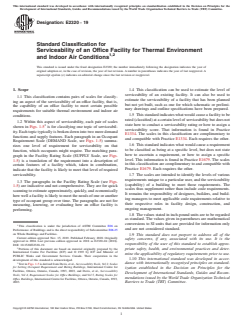
1.1 This classification contains pairs of scales for classifying an aspect of the serviceability of an office facility, that is, the capability of an office facility to meet certain possible requirements for suitable thermal environment and indoor air conditions.
1.2 Within this aspect of serviceability, each pair of scales shown in Figs. 1-53 is for classifying one topic of serviceability. Each topic typically is broken down into two more demand functions and supply features. Each paragraph in an Occupant Requirement Scale (DEMAND Scale, see Figs. 1-5) summarizes one level of requirement for serviceability on that function, which occupants might require. The matching paragraph in the Facility Rating Scale (SUPPLY Scale, see Figs. 1-5) is a translation of the requirement into a description of certain features of a facility which, taken in combination, indicate that the facility is likely to meet that level of required serviceability.
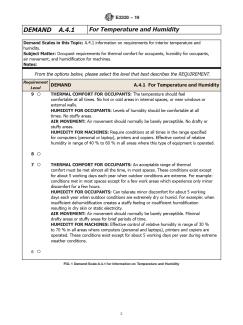
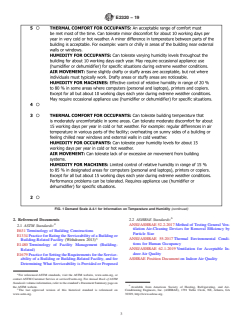
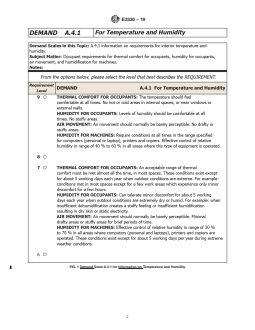
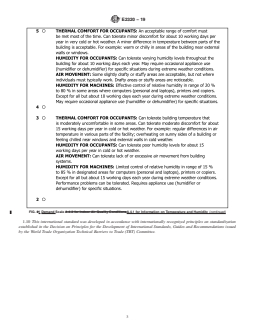
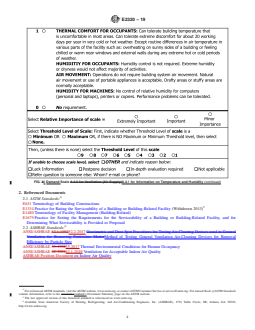
FIG. 1 Demand Scale A.4.1 for Information on Temperature and Humidity
FIG. 1 Demand Scale A.4.1 for Information on Temperature and Humidity (continued)
FIG. 1 Demand Scale A.4.1 for Information on Temperature and Humidity (continued)
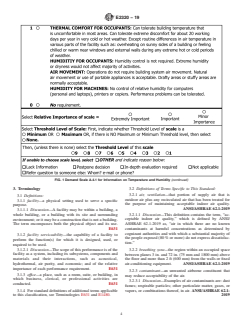
FIG. 1 Supply Scale A.4.1 for Information on Temperature and Humidity (continued)
FIG. 1 Supply Scale A.4.1 for Information on Temperature and Humidity (continued)
FIG. 1 Supply Scale A.4.1 for Information on Temperature and Humidity (continued)
FIG. 2 Demand Scale A.4.2 for Information on Indoor Air Quality Conditions
FIG. 2 Demand Scale A.4.2 for Information on Indoor Air Quality Conditions (continued)
FIG. 2 Supply Scale A.4.2 for Information on Indoor Air Quality (continued)
FIG. 2 Supply Scale A.4.2 for Information on Indoor Air Quality (continued)
FIG. 2 Supply Scale A.4.2 for Information on Indoor Air Quality (continued)
FIG. 3 Demand Scale A.4.3 for Information on Ventilation Supply Air
FIG. 3 Demand Scale A.4.3 ...
- Status
- Published
- Publication Date
- 14-Nov-2019
- Technical Committee
- E06 - Performance of Buildings
- Drafting Committee
- E06.25 - Whole Buildings and Facilities
Buy Documents
ASTM E2320-19 - Standard Classification for Serviceability of an Office Facility for Thermal Environment and Indoor Air Conditions
REDLINE ASTM E2320-19 - Standard Classification for Serviceability of an Office Facility for Thermal Environment and Indoor Air Conditions
Overview
ASTM E2320-19: Standard Classification for Serviceability of an Office Facility for Thermal Environment and Indoor Air Conditions provides a structured approach to classifying how well an office facility meets occupant requirements for thermal environment and indoor air quality. Developed by ASTM, this classification helps stakeholders estimate and compare the serviceability of office environments in terms of temperature, humidity, ventilation, and overall indoor air conditions.
The core purpose of the standard is to support designers, facility managers, and evaluators in assessing how closely a facility’s environmental conditions align with occupant needs-regardless of the facility’s age, location, structure, or mechanical system design. By providing both Occupant Requirement Scales (demand) and Facility Rating Scales (supply), ASTM E2320-19 allows for effective benchmarking and alignment between what building users require and what the facility delivers.
Key Topics
Major topics covered by ASTM E2320-19 include:
- Thermal Environment Assessment: Classification of temperature and humidity conditions to support occupant comfort.
- Indoor Air Quality (IAQ): Structured evaluation of ventilation, contaminant levels (dust, fumes, odors), and the ability to maintain acceptable IAQ.
- Ventilation Supply Air: Analysis of supply air types, including the capacity to provide fresh air and manage recirculation.
- Local Adjustments: Assessment of the ability for occupants to make local adjustments for comfort, such as personal control over temperature or ventilation settings.
- Openable Windows: Classification regarding the availability and effectiveness of operable windows for natural ventilation.
- Demand and Supply Scales: Structured pairing of scales for occupant requirements (demand) and the facility’s features or performance (supply).
These topics are essential for ensuring that office facilities maintain healthy and productive environments for occupants.
Applications
ASTM E2320-19 serves a range of practical purposes and user groups:
- Facility Planning and Design: Architects and engineers use the standard during design or renovation to estimate whether a planned or remodeled facility will meet future occupant requirements for air quality and thermal comfort.
- Facility Benchmarking: Building owners and managers apply the standard to compare serviceability among multiple office buildings, whether existing, new, or proposed.
- Property Assessment: Evaluators and facility professionals use the classification to estimate how well an office supports alternative uses based on environmental criteria.
- Occupant Satisfaction: Organizations leverage the demand and supply scales to better align building system performance with occupant comfort and productivity needs.
- Maintenance and Upgrades: Helps identify serviceability gaps, informing maintenance priorities or upgrades in HVAC, ventilation, and air handling systems.
- Due Diligence and Leasing: Tenants and investors evaluate whether a building’s thermal and air quality conditions align with organizational requirements ahead of leasing or acquisition.
This standard is not designed as a regulatory instrument, nor for detailed building diagnostics or fire risk assessment. Rather, it serves as a high-level, qualitative tool to guide informed decision-making in office facility management and improvement.
Related Standards
For comprehensive evaluation and alignment, ASTM E2320-19 is supported by and compatible with several other standards:
- ASTM E1334: Practice for Rating the Serviceability of a Building or Building-Related Facility
- ASTM E1679: Practice for Setting the Requirements for the Serviceability of a Building or Building-Related Facility
- ASTM E631 & E1480: Terminology standards for building construction and facility management
- ANSI/ASHRAE 55-2017: Thermal Environmental Conditions for Human Occupancy
- ANSI/ASHRAE 62.1-2019: Ventilation for Acceptable Indoor Air Quality
- ANSI/ASHRAE 52.2-2017: Methods of Testing Air-Cleaning Devices for General Ventilation
Integrating these standards ensures a holistic approach to evaluating and improving office environments for thermal comfort and indoor air quality.
Keywords: office serviceability, thermal environment, indoor air quality, facility rating, occupant requirements, ventilation, building classification, ASTM E2320-19
Relations
- Effective Date
- 15-Nov-2019
- Effective Date
- 01-Mar-2015
- Effective Date
- 01-Nov-2014
- Effective Date
- 01-Oct-2013
- Effective Date
- 01-Apr-2012
- Effective Date
- 01-Jun-2006
- Effective Date
- 01-May-2005
- Effective Date
- 01-May-2005
- Effective Date
- 01-Oct-2004
- Effective Date
- 28-Jul-2000
- Effective Date
- 10-Oct-1999
- Effective Date
- 10-Oct-1999
- Effective Date
- 10-Sep-1998
- Effective Date
- 15-Nov-2019
- Effective Date
- 15-Nov-2019
Buy Documents
ASTM E2320-19 - Standard Classification for Serviceability of an Office Facility for Thermal Environment and Indoor Air Conditions
REDLINE ASTM E2320-19 - Standard Classification for Serviceability of an Office Facility for Thermal Environment and Indoor Air Conditions
Get Certified
Connect with accredited certification bodies for this standard

DIBt (Deutsches Institut für Bautechnik)
German Institute for Building Technology.
DIN CERTCO
DIN Group product certification.

Aboma Certification B.V.
Specialized in construction, metal, and transport sectors.
Sponsored listings
Frequently Asked Questions
ASTM E2320-19 is a standard published by ASTM International. Its full title is "Standard Classification for Serviceability of an Office Facility for Thermal Environment and Indoor Air Conditions". This standard covers: SIGNIFICANCE AND USE 4.1 Each Occupant Requirement Scale (see Figs. 1-5) in this classification provides a means to set the required level of serviceability of a building or facility for one topic of serviceability and to compare that level against any level of any other occupant, or of any building or facility. 4.2 Each Facility Rating Scale (see Figs. 1-5) in this classification provides a means to estimate the level of serviceability of a building or facility for one topic of serviceability and to compare that level against any level of requirement of any occupant, or of any other building or facility. 4.3 This classification can be used for comparing how well different buildings or facilities meet a particular requirement for serviceability. It is applicable despite differences such as location, structure, mechanical systems, age, and building shape. 4.4 This classification can be used to estimate the amount of variance of serviceability from target or from requirement, for a single office facility, or within a group of office facilities. 4.5 This classification can be used to estimate the following: 4.5.1 Serviceability of an existing facility for uses other than its present use. 4.5.2 Serviceability (potential) of a facility that has been planned but not yet built. 4.5.3 Serviceability (potential) of a facility for which remodeling has been planned. 4.6 Use of this classification does not result in building evaluation or diagnosis. Building evaluation or diagnosis generally requires a special expertise in building engineering or technology, and the use of instruments, tools, or measurements. 4.7 This classification applies only to facilities that are building constructions, or part thereof. (While classification may be useful in rating the serviceability of facilities that are not building constructions, such facilities are outside the scope of this classification. See discussion under definition 3.1.1.) 4.8 This classification is not intended for, an... SCOPE 1.1 This classification contains pairs of scales for classifying an aspect of the serviceability of an office facility, that is, the capability of an office facility to meet certain possible requirements for suitable thermal environment and indoor air conditions. 1.2 Within this aspect of serviceability, each pair of scales shown in Figs. 1-53 is for classifying one topic of serviceability. Each topic typically is broken down into two more demand functions and supply features. Each paragraph in an Occupant Requirement Scale (DEMAND Scale, see Figs. 1-5) summarizes one level of requirement for serviceability on that function, which occupants might require. The matching paragraph in the Facility Rating Scale (SUPPLY Scale, see Figs. 1-5) is a translation of the requirement into a description of certain features of a facility which, taken in combination, indicate that the facility is likely to meet that level of required serviceability. FIG. 1 Demand Scale A.4.1 for Information on Temperature and Humidity FIG. 1 Demand Scale A.4.1 for Information on Temperature and Humidity (continued) FIG. 1 Demand Scale A.4.1 for Information on Temperature and Humidity (continued) FIG. 1 Supply Scale A.4.1 for Information on Temperature and Humidity (continued) FIG. 1 Supply Scale A.4.1 for Information on Temperature and Humidity (continued) FIG. 1 Supply Scale A.4.1 for Information on Temperature and Humidity (continued) FIG. 2 Demand Scale A.4.2 for Information on Indoor Air Quality Conditions FIG. 2 Demand Scale A.4.2 for Information on Indoor Air Quality Conditions (continued) FIG. 2 Supply Scale A.4.2 for Information on Indoor Air Quality (continued) FIG. 2 Supply Scale A.4.2 for Information on Indoor Air Quality (continued) FIG. 2 Supply Scale A.4.2 for Information on Indoor Air Quality (continued) FIG. 3 Demand Scale A.4.3 for Information on Ventilation Supply Air FIG. 3 Demand Scale A.4.3 ...
SIGNIFICANCE AND USE 4.1 Each Occupant Requirement Scale (see Figs. 1-5) in this classification provides a means to set the required level of serviceability of a building or facility for one topic of serviceability and to compare that level against any level of any other occupant, or of any building or facility. 4.2 Each Facility Rating Scale (see Figs. 1-5) in this classification provides a means to estimate the level of serviceability of a building or facility for one topic of serviceability and to compare that level against any level of requirement of any occupant, or of any other building or facility. 4.3 This classification can be used for comparing how well different buildings or facilities meet a particular requirement for serviceability. It is applicable despite differences such as location, structure, mechanical systems, age, and building shape. 4.4 This classification can be used to estimate the amount of variance of serviceability from target or from requirement, for a single office facility, or within a group of office facilities. 4.5 This classification can be used to estimate the following: 4.5.1 Serviceability of an existing facility for uses other than its present use. 4.5.2 Serviceability (potential) of a facility that has been planned but not yet built. 4.5.3 Serviceability (potential) of a facility for which remodeling has been planned. 4.6 Use of this classification does not result in building evaluation or diagnosis. Building evaluation or diagnosis generally requires a special expertise in building engineering or technology, and the use of instruments, tools, or measurements. 4.7 This classification applies only to facilities that are building constructions, or part thereof. (While classification may be useful in rating the serviceability of facilities that are not building constructions, such facilities are outside the scope of this classification. See discussion under definition 3.1.1.) 4.8 This classification is not intended for, an... SCOPE 1.1 This classification contains pairs of scales for classifying an aspect of the serviceability of an office facility, that is, the capability of an office facility to meet certain possible requirements for suitable thermal environment and indoor air conditions. 1.2 Within this aspect of serviceability, each pair of scales shown in Figs. 1-53 is for classifying one topic of serviceability. Each topic typically is broken down into two more demand functions and supply features. Each paragraph in an Occupant Requirement Scale (DEMAND Scale, see Figs. 1-5) summarizes one level of requirement for serviceability on that function, which occupants might require. The matching paragraph in the Facility Rating Scale (SUPPLY Scale, see Figs. 1-5) is a translation of the requirement into a description of certain features of a facility which, taken in combination, indicate that the facility is likely to meet that level of required serviceability. FIG. 1 Demand Scale A.4.1 for Information on Temperature and Humidity FIG. 1 Demand Scale A.4.1 for Information on Temperature and Humidity (continued) FIG. 1 Demand Scale A.4.1 for Information on Temperature and Humidity (continued) FIG. 1 Supply Scale A.4.1 for Information on Temperature and Humidity (continued) FIG. 1 Supply Scale A.4.1 for Information on Temperature and Humidity (continued) FIG. 1 Supply Scale A.4.1 for Information on Temperature and Humidity (continued) FIG. 2 Demand Scale A.4.2 for Information on Indoor Air Quality Conditions FIG. 2 Demand Scale A.4.2 for Information on Indoor Air Quality Conditions (continued) FIG. 2 Supply Scale A.4.2 for Information on Indoor Air Quality (continued) FIG. 2 Supply Scale A.4.2 for Information on Indoor Air Quality (continued) FIG. 2 Supply Scale A.4.2 for Information on Indoor Air Quality (continued) FIG. 3 Demand Scale A.4.3 for Information on Ventilation Supply Air FIG. 3 Demand Scale A.4.3 ...
ASTM E2320-19 is classified under the following ICS (International Classification for Standards) categories: 91.140.30 - Ventilation and air-conditioning systems. The ICS classification helps identify the subject area and facilitates finding related standards.
ASTM E2320-19 has the following relationships with other standards: It is inter standard links to ASTM E2320-04(2018), ASTM E631-15, ASTM E631-14, ASTM E1679-13, ASTM E1679-95(2012), ASTM E631-06, ASTM E1679-95(2005), ASTM E1334-95(2005), ASTM E1480-92(2004), ASTM E631-93a(1998)e1, ASTM E1679-95(1999), ASTM E1334-95(1999), ASTM E1480-92(1998)e1, ASTM E1765-16(2023), ASTM E1663-22. Understanding these relationships helps ensure you are using the most current and applicable version of the standard.
ASTM E2320-19 is available in PDF format for immediate download after purchase. The document can be added to your cart and obtained through the secure checkout process. Digital delivery ensures instant access to the complete standard document.
Standards Content (Sample)
This international standard was developed in accordance with internationally recognized principles on standardization established in the Decision on Principles for the
Development of International Standards, Guides and Recommendations issued by the World Trade Organization Technical Barriers to Trade (TBT) Committee.
Designation:E2320 −19
Standard Classification for
Serviceability of an Office Facility for Thermal Environment
1,2
and Indoor Air Conditions
This standard is issued under the fixed designation E2320; the number immediately following the designation indicates the year of
original adoption or, in the case of revision, the year of last revision. A number in parentheses indicates the year of last reapproval. A
superscript epsilon (´) indicates an editorial change since the last revision or reapproval.
1. Scope 1.4 This classification can be used to estimate the level of
serviceability of an existing facility. It can also be used to
1.1 This classification contains pairs of scales for classify-
estimate the serviceability of a facility that has been planned
ing an aspect of the serviceability of an office facility, that is,
but not yet built, such as one for which schematic or prelimi-
the capability of an office facility to meet certain possible
nary drawings and outline specifications have been prepared.
requirements for suitable thermal environment and indoor air
1.5 Thisstandardindicateswhatwouldcauseafacilitytobe
conditions.
rated(classified)atacertainlevelofserviceabilitybutdoesnot
1.2 Within this aspect of serviceability, each pair of scales
state how to conduct a serviceability rating or how to assign a
shown in Figs. 1-5 is for classifying one topic of serviceabil-
serviceability score. That information is found in Practice
ity. Each topic typically is broken down into two more demand
E1334. The scales in this classification are complimentary to
functions and supply features. Each paragraph in an Occupant
and compatible with Practice E1334. Each requires the other.
Requirement Scale (DEMAND Scale, see Figs. 1-5) summa-
1.6 This standard indicates what would cause a requirement
rizes one level of requirement for serviceability on that
to be classified as being at a specific level, but does not state
function, which occupants might require. The matching para-
how to ascertain a requirement, or how to assign a specific
graph in the Facility Rating Scale (SUPPLY Scale, see Figs.
level. This information is found in Practice E1679. The scales
1-5) is a translation of the requirement into a description of
in this classification are complimentary to and compatible with
certain features of a facility which, taken in combination,
Practice E1679. Each requires the other.
indicate that the facility is likely to meet that level of required
serviceability. 1.7 The scales are intended to identify the levels of various
requirements unique to a particular user, and the serviceability
1.3 The paragraphs in the Facility Rating Scale (see Figs.
(capability) of a building to meet those requirements. The
1-5) are indicative and not comprehensive. They are for quick
scales thus supplement rather than include code requirements.
scanning to estimate approximately, quickly, and economically
It remains the responsibility of designers, builders, and build-
how well a facility is likely to meet the needs of one or another
ing managers to meet applicable code requirements relative to
type of occupant group over time. The paragraphs are not for
their respective roles in facility design, construction, and
measuring, knowing, or evaluating how an office facility is
ongoing management.
performing.
1.8 The values stated in inch-pound units are to be regarded
as standard. The values given in parentheses are mathematical
conversions to SI units that are provided for information only
This classification is under the jurisdiction of ASTM Committee E06 on
and are not considered standard.
Performance of Buildings and is the direct responsibility of Subcommittee E06.25
on Whole Buildings and Facilities.
1.9 This standard does not purport to address all of the
Current edition approved Nov. 15, 2019. Published February 2020. Originally
safety concerns, if any, associated with its use. It is the
approved in 2004. Last previous edition approved in 2018 as E2320–04 (2018).
responsibility of the user of this standard to establish appro-
DOI: 10.1520/E2320–19.
Portions of this document are based on material originally prepared by the
priate safety, health, and environmental practices and deter-
International Centre For Facilities (ICF) and © 1993 by ICF and Minister of
mine the applicability of regulatory requirements prior to use.
PUBLIC Works and Government Services Canada. Their cooperation in the
1.10 This international standard was developed in accor-
development of this standard is acknowledged.
dance with internationally recognized principles on standard-
TextinFigs.1-5isderivedfromDavis,etal., Serviceability Tools, Vol 2, Scales
for Setting Occupant Requirement and Rating Buildings, International Centre for
ization established in the Decision on Principles for the
Facilities, Ottawa, Ontario, Canada, 1993, 2003, and Davis, et al., Serviceability
Development of International Standards, Guides and Recom-
Tools, Vol 4, Requirement Scales for Offıce Buildings, and Vol 5, Rating Scales for
mendations issued by the World Trade Organization Technical
Offıce Buildings, International Centre for Facilities, Ottawa, Ontario, Canada, 1993,
2003. Barriers to Trade (TBT) Committee.
Copyright © ASTM International, 100 Barr Harbor Drive, PO Box C700, West Conshohocken, PA 19428-2959. United States
E2320−19
FIG. 1Demand Scale A.4.1 for Information on Temperature and Humidity
E2320−19
FIG. 1Demand Scale A.4.1 for Information on Temperature and Humidity (continued)
2. Referenced Documents 2.2 ASHRAE Standards:
ANSI/ASHRAE 52.2-2017 Method of Testing General Ven-
2.1 ASTM Standards:
tilation Air-Cleaning Devices for Removal Efficiency by
E631 Terminology of Building Constructions
Particle Size
E1334 Practice for Rating the Serviceability of a Building or
ANSI/ASHRAE 55-2017 Thermal Environmental Condi-
Building-Related Facility (Withdrawn 2013)
tions for Human Occupancy
E1480 Terminology of Facility Management (Building-
ANSI/ASHRAE 62.1-2019 Ventilation for Acceptable In-
Related)
E1679 PracticeforSettingtheRequirementsfortheService- door Air Quality
ability of a Building or Building-Related Facility, and for ASHRAE Position Document on Indoor Air Quality
Determining What Serviceability is Provided or Proposed
For referenced ASTM standards, visit the ASTM website, www.astm.org, or
contact ASTM Customer Service at service@astm.org. For Annual Book of ASTM
Standards volume information, refer to the standard’s Document Summary page on
the ASTM website. Available from American Society of Heating, Refrigerating, and Air-
The last approved version of this historical standard is referenced on Conditioning Engineers, Inc. (ASHRAE), 1791 Tullie Circle, NE, Atlanta, GA
www.astm.org. 30329, http://www.ashrae.org.
E2320−19
FIG. 1Demand Scale A.4.1 for Information on Temperature and Humidity (continued)
3. Terminology 3.2 Definitions of Terms Specific to This Standard:
3.2.1 air, ventilation—that portion of supply air that is
3.1 Definitions:
outdoor air plus any recirculated air that has been treated for
3.1.1 facility—a physical setting used to serve a specific
the purpose of maintaining acceptable indoor air quality.
purpose.
ANSI/ASHRAE 62.1-2019
3.1.1.1 Discussion—A facility may be within a building, a
3.2.1.1 Discussion—This definition contains the term, “ac-
whole building, or a building with its site and surrounding
ceptable indoor air quality,” which is defined by ANSI/
environment; or it may be a construction that is not a building.
ASHRAE 62.1-2019 as, “air in which there are no known
The term encompasses both the physical object and its use.
contaminants at harmful concentrations as determined by
E631
cognizant authorities and with which a substantial majority of
3.1.2 facility serviceability—the capability of a facility to
the people exposed (80 % or more) do not express dissatisfac-
perform the function(s) for which it is designed, used, or
tion.”
required to be used.
3.1.2.1 Discussion—The scope of this performance is of the
3.2.2 breathing zone—the region within an occupied space
facility as a system, including its subsystems, components and between planes 3 in. and 72 in. (75 mm and 1800 mm) above
materials and their interactions, such as acoustical,
the floor and more than 2 ft (600 mm) from the walls or fixed
hydrothermal, air purity, and economic; and of the relative
air-conditioning equipment. ANSI/ASHRAE 62.1-2019
importance of each performance requirement. E631
3.2.3 contaminant—an unwanted airborne constituent that
3.1.3 offıce—a place, such as a room, suite, or building, in
may reduce acceptability of the air.
which business, clerical, or professional activities ar
...
This document is not an ASTM standard and is intended only to provide the user of an ASTM standard an indication of what changes have been made to the previous version. Because
it may not be technically possible to adequately depict all changes accurately, ASTM recommends that users consult prior editions as appropriate. In all cases only the current version
of the standard as published by ASTM is to be considered the official document.
Designation: E2320 − 04 (Reapproved 2018) E2320 − 19 An American National Standard
Standard Classification for
Serviceability of an Office Facility for Thermal Environment
1,2
and Indoor Air Conditions
This standard is issued under the fixed designation E2320; the number immediately following the designation indicates the year of
original adoption or, in the case of revision, the year of last revision. A number in parentheses indicates the year of last reapproval. A
superscript epsilon (´) indicates an editorial change since the last revision or reapproval.
1. Scope
1.1 This classification contains pairs of scales for classifying an aspect of the serviceability of an office facility, that is, the
capability of an office facility to meet certain possible requirements for suitable thermal environment and indoor air conditions.
1.2 Within this aspect of serviceability, each pair of scales,scales shown in Figs. 1-5, is for classifying one topic of
serviceability. Each topic typically is broken down into two more demand functions and supply features. Each paragraph in an
Occupant Requirement Scale (see (DEMAND Scale, see Figs. 1-5) summarizes one level of requirement for serviceability on that
topic,function, which occupants might require. The matching paragraph in the Facility Rating Scale (see (SUPPLY Scale, see Figs.
1-5) is a translation of the requirement into a description of certain features of a facility which, taken in combination, indicate that
the facility is likely to meet that level of required serviceability.
1.3 The paragraphs in the Facility Rating Scale (see Figs. 1-5) are indicative and not comprehensive. They are for quick
scanning to estimate approximately, quickly, and economically how well a facility is likely to meet the needs of one or another
type of occupant group over time. The paragraphs are not for measuring, knowing, or evaluating how an office facility is
performing.
1.4 This classification can be used to estimate the level of serviceability of an existing facility. It can also be used to estimate
the serviceability of a facility that has been planned but not yet built, such as one for which schematic or preliminary drawings
and outline specifications have been prepared.
1.5 This standard indicates what would cause a facility to be rated (classified) at a certain level of serviceability but does not
state how to conduct a serviceability rating or how to assign a serviceability score. That information is found in Practice E1334.
The scales in this classification are complimentary to and compatible with Practice E1334. Each requires the other.
1.6 This standard indicates what would cause a requirement to be classified as being at a specific level, but does not state how
to ascertain a requirement, or how to assign a specific level. This information is found in Practice E1679. The scales in this
classification are complimentary to and compatible with Practice E1679. Each requires the other.
1.7 The scales are intended to identify the levels of various requirements unique to a particular user, and the serviceability
(capability) of a building to meet those requirements. The scales thus supplement rather than include code requirements. It remains
the responsibility of designers, builders, and building managers to meet applicable code requirements relative to their respective
roles in facility design, construction, and ongoing management.
1.8 The values stated in SIinch-pound units are to be regarded as standard. The values given in parentheses are mathematical
conversions to inch-poundSI units that are provided for information only and are not considered standard.
1.9 This standard does not purport to address all of the safety concerns, if any, associated with its use. It is the responsibility
of the user of this standard to establish appropriate safety, health, and environmental practices and determine the applicability of
regulatory requirements prior to use.
This classification is under the jurisdiction of ASTM Committee E06 on Performance of Buildings and is the direct responsibility of Subcommittee E06.25 on Whole
Buildings and Facilities.
Current edition approved March 1, 2018Nov. 15, 2019. Published March 2018February 2020. Originally approved in 2004. Last previous edition approved in 20122018
as E2320 – 04 (2012).E2320–04 (2018). DOI: 10.1520/E2320-04R18.10.1520/E2320–19.
Portions of this document are based on material originally prepared by the International Centre For Facilities (ICF) and © 1993 by ICF and Minister of PUBLIC Works
and Government Services Canada. Their cooperation in the development of this standard is acknowledged.
Text in Figs.Figs. 1-5 1–5 is derived from Davis, et al., Serviceability Tools, Vol 2, Scales for Setting Occupant Requirement and Rating Buildings, International Centre
for Facilities, Ottawa, Ontario, Canada, 1993, 2003, and Davis, et al., Serviceability Tools, Vol 4, Requirement Scales for Offıce Buildings, and Vol 5, Rating Scales for Offıce
Buildings, International Centre for Facilities, Ottawa, Ontario, Canada, 1993, 2003.
Copyright © ASTM International, 100 Barr Harbor Drive, PO Box C700, West Conshohocken, PA 19428-2959. United States
E2320 − 19
FIG. 1 Demand Scale A.4.1 for Information on Temperature and Humidity
E2320 − 19
FIG. 21 Demand Scale A.4.2 for Indoor Air Quality ConditionsA.4.1 for Information on Temperature and Humidity (continued)
1.10 This international standard was developed in accordance with internationally recognized principles on standardization
established in the Decision on Principles for the Development of International Standards, Guides and Recommendations issued
by the World Trade Organization Technical Barriers to Trade (TBT) Committee.
E2320 − 19
FIG. 31 Demand Scale A.4.3 for Ventilation (Air Supply)A.4.1 for Information on Temperature and Humidity (continued)
2. Referenced Documents
2.1 ASTM Standards:
E631 Terminology of Building Constructions
E1334 Practice for Rating the Serviceability of a Building or Building-Related Facility (Withdrawn 2013)
E1480 Terminology of Facility Management (Building-Related)
E1679 Practice for Setting the Requirements for the Serviceability of a Building or Building-Related Facility, and for
Determining What Serviceability is Provided or Proposed
2.2 ASHRAE Standards:
ANSI/ASHRAE 52.1-199252.2-2017 Gravimetric and Dust-Spot Procedures for Testing Air-Cleaning Devices used in General
Ventilation for Removing Particulate MatterMethod of Testing General Ventilation Air-Cleaning Devices for Removal
Efficiency by Particle Size
ANSI/ASHRAE 55-199255-2017 Thermal Environmental Conditions for Human Occupancy
ANSI/ASHRAE 62-200162.1-2019 Ventilation for Acceptable Indoor Air Quality
ASHRAE Position Document on Indoor Air Quality
For referenced ASTM standards, visit the ASTM website, www.astm.org, or contact ASTM Customer Service at service@astm.org. For Annual Book of ASTM Standards
volume information, refer to the standard’sstandard’s Document Summary page on the ASTM website.
The last approved version of this historical standard is referenced on www.astm.org.
Available from American Society of Heating, Refrigerating, and Air-Conditioning Engineers, Inc. (ASHRAE), 1791 Tullie Circle, NE, Atlanta, GA 30329,
http://www.ashrae.org.
E2320 − 19
FIG. 41 Supply Scale A.4.4 for Local Adjustments by OccupantsA.4.1 for Information on Temperature and Humidity (continued)
E2320 − 19
FIG. 51 Supply Scale A.4.5 for Ventilation with Openable WindowsA.4.1 for Information on Temperature and Humidity (continued)
E2320 − 19
FIG. 1 Supply Scale A.4.1 for Information on Temperature and Humidity (continued)
3. Terminology
3.1 Definitions:
3.1.1 facility—a physical setting used to serve a specific purpose.
3.1.1.1 Discussion—
A facility may be within a building, a whole building, or a building with its site and surrounding environment; or it may be a
construction that is not a building. The term encompasses both the physical object and its use. E631
3.1.2 facility serviceability—the capability of a facility to perform the function(s) for which it is designed, used, or required to
be used.
3.1.2.1 Discussion—
The scope of this performance is of the facility as a system, including its subsystems, components and materials and their
interactions, such as acoustical, hydrothermal, air purity, and economic; and of the relative importance of each performance
requirement. E631
3.1.3 offıce—a place, such as a room, suite, or building, in which business, clerical, or professional activities are conducted.
E631
3.1.4 For standard definitions of additional terms applicable to this classification, see Terminologies E631 and E1480.
3.2 Definitions of Terms Specific to This Standard:
3.2.1 air, ventilation—that portion of supply air that is outdoor air plus any recirculated air that has been treated for the purpose
of maintaining acceptable indoor air quality. ASHRAE 62-2001ANSI/ASHRAE 62.1-2019
3.2.1.1 Discussion—
This definition contains the term, “acceptable indoor air quality,” which is defined by ASHRAE 62-2001ANSI/ASHRAE
62.1-2019 as, “air in which there are no known contaminants at harmful concentrations as determined by cognizant authorities and
with which a substantial majority of the people exposed (80 % or more) do not express dissatisfactio
...