

ASTM E1661-95a(2018)
(Classification)Standard Classification for Serviceability of an Office Facility for Meetings and Group Effectiveness
General Information
- Abstract
SIGNIFICANCE AND USE
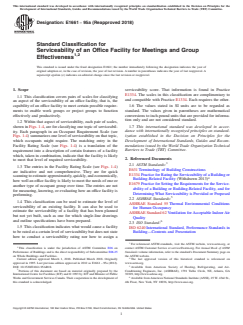
4.1 Each Facility Rating Scale (see Figs. 1-4) in this classification provides a means to estimate the level of serviceability of a building or facility for one topic of serviceability and to compare that level against the level of any other building or facility.
4.2 This classification can be used for comparing how well different buildings or facilities meet a particular requirement for serviceability. It is applicable despite differences such as location, structure, mechanical systems, age, and building shape.
4.3 This classification can be used to estimate the amount of variance of serviceability from target or from requirement, for a single office facility, or within a group of office facilities.
4.4 This classification can be used to estimate the following:
4.4.1 Serviceability of an existing facility for uses other than its present use.
4.4.2 Serviceability (potential) of a facility that has been planned but not yet built.
4.4.3 Serviceability (potential) of a facility for which a remodeling has been planned.
4.5 Use of this classification does not result in building evaluation or diagnosis. Building evaluation or diagnosis generally requires a special expertise in building engineering or technology and the use of instruments, tools, or measurements.
4.6 This classification applies only to facilities that are building constructions, or parts thereof. (While this classification may be useful in rating the serviceability of facilities that are not building constructions, such facilities are outside the scope of this classification.)
4.7 This classification is not intended for, and is not suitable for, use for regulatory purposes, nor for fire hazard assessment nor for fire risk assessment.
SCOPE
1.1 This classification covers pairs of scales for classifying an aspect of the serviceability of an office facility, that is, the capability of an office facility to meet certain possible requirements to enable work groups or project groups to function effectively and productively.
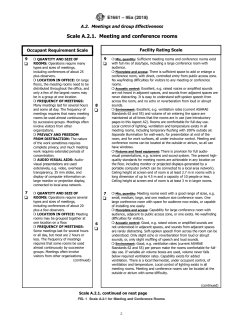
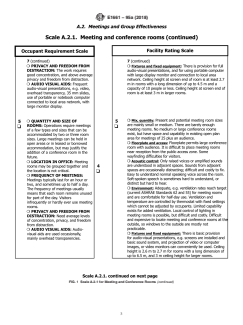
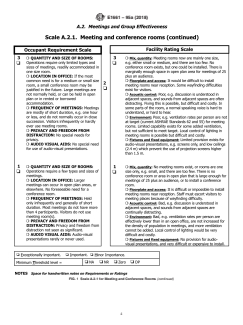
1.2 Within that aspect of serviceability, each pair of scales, shown in Figs. 1-4, are for classifying one topic of serviceability. Each paragraph in an Occupant Requirement Scale (see Figs. 1-4) summarizes one level of serviceability on that topic, which occupants might require. The matching entry in the Facility Rating Scale (see Figs. 1-4) is a translation of the requirement into a description of certain features of a facility which, taken in combination, indicate that the facility is likely to meet that level of required serviceability.
FIG. 1 Scale A.2.1 for Meeting and Conference Rooms
FIG. 1 Scale A.2.1 for Meeting and Conference Rooms (continued)
FIG. 1 Scale A.2.1 for Meeting and Conference Rooms (continued)
FIG. 2 Scale A.2.2 for Informal Meetings and Interaction
FIG. 2 Scale A.2.2 for Informal Meetings and Interaction (continued)
FIG. 3 Scale A.2.3 for Group Layout and Territory
FIG. 3 Scale A.2.3 for Group Layout and Territory (continued)
FIG. 4 Scale A.2.4 for Group Workrooms
FIG. 4 Scale A.2.4 for Group Workrooms (continued)
1.3 The entries in the Facility Rating Scale (see Figs. 1-4) are indicative and not comprehensive. They are for quick scanning to estimate approximately, quickly, and economically, how well an office facility is likely to meet the needs of one or another type of occupant group over time. The entries are not for measuring, knowing, or evaluating how an office facility is performing.
1.4 This classification can be used to estimate the level of serviceability of an existing facility. It can also be used to estimate the serviceability of a facility that has been planned but not yet built, such as one for which single-line drawings and outline specifications have been prepared.
1.5 This classification indicates what would cause a facility to be rated at a certain level of serviceability but does not state how to conduct a serviceabi...
- Status
- Published
- Publication Date
- 28-Feb-2018
- Technical Committee
- E06 - Performance of Buildings
- Drafting Committee
- E06.25 - Whole Buildings and Facilities
Overview
ASTM E1661-95a(2018): Standard Classification for Serviceability of an Office Facility for Meetings and Group Effectiveness establishes a systematic approach for classifying and comparing how well office facilities support meetings, group activities, and organizational effectiveness. Developed by ASTM International, this standard provides facility managers, owners, and designers with a structured method for estimating and comparing the serviceability of various office spaces based on defined criteria, regardless of differences in age, structure, location, or design.
ASTM E1661 is not intended for regulatory or fire safety assessment, nor does it serve as a comprehensive evaluation or diagnosis tool. Instead, it offers quick, economical estimation to support decision-making in office space planning and management.
Key Topics
Serviceability Scales: The standard includes pairs of scales focused on specific aspects of serviceability:
- Meeting and Conference Rooms
- Informal Meetings and Interaction Spaces
- Group Layout and Territory
- Group Workrooms
Occupant Requirement Scale: Outlines varying levels of serviceability that occupants might require for each topic.
Facility Rating Scale: Translates occupant requirements into descriptions of practical facility features likely to deliver those serviceability levels.
Applicability: Used for both existing and planned office facilities, including scenarios where remodeling is proposed or alternate uses are being considered.
Comparative Assessment: Enables stakeholders to compare serviceability across different buildings or within groups of facilities, providing valuable insights despite differences in building age, structure, or mechanical systems.
Limitations: The standard does not result in detailed building evaluation or diagnosis and is not suitable for regulatory or fire risk assessments. Its application is limited to building constructions or their parts.
Applications
ASTM E1661 serves multiple practical purposes for professionals involved in office facility planning, design, operation, and management:
Estimating Serviceability: Provides a straightforward method to assess how well a facility is likely to support meetings, group work, and collaborative activities, helping to align office environments with organizational goals.
Supporting Space Planning: Assists architects, facility managers, and workplace strategists in evaluating alternative design or layout concepts for new or existing spaces.
Comparing Facilities: Facilitates benchmarking of multiple properties to inform leasing, investment, or renovation decisions, providing a consistent framework for comparison.
Guiding Renovations and New Construction: Informs requirements definition for remodeling or new office projects, ensuring that facilities are planned to meet desired levels of group effectiveness and occupant support.
Quick Scanning: Particularly useful for rapid, high-level evaluation rather than in-depth technical performance measurement.
Related Standards
ASTM E1661 references or is compatible with several key industry standards related to office environments and building performance:
- ASTM E631: Terminology of Building Constructions
- ASTM E1334: Practice for Rating the Serviceability of a Building or Building-Related Facility (withdrawn)
- ASTM E1679: Practice for Setting Requirements for Serviceability and Determining Provided or Proposed Serviceability
- ASHRAE Standard 55: Thermal Environmental Conditions for Human Occupancy
- ASHRAE Standard 62: Ventilation for Acceptable Indoor Air Quality
- ISO 6240: International Standard, Performance Standards in Building-Contents and Presentation
Summary
ASTM E1661-95a(2018) provides a valuable classification system for analyzing and comparing the serviceability of office facilities specifically for meetings and group productivity. Its practical scales help organizations and facility managers make informed, comparative assessments to optimize workplace effectiveness efficiently and consistently. For further information or access to the standard, visit ASTM International.
Relations
- Effective Date
- 01-Mar-2018
- Effective Date
- 01-Mar-2015
- Effective Date
- 01-Nov-2014
- Effective Date
- 01-Oct-2013
- Effective Date
- 01-Apr-2012
- Effective Date
- 01-Jun-2006
- Effective Date
- 01-May-2005
- Effective Date
- 01-May-2005
- Effective Date
- 28-Jul-2000
- Effective Date
- 10-Oct-1999
- Effective Date
- 10-Oct-1999
- Effective Date
- 01-Mar-2018
Get Certified
Connect with accredited certification bodies for this standard

BSI Group
BSI (British Standards Institution) is the business standards company that helps organizations make excellence a habit.

NYCE
Mexican standards and certification body.
Sponsored listings
Frequently Asked Questions
ASTM E1661-95a(2018) is a standard published by ASTM International. Its full title is "Standard Classification for Serviceability of an Office Facility for Meetings and Group Effectiveness". This standard covers: SIGNIFICANCE AND USE 4.1 Each Facility Rating Scale (see Figs. 1-4) in this classification provides a means to estimate the level of serviceability of a building or facility for one topic of serviceability and to compare that level against the level of any other building or facility. 4.2 This classification can be used for comparing how well different buildings or facilities meet a particular requirement for serviceability. It is applicable despite differences such as location, structure, mechanical systems, age, and building shape. 4.3 This classification can be used to estimate the amount of variance of serviceability from target or from requirement, for a single office facility, or within a group of office facilities. 4.4 This classification can be used to estimate the following: 4.4.1 Serviceability of an existing facility for uses other than its present use. 4.4.2 Serviceability (potential) of a facility that has been planned but not yet built. 4.4.3 Serviceability (potential) of a facility for which a remodeling has been planned. 4.5 Use of this classification does not result in building evaluation or diagnosis. Building evaluation or diagnosis generally requires a special expertise in building engineering or technology and the use of instruments, tools, or measurements. 4.6 This classification applies only to facilities that are building constructions, or parts thereof. (While this classification may be useful in rating the serviceability of facilities that are not building constructions, such facilities are outside the scope of this classification.) 4.7 This classification is not intended for, and is not suitable for, use for regulatory purposes, nor for fire hazard assessment nor for fire risk assessment. SCOPE 1.1 This classification covers pairs of scales for classifying an aspect of the serviceability of an office facility, that is, the capability of an office facility to meet certain possible requirements to enable work groups or project groups to function effectively and productively. 1.2 Within that aspect of serviceability, each pair of scales, shown in Figs. 1-4, are for classifying one topic of serviceability. Each paragraph in an Occupant Requirement Scale (see Figs. 1-4) summarizes one level of serviceability on that topic, which occupants might require. The matching entry in the Facility Rating Scale (see Figs. 1-4) is a translation of the requirement into a description of certain features of a facility which, taken in combination, indicate that the facility is likely to meet that level of required serviceability. FIG. 1 Scale A.2.1 for Meeting and Conference Rooms FIG. 1 Scale A.2.1 for Meeting and Conference Rooms (continued) FIG. 1 Scale A.2.1 for Meeting and Conference Rooms (continued) FIG. 2 Scale A.2.2 for Informal Meetings and Interaction FIG. 2 Scale A.2.2 for Informal Meetings and Interaction (continued) FIG. 3 Scale A.2.3 for Group Layout and Territory FIG. 3 Scale A.2.3 for Group Layout and Territory (continued) FIG. 4 Scale A.2.4 for Group Workrooms FIG. 4 Scale A.2.4 for Group Workrooms (continued) 1.3 The entries in the Facility Rating Scale (see Figs. 1-4) are indicative and not comprehensive. They are for quick scanning to estimate approximately, quickly, and economically, how well an office facility is likely to meet the needs of one or another type of occupant group over time. The entries are not for measuring, knowing, or evaluating how an office facility is performing. 1.4 This classification can be used to estimate the level of serviceability of an existing facility. It can also be used to estimate the serviceability of a facility that has been planned but not yet built, such as one for which single-line drawings and outline specifications have been prepared. 1.5 This classification indicates what would cause a facility to be rated at a certain level of serviceability but does not state how to conduct a serviceabi...
SIGNIFICANCE AND USE 4.1 Each Facility Rating Scale (see Figs. 1-4) in this classification provides a means to estimate the level of serviceability of a building or facility for one topic of serviceability and to compare that level against the level of any other building or facility. 4.2 This classification can be used for comparing how well different buildings or facilities meet a particular requirement for serviceability. It is applicable despite differences such as location, structure, mechanical systems, age, and building shape. 4.3 This classification can be used to estimate the amount of variance of serviceability from target or from requirement, for a single office facility, or within a group of office facilities. 4.4 This classification can be used to estimate the following: 4.4.1 Serviceability of an existing facility for uses other than its present use. 4.4.2 Serviceability (potential) of a facility that has been planned but not yet built. 4.4.3 Serviceability (potential) of a facility for which a remodeling has been planned. 4.5 Use of this classification does not result in building evaluation or diagnosis. Building evaluation or diagnosis generally requires a special expertise in building engineering or technology and the use of instruments, tools, or measurements. 4.6 This classification applies only to facilities that are building constructions, or parts thereof. (While this classification may be useful in rating the serviceability of facilities that are not building constructions, such facilities are outside the scope of this classification.) 4.7 This classification is not intended for, and is not suitable for, use for regulatory purposes, nor for fire hazard assessment nor for fire risk assessment. SCOPE 1.1 This classification covers pairs of scales for classifying an aspect of the serviceability of an office facility, that is, the capability of an office facility to meet certain possible requirements to enable work groups or project groups to function effectively and productively. 1.2 Within that aspect of serviceability, each pair of scales, shown in Figs. 1-4, are for classifying one topic of serviceability. Each paragraph in an Occupant Requirement Scale (see Figs. 1-4) summarizes one level of serviceability on that topic, which occupants might require. The matching entry in the Facility Rating Scale (see Figs. 1-4) is a translation of the requirement into a description of certain features of a facility which, taken in combination, indicate that the facility is likely to meet that level of required serviceability. FIG. 1 Scale A.2.1 for Meeting and Conference Rooms FIG. 1 Scale A.2.1 for Meeting and Conference Rooms (continued) FIG. 1 Scale A.2.1 for Meeting and Conference Rooms (continued) FIG. 2 Scale A.2.2 for Informal Meetings and Interaction FIG. 2 Scale A.2.2 for Informal Meetings and Interaction (continued) FIG. 3 Scale A.2.3 for Group Layout and Territory FIG. 3 Scale A.2.3 for Group Layout and Territory (continued) FIG. 4 Scale A.2.4 for Group Workrooms FIG. 4 Scale A.2.4 for Group Workrooms (continued) 1.3 The entries in the Facility Rating Scale (see Figs. 1-4) are indicative and not comprehensive. They are for quick scanning to estimate approximately, quickly, and economically, how well an office facility is likely to meet the needs of one or another type of occupant group over time. The entries are not for measuring, knowing, or evaluating how an office facility is performing. 1.4 This classification can be used to estimate the level of serviceability of an existing facility. It can also be used to estimate the serviceability of a facility that has been planned but not yet built, such as one for which single-line drawings and outline specifications have been prepared. 1.5 This classification indicates what would cause a facility to be rated at a certain level of serviceability but does not state how to conduct a serviceabi...
ASTM E1661-95a(2018) is classified under the following ICS (International Classification for Standards) categories: 35.260 - Office machines. The ICS classification helps identify the subject area and facilitates finding related standards.
ASTM E1661-95a(2018) has the following relationships with other standards: It is inter standard links to ASTM E1661-95a(2012), ASTM E631-15, ASTM E631-14, ASTM E1679-13, ASTM E1679-95(2012), ASTM E631-06, ASTM E1679-95(2005), ASTM E1334-95(2005), ASTM E631-93a(1998)e1, ASTM E1679-95(1999), ASTM E1334-95(1999), ASTM E1765-16(2023). Understanding these relationships helps ensure you are using the most current and applicable version of the standard.
ASTM E1661-95a(2018) is available in PDF format for immediate download after purchase. The document can be added to your cart and obtained through the secure checkout process. Digital delivery ensures instant access to the complete standard document.
Standards Content (Sample)
This international standard was developed in accordance with internationally recognized principles on standardization established in the Decision on Principles for the
Development of International Standards, Guides and Recommendations issued by the World Trade Organization Technical Barriers to Trade (TBT) Committee.
Designation:E1661 −95a (Reapproved 2018)
Standard Classification for
Serviceability of an Office Facility for Meetings and Group
1,2
Effectiveness
This standard is issued under the fixed designation E1661; the number immediately following the designation indicates the year of
original adoption or, in the case of revision, the year of last revision. A number in parentheses indicates the year of last reapproval. A
superscript epsilon (´) indicates an editorial change since the last revision or reapproval.
1. Scope serviceability score. That information is found in Practice
E1334. The scales in this classification are complimentary to
1.1 This classification covers pairs of scales for classifying
and compatible with Practice E1334. Each requires the other.
an aspect of the serviceability of an office facility, that is, the
capability of an office facility to meet certain possible require- 1.6 The values stated in SI units are to be regarded as
ments to enable work groups or project groups to function standard. The values given in parentheses are mathematical
effectively and productively. conversions to inch-pound units that are provided for informa-
tion only and are not considered standard.
1.2 Within that aspect of serviceability, each pair of scales,
1.7 This international standard was developed in accor-
shown in Figs. 1-4, are for classifying one topic of serviceabil-
dance with internationally recognized principles on standard-
ity. Each paragraph in an Occupant Requirement Scale (see
ization established in the Decision on Principles for the
Figs. 1-4) summarizes one level of serviceability on that topic,
Development of International Standards, Guides and Recom-
which occupants might require. The matching entry in the
mendations issued by the World Trade Organization Technical
Facility Rating Scale (see Figs. 1-4) is a translation of the
Barriers to Trade (TBT) Committee.
requirement into a description of certain features of a facility
which, taken in combination, indicate that the facility is likely
2. Referenced Documents
to meet that level of required serviceability.
2.1 ASTM Standards:
1.3 The entries in the Facility Rating Scale (see Figs. 1-4)
E631 Terminology of Building Constructions
are indicative and not comprehensive. They are for quick
E1334 Practice for Rating the Serviceability of a Building or
scanningtoestimateapproximately,quickly,andeconomically,
Building-Related Facility (Withdrawn 2013)
how well an office facility is likely to meet the needs of one or
E1679 PracticeforSettingtheRequirementsfortheService-
another type of occupant group over time. The entries are not
ability of a Building or Building-Related Facility, and for
for measuring, knowing, or evaluating how an office facility is
Determining What Serviceability is Provided or Proposed
performing.
2.2 ASHRAE Standards:
1.4 This classification can be used to estimate the level of
ASHRAE Standard 55 Thermal Environmental Conditions
serviceability of an existing facility. It can also be used to
for Human Occupancy
estimate the serviceability of a facility that has been planned
ASHRAE Standard 62 Ventilation forAcceptable IndoorAir
but not yet built, such as one for which single-line drawings
Quality
and outline specifications have been prepared.
2.3 ISO Standard:
1.5 This classification indicates what would cause a facility ISO 6240 International Standard, Performance Standards in
to be rated at a certain level of serviceability but does not state
Building—Contents and Presentation
how to conduct a serviceability rating nor how to assign a
For referenced ASTM standards, visit the ASTM website, www.astm.org, or
This classification is under the jurisdiction of ASTM Committee E06 on contact ASTM Customer Service at service@astm.org. For Annual Book of ASTM
Performance of Buildings and is the direct responsibility of Subcommittee E06.25 Standards volume information, refer to the standard’s Document Summary page on
on Whole Buildings and Facilities. the ASTM website.
Current edition approved March 1, 2018. Published March 2018. Originally The last approved version of this historical standard is referenced on
approved in 1995. Last previous edition approved in 2012 as E1661 – 95a (2012). www.astm.org.
DOI: 10.1520/E1661-95AR18. Available from American Society of Heating, Refrigerating, and Air-
Portions of this document are based on material originally prepared by the Conditioning Engineers, Inc. (ASHRAE), 1791 Tullie Circle, NE, Atlanta, GA
International Centre for Facilities (ICF) and © 1993 by ICF and Minister of Public 30329, http://www.ashrae.org.
Works and Government Services Canada. Their cooperation in the development of Available fromAmerican National Standards Institute (ANSI), 25 W. 43rd St.,
this standard is acknowledged. 4th Floor, New York, NY 10036, http://www.ansi.org.
Copyright © ASTM International, 100 Barr Harbor Drive, PO Box C700, West Conshohocken, PA 19428-2959. United States
E1661−95a (2018)
FIG. 1 Scale A.2.1 for Meeting and Conference Rooms
E1661−95a (2018)
FIG. 1 Scale A.2.1 for Meeting and Conference Rooms (continued)
E1661−95a (2018)
FIG. 1 Scale A.2.1 for Meeting and Conference Rooms (continued)
E1661−95a (2018)
FIG. 2 Scale A.2.2 for Informal Meetings and Interaction
E1661−95a (2018)
FIG. 2 Scale A.2.2 for Informal Meetings and Interaction (continued)
E1661−95a (2018)
FIG. 3 Scale A.2.3 for Group Layout and Territory
E1661−95a (2018)
FIG. 3 Scale A.2.3 for Group Layout and Territory (continued)
E1661−95a (2018)
FIG. 4 Scale A.2.4 for Group Workrooms
E1661−95a (2018)
FIG. 4 Scale A.2.4 for Group Workrooms (continued)
E1661−95a (2018)
3. Terminology walls, for example, a workstation for computer work and a
workstationfordesk-workandreferencetodocumentsareboth
3.1 Definitions:
often found within the workplace of a single individual. (Note
3.1.1 facility—a physical setting used to serve a specific
that in facility planning and management, the term is not
purpose. E631
limited to a type of computer used in the workplace.)
3.1.1.1 Discussion—A facility may be within a building, a
whole building, or a building with its site an
...