


ASTM E1671-95a(2018)
(Classification)Standard Classification for Serviceability of an Office Facility for Cleanliness
Standard Classification for Serviceability of an Office Facility for Cleanliness
SIGNIFICANCE AND USE
4.1 Each Facility Rating Scale (see Figs. 1-5) in this classification provides a means to estimate the level of serviceability of a building or facility for one topic of serviceability and to compare that level against the level of any other building or facility.
4.2 This classification can be used for comparing how well different buildings or facilities meet a particular requirement for serviceability. It is applicable despite differences such as location, structure, mechanical systems, age, and building shape.
4.3 This classification can be used to estimate the following:
4.3.1 Serviceability of an existing facility for uses other than its present use.
4.3.2 Serviceability (potential) of a facility that has been planned but not yet built.
4.3.3 Serviceability (potential) of a facility for which remodeling has been planned.
4.4 Use of this classification does not result in building evaluation or diagnosis. Building evaluation or diagnosis generally requires a special expertise in building engineering or technology and the use of instruments, tools, or measurements.
4.5 This classification applies only to facilities that are building constructions, or parts thereof. (While this classification may be useful in rating the serviceability of facilities that are not building constructions, such facilities are outside the scope of this classification.)
4.6 This classification is not intended for, and is not suitable for, use for regulatory purposes nor for fire hazard assessment nor for fire risk assessment.
SCOPE
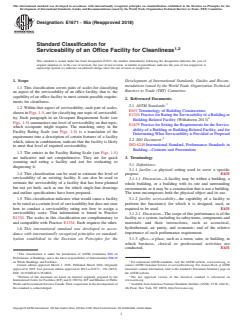
1.1 This classification covers pairs of scales for classifying an aspect of the serviceability of an office facility, that is, the capability of an office facility to meet certain possible requirements for cleanliness.
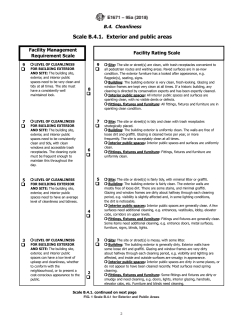
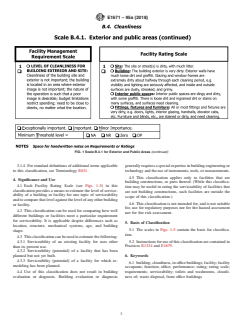
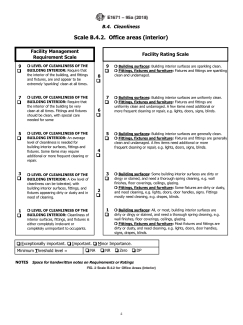
1.2 Within that aspect of serviceability, each pair of scales, shown in Figs. 1-5, are for classifying one topic of serviceability. Each paragraph in an Occupant Requirement Scale (see Figs. 1-5) summarizes one level of serviceability on that topic, which occupants might require. The matching entry in the Facility Rating Scale (see Figs. 1-5) is a translation of the requirement into a description of certain features of a facility which, taken in combination, indicate that the facility is likely to meet that level of required serviceability.
FIG. 1 Scale B.4.1 for Exterior and Public Areas
FIG. 1 Scale B.4.1 for Exterior and Public Areas (continued)
FIG. 2 Scale B.4.2 for Office Areas (Interior)
FIG. 3 Scale B.4.3 for Toilets and Washrooms
FIG. 4 Scale B.4.4 for Special Cleaning
FIG. 5 Scale B.4.5 for Waste Disposal for Building
FIG. 5 Scale B.4.5 for Waste Disposal for Building (continued)
1.3 The entries in the Facility Rating Scale (see Figs. 1-5) are indicative and not comprehensive. They are for quick scanning and rating a facility and not for evaluating or diagnosing it.
1.4 This classification can be used to estimate the level of serviceability of an existing facility. It can also be used to estimate the serviceability of a facility that has been planned but not yet built, such as one for which single-line drawings and outline specifications have been prepared.
1.5 This classification indicates what would cause a facility to be rated at a certain level of serviceability but does not state how to conduct a serviceability rating nor how to assign a serviceability score. That information is found in Practice E1334. The scales in this classification are complimentary to and compatible with Practice E1334. Each requires the other.
1.6 This international standard was developed in accordance with internationally recognized principles on standardization established in the Decision on Principles for the Development of International Standards, Guides and Recommendations issued by the World Trade Organization Technical Barriers to Trade (TBT) Committee.
General Information
- Status
- Published
- Publication Date
- 28-Feb-2018
- Technical Committee
- E06 - Performance of Buildings
- Drafting Committee
- E06.25 - Whole Buildings and Facilities
Relations
- Effective Date
- 01-Mar-2018
- Effective Date
- 01-Mar-2015
- Effective Date
- 01-Nov-2014
- Effective Date
- 01-Oct-2013
- Effective Date
- 01-Apr-2012
- Effective Date
- 01-Jun-2006
- Effective Date
- 01-May-2005
- Effective Date
- 01-May-2005
- Effective Date
- 28-Jul-2000
- Effective Date
- 10-Oct-1999
- Effective Date
- 10-Oct-1999
- Effective Date
- 01-Mar-2018
Overview
ASTM E1671-95a(2018), titled Standard Classification for Serviceability of an Office Facility for Cleanliness, is an international standard developed by ASTM International. This standard provides a structured approach to classify and estimate the serviceability of office facilities specifically related to cleanliness. It offers a consistent basis for comparing how various office buildings or parts thereof meet occupants’ cleanliness requirements.
This classification is valuable for building managers, facility owners, and planners who need to gauge or compare the cleanliness-related serviceability of existing buildings, new construction, or facilities undergoing remodeling. The standard utilizes pairs of rating scales for different facility topics, helping users to rate specific office areas with respect to cleanliness and maintenance without requiring in-depth engineering expertise.
Key Topics
Facility Rating Scales: Multiple rating scales focus on different areas within office facilities:
- Exterior and Public Areas
- Office (Interior) Areas
- Toilets and Washrooms
- Special Cleaning Requirements
- Waste Disposal Systems
Occupant Requirement Scale: Summarizes various levels of cleanliness serviceability that office occupants may require for each area.
Facility Rating Scale: Translates occupant requirements into specific observable features or conditions in the facility, indicating likely levels of serviceability.
Scope of Application:
- Applicable to all building constructions or their parts, regardless of differences in location, structure, age, or building shape.
- Not intended for evaluating non-building constructions, regulatory compliance, or fire risk assessments.
Estimation, Not Evaluation: The standard offers a rapid, indicative method for rating and comparing office facility cleanliness, but does not provide a full diagnostic evaluation or assign numerical serviceability scores.
Applications
ASTM E1671-95a(2018) is particularly suitable for the following practical applications:
- Comparative Facility Assessment: Allows stakeholders to consistently compare cleanliness-related serviceability between different office facilities or locations.
- Pre-Occupancy Analysis: Useful in assessing the cleanliness serviceability of planned or yet-to-be constructed office facilities based on design documentation.
- Remodeling and Renovation Planning: Supports estimation of potential cleanliness serviceability for facilities scheduled for remodeling projects.
- Building Management: Assists office facility managers in quickly identifying areas that may require attention to meet occupant expectations regarding cleanliness.
- Occupant Communication: Provides a common language and framework for discussing required or achieved cleanliness serviceability levels among building owners, managers, and occupants.
It is important to note that this classification is intended for preliminary or comparative purposes only. Full evaluation or diagnosis of building serviceability for cleanliness, including assignment of serviceability scores, requires additional practices and expertise, and falls outside the scope of ASTM E1671-95a(2018).
Related Standards
- ASTM E1334: Practice for Rating the Serviceability of a Building or Building-Related Facility (offers methods for conducting the rating process referenced by E1671).
- ASTM E631: Terminology of Building Constructions (provides standard terminology used throughout E1671).
- ASTM E1679: Practice for Setting the Requirements for the Serviceability of a Building or Building-Related Facility.
- ISO 6240: International Standard, Performance Standards in Building-Contents and Presentation.
Keywords: office facility serviceability, cleanliness rating, facility rating scale, occupant requirements, building management, office area maintenance, waste disposal, special cleaning, office construction, ASTM standards.
Implementing ASTM E1671-95a(2018) enhances consistency and clarity in classifying and communicating office facility cleanliness, leading to better maintenance planning and improved occupant satisfaction.
Get Certified
Connect with accredited certification bodies for this standard

BSI Group
BSI (British Standards Institution) is the business standards company that helps organizations make excellence a habit.

NYCE
Mexican standards and certification body.
Sponsored listings
Frequently Asked Questions
ASTM E1671-95a(2018) is a standard published by ASTM International. Its full title is "Standard Classification for Serviceability of an Office Facility for Cleanliness". This standard covers: SIGNIFICANCE AND USE 4.1 Each Facility Rating Scale (see Figs. 1-5) in this classification provides a means to estimate the level of serviceability of a building or facility for one topic of serviceability and to compare that level against the level of any other building or facility. 4.2 This classification can be used for comparing how well different buildings or facilities meet a particular requirement for serviceability. It is applicable despite differences such as location, structure, mechanical systems, age, and building shape. 4.3 This classification can be used to estimate the following: 4.3.1 Serviceability of an existing facility for uses other than its present use. 4.3.2 Serviceability (potential) of a facility that has been planned but not yet built. 4.3.3 Serviceability (potential) of a facility for which remodeling has been planned. 4.4 Use of this classification does not result in building evaluation or diagnosis. Building evaluation or diagnosis generally requires a special expertise in building engineering or technology and the use of instruments, tools, or measurements. 4.5 This classification applies only to facilities that are building constructions, or parts thereof. (While this classification may be useful in rating the serviceability of facilities that are not building constructions, such facilities are outside the scope of this classification.) 4.6 This classification is not intended for, and is not suitable for, use for regulatory purposes nor for fire hazard assessment nor for fire risk assessment. SCOPE 1.1 This classification covers pairs of scales for classifying an aspect of the serviceability of an office facility, that is, the capability of an office facility to meet certain possible requirements for cleanliness. 1.2 Within that aspect of serviceability, each pair of scales, shown in Figs. 1-5, are for classifying one topic of serviceability. Each paragraph in an Occupant Requirement Scale (see Figs. 1-5) summarizes one level of serviceability on that topic, which occupants might require. The matching entry in the Facility Rating Scale (see Figs. 1-5) is a translation of the requirement into a description of certain features of a facility which, taken in combination, indicate that the facility is likely to meet that level of required serviceability. FIG. 1 Scale B.4.1 for Exterior and Public Areas FIG. 1 Scale B.4.1 for Exterior and Public Areas (continued) FIG. 2 Scale B.4.2 for Office Areas (Interior) FIG. 3 Scale B.4.3 for Toilets and Washrooms FIG. 4 Scale B.4.4 for Special Cleaning FIG. 5 Scale B.4.5 for Waste Disposal for Building FIG. 5 Scale B.4.5 for Waste Disposal for Building (continued) 1.3 The entries in the Facility Rating Scale (see Figs. 1-5) are indicative and not comprehensive. They are for quick scanning and rating a facility and not for evaluating or diagnosing it. 1.4 This classification can be used to estimate the level of serviceability of an existing facility. It can also be used to estimate the serviceability of a facility that has been planned but not yet built, such as one for which single-line drawings and outline specifications have been prepared. 1.5 This classification indicates what would cause a facility to be rated at a certain level of serviceability but does not state how to conduct a serviceability rating nor how to assign a serviceability score. That information is found in Practice E1334. The scales in this classification are complimentary to and compatible with Practice E1334. Each requires the other. 1.6 This international standard was developed in accordance with internationally recognized principles on standardization established in the Decision on Principles for the Development of International Standards, Guides and Recommendations issued by the World Trade Organization Technical Barriers to Trade (TBT) Committee.
SIGNIFICANCE AND USE 4.1 Each Facility Rating Scale (see Figs. 1-5) in this classification provides a means to estimate the level of serviceability of a building or facility for one topic of serviceability and to compare that level against the level of any other building or facility. 4.2 This classification can be used for comparing how well different buildings or facilities meet a particular requirement for serviceability. It is applicable despite differences such as location, structure, mechanical systems, age, and building shape. 4.3 This classification can be used to estimate the following: 4.3.1 Serviceability of an existing facility for uses other than its present use. 4.3.2 Serviceability (potential) of a facility that has been planned but not yet built. 4.3.3 Serviceability (potential) of a facility for which remodeling has been planned. 4.4 Use of this classification does not result in building evaluation or diagnosis. Building evaluation or diagnosis generally requires a special expertise in building engineering or technology and the use of instruments, tools, or measurements. 4.5 This classification applies only to facilities that are building constructions, or parts thereof. (While this classification may be useful in rating the serviceability of facilities that are not building constructions, such facilities are outside the scope of this classification.) 4.6 This classification is not intended for, and is not suitable for, use for regulatory purposes nor for fire hazard assessment nor for fire risk assessment. SCOPE 1.1 This classification covers pairs of scales for classifying an aspect of the serviceability of an office facility, that is, the capability of an office facility to meet certain possible requirements for cleanliness. 1.2 Within that aspect of serviceability, each pair of scales, shown in Figs. 1-5, are for classifying one topic of serviceability. Each paragraph in an Occupant Requirement Scale (see Figs. 1-5) summarizes one level of serviceability on that topic, which occupants might require. The matching entry in the Facility Rating Scale (see Figs. 1-5) is a translation of the requirement into a description of certain features of a facility which, taken in combination, indicate that the facility is likely to meet that level of required serviceability. FIG. 1 Scale B.4.1 for Exterior and Public Areas FIG. 1 Scale B.4.1 for Exterior and Public Areas (continued) FIG. 2 Scale B.4.2 for Office Areas (Interior) FIG. 3 Scale B.4.3 for Toilets and Washrooms FIG. 4 Scale B.4.4 for Special Cleaning FIG. 5 Scale B.4.5 for Waste Disposal for Building FIG. 5 Scale B.4.5 for Waste Disposal for Building (continued) 1.3 The entries in the Facility Rating Scale (see Figs. 1-5) are indicative and not comprehensive. They are for quick scanning and rating a facility and not for evaluating or diagnosing it. 1.4 This classification can be used to estimate the level of serviceability of an existing facility. It can also be used to estimate the serviceability of a facility that has been planned but not yet built, such as one for which single-line drawings and outline specifications have been prepared. 1.5 This classification indicates what would cause a facility to be rated at a certain level of serviceability but does not state how to conduct a serviceability rating nor how to assign a serviceability score. That information is found in Practice E1334. The scales in this classification are complimentary to and compatible with Practice E1334. Each requires the other. 1.6 This international standard was developed in accordance with internationally recognized principles on standardization established in the Decision on Principles for the Development of International Standards, Guides and Recommendations issued by the World Trade Organization Technical Barriers to Trade (TBT) Committee.
ASTM E1671-95a(2018) is classified under the following ICS (International Classification for Standards) categories: 35.260 - Office machines. The ICS classification helps identify the subject area and facilitates finding related standards.
ASTM E1671-95a(2018) has the following relationships with other standards: It is inter standard links to ASTM E1671-95a(2012), ASTM E631-15, ASTM E631-14, ASTM E1679-13, ASTM E1679-95(2012), ASTM E631-06, ASTM E1679-95(2005), ASTM E1334-95(2005), ASTM E631-93a(1998)e1, ASTM E1334-95(1999), ASTM E1679-95(1999), ASTM E1765-16(2023). Understanding these relationships helps ensure you are using the most current and applicable version of the standard.
ASTM E1671-95a(2018) is available in PDF format for immediate download after purchase. The document can be added to your cart and obtained through the secure checkout process. Digital delivery ensures instant access to the complete standard document.
Standards Content (Sample)
This international standard was developed in accordance with internationally recognized principles on standardization established in the Decision on Principles for the
Development of International Standards, Guides and Recommendations issued by the World Trade Organization Technical Barriers to Trade (TBT) Committee.
Designation:E1671 −95a (Reapproved 2018)
Standard Classification for
1,2
Serviceability of an Office Facility for Cleanliness
This standard is issued under the fixed designation E1671; the number immediately following the designation indicates the year of
original adoption or, in the case of revision, the year of last revision. A number in parentheses indicates the year of last reapproval. A
superscript epsilon (´) indicates an editorial change since the last revision or reapproval.
1. Scope Development of International Standards, Guides and Recom-
mendations issued by the World Trade Organization Technical
1.1 This classification covers pairs of scales for classifying
Barriers to Trade (TBT) Committee.
an aspect of the serviceability of an office facility, that is, the
capability of an office facility to meet certain possible require-
2. Referenced Documents
ments for cleanliness.
2.1 ASTM Standards:
1.2 Within that aspect of serviceability, each pair of scales,
E631 Terminology of Building Constructions
shown in Figs. 1-5, are for classifying one topic of serviceabil-
E1334 Practice for Rating the Serviceability of a Building or
ity. Each paragraph in an Occupant Requirement Scale (see
Building-Related Facility (Withdrawn 2013)
Figs. 1-5) summarizes one level of serviceability on that topic,
E1679 Practice for Setting the Requirements for the Service-
which occupants might require. The matching entry in the
ability of a Building or Building-Related Facility, and for
Facility Rating Scale (see Figs. 1-5) is a translation of the
Determining What Serviceability is Provided or Proposed
requirement into a description of certain features of a facility
2.2 ISO Document:
which, taken in combination, indicate that the facility is likely
ISO 6240 International Standard, Performance Standards in
to meet that level of required serviceability.
Building—Contents and Presentation
1.3 The entries in the Facility Rating Scale (see Figs. 1-5)
are indicative and not comprehensive. They are for quick
3. Terminology
scanning and rating a facility and not for evaluating or
3.1 Definitions:
diagnosing it.
3.1.1 facility—a physical setting used to serve a specific
1.4 This classification can be used to estimate the level of
purpose. E631
serviceability of an existing facility. It can also be used to
3.1.1.1 Discussion—A facility may be within a building, a
estimate the serviceability of a facility that has been planned
whole building, or a building with its site and surrounding
but not yet built, such as one for which single-line drawings
environment; or it may be a construction that is not a building.
and outline specifications have been prepared.
The term encompasses both the physical object and its use.
1.5 This classification indicates what would cause a facility 3.1.2 facility serviceability—the capability of a facility to
to be rated at a certain level of serviceability but does not state
perform the function(s) for which it is designed, used, or
how to conduct a serviceability rating nor how to assign a required to be used. E631
serviceability score. That information is found in Practice
3.1.2.1 Discussion—The scope of this performance is of the
E1334. The scales in this classification are complimentary to facility as a system, including its subsystems, components and
and compatible with Practice E1334. Each requires the other.
materials and their interactions, such as acoustical,
hydrothermal, air purity, and economic; and of the relative
1.6 This international standard was developed in accor-
importance of each performance requirement.
dance with internationally recognized principles on standard-
ization established in the Decision on Principles for the 3.1.3 offıce—a place, such as a room, suite, or building, in
which business, clerical or professional activities are
conducted. E631
This classification is under the jurisdiction of ASTM Committee E06 on
Performance of Buildings and is the direct responsibility of Subcommittee E06.25
on Whole Buildings and Facilities. For referenced ASTM standards, visit the ASTM website, www.astm.org, or
Current edition approved March 1, 2018. Published March 2018. Originally contact ASTM Customer Service at service@astm.org. For Annual Book of ASTM
approved in 1995. Last previous edition approved in 2012 as E1671 – 95a (2012). Standards volume information, refer to the standard’s Document Summary page on
DOI: 10.1520/E1671-95AR18. the ASTM website.
2 4
Portions of this document are based on material originally prepared by the The last approved version of this historical standard is referenced on
International Cent
...
Questions, Comments and Discussion
Ask us and Technical Secretary will try to provide an answer. You can facilitate discussion about the standard in here.
Loading comments...