

ASTM D473-22
(Test Method)Standard Test Method for Sediment in Crude Oils and Fuel Oils by the Extraction Method
General Information
- Abstract
SIGNIFICANCE AND USE
5.1 A knowledge of the sediment content of crude oils and fuel oils is important both to the operation of refining and the buying or selling of these commodities.
SCOPE
1.1 This test method covers the determination of sediment in crude oils and fuel oils by extraction with toluene. The precision applies to a range of sediment levels from 0.01 % to 0.40 % mass, although higher levels may be determined.
Note 1: Precision on recycled oils and crankcase oils is unknown and additional testing is required to determine that precision.
1.2 The values stated in SI units are to be regarded as standard. No other units of measurement are included in this standard.
1.3 This standard does not purport to address all of the safety concerns, if any, associated with its use. It is the responsibility of the user of this standard to establish appropriate safety, health, and environmental practices and determine the applicability of regulatory limitations prior to use. For specific warning statements, see 6.1.1.6 and 7.1.
1.4 This international standard was developed in accordance with internationally recognized principles on standardization established in the Decision on Principles for the Development of International Standards, Guides and Recommendations issued by the World Trade Organization Technical Barriers to Trade (TBT) Committee.
- Status
- Published
- Publication Date
- 30-Jun-2022
- Technical Committee
- D02 - Petroleum Products, Liquid Fuels, and Lubricants
- Drafting Committee
- D02.02 - Hydrocarbon Measurement for Custody Transfer (Joint ASTM-API)
Buy Documents
ASTM D473-22 - Standard Test Method for Sediment in Crude Oils and Fuel Oils by the Extraction Method
REDLINE ASTM D473-22 - Standard Test Method for Sediment in Crude Oils and Fuel Oils by the Extraction Method
Overview
ASTM D473-22 is the internationally recognized standard test method for determining sediment content in crude oils and fuel oils using the extraction method. Developed by ASTM International, this standard provides a reliable procedure for quantifying sediment by extraction with toluene. The determination of sediment is critical for ensuring the consistent quality, storage, handling, and refining of crude and fuel oils. Accurate measurement of sediment content supports safe operations, contractual compliance, and operational efficiency in the petroleum industry.
Key Topics
- Purpose: Establishes a consistent method for measuring sediment in crude oils and fuel oils, essential for refining processes and verifying product quality in transactions.
- Test Method: Utilizes extraction with toluene as the solvent to dissolve and separate sediment from oil samples. The mass of the extracted residue is used to determine sediment content.
- Applicability: Precision is defined for sediment levels ranging from 0.01% to 0.40% by mass. Larger quantities can also be quantified, but the method's precision for recycled oils and crankcase oils remains unestablished.
- Units of Measurement: The standard uses SI units exclusively.
- Safety Considerations: Toluene is a flammable and toxic solvent. Appropriate safety, health, and environmental practices must be implemented during testing.
- Sampling and Mixing: Effective sampling following ASTM D4057 or D4177 ensures representative results. Proper mixing prevents error due to stratification or particulate settling.
Applications
The ASTM D473-22 test method is widely applied across multiple sectors of the petroleum industry:
- Refinery Operations: Sediment levels impact refining processes, affecting equipment performance and final product yield. Identification of excess sediment helps prevent plugging and fouling in refineries.
- Quality Control: Key for producers, traders, and buyers to validate oil quality before custody transfer. Measurement of sediment content is often stipulated in sales contracts and product specifications.
- Logistics and Storage: Ensures that sediment does not cause operational issues during the transportation or storage of crude oil and fuel oils, protecting pipelines, storage tanks, and distribution systems.
- Regulatory Compliance: Supports compliance with national and international petroleum product standards by providing a recognized method for sediment determination.
Related Standards
Several ASTM and international standards are referenced and commonly used alongside ASTM D473-22:
- ASTM D4057: Practice for Manual Sampling of Petroleum and Petroleum Products (API MPMS Chapter 8.1), ensuring accurate and representative sampling methods.
- ASTM D4177: Practice for Automatic Sampling of Petroleum and Petroleum Products (API MPMS Chapter 8.2), providing guidance on automated sampling techniques.
- ASTM D5854: Practice for Mixing and Handling of Liquid Samples of Petroleum and Petroleum Products (API MPMS Chapter 8.3), crucial for achieving homogeneous samples for testing.
- ISO 5272: Specifications for industrial toluene, ensuring the quality of the solvent used in extraction.
- ASTM D4175: Terminology standard, providing definitions for terms used in petroleum product testing.
Practical Value
Implementing ASTM D473-22 helps organizations maintain high-quality standards for crude and fuel oils, reduces operational risks, and ensures product integrity for end users and stakeholders in the oil supply chain. Reliable sediment determination allows industry professionals to make informed decisions in refining, trading, and regulatory environments. Following this standard facilitates fair trading practices and meets both contractual and regulatory requirements in the international oil market.
Keywords
Sediment in crude oil, fuel oil sediment test, oil extraction with toluene, ASTM D473-22, petroleum sediment determination, sediment testing standard, refining quality control, oil sampling standards, fuel oil analysis.
Relations
- Refers
ASTM D4175-23a - Standard Terminology Relating to Petroleum Products, Liquid Fuels, and Lubricants - Effective Date
- 15-Dec-2023
- Refers
ASTM D4175-23e1 - Standard Terminology Relating to Petroleum Products, Liquid Fuels, and Lubricants - Effective Date
- 01-Jul-2023
- Effective Date
- 01-Oct-2008
- Effective Date
- 15-Nov-2006
- Effective Date
- 15-Sep-2006
- Effective Date
- 01-May-2006
- Effective Date
- 01-Dec-2004
- Effective Date
- 10-May-2002
- Effective Date
- 10-May-1999
Buy Documents
ASTM D473-22 - Standard Test Method for Sediment in Crude Oils and Fuel Oils by the Extraction Method
REDLINE ASTM D473-22 - Standard Test Method for Sediment in Crude Oils and Fuel Oils by the Extraction Method
Get Certified
Connect with accredited certification bodies for this standard

Element Materials Technology
Materials testing and product certification.

ABS Group Brazil
ABS Group certification services in Brazil.

ABS Quality Evaluations Inc.
American Bureau of Shipping quality certification.
Sponsored listings
Frequently Asked Questions
ASTM D473-22 is a standard published by ASTM International. Its full title is "Standard Test Method for Sediment in Crude Oils and Fuel Oils by the Extraction Method". This standard covers: SIGNIFICANCE AND USE 5.1 A knowledge of the sediment content of crude oils and fuel oils is important both to the operation of refining and the buying or selling of these commodities. SCOPE 1.1 This test method covers the determination of sediment in crude oils and fuel oils by extraction with toluene. The precision applies to a range of sediment levels from 0.01 % to 0.40 % mass, although higher levels may be determined. Note 1: Precision on recycled oils and crankcase oils is unknown and additional testing is required to determine that precision. 1.2 The values stated in SI units are to be regarded as standard. No other units of measurement are included in this standard. 1.3 This standard does not purport to address all of the safety concerns, if any, associated with its use. It is the responsibility of the user of this standard to establish appropriate safety, health, and environmental practices and determine the applicability of regulatory limitations prior to use. For specific warning statements, see 6.1.1.6 and 7.1. 1.4 This international standard was developed in accordance with internationally recognized principles on standardization established in the Decision on Principles for the Development of International Standards, Guides and Recommendations issued by the World Trade Organization Technical Barriers to Trade (TBT) Committee.
SIGNIFICANCE AND USE 5.1 A knowledge of the sediment content of crude oils and fuel oils is important both to the operation of refining and the buying or selling of these commodities. SCOPE 1.1 This test method covers the determination of sediment in crude oils and fuel oils by extraction with toluene. The precision applies to a range of sediment levels from 0.01 % to 0.40 % mass, although higher levels may be determined. Note 1: Precision on recycled oils and crankcase oils is unknown and additional testing is required to determine that precision. 1.2 The values stated in SI units are to be regarded as standard. No other units of measurement are included in this standard. 1.3 This standard does not purport to address all of the safety concerns, if any, associated with its use. It is the responsibility of the user of this standard to establish appropriate safety, health, and environmental practices and determine the applicability of regulatory limitations prior to use. For specific warning statements, see 6.1.1.6 and 7.1. 1.4 This international standard was developed in accordance with internationally recognized principles on standardization established in the Decision on Principles for the Development of International Standards, Guides and Recommendations issued by the World Trade Organization Technical Barriers to Trade (TBT) Committee.
ASTM D473-22 is classified under the following ICS (International Classification for Standards) categories: 75.040 - Crude petroleum; 75.160.20 - Liquid fuels. The ICS classification helps identify the subject area and facilitates finding related standards.
ASTM D473-22 has the following relationships with other standards: It is inter standard links to ASTM D4175-23a, ASTM D4175-23e1, ASTM E29-08, ASTM E29-06b, ASTM E29-06a, ASTM E29-06, ASTM E29-04, ASTM E29-02e1, ASTM E29-93a(1999). Understanding these relationships helps ensure you are using the most current and applicable version of the standard.
ASTM D473-22 is available in PDF format for immediate download after purchase. The document can be added to your cart and obtained through the secure checkout process. Digital delivery ensures instant access to the complete standard document.
Standards Content (Sample)
This international standard was developed in accordance with internationally recognized principles on standardization established in the Decision on Principles for the
Development of International Standards, Guides and Recommendations issued by the World Trade Organization Technical Barriers to Trade (TBT) Committee.
Designation: D473 − 22
Manual of Petroleum Measurement Standards (MPMS), Chapter 10.1
Standard Test Method for
Sediment in Crude Oils and Fuel Oils by the Extraction
Method
This standard is issued under the fixed designation D473; the number immediately following the designation indicates the year of
original adoption or, in the case of revision, the year of last revision.Anumber in parentheses indicates the year of last reapproval.A
superscript epsilon (´) indicates an editorial change since the last revision or reapproval.
This standard has been approved for use by agencies of the U.S. Department of Defense.
1. Scope* D4057Practice for Manual Sampling of Petroleum and
Petroleum Products (API MPMS Chapter 8.1)
1.1 This test method covers the determination of sediment
D4175Terminology Relating to Petroleum Products, Liquid
in crude oils and fuel oils by extraction with toluene. The
Fuels, and Lubricants
precision applies to a range of sediment levels from 0.01% to
D4177Practice for Automatic Sampling of Petroleum and
0.40% mass, although higher levels may be determined.
Petroleum Products (API MPMS Chapter 8.2)
NOTE 1—Precision on recycled oils and crankcase oils is unknown and
D5854Practice for Mixing and Handling of Liquid Samples
additional testing is required to determine that precision.
of Petroleum and Petroleum Products (API MPMS Chap-
1.2 The values stated in SI units are to be regarded as
ter 8.3)
standard. No other units of measurement are included in this
E29Practice for Using Significant Digits in Test Data to
standard.
Determine Conformance with Specifications
1.3 This standard does not purport to address all of the
2.2 API Standards:
safety concerns, if any, associated with its use. It is the
Chapter 1Terms and Definitions Database
responsibility of the user of this standard to establish appro-
Chapter 8.1Manual Sampling of Petroleum and Petroleum
priate safety, health, and environmental practices and deter-
Products (ASTM Practice D4057)
mine the applicability of regulatory limitations prior to use.
Chapter 8.2Automatic Sampling of Petroleum and Petro-
For specific warning statements, see 6.1.1.6 and 7.1.
leum Products (ASTM Practice D4177)
1.4 This international standard was developed in accor-
Chapter 8.3Mixing and Handling of Liquid Samples of
dance with internationally recognized principles on standard-
Petroleum and Petroleum Products (ASTM Practice
ization established in the Decision on Principles for the
D5854)
Development of International Standards, Guides and Recom- 4
2.3 ISO Standard:
mendations issued by the World Trade Organization Technical
5272 Toluene for industrial use—Specifications
Barriers to Trade (TBT) Committee.
3. Terminology
2. Referenced Documents
3.1 For definitions of terms used in this standard test
2.1 ASTM Standards:
method, refer to Terminology D4175 and the API MPMS
Chapter 1 Terms and Definitions Database.
This test method is under the jurisdiction of ASTM Committee D02 on
4. Summary of Test Method
Petroleum Products, Liquid Fuels, and Lubricants and the API Committee on
Petroleum Measurement, and is the direct responsibility of Subcommittee D02.02
4.1 Extract test portion of a representative oil sample,
/COMQ, the joint ASTM-API Committee on Hydrocarbon Measurement for
contained in a refractory thimble, with hot toluene until the
Custody Transfer (Joint ASTM-API). This test method has been approved by the
residue reaches constant mass.The mass of residue, calculated
sponsoring committees and accepted by the Cooperating Societies in accordance
with established procedures. as a percentage, is reported as sediment by extraction.
CurrenteditionapprovedJuly1,2022.PublishedJuly2022.Originallyapproved
ɛ1
in 1938. Last previous edition approved in 2017 as D473–07 (2017) . DOI:
10.1520/D0473-22.
2 3
For referenced ASTM standards, visit the ASTM website, www.astm.org, or Available from American Petroleum Institute (API), 1220 L. St., NW,
contact ASTM Customer Service at service@astm.org. For Annual Book of ASTM Washington, DC 20005-4070, http://api-ec.api.org.
Standards volume information, refer to the standard’s Document Summary page on Available fromAmerican National Standards Institute (ANSI), 25 W. 43rd St.,
the ASTM website. 4th Floor, New York, NY 10036, http://www.ansi.org.
*A Summary of Changes section appears at the end of this standard
© Jointly copyrighted by ASTM International, 100 Barr Harbor Drive, PO Box C700, West Conshohocken, PA 19428-2959, USA and the American Petroleum Institute (API), 1220 L Street NW, Washington DC 20005, USA
D473 − 22
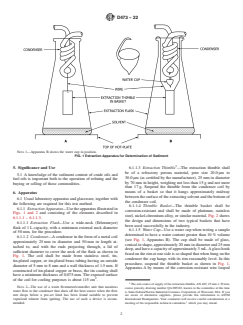
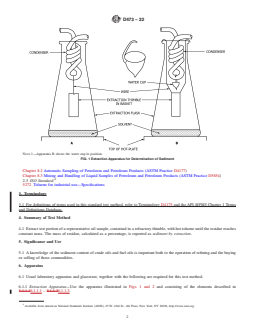
NOTE 1—Apparatus B shows the water cup in position.
FIG. 1 Extraction Apparatus for Determination of Sediment
5. Significance and Use 6.1.1.3 Extraction Thimble —The extraction thimble shall
be of a refractory porous material, pore size 20.0µm to
5.1 A knowledge of the sediment content of crude oils and
30.0µm (as certified by the manufacturer), 25mm in diameter
fuel oils is important both to the operation of refining and the
by 70mm in height, weighing not less than 15g and not more
buying or selling of these commodities.
than 17g. Suspend the thimble from the condenser coil by
means of a basket so that it hangs approximately midway
6. Apparatus
betweenthesurfaceoftheextractingsolventandthebottomof
6.1 Usuallaboratoryapparatusandglassware,togetherwith
the condenser coil.
the following are required for this test method.
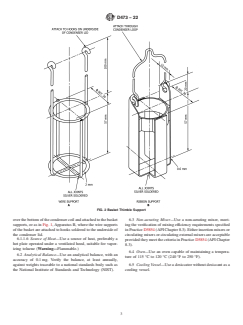
6.1.1.4 Thimble Basket—The thimble basket shall be
6.1.1 Extraction Apparatus—Usetheapparatusillustratedin
corrosion-resistant and shall be made of platinum, stainless
Figs. 1 and 2 and consisting of the elements described in
steel, nickel-chromium alloy, or similar material. Fig. 2 shows
6.1.1.1 – 6.1.1.3.
the design and dimensions of two typical baskets that have
6.1.1.1 Extraction Flask—Use a wide-neck (Erlenmeyer)
been used successfully in the industry.
flask of 1L capacity, with a minimum external neck diameter
6.1.1.5 Water Cup—Use a water cup when testing a sample
of 50mm, for the procedure.
determined to have a water content greater than 10% volume
6.1.1.2 Condenser—Acondenser in the form of a metal coil
(see Fig. 1, Apparatus B). The cup shall be made of glass,
approximately 25mm in diameter and 50mm in length at-
conicalinshape,approximately20mmindiameterand25mm
tached to, and with the ends projecting through, a lid of
deep,andhaveacapacityofapproximately3mL.Aglasshook
sufficient diameter to cover the neck of the flask as shown in
fusedontherimatonesideissoshapedthatwhenhungonthe
Fig. 1. The coil shall be made from stainless steel, tin,
condenser the cup hangs with its rim reasonably level. In this
tin-plated copper, or tin-plated brass tubing having an outside
procedure, suspend the thimble basket as shown in Fig. 1,
diameter of 5mm to 8mm and a wall thickness of 1.5mm. If
Apparatus A by means of the corrosion-resistant wire looped
constructed of tin-plated copper or brass, the tin coating shall
have a minimum thickness of 0.075mm. The exposed surface
of the coil for cooling purposes is about 115cm .
The sole source of supply of the extraction thimble,AN 485, 25mm × 70mm,
NOTE 2—The use of a water flowmeter/controller unit that monitors
coarse porosity, drawing number QA005163, known to the committee at this time
water flow to the condenser that shuts off the heat source when the flow
is Saint-Gobain/Norton Industrial Ceramics Corporation of Worcester, MA. If you
rate drops below a pre-set limit has been found suitable to prevent
are aware of alternative suppliers, please provide this information to ASTM
vaporized toluene from igniting. The use of such a device is recom- International Headquarters. Your comments will receive careful consideration at a
mended. meeting of the responsible technical committee, which you may attend.
D473 − 22
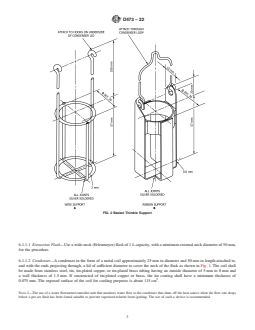
FIG. 2 Basket Thimble Support
overthebottomofthecondensercoilandattachedtothebasket 6.3 Non-aerating Mixer—Use a non-aerating mixer, meet-
supports, or as in Fig. 1,Apparatus B, where the wire supports ingtheverificationofmixingefficiencyrequirementsspecified
ofthebasketareattachedtohookssolderedtotheundersideof inPracticeD5854(APIChapter8.3).Eitherinsertionmixersor
the condenser lid.
circulatingmixersorcirculatingexternalmixersareacceptable
6.1.1.6 Source of Heat—Use a source of heat, preferably a
providedtheymeetthecriteriainPracticeD5854(APIChapter
hot plate operated under a ventilated hood, suitable for vapor-
8.3).
izing toluene (Warning—Flammable.)
6.4 Oven—Use an oven capable of maintaining a tempera-
6.2 Analytical Balance—Use an analytical balance, with an
ture of 115°C to 120°C (240°F to 250°F).
accuracy of 0.1mg. Verify the balance, at least annually,
6.5 Cooling Vessel—Useadesiccatorwithoutdesiccantasa
against weights traceable to a national standards body such as
the National Institute of Standards and Technology (NIST). cooling vessel.
D473 − 22
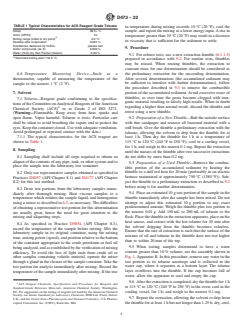
TABLE 1 Typical Characteristics for ACS Reagent Grade Toluene
in temperature during mixing exceeds 10°C (20°F), cool the
Assay 99.5+ % sample,andrepeatthemixingatalowerenergyinput.Arisein
Color (APHA) 10
temperaturegreaterthan10°C(20°F)mayresultinadecrease
A
Boiling range (initial to dry point) 2.0 °C
in viscosity that is sufficient for the sediment to settle.
Residue after evaporation 0.001 %
Substances darkened by H SO passes test
2 4
9. Procedure
Sulfur compounds (as S) 0.003 %
Water (H O) (by Karl Fischer titration) 0.03 %
9.1 For referee tests, use a new extraction thimble (6.1.1.3)
A
Recorded boiling point 110.6 °C.
prepared in accordance with 9.2. For routine tests, thimbles
may be reused. When reusing thimbles, the extraction to
constant mass for one determination should be considered as
the preliminary extraction for the succeeding determination.
6.6 Temperature Measuring Device—Such as a
After several determinations (the accumulated sediment may
thermometer, capable of measuring the temperature of the
be sufficient to interfere with further determinations), follow
sample to the nearest 1°C (2°F).
the procedure described in 9.3 to remove the combustible
7. Solvent portion of the accumulated sediment.Avoid excessive reuse of
thimbles, as over
...
This document is not an ASTM standard and is intended only to provide the user of an ASTM standard an indication of what changes have been made to the previous version. Because
it may not be technically possible to adequately depict all changes accurately, ASTM recommends that users consult prior editions as appropriate. In all cases only the current version
of the standard as published by ASTM is to be considered the official document.
´1
Designation: D473 − 07 (Reapproved 2017) D473 − 22
Manual of Petroleum Measurement Standards (MPMS), Chapter 10.1
Standard Test Method for
Sediment in Crude Oils and Fuel Oils by the Extraction
Method
This standard is issued under the fixed designation D473; the number immediately following the designation indicates the year of
original adoption or, in the case of revision, the year of last revision. A number in parentheses indicates the year of last reapproval. A
superscript epsilon (´) indicates an editorial change since the last revision or reapproval.
This standard has been approved for use by agencies of the U.S. Department of Defense.
ε NOTE—Footnote 1 was corrected editorially in August 2017.
1. Scope Scope*
1.1 This test method covers the determination of sediment in crude oils and fuel oils by extraction with toluene. The precision
applies to a range of sediment levels from 0.01 % to 0.40 % mass, although higher levels may be determined.
NOTE 1—Precision on recycled oils and crankcase oils is unknown and additional testing is required to determine that precision.
1.2 The values stated in SI units are to be regarded as standard. No other units of measurement are included in this standard.
1.3 This standard does not purport to address all of the safety concerns, if any, associated with its use. It is the responsibility
of the user of this standard to establish appropriate safety safety, health, and healthenvironmental practices and determine the
applicability of regulatory limitations prior to use. For specific warning statements, see 5.1.1.66.1.1.6 and 6.17.1.
1.4 This international standard was developed in accordance with internationally recognized principles on standardization
established in the Decision on Principles for the Development of International Standards, Guides and Recommendations issued
by the World Trade Organization Technical Barriers to Trade (TBT) Committee.
2. Referenced Documents
2.1 ASTM Standards:
D4057 Practice for Manual Sampling of Petroleum and Petroleum Products (API MPMS Chapter 8.1)
D4175 Terminology Relating to Petroleum Products, Liquid Fuels, and Lubricants
D4177 Practice for Automatic Sampling of Petroleum and Petroleum Products (API MPMS Chapter 8.2)
D5854 Practice for Mixing and Handling of Liquid Samples of Petroleum and Petroleum Products (API MPMS Chapter 8.3)
E29 Practice for Using Significant Digits in Test Data to Determine Conformance with Specifications
2.2 API Standards:
Chapter 1 Terms and Definitions Database
Chapter 8.1 Manual Sampling of Petroleum and Petroleum Products (ASTM Practice D4057)
This test method is under the jurisdiction of ASTM Committee D02 on Petroleum Products, Liquid Fuels, and Lubricants and the API Committee on Petroleum
Measurement, and is the direct responsibility of Subcommittee D02.02 /COMQ, the joint ASTM-API Committee on Hydrocarbon Measurement for Custody Transfer (Joint
ASTM-API). This test method has been approved by the sponsoring committees and accepted by the Cooperating Societies in accordance with established procedures.
Current edition approved June 1, 2017July 1, 2022. Published July 2017July 2022. Originally approved in 1938. Last previous edition approved in 20122017 as D473 – 07
ɛ1
(2012)(2017) . DOI: 10.1520/D0473-07R17E01.10.1520/D0473-22.
For referenced ASTM standards, visit the ASTM website, www.astm.org, or contact ASTM Customer Service at service@astm.org. For Annual Book of ASTM Standards
volume information, refer to the standard’s Document Summary page on the ASTM website.
Available from American Petroleum Institute (API), 1220 L. St., NW, Washington, DC 20005-4070, http://api-ec.api.org.
*A Summary of Changes section appears at the end of this standard
© Jointly copyrighted by ASTM International, 100 Barr Harbor Drive, PO Box C700, West Conshohocken, PA 19428-2959, USA and the American Petroleum Institute (API), 1220 L Street NW, Washington DC 20005, USA
D473 − 22
NOTE 1—Apparatus B shows the water cup in position.
FIG. 1 Extraction Apparatus for Determination of Sediment
Chapter 8.2 Automatic Sampling of Petroleum and Petroleum Products (ASTM Practice D4177)
Chapter 8.3 Mixing and Handling of Liquid Samples of Petroleum and Petroleum Products (ASTM Practice D5854)
2.3 ISO Standard:
5272 Toluene for industrial use—Specifications
3. Terminology
3.1 For definitions of terms used in this standard test method, refer to Terminology D4175 and the API MPMS Chapter 1 Terms
and Definitions Database.
4. Summary of Test Method
4.1 Extract test portion of a representative oil sample, contained in a refractory thimble, with hot toluene until the residue reaches
constant mass. The mass of residue, calculated as a percentage, is reported as sediment by extraction.
5. Significance and Use
5.1 A knowledge of the sediment content of crude oils and fuel oils is important both to the operation of refining and the buying
or selling of these commodities.
6. Apparatus
6.1 Usual laboratory apparatus and glassware, together with the following are required for this test method.
6.1.1 Extraction Apparatus—Use the apparatus illustrated in Figs. 1 and 2 and consisting of the elements described in
5.1.1.16.1.1.1 – 5.1.1.36.1.1.3.
Available from American National Standards Institute (ANSI), 25 W. 43rd St., 4th Floor, New York, NY 10036, http://www.ansi.org.
D473 − 22
FIG. 2 Basket Thimble Support
6.1.1.1 Extraction Flask—Use a wide-neck (Erlenmeyer) flask of 1 L capacity, with a minimum external neck diameter of 50 mm,
for the procedure.
6.1.1.2 Condenser—A condenser in the form of a metal coil approximately 25 mm in diameter and 50 mm in length attached to,
and with the ends projecting through, a lid of sufficient diameter to cover the neck of the flask as shown in Fig. 1. The coil shall
be made from stainless steel, tin, tin-plated copper, or tin-plated brass tubing having an outside diameter of 5 mm to 8 mm and
a wall thickness of 1.5 mm. If constructed of tin-plated copper or brass, the tin coating shall have a minimum thickness of
0.075 mm. The exposed surface of the coil for cooling purposes is about 115 cm .
NOTE 2—The use of a water flowmeter/controller unit that monitors water flow to the condenser that shuts off the heat source when the flow rate drops
below a pre-set limit has been found suitable to prevent vaporized toluene from igniting. The use of such a device is recommended.
D473 − 22
6.1.1.3 Extraction Thimble —The extraction thimble shall be of a refractory porous material, pore size 20.0 μm to 30.0 μm (as
certified by the manufacturer), 25 mm in diameter by 70 mm in height, weighing not less than 15 g and not more than 17 g.
Suspend the thimble from the condenser coil by means of a basket so that it hangs approximately midway between the surface of
the extracting solvent and the bottom of the condenser coil.
6.1.1.4 Thimble Basket—The thimble basket shall be corrosion-resistant and shall be made of platinum, stainless steel,
nickel-chromium alloy, or similar material. Fig. 2 shows the design and dimensions of two typical baskets that have been used
successfully in the industry.
6.1.1.5 Water Cup—Use a water cup when testing a sample determined to have a water content greater than 10 % volume (see
Fig. 1, Apparatus B). The cup shall be made of glass, conical in shape, approximately 20 mm in diameter and 25 mm deep, and
have a capacity of approximately 3 mL. A glass hook fused on the rim at one side is so shaped that when hung on the condenser
the cup hangs with its rim reasonably level. In this procedure, suspend the thimble basket as shown in Fig. 1, Apparatus A by means
of the corrosion-resistant wire looped over the bottom of the condenser coil and attached to the basket supports, or as in Fig. 1,
Apparatus B, where the wire supports of the basket are attached to hooks soldered to the underside of the condenser lid.
6.1.1.6 Source of Heat—Use a source of heat, preferably a hot plate operated under a ventilated hood, suitable for vaporizing
toluene (Warning—Flammable.)
6.2 Analytical Balance—Use an analytical balance, with an accuracy of 0.1 mg. Verify the balance, at least annually, against
weights traceable to a national standards body such as the National Institute of Standards and Technology (NIST).
6.3 Non-aerating Mixer—Use a non-aerating mixer, meeting the verification of mixing efficiency requirements specified in
Practice D5854 (API Chapter 8.3). Either insertion mixers or circulating mixers or circulating external mixers are acceptable
provided they meet the criteria in Practice D5854 (API Chapter 8.3).
6.4 Oven—Use an oven capable of maintaining a temperature of 115 °C to 120 °C (240 °F to 250 °F).
6.5 Cooling Vessel—Use a desiccator without desiccant as a cooling vessel.
6.6 Temperature Measuring Device—Such as a thermometer, capable of measuring the temperature of the sample to the nearest
1 °C (2 °F).
7. Solvent
7.1 Toluene—Reagent grade conforming to the specifications of the Committee on Analytical Reagents of the American Chemical
Society (ACS) or to Grade 2 of ISO 5272. (Warning—Flammable. Keep away from heat, sparks and open flame. Vapor harmful.
Toluene is toxic. Particular care shall be taken to avoid breathing the vapors and to protect the eyes. Keep the container closed.
Use with adequate ventilation. Avoid prolonged or repeated contact with the skin.)
7.1.1 The typical characteristics for the ACS reagent are shown in Table 1.
8. Sampling
8.1 Sampling shall include all steps required to obtain an aliquot of the contents of any pipe, tank, or other system and to place
the sample into the laboratory test container.
The sole source of supply of the extraction thimble, AN 485, 25 mm × 70 mm, coarse porosity, drawing number QA 005163, known to the committee at this time is
Saint-Gobain/Norton Industrial Ceramics Corporation of Worcester, MA. If you are aware of alternative suppliers, please provide this information to ASTM International
Headquarters. Your comments will receive careful consideration at a meeting of the responsible technical committee, which you may attend.
Reagent Chemicals, American Chemical Society SpecificationsACS Reagent Chemicals, Specifications and Procedures for Reagents and Standard-Grade Reference
Materials, , American Chemical Society, Washington, DC. For suggestions on the testing of reagents not listed by the American Chemical Society, see Analar Standards for
Laboratory Chemicals, BDH Ltd., Poole, Dorset, U.K., and the United States Pharmacopeia and National Formulary, U.S. Pharmacopeial
...