

ASTM D5708-15(2020)e1
(Test Method)Standard Test Methods for Determination of Nickel, Vanadium, and Iron in Crude Oils and Residual Fuels by Inductively Coupled Plasma (ICP) Atomic Emission Spectrometry
General Information
- Abstract
SIGNIFICANCE AND USE
4.1 These test methods cover, in single procedures, the determination of Ni, V, and Fe in crude oils and residual oils. These test methods complement Test Method D1548, which covers only the determination of vanadium.
4.2 When fuels are combusted, vanadium present in the fuel can form corrosive compounds. The value of crude oils can be determined, in part, by the concentrations of nickel, vanadium, and iron. Nickel and vanadium, present at trace levels in petroleum fractions, can deactivate catalysts during processing. These test methods provide a means of determining the concentrations of nickel, vanadium, and iron.
SCOPE
1.1 These test methods cover the determination of nickel, vanadium, and iron in crude oils and residual fuels by inductively coupled plasma (ICP) atomic emission spectrometry. Two different test methods are presented.
1.2 Test Method A (Sections 7 – 11 and 18 – 22)—ICP is used to analyze a sample dissolved in an organic solvent. This test method uses oil-soluble metals for calibration and does not purport to quantitatively determine or detect insoluble particulates.
1.3 Test Method B (Sections 12 – 22)—ICP is used to analyze a sample that is decomposed with acid.
1.4 The concentration ranges covered by these test methods are determined by the sensitivity of the instruments, the amount of sample taken for analysis, and the dilution volume. A specific statement is given in 15.2. Typically, the low concentration limits are a few tenths of a milligram per kilogram. Precision data are provided for the concentration ranges specified in Section 21.
1.5 The values stated in SI units are to be regarded as standard.
1.5.1 Exception—The values given in parentheses are for information only.
1.6 This standard does not purport to address all of the safety concerns, if any, associated with its use. It is the responsibility of the user of this standard to establish appropriate safety, health, and environmental practices and determine the applicability of regulatory limitations prior to use.
1.7 This international standard was developed in accordance with internationally recognized principles on standardization established in the Decision on Principles for the Development of International Standards, Guides and Recommendations issued by the World Trade Organization Technical Barriers to Trade (TBT) Committee.
- Status
- Published
- Publication Date
- 31-May-2020
- Technical Committee
- D02 - Petroleum Products, Liquid Fuels, and Lubricants
- Drafting Committee
- D02.03 - Elemental Analysis
Overview
ASTM D5708-15(2020)e1 specifies standard test methods for the determination of nickel, vanadium, and iron in crude oils and residual fuels using Inductively Coupled Plasma (ICP) Atomic Emission Spectrometry. These procedures address critical needs within the petroleum industry, supporting the monitoring of trace metals that can impact refining, catalyst performance, and fuel value. Ensuring accurate quantification of nickel, vanadium, and iron is essential for both quality control and regulatory compliance in petroleum operations worldwide.
Key Topics
- Scope: Covers two distinct ICP-AES test methods for quantifying Ni, V, and Fe in a variety of petroleum matrices.
- Test Method A: Sample dissolved in organic solvent; uses oil-soluble metals for calibration. Not suitable for detecting insoluble particulates.
- Test Method B: Sample is decomposed with acid, enabling element measurement after mineralization.
- Elemental Analysis: Determines nickel, vanadium, and iron concentrations, which are influential in assessing crude oil quality and predicting processing challenges.
- Significance:
- Trace metals can deactivate catalysts, reducing operational efficiency.
- Vanadium in fuels can form corrosive compounds upon combustion, making assessment essential for engine and equipment protection.
- Accurate metal quantification aids in valuation and classification of petroleum products.
- Applicability: Suitable for both crude oils and residual (heavy) fuels. The test methods can detect elements typically present at a few tenths of a milligram per kilogram.
Applications
- Petroleum Refining: Enables refineries to monitor and manage trace metal content to optimize catalyst use, reduce fouling, and improve yield.
- Fuel Characterization: Assists in ensuring fuels comply with environmental and performance standards by controlling metal-induced corrosion.
- Quality Assurance: Supports laboratories in maintaining product consistency and verifying that samples meet industry and regulatory specifications.
- Asset Protection: Prevents operational damage by identifying feedstocks with high nickel or vanadium, which can be problematic during combustion or processing.
- Trade and Valuation: Facilitates accurate crude oil classification and pricing based on metal content.
Related Standards
For comprehensive laboratory and sampling protocols, the following ASTM standards are closely related:
- ASTM D1548: Method for vanadium in heavy fuel oil.
- ASTM D4057: Practice for manual sampling of petroleum and petroleum products.
- ASTM D4177: Practice for automatic sampling of petroleum and petroleum products.
- ASTM D5185: Multielement determination in lubricating and base oils by ICP-AES.
- ASTM D6299: Statistical quality assurance and control charting techniques for analytical measurement.
- ASTM D7260: Optimization, calibration, and validation of ICP-AES for elemental analysis in petroleum products.
Practical Value
- High Sensitivity: Methods provide accurate measurement at low concentration levels, supporting detailed process analysis.
- Process Control: Enables real-time monitoring and troubleshooting for refineries and fuel producers.
- International Acceptance: Developed in accordance with internationally recognized principles on standardization, ensuring broad industry compatibility.
- Supports Compliance: Assists companies in meeting environmental, health, and safety regulations by quantifying harmful metal contaminants.
Keywords
ASTM D5708, ICP-AES, inductively coupled plasma, atomic emission spectrometry, nickel determination, vanadium determination, iron analysis, crude oil, residual fuel, trace metals in petroleum, catalyst deactivation, fuel corrosion, petroleum standard test methods.
Relations
- Effective Date
- 01-Dec-2023
- Effective Date
- 01-May-2019
- Effective Date
- 01-Apr-2018
- Effective Date
- 15-Dec-2017
- Effective Date
- 15-Nov-2017
- Effective Date
- 01-Jan-2017
- Effective Date
- 01-Oct-2013
- Refers
ASTM D4057-06(2011) - Standard Practice for Manual Sampling of Petroleum and Petroleum Products - Effective Date
- 01-Jun-2011
- Effective Date
- 01-Mar-2010
- Effective Date
- 01-Mar-2010
- Effective Date
- 01-Nov-2009
- Effective Date
- 15-Apr-2009
- Effective Date
- 15-Oct-2008
- Effective Date
- 01-Nov-2007
- Effective Date
- 01-Nov-2007
Get Certified
Connect with accredited certification bodies for this standard

Element Materials Technology
Materials testing and product certification.

ABS Group Brazil
ABS Group certification services in Brazil.

ABS Quality Evaluations Inc.
American Bureau of Shipping quality certification.
Sponsored listings
Frequently Asked Questions
ASTM D5708-15(2020)e1 is a standard published by ASTM International. Its full title is "Standard Test Methods for Determination of Nickel, Vanadium, and Iron in Crude Oils and Residual Fuels by Inductively Coupled Plasma (ICP) Atomic Emission Spectrometry". This standard covers: SIGNIFICANCE AND USE 4.1 These test methods cover, in single procedures, the determination of Ni, V, and Fe in crude oils and residual oils. These test methods complement Test Method D1548, which covers only the determination of vanadium. 4.2 When fuels are combusted, vanadium present in the fuel can form corrosive compounds. The value of crude oils can be determined, in part, by the concentrations of nickel, vanadium, and iron. Nickel and vanadium, present at trace levels in petroleum fractions, can deactivate catalysts during processing. These test methods provide a means of determining the concentrations of nickel, vanadium, and iron. SCOPE 1.1 These test methods cover the determination of nickel, vanadium, and iron in crude oils and residual fuels by inductively coupled plasma (ICP) atomic emission spectrometry. Two different test methods are presented. 1.2 Test Method A (Sections 7 – 11 and 18 – 22)—ICP is used to analyze a sample dissolved in an organic solvent. This test method uses oil-soluble metals for calibration and does not purport to quantitatively determine or detect insoluble particulates. 1.3 Test Method B (Sections 12 – 22)—ICP is used to analyze a sample that is decomposed with acid. 1.4 The concentration ranges covered by these test methods are determined by the sensitivity of the instruments, the amount of sample taken for analysis, and the dilution volume. A specific statement is given in 15.2. Typically, the low concentration limits are a few tenths of a milligram per kilogram. Precision data are provided for the concentration ranges specified in Section 21. 1.5 The values stated in SI units are to be regarded as standard. 1.5.1 Exception—The values given in parentheses are for information only. 1.6 This standard does not purport to address all of the safety concerns, if any, associated with its use. It is the responsibility of the user of this standard to establish appropriate safety, health, and environmental practices and determine the applicability of regulatory limitations prior to use. 1.7 This international standard was developed in accordance with internationally recognized principles on standardization established in the Decision on Principles for the Development of International Standards, Guides and Recommendations issued by the World Trade Organization Technical Barriers to Trade (TBT) Committee.
SIGNIFICANCE AND USE 4.1 These test methods cover, in single procedures, the determination of Ni, V, and Fe in crude oils and residual oils. These test methods complement Test Method D1548, which covers only the determination of vanadium. 4.2 When fuels are combusted, vanadium present in the fuel can form corrosive compounds. The value of crude oils can be determined, in part, by the concentrations of nickel, vanadium, and iron. Nickel and vanadium, present at trace levels in petroleum fractions, can deactivate catalysts during processing. These test methods provide a means of determining the concentrations of nickel, vanadium, and iron. SCOPE 1.1 These test methods cover the determination of nickel, vanadium, and iron in crude oils and residual fuels by inductively coupled plasma (ICP) atomic emission spectrometry. Two different test methods are presented. 1.2 Test Method A (Sections 7 – 11 and 18 – 22)—ICP is used to analyze a sample dissolved in an organic solvent. This test method uses oil-soluble metals for calibration and does not purport to quantitatively determine or detect insoluble particulates. 1.3 Test Method B (Sections 12 – 22)—ICP is used to analyze a sample that is decomposed with acid. 1.4 The concentration ranges covered by these test methods are determined by the sensitivity of the instruments, the amount of sample taken for analysis, and the dilution volume. A specific statement is given in 15.2. Typically, the low concentration limits are a few tenths of a milligram per kilogram. Precision data are provided for the concentration ranges specified in Section 21. 1.5 The values stated in SI units are to be regarded as standard. 1.5.1 Exception—The values given in parentheses are for information only. 1.6 This standard does not purport to address all of the safety concerns, if any, associated with its use. It is the responsibility of the user of this standard to establish appropriate safety, health, and environmental practices and determine the applicability of regulatory limitations prior to use. 1.7 This international standard was developed in accordance with internationally recognized principles on standardization established in the Decision on Principles for the Development of International Standards, Guides and Recommendations issued by the World Trade Organization Technical Barriers to Trade (TBT) Committee.
ASTM D5708-15(2020)e1 is classified under the following ICS (International Classification for Standards) categories: 75.040 - Crude petroleum; 75.160.20 - Liquid fuels. The ICS classification helps identify the subject area and facilitates finding related standards.
ASTM D5708-15(2020)e1 has the following relationships with other standards: It is inter standard links to ASTM D6299-23a, ASTM D7260-19, ASTM D5185-18, ASTM D6299-17b, ASTM D6299-17a, ASTM D6299-17, ASTM D6299-13e1, ASTM D4057-06(2011), ASTM D6299-10e2, ASTM D6299-10, ASTM D6299-09, ASTM D5185-09, ASTM D6299-08, ASTM D6299-07, ASTM D6299-07e1. Understanding these relationships helps ensure you are using the most current and applicable version of the standard.
ASTM D5708-15(2020)e1 is available in PDF format for immediate download after purchase. The document can be added to your cart and obtained through the secure checkout process. Digital delivery ensures instant access to the complete standard document.
Standards Content (Sample)
This international standard was developed in accordance with internationally recognized principles on standardization established in the Decision on Principles for the
Development of International Standards, Guides and Recommendations issued by the World Trade Organization Technical Barriers to Trade (TBT) Committee.
´1
Designation: D5708 − 15 (Reapproved 2020)
Standard Test Methods for
Determination of Nickel, Vanadium, and Iron in Crude Oils
and Residual Fuels by Inductively Coupled Plasma (ICP)
Atomic Emission Spectrometry
This standard is issued under the fixed designation D5708; the number immediately following the designation indicates the year of
original adoption or, in the case of revision, the year of last revision. A number in parentheses indicates the year of last reapproval. A
superscript epsilon (´) indicates an editorial change since the last revision or reapproval.
ε NOTE—Editorially updated X2.19 in July 2020.
1. Scope Development of International Standards, Guides and Recom-
mendations issued by the World Trade Organization Technical
1.1 These test methods cover the determination of nickel,
Barriers to Trade (TBT) Committee.
vanadium, and iron in crude oils and residual fuels by
inductively coupled plasma (ICP) atomic emission spectrom-
2. Referenced Documents
etry. Two different test methods are presented.
2.1 ASTM Standards:
1.2 Test Method A (Sections 7–11 and 18–22)—ICP is
D1193 Specification for Reagent Water
used to analyze a sample dissolved in an organic solvent. This
D1548 Test Method for Vanadium in Heavy Fuel Oil
test method uses oil-soluble metals for calibration and does not
(Withdrawn 1997)
purport to quantitatively determine or detect insoluble particu-
D4057 Practice for Manual Sampling of Petroleum and
lates.
Petroleum Products
D4177 Practice for Automatic Sampling of Petroleum and
1.3 Test Method B (Sections 12–22)—ICP is used to
Petroleum Products
analyze a sample that is decomposed with acid.
D5185 Test Method for Multielement Determination of
1.4 The concentration ranges covered by these test methods
Used and Unused Lubricating Oils and Base Oils by
are determined by the sensitivity of the instruments, the
Inductively Coupled Plasma Atomic Emission Spectrom-
amount of sample taken for analysis, and the dilution volume.
etry (ICP-AES)
A specific statement is given in 15.2. Typically, the low
D6299 Practice for Applying Statistical Quality Assurance
concentration limits are a few tenths of a milligram per
and Control Charting Techniques to Evaluate Analytical
kilogram. Precision data are provided for the concentration
Measurement System Performance
ranges specified in Section 21.
D7260 Practice for Optimization, Calibration, and Valida-
1.5 The values stated in SI units are to be regarded as
tion of Inductively Coupled Plasma-Atomic Emission
standard.
Spectrometry (ICP-AES) for ElementalAnalysis of Petro-
1.5.1 Exception—The values given in parentheses are for
leum Products and Lubricants
information only.
3. Summary of Test Method
1.6 This standard does not purport to address all of the
3.1 Test Method A—Approximately 10 g of the sample are
safety concerns, if any, associated with its use. It is the
dissolved in an organic solvent (Warning—Combustible. Va-
responsibility of the user of this standard to establish appro-
por is harmful.) to give a specimen solution containing 10 %
priate safety, health, and environmental practices and deter-
(m/m) of sample. The solution is nebulized into the plasma,
mine the applicability of regulatory limitations prior to use.
and the intensities of the emitted light at wavelengths charac-
1.7 This international standard was developed in accor-
teristic of the analytes are measured sequentially or simultane-
dance with internationally recognized principles on standard-
ously. The intensities are related to concentrations by the
ization established in the Decision on Principles for the
appropriate use of calibration data.
1 2
These test methods are under the jurisdiction of ASTM Committee D02 on For referenced ASTM standards, visit the ASTM website, www.astm.org, or
Petroleum Products, Liquid Fuels, and Lubricants and is the direct responsibility of contact ASTM Customer Service at service@astm.org. For Annual Book of ASTM
Subcommittee D02.03 on Elemental Analysis. Standards volume information, refer to the standard’s Document Summary page on
CurrenteditionapprovedJune1,2020.PublishedJuly2020.Originallyapproved the ASTM website.
in 1995. Last previous edition approved in 2015 as D5708 – 15. DOI: 10.1520/ The last approved version of this historical standard is referenced on
D5708-15R20E01. www.astm.org.
Copyright © ASTM International, 100 Barr Harbor Drive, PO Box C700, West Conshohocken, PA 19428-2959. United States
´1
D5708 − 15 (2020)
3.2 Test Method B—1 g to 20 g of sample are weighed into 6.2 Prior to weighing, stir the sample and manually shake
a beaker and decomposed with concentrated sulfuric acid the sample container. If the sample does not readily flow at
(Warning—Poison. Causes severe burns. Harmful or fatal if room temperature, heat the sample in a drying oven at 80 °C or
swallowed or inhaled.) by heating to dryness. Great care must at another safe temperature.
be used in this decomposition because the acid fumes are
TEST METHOD A—
corrosive and the mixture is potentially flammable. The re-
ICP WITH AN ORGANIC SOLVENT SPECIMEN
sidual carbon is burned off by heating at 525 °C in a muffle
SOLUTION
furnace. The inorganic residue is digested with nitric acid
(Warning—Poison. Causes severe burns. Harmful or fatal if
7. Apparatus
swallowed or inhaled.), evaporated to incipient dryness, dis-
7.1 Inductively Coupled Plasma Atomic Emission
solved in dilute nitric acid, and made up to volume. The
Spectrometer—Either a sequential or simultaneous
solution is nebulized into the plasma of an atomic emission
spectrometer,equippedwithaquartztorchandradio-frequency
spectrometer. The intensities of light emitted at characteristic
generator to form and sustain the plasma, is suitable.
wavelengths of the metals are measured sequentially or simul-
taneously.These intensities are related to concentrations by the
7.2 Nebulizer—The use of a high-solids nebulizer is op-
appropriate use of calibration data.
tional but strongly recommended. This type of nebulizer
minimizes the probability of clogging. A concentric glass
4. Significance and Use
nebulizer can also be used.
4.1 These test methods cover, in single procedures, the
7.3 Peristaltic Pump—This pump is required for non-
determination of Ni, V, and Fe in crude oils and residual oils.
aspirating nebulizers and optional for aspirating nebulizers.
These test methods complement Test Method D1548, which
The pump must achieve a flow rate in the range of 0.5 mL⁄min
covers only the determination of vanadium.
to 3 mL⁄min. The pump tubing must be able to withstand at
4.2 When fuels are combusted, vanadium present in the fuel
least a 6 h exposure to the solvent. Fluoroelastomer copolymer
can form corrosive compounds. The value of crude oils can be
tubing is recommended.
determined, in part, by the concentrations of nickel, vanadium,
7.4 Specimen Solution Containers, glass or plastic vials or
and iron. Nickel and vanadium, present at trace levels in
bottles with screw caps having a capacity of appropriate size.
petroleumfractions,candeactivatecatalystsduringprocessing.
One hundred millilitre glass bottles are satisfactory.
These test methods provide a means of determining the
concentrations of nickel, vanadium, and iron.
8. Reagents
8.1 Dilution Solvent—Mixed xylenes, o-xylene, tetralin and
5. Purity of Reagents
mixed paraffin-aromatic solvents are satisfactory. Solvent pu-
5.1 Reagent grade chemicals shall be used in all tests.
rity can affect analytical accuracy when the sample contains
Unless otherwise indicated, it is intended that all reagents
low concentrations (typically, a few milligrams per kilogram)
conform to the specifications of the Committee on Analytical
of the analytes.
Reagents of the American Chemical Society where such
8.2 Mineral Oil—Ahigh-purity oil such as U.S.P. white oil.
specifications are available. Other grades may be used, pro-
vided it is first ascertained that the reagent is of sufficiently
8.3 Organometallic Standards—Pre-prepared multielement
high purity to permit its use without lessening the accuracy of
concentrates containing 100 mg⁄kg concentrations of each
the determination.
element are satisfactory.
5.2 When determining metals at concentrations less than
8.4 Quality Control (QC) Samples, preferably are portions
1 mg⁄kg, use ultra-pure reagents.
of one or more liquid petroleum materials that are stable and
representative of the samples of interest. These QC samples
5.3 Purity of Water—Unless otherwise indicated, reference
can be used to check the validity of the testing process as
towatershallbeunderstoodtomeanreagentwaterconforming
described in Section 19.
to Type II of Specification D1193.
9. Preparation of Standards and Specimens
6. Sampling and Sample Handling
9.1 Blank—Prepare a blank by diluting mineral oil with
6.1 The objective of sampling is to obtain a sample for
dilutionsolvent.Theconcentrationofmineraloilmustbe10 %
testing purposes that is representative of the entire quantity.
(m/m). Mix well.
Thus, take samples in accordance with the instructions in
Practice D4057 or D4177. Do not fill the sample container
9.2 Check Standard—Using organometallic standards, min-
more than two-thirds full.
eral oil, and dilution solvent, prepare a check standard to
contain analyte concentrations approximately the same as
expected in the specimens. The concentration of oil in the
ACS Reagent Chemicals, Specifications and Procedures for Reagents and
check standard must be 10 % (m/m).
Standard-Grade Reference Materials, American Chemical Society, Washington,
DC. For suggestions on the testing of reagents not listed by theAmerican Chemical
Society, see Analar Standards for Laboratory Chemicals, BDH Ltd., Poole, Dorset,
U.K., and the United States Pharmacopeia and National Formulary, U.S. Pharma- Fluoroelastomer copolymer is manufactured asViton, a trademark owned by E.
copeial Convention, Inc. (USPC), Rockville, MD. I. duPont de Nemours.
´1
D5708 − 15 (2020)
9.3 Test Specimen—Weigh a portion of well-mixed sample load coil. Carbon deposits can invalidate a calibration and
into a container and add sufficient solvent to achieve a sample extinguish the plasma.
concentration of 10 % (m/m). Mix well.
11. Calibration and Analysis
9.4 Working Standard—Prepare an instrument calibration
standard that contains 10 mg⁄kg each of vanadium, nickel, and
11.1 Using the blank and working standard, perform a
iron. Combine the organometallic standard, dilution solvent
two-point calibration at the beginning of the analysis of each
and, if necessary, mineral oil so that the oil content of the
batch of specimens.Additional working standards can be used,
calibration standard is 10 % (m/m).
if desired.
9.5 Quality Control (QC) Samples—Weigh a portion of the
11.2 Use the check standard to determine if the calibration
well-mixed QC sample into a container and add sufficient
for each analyte is accurate. When the result obtained on the
solvent to achieve a sample concentration of 10 % (m/m).
check standard is not within 65 % of the expected concentra-
tion for each analyte, take corrective action and repeat the
10. Preparation of Apparatus
calibration.
10.1 Consult Practice D7260 regarding the optimum opera-
11.3 Analyze the specimens in the same manner as the
tion of any ICP-AES system.
calibration standards (that is, same integration time, plasma
10.2 Consult the manufacturer’s instructions for the opera-
conditions, and so forth). Calculate concentrations by multi-
tion of the ICPinstrument.This test method assumes that good
plying the concentration determined for the test specimen
operating procedures are followed. Design differences between
solution by the dilution factor. Calculation of concentrations
instruments make it impracticaltospecifyrequiredparameters.
can be performed manually or by computer when such a
feature is available.
10.3 Assign the appropriate operating parameters to the
instrument taskfile so that the desired analytes can be deter-
11.4 When the measured intensities for the test specimen
mined. Parameters include: (1) element, (2) analytical
solution exceed the corresponding intensities for the working
wavelength, (3) background correction wavelengths (optional),
standard, either ensure that the calibration curve is linear to the
(4) interelement correction factors (refer to 10.4), (5) integra-
concentration of the element in the test specimen solution or
tion time of 1 s to 10 s, (6) two to five consecutive repeat
dilute the test specimen solution with the blank solution and
integrations. Suggested wavelengths are listed in Table 1.
reanalyze.
10.4 Spectral Interferences—Check all spectral interfer-
11.5 Analyze the check standard after every fifth specimen.
ences expected for the analytes. If interference corrections are
If any result is not within 5 % of the expected concentration,
necessary, follow the manufacturer’s operating guide to de-
take corrective action, repeat the calibration, and reanalyze the
velop and apply correction factors.
specimen solutions back to the previous acceptable check
10.4.1 Spectral interferences can usually be avoided by
standard analysis.
judicious choice of analytical wavelengths. If spectral interfer-
ences cannot be avoided, the necessary corrections should be 11.6 The use of spectral background correction is highly
recommended, particularly when the test specimen solutions
made using the computer software supplied by the instrument
manufacturer or by using the empirical method described in contain low concentrations of the analytes (typically less than
1 mg/kg). When concentrations are low, background changes,
Test Method D5185.
which can result from variability in the compositions of test
10.5 Consult the instrument manufacturer’s instructions for
specimen solutions, can affect the accuracy of the analysis.
operating the instrument with organic solvents.
Background correction minimizes errors due to variable back-
10.6 During instrument warm-up, nebulize the blank solu-
ground intensities.
tion. Inspect the torch for carbon build-up. When carbon
TEST METHOD B—
build-up occurs, replace the torch and adjust the operating
ICP AFTER ACID DECOMPOSITION OF SAMPLE
conditions to correct the problem.
10.6.1 Carbon build-up within the torch can be caused by
12. Apparatus
improperly adjusted argon flow rates, improper solution flow
rates, and positioning the torch injector tube too close to the
12.1 Refer to 7.1 – 7.4.
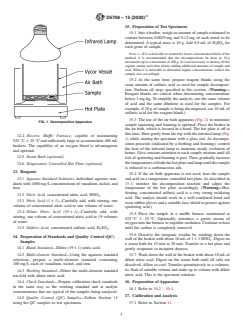
12.2 Sample Decomposition Apparatus (optional)—Thisap-
TABLE 1 Elements Determined and Suggested Wavelengths
paratus is shown in Fig. 1. It consists of a high-silica or
NOTE 1—These wavelengths are suggestions and do not represent all
borosilicate 400 mL beaker for the specimen, an air bath (Fig.
A
possible choices.
2) that rests on a hot plate, and a 250 watt infrared lamp
Element Wavelength, nm
supported 1 in. above the air bath. A variable transformer
Iron 259.94, 238.20
controls the voltage applied to the lamp.
Nickel 231.60, 216.56
Vanadium 292.40, 310.22
12.3 Glassware, high-silica or borosilicate 400 mLbeakers,
A
Winge,R.K.,Fassel,V.A.,Peterson,V.J.,andFloyd,M.A.,InductivelyCoupled
volumetric flasks of various capacities, and pipettes of various
PlasmaAtomic Emission Spectroscopy:AnAtlas of Spectral Information, Elsevier,
capacities. All glassware used in this test method must be
NY, 1985.
thoroughly cleaned and rinsed with water.
´1
D5708 − 15 (2020)
15. Preparation of Test Specimens
15.1 Into a beaker, weigh an amount of sample estimated to
contain between 0.0025 mg and 0.12 mg of each metal to be
determined. A typical mass is 10 g. Add 0.5 mL of H SO for
2 4
each gram of sample.
NOTE1—Ifitisdesirabletoextendthelowerconcentrationlimitsofthe
method, it is recommended that the decompositions be done in 10 g
incrementsuptoamaximumof100 g.Itisnotnecessarytodestroyallthe
organic matter each time before adding additional amounts of sample and
acid. When it is desirable to determine higher concentrations, reduce the
sample size accordingly.
15.2 At the same time, prepare reagent blanks using the
same amount of sulfuric acid as used for sample decomposi-
tion. Perform all steps specified in this section. (Warning—
Reagent blanks are critical when determining concentrations
below 1 mg⁄kg. To simplify the analysis, use the same volume
of acid and the same dilutions as used for the samples. For
example, if 20
...