

ASTM E2649-20
(Test Method)Standard Test Method for Determining Argon Concentration in Sealed Insulating Glass Units Using Spark Emission Spectroscopy
General Information
- Abstract
SIGNIFICANCE AND USE
5.1 This test method is intended to provide a means for determining the concentration of argon in sealed insulating glass units under controlled conditions in compliance with the apparatus manufacturer's instructions.
5.2 This is a non-destructive test method in that the edge seal of the test specimen is not breached in order to determine the argon gas concentration. However, damage to some glass coatings on the inner surfaces of the glass can occur.
5.3 This test method has been developed based on data collected in a controlled laboratory environment.
5.4 The device shall be used to determine the argon gas concentration in insulating glass units in a controlled laboratory environment. Refer to 12.3.
5.5 This test method may be used to determine the argon gas concentration before, during, or after the insulating glass unit is subjected to durability tests.
5.6 The accuracy of the test method is dependent upon the accuracy of the Spark Emission Spectroscope. When the concentration of the argon being measured is below certain levels, this test method is not applicable. See the spectroscope manufacturer’s literature for recommended levels of accuracy of a given model.
SCOPE
1.1 This test method covers procedures for using a spark emission spectroscope to determine the concentration of argon gas in the space between the lites of a sealed insulating glass unit.
1.2 This is a non-destructive test method.
1.3 This test method shall be used only in a controlled laboratory environment.
1.4 This test method is applicable for insulating glass units where argon has been added to the sealed insulating glass cavity and the balance of the gas is atmospheric air.
1.5 This test method is applicable for clear, double-glazed insulating glass units.
1.6 This test method is applicable for double-glazed insulating glass units with one lite having a metallic coating or tinted glass, or both, and with clear glass as the other lite.
1.7 This test method is applicable for triple-glazed insulating glass units only when the center lite of glass has a metallic coating (either low emissivity (low E) or reflective) and both of the other lites are clear glass.
1.8 This test method also includes a procedure for verifying the accuracy of the readings of the test apparatus.
1.9 The values stated in SI units are to be regarded as standard. The values given in parentheses after SI units are provided for information only and are not considered standard.
1.10 This standard does not purport to address all of the safety concerns, if any, associated with its use. It is the responsibility of the user of this standard to establish appropriate safety, health, and environmental practices and determine the applicability of regulatory limitations prior to use. For specific warning statements, refer to Section 7 on Hazards.
1.11 This international standard was developed in accordance with internationally recognized principles on standardization established in the Decision on Principles for the Development of International Standards, Guides and Recommendations issued by the World Trade Organization Technical Barriers to Trade (TBT) Committee.
- Status
- Published
- Publication Date
- 14-Feb-2020
- Technical Committee
- E06 - Performance of Buildings
- Drafting Committee
- E06.22 - Durability Performance of Building Constructions
Buy Documents
ASTM E2649-20 - Standard Test Method for Determining Argon Concentration in Sealed Insulating Glass Units Using Spark Emission Spectroscopy
REDLINE ASTM E2649-20 - Standard Test Method for Determining Argon Concentration in Sealed Insulating Glass Units Using Spark Emission Spectroscopy
Overview
ASTM E2649-20 provides a standardized test method for determining the concentration of argon gas within sealed insulating glass units (IGUs) using spark emission spectroscopy (SES). Developed by ASTM International, this standard is crucial for evaluating the integrity and performance of insulating glass units, especially where argon is used as a fill gas to enhance thermal efficiency. The test is performed non-destructively, allowing for quality control and assurance without breaching the edge seal of the IGU, though care must be taken to avoid potential damage to internal glass coatings.
Key Topics
- Non-destructive Testing: This method allows accurate measurement of argon concentration without opening or damaging the IGU's seal, preserving sample integrity.
- Laboratory Environment: The procedure requires a controlled laboratory setting to ensure reliability, consistent temperatures, and avoidance of direct sunlight or intense lighting.
- Test Applicability:
- Double-glazed units with or without metallic/tinted coatings
- Triple-glazed units when the center lite is coated and the outer lites are clear
- Instrument Calibration and Verification:
- Emphasizes the importance of frequent calibration and verification using specimens filled with known argon concentrations
- Users must refer to the spectroscope manufacturer’s guidelines for model-specific limitations and accuracy ranges
- Precision and Accuracy: The accuracy of results relies on both the device used and proper adherence to the outlined procedures, including using SI units as the standard measurement system.
- Safety: Operators are responsible for establishing and adhering to necessary safety measures, as the test involves high voltage equipment. The method should not be used near flammable substances or by persons with pacemakers.
Applications
The standardized test method outlined in ASTM E2649-20 offers significant value for:
- Quality Assurance in Manufacturing: IGU manufacturers can use this method as a quality control tool to verify proper argon gas fill levels in products before, during, or after durability testing.
- Product Evaluation: Laboratories assessing the performance of insulating glass units for energy efficiency or durability will find this method essential for accurate gas fill analysis.
- Durability Testing: The standard allows repeated assessment of argon concentration before and after subjecting IGUs to environmental or accelerated aging tests.
- Building Performance Verification: While the method is restricted to laboratory use, results support compliance with building and energy performance specifications that often require argon gas as a fill for improved insulation.
Related Standards
ASTM E2649-20 references a number of related ASTM standards that provide definitions or supplementary procedures relevant to glass products and test method validation. Key related standards include:
- ASTM C162: Terminology of Glass and Glass Products
- ASTM C717: Terminology of Building Seals and Sealants
- ASTM E631: Terminology of Building Constructions
- ASTM E177: Practice for Use of Terms Precision and Bias in ASTM Test Methods
- ASTM E691: Practice for Interlaboratory Studies to Determine the Precision of a Test Method
- ASTM E2190: Specification for Insulating Glass Unit Performance and Evaluation
By following ASTM E2649-20 and associated standards, manufacturers and laboratories ensure consistent, reliable assessment of argon gas concentrations in insulating glass units, ultimately contributing to better building performance and energy efficiency.
Keywords: ASTM E2649-20, argon concentration, sealed insulating glass unit, spark emission spectroscopy, non-destructive testing, IGU performance testing, laboratory procedure, building energy efficiency, gas fill verification.
Relations
- Effective Date
- 15-Feb-2020
- Effective Date
- 01-Oct-2023
- Effective Date
- 01-Apr-2019
- Effective Date
- 01-Mar-2019
- Effective Date
- 01-Mar-2018
- Effective Date
- 01-Nov-2017
- Effective Date
- 01-Jan-2017
- Effective Date
- 15-Nov-2016
- Effective Date
- 01-Sep-2016
- Effective Date
- 01-Nov-2015
- Effective Date
- 01-Mar-2015
- Effective Date
- 01-Nov-2014
- Effective Date
- 01-May-2014
- Effective Date
- 01-May-2014
- Effective Date
- 01-Feb-2014
Buy Documents
ASTM E2649-20 - Standard Test Method for Determining Argon Concentration in Sealed Insulating Glass Units Using Spark Emission Spectroscopy
REDLINE ASTM E2649-20 - Standard Test Method for Determining Argon Concentration in Sealed Insulating Glass Units Using Spark Emission Spectroscopy
Get Certified
Connect with accredited certification bodies for this standard

ECOCERT
Organic and sustainability certification.

Eurofins Food Testing Global
Global leader in food, environment, and pharmaceutical product testing.

Intertek Bangladesh
Intertek certification and testing services in Bangladesh.
Sponsored listings
Frequently Asked Questions
ASTM E2649-20 is a standard published by ASTM International. Its full title is "Standard Test Method for Determining Argon Concentration in Sealed Insulating Glass Units Using Spark Emission Spectroscopy". This standard covers: SIGNIFICANCE AND USE 5.1 This test method is intended to provide a means for determining the concentration of argon in sealed insulating glass units under controlled conditions in compliance with the apparatus manufacturer's instructions. 5.2 This is a non-destructive test method in that the edge seal of the test specimen is not breached in order to determine the argon gas concentration. However, damage to some glass coatings on the inner surfaces of the glass can occur. 5.3 This test method has been developed based on data collected in a controlled laboratory environment. 5.4 The device shall be used to determine the argon gas concentration in insulating glass units in a controlled laboratory environment. Refer to 12.3. 5.5 This test method may be used to determine the argon gas concentration before, during, or after the insulating glass unit is subjected to durability tests. 5.6 The accuracy of the test method is dependent upon the accuracy of the Spark Emission Spectroscope. When the concentration of the argon being measured is below certain levels, this test method is not applicable. See the spectroscope manufacturer’s literature for recommended levels of accuracy of a given model. SCOPE 1.1 This test method covers procedures for using a spark emission spectroscope to determine the concentration of argon gas in the space between the lites of a sealed insulating glass unit. 1.2 This is a non-destructive test method. 1.3 This test method shall be used only in a controlled laboratory environment. 1.4 This test method is applicable for insulating glass units where argon has been added to the sealed insulating glass cavity and the balance of the gas is atmospheric air. 1.5 This test method is applicable for clear, double-glazed insulating glass units. 1.6 This test method is applicable for double-glazed insulating glass units with one lite having a metallic coating or tinted glass, or both, and with clear glass as the other lite. 1.7 This test method is applicable for triple-glazed insulating glass units only when the center lite of glass has a metallic coating (either low emissivity (low E) or reflective) and both of the other lites are clear glass. 1.8 This test method also includes a procedure for verifying the accuracy of the readings of the test apparatus. 1.9 The values stated in SI units are to be regarded as standard. The values given in parentheses after SI units are provided for information only and are not considered standard. 1.10 This standard does not purport to address all of the safety concerns, if any, associated with its use. It is the responsibility of the user of this standard to establish appropriate safety, health, and environmental practices and determine the applicability of regulatory limitations prior to use. For specific warning statements, refer to Section 7 on Hazards. 1.11 This international standard was developed in accordance with internationally recognized principles on standardization established in the Decision on Principles for the Development of International Standards, Guides and Recommendations issued by the World Trade Organization Technical Barriers to Trade (TBT) Committee.
SIGNIFICANCE AND USE 5.1 This test method is intended to provide a means for determining the concentration of argon in sealed insulating glass units under controlled conditions in compliance with the apparatus manufacturer's instructions. 5.2 This is a non-destructive test method in that the edge seal of the test specimen is not breached in order to determine the argon gas concentration. However, damage to some glass coatings on the inner surfaces of the glass can occur. 5.3 This test method has been developed based on data collected in a controlled laboratory environment. 5.4 The device shall be used to determine the argon gas concentration in insulating glass units in a controlled laboratory environment. Refer to 12.3. 5.5 This test method may be used to determine the argon gas concentration before, during, or after the insulating glass unit is subjected to durability tests. 5.6 The accuracy of the test method is dependent upon the accuracy of the Spark Emission Spectroscope. When the concentration of the argon being measured is below certain levels, this test method is not applicable. See the spectroscope manufacturer’s literature for recommended levels of accuracy of a given model. SCOPE 1.1 This test method covers procedures for using a spark emission spectroscope to determine the concentration of argon gas in the space between the lites of a sealed insulating glass unit. 1.2 This is a non-destructive test method. 1.3 This test method shall be used only in a controlled laboratory environment. 1.4 This test method is applicable for insulating glass units where argon has been added to the sealed insulating glass cavity and the balance of the gas is atmospheric air. 1.5 This test method is applicable for clear, double-glazed insulating glass units. 1.6 This test method is applicable for double-glazed insulating glass units with one lite having a metallic coating or tinted glass, or both, and with clear glass as the other lite. 1.7 This test method is applicable for triple-glazed insulating glass units only when the center lite of glass has a metallic coating (either low emissivity (low E) or reflective) and both of the other lites are clear glass. 1.8 This test method also includes a procedure for verifying the accuracy of the readings of the test apparatus. 1.9 The values stated in SI units are to be regarded as standard. The values given in parentheses after SI units are provided for information only and are not considered standard. 1.10 This standard does not purport to address all of the safety concerns, if any, associated with its use. It is the responsibility of the user of this standard to establish appropriate safety, health, and environmental practices and determine the applicability of regulatory limitations prior to use. For specific warning statements, refer to Section 7 on Hazards. 1.11 This international standard was developed in accordance with internationally recognized principles on standardization established in the Decision on Principles for the Development of International Standards, Guides and Recommendations issued by the World Trade Organization Technical Barriers to Trade (TBT) Committee.
ASTM E2649-20 is classified under the following ICS (International Classification for Standards) categories: 71.040.50 - Physicochemical methods of analysis. The ICS classification helps identify the subject area and facilitates finding related standards.
ASTM E2649-20 has the following relationships with other standards: It is inter standard links to ASTM E2649-12, ASTM C162-23, ASTM E2190-19, ASTM C717-19, ASTM C717-18, ASTM C717-17a, ASTM C717-17, ASTM C717-16a, ASTM C717-16, ASTM C162-05(2015), ASTM E631-15, ASTM E631-14, ASTM E177-14, ASTM C717-14a, ASTM C717-14. Understanding these relationships helps ensure you are using the most current and applicable version of the standard.
ASTM E2649-20 is available in PDF format for immediate download after purchase. The document can be added to your cart and obtained through the secure checkout process. Digital delivery ensures instant access to the complete standard document.
Standards Content (Sample)
This international standard was developed in accordance with internationally recognized principles on standardization established in the Decision on Principles for the
Development of International Standards, Guides and Recommendations issued by the World Trade Organization Technical Barriers to Trade (TBT) Committee.
Designation: E2649 − 20
Standard Test Method for
Determining Argon Concentration in Sealed Insulating Glass
Units Using Spark Emission Spectroscopy
This standard is issued under the fixed designation E2649; the number immediately following the designation indicates the year of
original adoption or, in the case of revision, the year of last revision. A number in parentheses indicates the year of last reapproval. A
superscript epsilon (´) indicates an editorial change since the last revision or reapproval.
1. Scope ization established in the Decision on Principles for the
Development of International Standards, Guides and Recom-
1.1 This test method covers procedures for using a spark
mendations issued by the World Trade Organization Technical
emission spectroscope to determine the concentration of argon
Barriers to Trade (TBT) Committee.
gas in the space between the lites of a sealed insulating glass
unit.
2. Referenced Documents
1.2 This is a non-destructive test method.
2.1 ASTM Standards:
1.3 This test method shall be used only in a controlled
C162 Terminology of Glass and Glass Products
laboratory environment.
C717 Terminology of Building Seals and Sealants
E177 Practice for Use of the Terms Precision and Bias in
1.4 This test method is applicable for insulating glass units
where argon has been added to the sealed insulating glass ASTM Test Methods
E631 Terminology of Building Constructions
cavity and the balance of the gas is atmospheric air.
E691 Practice for Conducting an Interlaboratory Study to
1.5 This test method is applicable for clear, double-glazed
Determine the Precision of a Test Method
insulating glass units.
E2190 Specification for Insulating Glass Unit Performance
1.6 This test method is applicable for double-glazed insu-
and Evaluation
lating glass units with one lite having a metallic coating or
tinted glass, or both, and with clear glass as the other lite.
3. Terminology
1.7 This test method is applicable for triple-glazed insulat-
3.1 Definitions: For definitions of terms found in this test
ing glass units only when the center lite of glass has a metallic
method, refer to Terminologies C162, C717, and E631.
coating(eitherlowemissivity(lowE)orreflective)andbothof
3.2 Definitions of Terms Specific to This Standard:
the other lites are clear glass.
3.2.1 sealed insulating glass unit—an assembled unit, com-
prising sealed lites of glass separated by dehydrated space(s),
1.8 This test method also includes a procedure for verifying
normally intended for clear vision areas of buildings.
the accuracy of the readings of the test apparatus.
1.9 The values stated in SI units are to be regarded as
4. Summary of Test Method
standard. The values given in parentheses after SI units are
4.1 The spark emission spectroscope is placed against the
provided for information only and are not considered standard.
glass surface of a sealed insulating glass unit in a prescribed
1.10 This standard does not purport to address all of the
manner. A high voltage, at low current, is applied to the glass
safety concerns, if any, associated with its use. It is the
surface. This voltage creates a spark which induces a plasma
responsibility of the user of this standard to establish appro-
from the gas molecules inside the test specimen. This causes
priate safety, health, and environmental practices and deter-
light emissions (photons) of characteristic wavelengths. The
mine the applicability of regulatory limitations prior to use.
instrument then collects the photons and analyzes them by
For specific warning statements, refer to Section 7 on Hazards.
spark emission spectroscopy. The resulting spectrum is com-
1.11 This international standard was developed in accor-
pared to calibration data internal to the instrument to determine
dance with internationally recognized principles on standard-
the concentration of argon inside the unit.
This test method is under the jurisdiction of ASTM Committee E06 on
Performance of Buildings and is the direct responsibility of Subcommittee E06.22
on Durability Performance of Building Constructions. For referenced ASTM standards, visit the ASTM website, www.astm.org,or
Current edition approved Feb. 15, 2020. Published February 2020. Originally contact ASTM Customer Service at service@astm.org. For Annual Book of ASTM
approved in 2009. Last previous edition approved in 2012 as E2649–12. DOI: Standards volume information, refer to the standard’s Document Summary page on
10.1520/E2649–20. the ASTM website.
Copyright © ASTM International, 100 Barr Harbor Drive, PO Box C700, West Conshohocken, PA 19428-2959. United States
E2649 − 20
5. Significance and Use
5.1 This test method is intended to provide a means for
determining the concentration of argon in sealed insulating
glass units under controlled conditions in compliance with the
apparatus manufacturer’s instructions.
5.2 This is a non-destructive test method in that the edge
seal of the test specimen is not breached in order to determine
the argon gas concentration. However, damage to some glass
coatings on the inner surfaces of the glass can occur.
5.3 This test method has been developed based on data
collected in a controlled laboratory environment.
5.4 The device shall be used to determine the argon gas
concentration in insulating glass units in a controlled labora-
tory environment. Refer to 12.3.
5.5 Thistestmethodmaybeusedtodeterminetheargongas
concentrationbefore,during,oraftertheinsulatingglassunitis
subjected to durability tests.
5.6 The accuracy of the test method is dependent upon the
accuracy of the Spark Emission Spectroscope. When the
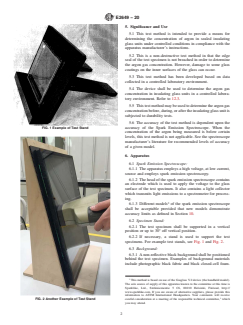
FIG. 1 Example of Test Stand
concentration of the argon being measured is below certain
levels, this test method is not applicable. See the spectroscope
manufacturer’s literature for recommended levels of accuracy
of a given model.
6. Apparatus
6.1 Spark Emission Spectroscope:
6.1.1 The apparatus employs a high voltage, at low current,
source and employs spark emission spectroscopy.
6.1.2 The head of the spark emission spectroscope contains
an electrode which is used to apply the voltage to the glass
surface of the test specimen. It also contains a light collector
which transmits light emissions to a spectrometer for process-
ing.
6.1.3 Different models of the spark emission spectroscope
shall be acceptable provided that new models demonstrate
accuracy limits as defined in Section 10.
6.2 Specimen Stand:
6.2.1 The test specimen shall be supported in a vertical
position or up to 30° off vertical position.
6.2.2 If necessary, a stand is used to support the test
specimens. For example test stands, see Fig. 1 and Fig. 2.
6.3 Background:
6.3.1 Anon-reflective black background shall be positioned
behind the test specimen. Examples of background materials
include photographic black fabric and black closed-cell foam.
This method is based on use of the Gasglass V.2 device (the handheld model).
The sole source of supply of this apparatus known to the committee at this time is
Sparklike, Ltd., Särkiniementie 5 C6, 00210 Helsinki, Finland, http://
www.sparklike.com. If you are aware of alternative suppliers, please provide this
information to ASTM International Headquarters. Your comments will receive
FIG. 2 Another Example of Test Stand
careful consideration at a meeting of the responsible technical committee, which
you may attend.
E2649 − 20
7. Hazards 10.3.4 If the user has defined a specific argon gas
concentration, then a third reference gas mixture is recom-
7.1 Warning—The high voltage of the spark emission
mended at the defined argon concentration.
spectroscope used in this test method can be harmful. Appro-
priate protective measures shall be observed. Refer to the
NOTE 2—Suitable gas mixtures can be obtained with a certificate of
instrument manufacturer’s instruction manual. analysis of the mixture from commercial gas suppliers. The accuracy of
the results of this test method depends on the accuracy of the certified
7.2 Warning—This instrument uses high voltage; persons
reference gas mixtures.
with heart conditions or who use pacemakers should not use
10.4 Verification Procedure:
this instrument.
10.4.1 Not less than five readings shall be taken on each
7.3 Warning—This instrument should NEVER be used to
verification specimen following the procedures outlined in the
measure any flammable substances, nor be used in any flam-
instruction manual of the spark emission spectroscope and
mable environment. Make certain the insulating glass unit does
following Sections11–13 of this test method. The average of
not contain any flammable substances.
the readings is recorded as the verification specimen value.
10.4.2 The verification specimen value shall not differ from
8. Test Specimens
the reference gas mixture value by more than 2 %.
8.1 Any sealed insulating glass unit cavity that allows the
10.4.3 Frequent verification of the instrument shall be
spark emission spectroscope to excite the gas present in the
performed. Users of the instrument shall establish the fre-
cavity can be tested using this test method.
quency of verification.
8.2 Typically,testspecimensare355 mmby505 mm(14 in.
by 20 in.) sealed insulating glass units constructed using one 11. Conditioning
5 1
lite of 4 mm ( ⁄32 in.) clear uncoated glass, a 12 mm ( ⁄2 in.) air
11.1 It takes time for the argon gas to equilibrate in any
space, and one lite of 4 mm ( ⁄32 in.) coated low E glass. Best
newly fabricated insulating glass unit. This is particularly
results are obtained if one of the lites of glass shall have a
important in units using a tubular or porous spacer and in units
metallic, low emissivity coating on its cavity facing surface.
containing interior components such as tubular or porous
muntin bars.There can also be si
...
This document is not an ASTM standard and is intended only to provide the user of an ASTM standard an indication of what changes have been made to the previous version. Because
it may not be technically possible to adequately depict all changes accurately, ASTM recommends that users consult prior editions as appropriate. In all cases only the current version
of the standard as published by ASTM is to be considered the official document.
Designation: E2649 − 12 E2649 − 20
Standard Test Method for
Determining Argon Concentration in Sealed Insulating Glass
Units Using Spark Emission Spectroscopy
This standard is issued under the fixed designation E2649; the number immediately following the designation indicates the year of
original adoption or, in the case of revision, the year of last revision. A number in parentheses indicates the year of last reapproval. A
superscript epsilon (´) indicates an editorial change since the last revision or reapproval.
1. Scope
1.1 This test method covers procedures for using a spark emission spectroscope to determine the concentration of argon gas in
the space between the lites of a sealed insulating glass unit.
1.2 This is a non-destructive test method.
1.3 This test method shall be used only in a controlled laboratory environment.
1.4 This test method is applicable for insulating glass units where argon has been added to the sealed insulating glass cavity
and the balance of the gas is atmospheric air.
1.5 This test method is applicable for clear, double-glazed insulating glass units.
1.6 This test method is applicable for double-glazed insulating glass units with one lite having a metallic coating or tinted glass,
or both, and with clear glass as the other lite.
1.7 This test method is applicable for triple-glazed insulating glass units only when the center lite of glass has a metallic coating
(either low emissivity (low E) or reflective) and both of the other lites are clear glass.
1.8 This test method also includes a procedure for verifying the accuracy of the readings of the test apparatus.
1.9 The values stated in SI units are to be regarded as the standard. The values given in parentheses are mathematical
conversions to inch-pound units that after SI units are provided for information only and are not considered standard.
1.10 This standard does not purport to address all of the safety concerns, if any, associated with its use. It is the responsibility
of the user of this standard to establish appropriate safety safety, health, and healthenvironmental practices and determine the
applicability of regulatory limitations prior to use. For specific warning statements, refer to Section 7.17. on Hazards.
1.11 This international standard was developed in accordance with internationally recognized principles on standardization
established in the Decision on Principles for the Development of International Standards, Guides and Recommendations issued
by the World Trade Organization Technical Barriers to Trade (TBT) Committee.
2. Referenced Documents
2.1 ASTM Standards:
C162 Terminology of Glass and Glass Products
C717 Terminology of Building Seals and Sealants
E631 Terminology of Building Constructions
E177 Practice for Use of the Terms Precision and Bias in ASTM Test Methods
E631 Terminology of Building Constructions
E691 Practice for Conducting an Interlaboratory Study to Determine the Precision of a Test Method
E2190 Specification for Insulating Glass Unit Performance and Evaluation
3. Terminology
3.1 Definitions: For definitions of terms found in this test method, refer to Terminologies C162, C717, and E631.
3.2 Definitions of Terms Specific to This Standard:
This test method is under the jurisdiction of ASTM Committee E06 on Performance of Buildings and is the direct responsibility of Subcommittee E06.22 on Durability
Performance of Building Constructions.
Current edition approved April 1, 2012Feb. 15, 2020. Published May 2012February 2020. Originally approved in 2009. Last previous edition approved in 20092012 as
E2649 – 09. DOI: 10.1520/E2649-09.–12. DOI: 10.1520/E2649–20.
For referenced ASTM standards, visit the ASTM website, www.astm.org,or contact ASTM Customer Service at service@astm.org. For Annual Book of ASTM Standards
volume information, refer to the standard’sstandard’s Document Summary page on the ASTM website.
Copyright © ASTM International, 100 Barr Harbor Drive, PO Box C700, West Conshohocken, PA 19428-2959. United States
E2649 − 20
3.2.1 sealed insulating glass unit—an assembled unit, comprising sealed lites of glass separated by dehydrated space(s),
normally intended for clear vision areas of buildings.
4. Summary of Test Method
4.1 The spark emission spectroscope is placed against the glass surface of a sealed insulating glass unit in a prescribed manner.
A high voltage, at low current, is applied to the glass surface. This voltage creates a spark which induces a plasma from the gas
molecules inside the test specimen. This causes light emissions (photons) of characteristic wavelengths. The instrument then
collects the photons and analyzes them by spark emission spectroscopy. The resulting spectrum is compared to calibration data
internal to the instrument to determine the concentration of argon inside the unit.
FIG. 1 Example of Test Stand
E2649 − 20
FIG. 2 Another Example of Test Stand
5. Significance and Use
5.1 This test method is intended to provide a means for determining the concentration of argon in sealed insulating glass units
under controlled conditions in compliance with the apparatus manufacturer’s instructions.
5.2 This is a non-destructive test method in that the edge seal of the test specimen is not breached in order to determine the argon
gas concentration. However, damage to some glass coatings on the inner surfaces of the glass can occur.
5.3 This test method has been developed based on data collected in a controlled laboratory environment.
5.4 The device shall be used to determine the argon gas concentration in insulating glass units in a controlled laboratory
environment. Refer to 12.3.
5.5 This test method may be used to determine the argon gas concentration before, during, or after the insulating glass unit is
subjected to durability tests.
5.6 The accuracy of the test method is dependent upon the accuracy of the Spark Emission Spectroscope. When the
concentration of the argon being measured is below certain levels, this test method is not applicable. See the spectroscope
manufacturer’s literature for recommended levels of accuracy of a given model.
6. Apparatus
6.1 Spark Emission Spectroscope:
6.1.1 The apparatus employs a high voltage, at low current, source and employs spark emission spectroscopy.
6.1.2 The head of the spark emission spectroscope contains an electrode which is used to apply the voltage to the glass surface
of the test specimen. It also contains a light collector which transmits light emissions to a spectrometer for processing.
E2649 − 20
6.1.3 Different models of the spark emission spectroscope shall be acceptable provided that new models demonstrate accuracy
limits as defined in Section 10.
6.2 Specimen Stand:
6.2.1 The test specimen shall be supported in a vertical position or up to 30° off vertical position.
6.2.2 If necessary, a stand is used to support the test specimens. For example test stands, see Fig. 1 and Fig. 2.
6.3 Background:
6.3.1 A non-reflective black background shall be positioned behind the test specimen. Examples of background materials
include photographic black fabric and black closed-cell foam.
7. Hazards
7.1 Warning—The high voltage of the spark emission spectroscope used in this test method can be harmful. Appropriate
protective measures shall be observed. Refer to the instrument manufacturer’smanufacturer’s instruction manual.
7.2 Warning—This instrument uses high voltage; persons with heart conditions or who use pacemakers should not use this
instrument.
7.3 Warning—This instrument should NEVER be used to measure any flammable substances, nor be used in any flammable
environment. Make certain the insulating glass unit does not contain any flammable substances.
8. Test Specimens
8.1 Any sealed insulating glass unit cavity that allows the spark emission spectroscope to excite the gas present in the
airspacecavity can be tested using this test method.
8.2 Typically, test specimens are 355 mm ×by 505 mm (14 in. ×by 20 in.) sealed insulating glass units constructed using one
5 1 5
lite of 4 mm ( ⁄32 in.) clear uncoated glass, a 12 mm ( ⁄2 in.) air space, and one lite of 4 mm ( ⁄32 in.) coated low E glass. Variations
in the specimen construction may require a correction. See the instrument manufacturer’s instruction manual for further
information.Best results are obtained if one of the lites of glass shall have a metallic, low emissivity coating on its cavity facing
surface.
9. Calibration
9.1 Adjustment of the instrument is recommended to be performed only by the manufacturer of the instrument or an authorized
service representative. The user shall verify the accuracy of the instrument readings using Section 10.
10. Verification
10.1 Verification of the accuracy of the instrument readings shall be performed by the user.
10.2 Verification Specimens:
10.2.1 The verification specimens shall be comprised of two lites of 4 mm glass, and a 12.0 mm 6 0.8 mm cavity. One of the
lites of glass shall have a metallic, low emissivity coating on its cavity facing surface. Specimen size is suggested to be 350 mm
×by 350 mm.
10.2.2 Follow the instrument manufacturer’smanufacturer’s instruction manual for gas filling of verification specimens. Fill the
verification specimens with reference gas mixtures according to 10.3.
NOTE 1—Different models of the spark emission spectroscope may have different requirements for gas filling of verification specimens. Consult the
manufacturer’s instruction manual specific to the model of use.
10.3 Reference Gas Mixtures:
10.3.1 At least two reference gas mixtures that contain known percentages of argon and atmospheric air are required for
verification. For increased confidence in the measurements over the capability range of the instrument, additional reference gas
mixtures are recommended.
10.3.2 The first reference gas mixture shall have an argon concentration of approximately 90 %.
10.3.3 The second reference gas mixture shall have an argon concentration of approximately 80 %.
10.3.4 If the user has defined a specific argon gas concentration, then a third reference gas mixture is recommended at the
defined argon concentration.
NOTE 2—Suitable gas mixtures can be obtained with a certificate of analysis of the mixture from commercial gas suppliers. The accuracy of the results
of this test method depends on the accuracy of the certified reference gas mixtures.
This method wasis based on use of the Gasglass 1002V.2 device (the wand model). As of this writing, there are other models of the device which include V1 and V2
(handheld models). handheld model). The sole source of supply of these apparatusesthis apparatus known to the committee at this time is Sparklike, Ltd., Särkiniementie 5
C6, 00210 Helsinki, Finland, http://www.sparklike.com. If you are a
...