

ASTM B163-22
(Specification)Standard Specification for Seamless Nickel and Nickel Alloy Condenser and Heat-Exchanger Tubes
General Information
- Abstract
ABSTRACT
This specification covers seamless tubes of nickel and nickel alloy for use in condenser and heat-exchanger service. This covers outside diameter and average wall, or outside diameter and minimum wall tube. Tube shall be furnished in the alloys and conditions defined by this specification. The material shall conform to the composition limits of nickel, copper, molybdenum, iron, manganese, carbon, silicon, chromium, aluminium, titanium, phosphorus, cerium, zirconium, yttrium, born, cobalt, columblum, tungsten, and nitrogen specified. Tensile strength, yield strength, elongation, and Rockwell hardness of the material shall conform to the required mechanical properties set by this specification. Test methods such as chemical analysis, tension, rounding procedure, Rockwell hardness, grain size and hardness conversion shall be performed.
SCOPE
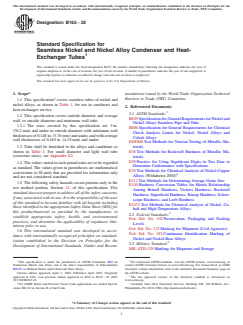
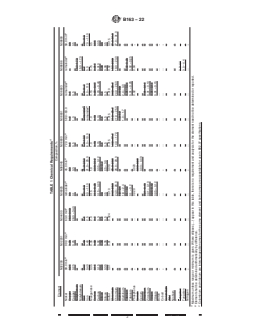
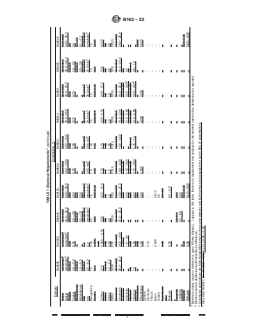
1.1 This specification2 covers seamless tubes of nickel and nickel alloys, as shown in Table 1, for use in condenser and heat-exchanger service.
1.2 This specification covers outside diameter and average wall, or outside diameter and minimum wall tube.
1.2.1 The sizes covered by this specification are 3 in. (76.2 mm) and under in outside diameter with minimum wall thicknesses of 0.148 in. (3.76 mm) and under, and with average wall thicknesses of 0.165 in. (4.19 mm) and under.
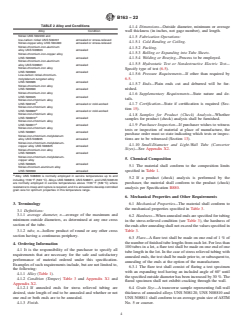
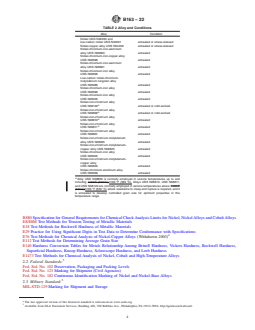
1.3 Tube shall be furnished in the alloys and conditions as shown in Table 2. For small diameter and light wall tube (converter sizes), see Appendix X2.
1.4 The values stated in inch-pound units are to be regarded as standard. The values given in parentheses are mathematical conversions to SI units that are provided for information only and are not considered standard.
1.5 The following safety hazards caveat pertains only to the test method portion, Section 12, of this specification. This standard does not purport to address all of the safety concerns, if any, associated with its use. It is the responsibility of the user of this standard to become familiar with all hazards including those identified in the appropriate Safety Data Sheet (SDS) for this product/material as provided by the manufacturer, to establish appropriate safety, health, and environmental practices, and determine the applicability of regulatory limitations prior to use.
1.6 This international standard was developed in accordance with internationally recognized principles on standardization established in the Decision on Principles for the Development of International Standards, Guides and Recommendations issued by the World Trade Organization Technical Barriers to Trade (TBT) Committee.
- Status
- Published
- Publication Date
- 31-Mar-2022
- Technical Committee
- B02 - Nonferrous Metals and Alloys
- Drafting Committee
- B02.07 - Refined Nickel and Cobalt and Their Alloys
Buy Documents
ASTM B163-22 - Standard Specification for Seamless Nickel and Nickel Alloy Condenser and Heat-Exchanger Tubes
REDLINE ASTM B163-22 - Standard Specification for Seamless Nickel and Nickel Alloy Condenser and Heat-Exchanger Tubes
Overview
ASTM B163-22 is the standard specification developed by ASTM International for seamless nickel and nickel alloy condenser and heat-exchanger tubes. These tubes are specifically designed for use in heat exchanger and condenser service, where high corrosion resistance, material reliability, and thermal efficiency are paramount. Covering a wide range of nickel and nickel alloy grades, this standard sets out the requirements for dimensions, chemical composition, mechanical properties, and test methods to ensure consistent product quality in demanding industrial environments such as power generation, chemical processing, and petrochemical industries.
Key Topics
Material Scope and Alloy Grades
- Covers seamless tubes with outside diameters up to 3 inches (76.2 mm), and wall thicknesses up to 0.165 inches (4.19 mm) average, or 0.148 inches (3.76 mm) minimum.
- Applicable to various nickel grades and nickel-based alloys, including but not limited to UNS N02200, N02201, N04400, N06600, N08800, N08935, and others.
Dimensional and Mechanical Requirements
- Tubes must conform to specified limits for outside diameter and wall thickness, with clear guidance on permissible variations and tolerances.
- Mechanical properties such as tensile strength, yield strength, elongation, and Rockwell hardness are detailed for each alloy and condition (annealed, stress-relieved, cold-worked).
Chemical Composition
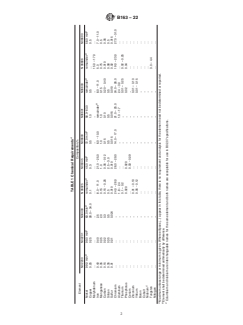
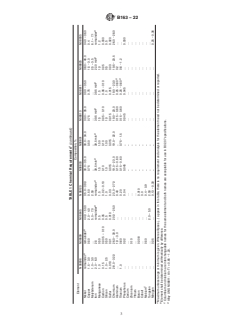
- Strict guidelines for elements such as nickel, copper, chromium, iron, molybdenum, silicon, manganese, carbon, and others based on specific alloy requirements.
- Analytical testing methods to verify conformance with composition limits as stipulated.
Testing and Inspection
- Mandatory hydrostatic or nondestructive electric testing for each tube to ensure integrity against leaks and material failures.
- Additional testing methods specified for mechanical properties, flare, and grain size in alignment with referenced ASTM standards.
Ordering and Certification
- Clear instructions for ordering, including details on alloy, condition, finish, dimensions, and supplementary requirements such as certification or special inspections.
- Bundles or shipping containers must be marked for traceability, including alloy, specification number, and other key data.
Applications
Heat Exchangers and Condensers:
Used widely in industries that require efficient heat transfer with exposure to corrosive fluids, such as power plants, refineries, and chemical processing facilities.Chemical and Petrochemical Processing:
Nickel and nickel alloy tubes specified under ASTM B163-22 provide excellent corrosion resistance in environments with acids, alkalis, or high temperatures.Desalination Plants:
Due to outstanding resistance to seawater corrosion, these seamless tubes are ideal for condenser tubing in desalination systems.Nuclear and Fossil Fuel Power Generation:
The high strength and durability characteristics make them suitable for both nuclear reactor heat exchangers and conventional boilers.Custom Fabrication:
Supports specialized shapes such as U-bent tubes for compact heat exchanger designs and custom coil configurations.
Related Standards
- ASTM B829: General requirements for nickel and nickel alloy seamless pipe and tube, referenced for additional technical guidance.
- ASTM E8/E8M: Methods for tensile testing of metallic materials.
- ASTM E18: Methods for determining Rockwell hardness of metals.
- ASTM B880: Check analysis limits for nickel, nickel alloys, and cobalt alloys.
- ASME SB-163: The ASME equivalent for applications involving boilers and pressure vessels.
- ASTM E112 & E140: Test methods and conversion tables for grain size and hardness, crucial for qualifying tube performance.
By adhering to the requirements of ASTM B163-22, manufacturers, specifiers, and purchasers can ensure seamless nickel and nickel alloy tubing will meet essential quality, performance, and safety standards for condenser and heat-exchanger service. This specification is vital for industries demanding reliable heat transfer and corrosion-resistant materials.
Relations
- Effective Date
- 01-Jan-2024
- Effective Date
- 01-Apr-2019
- Effective Date
- 01-Nov-2018
- Effective Date
- 01-Jul-2018
- Effective Date
- 01-Jul-2017
- Effective Date
- 01-Apr-2017
- Effective Date
- 15-Jul-2016
- Effective Date
- 01-Feb-2015
- Effective Date
- 01-Jun-2013
- Effective Date
- 01-Dec-2012
- Effective Date
- 15-Nov-2012
- Effective Date
- 01-Dec-2011
- Effective Date
- 01-Nov-2011
- Effective Date
- 01-Nov-2010
- Effective Date
- 15-Apr-2009
Buy Documents
ASTM B163-22 - Standard Specification for Seamless Nickel and Nickel Alloy Condenser and Heat-Exchanger Tubes
REDLINE ASTM B163-22 - Standard Specification for Seamless Nickel and Nickel Alloy Condenser and Heat-Exchanger Tubes
Get Certified
Connect with accredited certification bodies for this standard

Element Materials Technology
Materials testing and product certification.

Inštitut za kovinske materiale in tehnologije
Institute of Metals and Technology. Materials testing, metallurgical analysis, NDT.
Institut za varilstvo d.o.o. (Welding Institute)
Slovenia's leading welding institute since 1952. ISO 3834, EN 1090, pressure equipment certification, NDT personnel, welder qualification. Only IIW Au
Sponsored listings
Frequently Asked Questions
ASTM B163-22 is a technical specification published by ASTM International. Its full title is "Standard Specification for Seamless Nickel and Nickel Alloy Condenser and Heat-Exchanger Tubes". This standard covers: ABSTRACT This specification covers seamless tubes of nickel and nickel alloy for use in condenser and heat-exchanger service. This covers outside diameter and average wall, or outside diameter and minimum wall tube. Tube shall be furnished in the alloys and conditions defined by this specification. The material shall conform to the composition limits of nickel, copper, molybdenum, iron, manganese, carbon, silicon, chromium, aluminium, titanium, phosphorus, cerium, zirconium, yttrium, born, cobalt, columblum, tungsten, and nitrogen specified. Tensile strength, yield strength, elongation, and Rockwell hardness of the material shall conform to the required mechanical properties set by this specification. Test methods such as chemical analysis, tension, rounding procedure, Rockwell hardness, grain size and hardness conversion shall be performed. SCOPE 1.1 This specification2 covers seamless tubes of nickel and nickel alloys, as shown in Table 1, for use in condenser and heat-exchanger service. 1.2 This specification covers outside diameter and average wall, or outside diameter and minimum wall tube. 1.2.1 The sizes covered by this specification are 3 in. (76.2 mm) and under in outside diameter with minimum wall thicknesses of 0.148 in. (3.76 mm) and under, and with average wall thicknesses of 0.165 in. (4.19 mm) and under. 1.3 Tube shall be furnished in the alloys and conditions as shown in Table 2. For small diameter and light wall tube (converter sizes), see Appendix X2. 1.4 The values stated in inch-pound units are to be regarded as standard. The values given in parentheses are mathematical conversions to SI units that are provided for information only and are not considered standard. 1.5 The following safety hazards caveat pertains only to the test method portion, Section 12, of this specification. This standard does not purport to address all of the safety concerns, if any, associated with its use. It is the responsibility of the user of this standard to become familiar with all hazards including those identified in the appropriate Safety Data Sheet (SDS) for this product/material as provided by the manufacturer, to establish appropriate safety, health, and environmental practices, and determine the applicability of regulatory limitations prior to use. 1.6 This international standard was developed in accordance with internationally recognized principles on standardization established in the Decision on Principles for the Development of International Standards, Guides and Recommendations issued by the World Trade Organization Technical Barriers to Trade (TBT) Committee.
ABSTRACT This specification covers seamless tubes of nickel and nickel alloy for use in condenser and heat-exchanger service. This covers outside diameter and average wall, or outside diameter and minimum wall tube. Tube shall be furnished in the alloys and conditions defined by this specification. The material shall conform to the composition limits of nickel, copper, molybdenum, iron, manganese, carbon, silicon, chromium, aluminium, titanium, phosphorus, cerium, zirconium, yttrium, born, cobalt, columblum, tungsten, and nitrogen specified. Tensile strength, yield strength, elongation, and Rockwell hardness of the material shall conform to the required mechanical properties set by this specification. Test methods such as chemical analysis, tension, rounding procedure, Rockwell hardness, grain size and hardness conversion shall be performed. SCOPE 1.1 This specification2 covers seamless tubes of nickel and nickel alloys, as shown in Table 1, for use in condenser and heat-exchanger service. 1.2 This specification covers outside diameter and average wall, or outside diameter and minimum wall tube. 1.2.1 The sizes covered by this specification are 3 in. (76.2 mm) and under in outside diameter with minimum wall thicknesses of 0.148 in. (3.76 mm) and under, and with average wall thicknesses of 0.165 in. (4.19 mm) and under. 1.3 Tube shall be furnished in the alloys and conditions as shown in Table 2. For small diameter and light wall tube (converter sizes), see Appendix X2. 1.4 The values stated in inch-pound units are to be regarded as standard. The values given in parentheses are mathematical conversions to SI units that are provided for information only and are not considered standard. 1.5 The following safety hazards caveat pertains only to the test method portion, Section 12, of this specification. This standard does not purport to address all of the safety concerns, if any, associated with its use. It is the responsibility of the user of this standard to become familiar with all hazards including those identified in the appropriate Safety Data Sheet (SDS) for this product/material as provided by the manufacturer, to establish appropriate safety, health, and environmental practices, and determine the applicability of regulatory limitations prior to use. 1.6 This international standard was developed in accordance with internationally recognized principles on standardization established in the Decision on Principles for the Development of International Standards, Guides and Recommendations issued by the World Trade Organization Technical Barriers to Trade (TBT) Committee.
ASTM B163-22 is classified under the following ICS (International Classification for Standards) categories: 23.040.15 - Non-ferrous metal pipes; 77.150.40 - Nickel and chromium products. The ICS classification helps identify the subject area and facilitates finding related standards.
ASTM B163-22 has the following relationships with other standards: It is inter standard links to ASTM E8/E8M-24, ASTM B829-19, ASTM B829-18, ASTM E18-18, ASTM E18-17, ASTM B829-04a(2017), ASTM E8/E8M-16, ASTM E8/E8M-15, ASTM E8/E8M-13, ASTM E18-12, ASTM E112-12, ASTM E8/E8M-11, ASTM E18-11, ASTM E112-10, ASTM B829-04a(2009). Understanding these relationships helps ensure you are using the most current and applicable version of the standard.
ASTM B163-22 is available in PDF format for immediate download after purchase. The document can be added to your cart and obtained through the secure checkout process. Digital delivery ensures instant access to the complete standard document.
Standards Content (Sample)
This international standard was developed in accordance with internationally recognized principles on standardization established in the Decision on Principles for the
Development of International Standards, Guides and Recommendations issued by the World Trade Organization Technical Barriers to Trade (TBT) Committee.
Designation:B163 −22
Standard Specification for
Seamless Nickel and Nickel Alloy Condenser and Heat-
Exchanger Tubes
This standard is issued under the fixed designation B163; the number immediately following the designation indicates the year of
original adoption or, in the case of revision, the year of last revision.Anumber in parentheses indicates the year of last reapproval.A
superscript epsilon (´) indicates an editorial change since the last revision or reapproval.
This standard has been approved for use by agencies of the U.S. Department of Defense.
1. Scope* mendations issued by the World Trade Organization Technical
2 Barriers to Trade (TBT) Committee.
1.1 This specification covers seamless tubes of nickel and
nickel alloys, as shown in Table 1, for use in condenser and
2. Referenced Documents
heat-exchanger service.
2.1 ASTM Standards:
1.2 This specification covers outside diameter and average
B829SpecificationforGeneralRequirementsforNickeland
wall, or outside diameter and minimum wall tube.
Nickel Alloys Seamless Pipe and Tube
1.2.1 The sizes covered by this specification are 3in.
B880Specification for General Requirements for Chemical
(76.2mm) and under in outside diameter with minimum wall
Check Analysis Limits for Nickel, Nickel Alloys and
thicknessesof0.148in.(3.76mm)andunder,andwithaverage
Cobalt Alloys
wall thicknesses of 0.165in. (4.19mm) and under.
E8/E8MTest Methods for Tension Testing of Metallic Ma-
1.3 Tube shall be furnished in the alloys and conditions as
terials
shown in Table 2. For small diameter and light wall tube
E18Test Methods for Rockwell Hardness of Metallic Ma-
(converter sizes), see Appendix X2.
terials
E29Practice for Using Significant Digits in Test Data to
1.4 Thevaluesstatedininch-poundunitsaretoberegarded
Determine Conformance with Specifications
as standard. The values given in parentheses are mathematical
E76Test Methods for Chemical Analysis of Nickel-Copper
conversions to SI units that are provided for information only
Alloys (Withdrawn 2003)
and are not considered standard.
E112Test Methods for Determining Average Grain Size
1.5 The following safety hazards caveat pertains only to the
E140Hardness Conversion Tables for Metals Relationship
test method portion, Section 12, of this specification. This
Among Brinell Hardness, Vickers Hardness, Rockwell
standard does not purport to address all of the safety concerns,
Hardness, Superficial Hardness, Knoop Hardness, Sclero-
if any, associated with its use. It is the responsibility of the user
scope Hardness, and Leeb Hardness
of this standard to become familiar with all hazards including
E1473Test Methods for Chemical Analysis of Nickel, Co-
those identified in the appropriate Safety Data Sheet (SDS) for
balt and High-Temperature Alloys
this product/material as provided by the manufacturer, to
2.2 Federal Standards:
establish appropriate safety, health, and environmental
Fed. Std. No. 102Preservation, Packaging and Packing
practices, and determine the applicability of regulatory limi-
Levels
tations prior to use.
Fed. Std. No. 123Marking for Shipment (Civil Agencies)
1.6 This international standard was developed in accor-
Fed. Std. No. 182Continuous Identification Marking of
dance with internationally recognized principles on standard-
Nickel and Nickel-Base Alloys
ization established in the Decision on Principles for the
2.3 Military Standard:
Development of International Standards, Guides and Recom-
MIL-STD-129Marking for Shipment and Storage
1 3
This specification is under the jurisdiction of ASTM Committee B02 on For referenced ASTM standards, visit the ASTM website, www.astm.org, or
Nonferrous Metals and Alloys and is the direct responsibility of Subcommittee contact ASTM Customer Service at service@astm.org. For Annual Book of ASTM
B02.07 on Refined Nickel and Cobalt and Their Alloys. Standards volume information, refer to the standard’s Document Summary page on
Current edition approved April 1, 2022. Published April 2022. Originally the ASTM website.
approved in 1941. Last previous edition approved in 2019 as B163–19. DOI: The last approved version of this historical standard is referenced on
10.1520/B0163-22. www.astm.org.
2 5
For ASME Boiler and Pressure Vessel Code applications see related Specifi- Available from DLA Document Services, Building 4/D, 700 Robbins Ave.,
cation SB-163 in Section II of that Code. Philadelphia, PA 19111-5094, http://quicksearch.dla.mil.
*A Summary of Changes section appears at the end of this standard
Copyright © ASTM International, 100 Barr Harbor Drive, PO Box C700, West Conshohocken, PA 19428-2959. United States
B163−22
A
TABLE 1 Chemical Requirements
Composition,%
Element
N02200 N02201 N04400 N06025 N06045 N06600 N06601 N06603 N06686 N06690
B B B B B B B B B
Nickel 99.0 min 99.0 min 63.0 min remainder 45.0 min 72.0 min 58.0–63.0 remainder remainder 58.0 min
Copper 0.25 0.25 28.0 – 34.0 0.1 0.3 0.5 1.0 0.5 . 0.5
Molybdenum . . . . . . . . 15.0 – 17.0 .
B
Iron 0.40 0.40 2.5 8.0 – 11.0 21.0 – 25.0 6.0 – 10.0 remainder 8.0 – 11.0 5.0 7.0 – 11.0
Manganese 0.35 0.35 2.0 0.15 1.0 1.0 1.0 0.15 0.75 0.5
Carbon 0.15 0.02 0.3 0.15 – 0.25 0.05 – 0.12 0.15 0.10 0.20 – 0.40 0.010 0.05
Silicon 0.35 0.35 0.5 0.5 2.5 – 3.0 0.5 0.5 0.5 0.08 0.5
Sulfur 0.01 0.01 0.024 0.010 0.010 0.015 0.015 0.010 0.02 0.015
Chromium . . . 24.0 – 26.0 26.0 – 29.0 14.0 – 17.0 21.0 – 25.0 24.0 – 26.0 19.0 – 23.0 27.0 – 31.0
Aluminum . . . 1.8 – 2.4 . . 1.0 – 1.7 2.4 – 3.0 . .
Titanium . . . 0.1 – 0.2 . . . 0.01 – 0.25 0.02 – 0.25 .
Phosphorus . . . 0.020 0.020 . . 0.02 0.04 .
Cerium . . . . 0.03 – 0.09 . . . . .
Zirconium . . . 0.01 – 0.10 . . . 0.01 – 0.10 . .
Yttrium . . . 0.05 – 0.12 . . . 0.01 – 0.15 . .
Boron . . . . . . . . . .
Cobalt . . . . . . . . . .
C
Niobium . . . . . . . . . .
Tungsten . . . . . . . . 3.0 – 4.4 .
Nitrogen . . . . . . . . . .
A
Maximum unless range or minimum is given. Where ellipses (.) appear in this table, there is no requirement and analysis for the element need not be determined or reported.
B
Element shall be determined arithmetically by difference.
C
Columbium and niobium are interchangeable names for the same element and both names are acceptable for use in B02.07 specifications.
B163−22
A
TABLE 1 Chemical Requirements (continued)
Composition, %
Element
N06696 N06699 N06845 N08120 N08800 N08801 N08810 N08811 N08825 N08935
B B
Nickel remainder remainder 44.0 – 50.0 35.0 – 39.0 30.0 – 35.0 30.0 – 34.0 30.0 – 35.0 30.0 – 35.0 38.0 – 46.0 34.0 – 36.0
Copper 1.5 – 3.0 0.50 2.0 – 4.0 0.50 0.75 0.50 0.75 0.75 1.5 – 3.0 0.4
Molybdenum 1.0 – 3.0 . 5.0 – 7.0 2.50 . . . . 2.5 – 3.5 6.1 – 7.1
B B B B B B B B
Iron 2.0 – 6.0 2.5 remainder remainder 39.5 min 39.5 min 39.5 min 39.5 min 22.0 min remainder
Manganese 1.0 0.50 0.5 1.5 1.5 1.50 1.5 1.5 1.0 1.2
Carbon 0.15 0.005 – 0.10 0.05 0.02 – 0.10 0.10 0.10 0.05 – 0.10 0.06 – 0.10 0.05 0.030
Silicon 1.0 – 2.5 0.50 0.5 1.0 1.0 1.00 1.0 1.0 0.5 0.5
Sulfur 0.010 0.01 0.010 0.03 0.015 0.015 0.015 0.015 0.03 0.020
Chromium 28.0 – 32.0 26.0 – 30.0 20.0 – 25.0 23.0 – 27.0 19.0 – 23.0 19.0 – 22.0 19.0 – 23.0 19.0 – 23.0 19.5 – 23.5 26.0 – 28.0
D
Aluminum . 1.9 – 3.0 . 0.40 0.15 – 0.60 . 0.15 – 0.60 0.25 – 0.60 0.2 .
D
Titanium 1.0 0.60 . 0.20 0.15 – 0.60 0.75 – 1.5 0.15 – 0.60 0.25 – 0.60 0.6 – 1.2 .
Phosphorus . 0.02 . 0.04 0.045 . 0.045 0.045 . 0.030
Cerium . . . . . . . . . .
Zirconium . 0.10 . . . . . . . .
Yttrium . . . . . . . . . .
Boron . 0.008 . 0.010 . . . . . .
Cobalt . . . 3.0 . . . . . .
C
Niobium . 0.50 . 0.4 – 0.9 . . . . . .
Tungsten . . 2.0 – 5.0 2.50 . . . . . .
Nitrogen . 0.05 . 0.13 – 0.30 . . . . . 0.25 – 0.36
A
Maximum unless range or minimum is given. Where ellipses (.) appear in this table, there is no requirement and analysis for the element need not be determined or reported.
B
Element shall be determined arithmetically by difference.
C
Columbium and niobium are interchangeable names for the same element and both names are acceptable for use in B02.07 specifications.
D
Alloy UNS N08811: Al + Ti = 0.85 – 1.20.
B163−22
TABLE 2 Alloy and Conditions
4.1.4 Dimensions—Outside diameter, minimum or average
Alloy Condition wall thickness (in inches, not gage number), and length.
Nickel UNS N02200 and
4.1.5 Fabrication Operations:
low-carbon nickel UNS N02201 annealed or stress-relieved
4.1.5.1 Cold Bending or Coiling.
Nickel-copper alloy UNS N04400 annealed or stress-relieved
Nickel-chromium-iron-aluminum
4.1.5.2 Packing.
alloy UNS N06603 annealed
4.1.5.3 Rolling or Expanding into Tube Sheets.
Nickel-chromium-iron-copper alloy
UNS N06696 annealed
4.1.5.4 Welding or Brazing—Process to be employed.
Nickel-chromium-iron-aluminum
4.1.5.5 Hydrostatic Test or Nondestructive Electric Test—
alloy UNS N06601 annealed
Nickel-chromium-iron alloy
Specify type of test (6.5).
UNS N06600 annealed
4.1.5.6 Pressure Requirements—If other than required by
Low-carbon nickel-chromium-
molybdenum-tungsten alloy 6.5.
UNS N06686 annealed
4.1.5.7 Ends—Plain ends cut and deburred will be fur-
Nickel-chromium-iron alloy
nished.
UNS N06690 annealed
Nickel-chromium-iron alloy
4.1.6 Supplementary Requirements—State nature and de-
UNS N06045 annealed
tails.
Nickel-iron-chromium alloy
A
UNS N08120 annealed or cold-worked
4.1.7 Certification—State if certification is required (Sec-
Nickel-iron-chromium alloy
tion 15).
A
UNS N08800 annealed or cold-worked
Nickel-iron-chromium alloy
4.1.8 Samples for Product (Check) Analysis—Whether
A
UNS N08810 annealed
samples for product (check) analysis shall be furnished.
Nickel-iron-chromium alloy
A
UNS N08811 annealed 4.1.9 Purchaser Inspection—If purchaser wishes to witness
Nickel-iron-chromium alloy
tests or inspection of material at place of manufacture, the
UNS N08801 annealed
purchase order must so state indicating which tests or inspec-
Nickel-iron-chromium-molybdenum
alloy UNS N08935 annealed
tions are to be witnessed (Section 13).
Nickel-iron-chromium-molybdenum-
4.1.10 Small-Diameter and Light-Wall Tube (Converter
copper alloy UNS N08825 annealed
Sizes)—See Appendix X2.
Nickel-chromium-iron alloy
UNS N06025 annealed
Nickel-iron-chromium-molybdenum-
5. Chemical Composition
copper alloy
UNS N06845 annealed
5.1 The material shall conform to the composition limits
Nickel-chromium-aluminum alloy
UNS N06699 annealed specified in Table 1.
A
Alloy UNS N08800 is normally employed in service temperatures up to and
5.2 If a product (check) analysis is performed by the
including 1100 °F (593 °C). Alloys UNS N08810, UNS N08811, and UNS N08120
purchaser, the material shall conform to the product (check)
are normally employed in service temperatures above 1100 °F (539 °C) where
resistance to creep and rupture is required, and it is annealed to develop controlled
analysis per Specification B880.
grain size for optimum properties in this temperature range.
6. Mechanical Properties and Other Requirements
3. Terminology
6.1 Mechanical Properties—The material shall conform to
the mechanical properties specified in Table 3.
3.1 Definitions:
3.1.1 average diameter, n—average of the maximum and
6.2 Hardness—Whenannealedendsarespecifiedfortubing
minimum outside diameters, as determined at any one cross
in the stress-relieved condition (see Table 3), the hardness of
section of the tube.
theendsafterannealingshallnotexceedthevaluesspecifiedin
3.1.2 tube, n—hollow product of round or any other cross Table 3.
section having a continuous periphery.
6.3 Flare—Aflare test shall be made on one end of 1% of
thenumberoffinishedtubelengthsfromeachlot.Forlessthan
4. Ordering Information
100 tubes in a lot, a flare test shall be made on one end of one
4.1 It is the responsibility of the purchaser to specify all
tube length in the lot. In the case of stress relieved tubing with
requirements that are necessary for the safe and satisfactory
annealedends,thetestshallbemadepriorto,orsubsequentto,
performance of material ordered under this specification.
annealing of the ends at the option of the manufacturer.
Examples of such requirements include, but are not limited to,
6.3.1 The flare test shall consist of flaring a test specimen
the following:
with an expanding tool having an included angle of 60° until
4.1.1 Alloy (Table 1).
thespecifiedoutsidediameterhasbeenincreasedby30%.The
4.1.2 Condition (Temper) Table 3 and Appendix X1 and
flared specimen shall not exhibit cracking through the wall.
Appendix X2.
4.1.2.1 If annealed ends for stress relieved tubing are 6.4 Grain Size—A transverse sample representing full-wall
desired, state length of end to be annealed and whether or not thickness of annealed alloys UNS N08120, UNS N08810 and
one end or both ends are to be annealed. UNS N08811 shall conform to an average grain size ofASTM
4.1.3 Finish. No. 5 or coarser.
B163−22
TABLE 3 Mechanical Properties of Tubes
Yield Strength Elongation in 2 in. Rockwell Hardness
Tensile Strength,
Material and Condition (0.2 % Offset), or 50 mm (or 4 D) (or equivalent) for
min, ksi (MPa)
A
min, ksi (MPa) min, % annealed ends
Nickel UNS N02200:
Annealed 55 (379) 15 (103) 40 .
Stress-relieved 65 (448) 40 (276) 15 B65 max
Low-carbon nickel UNS N02201:
Annealed 50 (345) 12 (83) 40 .
Stress-relieved 60 (414) 30 (207) 15 B62 max
Nickel-copper alloy UNS N04400:
Annealed 70 (483) 28 (193) 35 .
Stress-relieved 85 (586) 55 (379) 15 B75 max
Nickel-chromium-iron alloys:
Annealed alloy UNS N06600 80 (552) 35 (241) 30 .
Annealed alloy UNS N06601 80 (552) 30 (207) 30 .
Annealed alloy UNS N06690 85 (586) 35 (241) 30 .
Annealed alloy UNS N06045 90 (620) 35 (240) 35 .
Annealed alloy UNS N06025 98 (680) 39 (270) 30 .
Annealed alloy UNS N06603 94 (650) 43 (300) 25 .
Annealed alloy UNS N06696 85 (586) 35 (240) 30 .
Low-carbon nickel-chromium-molybdenum-tungsten alloy:
Annealed UNS N06686 100 (690) 45 (310) 45 .
Nickel-iron-chromium alloys:
Annealed alloy UNS N08120 90 (620) 40 (276) 30 .
Annealed alloy UNS N08800 75 (517) 30 (207) 30 .
Annealed alloy UNS N08801 65 (448) 25 (172) 30 .
Cold-worked alloy UNS N08800 83 (572) 47 (324) 30 .
Annealed alloy UNS N08810 65 (448) 25 (172) 30 .
Annealed alloy UNS N08811 65 (448) 25 (172) 30 .
Nickel-iron-chromium-molybdenum alloy:
Annealed alloy UNS N08935 109 (750) 62 (425) 35 .
Nickel-iron-chromium-molybdenum-copper alloys:
Annealed UNS N08825 85 (586) 35 (241) 30 .
Annealed UNS N06845 100 (690) 40 (276) 30 .
Nickel-chromium-aluminum alloys:
Annealed UNS N06699 89 (610) 35 (240) 40 .
A
Rockwell or equivalent hardness values apply only to the annealed ends of stress-relieved tubing. Caution should be observed in using the Rockwell test on thin material,
as the results may be affected by the thickness of specimen. For thickness under 0.050 in. (1.27 mm) the use of the Rockwell superficial or the Vickers hardness test is
suggested. For hardness conversions for nickel and high-nickel alloys see Hardness Conversion Tables E140.
6.5 Hydrostatic or Nondestructive Electric Test—Each tube
psi MPa
Annealed low-carbon nickel UNS N02201 8 000 55.2
shall be subjected to either the hydrostatic test or the nonde-
Stress-relieved low-carbon nickel UNS N02201 15 000 103.4
structiveelectrictest.Thetypeoftesttobeusedshallbeatthe
Annealed nickel UNS N02200 10 000 68.9
option of the manufacturer, unless otherwise specified in the
Stress-relieved nickel UNS N02200 16 200 111.7
Annealed nickel-copper alloy UNS N04400 17 500 120.6
purchase order.
Stress-relieved nickel-copper alloy UNS N04400 21 200 146.2
6.5.1 Hydrostatic Test:
Annealed nickel-chromium-aluminum alloy UNS N06699 22 100 152
6.5.1.1 Each tube with an outside diameter ⁄8 in. (3.2 mm)
Annealed nickel-chromium-iron alloy UNS N06600 20 000 137.9
Annealed nickel-chromium-iron alloy UNS N06601 20 000 137.9
andlargerandtubeswithwallthicknessof0.015in.(0.38mm)
Annealed nickel-chromium-iron alloy UNS N06690 21 200 146
and over shall be tested by the manufacturer to an internal
Annealed nickel-chromium-iron alloy UNS N06045 22 500 155
hydrostatic pressure of 1000 psi (6.9 MPa) provided that the
Annealed nickel-chromium-iron alloy UNS N06025 24 500 169
Solution annealed low-carbon nickel-chromium- 25 000 172
fiber stress calculated in accordance with the following equa-
molybdenum-tungsten alloy UNS N06686
tion does not exceed the allowable fiber stress, S, indicated
Annealed nickel-chromium-iron-aluminum alloy
below. The tube shall show no evidence of leakage. UNS N06603 24 000 165
Annealed nickel-chromium-iron-copper alloy
P 52St/D
UNS N06696 21 200 146
Annealed nickel-iron-chromium alloy UNS N08120 22 500 155
where:
Annealed nickel-iron-chromium alloy UNS N08800 18 700 128.9
Annealed nickel-iron-chromium alloy UNS N08810 16 600 114.4
P = hydrostatic test pressure, psi (MPa),
Annealed nickel-iron-chromium alloy UNS N08811 16 600 114.4
S = allowable fiber stress for material in the condition
Annealed nickel-iron-chromium alloy UNS N08801 16 600 114.4
furnished, as follows: Annealed nickel-iron-chromium-molybdenum alloy UNS 27 200 187.5
N08935
t = minimum wall thickness, in. (mm); equal to the speci-
Annealed nickel-iron-chromium-molybdenum copper
fied average wall minus the permissible “minus” wall
alloy UNS N08825 21 000 144.8
tolerance, Table 4 and Table X2.2, or the specified
Annealed nickel-iron-chromium-molydenum-copper
alloy UNS N06845 21 200 146.2
minimum wall thickness, and
Cold-worked nickel-iron-chromium alloy UNS N08800 20 700 142.7
D = outside diameter of the tube, in. (mm).
B163−22
TABLE 4 Permissible Variations in Outside Diameter and Wall Thickness of Condenser and Heat Exchanger Tubes
NOTE 1—The tolerances in the table apply to individual measurements of outside diameter and include out-of-roundness (ovality), and apply to all
materials and all conditions, except that for thin wall tubes having a nominal wall of 3% or less of the outside diameter, the mean outside diameter shall
comply with the permissible variations of the above table and individual measurements (including ovality) shall conform to the plus and minus values
of the table with the values increased by ⁄2% of the nominal outside diameter.
NOTE 2—Eccentricity—The variation in wall thickness in any one cross section of any one tube shall not exceed plus or minus 10% of the actual
(measured) average wall of that section. The actual average wall is defined as the average of the thickest and thinnest wall of that section.
NOTE 3—For tolerances of small diameter and light wall tube (converter sizes) see Appendix X2 (Table X2.2).
A
Permissible Variations
Outside Diameter, in. (mm) Wall Thickness,%
Material Nominal Outside Diameter, in. (mm)
Average Wall Minimum Wall
+−
+− + −
1 5
UNS N02200, UNS N02201, ⁄2 to ⁄8 (12.7 to 15.9), excl 0.005 (0.13) 0 12.5 12.5 25.0 0
and UNS N04400
5 1
⁄8 to 1 ⁄2 (15.9 to 38.1), incl 0.005 (0.13) 0.005 (0.13) 10.0 10.0 20.0 0
over 1 ⁄2 to 3 (38.1 to 76.2), incl 0.010 (0.25) 0.010 (0.25) 10.0 10.0 22.0 0
1 5
UNS N06600, UNS N06601, UNS ⁄2 to ⁄8 (12.7 to 15.9), excl 0.005 (0.13) 0.005 (0.13) 12.5 12.5 25.0 0
N06690,
UNS N06045, UNS N06025, UNS
N06603, UNS N06696, UNS N08800,
UNS N06699
UNS N08810, UNS N08811, UNS
N08801,
UNS N08935
UNS N08825, UNS N06845, and UNS
N08120
5 1
UNS N06686 ⁄8 to 1 ⁄2 (15.9 to 38.1), incl 0.0075 (0.19) 0.0075 (0.19) 10.0 10.0 20.0 0
over 1 ⁄2 to 3 (38.1 to 76.2), incl 0.010 (0.25) 0.010 (0.25) 10.0 10.0 22.0 0
A
Wall variations as indicated above are applicable only to the wall as ordered, for instance, to minimum or to average wall, but not to both.
6.5.1.2 Whensoagreeduponbetweenthemanufacturerand 7.2 Length—When tube is ordered cut-to-length, the length
1 1
the purchaser, tube may be tested to 1 ⁄2 times the above shallnotbelessthanthatspecified,butavariationofplus ⁄8in.
allowable fiber stress. (3.2mm) will be permitted, except that for lengths over 30ft
6.5.1.3 Whenstress-relievedtubeswithannealedendsareto (9.1m), a variation of plus ⁄4 in. (6.4 mm) will be permitted.
be tested hydrostatically, such pressure testing shall be done
7.3 Straightness—Material shall be reasonably straight and
prior to annealing of the ends of the tube.
free of bends or kinks.
6.5.2 Nondestructive Electric Test—Each tube shall be ex-
8. Workmanship, Finish, and Appearance
amined with a nondestructive electric test as prescribed in
Specification B829.
8.1 The material shall be uniform in quality and temper,
smooth, commercially straight, and free of injurious imperfec-
7. Dimensions and Permissible Variations
tions.
7.1 Outside Diameter and Wall Thickness—The permissible
9. Sampling
variations in the outside diameter and wall thickness of tube
shallnotexceedthoseprescribedinTable4andTableX2.2,as 9.1 Lot—Definition:
applicable. (See also Table 5 and Table 6.) 9.1.1 A lot for chemical analysis shall consist of one heat.
A
TABLE 5 Alloy, Condition, Tube Size, and Bend Radii Limitations
Minimum Bend Radius, in.
(mm)
B
Tube OD, in. (mm) Average Tube Wall, in. (mm)
Annealed Stress-Relieved
Condition Condition
1 3 1
Up to ⁄2 (12.7), incl 0.046 to 0.057 (1.17 to 1.45), incl 1 ⁄16 (30.2) 1 ⁄4 (31.8)
1 1
Up to ⁄2 (12.7), incl Over 0.057 to 0.120 (1.45 to 3.05), incl 1 (25.4) 1 ⁄8 (28.6)
1 5 3 1
Over ⁄2 to ⁄8 (12.7 to 15.9), incl 0.037 to 0.057 (0.94 to 1.45), incl 1 ⁄16 (30.2) 1 ⁄4 (31.8)
1 5 3
Over ⁄2 to ⁄8 (12.7 to 15.9), incl Over 0.057 to 0.120 (1.45 to 3.05), incl 1 (25.4) 1 ⁄16 (30.2)
5 3 1 1
Over ⁄8 to ⁄4 (15.9 to 19.0), incl 0.049 to 0.057 (1.24 to 1.45), incl 1 ⁄4 (31.8) 1 ⁄2 (38.1)
5 3 3 1
Over ⁄8 to ⁄4 (15.9 to 19.0), incl Over 0.057 to 0.109 (1.45 to 2.77), incl 1 ⁄16 (30.2) 1 ⁄4 (31.8)
Over ⁄4 to 1 (19.0 to 25.4), incl 0.049 to 0.058 (1.24 to 1.47), incl 2 (50.8) 4 (101.6)
3 3 1
Over ⁄4 to 1 (19.0 to 25.4), incl Over 0.058 to 0.109 (1.47 to 2.77), incl 1 ⁄4 (44.5) 2 ⁄4 (57.2)
A
Applies for all alloys except alloy UNS N08810, alloy UNS N08801, and UNS N08811.
B
To determine the bend radius applicable to minimum wall tubing, compute the corresponding average wall f
...
This document is not an ASTM standard and is intended only to provide the user of an ASTM standard an indication of what changes have been made to the previous version. Because
it may not be technically possible to adequately depict all changes accurately, ASTM recommends that users consult prior editions as appropriate. In all cases only the current version
of the standard as published by ASTM is to be considered the official document.
Designation: B163 − 19 B163 − 22
Standard Specification for
Seamless Nickel and Nickel Alloy Condenser and Heat-
Exchanger Tubes
This standard is issued under the fixed designation B163; the number immediately following the designation indicates the year of
original adoption or, in the case of revision, the year of last revision. A number in parentheses indicates the year of last reapproval. A
superscript epsilon (´) indicates an editorial change since the last revision or reapproval.
This standard has been approved for use by agencies of the U.S. Department of Defense.
1. Scope*
1.1 This specification covers seamless tubes of nickel and nickel alloys, as shown in Table 1, for use in condenser and
heat-exchanger service.
1.2 This specification covers outside diameter and average wall, or outside diameter and minimum wall tube.
1.2.1 The sizes covered by this specification are 3 in. (76.2 mm) 3 in. (76.2 mm) and under in outside diameter with minimum
wall thicknesses of 0.148 in. (3.76 mm) 0.148 in. (3.76 mm) and under, and with average wall thicknesses of 0.165 in. (4.19 mm)
0.165 in. (4.19 mm) and under.
1.3 Tube shall be furnished in the alloys and conditions as shown in Table 2. For small diameter and light wall tube (converter
sizes), see Appendix X2.
1.4 The values stated in inch-pound units are to be regarded as standard. The values given in parentheses are mathematical
conversions to SI units that are provided for information only and are not considered standard.
1.5 The following safety hazards caveat pertains only to the test method portion, Section 12, of this specification. This standard
does not purport to address all of the safety concerns, if any, associated with its use. It is the responsibility of the user of this
standard to become familiar with all hazards including those identified in the appropriate Safety Data Sheet (SDS) for this
product/material as provided by the manufacturer, to establish appropriate safety, health, and environmental practices, and
determine the applicability of regulatory limitations prior to use.
1.6 This international standard was developed in accordance with internationally recognized principles on standardization
established in the Decision on Principles for the Development of International Standards, Guides and Recommendations issued
by the World Trade Organization Technical Barriers to Trade (TBT) Committee.
2. Referenced Documents
2.1 ASTM Standards:
B829 Specification for General Requirements for Nickel and Nickel Alloys Seamless Pipe and Tube
This specification is under the jurisdiction of ASTM Committee B02 on Nonferrous Metals and Alloys and is the direct responsibility of Subcommittee B02.07 on Refined
Nickel and Cobalt and Their Alloys.
Current edition approved Nov. 1, 2019April 1, 2022. Published November 2019April 2022. Originally approved in 1941. Last previous edition approved in 20182019 as
B163 – 18.B163 – 19. DOI: 10.1520/B0163-19.10.1520/B0163-22.
For ASME Boiler and Pressure Vessel Code applications see related Specification SB-163 in Section II of that Code.
For referenced ASTM standards, visit the ASTM website, www.astm.org, or contact ASTM Customer Service at service@astm.org. For Annual Book of ASTM Standards
volume information, refer to the standard’s Document Summary page on the ASTM website.
*A Summary of Changes section appears at the end of this standard
Copyright © ASTM International, 100 Barr Harbor Drive, PO Box C700, West Conshohocken, PA 19428-2959. United States
B163 − 22
A
TABLE 1 Chemical Requirements
Composition,%
Element
N02200 N02201 N04400 N06025 N06045 N06600 N06601 N06603 N06686 N06690
B B B B B B B B B
Nickel 99.0 min 99.0 min 63.0 min remainder 45.0 min 72.0 min 58.0–63.0 remainder remainder 58.0 min
Copper 0.25 0.25 28.0–34.0 0.1 0.3 0.5 1.0 0.5 . 0.5
Copper 0.25 0.25 28.0 – 34.0 0.1 0.3 0.5 1.0 0.5 . 0.5
Molybdenum . . . . . . . . 15.0–17.0 .
Molybdenum . . . . . . . . 15.0 – 17.0 .
B
Iron 0.40 0.40 2.5 8.0–11.0 21.0–25.0 6.0–10.0 remainder 8.0–11.0 5.0 7.0–11.0
B
Iron 0.40 0.40 2.5 8.0 – 11.0 21.0 – 25.0 6.0 – 10.0 remainder 8.0 – 11.0 5.0 7.0 – 11.0
Manganese 0.35 0.35 2.0 0.15 1.0 1.0 1.0 0.15 0.75 0.5
Carbon 0.15 0.02 0.3 0.15–0.25 0.05–0.12 0.15 0.10 0.20–0.40 0.010 0.05
Carbon 0.15 0.02 0.3 0.15 – 0.25 0.05 – 0.12 0.15 0.10 0.20 – 0.40 0.010 0.05
Silicon 0.35 0.35 0.5 0.5 2.5–3.0 0.5 0.5 0.5 0.08 0.5
Silicon 0.35 0.35 0.5 0.5 2.5 – 3.0 0.5 0.5 0.5 0.08 0.5
Sulfur 0.01 0.01 0.024 0.010 0.010 0.015 0.015 0.010 0.02 0.015
Chromium . . . 24.0–26.0 26.0–29.0 14.0–17.0 21.0–25.0 24.0–26.0 19.0–23.0 27.0–31.0
Chromium . . . 24.0 – 26.0 26.0 – 29.0 14.0 – 17.0 21.0 – 25.0 24.0 – 26.0 19.0 – 23.0 27.0 – 31.0
Aluminum . . . 1.8–2.4 . . 1.0–1.7 2.4–3.0 . .
Aluminum . . . 1.8 – 2.4 . . 1.0 – 1.7 2.4 – 3.0 . .
Titanium . . . 0.1–0.2 . . . 0.01–0.25 0.02–0.25 .
Titanium . . . 0.1 – 0.2 . . . 0.01 – 0.25 0.02 – 0.25 .
Phosphorus . . . 0.020 0.020 . . 0.02 0.04 .
Cerium . . . . 0.03–0.09 . . . . .
Cerium . . . . 0.03 – 0.09 . . . . .
Zirconium . . . 0.01–0.10 . . . 0.01–0.10 . .
Zirconium . . . 0.01 – 0.10 . . . 0.01 – 0.10 . .
Yttrium . . . 0.05–0.12 . . . 0.01–0.15 . .
Yttrium . . . 0.05 – 0.12 . . . 0.01 – 0.15 . .
Boron . . . . . . . . . .
Cobalt . . . . . . . . . .
Columbium . . . . . . . . . .
(Nb)
Niobium . . . . . . . . . .
C
Tungsten . . . . . . . . 3.0–4.4 .
Tungsten . . . . . . . . 3.0 – 4.4 .
Nitrogen . . . . . . . . . .
A
Maximum unless range or minimum is given. Where ellipses (.) appear in this table, there is no requirement and analysis for the element need not be determined or reported.
B
Element shall be determined arithmetically by difference.
C
Columbium and niobium are interchangeable names for the same element and both names are acceptable for use in B02.07 specifications.
B163 − 22
A
TABLE 1 Chemical Requirements (continued)
Composition, %
Element
N06696 N06699 N06845 N08120 N08800 N08801 N08810 N08811 N08825 N08935
B B
Nickel remainder remainder 44.0–50.0 35.0–39.0 30.0–35.0 30.0–34.0 30.0–35.0 30.0–35.0 38.0–46.0 34.0–36.0
B B
Nickel remainder remainder 44.0 – 50.0 35.0 – 39.0 30.0 – 35.0 30.0 – 34.0 30.0 – 35.0 30.0 – 35.0 38.0 – 46.0 34.0 – 36.0
Copper 1.5–3.0 0.50 2.0–4.0 0.50 0.75 0.50 0.75 0.75 1.5–3.0 0.4
Copper 1.5 – 3.0 0.50 2.0 – 4.0 0.50 0.75 0.50 0.75 0.75 1.5 – 3.0 0.4
Molybdenum 1.0–3.0 . 5.0–7.0 2.50 . . . . 2.5–3.5 6.1–7.1
Molybdenum 1.0 – 3.0 . 5.0 – 7.0 2.50 . . . . 2.5 – 3.5 6.1 – 7.1
B B B B B B B B
Iron 2.0–6.0 2.5 remainder remainder 39.5 min 39.5 min 39.5 min 39.5 min 22.0 min remainder
B B B B B B B B
Iron 2.0 – 6.0 2.5 remainder remainder 39.5 min 39.5 min 39.5 min 39.5 min 22.0 min remainder
Manganese 1.0 0.50 0.5 1.5 1.5 1.50 1.5 1.5 1.0 1.2
Carbon 0.15 0.005- 0.05 0.02–0.10 0.10 0.10 0.05–0.10 0.06–0.10 0.05 0.030
0.10
Carbon 0.15 0.005 – 0.10 0.05 0.02 – 0.10 0.10 0.10 0.05 – 0.10 0.06 – 0.10 0.05 0.030
Silicon 1.0–2.5 0.50 0.5 1.0 1.0 1.00 1.0 1.0 0.5 0.5
Silicon 1.0 – 2.5 0.50 0.5 1.0 1.0 1.00 1.0 1.0 0.5 0.5
Sulfur 0.010 0.01 0.010 0.03 0.015 0.015 0.015 0.015 0.03 0.020
Chromium 28.0–32.0 26.0-30.0 20.0–25.0 23.0–27.0 19.0–23.0 19.0–22.0 19.0–23.0 19.0–23.0 19.5–23.5 26.0–28.0
Chromium 28.0 – 32.0 26.0 – 30.0 20.0 – 25.0 23.0 – 27.0 19.0 – 23.0 19.0 – 22.0 19.0 – 23.0 19.0 – 23.0 19.5 – 23.5 26.0 – 28.0
C
Aluminum . 1.9-3.0 . 0.40 0.15–0.60 . 0.15–0.60 0.15–0.60 0.2 .
D
Aluminum . 1.9 – 3.0 . 0.40 0.15 – 0.60 . 0.15 – 0.60 0.25 – 0.60 0.2 .
C
Titanium 1.0 0.60 . 0.20 0.15–0.60 0.75–1.5 0.15–0.60 0.15–0.60 0.6–1.2 .
D
Titanium 1.0 0.60 . 0.20 0.15 – 0.60 0.75 – 1.5 0.15 – 0.60 0.25 – 0.60 0.6 – 1.2 .
Phosphorus . 0.02 . 0.04 . . . . . 0.030
Phosphorus . 0.02 . 0.04 0.045 . 0.045 0.045 . 0.030
Cerium . . . . . . . . . .
Zirconium . 0.10 . . . . . . . .
Yttrium . . . . . . . . . .
Boron . 0.008 . 0.010 . . . . . .
Cobalt . . . 3.0 . . . . . .
Columbium . 0.50 . 0.4–0.9 . . . . . .
(Nb)
Niobium . 0.50 . 0.4 – 0.9 . . . . . .
C
Tungsten . . 2.0–5.0 2.50 . . . . . .
Tungsten . . 2.0 – 5.0 2.50 . . . . . .
Nitrogen . 0.05 . 0.13–0.30 . . . . . 0.25–0.36
Nitrogen . 0.05 . 0.13 – 0.30 . . . . . 0.25 – 0.36
A
Maximum unless range or minimum is given. Where ellipses (.) appear in this table, there is no requirement and analysis for the element need not be determined or reported.
B
Element shall be determined arithmetically by difference.
C
Columbium and niobium are interchangeable names for the same element and both names are acceptable for use in B02.07 specifications.
D
Alloy UNS N08811: Al + Ti, 0.85 − 1.20.Al + Ti = 0.85 – 1.20.
B163 − 22
TABLE 2 Alloy and Conditions
Alloy Condition
Nickel UNS N02200 and
low-carbon nickel UNS N02201 annealed or stress-relieved
Nickel-copper alloy UNS N04400 annealed or stress-relieved
Nickel-chromium-iron-aluminum
alloy UNS N06603 annealed
Nickel-chromium-iron-copper alloy
UNS N06696 annealed
Nickel-chromium-iron-aluminum
alloy UNS N06601 annealed
Nickel-chromium-iron alloy
UNS N06600 annealed
Low-carbon nickel-chromium-
molybdenum-tungsten alloy
UNS N06686 annealed
Nickel-chromium-iron alloy
UNS N06690 annealed
Nickel-chromium-iron alloy
UNS N06045 annealed
Nickel-iron-chromium alloy
A
UNS N08120 annealed or cold-worked
Nickel-iron-chromium alloy
A
UNS N08800 annealed or cold-worked
Nickel-iron-chromium alloy
A
UNS N08810 annealed
Nickel-iron-chromium alloy
A
UNS N08811 annealed
Nickel-iron-chromium alloy
UNS N08801 annealed
Nickel-iron-chromium-molybdenum
alloy UNS N08935 annealed
Nickel-iron-chromium-molybdenum-
copper alloy UNS N08825 annealed
Nickel-chromium-iron alloy
UNS N06025 annealed
Nickel-iron-chromium-molybdenum-
copper alloy
UNS N06845 annealed
Nickel-chromium-aluminum alloy
UNS N06699 annealed
A
Alloy UNS N08800 is normally employed in service temperatures up to and
including 1100°F (593°C).1100 °F (593 °C). Alloys UNS N08810, UNS N08811,
and UNS N08120 are normally employed in service temperatures above 1100°F
(539°C)1100 °F (539 °C) where resistance to creep and rupture is required, and it
is annealed to develop controlled grain size for optimum properties in this
temperature range.
B880 Specification for General Requirements for Chemical Check Analysis Limits for Nickel, Nickel Alloys and Cobalt Alloys
E8/E8M Test Methods for Tension Testing of Metallic Materials
E18 Test Methods for Rockwell Hardness of Metallic Materials
E29 Practice for Using Significant Digits in Test Data to Determine Conformance with Specifications
E76 Test Methods for Chemical Analysis of Nickel-Copper Alloys (Withdrawn 2003)
E112 Test Methods for Determining Average Grain Size
E140 Hardness Conversion Tables for Metals Relationship Among Brinell Hardness, Vickers Hardness, Rockwell Hardness,
Superficial Hardness, Knoop Hardness, Scleroscope Hardness, and Leeb Hardness
E1473 Test Methods for Chemical Analysis of Nickel, Cobalt and High-Temperature Alloys
2.2 Federal Standards:
Fed. Std. No. 102 Preservation, Packaging and Packing Levels
Fed. Std. No. 123 Marking for Shipment (Civil Agencies)
Fed. Std. No. 182 Continuous Identification Marking of Nickel and Nickel-Base Alloys
2.3 Military Standard:
MIL-STD-129 Marking for Shipment and Storage
The last approved version of this historical standard is referenced on www.astm.org.
Available from DLA Document Services, Building 4/D, 700 Robbins Ave., Philadelphia, PA 19111-5094, http://quicksearch.dla.mil.
B163 − 22
3. Terminology
3.1 Definitions:
3.1.1 average diameter, n—average of the maximum and minimum outside diameters, as determined at any one cross section of
the tube.
3.1.2 tube, n—hollow product of round or any other cross section having a continuous periphery.
4. Ordering Information
4.1 It is the responsibility of the purchaser to specify all requirements that are necessary for the safe and satisfactory performance
of material ordered under this specification. Examples of such requirements include, but are not limited to, the following:
4.1.1 Alloy (Table 1).
4.1.2 Condition (Temper) Table 3 and Appendix X1 and Appendix X2.
4.1.2.1 If annealed ends for stress relieved tubing are desired, state length of end to be annealed and whether or not one end or
both ends are to be annealed.
4.1.3 Finish.
4.1.4 Dimensions—Outside diameter, minimum or average wall thickness (in inches, not gage number), and length.
4.1.5 Fabrication Operations:
TABLE 3 Mechanical Properties of Tubes
Yield Strength Elongation in 2 in. Rockwell Hardness
Tensile Strength,
Material and Condition (0.2 % Offset), or 50 mm (or 4 D) (or equivalent) for
min, ksi (MPa)
A
min, ksi (MPa) min, % annealed ends
Nickel UNS N02200:
Annealed 55 (379) 15 (103) 40 .
Stress-relieved 65 (448) 40 (276) 15 B65 max
Low-carbon nickel UNS N02201:
Annealed 50 (345) 12 (83) 40 .
Stress-relieved 60 (414) 30 (207) 15 B62 max
Nickel-copper alloy UNS N04400:
Annealed 70 (483) 28 (193) 35 .
Stress-relieved 85 (586) 55 (379) 15 B75 max
Nickel-chromium-iron alloys:
Annealed alloy UNS N06600 80 (552) 35 (241) 30 .
Annealed alloy UNS N06601 80 (552) 30 (207) 30 .
Annealed alloy UNS N06690 85 (586) 35 (241) 30 .
Annealed alloy UNS N06045 90 (620) 35 (240) 35 .
Annealed alloy UNS N06025 98 (680) 39 (270) 30 .
Annealed alloy UNS N06603 94 (650) 43 (300) 25 .
Annealed alloy UNS N06696 85 (586) 35 (240) 30 .
Low-carbon nickel-chromium-molybdenum-tungsten alloy:
Annealed UNS N06686 100 (690) 45 (310) 45 .
Nickel-iron-chromium alloys:
Annealed alloy UNS N08120 90 (620) 40 (276) 30 .
Annealed alloy UNS N08800 75 (517) 30 (207) 30 .
Annealed alloy UNS N08801 65 (448) 25 (172) 30 .
Cold-worked alloy UNS N08800 83 (572) 47 (324) 30 .
Annealed alloy UNS N08810 65 (448) 25 (172) 30 .
Annealed alloy UNS N08811 65 (448) 25 (172) 30 .
Nickel-iron-chromium-molybdenum alloy:
Annealed alloy UNS N08935 109 (750) 62 (425) 35 .
Nickel-iron-chromium-molybdenum-copper alloys:
Annealed UNS N08825 85 (586) 35 (241) 30 .
Annealed UNS N06845 100 (690) 40 (276) 30 .
Nickel-chromium-aluminum alloys:
Annealed UNS N06699 89 (610) 35 (240) 40 .
A
Rockwell or equivalent hardness values apply only to the annealed ends of stress-relieved tubing. Caution should be observed in using the Rockwell test on thin material,
as the results may be affected by the thickness of specimen. For thickness under 0.050 in. (1.27 mm) the use of the Rockwell superficial or the Vickers hardness test is
suggested. For hardness conversions for nickel and high-nickel alloys see Hardness Conversion Tables E140.
B163 − 22
TABLE 4 Permissible Variations in Outside Diameter and Wall Thickness of Condenser and Heat Exchanger Tubes
NOTE 1—The tolerances in the table apply to individual measurements of outside diameter and include out-of-roundness (ovality), and apply to all
materials and all conditions, except that for thin wall tubes having a nominal wall of 3 % or less of the outside diameter, the mean outside diameter shall
comply with the permissible variations of the above table and individual measurements (including ovality) shall conform to the plus and minus values
of the table with the values increased by ⁄2 % of the nominal outside diameter.
NOTE 2—Eccentricity—The variation in wall thickness in any one cross section of any one tube shall not exceed plus or minus 10 % of the actual
(measured) average wall of that section. The actual average wall is defined as the average of the thickest and thinnest wall of that section.
NOTE 3—For tolerances of small diameter and light wall tube (converter sizes) see Appendix X2 (Table X2.2).
A
Permissible Variations
Outside Diameter, in. (mm) Wall Thickness,%
Material Nominal Outside Diameter, in. (mm)
Average Wall Minimum Wall
+ −
+ − + −
1 5
UNS N02200, UNS N02201, ⁄2 to ⁄8 (12.7 to 15.9), excl 0.005 (0.13) 0 12.5 12.5 25.0 0
and UNS N04400
5 1
⁄8 to 1 ⁄2 (15.9 to 38.1), incl 0.005 (0.13) 0.005 (0.13) 10.0 10.0 20.0 0
over 1 ⁄2 to 3 (38.1 to 76.2), incl 0.010 (0.25) 0.010 (0.25) 10.0 10.0 22.0 0
1 5
UNS N06600, UNS N06601, UNS ⁄2 to ⁄8 (12.7 to 15.9), excl 0.005 (0.13) 0.005 (0.13) 12.5 12.5 25.0 0
N06690,
UNS N06045, UNS N06025, UNS
N06603, UNS N06696, UNS N08800,
UNS N06699
UNS N08810, UNS N08811, UNS
N08801,
UNS N08935
UNS N08825, UNS N06845, and UNS
N08120
5 1
UNS N06686 ⁄8 to 1 ⁄2 (15.9 to 38.1), incl 0.0075 (0.19) 0.0075 (0.19) 10.0 10.0 20.0 0
over 1 ⁄2 to 3 (38.1 to 76.2), incl 0.010 (0.25) 0.010 (0.25) 10.0 10.0 22.0 0
A
Wall variations as indicated above are applicable only to the wall as ordered, for instance, to minimum or to average wall, but not to both.
4.1.5.1 Cold Bending or Coiling.
4.1.5.2 Packing.
4.1.5.3 Rolling or Expanding into Tube Sheets.
4.1.5.4 Welding or Brazing—Process to be employed.
4.1.5.5 Hydrostatic Test or Nondestructive Electric Test—Specify type of test (6.5).
4.1.5.6 Pressure Requirements—If other than required by 6.5.
4.1.5.7 Ends—Plain ends cut and deburred will be furnished.
4.1.6 Supplementary Requirements—State nature and details.
4.1.7 Certification—State if certification is required (Section 15).
4.1.8 Samples for Product (Check) Analysis—Whether samples for product (check) analysis shall be furnished.
4.1.9 Purchaser Inspection—If purchaser wishes to witness tests or inspection of material at place of manufacture, the purchase
order must so state indicating which tests or inspections are to be witnessed (Section 13).
4.1.10 Small-Diameter and Light-Wall Tube (Converter Sizes)—See Appendix X2.
5. Chemical Composition
5.1 The material shall conform to the composition limits specified in Table 1.
B163 − 22
5.2 If a product (check) analysis is performed by the purchaser, the material shall conform to the product (check) analysis per
Specification B880.
6. Mechanical Properties and Other Requirements
6.1 Mechanical Properties—The material shall conform to the mechanical properties specified in Table 3.
6.2 Hardness—When annealed ends are specified for tubing in the stress-relieved condition (see Table 3), the hardness of the ends
after annealing shall not exceed the values specified in Table 3.
6.3 Flare—A flare test shall be made on one end of 1 % of the number of finished tube lengths from each lot. For less than 100
tubes in a lot, a flare test shall be made on one end of one tube length in the lot. In the case of stress relieved tubing with annealed
ends, the test shall be made prior to, or subsequent to, annealing of the ends at the option of the manufacturer.
6.3.1 The flare test shall consist of flaring a test specimen with an expanding tool having an included angle of 60° until the
specified outside diameter has been increased by 30 %. The flared specimen shall not exhibit cracking through the wall.
6.4 Grain Size—A transverse sample representing full-wall thickness of annealed alloys UNS N08120, UNS N08810 and UNS
N08811 shall conform to an average grain size of ASTM No. 5 or coarser.
6.5 Hydrostatic or Nondestructive Electric Test—Each tube shall be subjected to either the hydrostatic test or the nondestructive
electric test. The type of test to be used shall be at the option of the manufacturer, unless otherwise specified in the purchase order.
6.5.1 Hydrostatic Test:
6.5.1.1 Each tube with an outside diameter ⁄8 in. (3.2 mm) and larger and tubes with wall thickness of 0.015 in. (0.38 mm) and
over shall be tested by the manufacturer to an internal hydrostatic pressure of 1000 psi (6.9 MPa) provided that the fiber stress
calculated in accordance with the following equation does not exceed the allowable fiber stress, S, indicated below. The tube shall
show no evidence of leakage.
P 5 2St/D
where:
P = hydrostatic test pressure, psi (MPa),
S = allowable fiber stress for material in the condition furnished, as follows:
t = minimum wall thickness, in. (mm); equal to the specified average wall minus the permissible “minus” wall tolerance, Table
4 and Table X2.2, or the specified minimum wall thickness, and
D = outside diameter of the tube, in. (mm).
psi MPa
Annealed low-carbon nickel UNS N02201 8 000 55.2
Stress-relieved low-carbon nickel UNS N02201 15 000 103.4
Annealed nickel UNS N02200 10 000 68.9
Stress-relieved nickel UNS N02200 16 200 111.7
Annealed nickel-copper alloy UNS N04400 17 500 120.6
Stress-relieved nickel-copper alloy UNS N04400 21 200 146.2
Annealed nickel-chromium-aluminum alloy UNS N06699 22 100 152
Annealed nickel-chromium-iron alloy UNS N06600 20 000 137.9
Annealed nickel-chromium-iron alloy UNS N06601 20 000 137.9
Annealed nickel-chromium-iron alloy UNS N06690 21 200 146
Annealed nickel-chromium-iron alloy UNS N06045 22 500 155
Annealed nickel-chromium-iron alloy UNS N06025 24 500 169
Solution annealed low-carbon nickel-chromium- 25 000 172
molybdenum-tungsten alloy UNS N06686
Annealed nickel-chromium-iron-aluminum alloy
UNS N06603 24 000 165
Annealed nickel-chromium-iron-copper alloy
UNS N06696 21 200 146
Annealed nickel-iron-chromium alloy UNS N08120 22 500 155
Annealed nickel-iron-chromium alloy UNS N08800 18 700 128.9
Annealed nickel-iron-chromium alloy UNS N08810 16 600 114.4
B163 − 22
Annealed nickel-iron-chromium alloy UNS N08811 16 600 114.4
Annealed nickel-iron-chromium alloy UNS N08801 16 600 114.4
Annealed nickel-iron-chromium-molybdenum alloy UNS 27 200 187.5
N08935
Annealed nickel-iron-chromium-molybdenum copper
alloy UNS N08825 21 000 144.8
Annealed nickel-iron-chromium-molydenum-copper
alloy UNS N06845 21 200 146.2
Cold-worked nickel-iron-chromium alloy UNS N08800 20 700 142.7
6.5.1.2 When so agreed upon between the manufacturer and the purchaser, tube may be tested to 1 ⁄2 times the above allowable
fiber stress.
6.5.1.3 When stress-relieved tubes with annealed ends are to be tested hydrostatically, such pressure testing shall be done prior
to annealing of the ends of the tube.
6.5.2 Nondestructive Electric Test—Each tube shall be examined with a nondestructive electric test as prescribed in Specification
B829.
7. Dimensions and Permissible Variations
7.1 Outside Diameter and Wall Thickness—The permissible variations in the outside diameter and wall thickness of tube shall not
exceed those prescribed in Table 4 and Table X2.2, as applicable. (See also Table 5 and Table 6.)
7.2 Length—When tube is ordered cut-to-length, the length shall not be less than that specified, but a variation of plus ⁄8 in. (3.2
mm) in. (3.2 mm) will be permitted, except that for lengths over 30 ft (9.1 m), 30 ft (9.1 m), a variation of plus ⁄4 in. (6.4 mm)
will be permitted.
7.3 Straightness—Material shall be reasonably straight and free of bends or kinks.
8. Workmanship, Finish, and Appearance
8.1 The material shall be uniform in quality and temper, smooth, commercially straight, and free of injurious imperfections.
9. Sampling
9.1 Lot—Definition:
9.1.1 A lot for chemical analysis shall consist of one heat.
9.1.2 A lot for mechanical properties, hardness, flaring, and grain size testing shall consist of all material from the same heat,
nominal size (except length), and condition (temper).
A
TABLE 5 Alloy, Condition, Tube Size, and Bend Radii Limitations
Minimum Bend Radius, in.
(mm)
B
Tube OD, in. (mm)
...