

ASTM F2644-07(2019)
(Test Method)Standard Test Method for Performance of Commercial Patio Heaters
General Information
- Abstract
SIGNIFICANCE AND USE
5.1 The energy input rate test is used to confirm that the patio heater is operating properly prior to further testing.
5.2 Preheat energy and time can be useful to food service operators to manage energy demands and to know how quickly the patio heater can be ready for operation.
5.3 The temperature distribution of a patio heater can be used by operators and designers to determine the most effective layout for a patio heating system.
5.4 The effective heated area can be used by operators to choose a patio heater that meets their heating needs.
SCOPE
1.1 This test method covers the heating performance and energy consumption of commercial radiant patio heaters. The food service operator can use this evaluation to select a commercial patio heater and understand its energy performance and effective heated area.
1.2 This test method is applicable to commercial gas and electric radiant patio heaters.
1.3 The patio heater can be evaluated with respect to the following:
1.3.1 Energy input rate (10.2),
1.3.2 Preheat energy consumption and time (10.3),
1.3.3 Temperature distribution (10.4), and
1.3.4 Effective heated area (10.4).
1.4 The values stated in inch-pound units are to be regarded as the standard. The values given in parentheses are for information only.
1.5 This standard does not purport to address all of the safety concerns, if any, associated with its use. It is the responsibility of the user of this standard to establish appropriate safety, health, and environmental practices and determine the applicability of regulatory limitations prior to use.
1.6 This international standard was developed in accordance with internationally recognized principles on standardization established in the Decision on Principles for the Development of International Standards, Guides and Recommendations issued by the World Trade Organization Technical Barriers to Trade (TBT) Committee.
- Status
- Published
- Publication Date
- 30-Apr-2019
- Technical Committee
- F26 - Food Service Equipment
- Drafting Committee
- F26.06 - Productivity and Energy Protocol
Overview
ASTM F2644-07(2019) - Standard Test Method for Performance of Commercial Patio Heaters, issued by ASTM International, sets out procedures for evaluating the heating performance and energy consumption of commercial radiant patio heaters. Designed for food service operators and facility managers, this standard applies to both gas and electric patio heaters commonly used in outdoor dining and hospitality environments. The test method quantifies critical performance attributes, supporting the selection and effective deployment of patio heaters for optimal energy management and comfort.
Key Topics
- Energy Input Rate Testing: Confirms that the patio heater operates within the manufacturer’s stated energy input ratings, ensuring reliable performance prior to further testing.
- Preheat Energy and Time: Measures both the amount of energy and time needed to bring a patio heater from ambient temperature to full operating conditions. This helps operators manage energy consumption and estimate setup times.
- Temperature Distribution: Determines how heat is distributed within a defined area, enabling operators and designers to configure patio heaters for maximum comfort and efficiency.
- Effective Heated Area: Defines the square footage that can be raised to a specified temperature above the ambient level. This supports data-driven decision-making when selecting and positioning commercial patio heaters.
Applications
ASTM F2644-07(2019) is vital for:
- Food Service Operators: Use the outlined test methods to select patio heaters based on demonstrated energy performance and to accurately plan heated outdoor spaces.
- Facility Designers and Engineers: Analyze test data to determine optimal heater placement, ensuring uniform heat coverage for outdoor dining, recreational, or event venues.
- Manufacturers and Suppliers: Ensure product claims about energy efficiency, coverage, and operational readiness are verifiable and transparent to buyers.
- Energy Management: Optimize patio heating systems by understanding preheat demands and operational efficiency, reducing energy costs and environmental impacts.
Related Standards
For a comprehensive approach to commercial heating performance, the following industry standards are frequently referenced alongside ASTM F2644-07(2019):
- ANSI Z83.19 - Gas-Fired High-Intensity Infrared Heaters: Covers safety and performance for high-intensity gas-fired patio and space heaters.
- ANSI Z83.20 - Gas-Fired Low-Intensity Infrared Heaters: Sets requirements for gas heaters delivering radiant energy at lower intensities.
- ASHRAE 55 - Thermal Environmental Conditions for Human Occupancy: Provides guidance for measuring and achieving occupant comfort in various thermal environments.
- ASTM D3588 - Practice for Calculating Heat Value, Compressibility Factor, and Relative Density of Gaseous Fuels: Assists in calculating and correcting gas energy measurements during testing.
Practical Value
By following ASTM F2644-07(2019), organizations ensure objective comparison and reliable reporting of commercial patio heater performance, encompassing energy input rate, preheat time/consumption, heat distribution, and effective coverage area. Adherence to this internationally recognized standard promotes operational efficiency, user comfort, and regulatory compliance, supporting the ROI of outdoor heating solutions in hospitality and commercial applications.
Keywords: commercial patio heaters, ASTM F2644-07, energy performance, temperature distribution, effective heated area, food service patio heating, energy input rate, heater selection, outdoor heating standards.
Relations
- Effective Date
- 01-May-2019
- Effective Date
- 01-Nov-2011
- Effective Date
- 10-May-2003
- Effective Date
- 10-May-1998
- Effective Date
- 01-May-2019
Frequently Asked Questions
ASTM F2644-07(2019) is a standard published by ASTM International. Its full title is "Standard Test Method for Performance of Commercial Patio Heaters". This standard covers: SIGNIFICANCE AND USE 5.1 The energy input rate test is used to confirm that the patio heater is operating properly prior to further testing. 5.2 Preheat energy and time can be useful to food service operators to manage energy demands and to know how quickly the patio heater can be ready for operation. 5.3 The temperature distribution of a patio heater can be used by operators and designers to determine the most effective layout for a patio heating system. 5.4 The effective heated area can be used by operators to choose a patio heater that meets their heating needs. SCOPE 1.1 This test method covers the heating performance and energy consumption of commercial radiant patio heaters. The food service operator can use this evaluation to select a commercial patio heater and understand its energy performance and effective heated area. 1.2 This test method is applicable to commercial gas and electric radiant patio heaters. 1.3 The patio heater can be evaluated with respect to the following: 1.3.1 Energy input rate (10.2), 1.3.2 Preheat energy consumption and time (10.3), 1.3.3 Temperature distribution (10.4), and 1.3.4 Effective heated area (10.4). 1.4 The values stated in inch-pound units are to be regarded as the standard. The values given in parentheses are for information only. 1.5 This standard does not purport to address all of the safety concerns, if any, associated with its use. It is the responsibility of the user of this standard to establish appropriate safety, health, and environmental practices and determine the applicability of regulatory limitations prior to use. 1.6 This international standard was developed in accordance with internationally recognized principles on standardization established in the Decision on Principles for the Development of International Standards, Guides and Recommendations issued by the World Trade Organization Technical Barriers to Trade (TBT) Committee.
SIGNIFICANCE AND USE 5.1 The energy input rate test is used to confirm that the patio heater is operating properly prior to further testing. 5.2 Preheat energy and time can be useful to food service operators to manage energy demands and to know how quickly the patio heater can be ready for operation. 5.3 The temperature distribution of a patio heater can be used by operators and designers to determine the most effective layout for a patio heating system. 5.4 The effective heated area can be used by operators to choose a patio heater that meets their heating needs. SCOPE 1.1 This test method covers the heating performance and energy consumption of commercial radiant patio heaters. The food service operator can use this evaluation to select a commercial patio heater and understand its energy performance and effective heated area. 1.2 This test method is applicable to commercial gas and electric radiant patio heaters. 1.3 The patio heater can be evaluated with respect to the following: 1.3.1 Energy input rate (10.2), 1.3.2 Preheat energy consumption and time (10.3), 1.3.3 Temperature distribution (10.4), and 1.3.4 Effective heated area (10.4). 1.4 The values stated in inch-pound units are to be regarded as the standard. The values given in parentheses are for information only. 1.5 This standard does not purport to address all of the safety concerns, if any, associated with its use. It is the responsibility of the user of this standard to establish appropriate safety, health, and environmental practices and determine the applicability of regulatory limitations prior to use. 1.6 This international standard was developed in accordance with internationally recognized principles on standardization established in the Decision on Principles for the Development of International Standards, Guides and Recommendations issued by the World Trade Organization Technical Barriers to Trade (TBT) Committee.
ASTM F2644-07(2019) is classified under the following ICS (International Classification for Standards) categories: 97.100.10 - Electric heaters. The ICS classification helps identify the subject area and facilitates finding related standards.
ASTM F2644-07(2019) has the following relationships with other standards: It is inter standard links to ASTM F2644-07(2013), ASTM D3588-98(2011), ASTM D3588-98(2003), ASTM D3588-98, ASTM F2687-13(2019). Understanding these relationships helps ensure you are using the most current and applicable version of the standard.
ASTM F2644-07(2019) is available in PDF format for immediate download after purchase. The document can be added to your cart and obtained through the secure checkout process. Digital delivery ensures instant access to the complete standard document.
Standards Content (Sample)
This international standard was developed in accordance with internationally recognized principles on standardization established in the Decision on Principles for the
Development of International Standards, Guides and Recommendations issued by the World Trade Organization Technical Barriers to Trade (TBT) Committee.
Designation: F2644 − 07 (Reapproved 2019) An American National Standard
Standard Test Method for
Performance of Commercial Patio Heaters
This standard is issued under the fixed designation F2644; the number immediately following the designation indicates the year of
original adoption or, in the case of revision, the year of last revision.Anumber in parentheses indicates the year of last reapproval.A
superscript epsilon (´) indicates an editorial change since the last revision or reapproval.
1. Scope 2.2 ANSI Documents:
ANSI Z83.19Gas-Fired High-Intensity Infrared Heaters
1.1 This test method covers the heating performance and
ANSI Z83.20Gas-Fired Low-Intensity Infrared Heaters
energy consumption of commercial radiant patio heaters. The
2.3 ASHRAE Documents:
food service operator can use this evaluation to select a
ASHRAE 55–1992Thermal Environmental Conditions for
commercial patio heater and understand its energy perfor-
Human Occupancy
mance and effective heated area.
1.2 This test method is applicable to commercial gas and
3. Terminology
electric radiant patio heaters.
3.1 Definitions:
1.3 The patio heater can be evaluated with respect to the
3.1.1 boundary,n—theedgeoftheareabeingwarmedunder
following:
a patio heater that corresponds to 3°F above the design
1.3.1 Energy input rate (10.2),
environment mean radiant temperature.
1.3.2 Preheat energy consumption and time (10.3),
3.1.2 design environment, n—unheated environment for
1.3.3 Temperature distribution (10.4), and
which test unit’s performance is to be evaluated. Design
1.3.4 Effective heated area (10.4).
environment is specified as having a mean radiant temperature
1.4 Thevaluesstatedininch-poundunitsaretoberegarded of 60°F.
as the standard. The values given in parentheses are for
3.1.3 effectiveheatedarea,n—theamountofsquarefootage
information only.
that can be warmed to a specified temperature (3°F above the
1.5 This standard does not purport to address all of the design environment mean radiant temperature) under a patio
safety concerns, if any, associated with its use. It is the heater.
responsibility of the user of this standard to establish appro-
3.1.4 energyinputrate,n—peakrateatwhichapatioheater
priate safety, health, and environmental practices and deter-
consumes energy (kW or Btu/h), typically reflected during
mine the applicability of regulatory limitations prior to use.
preheat.
1.6 This international standard was developed in accor-
3.1.5 heating index, n—the quotient of the effective heated
dance with internationally recognized principles on standard-
area and the measured energy input rate.
ization established in the Decision on Principles for the
3.1.6 mean radiant temperature, n—the uniform surface
Development of International Standards, Guides and Recom-
temperature of an imaginary black enclosure in which an
mendations issued by the World Trade Organization Technical
occupant would exchange the same amount of radiant heat as
Barriers to Trade (TBT) Committee.
in the actual non-uniform space.
2. Referenced Documents
NOTE 1—Since all environments radiate thermal energy, the mean
radianttemperaturecanbedeterminedforanunheatedaswellasaheated
2.1 ASTM Standards:
environment.
D3588Practice for Calculating Heat Value, Compressibility
3.1.7 operative temperature, n—the uniform temperature of
Factor, and Relative Density of Gaseous Fuels
an imaginary black enclosure in which an occupant would
exchangethesameamountofheatbyradiationplusconvection
This test method is under the jurisdiction of ASTM Committee F26 on Food
as in the actual non-uniform environment. Operative tempera-
Service Equipment and is the direct responsibility of Subcommittee F26.06 on
ture is numerically the average of the air temperature (T ) and
Productivity and Energy Protocol. a
Current edition approved May 1, 2019. Published June 2019. Originally
approved in 2007. Last previous edition approved in 2013 as F2644–07 (2013).
DOI: 10.1520/F2644-07R19. Available fromAmerican National Standards Institute (ANSI), 25 W. 43rd St.,
For referenced ASTM standards, visit the ASTM website, www.astm.org, or 4th Floor, New York, NY 10036, http://www.ansi.org.
contact ASTM Customer Service at service@astm.org. For Annual Book of ASTM Available from American Society of Heating, Refrigerating, and Air-
Standards volume information, refer to the standard’s Document Summary page on Conditioning Engineers, Inc. (ASHRAE), 1791 Tullie Circle, NE, Atlanta, GA
theASTM website. 30329,http://www.ashrae.org.
Copyright © ASTM International, 100 Barr Harbor Drive, PO Box C700, West Conshohocken, PA 19428-2959. United States
F2644 − 07 (2019)
themeanradianttemperature(T ),weightedbytheirrespective 5.2 Preheat energy and time can be useful to food service
r
heat transfer coefficients (h and h ) (see ASHRAE 55–1992): operatorstomanageenergydemandsandtoknowhowquickly
c r
the patio heater can be ready for operation.
h 3T 1h 3T
~ !
c a r r
T 5
o
~h 1h ! 5.3 The temperature distribution of a patio heater can be
c r
NOTE 2—In the absence of air movement, the operative temperature is
usedbyoperatorsanddesignerstodeterminethemosteffective
equal to the mean radiant temperature.
layout for a patio heating system.
3.1.8 patio heater, n—an appliance that is designed for
5.4 The effective heated area can be used by operators to
warming outdoor areas using radiant heat.
choose a patio heater that meets their heating needs.
3.1.9 preheat energy, n—amount of energy consumed by
thepatioheaterwhilepreheatingthepatioheaterfromambient
6. Apparatus
room temperature (75 6 10°F) to its operating temperature.
6.1 Aspirated Thermocouples, for measuring average bulk
3.1.10 preheat rate, n—average rate (°F/min) at which the
air temperature in the test space.
patioheatercomesuptoitsoperatingtemperaturefroma75 6
6.2 Barometer, for measuring absolute atmospheric
10°F ambient temperature.
pressure, to be used for adjustment of measured gas volume to
3.1.11 preheattime,n—timerequiredforthepatioheaterto
standard conditions. Shall have a resolution of 0.2 in. Hg and
preheat from ambient room temperature (75 6 10°F) to its
an uncertainty of 0.2 in. Hg.
operating temperature.
6.3 Data Acquisition System, for measuring energy and
3.1.12 uncertainty, n—measure of systematic and precision
temperatures, capable of multiple channel displays updating at
errors in specified instrumentation or measure of repeatability
least every 2 s.
of a reported test result.
6.4 GasMeter,formeasuringthegasconsumptionofapatio
heater, shall be a dry positive displacement type with a
4. Summary of Test Method
resolution of at least 0.01 ft and a maximum uncertainty no
4.1 Thepatioheaterisconnectedtotheappropriatemetered
greaterthan1%ofthemeasuredvalueforanydemandgreater
energy source, and energy input rate is determined to confirm
than 2.2 ft /h. If the meter is used for measuring the gas
that the appliance is operating within 5% of the nameplate
consumed by the pilot lights, it shall have a resolution of at
energy input rate.
least 0.01 ft and a maximum uncertainty no greater than 2%
4.2 The amount of energy and time required to preheat the
of the measured value.
patio heater to its operating temperature is determined.
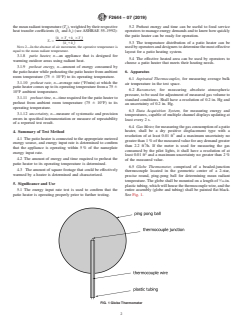
6.5 Globe Thermometer, comprised of a beaded-junction
4.3 The amount of square footage that could be effectively
thermocouple located in the geometric center of a 2-star,
warmed by a heater is determined and characterized.
precise round, ping-pong ball for determining mean radiant
temperature.The globe shall be mounted on a length of ⁄16-in.
5. Significance and Use
plastictubing,whichwillhousethethermocouplewire,andthe
5.1 The energy input rate test is used to confirm that the entire assembly (globe and tubing) shall be painted flat black.
patio heater is operating properly prior to further testing. See Fig. 1.
FIG. 1 Globe Thermometer
F2644 − 07 (2019)
NOTE 3—A high bay area may be required to provide suitable vertical
6.6 PressureGauge,formonitoringgaspressure.Shallhave
clearances for testing mounted style patio heaters.
a range of zero to 15 in. H O, a resolution of 0.5 in. H O, and
2 2
a maximum uncertainty of 1% of the measured value.
9.2 Connect the patio heater to a calibrated energy test
meter. For gas installations, install a pressure regulator down-
6.7 Stop Watch,witha1s resolution.
stream from the meter to maintain a constant pressure of gas
6.8 Temperature Sensor, for measuring gas temperature in
for all tests. Install instrumentation to record both the pressure
the range of 50 to 100°F with an uncertainty of 61°F.
and temperature of the gas supplied to the patio heater and the
6.9 Thermocouple(s), for measuring globe and ambient barometric pressure during each test so that the measured gas
temperatures, industry standard type T or type K, 24 gauge flow can be corrected to standard conditions. For electric
thermocouplewire,weldedandcalibrated,witharangeof0to installations,avoltageregulatormayberequiredduringtestsif
150°F and an uncertainty of 61°F. the voltage supply is not within 62.5% of the manufacturer’s
nameplate voltage.
6.10 Thermocouple Wire, for measuring reflector
temperature,shallbetypeKthermocouplewirewitharangeof 9.3 For a gas patio heater, adjust (during maximum energy
0 to 1000°F and an uncertainty of 61°F. input) the gas supply pressure downstream from the appli-
ance’s pressure regulator to within 62.5% of the operating
6.11 Watt-Hour Meter, for measuring the electrical energy
manifold pressure specified by the manufacturer. Make adjust-
consumptionofapatioheater,shallhavearesolutionofatleast
ments to the appliance following the manufacturer’s recom-
10Whandamaximumuncertaintynogreaterthan1.5%ofthe
mendations for optimizing combustion. Proper combustion
measured value for any demand greater than 100 W. For any
may be verified by measuring air-free CO in accordance with
demandlessthan100W,themetershallhavearesolutionofat
ANSI Z83.19 and ANSI Z83.20.
least 10Wh and a maximum uncertainty no greater than 10%.
9.4 Confirm (while the elements are energized) that the
7. Reagents and Materials
supply voltage is within 62.5% of the operating voltage
specified by the manufacturer. Record the test voltage for each
7.1 Ping-Pong Balls, two-star, precise round, weighing 2.5
6 0.5 g for constructing globe thermometers. test.
NOTE 4—It is the intent of the testing procedure herein to evaluate the
7.2 Model Airplane Control Rods, for supporting the globe
performanceofapatioheateratitsratedelectricvoltage.Ifanelectricunit
thermometers, shall be a minimum of 12 in. long with a
is rated dual voltage (that is, designed to operate at either 208 or 240 V
nominal outside diameter of ⁄16 in. with no change in components), the voltage selected by the manufacturer
and/or tester shall be reported. If a patio heater is designed to operate at
two voltages without a change in the resistance of the heating elements,
8. Sampling, Test Units
the performance of the unit (for example, preheat time) may differ at the
8.1 Patio Heater—Select a representative production model
two voltages.
for performance testing.
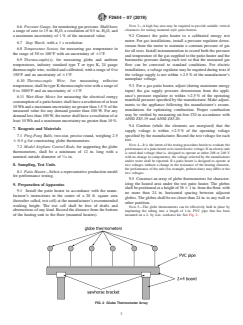
9.5 Construct an array of globe thermometers for character-
izing the heated area under the test patio heater. The globes
9. Preparation of Apparatus
shallbepositionedataheightof36 61in.fromthefloor,with
9.1 Install the patio heater in accordance with the manu-
no more than 24 in. horizontal spacing between adjacent
facturer’s instructions in the center of a 20 ft. square area
globes.The globes shall be no closer than 24 in. to any wall or
(hereafter called, test cell) at the manufacturer’s recommended
other partition.
working height. The test cell shall be free of drafts and
NOTE 5—The globe thermometers can be effectively held in place by
obstructions of any kind. Record the distance from the bottom
implanting the tubing into a length of 1-in. PVC pipe that has been
of the heating unit to the floor (mounted heaters). mounted on a 2- by 4-in. sawhorse kit. See Fig. 2.
FIG. 2 Globe Thermometer Array
F2644 − 07 (2019)
9.6 Divide the test area into four equal-sized quadrants. 10.3 Preheat Energy Consumption and Time:
Position four aspirated thermocouples, one in the center of
NOTE 7—The preheat test should be conducted as the first appliance
eachquadrantataheightof36-in.Thesefourtemperatureswill
operation on the day of the test, starting at a 75 6 10°F ambient
be used to determine the average ambient temperature.
temperature.
9.7 In preparation for the preheat test, tack-weld a thermo-
10.3.1 Confirmthatthepatioheater’sreflectorisatambient
couple to the heater’s reflector, centered as closely as possible.
temperature (75 6 10°F). Turn the unit on with control(s) set
to their maximum setting.
10. Procedure
10.3.2 Commence monitoring globe and ambient tempera-
tures.Theambientshallbe75 610°Fduringthecourseofthe
10.1 General:
test. If the ambient temperature is outside the specified range,
10.1.1 For gas patio heaters, record the following for each
the test is invalid and must be repeated.
test run:
10.3.3 Record the globe temperatures over a minimum of
10.1.1.1 Higher heating value,
10-s intervals during the course of preheat.
10.1.1.2 Standard gas pressure and temperature used to
10.3.4 Record the energy and time to preheat the patio
correct measured gas volume to standard conditions,
heater. Preheat is judged complete when the reflector reaches
10.1.1.3 Measured gas temperature,
95% of its maximum temperature.
10.1.1.4 Measured gas pressure,
10.1.1.5 Barometric pressure,
10.4 Temperature Distribution and Effective Heated Area:
10.1.1.6 Average ambient temperature, and
10.4.1 The temperature distribution and effective heated
10.1.1.7 Energy input rate during or immediately prior to
area test shall be repeated a minimum of three times. Conduct
test.
each replicate on different days.
10.4.2 Record globe and ambient temperatures at 30-s
NOTE6—Usingacalorimeterorgaschromatographinaccordancewith
accepted laboratory procedures
...