

ASTM E2523-23
(Terminology)Standard Terminology for Metalworking Fluids and Operations
General Information
- Abstract
SIGNIFICANCE AND USE
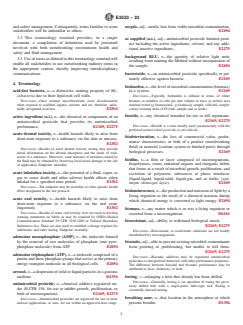
3.1 Personnel from a wide range of disciplines contribute to metalworking fluid management and plant environment health and safety management. Consequently, terms familiar to some stakeholders will be unfamiliar to others.
3.2 This terminology standard provides, in a single document, a compilation of definitions used by personnel involved with both metalworking environment health and safety and fluid management.
3.3 Use of terms as defined in this terminology standard will enable all stakeholders to use metalworking industry terms in the appropriate context, thereby improving interdisciplinary communications.
SCOPE
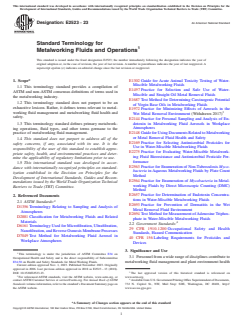
1.1 This terminology standard provides a compilation of ASTM and non-ASTM consensus definitions of terms used in the metalworking industry.
1.2 This terminology standard does not purport to be an exhaustive lexicon. Rather, it defines terms relevant to metalworking fluid management and metalworking fluid health and safety.
1.3 This terminology standard defines primary metalworking operations, fluid types, and other terms germane to the practice of metalworking fluid management.
1.4 This standard does not purport to address all of the safety concerns, if any, associated with its use. It is the responsibility of the user of this standard to establish appropriate safety, health, and environmental practices and determine the applicability of regulatory limitations prior to use.
1.5 This international standard was developed in accordance with internationally recognized principles on standardization established in the Decision on Principles for the Development of International Standards, Guides and Recommendations issued by the World Trade Organization Technical Barriers to Trade (TBT) Committee.
- Status
- Published
- Publication Date
- 31-Oct-2023
- Technical Committee
- E34 - Occupational Health and Safety
- Drafting Committee
- E34.50 - Health and Safety Standards for Metal Working Fluids
Overview
ASTM E2523-23: Standard Terminology for Metalworking Fluids and Operations is an authoritative guide developed by ASTM to unify the language used in the metalworking industry. This standard aggregates definitions of key terms related to metalworking fluid management, health, and safety across manufacturing and industrial environments. By providing standardized terminology, ASTM E2523-23 enhances interdisciplinary communication, compliance, and clarity for professionals involved in metalworking operations worldwide.
Key Topics
- Standardized definitions: Compilation of ASTM and non-ASTM terms pertinent to metalworking fluids, operations, and associated health and safety practices
- Fluid types: Addresses water-miscible fluids, straight oils, semi-synthetic and synthetic fluids, and metalforming fluids
- Health and safety: Terminology for exposure, hazards, toxicity, bioresistance, contamination, and workplace controls
- Processes and operations: Definitions for machining, metal removal (drilling, turning, milling, grinding, reaming, broaching, tapping), forming, and surface finishing techniques
- Workplace environment and monitoring: Terms for aerosols, ventilation, employee exposure, personal sampling, and contaminant control
- Testing and analysis: Vocabulary for laboratory assays, monitoring of bioburden, endotoxin concentration, and antimicrobial performance
- Regulatory alignment: Incorporates references to U.S. OSHA standards and EPA regulations as well as internationally recognized principles for standardization
Applications
ASTM E2523-23 is essential for:
- Industrial and manufacturing facilities: Ensures consistent use of terminology for fluid selection, management, and monitoring processes in metalworking operations.
- Health and safety professionals: Provides clarity on exposure limits, hazard communications, and workplace environmental controls.
- Quality assurance and compliance teams: Facilitates regulatory adherence, risk management, and reporting by standardizing language and definitions.
- Product formulators and chemical suppliers: Aids in communicating characteristics of metalworking fluids and additives.
- Training and documentation: Offers a foundational lexicon for technical training, manuals, and safety documentation within the metalworking industry.
- Cross-disciplinary teams: Bridges language gaps between engineers, environmental health specialists, chemists, regulatory staff, and other stakeholders.
By clearly defining shared terms such as "coolant," "biocide," "tramp oil," "emulsifiable oil," or "exposure," this standard minimizes misinterpretation and promotes best practices in fluid management, safety procedures, and environmental stewardship.
Related Standards
Professionals using ASTM E2523-23 often rely on several complementary ASTM and regulatory standards, including:
- ASTM D2881: Classification for Metalworking Fluids and Related Materials
- ASTM D1356: Terminology Relating to Sampling and Analysis of Atmospheres
- ASTM D6161: Membrane Filtration Processes
- ASTM D7049: Test Method for Metalworking Fluid Aerosol in Workplace Atmospheres
- ASTM E1302: Guide for Acute Animal Toxicity Testing of Metalworking Fluids
- ASTM E1497: Practice for Selection and Safe Use of Water-Miscible and Straight Oil Metal Removal Fluids
- ASTM E2144: Practice for Personal Sampling and Analysis of Endotoxin in Metalworking Fluid Aerosols
- ASTM E2169: Selecting Antimicrobial Pesticides for Water-Miscible Metalworking Fluids
- OSHA 29 CFR 1910.1200: Hazard Communication Standard
- EPA 40 CFR 156: Labeling Requirements for Pesticides
Practical Value
By adopting ASTM E2523-23, facilities and professionals benefit from:
- Enhanced safety and compliance: Through clear, shared terminology supporting regulatory requirements and risk reduction.
- Improved communication: Between multidisciplinary teams, reducing errors and increasing efficiency.
- Consistent training and documentation: Supporting quality management and workforce development.
- Industry best practices: Anchored in global consensus and informed by the latest technical and regulatory advances in the metalworking sector.
Keywords: metalworking fluids, metal removal, coolants, safety, terminology, synthetic fluids, emulsifiable oils, regulatory compliance, occupational health.
Relations
- Effective Date
- 01-Nov-2023
- Effective Date
- 01-Mar-2024
- Effective Date
- 01-Oct-2023
- Effective Date
- 01-Oct-2023
- Effective Date
- 01-Oct-2018
- Effective Date
- 01-Oct-2018
- Effective Date
- 01-Oct-2017
- Effective Date
- 01-Nov-2023
- Effective Date
- 01-Nov-2023
- Effective Date
- 01-Nov-2023
- Effective Date
- 01-Nov-2023
- Effective Date
- 01-Nov-2023
- Effective Date
- 01-Nov-2023
- Effective Date
- 01-Nov-2023
- Referred By
ASTM E3265-21 - Standard Guide for Evaluating Water-Miscible Metalworking Fluid Foaming Tendency - Effective Date
- 01-Nov-2023
Get Certified
Connect with accredited certification bodies for this standard

Element Materials Technology
Materials testing and product certification.

ABS Group Brazil
ABS Group certification services in Brazil.

ABS Quality Evaluations Inc.
American Bureau of Shipping quality certification.
Sponsored listings
Frequently Asked Questions
ASTM E2523-23 is a standard published by ASTM International. Its full title is "Standard Terminology for Metalworking Fluids and Operations". This standard covers: SIGNIFICANCE AND USE 3.1 Personnel from a wide range of disciplines contribute to metalworking fluid management and plant environment health and safety management. Consequently, terms familiar to some stakeholders will be unfamiliar to others. 3.2 This terminology standard provides, in a single document, a compilation of definitions used by personnel involved with both metalworking environment health and safety and fluid management. 3.3 Use of terms as defined in this terminology standard will enable all stakeholders to use metalworking industry terms in the appropriate context, thereby improving interdisciplinary communications. SCOPE 1.1 This terminology standard provides a compilation of ASTM and non-ASTM consensus definitions of terms used in the metalworking industry. 1.2 This terminology standard does not purport to be an exhaustive lexicon. Rather, it defines terms relevant to metalworking fluid management and metalworking fluid health and safety. 1.3 This terminology standard defines primary metalworking operations, fluid types, and other terms germane to the practice of metalworking fluid management. 1.4 This standard does not purport to address all of the safety concerns, if any, associated with its use. It is the responsibility of the user of this standard to establish appropriate safety, health, and environmental practices and determine the applicability of regulatory limitations prior to use. 1.5 This international standard was developed in accordance with internationally recognized principles on standardization established in the Decision on Principles for the Development of International Standards, Guides and Recommendations issued by the World Trade Organization Technical Barriers to Trade (TBT) Committee.
SIGNIFICANCE AND USE 3.1 Personnel from a wide range of disciplines contribute to metalworking fluid management and plant environment health and safety management. Consequently, terms familiar to some stakeholders will be unfamiliar to others. 3.2 This terminology standard provides, in a single document, a compilation of definitions used by personnel involved with both metalworking environment health and safety and fluid management. 3.3 Use of terms as defined in this terminology standard will enable all stakeholders to use metalworking industry terms in the appropriate context, thereby improving interdisciplinary communications. SCOPE 1.1 This terminology standard provides a compilation of ASTM and non-ASTM consensus definitions of terms used in the metalworking industry. 1.2 This terminology standard does not purport to be an exhaustive lexicon. Rather, it defines terms relevant to metalworking fluid management and metalworking fluid health and safety. 1.3 This terminology standard defines primary metalworking operations, fluid types, and other terms germane to the practice of metalworking fluid management. 1.4 This standard does not purport to address all of the safety concerns, if any, associated with its use. It is the responsibility of the user of this standard to establish appropriate safety, health, and environmental practices and determine the applicability of regulatory limitations prior to use. 1.5 This international standard was developed in accordance with internationally recognized principles on standardization established in the Decision on Principles for the Development of International Standards, Guides and Recommendations issued by the World Trade Organization Technical Barriers to Trade (TBT) Committee.
ASTM E2523-23 is classified under the following ICS (International Classification for Standards) categories: 01.040.75 - Petroleum and related technologies (Vocabularies); 75.100 - Lubricants, industrial oils and related products. The ICS classification helps identify the subject area and facilitates finding related standards.
ASTM E2523-23 has the following relationships with other standards: It is inter standard links to ASTM E2523-13(2018), ASTM D7049-24, ASTM E2564-23, ASTM E2563-23, ASTM E2563-18, ASTM E2564-18, ASTM D7049-17, ASTM E2144-21, ASTM E2694-21, ASTM E2275-19, ASTM E1497-23, ASTM E2148-21, ASTM E2889-23, ASTM D7687-23, ASTM E3265-21. Understanding these relationships helps ensure you are using the most current and applicable version of the standard.
ASTM E2523-23 is available in PDF format for immediate download after purchase. The document can be added to your cart and obtained through the secure checkout process. Digital delivery ensures instant access to the complete standard document.
Standards Content (Sample)
This international standard was developed in accordance with internationally recognized principles on standardization established in the Decision on Principles for the
Development of International Standards, Guides and Recommendations issued by the World Trade Organization Technical Barriers to Trade (TBT) Committee.
Designation: E2523 − 23 An American National Standard
Standard Terminology for
Metalworking Fluids and Operations
This standard is issued under the fixed designation E2523; the number immediately following the designation indicates the year of
original adoption or, in the case of revision, the year of last revision. A number in parentheses indicates the year of last reapproval. A
superscript epsilon (´) indicates an editorial change since the last revision or reapproval.
1. Scope* E1302 Guide for Acute Animal Toxicity Testing of Water-
Miscible Metalworking Fluids
1.1 This terminology standard provides a compilation of
E1497 Practice for Selection and Safe Use of Water-
ASTM and non-ASTM consensus definitions of terms used in
Miscible and Straight Oil Metal Removal Fluids
the metalworking industry.
E1687 Test Method for Determining Carcinogenic Potential
1.2 This terminology standard does not purport to be an
of Virgin Base Oils in Metalworking Fluids
exhaustive lexicon. Rather, it defines terms relevant to metal-
E1972 Practice for Minimizing Effects of Aerosols in the
working fluid management and metalworking fluid health and
Wet Metal Removal Environment (Withdrawn 2017)
safety.
E2144 Practice for Personal Sampling and Analysis of En-
dotoxin in Metalworking Fluid Aerosols in Workplace
1.3 This terminology standard defines primary metalwork-
ing operations, fluid types, and other terms germane to the Atmospheres
E2148 Guide for Using Documents Related to Metalworking
practice of metalworking fluid management.
or Metal Removal Fluid Health and Safety
1.4 This standard does not purport to address all of the
E2169 Practice for Selecting Antimicrobial Pesticides for
safety concerns, if any, associated with its use. It is the
Use in Water-Miscible Metalworking Fluids
responsibility of the user of this standard to establish appro-
E2275 Practice for Evaluating Water-Miscible Metalwork-
priate safety, health, and environmental practices and deter-
ing Fluid Bioresistance and Antimicrobial Pesticide Per-
mine the applicability of regulatory limitations prior to use.
formance
1.5 This international standard was developed in accor-
E2563 Practice for Enumeration of Non-Tuberculosis Myco-
dance with internationally recognized principles on standard-
bacteria in Aqueous Metalworking Fluids by Plate Count
ization established in the Decision on Principles for the
Method
Development of International Standards, Guides and Recom-
E2564 Practice for Enumeration of Mycobacteria in Metal-
mendations issued by the World Trade Organization Technical
working Fluids by Direct Microscopic Counting (DMC)
Barriers to Trade (TBT) Committee.
Method
E2657 Practice for Determination of Endotoxin Concentra-
2. Referenced Documents
tions in Water-Miscible Metalworking Fluids
2.1 ASTM Standards:
E2693 Practice for Prevention of Dermatitis in the Wet
D1356 Terminology Relating to Sampling and Analysis of
Metal Removal Fluid Environment
Atmospheres
E2694 Test Method for Measurement of Adenosine Triphos-
D2881 Classification for Metalworking Fluids and Related
phate in Water-Miscible Metalworking Fluids
Materials
2.2 Government Standards:
D6161 Terminology Used for Microfiltration, Ultrafiltration,
29 CFR 1910.1200 Occupational Safety and Health
Nanofiltration, and Reverse Osmosis Membrane Processes
Standards, Hazard Communication
D7049 Test Method for Metalworking Fluid Aerosol in
40 CFR 156 Labeling Requirements for Pesticides and
Workplace Atmospheres
Devices
3. Significance and Use
This terminology is under the jurisdiction of ASTM Committee E34 on
3.1 Personnel from a wide range of disciplines contribute to
Occupational Health and Safety and is the direct responsibility of Subcommittee
E34.50 on Health and Safety Standards for Metal Working Fluids.
metalworking fluid management and plant environment health
Current edition approved Nov. 1, 2023. Published November 2023. Originally
approved in 2006. Last previous edition approved in 2018 as E2523 – 13 (2018).
DOI: 10.1520/E2523-23. The last approved version of this historical standard is referenced on
For referenced ASTM standards, visit the ASTM website, www.astm.org, or www.astm.org.
contact ASTM Customer Service at service@astm.org. For Annual Book of ASTM Available from U.S. Government Printing Office Superintendent of Documents,
Standards volume information, refer to the standard’s Document Summary page on 732 N. Capitol St., NW, Mail Stop: SDE, Washington, DC 20401, http://
the ASTM website. www.access.gpo.gov.
*A Summary of Changes section appears at the end of this standard
Copyright © ASTM International, 100 Barr Harbor Drive, PO Box C700, West Conshohocken, PA 19428-2959. United States
E2523 − 23
and safety management. Consequently, terms familiar to some aseptic, adj—sterile, free from viable microbial contamination.
stakeholders will be unfamiliar to others. E2694
3.2 This terminology standard provides, in a single
as supplied (a.s.), adj—antimicrobial pesticide finished prod-
document, a compilation of definitions used by personnel
uct including the active ingredients, solvent, and any addi-
involved with both metalworking environment health and
tional inactive ingredients. E2275
safety and fluid management.
background RLU, n—the quantity of relative light units
3.3 Use of terms as defined in this terminology standard will
resulting from running the Method without incorporation of
enable all stakeholders to use metalworking industry terms in
the sample. E2694
the appropriate context, thereby improving interdisciplinary
communications. bactericide, n—an antimicrobial pesticide specifically or pri-
marily effective against bacteria. E2169
4. Terminology
bioburden, n—the level of microbial contamination (biomass)
acid-fast bacteria, n—a distinctive staining property of My-
in a system. E2169
cobacteria due to their lipid-rich cell walls.
DISCUSSION—Typically, bioburden is defined in terms of either
DISCUSSION—Once stained, mycobacterium resist decolorization biomass or numbers of cells per unit volume or mass or surface area
when exposed to acidified organic solvents and are, therefore, infor- material tested (g biomass/mL; g biomass/g sample; cells/mL sample;
colony forming units (CFU)/mL sample and so forth).
mally designated acid-fast. E2564
biocide, n—any chemical intended for use to kill organisms.
active ingredient (a.i.), n—the chemical or components of an
E2169, E2275
antimicrobial pesticide that provides its antimicrobial
DISCUSSION—Biocide is a term usually used synonymously with the
performance. E2169, E2275
preferred antimicrobial pesticide or microbicide.
acute dermal toxicity, n—health hazards likely to arise from
biodeterioration, n—the loss of commercial value, perfor-
short-term exposure to a substance via the skin or mucosa.
mance characteristics, or both of a product (metalworking
E1302
fluid) or material (coolant system or finished parts) through
DISCUSSION—Results of acute dermal toxicity testing may provide
biological processes. E2169
initial information on the dermal absorption and the mode of toxic
action of a substance. Moreover, some measure of irritation caused by
biofilm, n—a film or layer composed of microorganisms,
the fluid may be obtained by observing local tissue damage at the site
biopolymers, water, entrained organic and inorganic debris
of application. Endpoint: mortality.
that forms as a result of microbial growth, proliferation, and
acute inhalation toxicity, n—the potential of a fluid, vapor, or
excretion of polymeric substances at phase interfaces
gas to cause death and other adverse health effects when
(liquid-liquid, liquid-solid, liquid-gas, and so forth). (syn-
inhaled for a specified time period. E1302
onym: skinnogen layer). E2169
DISCUSSION—The endpoint may be mortality or other specific health
effect designated in the test protocol. bioluminescence, n—the production and emission of light by a
living organism as the result of a chemical reaction during
acute oral toxicity, n—health hazards likely to arise from
which chemical energy is converted to light energy. E2694
short-term exposure to a substance via the oral route
(ingestion). E1302
biomass, n—any matter which is or was a living organism or
DISCUSSION—Results of acute oral toxicity tests are used to develop
excreted from a microorganism. D6161
warning statements on labels as may be required by OSHA Hazard
bioresistant, adj—ability to withstand biological attack.
Communication Standard 29 CFR 1910.1200 or Federal Hazardous
Substances Act. These are also used to establish a dosage regimen for
E2169, E2275
subchronic and other testing. Endpoint: mortality.
DISCUSSION—Bioresistant, or recalcitrant, chemicals are not readily
metabolized by microorganisms.
adenosine monophosphate (AMP), n—the molecule formed
by the removal of two molecules of phosphate (one pyro-
biostatic, adj—able to prevent existing microbial contaminants
phosphate molecule) from ATP. E2694
from growing or proliferating, but unable to kill them.
E2169, E2275
adenosine triphosphate (ATP), n—a molecule comprised of a
DISCUSSION—Biostatic additives may be registered antimicrobial
purine and three phosphate groups that serves as the primary
pesticides or unregistered chemicals with other performance properties.
energy transport molecule in all biological cells. E2694
The difference between biocidal and biostatic performance may be
attributed to dose, chemistry, or both.
aerosol, n—a dispersion of solid or liquid particles in a gaseous
medium. D1356
boring, v—enlarging a hole that already has been drilled.
DISCUSSION—Generally, boring is an operation of truing the previ-
antimicrobial pesticide, n—chemical additive registered un-
ously drilled hole with a single-point, lathe-type tool. Boring is
der 40 CFR 156, for use to inhibit growth, proliferation, or
essentially internal turning.
both of microorganisms. E2169, E2275
breathing zone, n—that location in the atmosphere at which
DISCUSSION—Antimicrobial pesticides are registered for one or more
end-use applications, or sites, for use within an approved dose range. persons breathe. D1356
E2523 − 23
DISCUSSION—The worker’s breathing zone consists of a hemisphere
dermatitis, n—an inflammatory response of the skin. E1497
300-mm radius in front of the face and measured from a line bisecting
DISCUSSION—Dermatitis can result from a wide variety of sources and
the ears. D7049
processes. The most common origins are irritants or allergic responses
to a chemical or physical agent. Signs and symptoms that typify the
broaching, v—an operation in which a cutter progressively
initial onset of dermatitis include: erythema (redness); edema (swell-
enlarges a slot or hole, or shapes a workpiece exterior.
ing); pruritis (itching); and vesiculation (pimple-like eruptions). In
DISCUSSION—Low teeth start the cut, intermediate teeth remove the
more severe cases, fissures (deep cracks) and ulcers (open sores) may
majority of the material, and high teeth finish the task. Broaching can
develop. The condition is usually reversible when exposure to the
be a one-step operation, as opposed to milling and slotting, which
causative agent ceases. More severe cases may require more time and
require repeated passes. Typically, however, broaching also involves
some medical attention. Some individuals may be at higher risk.
multiple passes.
dilution ventilation, n—referring to the supply and exhaust of
bubbler, n—a sampling device consisting of a gas dispenser
air with respect to an area, room, or building, the dilution of
immersed in an absorbing liquid. D1356
contaminated air with uncontaminated air for the purpose of
controlling potential health hazards, fire and explosion
coining, v—a closed-die squeezing operation in which all
conditions, odors, and nuisance-type contaminants, from
surfaces of the work are restrained (coined).
DISCUSSION—Coining often imparts a pattern or shape onto the Industrial Ventilation: A Manual of Recommended Practice.
workpiece. Coining also refers to a press-brake bending operation in
E2693
which the punch bottoms against the workpiece and the die. It also
refers to a process similar to bottoming although greater force is dose, n—concentration of antimicrobial pesticide added to
applied. Coining alters the radius, and bottoming sets the bend open but
treated solution. E2169, E2275
does not affect shape.
DISCUSSION—Dose is generally expressed as either ppm active
ingredient (a.i.) or ppm as supplied (a.s.).
collector, n—a device for removing and retaining contaminants
from air or other gases. D1356
drawing, v—process by which a metal blank is forced to flow
through a die cavity without any constraint other than against
contaminant, n—substances contained in in-use metalworking
buckling.
fluids that are not part of the received fluid, such as abrasive
DISCUSSION—Internal resistance flow of the metal towards the punch
particles, tramp oils, cleaners, dirt, metal fines and shavings,
and dies sets up compressive stresses which, combined with tensile
dissolved metal and hard water salts, bacteria, fungi and
stresses created by the motion of the punch, produce two-dimensional
microbiological decay products, and waste. E1497
shear.
contamination control, n—maintenance of bioburden at an
drilling, v—operation in which a rotating tool is used to create
operationally defined level, at or below which the bioburden
a round hole in a workpiece.
does not affect the fluid or system adversely. E2169
DISCUSSION—Drilling is normally the first step in machining opera-
tions such as boring, reaming, tapping, counterboring, countersinking,
control, v—to prevent, eliminate, or reduce hazards related to
and spotfacing.
the use of metalworking fluids in metalworking processes
and to provide appropriate supplemental, or interim
emergency, n—any occurrence such as, but not limited to,
protection, or both, as necessary, to employees. E1497
equipment failure, rupture of containers, or failure of control
equipment that results in an uncontrolled release of a
control standard endotoxin (CSE), n—a purified preparation
significant amount of metalworking fluid. E1497
of endotoxin based on the USP Reference Standard Endo-
toxin (RSE); used in laboratories to prepare standard
employee exposure, n—the exposure to metalworking fluids
solutions. E2657
and contaminants which would occur without corrections for
protection by any respirator or other personal protective
coolant, n—any liquid used for the purpose of facilitating heat
equipment that is in use.
removal from metal removal, forming, or both types of
metalworking operations.
emulsifiable oil (frequently referred to as “soluble oil”),
DISCUSSION—Coolants are typically classified by the general chemi-
n—a metalworking fluid that generally contains >30 % oil
cal composition as emulsifiable oils, semi-synthetic oils, straight oils,
before dilution with water. D2881
or synthetic fluid (Classification D2881). See definitions 4.32, 4.72,
4.77 and 4.78, respectively. Coolants are used primarily to cool and DISCUSSION—Emulsifiable oils contain emulsifiers and other func-
lubricate. tional additives and generally create macro-emulsions (average size
>1.0 μm) when diluted with water.
culturable, adj—microorganisms that proliferate as indicated
DISCUSSION—Emulsifiable oils are blended with water in their end
by the formation of colonies on solid growth media or the
use.
development of turbidity in liquid growth media under
specific growth conditions. E2694
emulsifier, n—a surface-active agent, or surfactant, that is at
least partially soluble in both liquids (phases) of an
demand, n—the sum of all factors that contribute to decreasing
emulsion, and thus stabilizes one in the other. D2881
the effective concentration of antimicrobial pesticide. E2169
DISCUSSION—Processes contributing to demand include, but are not
emulsion, n—a relatively stable mixture of two immiscible
limited to, reactions with microbes, reactions with other chemicals in
liquids, one of which is held in suspension in the other by
the fluid, adsorption onto surfaces, absorption into materials, and
temperature. small amounts of emulsifiers. D2881
E2523 − 23
emulsion synthetic fluid, n—a metalworking fluid formulation when subjected to the differential Gram staining procedure.
that is prepared from vegetable oil, esters, or other synthetic E2657
basestocks; contains emulsifiers and other functional addi-
grinding, v—machining operation in which material is re-
tives but no petroleum oil, and produces an emulsion when
moved from the workpiece by a powered abrasive wheel,
added to water. D2881
stone, belt, paste, sheet, compound, slurry, etc.
DISCUSSION—Emulsion synthetic fluids are blended with water in
their end use.
gundrilling (gunning), v—drilling process using a single-lip,
self-guiding tool to produce deep, precise holes.
endotoxin, n—a lipopolysaccharide derived from the outer
membrane of Gram-negative bacteria. E1497, E2144, DISCUSSION—During gunning, high-pressure coolant is fed to the
cutting area, usually through the gundrill’s shank.
E2657
half-life (T ⁄2 ), n—time required for concentration of a micro-
endotoxin unit (EU), n—a biological potency unit equivalent
bicide to diminish to one-half its original concentration.
to the FDA Reference Standard Endotoxin (RSE). E2144,
E2657
honing, v—a low-velocity abrading process by which material
DISCUSSION—Currently EC-6 is equivalent to 0.1 ng 3D 1 EU.
removal is accomplished at lower cutting speeds than in
exposure, n—contact with a chemical, biological, physical, or grinding.
other agent over a specified period time. D1356
DISCUSSION—In honing, heat and pressure are minimized, resulting in
excellent size and geometry control. The most common application of
DISCUSSION—Exposure is expressed as the integral of the concentra-
honing is internal cylindrical surfaces. The cutting action is obtained
tion (or intensity) of the agent at the boundary of the receptor over the
using abrasive sticks (aluminum oxide and silicon carbide) mounted on
time period of contact, that is, E~ =~∫|C(t) dt.
a metal mandrel.
extractable mass, n—the material removed by the liquid of the
impactor, n—a device for collecting airborne or emission
sampling filter using a mixed polarity mixture as described
particulate matter in which the air or gas being sampled is
in Test Method D7049. E1972
impacted or impinged against a surface. D1356
DISCUSSION—This mass is an approximation of the metalworking
fluid portion of the workplace aerosol.
DISCUSSION—A cascade impactor is a type of impactor which
employs several stages of impaction in series to collect successively
eye irritation, n—damage or inflammatory effect caused to the
smaller sizes of particles.
eye due to exposure to a chemical substance.
impingement, n—the act of bringing matter forcibly in
folliculitis, n—an inflammatory reaction in hair follicles.
contact. D1356
E1497
DISCUSSION—As used in air sampling, impingement refers to a
process for the collection of particulate matter in which the gas being
forming, v—process in which material is stamped, stretched,
sampled is directed forcibly against a surface.
bent, or given a new shape without intentionally removing
material.
impinger, n—broadly, a sampling instrument employing im-
pingement of the collection of particulate matter. D1356
fume, n—properly, the solid particles generated by condensa-
tion from the gaseous state, generally after volatilization
inactive ingredient, n—component of antimicrobial pesticide
from melted substances, and often accompanied by a chemi-
that is not directly responsible for the pesticide’s antimicro-
cal reaction such as oxidation. D1356
bial performance. E2275
DISCUSSION—Fumes flocculate and sometimes coalesce. Popularly,
DISCUSSION—Inactive ingredients may include, but are not limited to,
the term is used in reference to any or all types of contaminant, and in
solvents and chemicals that improve the pesticide’s non-biocidal
many laws or regulations with the added qualification that the contami-
performance properties, such as miscibility and reactivity with non-
nant has some unwanted action.
target molecules in the treated material.
functional additive, n—in metalworking fluid, a chemical
lethal dose, n—a concentration (usually mass of treatment
substance formulated into a metalworking fluid to provide
agent per unit mass of test subject) at which treatment kills
one or more specific performance properties not inherently
at least one of test subjects. E2169
provided by the basestock. D2881
DISCUSSION—The LD is the term used in toxicology defining the
DISCUSSION—Functional additives include but are not limited to:
dose that kills fifty percent of the test population.
antifoaming agents, antimicrobial pesticides, buffers, corrosion
inhibitors, coupling agents, emulsifiers, lubricity additives, and metal
limulus amebocyte lysate (LAL) assay, n—a biological assay
deactivators. The number and range of functional additives varies with
that detects endotoxin. E2144
the metalworking fluid formulation, and can range from a single
additive to numerous additives in order to provide the performance
limulus amebocyte lysate (LAL) assay, n—a biological assay
properties specified by the fluid compounder.
dependent on a series of cascading enzyme reactions that
fungicide, n—antimicrobial pesticide specifically or primarily occur when Limulus blood cell (amebocyte) lysate combines
with endotoxin. E2657
effective against fungi. E2169
gram-negative bacteria, n—prokaryotic cells that have a Luciferase, n—a general term for a class of enzymes that
complex cell-wall structure that stains characteristically catalyze bioluminescent reactions. E2694
E2523 − 23
on an arbor. Horizontal milling is further broken down into conven-
Luciferin, n—a general term for a class of light-emitting
tional milling, where the cutter rotates opposite the workpiece; and
biological pigments found in organisms capable of
climb milling, where the cutter rotates in the direction of the feed.
bioluminescence. E2694
minimum inhibitory concentration (MIC), n—lowest treat-
luminometer, n—an instrument capable of measuring light
ment dose that will prevent test population from growing,
emitted as a result of non-thermal excitation. E2694
proliferating, or otherwise contributing to biodeterioration.
lysis, n—refers to the death of a biological cell by breaking of
E2169, E2275
the cellular membrane. E2694
mist, n—liquid, usually water in the form of particles sus-
metalforming, v—see forming.
pended in the atmosphere at or near the surface of the earth;
small water droplets floating or falling, approaching the form
metalforming fluid, n—any fluid in the subclass of metal-
of rain and sometimes distinguished from fog as being more
working fluids used for the purpose of drawing, rolling,
transparent or as having particles perceptibly moving
stamping, or other metal-shaping process.
downward. D1356
metal removal fluid (MRF), n—any fluid in the subclass of
mutagenicity index (MI), n—the slope of the dose response
metalworking fluids used to cut, or otherwise take away
curve for mutagenicity in the modified Ames test. E1687
material or piece of stock. E2148
DISCUSSION—MI is an index of relative mutagenic potency.
DISCUSSION—Metal removal fluids include straight or neat oils
(D2881) not intended for further dilution with water, and water-
non-tuberculous Mycobacteria (NTM)—environmental
miscible soluble oils, semisynthetics, and synthetics, which are in-
mycobacteria, not associated with tuberculosis. E2564
tended to be diluted with water before use. Metal removal fluids
become contaminated during use in the workplace with a variety of
odor, n—that property of a substance which affects the sense of
workplace substances including, but not limited to, abrasive particles,
smell; any smell; scent; perfume. D1356
tramp oils, cleaners, dirt, metal fines and shavings, dissolved metal and
hard water salts, bacteria, fungi, microbiological decay products, and
odor threshold, n—the concentration of an odorous compound
waste. These contaminants can cause changes in the lubricity and
cooling ability of the metal removal fluid, as well as have the potential at which the physiological effect elicits a response 50 % of
to adversely affect the health and welfare of employees in contact with
the time. D1356
the contaminated metal removal fluid. (E2148)
oil immersion field (OIF), n—the circular area of a micro-
metal removal fluid aerosol, n—aerosol generated by opera-
scopic field visible in the eye piece of the microscope using
tion of the machine tool itself, as well as from circulation
oil immersion objective. E2564
and filtration systems associated with wet metal removal
operations, and may include airborne contaminants of mi-
personal sampler, n—a portable sampling instrument that is
crobial origin. E1972
attached to a person to ascertain the concentration of specific
DISCUSSION—Metal removal aerosol does not include background
constituents in the air in the person’s breathing zone. E2144
aerosol in the workplace atmosphere, which may include suspended
insoluble particulates.
polycyclic aromatics (PCA), n—for the purposes of this test
method, PCA refers to fused-ring polycyclic aromatic com-
metal removal process, n—a manufacturing process that
pounds with three or more rings. E1687
removes metal during shaping of a part, including machining
DISCUSSION—Examples of this hydrocarbon series include
processes such as milling, drilling, turning, broaching, tap-
phenanthrene (3), pyrene (4), benzopyrene (5), dibenzopyrene (6), and
ping and grinding processes, as well as honing and lapping,
coronene (7). Heterocyclic polynuclear compounds are also included in
and other similar mechanical operations in which metal is
this definition. Polycyclic aromatics are also referred to as polynuclear
removed to form a finished part. E1497
aromatics (PNA) and polycyclic aromatic hydrocarbons (PAH).
metalworking fluid (MWF), n—any fluid used for the purpose
pyrogen-free (PF), adj—material(s) devoid of measurable
of cooling or treating metal surfaces during metal removal,
endotoxin activity. E2657
metal forming, or surface protection or preservation.
rapidly growing mycobacteria (RGM), n—non-tuberculosis
microbicide, n—synonymous with antimicrobial pesticide.
Mycobacteria that grow and produce visible colonies in four
E2169
to seven days. E2563
microscopic factor (MF), n—a calibrated conversion factor
reaming, v—a machining process that uses a multi-edge, fluted
for calculating the Mycobacterium count per mL.
cutting tool to smooth, enlarge, or accurately size an existing
DISCUSSION—The average number of mycobacterium cells per one
hole.
microscopic field (or oil field, OIF) is multiplied by the MF to give the
concentration of mycobacterium per mL of sample. E2564
relative light unit (RLU), n—an instrument-specific unit of
measurement reflecting the number of photons emitted by
milling, v—machining operation in which metal or other
the Luciferin-Luciferase driven hydrolysis of ATP to AMP
material is removed by applying power to a rotating cutter.
plus pyrophosphate.
DISCUSSION—Milling takes two general forms. In vertical milling, the
DISCUSSION—RLU is not an SI unit, however, RLU are proportional
cutting tool is mounted vertically on the spindle. In horizontal milling,
the cutting tool is mounted horizontally, either directly on the spindle or to ATP concentration. E2694
E2523 − 23
roll forming, v—a process for forming cylindrical or semicy- synthetic fluid, n—a metalworking fluid that contains no oil
lindrical shapes from sheet or plate by feeding the work and forms a true solution (no micelles) when mixed with
edgewise into the gap between a cluster of at least three water.
relatively small diameter straight rolls. DISCUSSION—Classification D2881 categorizes synthetic fluids as
non-petroleum oil containing solution synthetic fluids, emulsion syn-
DISCUSSION—The size of the gap between rolls, and its relationship to
thetic fluids, or straight synthetic oils, depending on whether the
sheet thickness, determines the bend radius in the finished cylinder.
finished product forms a true solution or emulsion with water, or is
Roll bending is also used to form solid bars, rods, heavy-wall tubes and
immiscible with water. For the purposes of this document, synthetic
special shapes into desired shapes.
fluid is synonymous with solution synthetic fluid.
sawing, v—machining operation in which a powered machine,
tapping, v—machining operation in which a tap with teeth on
usually equipped with a blade having milled or ground teeth,
its periphery cuts internal threads in a pre-drilled hole having
is used to part material (cutoff) or give it a new shape
a smaller diameter than the tap diameter.
(contour bandsawing).
DISCUSSION—Threads are formed by a combined rotary and axial-
DISCUSSION—The four basic types of sawing operations are: (1)
relative motion between tap and workpiece.
hacksawing: power or manual operation in which the blade moves back
and forth through the work, cutting on one of the strokes; (2) cold or
tramp oil, n—oil and oil-soluble additives, sometimes
circular sawing: a rotating, circular, toothed blade parts the material; (3)
insoluble, resulting from leaking hydraulic, spindle, slide-
bandsawing: a flexible, toothed blade rides on wheels under tension and
is guided through the work; and (4) abrasive sawing: abrasive points way, or gear oil into the metalworking fluid. E1497
attached to a fiber or metal backing part stock.
DISCUSSION—Tramp oils may contaminate the metalworking fluid
with components that are emulsifiable but which are not parts of the
semi-synthetic fluid, n—a metalworking fluid that generally
metalworking fluid as formulated.
contains >20 % water and <50 % petroleum oil and func-
vapor, n—the gaseous phase of matter that normally exists in
tional additives.
a liquid or solid state. D1356
DISCUSSION—Semi-synthetic fluids are blended with water in their
end use and generally create micro-emulsions (average particle size
viable microbial biomass, n—metabolically active (living)
<1.0 μm) when diluted with water. D2881
microorganisms. E2694
sensory irritation, n—discomfort or burning sensation of the
wet metalworking fluid environment, n—the workplace en-
eyes, nose, or throat, or cough caused by exposure to a
vironment in which wet metalworking operations occur.
chemical substance (sensory irritant).
E1497
skin corrosion, n—visible destruction of, or irreversible altera-
tions in living tissue caused by chemical action at the site of
5. Symbols, Abbreviations, and Acronyms
contact. E1302
5.1 AFB—acid-fast bacteria
skin irritation, n—a reversible inflammatory effect on living
5.2 a.i.—active ingredient
tissue by a chemical reaction at the site of contact. E1302
5.3 AMP—adenosine monophosphate
skin sensitization, n—an allergic reaction in normal tissue
5.4 a.s.—as supplied
after repeated exposure to a chemical.
DISCUSSION—Chemical sensitizers are materials that cause a substan-
5.5 ATP—adenosine triphosph
...
This document is not an ASTM standard and is intended only to provide the user of an ASTM standard an indication of what changes have been made to the previous version. Because
it may not be technically possible to adequately depict all changes accurately, ASTM recommends that users consult prior editions as appropriate. In all cases only the current version
of the standard as published by ASTM is to be considered the official document.
Designation: E2523 − 13 (Reapproved 2018) E2523 − 23 An American National Standard
Standard Terminology for
Metalworking Fluids and Operations
This standard is issued under the fixed designation E2523; the number immediately following the designation indicates the year of
original adoption or, in the case of revision, the year of last revision. A number in parentheses indicates the year of last reapproval. A
superscript epsilon (´) indicates an editorial change since the last revision or reapproval.
1. Scope Scope*
1.1 This terminology standard provides a compilation of ASTM and non-ASTM consensus definitions of terms used in the
metalworking industry.
1.2 This terminology standard does not purport to be an exhaustive lexicon. Rather, it defines terms relevant to metalworking fluid
management and metalworking fluid health and safety.
1.3 This terminology standard defines primary metalworking operations, fluid types, and other terms germane to the practice of
metalworking fluid management.
1.4 This standard does not purport to address all of the safety concerns, if any, associated with its use. It is the responsibility
of the user of this standard to establish appropriate safety, health, and environmental practices and determine the applicability of
regulatory limitations prior to use.
1.5 This international standard was developed in accordance with internationally recognized principles on standardization
established in the Decision on Principles for the Development of International Standards, Guides and Recommendations issued
by the World Trade Organization Technical Barriers to Trade (TBT) Committee.
2. Referenced Documents
2.1 ASTM Standards:
D1356 Terminology Relating to Sampling and Analysis of Atmospheres
D2881 Classification for Metalworking Fluids and Related Materials
D6161 Terminology Used for Microfiltration, Ultrafiltration, Nanofiltration, and Reverse Osmosis Membrane Processes
D7049 Test Method for Metalworking Fluid Aerosol in Workplace Atmospheres
E1302 Guide for Acute Animal Toxicity Testing of Water-Miscible Metalworking Fluids
E1497 Practice for Selection and Safe Use of Water-Miscible and Straight Oil Metal Removal Fluids
E1687 Test Method for Determining Carcinogenic Potential of Virgin Base Oils in Metalworking Fluids
E1972 Practice for Minimizing Effects of Aerosols in the Wet Metal Removal Environment (Withdrawn 2017)
E2144 Practice for Personal Sampling and Analysis of Endotoxin in Metalworking Fluid Aerosols in Workplace Atmospheres
E2148 Guide for Using Documents Related to Metalworking or Metal Removal Fluid Health and Safety
E2169 Practice for Selecting Antimicrobial Pesticides for Use in Water-Miscible Metalworking Fluids
E2275 Practice for Evaluating Water-Miscible Metalworking Fluid Bioresistance and Antimicrobial Pesticide Performance
This terminology is under the jurisdiction of ASTM Committee E34 on Occupational Health and Safety and is the direct responsibility of Subcommittee E34.50 on Health
and Safety Standards for Metal Working Fluids.
Current edition approved Oct. 1, 2018Nov. 1, 2023. Published October 2018November 2023. Originally approved in 2006. Last previous edition approved in 20132018
as E2523 – 13.E2523 – 13 (2018). DOI: 10.1520/E2523-13R18.10.1520/E2523-23.
For referenced ASTM standards, visit the ASTM website, www.astm.org, or contact ASTM Customer Service at service@astm.org. For Annual Book of ASTM Standards
volume information, refer to the standard’s Document Summary page on the ASTM website.
The last approved version of this historical standard is referenced on www.astm.org.
*A Summary of Changes section appears at the end of this standard
Copyright © ASTM International, 100 Barr Harbor Drive, PO Box C700, West Conshohocken, PA 19428-2959. United States
E2523 − 23
E2563 Practice for Enumeration of Non-Tuberculosis Mycobacteria in Aqueous Metalworking Fluids by Plate Count Method
E2564 Practice for Enumeration of Mycobacteria in Metalworking Fluids by Direct Microscopic Counting (DMC) Method
E2657 Practice for Determination of Endotoxin Concentrations in Water-Miscible Metalworking Fluids
E2693 Practice for Prevention of Dermatitis in the Wet Metal Removal Fluid Environment
E2694 Test Method for Measurement of Adenosine Triphosphate in Water-Miscible Metalworking Fluids
2.2 Government Standards:
29 CFR 1910.1200 Occupational Safety and Health Standards, Hazard Communication
40 CFR 156 Labeling Requirements for Pesticides and Devices
3. Significance and Use
3.1 Personnel from a wide range of disciplines contribute to metalworking fluid management and plant environment health and
safety management. Consequently, terms familiar to some stakeholders will be unfamiliar to others.
3.2 This terminology standard provides, in a single document, a compilation of definitions used by personnel involved with both
metalworking environment health and safety and fluid management.
3.3 Use of terms as defined in this terminology standard will enable all stakeholders to use metalworking industry terms in the
appropriate context, thereby improving interdisciplinary communications.
4. Terminology
acid-fast bacteria, n—a distinctive staining property of Mycobacteria due to their lipid-rich cell walls.
DISCUSSION—
Once stained, mycobacterium resist decolorization when exposed to acidified organic solvents and are, therefore, informally designated acid-fast.
E2564
active ingredient (a.i.), n—the chemical or components of an antimicrobial pesticide that provides its antimicrobial
performance. E2169, E2275
acute dermal toxicity, n—health hazards likely to arise from short-term exposure to a substance via the skin or mucosa. E1302
DISCUSSION—
Results of acute dermal toxicity testing may provide initial information on the dermal absorption and the mode of toxic action of a substance. Moreover,
some measure of irritation caused by the fluid may be obtained by observing local tissue damage at the site of application. Endpoint: mortality.
acute inhalation toxicity, n—the potential of a fluid, vapor, or gas to cause death and other adverse health effects when inhaled
for a specified time period. E1302
DISCUSSION—
The endpoint may be mortality or other specific health effect designated in the test protocol.
acute oral toxicity, n—health hazards likely to arise from short-term exposure to a substance via the oral route (ingestion).
E1302
DISCUSSION—
Results of acute oral toxicity tests are used to develop warning statements on labels as may be required by OSHA Hazard Communication Standard
29 CFR 1910.1200 or Federal Hazardous Substances Act. These are also used to establish a dosage regimen for subchronic and other testing. Endpoint:
mortality.
adenosine monophosphate (AMP), n—the molecule formed by the removal of two molecules of phosphate (one pyrophosphate
molecule) from ATP. E2694
adenosine triphosphate (ATP), n—a molecule comprised of a purine and three phosphate groups that serves as the primary
energy transport molecule in all biological cells. E2694
Available from U.S. Government Printing Office Superintendent of Documents, 732 N. Capitol St., NW, Mail Stop: SDE, Washington, DC 20401, http://
www.access.gpo.gov.
E2523 − 23
aerosol, n—a dispersion of solid or liquid particles in a gaseous medium. D1356
antimicrobial pesticide, n—chemical additive registered under 40 CFR 156, for use to inhibit growth, proliferation, or both of
microorganisms. E2169, E2275
DISCUSSION—
Antimicrobial pesticides are registered for one or more end-use applications, or sites, for use within an approved dose range.
aseptic, adj—sterile, free from viable microbial contamination. E2694
as supplied (a.s.), adj—antimicrobial pesticide finished product including the active ingredients, solvent, and any additional
inactive ingredients. E2275
background RLU, n—the quantity of relative light units resulting from running the Method without incorporation of the sample.
E2694
bactericide, n—an antimicrobial pesticide specifically or primarily effective against bacteria. E2169
bioburden, n—the level of microbial contamination (biomass) in a system. E2169
DISCUSSION—
Typically, bioburden is defined in terms of either biomass or numbers of cells per unit volume or mass or surface area material tested (g biomass/mL;
g biomass/g sample; cells/mL sample; colony forming units (CFU)/mL sample and so forth).
biocide, n—any chemical intended for use to kill organisms. E2169, E2275
DISCUSSION—
Biocide is a term usually used synonymously with the preferred antimicrobial pesticide or microbicide.
biodeterioration, n—the loss of commercial value, performance characteristics, or both of a product (metalworking fluid) or
material (coolant system or finished parts) through biological processes. E2169
biofilm, n—a film or layer composed of microorganisms, biopolymers, water, entrained organic and inorganic debris that forms
as a result of microbial growth, proliferation, and excretion of polymeric substances at phase interfaces (liquid-liquid,
liquid-solid, liquid-gas, and so forth). (synonym: skinnogen layer). E2169
bioluminescence, n—the production and emission of light by a living organism as the result of a chemical reaction during which
chemical energy is converted to light energy. E2694
biomass, n—any matter which is or was a living organism or excreted from a microorganismmicroorganism. D6161
bioresistant, adj—ability to withstand biological attack. E2169, E2275
DISCUSSION—
Bioresistant, or recalcitrant, chemicals are not readily metabolized by microorganisms.
biostatic, adj—able to prevent existing microbial contaminants from growing or proliferating, but unable to kill them. E2169,
E2275
DISCUSSION—
Biostatic additives may be registered antimicrobial pesticides or unregistered chemicals with other performance properties. The difference between
biocidal and biostatic performance may be attributed to dose, chemistry, or both.
boring, v—enlarging a hole that already has been drilled.
DISCUSSION—
Generally, boring is an operation of truing the previously drilled hole with a single-point, lathe-type tool. Boring is essentially internal turning.
E2523 − 23
breathing zone, n—that location in the atmosphere at which persons breathe. D1356
DISCUSSION—
The worker’s breathing zone consists of a hemisphere 300-mm radius in front of the face and measured from a line bisecting the ears. D7049
broaching, v—an operation in which a cutter progressively enlarges a slot or hole, or shapes a workpiece exterior.
DISCUSSION—
Low teeth start the cut, intermediate teeth remove the majority of the material, and high teeth finish the task. Broaching can be a one-step operation,
as opposed to milling and slotting, which require repeated passes. Typically, however, broaching also involves multiple passes.
bubbler, n—a sampling device consisting of a gas dispenser immersed in an absorbing liquid. D1356
coining, v—a closed-die squeezing operation in which all surfaces of the work are restrained (coined).
DISCUSSION—
Coining often imparts a pattern or shape onto the workpiece. Coining also refers to a press-brake bending operation in which the punch bottoms against
the workpiece and the die. It also refers to a process similar to bottoming although greater force is applied. Coining alters the radius, and bottoming
sets the bend open but does not affect shape.
collector, n—a device for removing and retaining contaminants from air or other gases. D1356
contaminant, n—substances contained in in-use metalworking fluids that are not part of the received fluid, such as abrasive
particles, tramp oils, cleaners, dirt, metal fines and shavings, dissolved metal and hard water salts, bacteria, fungi and
microbiological decay products, and waste. E1497
contamination control, n—maintenance of bioburden at an operationally defined level, at or below which the bioburden does
not affect the fluid or system adversely. E2169
control, v—to prevent, eliminate, or reduce hazards related to the use of metalworking fluids in metalworking processes and to
provide appropriate supplemental, or interim protection, or both, as necessary, to employees. E1497
control standard endotoxin (CSE), n—a purified preparation of endotoxin based on the USP Reference Standard Endotoxin
(RSE); used in laboratories to prepare standard solutions. E2657
coolant, n—any liquid used for the purpose of facilitating heat removal from metal removal, forming, or both types of
metalworking operations.
DISCUSSION—
Coolants are typically classified by the general chemical composition as emulsifiable oils, semi-synthetic oils, straight oils, or synthetic fluid
(Classification D2881). See definitions 4.32, 4.72, 4.77 and 4.78, respectively. Coolants are used primarily to cool and lubricate.
culturable, adj—microorganisms that proliferate as indicated by the formation of colonies on solid growth media or the
development of turbidity in liquid growth media under specific growth conditions. E2694
demand, n—the sum of all factors that contribute to decreasing the effective concentration of antimicrobial pesticide. E2169
DISCUSSION—
Processes contributing to demand include, but are not limited to, reactions with microbes, reactions with other chemicals in the fluid, adsorption onto
surfaces, absorption into materials, and temperature.
dermatitis, n—an inflammatory response of the skin. E1497
DISCUSSION—
Dermatitis can result from a wide variety of sources and processes. The most common origins are irritants or allergic responses to a chemical or
physical agent. Signs and symptoms that typify the initial onset of dermatitis include: erythema (redness); edema (swelling); pruritis (itching); and
vesiculation (pimple-like eruptions). In more severe cases, fissures (deep cracks) and ulcers (open sores) may develop. The condition is usually
reversible when exposure to the causative agent ceases. More severe cases may require more time and some medical attention. Some individuals may
be at higher risk.
E2523 − 23
dilution ventilation, n—referring to the supply and exhaust of air with respect to an area, room, or building, the dilution of
contaminated air with uncontaminated air for the purpose of controlling potential health hazards, fire and explosion conditions,
odors, and nuisance-type contaminants, from Industrial Ventilation: A Manual of Recommended Practice. E2693
dose, n—concentration of antimicrobial pesticide added to treated solution. E2169, E2275
DISCUSSION—
Dose is generally expressed as either ppm active ingredient (a.i.) or ppm as supplied (a.s.).
drawing, v—process by which a metal blank is forced to flow through a die cavity without any constraint other than against
buckling.
DISCUSSION—
Internal resistance flow of the metal towards the punch and dies sets up compressive stresses which, combined with tensile stresses created by the
motion of the punch, produce two-dimensional shear.
drilling, v—operation in which a rotating tool is used to create a round hole in a workpiece.
DISCUSSION—
Drilling is normally the first step in machining operations such as boring, reaming, tapping, counterboring, countersinking, and spotfacing.
emergency, n—any occurrence such as, but not limited to, equipment failure, rupture of containers, or failure of control
equipment that results in an uncontrolled release of a significant amount of metalworking fluid. E1497
employee exposure, n—the exposure to metalworking fluids and contaminants which would occur without corrections for
protection by any respirator or other personal protective equipment that is in use.
emulsifiable oil (frequently referred to as “soluble oil”), n—a metalworking fluid that generally contains >30 % oil before
dilution with water. D2881
DISCUSSION—
Emulsifiable oils contain emulsifiers and other functional additives and generally create macro-emulsions (average size >1.0 μm) when diluted with
water.
DISCUSSION—
Emulsifiable oils are blended with water in their end use.
emulsifier, n—a surface-active agent, or surfactant, that is at least partially soluble in both liquids (phases) of an emulsion, and
thus stabilizes one in the other. D2881
emulsion, n—a relatively stable mixture of two immiscible liquids, one of which is held in suspension in the other by small
amounts of emulsifiers. D2881
emulsion synthetic fluid, n—a metalworking fluid formulation that is prepared from vegetable oil, esters, or other synthetic
basestocks; contains emulsifiers and other functional additives but no petroleum oil, and produces an emulsion when added to
water. D2881
DISCUSSION—
Emulsion synthetic fluids are blended with water in their end use.
endotoxin, n—a lipopolysaccharide derived from the outer membrane of Gram-negative bacteria. E1497, E2144, E2657
endotoxin unit (EU), n—a biological potency unit equivalent to the FDA Reference Standard Endotoxin (RSE). E2144, E2657
DISCUSSION—
Currently EC-6 is equivalent to 0.1 ng 3D 1 EU.
exposure, n—contact with a chemical, biological, physical, or other agent over a specified period time. D1356
E2523 − 23
DISCUSSION—
Exposure is expressed as the integral of the concentration (or intensity) of the agent at the boundary of the receptor over the time period of contact,
that is, E~ =~∫|C(t) dt.
extractable mass, n—the material removed by the liquid of the sampling filter using a mixed polarity mixture as described in
Test Method D7049. E1972
DISCUSSION—
This mass is an approximation of the metalworking fluid portion of the workplace aerosol.
eye irritation, n—damage or inflammatory effect caused to the eye due to exposure to a chemical substance.
folliculitis, n—an inflammatory reaction in hair follicles. E1497
forming, v—process in which material is stamped, stretched, bent, or given a new shape without intentionally removing material.
fume, n—properly, the solid particles generated by condensation from the gaseous state, generally after volatilization from
melted substances, and often accompanied by a chemical reaction such as oxidation. D1356
DISCUSSION—
Fumes flocculate and sometimes coalesce. Popularly, the term is used in reference to any or all types of contaminant, and in many laws or regulations
with the added qualification that the contaminant has some unwanted action.
functional additive, n—in metalworking fluid, a chemical substance formulated into a metalworking fluid to provide one or
more specific performance properties not inherently provided by the basestock. D2881
DISCUSSION—
Functional additives include but are not limited to: antifoaming agents, antimicrobial pesticides, buffers, corrosion inhibitors, coupling agents,
emulsifiers, lubricity additives, and metal deactivators. The number and range of functional additives varies with the metalworking fluid formulation,
and can range from a single additive to numerous additives in order to provide the performance properties specified by the fluid compounder.
fungicide, n—antimicrobial pesticide specifically or primarily effective against fungi. E2169
gram-negative bacteria, n—prokaryotic cells that have a complex cell-wall structure that stains characteristically when
subjected to the differential Gram staining procedure. E2657
grinding, v—machining operation in which material is removed from the workpiece by a powered abrasive wheel, stone, belt,
paste, sheet, compound, slurry, etc.
gundrilling (gunning), v—drilling process using a single-lip, self-guiding tool to produce deep, precise holes.
DISCUSSION—
During gunning, high-pressure coolant is fed to the cutting area, usually through the gundrill’s shank.
half-life (T ⁄2), n—time required for concentration of a microbicide to diminish to one-half its original concentration.
honing, v—a low-velocity abrading process by which material removal is accomplished at lower cutting speeds than in grinding.
DISCUSSION—
In honing, heat and pressure are minimized, resulting in excellent size and geometry control. The most common application of honing is internal
cylindrical surfaces. The cutting action is obtained using abrasive sticks (aluminum oxide and silicon carbide) mounted on a metal mandrel.
impactor, n—a device for collecting airborne or emission particulate matter in which the air or gas being sampled is impacted
or impinged against a surface. D1356
DISCUSSION—
A cascade impactor is a type of impactor which employs several stages of impaction in series to collect successively smaller sizes of particles.
impingement, n—the act of bringing matter forcibly in contact. D1356
E2523 − 23
DISCUSSION—
As used in air sampling, impingement refers to a process for the collection of particulate matter in which the gas being sampled is directed forcibly
against a surface.
impinger, n—broadly, a sampling instrument employing impingement of the collection of particulate matter. D1356
inactive ingredient, n—component of antimicrobial pesticide that is not directly responsible for the pesticide’s antimicrobial
performance. E2275
DISCUSSION—
Inactive ingredients may include, but are not limited to, solvents and chemicals that improve the pesticide’s non-biocidal performance properties, such
as miscibility and reactivity with non-target molecules in the treated material.
lethal dose, n—a concentration (usually mass of treatment agent per unit mass of test subject) at which treatment kills at least
one of test subjects. E2169
DISCUSSION—
The LD is the term used in toxicology defining the dose that kills fifty percent of the test population.
limulus amebocyte lysate (LAL) assay, n—a biological assay that detects endotoxin. E2144
limulus amebocyte lysate (LAL) assay, n—a biological assay dependent on a series of cascading enzyme reactions that occur
when Limulus blood cell (amebocyte) lysate combines with endotoxin. E2657
Luciferase, n—a general term for a class of enzymes that catalyze bioluminescent reactions. E2694
Luciferin, n—a general term for a class of light-emitting biological pigments found in organisms capable of bioluminescence.
E2694
luminometer, n—an instrument capable of measuring light emitted as a result of non-thermal excitation. E2694
lysis, n—refers to the death of a biological cell by breaking of the cellular membranemembrane. E2694
metalforming, v—see forming.
metalforming fluid, n—any fluid in the subclass of metalworking fluids used for the purpose of drawing, rolling, stamping, or
other metal-shaping process.
metal removal fluid (MRF), n—any fluid in the subclass of metalworking fluids used to cut, or otherwise take away material
or piece of stock. E2148
DISCUSSION—
Metal removal fluids include straight or neat oils (D2881) not intended for further dilution with water, and water-miscible soluble oils, semisynthetics,
and synthetics, which are intended to be diluted with water before use. Metal removal fluids become contaminated during use in the workplace with
a variety of workplace substances including, but not limited to, abrasive particles, tramp oils, cleaners, dirt, metal fines and shavings, dissolved metal
and hard water salts, bacteria, fungi, microbiological decay products, and waste. These contaminants can cause changes in the lubricity and cooling
ability of the metal removal fluid, as well as have the potential to adversely affect the health and welfare of employees in contact with the contaminated
metal removal fluid. (E2148)
metal removal fluid aerosol, n—aerosol generated by operation of the machine tool itself, as well as from circulation and
filtration systems associated with wet metal removal operations, and may include airborne contaminants of microbial origin.
E1972
DISCUSSION—
Metal removal aerosol does not include background aerosol in the workplace atmosphere, which may include suspended insoluble particulates.
metal removal process, n—a manufacturing process that removes metal during shaping of a part, including machining processes
E2523 − 23
such as milling, drilling, turning, broaching, tapping and grinding processes, as well as honing and lapping, and other similar
mechanical operations in which metal is removed to form a finished part. E1497
metalworking fluid (MWF), n—any fluid used for the purpose of cooling or treating metal surfaces during metal removal, metal
forming, or surface protection or preservation.
microbicide, n—synonymous with antimicrobial pesticide. E2169
microscopic factor (MF), n—a calibrated conversion factor for calculating the Mycobacterium count per mL.
DISCUSSION—
The average number of mycobacterium cells per one microscopic field (or oil field, OIF) is multiplied by the MF to give the concentration of
mycobacterium per mL of sample. E2564
milling, v—machining operation in which metal or other material is removed by applying power to a rotating cutter.
DISCUSSION—
Milling takes two general forms. In vertical milling, the cutting tool is mounted vertically on the spindle. In horizontal milling, the cutting tool is
mounted horizontally, either directly on the spindle or on an arbor. Horizontal milling is further broken down into conventional milling, where the cutter
rotates opposite the workpiece; and climb milling, where the cutter rotates in the direction of the feed.
minimum inhibitory concentration (MIC), n—lowest treatment dose that will prevent test population from growing,
proliferating, or otherwise contributing to biodeterioration. E2169, E2275
mist, n—liquid, usually water in the form of particles suspended in the atmosphere at or near the surface of the earth; small water
droplets floating or falling, approaching the form of rain and sometimes distinguished from fog as being more transparent or as
having particles perceptibly moving downward. D1356
mutagenicity index (MI), n—the slope of the dose response curve for mutagenicity in the modified Ames test. E1687
DISCUSSION—
MI is an index of relative mutagenic potency.
non-tuberculous Mycobacteria (NTM)—environmental mycobacteria, not associated with tuberculosis. E2564
odor, n—that property of a substance which affects the sense of smell; any smell; scent; perfume. D1356
odor threshold, n—the concentration of an odorous compound at which the physiological effect elicits a response 50 % of the
time. D1356
oil immersion field (OIF), n—the circular area of a microscopic field visible in the eye piece of the microscope using oil
immersion objective. E2564
personal sampler, n—a portable sampling instrument that is attached to a person to ascertain the concentration of specific
constituents in the air in the person’s breathing zone. E2144
polycyclic aromatics (PCA), n—for the purposes of this test method, PCA refers to fused-ring polycyclic aromatic compounds
with three or more rings. E1687
DISCUSSION—
Examples of this hydrocarbon series include phenanthrene (3), pyrene (4), benzopyrene (5), dibenzopyrene (6), and coronene (7). Heterocyclic
polynuclear compounds are also included in this definition. Polycyclic aromatics are also referred to as polynuclear aromatics (PNA) and polycyclic
aromatic hydrocarbons (PAH).
pyrogen-free (PF), adj—material(s) devoid of measurable endotoxin activity. E2657
E2523 − 23
rapidly growing mycobacteria (RGM), n—non-tuberculosis Mycobacteria that grow and produce visible colonies in four to
seven days. E2563
reaming, v—a machining process that uses a multi-edge, fluted cutting tool to smooth, enlarge, or accurately size an existing
hole.
relative light unit (RLU), n—an instrument-specific unit of measurement reflecting the number of photons emitted by the
Luciferin-Luciferase driven hydrolysis of ATP to AMP plus pyrophosphate.
DISCUSSION—
RLU is not an SI unit, however, RLU are proportional to ATP concentration. E2694
roll forming, v—a process for forming cylindrical or semicylindrical shapes from sheet or plate by feeding the work edgewise
into the gap between a cluster of at least three relatively small diameter straight rolls.
DISCUSSION—
The size of the gap between rolls, and its relationship to sheet thickness, determines the bend radius in the finished cylinder. Roll bending is also used
to form solid bars, rods, heavy-wall tubes and special shapes into desired shapes.
sawing, v—machining operation in which a powered machine, usually equipped with a blade having milled or ground teeth, is
used to part material (cutoff) or give it a new shape (contour bandsawing).
DISCUSSION—
The four basic types of sawing operations are: 1)(1) hacksawing: power or manual operation in which the blade moves back and forth through the work,
cutting on one of the strokes; 2)(2) cold or circular sawing: a rotating, circular, toothed blade parts the material; 3)(3) bandsawing: a flexible, toothed
blade rides on wheels under tension and is guided through the work; and 4)(4) abrasive sawing: abrasive points attached to a fiber or metal backing
part stock.
semi-synthetic fluid, n—a metalworking fluid that generally contains >20 % water and <50 % petroleum oil and functional
additives.
DISCUSSION—
Semi-synthetic fluids are blended with water in their end use and generally create micro-emulsions (average particle size <1.0 μm) when diluted with
water. D2881
sensory irritation, n—discomfort or burning sensation of the eyes, nose, or throat, or cough caused by exposure to a chemical
substance (sensory irritant).
skin corrosion, n—visible destruction of, or irreversible alterations in living tissue caused by chemical action at the site of
contact. E1302
skin irritation, n—a reversible inflammatory effect on living tissue by a chemical reaction at the site of contact. E1302
skin sensitization, n—an allergic reaction in normal tissue after repeated exposure to a chemical.
DISCUSSION—
Chemical sensitizers are materials that cause a substantial proportion of exposed individuals to become sensitized after repeated exposure.
solution synthetic fluid, n—a metalworking fluid formulation that contains no petroleum oil and forms in a single-phase, a true
solution (no micelles) when mixed with water. D2881
DISCUSSION—
Solution synthetic fluids are blended with water in their end use.
straight oil, n—in metalworking fluids, a metalworking fluid that contains petroleum oil, but essentially no water and is not
emulsifiable.
DISCUSSION—
Straight oils can contain functional additives. D2881
E2523 − 23
straight synthetic oil, n—a metalworking fluid formulation that contains no petroleum oil or water. D2881
DISCUSSION—
Straight synthetic oil formulations typically prepared with renewable triglycerides, synthetic hydrocarbons, esters, or other oil-soluble basestocks;
generally combined with oil-soluble additives that contain no water.
DISCUSSION—
These formulations are not intended to be diluted nor emulsified with water in its end use.
synthetic fluid, n—a metalworking fluid that contains no oil and forms a true solution (no micelles) when mixed with water.
DISCUSSION—
Classification D2881 categorizes synthetic fluids as non-petroleum oil containing solution synthetic fluids, emulsion synthetic fluids, or straight
synthetic oils, depending on whether the finished product forms a true solution or emulsion with water, or is immiscible with water. For
...