

ASTM E1685-20
(Practice)Standard Practice for Measuring the Change in Length of Bolts Using the Ultrasonic Pulse-Echo Technique
General Information
- Abstract
SIGNIFICANCE AND USE
5.1 The techniques described provide for the measurement of change in length of a fastener. Such measurements are made from one end of the specimen without requiring access to the rear surface.
5.2 The Ultrasonic Pulse Echo technique is used to monitor changes in length of fasteners and as a tool for industrial quality control. Applications include fasteners used in turbines, petrochemical pressure vessels, aircraft, automotive manufacturing, general bolting within the nuclear industry, structural steel connections, and laboratory testing.
SCOPE
1.1 This practice covers a procedure for measuring changes in length of threaded bolts using the ultrasonic pulse-echo technique.
1.2 This procedure is normally intended for metal bolting 6.3 mm or more in nominal diameter with effective length-to-diameter ratios of 2:1 or greater.
1.3 The values stated in SI units are to be regarded as standard. No other units of measurement are included in this standard.
1.4 This standard does not purport to address all of the safety concerns, if any, associated with its use. It is the responsibility of the user of this standard to establish appropriate safety, health, and environmental practices and determine the applicability of regulatory limitations prior to use.
1.5 This international standard was developed in accordance with internationally recognized principles on standardization established in the Decision on Principles for the Development of International Standards, Guides and Recommendations issued by the World Trade Organization Technical Barriers to Trade (TBT) Committee.
- Status
- Published
- Publication Date
- 30-Sep-2020
- Technical Committee
- E28 - Mechanical Testing
- Drafting Committee
- E28.13 - Residual Stress Measurement
Buy Documents
ASTM E1685-20 - Standard Practice for Measuring the Change in Length of Bolts Using the Ultrasonic Pulse-Echo Technique
REDLINE ASTM E1685-20 - Standard Practice for Measuring the Change in Length of Bolts Using the Ultrasonic Pulse-Echo Technique
Overview
ASTM E1685-20 is the recognized standard practice for measuring the change in length of bolts using the ultrasonic pulse-echo technique. Developed by ASTM International, this procedure enables precise, non-destructive monitoring of threaded fasteners’ elongation, critical for assessing tension and residual stress in various applications. A notable advantage of this method is that measurements can be taken from one end of the fastener, without requiring access to the rear surface. ASTM E1685-20 primarily applies to metal bolts with a nominal diameter of 6.3 mm or greater and suitable length-to-diameter ratios.
The ultrasonic pulse-echo technique described in this standard is widely used for industrial quality control and safety-critical inspections in sectors such as energy, aerospace, petrochemical, nuclear, automotive manufacturing, and structural engineering.
Key Topics
Ultrasonic Pulse-Echo Technology
- Uses brief, high-frequency ultrasound pulses to measure bolt elongation.
- Detects the time-of-flight of the ultrasonic pulse as it travels through and reflects back from the fastener.
- Measures changes in length due to tension, which is essential for proper bolt preload assessment.
Precision and Calibration
- Requires accurate calibration with reference blocks to ensure reliable results.
- Addresses factors such as material sound velocity, stress effects, and temperature compensation.
Instrumentation and Preparation
- Involves a pulse-echo bolt-measuring instrument with a suitable transducer, often in the 1 MHz–10 MHz range.
- The bolt’s ends must be prepared with adequate flatness and surface finish for consistent measurement.
Field Applications
- Portable equipment allows for on-site bolt verification in assembled structures.
- Technique works for both tightening (within the elastic range) and loosening scenarios.
Applications
ASTM E1685-20 is invaluable for a range of industrial and research purposes requiring accurate measurement of fastener elongation to ensure structural integrity and performance:
- Energy Facilities: Monitoring bolt tension in turbines, pressure vessels, and nuclear installations where safety and reliability are paramount.
- Aerospace and Automotive: Ensuring proper preload of critical fasteners during manufacturing and maintenance to prevent joint failure.
- Petrochemical and Process Industries: Verifying bolt elongation in pressure vessels and piping to comply with stringent safety standards.
- Structural Steel Connections: Assessing bolt tension in infrastructure projects to support load-bearing requirements.
- Laboratory Testing: Supporting material science research and mechanical testing protocols.
The ultrasonic pulse-echo technique allows for non-destructive, repeatable, and highly accurate detection of changes in fastener length, making it a preferred choice for industrial quality control programs.
Related Standards
Organizations using ASTM E1685-20 may also reference related standards to support comprehensive quality assurance in fastener testing:
- ASTM E6: Terminology Relating to Methods of Mechanical Testing
- ASTM E111: Test Method for Young’s Modulus, Tangent Modulus, and Chord Modulus
- ASTM E1316: Terminology for Nondestructive Examinations
- ASTM E1544: Practice for Construction of a Stepped Block and Its Use to Estimate Errors Produced by Speed-of-Sound Measurement Systems for Use on Solids (Withdrawn 2012)
- ASME B46.1: Surface Texture (Surface Roughness, Waviness, and Lay)
These standards collectively ensure best practices in measurement, terminology, and calibration, supporting the rigorous requirements of ultrasonic fastener inspection and structural assessment.
Keywords: ASTM E1685-20, ultrasonic pulse-echo technique, bolt elongation measurement, fastener tension, nondestructive testing, industrial quality control, residual stress, calibration, structural steel, energy facilities.
Relations
- Effective Date
- 01-Feb-2024
- Effective Date
- 01-Dec-2019
- Effective Date
- 01-Mar-2019
- Effective Date
- 01-Jan-2018
- Effective Date
- 15-Jun-2017
- Effective Date
- 01-Feb-2017
- Effective Date
- 01-Aug-2016
- Effective Date
- 01-Feb-2016
- Effective Date
- 01-Dec-2015
- Effective Date
- 01-Sep-2015
- Effective Date
- 01-Jun-2014
- Effective Date
- 01-Jun-2014
- Effective Date
- 01-Dec-2013
- Effective Date
- 15-Jun-2013
- Effective Date
- 01-Jun-2013
Buy Documents
ASTM E1685-20 - Standard Practice for Measuring the Change in Length of Bolts Using the Ultrasonic Pulse-Echo Technique
REDLINE ASTM E1685-20 - Standard Practice for Measuring the Change in Length of Bolts Using the Ultrasonic Pulse-Echo Technique
Get Certified
Connect with accredited certification bodies for this standard

BSMI (Bureau of Standards, Metrology and Inspection)
Taiwan's standards and inspection authority.
Sponsored listings
Frequently Asked Questions
ASTM E1685-20 is a standard published by ASTM International. Its full title is "Standard Practice for Measuring the Change in Length of Bolts Using the Ultrasonic Pulse-Echo Technique". This standard covers: SIGNIFICANCE AND USE 5.1 The techniques described provide for the measurement of change in length of a fastener. Such measurements are made from one end of the specimen without requiring access to the rear surface. 5.2 The Ultrasonic Pulse Echo technique is used to monitor changes in length of fasteners and as a tool for industrial quality control. Applications include fasteners used in turbines, petrochemical pressure vessels, aircraft, automotive manufacturing, general bolting within the nuclear industry, structural steel connections, and laboratory testing. SCOPE 1.1 This practice covers a procedure for measuring changes in length of threaded bolts using the ultrasonic pulse-echo technique. 1.2 This procedure is normally intended for metal bolting 6.3 mm or more in nominal diameter with effective length-to-diameter ratios of 2:1 or greater. 1.3 The values stated in SI units are to be regarded as standard. No other units of measurement are included in this standard. 1.4 This standard does not purport to address all of the safety concerns, if any, associated with its use. It is the responsibility of the user of this standard to establish appropriate safety, health, and environmental practices and determine the applicability of regulatory limitations prior to use. 1.5 This international standard was developed in accordance with internationally recognized principles on standardization established in the Decision on Principles for the Development of International Standards, Guides and Recommendations issued by the World Trade Organization Technical Barriers to Trade (TBT) Committee.
SIGNIFICANCE AND USE 5.1 The techniques described provide for the measurement of change in length of a fastener. Such measurements are made from one end of the specimen without requiring access to the rear surface. 5.2 The Ultrasonic Pulse Echo technique is used to monitor changes in length of fasteners and as a tool for industrial quality control. Applications include fasteners used in turbines, petrochemical pressure vessels, aircraft, automotive manufacturing, general bolting within the nuclear industry, structural steel connections, and laboratory testing. SCOPE 1.1 This practice covers a procedure for measuring changes in length of threaded bolts using the ultrasonic pulse-echo technique. 1.2 This procedure is normally intended for metal bolting 6.3 mm or more in nominal diameter with effective length-to-diameter ratios of 2:1 or greater. 1.3 The values stated in SI units are to be regarded as standard. No other units of measurement are included in this standard. 1.4 This standard does not purport to address all of the safety concerns, if any, associated with its use. It is the responsibility of the user of this standard to establish appropriate safety, health, and environmental practices and determine the applicability of regulatory limitations prior to use. 1.5 This international standard was developed in accordance with internationally recognized principles on standardization established in the Decision on Principles for the Development of International Standards, Guides and Recommendations issued by the World Trade Organization Technical Barriers to Trade (TBT) Committee.
ASTM E1685-20 is classified under the following ICS (International Classification for Standards) categories: 17.040.30 - Measuring instruments; 21.060.01 - Fasteners in general. The ICS classification helps identify the subject area and facilitates finding related standards.
ASTM E1685-20 has the following relationships with other standards: It is inter standard links to ASTM E1316-24, ASTM E1316-19b, ASTM E1316-19, ASTM E1316-18, ASTM E1316-17a, ASTM E1316-17, ASTM E1316-16a, ASTM E1316-16, ASTM E1316-15a, ASTM E1316-15, ASTM E1316-14, ASTM E1316-14e1, ASTM E1316-13d, ASTM E1316-13c, ASTM E1316-13b. Understanding these relationships helps ensure you are using the most current and applicable version of the standard.
ASTM E1685-20 is available in PDF format for immediate download after purchase. The document can be added to your cart and obtained through the secure checkout process. Digital delivery ensures instant access to the complete standard document.
Standards Content (Sample)
This international standard was developed in accordance with internationally recognized principles on standardization established in the Decision on Principles for the
Development of International Standards, Guides and Recommendations issued by the World Trade Organization Technical Barriers to Trade (TBT) Committee.
Designation: E1685 − 20
Standard Practice for
Measuring the Change in Length of Bolts Using the
Ultrasonic Pulse-Echo Technique
This standard is issued under the fixed designation E1685; the number immediately following the designation indicates the year of
original adoption or, in the case of revision, the year of last revision. A number in parentheses indicates the year of last reapproval. A
superscript epsilon (´) indicates an editorial change since the last revision or reapproval.
1. Scope* Measurement Systems for Use on Solids (Withdrawn
2012)
1.1 This practice covers a procedure for measuring changes
in length of threaded bolts using the ultrasonic pulse-echo
3. Terminology
technique.
3.1 The definitions of calibration, extensometer system,
1.2 This procedure is normally intended for metal bolting
metrological traceability, reference standard, testing machine,
6.3 mm or more in nominal diameter with effective length-to-
and verification, in this practice are used as defined in
diameter ratios of 2:1 or greater.
Terminology E6.
1.3 The values stated in SI units are to be regarded as 3.2 The definitions of attenuation, couplant, echo, longitu-
standard. No other units of measurement are included in this dinal wave, pulse, pulse echo method, reference block,
standard. reflector, resolution, time-of-flight, transducer, and ultrasonic
are used as defined in Section I of Terminology E1316.
1.4 This standard does not purport to address all of the
safety concerns, if any, associated with its use. It is the 3.3 Definitions of Terms Specific to This Standard:
3.3.1 change in length [L], n—physical change in length of
responsibility of the user of this standard to establish appro-
priate safety, health, and environmental practices and deter- a threaded fastener due to a change in tension within the
fastener.
mine the applicability of regulatory limitations prior to use.
1.5 This international standard was developed in accor-
3.3.2 effective length [L], n—the length of a bolt that is
dance with internationally recognized principles on standard-
responsive to stress, defined here as the bolt length between
ization established in the Decision on Principles for the
head and nut plus half the thickness of the head plus half the
Development of International Standards, Guides and Recom-
thickness of the nut.
mendations issued by the World Trade Organization Technical
3.3.3 pulse-echo bolt-measuring instrument—an assembly
Barriers to Trade (TBT) Committee.
of ultrasonic instruments designed specifically to measure
changes in the lengths of bolts. See Appendix X1.
2. Referenced Documents
3.3.4 reference length [L], n—the ultrasonic time-of-flight
2.1 ASTM Standards: in the test specimen multiplied by a reference propagation
E6 Terminology Relating to Methods of Mechanical Testing
velocity.
E111 Test Method for Young’s Modulus, Tangent Modulus, 3.3.4.1 Discussion—The reference propagation velocity is
and Chord Modulus
the velocity of propagation of the ultrasonic wavefront in a
E1316 Terminology for Nondestructive Examinations
calibration test block or in the bolts whose changes of length
E1544 Practice for Construction of a Stepped Block and Its
are being measured.
Use to Estimate Errors Produced by Speed-of-Sound
4. Summary of Practice
4.1 This practice describes a procedure for determining the
1 change in length of a threaded fastener due to a change in
This practice is under the jurisdiction ofASTM Committee E28 on Mechanical
Testing and is the direct responsibility of Subcommittee E28.13 on Residual Stress tension in the fastener. Measurements of the ultrasonic time-
Measurement.
of-flight are made before and after the fastener tension is
Current edition approved Oct. 1, 2020. Published December 2020. Originally
changed, and a calculation of the change in length is made
approved in 1995. Last previous edition approved in 2013 as E1685–13. DOI:
from the change in the time-of-flight.
10.1520/E1685-20.
For referenced ASTM standards, visit the ASTM website, www.astm.org, or
contact ASTM Customer Service at service@astm.org. For Annual Book of ASTM
Standards volume information, refer to the standard’s Document Summary page on The last approved version of this historical standard is referenced on
the ASTM website. www.astm.org.
*A Summary of Changes section appears at the end of this standard
Copyright © ASTM International, 100 Barr Harbor Drive, PO Box C700, West Conshohocken, PA 19428-2959. United States
E1685 − 20
4.1.1 Brief bursts of ultrasound (pulses) are generated by 6.1.5.2 Conversely, the frequency should be low enough so
applying high-voltage electrical signals to an electroacoustic that the signal reflected from the far end of the fastener is large
transducer having a resonant frequency in the 1 MHz to enough for successful detection.
10-MHz range (typical). The pulses enter the bolt through the
NOTE 2— In general, short fasteners require higher frequency, whereas
transducer/bolt interface, travel to the far end of the bolt, and
long fasteners require low frequencies.
reflect back (echo) to the transducer. The time-of-flight re-
6.1.5.3 The diameter of the ultrasonic transducer should be
quired for the signal to make its round-trip is measured
as large as possible, but shall not be larger than the minimum
electronically. By measuring the change in the time-of-flight
body diameter of the bolt.
duetoachangeintensionwithintheboltandcompensatingfor
6.1.6 Pulse-echo bolt-measuring instruments are designed
the direct effect of stress on the propagation velocity in the bolt
to measure and report the change in length of a bolt to the
thechangeinlengthoftheboltduetothechangeintensioncan
nearest 0.0025 mm or 0.00025 mm. To do this the instrument
be determined.
resolution shall be 0.0012 mm or 0.00012 mm.
4.2 This procedure is used on fasteners as they are tightened
NOTE 3—This degree of precision is required because a typical bolt
within their elastic limits; or on previously tightened fasteners
tightened to yield will stretch only about 0.003 mm/mm of grip length.
as they are loosened. The latter can have been tightened past
yield.
6.2 Other Apparatus:
6.2.1 Couplant—a liquid or glue that couples ultrasound
5. Significance and Use
between the transducer and the fastener.
5.1 The techniques described provide for the measurement
NOTE 4—A 50/50 glycerine/water mix, light oil or standard commeri-
of change in length of a fastener. Such measurements are made
cally available couplants and glues can provide satisfactory results.
from one end of the specimen without requiring access to the
rear surface.
7. Procedure
5.2 The Ultrasonic Pulse Echo technique is used to monitor
7.1 The performance of the pulse-echo bolt-measuring in-
changes in length of fasteners and as a tool for industrial
strument should be calibrated to a reference standard in
quality control.Applications include fasteners used in turbines,
accordance with Annex A1.
petrochemical pressure vessels, aircraft, automotive
7.1.1 In noncritical applications, where uncertainties greater
manufacturing, general bolting within the nuclear industry,
than 63 % of the change in length are acceptable, an instru-
structural steel connections, and laboratory testing.
ment calibrated on one bolt of a given material may used on
6. Apparatus
other bolts of the same material but having different shapes.
7.1.2 In critical, safety-related applications or where uncer-
6.1 Pulse-echo bolt-measuring instrument—For ultrasonic
tainties of less than 3 % are required, or both, the pulse-echo
measurements of the change in length of bolts, the pulse-echo
bolt-measuring instrument should be recalibrated on a statisti-
bolt-measuring instrument shall be capable of determining the
cally significant sample of each new lot of bolts.
calculated change in length to the accuracy and precision
requirements set forth in AnnexA1. The major components of
7.2 Fastener Preparation—The finish and geometry of the
suitable instruments are as follows:
fastener shall be prepared to ensure reliable ultrasonic mea-
6.1.1 Pulser/transmitter, a means of generating electrical
surements. One end shall be accessible for transducer place-
pulses to excite an ultrasonic transducer.
ment.This end shall, for at least the diameter of the transducer,
6.1.2 Receiver, a means of amplifying the returning back-
be flat and perpendicular to the axis of the bolt. Any raised
wall echo.
grade markings should be removed. If the end is recessed it
6.1.3 Time-base Controller, a means of measuring changes
shall have a flat spot face. The surface of the reflector end of
in ultrasonic time-of-flight.
the fastener shall be flat and parallel to the other end. The
6.1.4 Data analysis computer,acomputerormicroprocessor
amount of axial runout on the end depends on fastener size and
for processing the ultrasonic data for determination of the
the accuracy requirement. An area as small as 3 mm in
material stress level from the measured fastener strain.
diameter may be sufficient.
6.1.4.1 The pulser/transmitter, receiver/detector, time-base
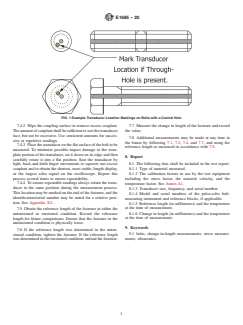
7.2.1 The ends of bolts with through center holes may be
controller, and computer may be integrated into a unified
prepared adjacent to the holes, with the transducer locations
system or instrumented together from separate components.
marked, as illustrated in Fig. 1.
6.1.5 Ultrasonic Transducer,ameansofsendingandreceiv-
7.2.2 Do not remove grade markings indiscriminately.
ing ultrasonic waves. The resonance of the transducer should
Document and maintain grade marking removals.
be in the range 1MHz to 10 MHz.
7.3 Measure average fastener temperature with an error less
NOTE 1—The choice of transducer frequency is determined by the
than 1 °C.
length of fastener under investigation and dependent on two primary
factors: signal clarity and attenuation.
7.4 Transducer Placement:
6.1.5.1 The ultrasonic frequency should be high enough to 7.4.1 Apply a suitable acoustic couplant to allow adequate
produce an ultrasonic pulse that is sufficiently short so that the sound transmiss
...
This document is not an ASTM standard and is intended only to provide the user of an ASTM standard an indication of what changes have been made to the previous version. Because
it may not be technically possible to adequately depict all changes accurately, ASTM recommends that users consult prior editions as appropriate. In all cases only the current version
of the standard as published by ASTM is to be considered the official document.
Designation: E1685 − 13 E1685 − 20
Standard Practice for
Measuring the Change in Length of FastenersBolts Using
the Ultrasonic Pulse-Echo Technique
This standard is issued under the fixed designation E1685; the number immediately following the designation indicates the year of
original adoption or, in the case of revision, the year of last revision. A number in parentheses indicates the year of last reapproval. A
superscript epsilon (´) indicates an editorial change since the last revision or reapproval.
1. Scope*
1.1 This practice covers a procedure for measuring changes in length of threaded fastenersbolts using conventional ultrasonic
pulse-echo bolt-measuring instrumentation which has been properly calibrated.the ultrasonic pulse-echo technique.
1.2 This procedure is normally intended for metal bolting 6.3 mm or more in nominal diameter with effective length-to-diameter
ratios of 2:1 or greater.
1.3 The values stated in SI units are to be regarded as standard. No other units of measurement are included in this standard.
1.4 This standard does not purport to address all of the safety concerns, if any, associated with its use. It is the responsibility
of the user of this standard to establish appropriate safety safety, health, and healthenvironmental practices and determine the
applicability of regulatory limitations prior to use.
1.5 This international standard was developed in accordance with internationally recognized principles on standardization
established in the Decision on Principles for the Development of International Standards, Guides and Recommendations issued
by the World Trade Organization Technical Barriers to Trade (TBT) Committee.
2. Referenced Documents
2.1 ASTM Standards:
E6 Terminology Relating to Methods of Mechanical Testing
E111 Test Method for Young’s Modulus, Tangent Modulus, and Chord Modulus
E1316 Terminology for Nondestructive Examinations
E1544 Practice for Construction of a Stepped Block and Its Use to Estimate Errors Produced by Speed-of-Sound Measurement
Systems for Use on Solids (Withdrawn 2012)
2.2 ASME Standards:
ASME B46.1–2009 Surface Texture (Surface Roughness, Waviness, and Lay)
3. Terminology
3.1 The definitions of calibration, extensometer system, metrological traceability, reference standard, testing machine, and
verification, in this practice are in accordance with used as defined in Terminology E6 and Section I of Terminology E1316.
This practice is under the jurisdiction of ASTM Committee E28 on Mechanical Testing and is the direct responsibility of Subcommittee E28.13 on Residual Stress
Measurement.
Current edition approved Nov. 1, 2013Oct. 1, 2020. Published January 2014December 2020. Originally approved in 1995. Last previous edition approved in 20062013
as E1685–00(2006).E1685–13. DOI: 10.1520/E1685-13.10.1520/E1685-20.
For referenced ASTM standards, visit the ASTM website, www.astm.org, or contact ASTM Customer Service at service@astm.org. For Annual Book of ASTM Standards
volume information, refer to the standard’s Document Summary page on the ASTM website.
The last approved version of this historical standard is referenced on www.astm.org.
*A Summary of Changes section appears at the end of this standard
Copyright © ASTM International, 100 Barr Harbor Drive, PO Box C700, West Conshohocken, PA 19428-2959. United States
E1685 − 20
3.2 The definitions of attenuation, couplant, echo, longitudinal wave, pulse, pulse echo method, reference block, reflector,
resolution, time-of-flight, transducer, and ultrasonic are used as defined in Section I of Terminology E1316.
3.3 Definitions of Terms Specific to This Standard:
3.3.1 change in length [L], n—physical change in length of a threaded fastener due to a change in tension within the fastener.
3.3.2 effective length [L], n—the length of a bolt that is responsive to stress. stress, defined here as the bolt length between head
and nut plus half the thickness of the head plus half the thickness of the nut.
3.2.2.1 Discussion—
This quantity lies somewhere between the overall length of the bolt and the grip length. It is usually estimated as the grip length
plus one half the thickness of the head and one half the thickness of the nut.
3.2.3 longitudinal wave, n—those waves in which the particle motion of the material is in the same direction as the wave
propagation.
3.3.3 pulse-echo bolt-measuring instrument—an assembly of ultrasonic instruments designed specifically to measure changes in
the lengths of bolts. See Appendix X1.
3.2.5 reference length [L], n—the ultrasonic time of flight in the test specimen multiplied by a reference propagation velocity.
-1
3.3.4 reference propagation velocity, [LT length [L], ], n—the velocity of propagation of the ultrasonic wavefront in a calibration
test block or in the bolts whose changes of length are being measured.ultrasonic time-of-flight in the test specimen multiplied by
a reference propagation velocity.
3.3.4.1 Discussion—
The reference propagation velocity is the velocity of propagation of the ultrasonic wavefront in a calibration test block or in the
bolts whose changes of length are being measured.
3.2.7 time of flight, [T], n—the measured time interval between the launching of an ultrasonic pulse at the start of a path of travel
and the reception of the pulse at the end of the path.
4. Summary of Practice
4.1 This practice describes a procedure for determining the change in length of a threaded fastener due to a change in tension in
the fastener. Measurements of the ultrasonic time of flight time-of-flight are made before and after the fastener tension is changed,
and a calculation of the change in length is made from the change in the time of flight.time-of-flight.
4.1.1 Brief bursts of ultrasound (pulses) are generated by applying high-voltage electrical signals to an electroacoustic transducer
having a resonant frequency in the 5 1 MHz to 10-MHz range. range (typical). The pulses enter the bolt through the transducer/bolt
interface, travel to the far end of the bolt, and reflect back (echo) to the transducer. The time of flight time-of-flight required for
the signal to make its round-trip is measured electronically. By measuring the change in the time of flight time-of-flight due to a
change in tension within the bolt, the equipment can determine the change in the length of the bolt due to the change in tension.
Compensation bolt and compensating for the direct effect of stress on the propagation velocity in the bolt is automatically done
by a computer or microprocessor within the equipment.the change in length of the bolt due to the change in tension can be
determined.
4.2 This procedure is used on fasteners as they are tightened within their elastic limits; or on previously tightened fasteners as they
are loosened. The latter can have been tightened past yield.
5. Significance and Use
5.1 The techniques described provide for the indirect measurement of change in length of a fastener. Such measurements are made
from one end of the specimen without requiring access to the rear surface.
5.2 The equipment is field portable and should be used in the manner prescribed by the manufacturer. Common uses include
monitoring Ultrasonic Pulse Echo technique is used to monitor changes in length of fasteners and as a tool for industrial quality
E1685 − 20
control. Current applications Applications include fasteners used in turbines, petrochemical pressure vessels, aircraft, automotive
manufacturing, general bolting within the nuclear industry, structural steel connections, laboratory testing, and so forth.and
laboratory testing.
6. Apparatus
6.1 Pulse-echo bolt-measuring instrument—For ultrasonic measurementsof measurements of the change in length of bolts, any
longitudinal-wave the pulse-echo ultrasonicbolt-measuring instrument shall be capable of reporting determining the calculated
changeschange in length is acceptable provided that its to the accuracy and precision satisfy the requirements set forth in Annex
A1. The major components of suitable instruments are as follows:
6.1.1 Pulser/transmitter, a means of generating electrical pulses to excite an acousticultrasonic transducer.
6.1.2 Receiver/detector,Receiver, a means of amplifying and detecting the returning back-wall echo.
6.1.3 Time-base Controller, a means of measuring changes in ultrasonic time of flight.time-of-flight.
6.1.4 Data analysis computer, a computer or microprocessor for processing the ultrasonic data for determination of the material
stress level from the measured fastener strain.
6.1.4.1 The pulser/transmitter, receiver/detector, time-base controller, and computer may be integrated into a unified system or
instrumented together from separate components.
6.1.5 AcousticUltrasonic Transducer, a means of sending and receiving ultrasonic waves. Experience has shown that transducers
with resonances in the 5 to 10-MHz frequency range are usually satisfactory. In general, select an acoustic transducer having an
element of the largest diameter available while not exceeding the minimum body diameter of the bolt.The resonance of the
transducer should be in the range 1MHz to 10 MHz.
NOTE 1—The choice of transducer frequency is determined by the length of fastener under investigation and dependent on two primary factors: signal
clarity and attenuation.
6.1.5.1 The ultrasonic frequency should be high enough to produce an ultrasonic pulse that is sufficiently short so that the
ultrasonic reflections from the far end of the fastener occurs after the ultrasonic reflection from entry surface has ended.
6.1.5.2 Conversely, the frequency should be low enough so that the signal reflected from the far end of the fastener is large enough
for successful detection.
NOTE 2— In general, short fasteners require higher frequency, whereas long fasteners require low frequencies.
6.1.5.3 The diameter of the ultrasonic transducer should be as large as possible, but shall not be larger than the minimum body
diameter of the bolt.
6.1.6 Pulse-echo bolt-measuring instruments are designed to measure and report the change in length of a bolt to the nearest
0.0025 mm or 0.00025 mm. To do this the instrument resolution shall be 0.0012 mm or 0.00012 mm.
NOTE 3—This degree of precision is required because a typical bolt tightened to yield will stretch only about 0.003 mm/mm of grip length.
6.2 Other Apparatus:
6.2.1 Couplant—For longitudinal pulse-echo measurements, a liquid is required to couplea liquid or glue that couples ultrasound
between the transducer and the fastener. Of the couplants commonly used, where applicable a 50/50 glycerine/water mix often
provides optimal results. Light oil or standard commercially available ultrasonic couplants are also satisfactory.
NOTE 4—A 50/50 glycerine/water mix, light oil or standard commerically available couplants and glues can provide satisfactory results.
E1685 − 20
6.2.2 Oscilloscope—For optimal adjustment of the apparatus, the use of an oscilloscope is necessary. The oscilloscope must have
two input channels, two traces, external triggering, and a dual time base with delayed sweep capability. Its bandwidth should be
at least 35 MHz or its equivalent.
6.2.2.1 Pulse-echo bolt-measuring instruments with built-in oscilloscope display capabilities must have sampling speeds
equivalent to at least ten times the transducer frequency for satisfactory signal display.
6.2.3 Standard Reference Blocks, for periodic recalibration of the pulse-echo bolt-measuring instrument.
6.2.3.1 A glass or metallic reference block of known length and appropriate surface roughness, shape, thickness, and parallelism
is recommended. Acceptable standards include a glass block, two metal bars of unequal length, and single bars of known acoustic
velocity. The path length of the standard must be determined by a technique of higher accuracy. See Practice E1544. The calibration
of instruments and standards should be traceable to national standards, where systems of traceability exist.
7. Procedure
7.1 The performance of the pulse-echo bolt-measuring instrument should be verified or adjusted calibrated to a reference standard
in accordance with the manufacturer’s specifications. See Annex A2A1.
7.1.1 In noncritical applications, where uncertainties smallergreater than 615 %63 % of the change in length are not required,
acceptable, an instrument calibrated on one bolt of a given material may used on other bolts of the same material but having
different shapes.
7.1.2 In critical, safety-related applications or where uncertainties of less than 3 % are required, or both, the pulse-echo
bolt-measuring instrument should be recalibrated on a statistically significant sample of each new lot of bolts.
7.2 Fastener Preparation—To ensure reliable ultrasonic measurements the The finish and geometry of the fastener shall be
suitable. prepared to ensure reliable ultrasonic measurements. One end shall be acc
...