

ASTM C1785-17
(Test Method)Standard Test Method for Concentration of Pinhole Detections in Moisture Barriers on Metal Jacketing
General Information
- Abstract
SIGNIFICANCE AND USE
5.1 Corrosion on the interior surface of metal jacketing can be caused by the formation of a galvanic cell between the dissimilar metals of the pipe and jacket or by crevice or pitting corrosion.
5.2 The application of a moisture barrier to the interior surface of the metal jacketing inhibits this corrosion by interfering with the galvanic cell formation or by preventing water from contacting the interior metal surface.
5.3 Holes in the moisture barrier decrease its effectiveness in preventing corrosion. Large holes, scratches, or tears in the moisture barrier visible to the naked eye are easily discerned and are cause for rejection of the metal jacketing.
5.4 Small holes called pinholes or holidays that are not visible to the naked eye but are large enough to allow corrosion are a significant concern and should be avoided to the extent possible.
5.5 This test method is used to quantify the concentration of pinhole detections present in a moisture barrier for the purpose of quality control on metal jacketing with an applied moisture barrier.
5.6 Examples of standards which have specific requirements for the maximum allowable concentration of pinhole detections in the moisture barrier are Specifications C1729 and C1767.
SCOPE
1.1 This test method covers the determination of the concentration of pinhole detections in a moisture barrier film or coating that is applied to the interior surface of metal jacketing.
1.2 Since this method relies on the completion through the metal jacketing of an electrical circuit, this method is only applicable to jacketing that is electrically conductive and has a moisture barrier applied which is not electrically conductive.
1.3 The values stated in inch-pound units are to be regarded as standard. The values given in parentheses are mathematical conversions to SI units that are provided for information only and are not considered standard.
1.4 This standard does not purport to address all of the safety concerns, if any, associated with its use. It is the responsibility of the user of this standard to establish appropriate safety, health, and environmental practices and determine the applicability of regulatory limitations prior to use.
1.5 This international standard was developed in accordance with internationally recognized principles on standardization established in the Decision on Principles for the Development of International Standards, Guides and Recommendations issued by the World Trade Organization Technical Barriers to Trade (TBT) Committee.
- Status
- Published
- Publication Date
- 31-Aug-2017
- Technical Committee
- C16 - Thermal Insulation
- Drafting Committee
- C16.33 - Insulation Finishes and Moisture
Buy Documents
ASTM C1785-17 - Standard Test Method for Concentration of Pinhole Detections in Moisture Barriers on Metal Jacketing
REDLINE ASTM C1785-17 - Standard Test Method for Concentration of Pinhole Detections in Moisture Barriers on Metal Jacketing
Overview
ASTM C1785-17: Standard Test Method for Concentration of Pinhole Detections in Moisture Barriers on Metal Jacketing outlines a procedure for quantifying pinhole detections in moisture barriers applied to the interior surfaces of metal jacketing. This standard focuses on moisture barrier integrity for metal jacketing used primarily in thermal insulation systems and is essential for maintaining the performance and longevity of insulation cladding systems. By systematically detecting pinholes-tiny holes that can allow moisture to penetrate and initiate corrosion-this method supports rigorous quality control practices and helps protect metal jacketing from corrosion caused by water ingress or galvanic reactions.
Key Topics
Purpose and Significance
- Prevents corrosion of the interior surface of metal jacketing by ensuring the effectiveness of applied moisture barriers.
- Addresses both large visible defects (holes, scratches) and smaller, invisible holes termed “pinholes” or “holidays,” which are critical yet not detectable by visual inspection.
- Vital for quality control where specific limits on pinhole concentration are specified.
Applicability
- The method is applicable to electrically conductive metal jacketing with a non-conductive moisture barrier.
- Commonly used on aluminum and stainless steel jacketing in thermal insulation systems.
Test Method Overview
- Utilizes a voltage-applied test with a dampened cellulose sponge to detect electrical continuity through pinholes.
- Quantifies the number of pinhole detections over specified test areas for consistent and repeatable results.
Detection Patterns
- Discreet pinhole detections: Easily counted when clearly separated.
- Continuous pinhole detection: Identified by sustained alarms over larger areas.
- Mixed or irregular detection: Managed with alternative grid-based testing protocols for complex cases.
Applications
Thermal Insulation Systems
- Used in the fabrication and quality control of aluminum and stainless steel jacketing for pipes and equipment subjected to insulation.
- Supports maintenance of moisture barriers in HVAC, industrial, and power generation applications.
Corrosion Prevention
- Ensures the moisture retarder (barrier) effectively protects against galvanic, crevice, or pitting corrosion on the interior surface of metal jacketing.
Manufacturing and Compliance
- Provides objective, auditable metrics for manufacturers to certify their jacketing products meet specified moisture barrier integrity standards.
- Assists end users and inspectors in verifying conformance to industry requirements for insulation jacketing performance.
Quality Assurance
- Used for incoming inspection, process control, and final product validation for moisture barrier application.
Related Standards
- ASTM C1729: Specification for Aluminum Jacketing for Insulation - details the requirements for aluminum jacketing and sets allowable pinhole concentrations.
- ASTM C1767: Specification for Stainless Steel Jacketing for Insulation - outlines similar provisions for stainless steel jacketing.
- ASTM C168: Terminology Relating to Thermal Insulation - provides definitions for insulation-related terms.
- ASTM E177 & E691: Practices for use of precision and bias, and interlaboratory studies in test methods.
Practical Value
Adherence to ASTM C1785-17 is crucial for suppliers, contractors, and asset owners concerned with long-term insulation system durability and compliance. Accurate detection and quantification of pinholes help ensure the installed moisture barrier performs as intended, minimizing the risk of costly corrosion, system failures, and downtime in both industrial and commercial environments.
Keywords: pinhole detection, moisture barrier, metal jacketing, thermal insulation, corrosion prevention, ASTM C1785-17, quality control, moisture retarder, holiday detection, aluminum jacketing, stainless steel jacketing
Relations
- Effective Date
- 01-Sep-2017
- Effective Date
- 15-Apr-2024
- Effective Date
- 15-Apr-2018
- Effective Date
- 01-Jun-2017
- Effective Date
- 01-May-2017
- Effective Date
- 01-Sep-2016
- Effective Date
- 01-Sep-2016
- Effective Date
- 01-Mar-2016
- Effective Date
- 01-Mar-2016
- Effective Date
- 01-Nov-2015
- Effective Date
- 01-Nov-2015
- Effective Date
- 15-Oct-2015
- Effective Date
- 01-Oct-2015
- Effective Date
- 01-Jun-2015
- Effective Date
- 01-Sep-2014
Buy Documents
ASTM C1785-17 - Standard Test Method for Concentration of Pinhole Detections in Moisture Barriers on Metal Jacketing
REDLINE ASTM C1785-17 - Standard Test Method for Concentration of Pinhole Detections in Moisture Barriers on Metal Jacketing
Get Certified
Connect with accredited certification bodies for this standard

DIBt (Deutsches Institut für Bautechnik)
German Institute for Building Technology.
DIN CERTCO
DIN Group product certification.

IMQ S.p.A. (Certification)
Italian electrical product certification.
Sponsored listings
Frequently Asked Questions
ASTM C1785-17 is a standard published by ASTM International. Its full title is "Standard Test Method for Concentration of Pinhole Detections in Moisture Barriers on Metal Jacketing". This standard covers: SIGNIFICANCE AND USE 5.1 Corrosion on the interior surface of metal jacketing can be caused by the formation of a galvanic cell between the dissimilar metals of the pipe and jacket or by crevice or pitting corrosion. 5.2 The application of a moisture barrier to the interior surface of the metal jacketing inhibits this corrosion by interfering with the galvanic cell formation or by preventing water from contacting the interior metal surface. 5.3 Holes in the moisture barrier decrease its effectiveness in preventing corrosion. Large holes, scratches, or tears in the moisture barrier visible to the naked eye are easily discerned and are cause for rejection of the metal jacketing. 5.4 Small holes called pinholes or holidays that are not visible to the naked eye but are large enough to allow corrosion are a significant concern and should be avoided to the extent possible. 5.5 This test method is used to quantify the concentration of pinhole detections present in a moisture barrier for the purpose of quality control on metal jacketing with an applied moisture barrier. 5.6 Examples of standards which have specific requirements for the maximum allowable concentration of pinhole detections in the moisture barrier are Specifications C1729 and C1767. SCOPE 1.1 This test method covers the determination of the concentration of pinhole detections in a moisture barrier film or coating that is applied to the interior surface of metal jacketing. 1.2 Since this method relies on the completion through the metal jacketing of an electrical circuit, this method is only applicable to jacketing that is electrically conductive and has a moisture barrier applied which is not electrically conductive. 1.3 The values stated in inch-pound units are to be regarded as standard. The values given in parentheses are mathematical conversions to SI units that are provided for information only and are not considered standard. 1.4 This standard does not purport to address all of the safety concerns, if any, associated with its use. It is the responsibility of the user of this standard to establish appropriate safety, health, and environmental practices and determine the applicability of regulatory limitations prior to use. 1.5 This international standard was developed in accordance with internationally recognized principles on standardization established in the Decision on Principles for the Development of International Standards, Guides and Recommendations issued by the World Trade Organization Technical Barriers to Trade (TBT) Committee.
SIGNIFICANCE AND USE 5.1 Corrosion on the interior surface of metal jacketing can be caused by the formation of a galvanic cell between the dissimilar metals of the pipe and jacket or by crevice or pitting corrosion. 5.2 The application of a moisture barrier to the interior surface of the metal jacketing inhibits this corrosion by interfering with the galvanic cell formation or by preventing water from contacting the interior metal surface. 5.3 Holes in the moisture barrier decrease its effectiveness in preventing corrosion. Large holes, scratches, or tears in the moisture barrier visible to the naked eye are easily discerned and are cause for rejection of the metal jacketing. 5.4 Small holes called pinholes or holidays that are not visible to the naked eye but are large enough to allow corrosion are a significant concern and should be avoided to the extent possible. 5.5 This test method is used to quantify the concentration of pinhole detections present in a moisture barrier for the purpose of quality control on metal jacketing with an applied moisture barrier. 5.6 Examples of standards which have specific requirements for the maximum allowable concentration of pinhole detections in the moisture barrier are Specifications C1729 and C1767. SCOPE 1.1 This test method covers the determination of the concentration of pinhole detections in a moisture barrier film or coating that is applied to the interior surface of metal jacketing. 1.2 Since this method relies on the completion through the metal jacketing of an electrical circuit, this method is only applicable to jacketing that is electrically conductive and has a moisture barrier applied which is not electrically conductive. 1.3 The values stated in inch-pound units are to be regarded as standard. The values given in parentheses are mathematical conversions to SI units that are provided for information only and are not considered standard. 1.4 This standard does not purport to address all of the safety concerns, if any, associated with its use. It is the responsibility of the user of this standard to establish appropriate safety, health, and environmental practices and determine the applicability of regulatory limitations prior to use. 1.5 This international standard was developed in accordance with internationally recognized principles on standardization established in the Decision on Principles for the Development of International Standards, Guides and Recommendations issued by the World Trade Organization Technical Barriers to Trade (TBT) Committee.
ASTM C1785-17 is classified under the following ICS (International Classification for Standards) categories: 29.035.01 - Insulating materials in general; 91.100.60 - Thermal and sound insulating materials. The ICS classification helps identify the subject area and facilitates finding related standards.
ASTM C1785-17 has the following relationships with other standards: It is inter standard links to ASTM C1785-16a, ASTM C168-24, ASTM C168-18, ASTM C168-17, ASTM C1729-17, ASTM C1729-16a, ASTM C1767-16a, ASTM C1729-16, ASTM C1767-16, ASTM C1767-15, ASTM C1729-15a, ASTM C168-15a, ASTM C1729-15, ASTM C168-15, ASTM C1767-14a. Understanding these relationships helps ensure you are using the most current and applicable version of the standard.
ASTM C1785-17 is available in PDF format for immediate download after purchase. The document can be added to your cart and obtained through the secure checkout process. Digital delivery ensures instant access to the complete standard document.
Standards Content (Sample)
This international standard was developed in accordance with internationally recognized principles on standardization established in the Decision on Principles for the
Development of International Standards, Guides and Recommendations issued by the World Trade Organization Technical Barriers to Trade (TBT) Committee.
Designation: C1785 − 17
Standard Test Method for
Concentration of Pinhole Detections in Moisture Barriers on
Metal Jacketing
This standard is issued under the fixed designation C1785; the number immediately following the designation indicates the year of
original adoption or, in the case of revision, the year of last revision. A number in parentheses indicates the year of last reapproval. A
superscript epsilon (´) indicates an editorial change since the last revision or reapproval.
1. Scope E691 Practice for Conducting an Interlaboratory Study to
Determine the Precision of a Test Method
1.1 This test method covers the determination of the con-
centration of pinhole detections in a moisture barrier film or
3. Terminology
coating that is applied to the interior surface of metal jacketing.
3.1 Definitions—Definitions in Terminology C168 apply to
1.2 Since this method relies on the completion through the
terms used in this specification.
metal jacketing of an electrical circuit, this method is only
3.2 Definitions of Terms Specific to This Standard:
applicable to jacketing that is electrically conductive and has a
3.2.1 continuous pinhole detection—while the test is being
moisture barrier applied which is not electrically conductive.
conducted, a continuous sounding of the audible test equip-
1.3 The values stated in inch-pound units are to be regarded
ment alarm over an area larger than the contact area of the
as standard. The values given in parentheses are mathematical
cellulose sponge.
conversions to SI units that are provided for information only
3.2.1.1 Discussion—In some cases, large portions of one or
and are not considered standard.
more of the test areas (see 8.2.1) or even all of one or more test
1.4 This standard does not purport to address all of the
areas will yield a continuous pinhole detection.This concept of
safety concerns, if any, associated with its use. It is the
a continuous pinhole detection and the area yielding this
responsibility of the user of this standard to establish appro-
performance is necessary to quantify the number of pinhole
priate safety, health, and environmental practices and deter-
detections in a sample exhibiting this phenomenon (see 9.2 and
mine the applicability of regulatory limitations prior to use.
9.3)
1.5 This international standard was developed in accor-
3.2.2 moisture barrier (moisture retarder)—a layer of plas-
dance with internationally recognized principles on standard-
tic film or other material applied to the inner side of metal
ization established in the Decision on Principles for the
jacketing to inhibit jacket corrosion by interfering with the
Development of International Standards, Guides and Recom-
formation of a galvanic cell between the dissimilar metals of
mendations issued by the World Trade Organization Technical
the pipe and jacket or by preventing crevice or pitting
Barriers to Trade (TBT) Committee.
corrosion.
2. Referenced Documents
3.2.3 pinhole—a hole completely through a moisture barrier
typically too small to be seen by the eye.
2.1 ASTM Standards:
C168 Terminology Relating to Thermal Insulation 3.2.4 pinhole detection—a single sounding of the audible
C1729 Specification for Aluminum Jacketing for Insulation test equipment alarm while the test is being conducted.
C1767 Specification for Stainless Steel Jacketing for Insula- 3.2.4.1 Discussion—Because pinholes are very small and
tion the dampened cellulose sponge contacts the moisture barrier in
E177 Practice for Use of the Terms Precision and Bias in an area larger than a single pinhole (see 6.4), it is theoretically
ASTM Test Methods possible that multiple pinholes in close proximity to each other
would register as a single detection. For this reason, this test
methodmeasurestheconcentrationofpinholedetectionsrather
ThistestmethodisunderthejurisdictionofASTMCommitteeC16onThermal
than pinholes.
Insulation and is the direct responsibility of Subcommittee C16.33 on Insulation
Finishes and Moisture.
3.2.5 holiday—synonymous with pinhole.
Current edition approved Sept. 1, 2017. Published October 2017. Originally
approved in 2013. Last previous edition approved in 2016 as C1785 – 16a. DOI:
4. Summary of Test Method
10.1520/C1785-17.
For referenced ASTM standards, visit the ASTM website, www.astm.org, or
4.1 A voltage is applied across the nonconductive moisture
contact ASTM Customer Service at service@astm.org. For Annual Book of ASTM
barrier on metal jacketing using an electrode consisting of a
Standards volume information, refer to the standard’s Document Summary page on
the ASTM website. cellulose sponge dampened with an electrically conductive
Copyright © ASTM International, 100 Barr Harbor Drive, PO Box C700, West Conshohocken, PA 19428-2959. United States
C1785 − 17
liquid such as tap water. Holes in the moisture barrier lead to 7.3 For rolls, a length of 30 ft (9.1 m) is required.
completion of an electrical circuit which triggers an audible
7.4 For sheets, test as many sheets at a time as will fit on the
alarm in the test equipment. The number of pinhole detections
approximately 30 ft (9.1 m) long testing surface.
collectively in ten specified test areas is determined and
reported.
8. Procedure
8.1 Sample Preparation:
5. Significance and Use
8.1.1 Place specimen(s) on a reasonably flat, level, and
5.1 Corrosion on the interior surface of metal jacketing can
clean surface with the moisture barrier facing up.
be caused by the formation of a galvanic cell between the
8.1.2 If necessary, secure the jacketing to the test surface so
dissimilar metals of the pipe and jacket or by crevice or pitting
that it is reasonably flat and does not curl up during testing.
corrosion.
This can be done with weights or with clamps.Assure that the
5.2 The application of a moisture barrier to the interior
securement method does not scratch or damage the moisture
surface of the metal jacketing inhibits this corrosion by
barrier.
interfering with the galvanic cell formation or by preventing
8.1.3 The moisture barrier must not come in contact with
water from contacting the interior metal surface.
dirt or grit, for example, by walking on the surface, as this is
likely to cause damage to the moisture barrier.
5.3 Holes in the moisture barrier decrease its effectiveness
in preventing corrosion. Large holes, scratches, or tears in the
8.2 Test Area Selection:
moisture barrier visible to the naked eye are easily discerned
8.2.1 For roll jacketing, select about 4.8 to 5.2 ft (0.45 to
and are cause for rejection of the metal jacketing.
0.48 m ) in each of ten successive 3 lineal ft (0.91 m) long
sections of the test specimen. This yields 10 approximately
5.4 Small holes called pinholes or holidays that are not
evenly spaced and evenly sized test areas.
visibletothenakedeyebutarelargeenoughtoallowcorrosion
8.2.2 For sheet jacketing, select one or more 4.8 to 5.2
are a significant concern and should be avoided to the extent
2 2
ft (0.45 to 0.48 m ) sections per sheet. Test enough sheets to
possible.
yield 10 approximately evenly spaced and evenly sized test
5.5 This test method is used to quantify the concentration of
areas.
pinhole detections present in a moisture barrier for the purpose
of quality control on metal jacketing with an applied moisture NOTE 2—For both roll and sheet jacketing, a series of ten rectangular
test areas of size 2 by 2.5 ft (610 by 762 mm) is recommended.
barrier.
8.3 Normal Testing Procedure:
5.6 Examplesofstandardswhichhavespecificrequirements
8.3.1 Wet a test area with an electrolyte such as tap water
forthemaximumallowableconcentrationofpinholedetections
without allowing a wet connection to form between the wetted
in the moisture barrier are Specifications C1729 and C1767.
areasandanybaremetaledgeofthejacketing.Donotfloodthe
moisture barrier surface with electrolyte.
6. Apparatus
8.3.2 Water tends to run freely on the surface of painted and
6.1 Test equipment shall be a pinhole or holiday detector
plastic film moisture barriers so special care must be taken to
with an output voltage of 65 to 75 volts DC that emits an
prevent contact of the electrolyte with the bare metal edges
audible signal when a connection between the two leads is
when testing these types.
detected.
8.3.3 Allow 5 min after wetting for the water to permeate
NOTE 1—These instruments can be found by performing a web search
the moisture barrier.
for “wet sponge pinhole detector” or “wet sponge holiday detector”.
8.3.4 Test for pinhole detections between five and ten
6.2 One lead of the pinhole detector shall have a spring
minutes after initial wetting.
tensioned metal clamp capable of being attached to the metal
8.3.5 Attach one lead of the pinhole tester to bare metal on
jacketing.
the jacketing piece being tested.
6.3 The other lead of the pinhole detector shall have a metal
8.3.6 Wetthecellulosespongeattachedtotheotherleadand
clamp capable of securing a cellulose sponge.
move this sponge over the test area such that all portions of the
test area are tested once. The presence of one or more pinholes
6.4 The cellulose sponge clamped to the pinhole detector
in the area covered by the sponge allows the completion of an
lead shall have a size capable of touching the moisture barrier
1 1
electrical circuit which will be signaled by the test equipment
of 2 6 ⁄16 by 2 6 ⁄16 in. (50.8 6 1.6 by 50.8 6 1.6 mm).
as an audible alarm.
6.5 Testequipmentshallhaveitstestvoltageandoperability
8.3.7 During the test, note the number of discrete soundings
validated on a regular basis.
of the audible alarm in the test area.
8.3.8 If one or more portions of the test area yield a
7. Test Specimens
continuous pinhole detection (see 3.2.1), mark these areas.
7.1 Specimens tested are metal jacketing rolls or metal
8.3.8.1 Determinethesizeofthemarkedcontinuouspinhole
jacketing sheets.
detection areas in inches squared (millimeters squared) and
7.2 Any width that can be conveniently placed on a table note this value.
can be tested but the typical width of metal jacketing is 3 ft 8.3.9 Repeat steps 8.3.1 through 8.3.8 for each of the
(0.91 m) or, rarely, 4 ft (1.22 m). remaining nine test areas.
C1785 − 17
8.4 Alternative Testing Procedure: 8.4.5 Allow 5 min after wetting for the water to permeate
the moisture barrier.
NOTE 3—This alternative testing procedure is more time-consuming
8.4.6 Test for pinhole detections between five and ten
during sample preparation but is useful on those specimens where there
are many irregularly shaped relatively small areas of continuous pinhole minutes after initial wetting.
detection. See X1.2.4 for further information.
8.4.7 Attach one lead of the pinhole tester to bare metal on
2 2
8.4.1 Outline a rectangular 4.8 to 5.2 ft (0.45 to 0.48 m ) the jacketing piece being tested.
test area with a permanent marker. An area of size 2 by 2.5 ft
8.4.8 Wetthecellulosespongeattachedtotheotherleadand
(610 by 762 mm) is recommended.
touch this sponge with light pressure to each of the 180 squares
8.4.2 Using a permanent marker, draw a series of lines 2 in.
markedinthetestarea(see8.4.2).Thepresenceofoneormore
(51 mm) apart roughly parallel to both sides of the rectangular
pinholes in the area covered by the sponge allows the comple-
test area identified and marked per 8.4.1. This will yield 180
tion of an electrical circuit which will be signaled by the test
2 2
marked boxes of size 4 in. (2581 mm ). The left drawing in
equipment as an audible alarm.
Fig. 1 shows an example of a test area marked in the manner
8.4.9 During the testing of the 180 squares in the test area,
described in 8.4.1 and 8.4.2. Note that the size
...
This document is not an ASTM standard and is intended only to provide the user of an ASTM standard an indication of what changes have been made to the previous version. Because
it may not be technically possible to adequately depict all changes accurately, ASTM recommends that users consult prior editions as appropriate. In all cases only the current version
of the standard as published by ASTM is to be considered the official document.
Designation: C1785 − 16a C1785 − 17
Standard Test Method for
Concentration of Pinhole Detections in Moisture Barriers on
Metal Jacketing
This standard is issued under the fixed designation C1785; the number immediately following the designation indicates the year of
original adoption or, in the case of revision, the year of last revision. A number in parentheses indicates the year of last reapproval. A
superscript epsilon (´) indicates an editorial change since the last revision or reapproval.
1. Scope
1.1 This test method covers the determination of the concentration of pinhole detections in a moisture barrier film or coating
that is applied to the interior surface of metal jacketing.
1.2 Since this method relies on the completion through the metal jacketing of an electrical circuit, this method is only applicable
to jacketing that is electrically conductive and has a moisture barrier applied which is not electrically conductive.
1.3 The values stated in inch-pound units are to be regarded as standard. The values given in parentheses are mathematical
conversions to SI units that are provided for information only and are not considered standard.
1.4 This standard does not purport to address all of the safety concerns, if any, associated with its use. It is the responsibility
of the user of this standard to establish appropriate safety safety, health, and healthenvironmental practices and determine the
applicability of regulatory limitations prior to use.
1.5 This international standard was developed in accordance with internationally recognized principles on standardization
established in the Decision on Principles for the Development of International Standards, Guides and Recommendations issued
by the World Trade Organization Technical Barriers to Trade (TBT) Committee.
2. Referenced Documents
2.1 ASTM Standards:
C168 Terminology Relating to Thermal Insulation
C1729 Specification for Aluminum Jacketing for Insulation
C1767 Specification for Stainless Steel Jacketing for Insulation
E177 Practice for Use of the Terms Precision and Bias in ASTM Test Methods
E691 Practice for Conducting an Interlaboratory Study to Determine the Precision of a Test Method
3. Terminology
3.1 Definitions—Definitions in Terminology C168 apply to terms used in this specification.
3.2 Definitions of Terms Specific to This Standard:
3.2.1 continuous pinhole detection—while the test is being conducted, a continuous sounding of the audible test equipment
alarm over an area larger than the contact area of the cellulose sponge.
This test method is under the jurisdiction of ASTM Committee C16 on Thermal Insulation and is the direct responsibility of Subcommittee C16.33 on Insulation Finishes
and Moisture.
Current edition approved Sept. 1, 2016Sept. 1, 2017. Published September 2016October 2017. Originally approved in 2013. Last previous edition approved in 2016 as
C1785 – 16.C1785 – 16a. DOI: 10.1520/C1785-16A.10.1520/C1785-17.
For referenced ASTM standards, visit the ASTM website, www.astm.org, or contact ASTM Customer Service at service@astm.org. For Annual Book of ASTM Standards
volume information, refer to the standard’s Document Summary page on the ASTM website.
3.2.1.1 Discussion—
In some cases, large portions of one or more of the test areas (see 8.2.1) or even all of one or more test areas will yield a continuous
pinhole detection. This concept of a continuous pinhole detection and the area yielding this performance is necessary to quantify
the number of pinhole detections in a sample exhibiting this phenomenon (see 9.2 and 9.3)
Copyright © ASTM International, 100 Barr Harbor Drive, PO Box C700, West Conshohocken, PA 19428-2959. United States
C1785 − 17
3.2.2 moisture barrier (moisture retarder)—a layer of plastic film or other material applied to the inner side of metal jacketing
to inhibit jacket corrosion by interfering with the formation of a galvanic cell between the dissimilar metals of the pipe and jacket
or by preventing crevice or pitting corrosion.
3.2.3 pinhole—a hole completely through a moisture barrier typically too small to be seen by the eye.
3.2.4 pinhole detection—a single sounding of the audible test equipment alarm while the test is being conducted.
3.2.4.1 Discussion—
Because pinholes are very small and the dampened cellulose sponge contacts the moisture barrier in an area larger than a single
pinhole (see 6.4), it is theoretically possible that multiple pinholes in close proximity to each other would register as a single
detection. For this reason, this test method measures the concentration of pinhole detections rather than pinholes.
3.2.5 holiday—synonymous with pinhole.
4. Summary of Test Method
4.1 A voltage is applied across the nonconductive moisture barrier on metal jacketing using an electrode consisting of a cellulose
sponge dampened with an electrically conductive liquid such as tap water. Holes in the moisture barrier lead to completion of an
electrical circuit which triggers an audible alarm in the test equipment. The number of pinhole detections collectively in ten
specified test areas is determined and reported.
5. Significance and Use
5.1 Corrosion on the interior surface of metal jacketing can be caused by the formation of a galvanic cell between the dissimilar
metals of the pipe and jacket or by crevice or pitting corrosion.
5.2 The application of a moisture barrier to the interior surface of the metal jacketing inhibits this corrosion by interfering with
the galvanic cell formation or by preventing water from contacting the interior metal surface.
5.3 Holes in the moisture barrier decrease its effectiveness in preventing corrosion. Large holes, scratches, or tears in the
moisture barrier visible to the naked eye are easily discerned and are cause for rejection of the metal jacketing.
5.4 Small holes called pinholes or holidays that are not visible to the naked eye but are large enough to allow corrosion are a
significant concern and should be avoided to the extent possible.
5.5 This test method is used to quantify the concentration of pinhole detections present in a moisture barrier for the purpose of
quality control on metal jacketing with an applied moisture barrier.
5.6 Examples of standards which have specific requirements for the maximum allowable concentration of pinhole detections in
the moisture barrier are Specifications C1729 and C1767.
6. Apparatus
6.1 Test equipment shall be a pinhole or holiday detector with an output voltage of 65 to 75 volts DC that emits an audible signal
when a connection between the two leads is detected.
NOTE 1—These instruments can be found by performing a web search for “wet sponge pinhole detector” or “wet sponge holiday detector”.
6.2 One lead of the pinhole detector shall have a spring tensioned metal clamp capable of being attached to the metal jacketing.
6.3 The other lead of the pinhole detector shall have a metal clamp capable of securing a cellulose sponge.
6.4 The cellulose sponge clamped to the pinhole detector lead shall have a size capable of touching the moisture barrier of 2
1 1
6 ⁄16 by 2 6 ⁄16 in. (50.8 6 1.6 by 50.8 6 1.6 mm).
6.5 Test equipment shall have its test voltage and operability validated on a regular basis.
7. Test Specimens
7.1 Specimens tested are metal jacketing rolls or metal jacketing sheets.
7.2 Any width that can be conveniently placed on a table can be tested but the typical width of metal jacketing is 3 ft (0.91 m)
or, rarely, 4 ft (1.22 m).
7.3 For rolls, a length of 30 ft (9.1 m) is required.
7.4 For sheets, test as many sheets at a time as will fit on the approximately 30 ft (9.1 m) long testing surface.
8. Procedure
8.1 Sample Preparation:
8.1.1 Place specimen(s) on a reasonably flat, level, and clean surface with the moisture barrier facing up.
C1785 − 17
8.1.2 If necessary, secure the jacketing to the test surface so that it is reasonably flat and does not curl up during testing. This
can be done with weights or with clamps. Assure that the securement method does not scratch or damage the moisture barrier.
8.1.3 The moisture barrier must not come in contact with dirt or grit, for example, by walking on the surface, as this is likely
to cause damage to the moisture barrier.
8.2 Test Area Selection:
2 2
8.2.1 For roll jacketing, select about 4.8 to 5.2 ft (0.45 to 0.48 m ) in each of ten successive 3 lineal ft (0.91 m) long sections
of the test specimen. This yields 10 approximately evenly spaced and evenly sized test areas.
2 2
8.2.2 For sheet jacketing, select one or more 4.8 to 5.2 ft (0.45 to 0.48 m ) sections per sheet. Test enough sheets to yield 10
approximately evenly spaced and evenly sized test areas.
NOTE 2—For both roll and sheet jacketing, a series of ten rectangular test areas of size 2 by 2.5 ft (610 by 762 mm) is recommended.
8.3 Normal Testing Procedure:
8.3.1 Wet a test area with an electrolyte such as tap water without allowing a wet connection to form between the wetted areas
and any bare metal edge of the jacketing. Do not flood the moisture barrier surface with electrolyte.
8.3.2 Water tends to run freely on the surface of painted and plastic film moisture barriers so special care must be taken to
prevent contact of the electrolyte with the bare metal edges when testing these types.
8.3.3 Allow 5 min after wetting for the water to permeate the moisture barrier.
8.3.4 Test for pinhole detections between five and ten minutes after initial wetting.
8.3.5 Attach one lead of the pinhole tester to bare metal on the jacketing piece being tested.
8.3.6 Wet the cellulose sponge attached to the other lead and move this sponge over the test area such that all portions of the
test area are tested once. The presence of one or more pinholes in the area covered by the sponge allows the completion of an
electrical circuit which will be signaled by the test equipment as an audible alarm.
8.3.7 During the test, note the number of discrete soundings of the audible alarm in the test area.
8.3.8 If one or more portions of the test area yield a continuous pinhole detection (see 3.2.1), mark these areas.
8.3.8.1 Determine the size of the marked continuous pinhole detection areas in inches squared (millimeters squared) and note
this value.
8.3.9 Repeat steps 8.3.1 through 8.3.8 for each of the remaining nine test areas.
8.4 Alternative Testing Procedure:
NOTE 3—This alternative testing procedure is more time-consuming during sample preparation but is useful on those specimens where there are many
irregularly shaped relatively small areas of continuous pinhole detection. See X1.2.4 for further information.
2 2
8.4.1 Outline a rectangular 4.8 to 5.2 ft (0.45 to 0.48 m ) test area with a permanent marker. An area of size 2 by 2.5 ft (610
by 762 mm) is recommended.
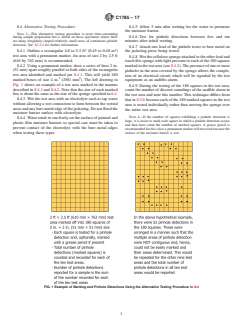
8.4.2 Using a permanent marker, draw a series of lines 2 in. (51 mm) apart roughly parallel to both sides of the rectangular test
2 2
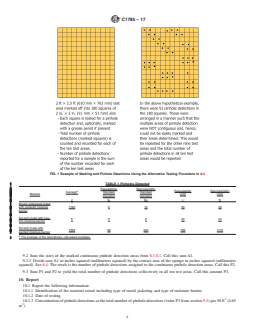
area identified and marked per 8.4.1. This will yield 180 marked boxes of size 4 in. (2581 mm ). The left drawing in Fig. 1 shows
an example of a test area marked in the manner described in 8.4.1 and 8.4.2. Note that the size of each marked box is about the
same as the size of the sponge specified in 6.4.
8.4.3 Wet the test area with an electrolyte such as tap water without allowing a wet connection to form between the wetted areas
and any bare metal edge of the jacketing. Do not flood the moisture barrier surface with electrolyte.
8.4.4 Water tends to run freely on the surface of painted and plastic film moisture barriers so special care must be taken to
prevent contact of the electrolyte with the bare metal edges when testing these types.
8.4.5 Allow 5 min after wetting for the water to permeate the moisture barrier.
8.4.6 Test for pinhole detections between five and ten minutes after initial wetting.
8.4.7 Attach one lead of the pinhole tester to bare metal on the jacketing piece being tested.
8.4.8 Wet the cellulose s
...