

ASTM D7880/D7880M-22
(Test Method)Standard Test Method for Determining Flow Rate of Water and Suspended Solids Retention from a Closed Geosynthetic Bag
General Information
- Abstract
SIGNIFICANCE AND USE
5.1 This test method may be used as an aid to design geotextile container systems that contain fine-grained, high water content slurries such as dredged materials to meet special environmental or operational requirements. This test is often used to demonstrate the efficacy of geotextile dewatering to regulatory agencies in determining the amount of dredged material sediment passing through a geotextile and the flow rate for specific high water content materials.
5.2 The designer can use this test method to assess the quantity of fine-grained dredged material sediment that may pass through the geotextile container into the environment.
5.3 This test method is intended for evaluation of a specific material, as the results will depend on the specific high water content slurry and geotextile evaluated and the location of the geotextile container below or above water. It is recommended that the user or a design representative perform the test because geotextile manufacturers are not typically equipped to handle or test fine-grained slurries.
5.4 This test method provides a means of evaluating geotextile containers with different dredged materials or high water content materials under various conditions. The number of times this test is repeated depends on the users and the test conditions.
5.5 This test method may not simulate site conditions and the user is cautioned to carefully evaluate how the results are applied.
SCOPE
1.1 This test method is used to determine the flow rate of water and suspended solids through a geosynthetic permeable closed bag used to contain high water content slurry such as dredged material.
1.2 The results for the water and sediment that pass through the geotextile bag are shown as liters of water per time period, and the percent total suspended solids in milligrams per liter or parts per million.
1.3 The flow rate is the average rate of passage of a quantity of solids and water through the bag over a specific time period.
1.4 This test method requires several pieces of specified equipment such as an integrated water sampler, analytical balance, geotextile bag, stand clear PVC pipes, testing frame, and clean containers to collect the decant water and a representative sample of high water content material from the proposed dredge area or slurry source.
1.5 The values stated in either SI units or inch-pound units are to be regarded separately as standard. The values stated in each system are not necessarily exact equivalents; therefore, to ensure conformance with the standard, each system shall be used independently of the other, and values from the two systems shall not be combined.
1.6 This standard does not purport to address all of the safety concerns, if any, associated with its use. It is the responsibility of the user of this standard to establish appropriate safety, health, and environmental practices and determine the applicability of regulatory limitations prior to use.
1.7 This international standard was developed in accordance with internationally recognized principles on standardization established in the Decision on Principles for the Development of International Standards, Guides and Recommendations issued by the World Trade Organization Technical Barriers to Trade (TBT) Committee.
- Status
- Published
- Publication Date
- 30-Nov-2022
- Technical Committee
- D35 - Geosynthetics
- Drafting Committee
- D35.03 - Permeability and Filtration
Overview
ASTM D7880/D7880M-22 is the internationally recognized standard test method for determining the flow rate of water and the retention of suspended solids from a closed geosynthetic bag. Published by ASTM International, this method is primarily intended for the evaluation and design of geotextile container systems, especially for applications involving fine-grained, high water content slurries such as dredged materials. The standard aids both designers and regulatory agencies in assessing geotextile bag performance in terms of permeability, sediment capture, and dewatering efficiency.
Geotextile containers, such as bags or tubes, are frequently used to contain and dewater slurry materials as part of environmental, civil, and geotechnical engineering projects. ASTM D7880/D7880M-22 provides a uniform approach for quantifying water flow and suspended solids escape, which is crucial for meeting project-specific environmental or operational requirements.
Key Topics
- Test Objective: To measure the average flow rate and suspended solids passing through a geosynthetic bag containing high-water-content materials, typically fine-grained dredged sediments.
- Metrics: Results are expressed as liters of water per time period and as total suspended solids in milligrams per liter (mg/L) or parts per million (ppm).
- Equipment Requirements: Utilizes specific apparatus including an integrated water sampler, geotextile bag, PVC stand pipes, analytical balance, filtration equipment, and collection containers.
- Test Material: Requires representative samples of both the geotextile and the slurry to accurately simulate field conditions and obtain meaningful, site-specific results.
- Result Interpretation: Flow rate data and sediment retention results are used to compare the effectiveness of various geotextile bag constructions and materials under different operational or environmental scenarios.
- Applicability: This method is an index test, meaning it provides comparative results for different systems but may not fully replicate site conditions.
- Safety & Compliance: Users must ensure compliance with appropriate safety, health, and environmental regulations and confirm local applicability.
Applications
ASTM D7880/D7880M-22 is widely used in areas where management of high water content sludge or slurry is required, such as:
- Dredged Material Dewatering: Assessing and designing geotextile containers for efficient sediment retention during dewatering operations.
- Environmental Protection: Demonstrating geotextile efficacy to regulatory agencies concerned with sediment migration and water quality.
- Civil Engineering Projects: Supporting construction activities involving excavation, lagoon closure, or mine waste management where sludge needs to be contained and water separated.
- Product Comparison and Quality Control: Allowing infrastructure designers and engineers to compare different geotextile bag configurations and materials for optimal performance.
- Regulatory Submittals: Providing verifiable data for compliance documentation when seeking project approvals or environmental permits.
Related Standards
Several ASTM standards complement or provide reference context for ASTM D7880/D7880M-22:
- ASTM D123: Terminology Relating to Textiles
- ASTM D653: Terminology Relating to Soil, Rock, and Contained Fluids
- ASTM D4354: Practice for Sampling of Geosynthetics and Rolled Erosion Control Products (RECPs) for Testing
- ASTM D4439: Terminology for Geosynthetics
Practical Value
By standardizing the methodology for evaluating geotextile container performance, ASTM D7880/D7880M-22 ensures that stakeholders can reliably:
- Quantify and control sediment loss and water flow during dewatering
- Meet stringent regulatory and environmental requirements
- Select suitable geosynthetic bags and materials for site-specific conditions
- Protect natural resources by minimizing the environmental impact of sediment-laden water discharges
Keywords: ASTM D7880, suspended solids, geotextile containers, dredged materials, flow rate, sediment retention, geosynthetic bag, dewatering, environmental protection, slurry containment
Relations
- Effective Date
- 01-Feb-2024
- Effective Date
- 01-May-2020
- Effective Date
- 15-Apr-2018
- Effective Date
- 01-Aug-2017
- Effective Date
- 01-Mar-2017
- Effective Date
- 15-Sep-2015
- Effective Date
- 01-Sep-2015
- Effective Date
- 01-Sep-2015
- Effective Date
- 01-Jul-2015
- Effective Date
- 01-Apr-2015
- Effective Date
- 01-Aug-2014
- Effective Date
- 01-Mar-2014
- Effective Date
- 15-Jun-2013
- Effective Date
- 15-Jun-2013
- Effective Date
- 15-May-2013
Get Certified
Connect with accredited certification bodies for this standard

Control Union Certifications
Global certification for agriculture and sustainability.

Hohenstein Institut
Textile testing and certification.
BRCGS (Brand Reputation Compliance Global Standards)
Global food safety and quality standards owner.
Sponsored listings
Frequently Asked Questions
ASTM D7880/D7880M-22 is a standard published by ASTM International. Its full title is "Standard Test Method for Determining Flow Rate of Water and Suspended Solids Retention from a Closed Geosynthetic Bag". This standard covers: SIGNIFICANCE AND USE 5.1 This test method may be used as an aid to design geotextile container systems that contain fine-grained, high water content slurries such as dredged materials to meet special environmental or operational requirements. This test is often used to demonstrate the efficacy of geotextile dewatering to regulatory agencies in determining the amount of dredged material sediment passing through a geotextile and the flow rate for specific high water content materials. 5.2 The designer can use this test method to assess the quantity of fine-grained dredged material sediment that may pass through the geotextile container into the environment. 5.3 This test method is intended for evaluation of a specific material, as the results will depend on the specific high water content slurry and geotextile evaluated and the location of the geotextile container below or above water. It is recommended that the user or a design representative perform the test because geotextile manufacturers are not typically equipped to handle or test fine-grained slurries. 5.4 This test method provides a means of evaluating geotextile containers with different dredged materials or high water content materials under various conditions. The number of times this test is repeated depends on the users and the test conditions. 5.5 This test method may not simulate site conditions and the user is cautioned to carefully evaluate how the results are applied. SCOPE 1.1 This test method is used to determine the flow rate of water and suspended solids through a geosynthetic permeable closed bag used to contain high water content slurry such as dredged material. 1.2 The results for the water and sediment that pass through the geotextile bag are shown as liters of water per time period, and the percent total suspended solids in milligrams per liter or parts per million. 1.3 The flow rate is the average rate of passage of a quantity of solids and water through the bag over a specific time period. 1.4 This test method requires several pieces of specified equipment such as an integrated water sampler, analytical balance, geotextile bag, stand clear PVC pipes, testing frame, and clean containers to collect the decant water and a representative sample of high water content material from the proposed dredge area or slurry source. 1.5 The values stated in either SI units or inch-pound units are to be regarded separately as standard. The values stated in each system are not necessarily exact equivalents; therefore, to ensure conformance with the standard, each system shall be used independently of the other, and values from the two systems shall not be combined. 1.6 This standard does not purport to address all of the safety concerns, if any, associated with its use. It is the responsibility of the user of this standard to establish appropriate safety, health, and environmental practices and determine the applicability of regulatory limitations prior to use. 1.7 This international standard was developed in accordance with internationally recognized principles on standardization established in the Decision on Principles for the Development of International Standards, Guides and Recommendations issued by the World Trade Organization Technical Barriers to Trade (TBT) Committee.
SIGNIFICANCE AND USE 5.1 This test method may be used as an aid to design geotextile container systems that contain fine-grained, high water content slurries such as dredged materials to meet special environmental or operational requirements. This test is often used to demonstrate the efficacy of geotextile dewatering to regulatory agencies in determining the amount of dredged material sediment passing through a geotextile and the flow rate for specific high water content materials. 5.2 The designer can use this test method to assess the quantity of fine-grained dredged material sediment that may pass through the geotextile container into the environment. 5.3 This test method is intended for evaluation of a specific material, as the results will depend on the specific high water content slurry and geotextile evaluated and the location of the geotextile container below or above water. It is recommended that the user or a design representative perform the test because geotextile manufacturers are not typically equipped to handle or test fine-grained slurries. 5.4 This test method provides a means of evaluating geotextile containers with different dredged materials or high water content materials under various conditions. The number of times this test is repeated depends on the users and the test conditions. 5.5 This test method may not simulate site conditions and the user is cautioned to carefully evaluate how the results are applied. SCOPE 1.1 This test method is used to determine the flow rate of water and suspended solids through a geosynthetic permeable closed bag used to contain high water content slurry such as dredged material. 1.2 The results for the water and sediment that pass through the geotextile bag are shown as liters of water per time period, and the percent total suspended solids in milligrams per liter or parts per million. 1.3 The flow rate is the average rate of passage of a quantity of solids and water through the bag over a specific time period. 1.4 This test method requires several pieces of specified equipment such as an integrated water sampler, analytical balance, geotextile bag, stand clear PVC pipes, testing frame, and clean containers to collect the decant water and a representative sample of high water content material from the proposed dredge area or slurry source. 1.5 The values stated in either SI units or inch-pound units are to be regarded separately as standard. The values stated in each system are not necessarily exact equivalents; therefore, to ensure conformance with the standard, each system shall be used independently of the other, and values from the two systems shall not be combined. 1.6 This standard does not purport to address all of the safety concerns, if any, associated with its use. It is the responsibility of the user of this standard to establish appropriate safety, health, and environmental practices and determine the applicability of regulatory limitations prior to use. 1.7 This international standard was developed in accordance with internationally recognized principles on standardization established in the Decision on Principles for the Development of International Standards, Guides and Recommendations issued by the World Trade Organization Technical Barriers to Trade (TBT) Committee.
ASTM D7880/D7880M-22 is classified under the following ICS (International Classification for Standards) categories: 55.080 - Sacks. Bags; 59.080.70 - Geotextiles. The ICS classification helps identify the subject area and facilitates finding related standards.
ASTM D7880/D7880M-22 has the following relationships with other standards: It is inter standard links to ASTM D4439-24, ASTM D4354-12(2020), ASTM D4439-18, ASTM D4439-17, ASTM D123-17, ASTM D123-15b, ASTM D123-15a, ASTM D4439-15a, ASTM D4439-15, ASTM D123-15, ASTM D653-14, ASTM D4439-14, ASTM D123-13ae1, ASTM D123-13a, ASTM D123-13. Understanding these relationships helps ensure you are using the most current and applicable version of the standard.
ASTM D7880/D7880M-22 is available in PDF format for immediate download after purchase. The document can be added to your cart and obtained through the secure checkout process. Digital delivery ensures instant access to the complete standard document.
Standards Content (Sample)
This international standard was developed in accordance with internationally recognized principles on standardization established in the Decision on Principles for the
Development of International Standards, Guides and Recommendations issued by the World Trade Organization Technical Barriers to Trade (TBT) Committee.
Designation: D7880/D7880M − 22
Standard Test Method for
Determining Flow Rate of Water and Suspended Solids
Retention from a Closed Geosynthetic Bag
This standard is issued under the fixed designation D7880/D7880M; the number immediately following the designation indicates the
year of original adoption or, in the case of revision, the year of last revision. A number in parentheses indicates the year of last
reapproval. A superscript epsilon (´) indicates an editorial change since the last revision or reapproval.
1. Scope 2. Referenced Documents
1.1 This test method is used to determine the flow rate of 2.1 ASTM Standards:
water and suspended solids through a geosynthetic permeable D123 Terminology Relating to Textiles
closed bag used to contain high water content slurry such as D653 Terminology Relating to Soil, Rock, and Contained
dredged material. Fluids
D4354 Practice for Sampling of Geosynthetics and Rolled
1.2 The results for the water and sediment that pass through
Erosion Control Products (RECPs) for Testing
the geotextile bag are shown as liters of water per time period,
D4439 Terminology for Geosynthetics
and the percent total suspended solids in milligrams per liter or
parts per million.
3. Terminology
1.3 The flow rate is the average rate of passage of a quantity
3.1 Definitions:
of solids and water through the bag over a specific time period.
3.1.1 For definitions of other terms relating to
1.4 This test method requires several pieces of specified
geosynthetics, refer to Terminology D4439.
equipment such as an integrated water sampler, analytical 3.1.2 For definitions of textile terms, refer to Terminology
balance, geotextile bag, stand clear PVC pipes, testing frame,
D123.
and clean containers to collect the decant water and a repre- 3.1.3 For definitions of soil terms, refer to Terminology
sentative sample of high water content material from the D653.
proposed dredge area or slurry source. 3.1.4 high water content material, n—a slurry of water and
solids exhibiting the properties of a liquid, typically having a
1.5 The values stated in either SI units or inch-pound units
percent solids by weight smaller than 50 % (water content
are to be regarded separately as standard. The values stated in
greater than 100 %), and the size of the solid particles tend to
each system are not necessarily exact equivalents; therefore, to
be very fine grained (<0.064 mm).
ensure conformance with the standard, each system shall be
used independently of the other, and values from the two 3.2 Definitions of Terms Specific to This Standard:
systems shall not be combined.
3.2.1 flow rate, n—volume of fluid per unit time, expressed
as an average, that passes through a geotextile hanging bag.
1.6 This standard does not purport to address all of the
safety concerns, if any, associated with its use. It is the
3.2.2 geotextile hanging bag, n—bag, tube, sock, or con-
responsibility of the user of this standard to establish appro- tainer designed and fabricated from a single or a combination
priate safety, health, and environmental practices and deter-
of layers of permeable geosynthetic to retain fine-grained
mine the applicability of regulatory limitations prior to use. particles such as found in dredged material, for subsequent
1.7 This international standard was developed in accor-
dewatering of the contained semi-fluid materials.
dance with internationally recognized principles on standard-
4. Summary of Test Method
ization established in the Decision on Principles for the
Development of International Standards, Guides and Recom-
4.1 A geotextile bag is constructed by sewing one or more
mendations issued by the World Trade Organization Technical
layersofgeotextilestogethertoformaclosedcontainerwithan
Barriers to Trade (TBT) Committee.
entry clear PVC pipe providing entry to the bag. The bag will
support and contain a measured amount of saturated dredged
material or other high water content material.
This test method is under the jurisdiction of ASTM Committee D35 on
Geosynthetics and is the direct responsibility of Subcommittee D35.03 on Perme-
ability and Filtration.
Current edition approved Dec. 1, 2022. Published December 2022. Originally For referenced ASTM standards, visit the ASTM website, www.astm.org, or
approved in 2013. Last previous edition approved in 2013 as D7880/D7880M – 13, contact ASTM Customer Service at service@astm.org. For Annual Book of ASTM
which was withdrawn July 2022 and reinstated in December 2022. DOI: 10.1520/ Standards volume information, refer to the standard’s Document Summary page on
D7880_D7880M-22. the ASTM website.
Copyright © ASTM International, 100 Barr Harbor Drive, PO Box C700, West Conshohocken, PA 19428-2959. United States
D7880/D7880M − 22
4.2 The amount of water and sediment that flows through thattheuseroradesignrepresentativeperformthetestbecause
the geotextile container is collected at given time intervals and geotextile manufacturers are not typically equipped to handle
measured. The amount of sediment passing the geotextile or test fine-grained slurries.
container is determined as the total suspended solids.
5.4 This test method provides a means of evaluating geo-
4.3 Use material from the designated area to be dredged at textile containers with different dredged materials or high
the estimated initial percent solids as the actual field water content materials under various conditions. The number
conditions, or the source of the high water content material. of times this test is repeated depends on the users and the test
conditions.
5. Significance and Use
5.5 This test method may not simulate site conditions and
5.1 This test method may be used as an aid to design
the user is cautioned to carefully evaluate how the results are
geotextile container systems that contain fine-grained, high
applied.
watercontentslurriessuchasdredgedmaterialstomeetspecial
environmental or operational requirements. This test is often 6. Apparatus
used to demonstrate the efficacy of geotextile dewatering to
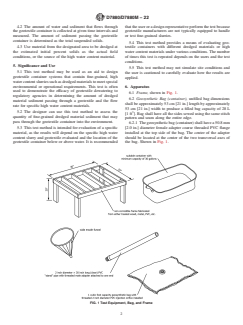
6.1 Frame, shown in Fig. 1.
regulatory agencies in determining the amount of dredged
6.2 Geosynthetic Bag (container), unfilled bag dimensions
material sediment passing through a geotextile and the flow
shall be approximately 53 cm [21 in.] length by approximately
rate for specific high water content materials.
53 cm [21 in.] width to produce a filled bag capacity of 28 L
5.2 The designer can use this test method to assess the 3
[1 ft ]. Bag shall have all the sides sewed using the same stitch
quantity of fine-grained dredged material sediment that may
pattern and seam along the entire edge.
pass through the geotextile container into the environment.
6.2.1 Thegeosyntheticbag(container)shallhavea50.8mm
5.3 This test method is intended for evaluation of a specific [2.0 in.] diameter female adapter coarse threaded PVC flange
material, as the results will depend on the specific high water installed at the top side of the bag. The center of the adapter
content slurry and geotextile evaluated and the location of the should be located at the center of the two transversal axes of
geotextile container below or above water. It is recommended the bag. Shown in Fig. 1.
FIG. 1 Test Equipment, Bag, and Frame
D7880/D7880M − 22
6.3 Collection Container, approximate capacity filled about 8.3 After the soaked geotextile container has drained of free
75 L [20 gal], suitable to capture filtrate and proportionately water, place a dry shallow collector pan as described in 6.3
sized to allow placement under the testing frame. Shown in under the geotextile container to collect water and sediment by
Fig. 1. gravity flow.
6.4 “Stand” Pipe, made from 50.8 mm [2.0 in.] diameter 8.4 Collect approximately 55 to 95 L [15 to 25 gal] of
and at least 1.10 m [43.30 in.] in length clear PVC or other sludge into a suitable container and mix to ensure uniformity.
suitable plastic. “Stand” pipe shall include a threaded male
NOTE 1—Alarger sample of sludge may be required if a low percentage
adapter to facilitate connection the female PVC flange.
of solids is present.
6.5 Funnel.
8.5 Assemble the testing frame if necessary and place a
suitable collection container under the frame to catch the
6.6 Integrated Water Sampler, a 0.5 L[0.13 gal] device used
effluent during testing.
to collect integrated samples of water.
8.6 Fill the geosynthetic bag by pouring the sludge into the
6.7 Stopwatch.
top of the “stand” pipe. A smaller bucket and funnel can be
6.8 Stirrer, such as
...