

ASTM E2071-21
(Practice)Standard Practice for Calculating Heat of Vaporization or Sublimation from Vapor Pressure Data
General Information
- Abstract
ABSTRACT
This practice describes the calculation of the heat of vaporization of a liquid or the heat of sublimation of a solid from measured vapor pressure data. It is applicable to pure liquids, azeotropes, pure solids, and homogenous solid solutions over the temperature range for which the vapor pressure equation fitted to the measured data is applicable. Vapor pressure data shall be measured in accordance to the test methods and shall be correlated with the Antoine equation. The heat of vaporization or sublimation is computed at the desired temperature from the vapor-pressure temperature derivative from the fitted Antoine equation by use of the Clapeyron equation.
SCOPE
1.1 This practice describes the calculation of the heat of vaporization of a liquid or the heat of sublimation of a solid from measured vapor pressure data. It is applicable to pure liquids, azeotropes, pure solids, and homogenous solid solutions over the temperature range for which the vapor pressure equation fitted to the measured data is applicable.
Note 1: This practice is generally not applicable to liquid mixtures. For a pure liquid or azeotrope, composition does not change upon vaporization so that the integral heat of vaporization is identical to the differential heat of vaporization. Non-azeotropic liquid mixtures change composition upon vaporizing. Heat of vaporization data computed from this practice for a liquid mixture are valid only as an approximation to the mixture differential heat of vaporization; it is not a valid approximation to the mixture integral heat of vaporization.
1.2 The values stated in SI units are to be regarded as standard. No other units of measurement are included in this standard.
1.3 This standard does not purport to address all of the safety concerns, if any, associated with its use. It is the responsibility of the user of this standard to establish appropriate safety, health, and environmental practices and determine the applicability of regulatory limitations prior to use.
1.4 This international standard was developed in accordance with internationally recognized principles on standardization established in the Decision on Principles for the Development of International Standards, Guides and Recommendations issued by the World Trade Organization Technical Barriers to Trade (TBT) Committee.
- Status
- Published
- Publication Date
- 28-Feb-2021
- Technical Committee
- E37 - Thermal Measurements
- Drafting Committee
- E37.10 - Fundamental, Statistical and Mechanical Properties
Buy Documents

ASTM E2071-21 - Standard Practice for Calculating Heat of Vaporization or Sublimation from Vapor Pressure Data
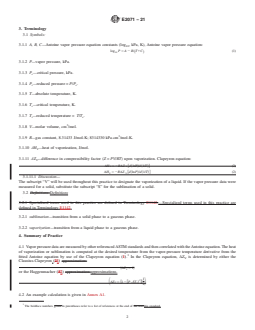
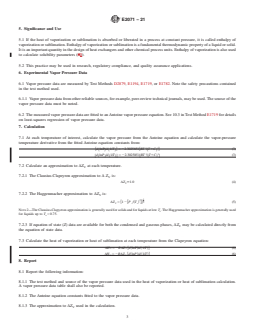
REDLINE ASTM E2071-21 - Standard Practice for Calculating Heat of Vaporization or Sublimation from Vapor Pressure Data
Overview
ASTM E2071-21 is the standard practice for calculating the heat of vaporization or sublimation using vapor pressure data. Developed by ASTM International, this standard provides a systematic approach to determine the enthalpy (heat) of vaporization for liquids or sublimation for solids through data obtained from vapor pressure measurements. It is primarily applicable to pure liquids, azeotropes, pure solids, and homogeneous solid solutions within the valid range of the fitted vapor pressure equation. The practice uses established thermodynamic relationships, notably the Antoine equation and Clapeyron equation, to convert vapor pressure data into quantitative enthalpy values. This process is critical for applications in chemical engineering, research, and process design where accurate thermophysical property data are required.
Key Topics
- Heat of Vaporization and Sublimation: Calculation of energy absorbed or released during phase changes from liquid to gas (vaporization) or solid to gas (sublimation), expressed as enthalpy.
- Vapor Pressure Data Acquisition: Measurement methods must align with referenced ASTM methods (such as ASTM D2879, E1194, E1719, E1782). Only data from reliable sources or peer-reviewed literature should be considered.
- Antoine Equation: Used to fit experimental vapor pressure data and provide the necessary mathematical relationship between temperature and pressure.
- Clapeyron Equation: Employed to calculate the heat of vaporization or sublimation from the temperature derivative of the vapor pressure as per the fitted Antoine equation.
- Approximations for Compressibility Factor Difference (ΔZ): Utilizes Clausius-Clapeyron and Haggenmacher approximations to account for phase changes, enhancing calculation accuracy across temperature ranges.
- Reporting Requirements: Comprehensive reporting of the source and method of vapor pressure data, Antoine equation constants, approximation methods, and all calculation results is mandatory.
Applications
ASTM E2071-21 has significant practical value in multiple domains:
- Chemical Process Design: Determining reliable heat of vaporization and sublimation values is essential for sizing and designing equipment such as heat exchangers, distillation columns, and reactors, where phase changes occur.
- Thermophysical Research: Used in research settings to obtain fundamental thermodynamic properties for new materials or substances under investigation.
- Regulatory Compliance and Quality Assurance: Provides standardized methods for documenting material properties needed for regulatory submissions, safety data sheets, and quality control in manufacturing.
- Solubility and Mixture Analysis: Accurate enthalpy values contribute to the calculation of solubility parameters and inform mixture behavior, though the standard cautions its use for non-azeotropic mixtures.
- Materials Science: Useful in evaluating phase transitions in new solid materials, particularly in fields like pharmaceuticals, polymers, and advanced materials engineering.
Related Standards
- ASTM D2879: Test Method for Vapor Pressure-Temperature Relationship and Initial Decomposition Temperature of Liquids by Isoteniscope.
- ASTM E1142: Standard Terminology Relating to Thermophysical Properties.
- ASTM E1194: Test Method for Vapor Pressure.
- ASTM E1719: Test Method for Vapor Pressure of Liquids by Ebulliometry.
- ASTM E1782: Test Method for Determining Vapor Pressure by Thermal Analysis.
These referenced standards detail procedures for generating the vapor pressure data that underpin the heat of vaporization and sublimation calculations in ASTM E2071-21. They ensure that the data used are accurate, reliable, and derived from validated experimental techniques.
Keywords: ASTM E2071-21, heat of vaporization, heat of sublimation, vapor pressure data, Antoine equation, Clapeyron equation, thermophysical properties, enthalpy of vaporization, chemical process design, ASTM standards.
Relations
- Effective Date
- 01-Mar-2024
- Effective Date
- 01-Dec-2023
- Effective Date
- 01-Oct-2023
- Effective Date
- 01-Dec-2018
- Effective Date
- 01-Mar-2017
- Effective Date
- 01-May-2015
- Effective Date
- 15-Aug-2014
- Effective Date
- 01-Apr-2014
- Effective Date
- 15-Feb-2014
- Effective Date
- 01-Sep-2012
- Effective Date
- 01-Apr-2012
- Effective Date
- 01-Aug-2011
- Effective Date
- 15-Jun-2011
- Effective Date
- 01-Apr-2011
- Effective Date
- 01-Oct-2010
Buy Documents
ASTM E2071-21 - Standard Practice for Calculating Heat of Vaporization or Sublimation from Vapor Pressure Data
REDLINE ASTM E2071-21 - Standard Practice for Calculating Heat of Vaporization or Sublimation from Vapor Pressure Data
Get Certified
Connect with accredited certification bodies for this standard

DNV
DNV is an independent assurance and risk management provider.

Lloyd's Register
Lloyd's Register is a global professional services organisation specialising in engineering and technology.
DNV Energy Systems
Energy and renewable energy certification.
Sponsored listings
Frequently Asked Questions
ASTM E2071-21 is a standard published by ASTM International. Its full title is "Standard Practice for Calculating Heat of Vaporization or Sublimation from Vapor Pressure Data". This standard covers: ABSTRACT This practice describes the calculation of the heat of vaporization of a liquid or the heat of sublimation of a solid from measured vapor pressure data. It is applicable to pure liquids, azeotropes, pure solids, and homogenous solid solutions over the temperature range for which the vapor pressure equation fitted to the measured data is applicable. Vapor pressure data shall be measured in accordance to the test methods and shall be correlated with the Antoine equation. The heat of vaporization or sublimation is computed at the desired temperature from the vapor-pressure temperature derivative from the fitted Antoine equation by use of the Clapeyron equation. SCOPE 1.1 This practice describes the calculation of the heat of vaporization of a liquid or the heat of sublimation of a solid from measured vapor pressure data. It is applicable to pure liquids, azeotropes, pure solids, and homogenous solid solutions over the temperature range for which the vapor pressure equation fitted to the measured data is applicable. Note 1: This practice is generally not applicable to liquid mixtures. For a pure liquid or azeotrope, composition does not change upon vaporization so that the integral heat of vaporization is identical to the differential heat of vaporization. Non-azeotropic liquid mixtures change composition upon vaporizing. Heat of vaporization data computed from this practice for a liquid mixture are valid only as an approximation to the mixture differential heat of vaporization; it is not a valid approximation to the mixture integral heat of vaporization. 1.2 The values stated in SI units are to be regarded as standard. No other units of measurement are included in this standard. 1.3 This standard does not purport to address all of the safety concerns, if any, associated with its use. It is the responsibility of the user of this standard to establish appropriate safety, health, and environmental practices and determine the applicability of regulatory limitations prior to use. 1.4 This international standard was developed in accordance with internationally recognized principles on standardization established in the Decision on Principles for the Development of International Standards, Guides and Recommendations issued by the World Trade Organization Technical Barriers to Trade (TBT) Committee.
ABSTRACT This practice describes the calculation of the heat of vaporization of a liquid or the heat of sublimation of a solid from measured vapor pressure data. It is applicable to pure liquids, azeotropes, pure solids, and homogenous solid solutions over the temperature range for which the vapor pressure equation fitted to the measured data is applicable. Vapor pressure data shall be measured in accordance to the test methods and shall be correlated with the Antoine equation. The heat of vaporization or sublimation is computed at the desired temperature from the vapor-pressure temperature derivative from the fitted Antoine equation by use of the Clapeyron equation. SCOPE 1.1 This practice describes the calculation of the heat of vaporization of a liquid or the heat of sublimation of a solid from measured vapor pressure data. It is applicable to pure liquids, azeotropes, pure solids, and homogenous solid solutions over the temperature range for which the vapor pressure equation fitted to the measured data is applicable. Note 1: This practice is generally not applicable to liquid mixtures. For a pure liquid or azeotrope, composition does not change upon vaporization so that the integral heat of vaporization is identical to the differential heat of vaporization. Non-azeotropic liquid mixtures change composition upon vaporizing. Heat of vaporization data computed from this practice for a liquid mixture are valid only as an approximation to the mixture differential heat of vaporization; it is not a valid approximation to the mixture integral heat of vaporization. 1.2 The values stated in SI units are to be regarded as standard. No other units of measurement are included in this standard. 1.3 This standard does not purport to address all of the safety concerns, if any, associated with its use. It is the responsibility of the user of this standard to establish appropriate safety, health, and environmental practices and determine the applicability of regulatory limitations prior to use. 1.4 This international standard was developed in accordance with internationally recognized principles on standardization established in the Decision on Principles for the Development of International Standards, Guides and Recommendations issued by the World Trade Organization Technical Barriers to Trade (TBT) Committee.
ASTM E2071-21 is classified under the following ICS (International Classification for Standards) categories: 27.040 - Gas and steam turbines. Steam engines. The ICS classification helps identify the subject area and facilitates finding related standards.
ASTM E2071-21 has the following relationships with other standards: It is inter standard links to ASTM E1719-24, ASTM D2879-23, ASTM E1142-23b, ASTM D2879-18, ASTM E1194-17, ASTM E1142-15, ASTM E1142-14b, ASTM E1142-14a, ASTM E1142-14, ASTM E1142-12, ASTM E1719-12, ASTM E1142-11b, ASTM E1142-11a, ASTM E1142-11, ASTM D2879-10. Understanding these relationships helps ensure you are using the most current and applicable version of the standard.
ASTM E2071-21 is available in PDF format for immediate download after purchase. The document can be added to your cart and obtained through the secure checkout process. Digital delivery ensures instant access to the complete standard document.
Standards Content (Sample)
This international standard was developed in accordance with internationally recognized principles on standardization established in the Decision on Principles for the
Development of International Standards, Guides and Recommendations issued by the World Trade Organization Technical Barriers to Trade (TBT) Committee.
Designation: E2071 − 21
Standard Practice for
Calculating Heat of Vaporization or Sublimation from Vapor
Pressure Data
This standard is issued under the fixed designation E2071; the number immediately following the designation indicates the year of
original adoption or, in the case of revision, the year of last revision. A number in parentheses indicates the year of last reapproval. A
superscript epsilon (´) indicates an editorial change since the last revision or reapproval.
1. Scope tionship and Initial Decomposition Temperature of Liq-
uids by Isoteniscope
1.1 This practice describes the calculation of the heat of
E1142 Terminology Relating to Thermophysical Properties
vaporization of a liquid or the heat of sublimation of a solid
E1194 Test Method for Vapor Pressure
from measured vapor pressure data. It is applicable to pure
E1719 Test Method for Vapor Pressure of Liquids by Ebul-
liquids, azeotropes, pure solids, and homogenous solid solu-
liometry
tions over the temperature range for which the vapor pressure
E1782 Test Method for Determining Vapor Pressure by
equation fitted to the measured data is applicable.
Thermal Analysis
NOTE 1—This practice is generally not applicable to liquid mixtures.
For a pure liquid or azeotrope, composition does not change upon
3. Terminology
vaporization so that the integral heat of vaporization is identical to the
differential heat of vaporization. Non-azeotropic liquid mixtures change
3.1 Symbols:
composition upon vaporizing. Heat of vaporization data computed from
3.1.1 A, B, C—Antoine vapor pressure equation constants
this practice for a liquid mixture are valid only as an approximation to the
(log , kPa, K), Antoine vapor pressure equation:
mixture differential heat of vaporization; it is not a valid approximation to 10
the mixture integral heat of vaporization.
log P 5 A 2 B/~T1C! (1)
1.2 The values stated in SI units are to be regarded as
3.1.2 P—vapor pressure, kPa.
standard. No other units of measurement are included in this
3.1.3 P —critical pressure, kPa.
c
standard.
3.1.4 P —reduced pressure = P/P .
1.3 This standard does not purport to address all of the r c
safety concerns, if any, associated with its use. It is the
3.1.5 T—absolute temperature, K.
responsibility of the user of this standard to establish appro-
3.1.6 T —critical temperature, K.
c
priate safety, health, and environmental practices and deter-
mine the applicability of regulatory limitations prior to use. 3.1.7 T —reduced temperature = T/T .
r c
1.4 This international standard was developed in accor- 3
3.1.8 V—molar volume, cm /mol.
dance with internationally recognized principles on standard-
3.1.9 R—gas constant, 8.31433 J/mol-K; 8314330 kPa-cm /
ization established in the Decision on Principles for the
mol-K.
Development of International Standards, Guides and Recom-
mendations issued by the World Trade Organization Technical
3.1.10 ∆H —heat of vaporization, J/mol.
V
Barriers to Trade (TBT) Committee.
3.1.11 ∆Z —difference in compressibility factor (Z = PV/
V
RT) upon vaporization. Clapeyron equation:
2. Referenced Documents
∆H 52R∆Z @d~lnP!/d~1/T!# (2)
V V
2.1 ASTM Standards:
3.1.11.1 Discussion—The subscript “V” will be used
D2879 Test Method for Vapor Pressure-Temperature Rela-
throughout this practice to designate the vaporization of a
liquid. If the vapor pressure data were measured for a solid,
This practice is under the jurisdiction of Committee E37 on Thermal Measure-
substitute the subscript “S” for the sublimation of a solid.
ments and is the direct responsibility of Subcommittee E37.10 on Fundamental,
Statistical and Mechanical Properties. 3.2 Definitions—Specialized terms used in this practice are
Current edition approved March 1, 2021. Published April 2021. Originally
defined in Terminology E1142.
approved in 2000. Last previous edition approved in 2015 as E2071 – 00 (2015).
3.2.1 sublimation—transition from a solid phase to a gas-
DOI: 510.1520/E2071-21.
For referenced ASTM standards, visit the ASTM website, www.astm.org, or eous phase.
contact ASTM Customer Service at service@astm.org. For Annual Book of ASTM
3.2.2 vaporization—transition from a liquid phase to a
Standards volume information, refer to the standard’s Document Summary page on
the ASTM website. gaseous phase.
Copyright © ASTM International, 100 Barr Harbor Drive, PO Box C700, West Conshohocken, PA 19428-2959. United States
E2071 − 21
2 2
4. Summary of Practice d lnP /d 1/T 522.3025851 BT / T1C (3)
@ ~ ! ~ !# @ ~ ! #
7.2 Calculate an approximation to∆Z at each temperature.
4.1 Vapor pressure data are measured by other referenced
V
ASTM standards and then correlated with the Antoine equa- 7.2.1 The Clausius-Clapeyron approximation to ∆ Z is:
V
tion.Theheatofvaporizationorsublimationiscomputedatthe
∆Z [1.0 (4)
V
desired temperature from the vapor-pressure temperature de-
7.2.2 The Haggenmacher approximation to ∆Z is:
rivative from the fitted Antoine equation by use of the V
Clapeyron equation (1). In the Clapeyron equation, ∆Z is
V
∆Z 5 1 2 P / T 2 (5)
~ !
V $ @ r r #%
determined by either the Clausius-Clapeyron (1) or the
NOTE 2—The Clausius-Clapyeron approximation is generally used for
Haggenmacher (2) approximations.
solids and for liquids at low T . The Haggenmacher approximation is
r
generally used for liquids up to T ≈ 0.75.
r
4.2 An example calculation is given in Annex A1.
7.2.3 If equation of state (Z) data are available for both the
5. Significance and Use
condensed and gaseous phases,∆Z may be calculated directly
V
5.1 If the heat of vaporization or sublimation is absorbed or
from the equation of state data.
liberated in a process at constant pressure, it is called enthalpy
7.3 Calculate the heat of vaporization or heat of sublimation
of vaporization or sublimation. Enthalpy of vaporization or
at each temperature from the Clapeyron equation:
sublimation is a fundamental thermodynamic property of a
∆H 52R∆Z @d~lnP!/d~1/T!# (6)
liquid or solid. It is an important quantity in the design of heat V V
exchangers and other chemical process units. Enthalpy of
8. Report
vaporization is also used to calculate solubility parameters (3).
8.1 Report the following information:
5.2 This practice may be used in research, regulatory
8.1.1 The test method and source of the vapor pressure data
compliance, and quality assurance applications.
used in the heat of vaporization or heat of sublimation
6. Experimental Vapor Pressure Data
calculation. A vapor pressure data table shall also be reported.
6.1 Vapor pressure data are measured by Test Methods
8.1.2 The Antoine equation constants fitted to the vapor
D2879, E1194, E1719,or E1782. Note the safety precautions pressure data.
contained in the test method used.
8.1.3 The approximation to ∆Z used in the calculation.
V
6.1.1 Vapor pressure data from other reliable sources, for
8.1.4 The values and source of the critical temperature and
example, peer-review technical journals, may be used. The
critical pressure data i
...
This document is not an ASTM standard and is intended only to provide the user of an ASTM standard an indication of what changes have been made to the previous version. Because
it may not be technically possible to adequately depict all changes accurately, ASTM recommends that users consult prior editions as appropriate. In all cases only the current version
of the standard as published by ASTM is to be considered the official document.
Designation: E2071 − 00 (Reapproved 2015) E2071 − 21
Standard Practice for
Calculating Heat of Vaporization or Sublimation from Vapor
Pressure Data
This standard is issued under the fixed designation E2071; the number immediately following the designation indicates the year of
original adoption or, in the case of revision, the year of last revision. A number in parentheses indicates the year of last reapproval. A
superscript epsilon (´) indicates an editorial change since the last revision or reapproval.
1. Scope
1.1 This practice describes the calculation of the heat of vaporization of a liquid or the heat of sublimation of a solid from
measured vapor pressure data. It is applicable to pure liquids, azeotropes, pure solids, and homogenous solid solutions over the
temperature range for which the vapor pressure equation fitted to the measured data is applicable.
NOTE 1—This practice is generally not applicable to liquid mixtures. For a pure liquid or azeotrope, composition does not change upon vaporization so
that the integral heat of vaporization is identical to the differential heat of vaporization. Non-azeotropic liquid mixtures change composition upon
vaporizing. Heat of vaporization data computed from this practice for a liquid mixture are valid only as an approximation to the mixture differential heat
of vaporization; it is not a valid approximation to the mixture integral heat of vaporization.
1.2 The values stated in SI units are to be regarded as standard. No other units of measurement are included in this standard.
1.3 There is no ISO standard equivalent to this practice.
1.3 This standard does not purport to address all of the safety concerns, if any, associated with its use. It is the responsibility
of the user of this standard to establish appropriate safety safety, health, and healthenvironmental practices and determine the
applicability of regulatory limitations prior to use.
1.4 This international standard was developed in accordance with internationally recognized principles on standardization
established in the Decision on Principles for the Development of International Standards, Guides and Recommendations issued
by the World Trade Organization Technical Barriers to Trade (TBT) Committee.
2. Referenced Documents
2.1 ASTM Standards:
D2879 Test Method for Vapor Pressure-Temperature Relationship and Initial Decomposition Temperature of Liquids by
Isoteniscope
E1142 Terminology Relating to Thermophysical Properties
E1194 Test Method for Vapor Pressure
E1719 Test Method for Vapor Pressure of Liquids by Ebulliometry
E1782 Test Method for Determining Vapor Pressure by Thermal Analysis
This practice is under the jurisdiction of Committee E37 on Thermal Measurements and is the direct responsibility of Subcommittee E37.10 on Fundamental, Statistical
and Mechanical Properties.
Current edition approved May 1, 2015March 1, 2021. Published May 2015April 2021. Originally approved in 2000. Last previous edition approved in 20102015 as
E2071 – 00 (2010).(2015). DOI: 510.1520/E2071-00R15.510.1520/E2071-21.
For referenced ASTM standards, visit the ASTM website, www.astm.org, or contact ASTM Customer Service at service@astm.org. For Annual Book of ASTM Standards
volume information, refer to the standard’s Document Summary page on the ASTM website.
Copyright © ASTM International, 100 Barr Harbor Drive, PO Box C700, West Conshohocken, PA 19428-2959. United States
E2071 − 21
3. Terminology
3.1 Symbols:
3.1.1 A, B, C—Antoine vapor pressure equation constants (log , kPa, K), Antoine vapor pressure equation:
log P 5 A 2 B/ T1C (1)
~ !
3.1.2 P—vapor pressure, kPa.
3.1.3 P —critical pressure, kPa.
c
3.1.4 P —reduced pressure = P/P .
r c
3.1.5 T—absolute temperature, K.
3.1.6 T —critical temperature, K.
c
3.1.7 T —reduced temperature = T/T .
r c
3.1.8 V—molar volume, cm /mol.
3.1.9 R—gas constant, 8.31433 J/mol-K; 8314330 kPa-cm /mol-K.
3.1.10 ΔH —heat of vaporization, J/mol.
V
3.1.11 ΔZ —difference in compressibility factor (Z = PV/RT) upon vaporization. Clapeyron equation:
V
ΔH 52RΔZ d lnP /d 1/T (2)
@ ~ ! ~ !#
V V
ΔH 52RΔZ d lnP /d 1/T (2)
@ ~ ! ~ !#
V V
3.1.11.1 Discussion—
The subscript “V” will be used throughout this practice to designate the vaporization of a liquid. If the vapor pressure data were
measured for a solid, substitute the subscript “S” for the sublimation of a solid.
3.2 Definitions:Definitions
3.2.1 Specialized terms used in this practice are defined in Terminology E1142.—Specialized terms used in this practice are
defined in Terminology E1142.
3.2.1 sublimation—transition from a solid phase to a gaseous phase.
3.2.2 vaporization—transition from a liquid phase to a gaseous phase.
4. Summary of Practice
4.1 Vapor pressure data are measured by other referenced ASTM standards and then correlated with the Antoine equation. The heat
of vaporization or sublimation is computed at the desired temperature from the vapor-pressure temperature derivative from the
fitted Antoine equation by use of the Clapeyron equation (1). In the Clapeyron equation, ΔZ is determined by either the
V
Clausius-Clapeyron (21) approximation:
~ΔZ 5 1!
V
or the Haggenmacher (32) approximation:approximations.
ΔZ 5 12 P /~T !
S $ @ #% D
V r r
4.2 An example calculation is given in Annex A1.
The boldface numbers given in parentheses refer to a list of references at the end of the text.this standard.
E2071 − 21
5. Significance and Use
5.1 If the heat of vaporization or sublimation is absorbed or liberated in a process at constant pressure, it is called enthalpy of
vaporization or sublimation. Enthalpy of vaporization or sublimation is a fundamental thermodynamic property of a liquid or solid.
It is an important quantity in the design of heat exchangers and other chemical process units. Enthalpy of vaporization is also used
to calculate solubility parameters (43).
5.2 This practice may be used in research, regulatory compliance, and quality assurance applications.
6. Experimental Vapor Pressure Data
6.1 Vapor pressure data are measured by Test Methods D2879, E1194, E1719, or E1782. Note the safety precautions contained
in the test method used.
6.1.1 Vapor pressure data from other reliable sources, for example, peer-review technical journals, may be used. The source of the
vapor pressure data must be noted.
6.2 The measured vapor pressure data are fitted to an Antoine vapor pressure equation. See 10.3 in Test Method E1719 for details
on least-squares regression of vapor pressure data.
7. Calculation
7.1 At each temperature of interest, calculate the vapor pressure from the Antoine equation and calculate the vapor-pressure
temperature derivative from the fitted Antoine equation constants from:
2 2
d lnP /d 1/T 522.3025851 BT / T1C (3)
@ ~ ! ~ !# @ ~ ! #
2 2
@d~lnP!/d~1/T!# 522.3025851@BT /~T1C! # (3)
7.2 Calculate an approximation to ΔZ at each temperature.
V
7.2.1 The Clausius-Clapeyron approximation to Δ Z is:
V
ΔZ [1.0 (4)
V
7.2.2 The Haggenmacher approximation to ΔZ is:
V
ΔZ 5 12 P / T 2 (5)
$ @ ~ ! #%
V r r
NOTE 2—The Clausius-Clapyeron approximation is generally used for solids and for liquids at low T . The Haggenmacher approximation is generally used
r
for liquids up to T ≈ 0.75.
r
7.2.3 If equation of state (Z) data are available for both the condensed and gaseous phases, ΔZ may be calculated directly from
V
the equation of state data.
7.3 Calculate the heat of vaporization or heat of sublimation at each temperature from the Clapeyron equation:
ΔH 52RΔZ d lnP /d 1/T (6)
@ ~ ! ~ !#
V V
ΔH 52RΔZ @d~lnP!/d~1/T!# (6)
V V
8. Report
8.1 Report the following information:
8.1.1 The test method and source of the vapor pressure data used in the heat of vaporization or heat of sublimation calculation.
A vapor pressure data table shall a
...