

ASTM E1194-17
(Test Method)Standard Test Method for Vapor Pressure
General Information
- Abstract
SIGNIFICANCE AND USE
5.1 Vapor pressure values can be used to predict volatilization rates (5). Vapor pressures, along with vapor-liquid partition coefficients (Henry's Law constant) are used to predict volatilization rates from liquids such as water. These values are thus particularly important for the prediction of the transport of a chemical in the environment (6).
SCOPE
1.1 This test method describes procedures for measuring the vapor pressure of pure liquid or solid compounds. No single technique is able to measure vapor pressures from 1 × 10⁻¹¹ to 100 kPa (approximately 10−10 to 760 torr). The subject of this standard is gas saturation which is capable of measuring vapor pressures from 1 × 10–11 to 1 kPa (approximately 10–10 to 10 torr). Other methods, such as isoteniscope and differential scanning calorimetry (DSC) are suitable for measuring vapor pressures above 0.1 kPa An isoteniscope (standard) procedure for measuring vapor pressures of liquids from 1 × 10⁻¹ to 100 kPa (approximately 1 to 760 torr) is available in Test Method D2879. A DSC (standard) procedure for measuring vapor pressures from 2 × 10⁻¹ to 100 kPa (approximately 1 to 760 torr) is available in Test Method E1782. A gas-saturation procedure for measuring vapor pressures from 1 × 10⁻¹¹ to 1 kPa (approximately 10−10 to 10 torr) is presented in this test method. All procedures are subjects of U.S. Environmental Protection Agency Test Guidelines.
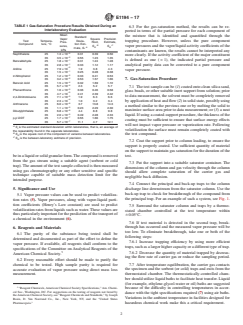
1.2 The gas saturation method is very useful for providing vapor pressure data at normal environmental temperatures (–40 to +60°C). At least three temperature values should be studied to allow definition of a vapor pressure-temperature correlation. Values determined should be based on temperature selections such that a measurement is made at 25°C (as recommended by IUPAC) (1),2 a value can be interpolated for 25°C, or a value can be reliably extrapolated for 25°C. Extrapolation to 25°C should be avoided if the temperature range tested includes a value at which a phase change occurs. Extrapolation to 25°C over a range larger than 10°C should also be avoided. If possible, the temperatures investigated should be above and below 25°C to avoid extrapolation altogether. The gas saturation method was selected because of its extended range, simplicity, and general applicability (2). Examples of results produced by the gas-saturation procedure during an interlaboratory evaluation are given in Table 1. These data have been taken from Reference (3). (A) Sr is the estimated standard deviation within laboratories, that is, an average of the repeatability found in the separate laboratories.(B) SR is the square root of the component of variance between laboratories.(C) SR is the between-laboratory estimate of precision.
1.3 The values stated in SI units are to be regarded as standard. No other units of measurement are included in this standard.
1.4 This standard does not purport to address all of the safety problems, if any, associated with its use. It is the responsibility of the user of this standard to establish appropriate safety and health practices and determine the applicability of regulatory limitations prior to use.
- Status
- Published
- Publication Date
- 28-Feb-2017
- Technical Committee
- E50 - Environmental Assessment, Risk Management and Corrective Action
- Drafting Committee
- E50.47 - Biological Effects and Environmental Fate
Overview
ASTM E1194-17: Standard Test Method for Vapor Pressure provides procedures for measuring the vapor pressure of pure liquid or solid compounds using the gas saturation technique. Developed by ASTM International, this method supports the accurate determination of vapor pressure for substances across a wide range of low pressures, specifically from 1 × 10⁻¹¹ to 1 kPa (approximately 10⁻¹⁰ to 10 torr). Vapor pressure is a critical property for understanding the behavior of chemicals, particularly concerning their volatilization rates and environmental transport.
Key Topics
Measurement Range and Methods:
- The gas saturation method is effective for vapor pressures from 1 × 10⁻¹¹ to 1 kPa.
- Isoteniscope and Differential Scanning Calorimetry (DSC) methods are referenced for higher vapor pressures, but ASTM E1194-17 focuses on the gas saturation technique.
- Measurements should cover at least three temperatures within the range of -40°C to +60°C, ideally including or interpolating to 25°C as recommended by IUPAC.
Significance of Vapor Pressure Data:
- Vapor pressure values are essential for predicting volatilization rates of chemicals.
- Combined with vapor-liquid partition coefficients (Henry's Law constant), these data are used to model the environmental fate and transport of chemicals, especially in water and the atmosphere.
- Accurate vapor pressure measurements inform risk assessments and regulatory compliance.
Procedural Considerations:
- High sample purity is necessary for valid vapor pressure results.
- The technique involves an inert carrier gas passing over the test substance, with vapor carried through sorbent or cold traps for quantification.
- Testing should avoid extrapolation beyond 10°C from the measurement range and should be conducted above and below 25°C where possible.
- Safety and regulatory considerations must be addressed individually by each user.
Applications
Environmental Fate Studies:
- Used to predict how chemicals volatilize from water and soil into the air.
- Supports the development of environmental models and exposure assessments required by regulatory agencies.
Regulatory Testing:
- Recognized for compliance with U.S. Environmental Protection Agency (EPA) guidelines under the Toxic Substances Control Act (TSCA).
- Provides essential data for substance registration, hazard classification, and risk management.
Chemical Safety and Handling:
- Assists industrial and research laboratories in understanding the volatility and handling requirements of chemicals.
- Informs the design of safe storage, transportation, and spill response procedures.
Product Development and Quality Control:
- Used in the chemical manufacturing sector to ensure products meet volatility specifications.
Related Standards
- ASTM D2879: Test Method for Vapor Pressure-Temperature Relationship and Initial Decomposition Temperature of Liquids by Isoteniscope - for higher vapor pressure measurements.
- ASTM E1782: Test Method for Determining Vapor Pressure by Thermal Analysis - for vapor pressures from 2 × 10⁻¹ to 100 kPa.
- ASTM E691: Practice for Conducting an Interlaboratory Study to Determine the Precision of a Test Method.
- EPA TSCA Test Guidelines: Federal methods for determining vapor pressure required in environmental safety evaluations.
Keywords: ASTM E1194-17, vapor pressure test, gas saturation method, environmental fate, chemical volatility, standard test method, regulatory compliance, environmental assessment, partition coefficient, volatilization rates.
Relations
- Effective Date
- 01-Dec-2023
- Effective Date
- 01-Dec-2018
- Effective Date
- 01-May-2013
- Effective Date
- 01-Nov-2011
- Effective Date
- 01-Oct-2010
- Effective Date
- 01-Oct-2008
- Effective Date
- 01-Mar-2008
- Effective Date
- 01-May-2007
- Effective Date
- 01-Nov-2005
- Effective Date
- 10-Mar-2003
- Effective Date
- 10-May-1999
- Effective Date
- 10-Mar-1998
- Effective Date
- 10-Apr-1997
- Effective Date
- 10-Apr-1997
- Effective Date
- 01-Mar-2017
Get Certified
Connect with accredited certification bodies for this standard

BSMI (Bureau of Standards, Metrology and Inspection)
Taiwan's standards and inspection authority.
Sponsored listings
Frequently Asked Questions
ASTM E1194-17 is a standard published by ASTM International. Its full title is "Standard Test Method for Vapor Pressure". This standard covers: SIGNIFICANCE AND USE 5.1 Vapor pressure values can be used to predict volatilization rates (5). Vapor pressures, along with vapor-liquid partition coefficients (Henry's Law constant) are used to predict volatilization rates from liquids such as water. These values are thus particularly important for the prediction of the transport of a chemical in the environment (6). SCOPE 1.1 This test method describes procedures for measuring the vapor pressure of pure liquid or solid compounds. No single technique is able to measure vapor pressures from 1 × 10⁻¹¹ to 100 kPa (approximately 10−10 to 760 torr). The subject of this standard is gas saturation which is capable of measuring vapor pressures from 1 × 10–11 to 1 kPa (approximately 10–10 to 10 torr). Other methods, such as isoteniscope and differential scanning calorimetry (DSC) are suitable for measuring vapor pressures above 0.1 kPa An isoteniscope (standard) procedure for measuring vapor pressures of liquids from 1 × 10⁻¹ to 100 kPa (approximately 1 to 760 torr) is available in Test Method D2879. A DSC (standard) procedure for measuring vapor pressures from 2 × 10⁻¹ to 100 kPa (approximately 1 to 760 torr) is available in Test Method E1782. A gas-saturation procedure for measuring vapor pressures from 1 × 10⁻¹¹ to 1 kPa (approximately 10−10 to 10 torr) is presented in this test method. All procedures are subjects of U.S. Environmental Protection Agency Test Guidelines. 1.2 The gas saturation method is very useful for providing vapor pressure data at normal environmental temperatures (–40 to +60°C). At least three temperature values should be studied to allow definition of a vapor pressure-temperature correlation. Values determined should be based on temperature selections such that a measurement is made at 25°C (as recommended by IUPAC) (1),2 a value can be interpolated for 25°C, or a value can be reliably extrapolated for 25°C. Extrapolation to 25°C should be avoided if the temperature range tested includes a value at which a phase change occurs. Extrapolation to 25°C over a range larger than 10°C should also be avoided. If possible, the temperatures investigated should be above and below 25°C to avoid extrapolation altogether. The gas saturation method was selected because of its extended range, simplicity, and general applicability (2). Examples of results produced by the gas-saturation procedure during an interlaboratory evaluation are given in Table 1. These data have been taken from Reference (3). (A) Sr is the estimated standard deviation within laboratories, that is, an average of the repeatability found in the separate laboratories.(B) SR is the square root of the component of variance between laboratories.(C) SR is the between-laboratory estimate of precision. 1.3 The values stated in SI units are to be regarded as standard. No other units of measurement are included in this standard. 1.4 This standard does not purport to address all of the safety problems, if any, associated with its use. It is the responsibility of the user of this standard to establish appropriate safety and health practices and determine the applicability of regulatory limitations prior to use.
SIGNIFICANCE AND USE 5.1 Vapor pressure values can be used to predict volatilization rates (5). Vapor pressures, along with vapor-liquid partition coefficients (Henry's Law constant) are used to predict volatilization rates from liquids such as water. These values are thus particularly important for the prediction of the transport of a chemical in the environment (6). SCOPE 1.1 This test method describes procedures for measuring the vapor pressure of pure liquid or solid compounds. No single technique is able to measure vapor pressures from 1 × 10⁻¹¹ to 100 kPa (approximately 10−10 to 760 torr). The subject of this standard is gas saturation which is capable of measuring vapor pressures from 1 × 10–11 to 1 kPa (approximately 10–10 to 10 torr). Other methods, such as isoteniscope and differential scanning calorimetry (DSC) are suitable for measuring vapor pressures above 0.1 kPa An isoteniscope (standard) procedure for measuring vapor pressures of liquids from 1 × 10⁻¹ to 100 kPa (approximately 1 to 760 torr) is available in Test Method D2879. A DSC (standard) procedure for measuring vapor pressures from 2 × 10⁻¹ to 100 kPa (approximately 1 to 760 torr) is available in Test Method E1782. A gas-saturation procedure for measuring vapor pressures from 1 × 10⁻¹¹ to 1 kPa (approximately 10−10 to 10 torr) is presented in this test method. All procedures are subjects of U.S. Environmental Protection Agency Test Guidelines. 1.2 The gas saturation method is very useful for providing vapor pressure data at normal environmental temperatures (–40 to +60°C). At least three temperature values should be studied to allow definition of a vapor pressure-temperature correlation. Values determined should be based on temperature selections such that a measurement is made at 25°C (as recommended by IUPAC) (1),2 a value can be interpolated for 25°C, or a value can be reliably extrapolated for 25°C. Extrapolation to 25°C should be avoided if the temperature range tested includes a value at which a phase change occurs. Extrapolation to 25°C over a range larger than 10°C should also be avoided. If possible, the temperatures investigated should be above and below 25°C to avoid extrapolation altogether. The gas saturation method was selected because of its extended range, simplicity, and general applicability (2). Examples of results produced by the gas-saturation procedure during an interlaboratory evaluation are given in Table 1. These data have been taken from Reference (3). (A) Sr is the estimated standard deviation within laboratories, that is, an average of the repeatability found in the separate laboratories.(B) SR is the square root of the component of variance between laboratories.(C) SR is the between-laboratory estimate of precision. 1.3 The values stated in SI units are to be regarded as standard. No other units of measurement are included in this standard. 1.4 This standard does not purport to address all of the safety problems, if any, associated with its use. It is the responsibility of the user of this standard to establish appropriate safety and health practices and determine the applicability of regulatory limitations prior to use.
ASTM E1194-17 is classified under the following ICS (International Classification for Standards) categories: 17.100 - Measurement of force, weight and pressure. The ICS classification helps identify the subject area and facilitates finding related standards.
ASTM E1194-17 has the following relationships with other standards: It is inter standard links to ASTM D2879-23, ASTM D2879-18, ASTM E691-13, ASTM E691-11, ASTM D2879-10, ASTM E691-08, ASTM E1782-08, ASTM D2879-97(2007), ASTM E691-05, ASTM E1782-03, ASTM E691-99, ASTM E1782-98, ASTM D2879-97, ASTM D2879-97(2002)e1, ASTM E2071-21. Understanding these relationships helps ensure you are using the most current and applicable version of the standard.
ASTM E1194-17 is available in PDF format for immediate download after purchase. The document can be added to your cart and obtained through the secure checkout process. Digital delivery ensures instant access to the complete standard document.
Standards Content (Sample)
This international standard was developed in accordance with internationally recognized principles on standardization established in the Decision on Principles for the
Development of International Standards, Guides and Recommendations issued by the World Trade Organization Technical Barriers to Trade (TBT) Committee.
Designation: E1194 − 17
Standard Test Method for
Vapor Pressure
This standard is issued under the fixed designation E1194; the number immediately following the designation indicates the year of
original adoption or, in the case of revision, the year of last revision.Anumber in parentheses indicates the year of last reapproval.A
superscript epsilon (´) indicates an editorial change since the last revision or reapproval.
1. Scope ratory evaluation are given in Table 1. These data have been
taken from Reference (3).
1.1 Thistestmethoddescribesproceduresformeasuringthe
vapor pressure of pure liquid or solid compounds. No single 1.3 The values stated in SI units are to be regarded as
−11
technique is able to measure vapor pressures from 1×10 to standard. No other units of measurement are included in this
−10
100 kPa (approximately 10 to 760 torr). The subject of this standard.
standard is gas saturation which is capable of measuring vapor
1.4 This standard does not purport to address all of the
–11 –10
pressures from 1×10 to 1 kPa (approximately 10 to 10
safety problems, if any, associated with its use. It is the
torr). Other methods, such as isoteniscope and differential
responsibility of the user of this standard to establish appro-
scanning calorimetry (DSC) are suitable for measuring vapor
priate safety and health practices and determine the applica-
pressures above 0.1 kPaAn isoteniscope (standard) procedure
bility of regulatory limitations prior to use.
−1
for measuring vapor pressures of liquids from 1×10 to 100
kPa (approximately 1 to 760 torr) is available in Test Method
2. Referenced Documents
D2879. A DSC (standard) procedure for measuring vapor 3
2.1 ASTM Standards:
−1
pressures from 2×10 to 100 kPa (approximately 1 to 760
D2879Test Method for Vapor Pressure-Temperature Rela-
torr) is available in Test Method E1782. A gas-saturation
tionship and Initial Decomposition Temperature of Liq-
−11
procedure for measuring vapor pressures from 1×10 to 1
uids by Isoteniscope
−10
kPa (approximately 10 to 10 torr) is presented in this test
E691Practice for Conducting an Interlaboratory Study to
method. All procedures are subjects of U.S. Environmental
Determine the Precision of a Test Method
Protection Agency Test Guidelines.
E1782Test Method for Determining Vapor Pressure by
1.2 The gas saturation method is very useful for providing
Thermal Analysis
vaporpressuredataatnormalenvironmentaltemperatures(–40
2.2 U.S. Environmental Protection Agency Test Guidelines:
to +60°C).At least three temperature values should be studied
Toxic Substances Control Act Test Guidelines; Final Rules,
toallowdefinitionofavaporpressure-temperaturecorrelation.
Vapor Pressure
Values determined should be based on temperature selections
such that a measurement is made at 25°C (as recommended by 3. Terminology Definition
IUPAC) (1), a value can be interpolated for 25°C, or a value
3.1 vaporpressure—ameasureofthevolatilityinunitsofor
can be reliably extrapolated for 25°C. Extrapolation to 25°C 2
equivalenttokg/m (pascal)ofasubstanceinequilibriumwith
should be avoided if the temperature range tested includes a
the pure liquid or solid of that same substance at a given
value at which a phase change occurs. Extrapolation to 25°C
temperature (4).
over a range larger than 10°C should also be avoided. If
possible, the temperatures investigated should be above and
4. Summary of Gas-Saturation Method
below 25°C to avoid extrapolation altogether. The gas satura-
4.1 Pressures less than 1.33 kPa may be measured using the
tion method was selected because of its extended range,
gas-saturation procedure (4).
simplicity, and general applicability (2). Examples of results
4.2 Inthistestmethod,aninertcarriergas(forexampleN )
produced by the gas-saturation procedure during an interlabo- 2
is passed through a sufficient amount of compound to maintain
saturation for the duration of the test. The compound may be
This test method is under the jurisdiction of ASTM Committee E50 on
coatedontoaninertsupport(forexampleglassbeads)oritmay
Environmental Assessment, Risk Management and Corrective Actionand is the
direct responsibility of Subcommittee E50.47 on Biological Effects and Environ-
mental Fate.
Current edition approved March 1, 2017. Published March 2017. Originally For referenced ASTM standards, visit the ASTM website, www.astm.org, or
approved in 1987. Last previous edition approved in 2007 as E1194 which was contact ASTM Customer Service at service@astm.org. For Annual Book of ASTM
withdrawn March 2013 and reinstated in March 2017. DOI: 10.1520/E1194-17. Standards volume information, refer to the standard’s Document Summary page on
Theboldfacenumbersinparenthesesrefertothelistofreferencesattheendof the ASTM website.
this test method. Federal Register, Vol 50, No. 188, 1985, pp. 39270–39273.
Copyright © ASTM International, 100 Barr Harbor Drive, PO Box C700, West Conshohocken, PA 19428-2959. United States
E1194 − 17
TABLE 1 Gas-Saturation Procedure Results Obtained During an
6.3 For the gas-saturation method, the results can be re-
Interlaboratory Evaluation
ported in terms of the partial pressure for each component of
Mean
the mixture that is identified and quantified through the
Standard
Vapor Square Precision
Test Tempera- Devia-
trapping procedure. However, unless the pure component
Pres- Root, Estimate,
Compound ture, °C tion Esti-
B C
vaporpressuresandthevapor/liquidactivitycoefficientsofthe
sures, S S
A R R
mate, S
r
kPa
contaminants are known, the results cannot be interpreted any
−2
Naphthalene 25 1.3 × 10 0.31 0.39 0.50
more clearly. If the activity coefficient of the major constituent
−2
35 3.5 × 10 0.55 1.23 1.35
−1 is defined as one (=1), the indicated partial pressure and
Benzaldehyde 25 1.8 × 10 0.31 1.24 1.28
−1
35 2.8 × 10 0.33 1.12 1.17 analytical purity data can be converted to a pure component
−2
Aniline 25 7.9 × 10 1.9 3.8 4.3
vapor pressure.
−1
35 1.5 × 10 0.25 0.28 0.38
−2
2-Nitrophenol 25 1.2 × 10 0.33 0.41 0.53
−2
35 3.2 × 10 0.53 1.57 1.66 7. Gas-Saturation Procedure
−4
Benzoic Acid 25 1.5 × 10 0.32 1.69 1.72
−4
35 5.7 × 10 2.3 5.2 5.7 7.1 Thetestsamplecanbe(1)coatedontocleansilicasand,
−5
Phenanthrene 25 1.6 × 10 0.36 0.46 0.58
glass beads, or other suitable inert support from solution; prior
−5
35 4.7 × 10 2.41 2.39 2.42
−5 to data measurement, the solvent must be completely removed
2,4-Dinitrotoluene 25 7.1 × 10 1.9 6.3 6.6
−4
35 2.3 × 10 1.0 3.2 3.4
byapplicationofheatandflow(2)insolidstate,possiblyusing
−6
Anthracene 25 6.0 × 10 3.7 13.8 14.3
a method similar to the previous one or by melting the solid to
−5
35 1.1 × 10 0.23 2.29 2.30
−6
maximize surface area prior to data measurement; or (3) a neat
Dibutylphthalate 25 6.8 × 10 4.4 8.8 9.8
−5
35 2.0 × 10 0.49 2.28 2.33
liquid.Ifusingacoated-supportprocedure,thethicknessofthe
−7
p,p'-DDT 25 1.7 × 10 0.55 1.66 1.75
coating must be sufficient to ensure that surface energy effects
−7
35 5.7 × 10 11.1 4.7 12.1
will not impact vapor pressure or vaporization rate. Following
A
S is the estimated standard deviation within laboratories, that is, an average of
r
volatilization the surface must remain completely coated with
the repeatability found in the separate laboratories.
B
S is the square root of the component of variance between laboratories. the test compound.
R
C
S is the between-laboratory estimate of precision.
R
7.2 Coat the support prior to column loading, to ensure the
support is properly coated. Use sufficient quantity of material
onthesupporttomaintaingassaturationforthedurationofthe
test.
beinaliquidorsolidgranularform.Thecompoundisremoved
from the gas stream using a suitable agent (sorbent or cold
7.3 Put the support into a suitable saturator container. The
trap).Theamountofthetestsamplecollectedisthenmeasured
dimensionsofthecolumnandgasvelocitythroughthecolumn
using gas chromatography or any other sensitive and specific
should allow complete saturation of the carrier gas and
technique capable of suitable mass detection limit for the
negligible back diffusion.
intended purpose.
7.4 Connect the principal and back-up traps to the column
5. Significance and Use
discharge line downstream from the saturator column. Use the
back-up trap to check for breakthrough of the compound from
5.1 Vapor pressure values can be used to predict volatiliza-
the principal trap. For an example of such a system, see Fig. 1.
tion rates (5). Vapor pressures, along with vapor-liquid parti-
tion coefficients (Henry’s Law constant) are used to predict
7.5 Surround the saturator column and traps by a thermo-
volatilizationratesfromliquidssuchaswater.Thesevaluesare
stated chamber controlled at the test temperature within
thusparticularlyimportantforthepredictionofthetransportof
60.05°C.
a chemical in the environment (6).
7.6 If test material is detected in the second trap, break-
through has occurred and the measured vapor pressure will be
6. Reagents and Materials
too low. To eliminate breakthrough, take one or both of the
6.1 The purity of the substance being tested shall be
following steps:
determined and documented as part of the effort to define the
7.6.1 Increase trapping efficiency by using more efficient
vapor pressure. If available, all reagents shall conform to the
traps,suchasalargerhighercapacityoradifferenttypeoftrap.
specifications of the Committee onAnalytical Reagents of the
7.6.2 Decrease the quantity of material trapped by decreas-
American Chemical Society.
ing the flow rate of carrier gas or reduce the sampling period.
6.2 Every reasonable effort should be made to purify the
7.7 After temperature equilibration, the carrier gas contacts
chemical to be tested. High sample purity is required for
accurate evaluation of vapor pressure using direct mass loss the specimen and the sorbent (or cold) traps and exits from the
thermostated chamber. The thermostatically-controlled cham-
measurement.
ber should utilize liquid baths to facilitate heat transfer. Liquid
(forexample,ethylene-glycol-wateroroil)bathsaresuggested
“Reagent Chemicals,American Chemical Society Specifications,”Am. Chemi-
because of the difficulty in controlling temperatures in accor-
cal Soc., Washington, DC. For suggestions on the testing of reagents not listed by
dance with the tight specifications required (7) using air baths.
theAmericanChemicalSociety,see“ReagentChemicalsandStandards,”byJoseph
Variations in the ambient temperature in facilities designed for
Rosin, D. Van Nostrand Co., Inc., New York, NY, and the “United States
Pharmacopeia.” hazardous chemical work make this a critical requirement.
E1194 − 17
FIG. 1 Configuration of Analytical Apparatus
7.8 Measure the flow rate of the effluent carrier gas at the flow rate at the same system temperature gives a different
adiabatic saturation temperature using a calibrated mass flow calculated vapor pressure.
meter bubble meter or other, nonhumidifying devices consid-
7.13 Measure the desorption efficiency for every
...