

ASTM D2837-22
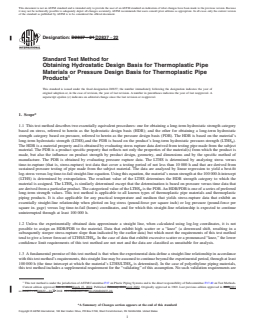
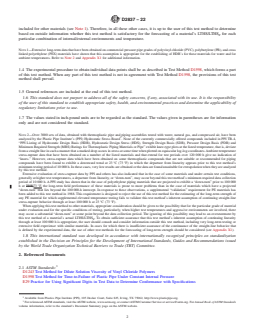
(Test Method)Standard Test Method for Obtaining Hydrostatic Design Basis for Thermoplastic Pipe Materials or Pressure Design Basis for Thermoplastic Pipe Products
General Information
- Abstract
SIGNIFICANCE AND USE
4.1 The procedure for estimating long-term hydrostatic strength or pressure-strength is essentially an extrapolation with respect to time of a stress-time or pressure-time regression line based on data obtained in accordance with Test Method D1598. Stress or pressure-failure time plots are obtained for the selected temperature and environment: the extrapolation is made in such a manner that the long-term hydrostatic strength or pressure strengthis estimated for these conditions.
Note 3: Test temperatures should preferably be selected from the following: 68 °F (20 °C), 73 °F (23 °C), 140 °F (60 °C), 176 °F (80 °C), 180 °F (82 °C), and 200 °F (93 °C). It is strongly recommended that data be generated at 73 °F (23 °C) for comparative purposes.
4.2 The hydrostatic or pressure design basis is determined by considering the following items and evaluating them in accordance with 5.4.
4.2.1 Long-term hydrostatic strength or hydrostatic pressure-strength at 100 000 h,
4.2.2 Long-term hydrostatic strength or hydrostatic pressure-strength at 50 years, and
4.2.3 Stress that will give 5 % expansion at 100 000 h.
4.2.4 The intent is to make allowance for the basic stress-strain characteristics of the material, as they relate to time.
4.3 Results obtained at one temperature cannot, with any certainty, be used to estimate values for other temperatures. Therefore, it is essential that hydrostatic or pressure design bases be determined for each specific kind and type of plastic compound and each temperature. Estimates of long-term strengths of materials can be made for a specific temperature provided that calculated values, based on experimental data, are available for temperatures both above and below the temperature of interest.
4.4 Hydrostatic design stresses are obtained by multiplying the hydrostatic design basis values by a service (design) factor.
4.5 Pressure ratings for pipe may be calculated from the hydrostatic design stress (HDS) value for the s...
SCOPE
1.1 This test method describes two essentially equivalent procedures: one for obtaining a long-term hydrostatic strength category based on stress, referred to herein as the hydrostatic design basis (HDB); and the other for obtaining a long-term hydrostatic strength category based on pressure, referred to herein as the pressure design basis (PDB). The HDB is based on the material's long-term hydrostatic strength (LTHS),and the PDB is based on the product's long-term hydrostatic pressure-strength (LTHSP). The HDB is a material property and is obtained by evaluating stress rupture data derived from testing pipe made from the subject material. The PDB is a product specific property that reflects not only the properties of the material(s) from which the product is made, but also the influence on product strength by product design, geometry, and dimensions and by the specific method of manufacture. The PDB is obtained by evaluating pressure rupture data. The LTHS is determined by analyzing stress versus time-to-rupture (that is, stress-rupture) test data that cover a testing period of not less than 10 000 h and that are derived from sustained pressure testing of pipe made from the subject material. The data are analyzed by linear regression to yield a best-fit log-stress versus log time-to-fail straight-line equation. Using this equation, the material's mean strength at the 100 000-h intercept (LTHS) is determined by extrapolation. The resultant value of the LTHS determines the HDB strength category to which the material is assigned. The LTHSP is similarly determined except that the determination is based on pressure versus time data that are derived from a particular product. The categorized value of the LTHSP is the PDB. An HDB/PDB is one of a series of preferred long-term strength values. This test method is applicable to all known types of thermoplastic pipe materials and thermoplastic piping products. It is also applicabl...
- Status
- Published
- Publication Date
- 14-Mar-2022
- Technical Committee
- F17 - Plastic Piping Systems
- Drafting Committee
- F17.40 - Test Methods
Buy Documents
ASTM D2837-22 - Standard Test Method for Obtaining Hydrostatic Design Basis for Thermoplastic Pipe Materials or Pressure Design Basis for Thermoplastic Pipe Products
REDLINE ASTM D2837-22 - Standard Test Method for Obtaining Hydrostatic Design Basis for Thermoplastic Pipe Materials or Pressure Design Basis for Thermoplastic Pipe Products
Overview
ASTM D2837-22 is a standard test method established by ASTM International for determining the Hydrostatic Design Basis (HDB) of thermoplastic pipe materials or the Pressure Design Basis (PDB) for thermoplastic pipe products. This standard is crucial for predicting the long-term performance of plastic piping materials under internal pressure and for ensuring safe and effective pressure piping system design.
The procedure assesses the long-term hydrostatic strength (LTHS) or hydrostatic pressure-strength (LTHSP) using extended-duration stress-rupture data, typically extrapolated to 100,000 hours and 50 years. By providing a scientifically validated approach, ASTM D2837-22 supports manufacturers, designers, and industry stakeholders in establishing reliable pressure ratings for thermoplastic pipes used in water, gas, and various industrial applications.
Key Topics
- Long-Term Hydrostatic Strength (LTHS): Evaluation of the material’s ability to withstand continuous internal pressure over extended periods.
- Hydrostatic Design Basis (HDB): Categorization of pipe material strength, based on 100,000-hour extrapolation of stress rupture data.
- Pressure Design Basis (PDB): Product-specific rating that factors in not just the material, but also the influence of pipe design, geometry, and manufacturing process.
- Test Procedure: Data is generated in accordance with ASTM D1598, involving sustained internal pressure tests at selected temperatures to produce failure-time plots.
- Extrapolation: Regression analysis of log-stress vs. log time-to-failure data to predict long-term strength values.
- Temperature-Specific Testing: Hydrostatic or pressure design bases must be determined at each relevant temperature, since results are not transferable across temperature ranges.
- Service (Design) Factor: Application of a safety factor to the HDB/PDB to account for manufacturing, testing, installation, and service conditions.
Applications
Industry Sectors
- Water and Gas Distribution: Ensures the safety and longevity of thermoplastic piping in municipal and utility installations.
- Industrial Piping: Used in chemical processing, mining, and other sectors where reliable pressure containment in thermoplastic piping is essential.
- Plumbing and HVAC: Supports safe design of plumbing systems and distribution networks.
Practical Uses
- Pipe Specification: Manufacturers use ASTM D2837-22 to assign HDB or PDB values to their thermoplastic pipes, supporting product labeling and product data sheets.
- Pressure Rating Calculations: Engineers use the standard to calculate maximum allowable working pressures, ensuring compliance with building codes and industry requirements.
- Product Comparison: Standardized ratings enable transparent comparison between different materials or pipe designs for informed material selection.
- Quality Assurance: The standard supports consistent product performance and long-term reliability by providing robust validation methods, including special provisions for materials like polyethylene.
Related Standards
- ASTM D1598: Test Method for Time-to-Failure of Plastic Pipe Under Constant Internal Pressure - foundational to the test data required by D2837.
- ASTM E29: Practice for Using Significant Digits in Test Data to Determine Conformance with Specifications.
- ISO 9080: International equivalent for determining long-term hydrostatic strength of thermoplastics in piping, often referenced for global compatibility.
- PPI TR-3 and TR-4: Resources from the Plastics Pipe Institute related to hydrostatic design bases, stresses, and minimum required strength ratings.
Summary
ASTM D2837-22 is a foundational standard for assessing and assigning long-term pressure ratings to thermoplastic piping materials and products. By employing rigorous hydrostatic strength testing and analysis, this method ensures safety, reliability, and performance across various applications that depend on the integrity of plastic pressure pipes. Compliance with this standard is vital for manufacturers, engineers, and specifiers in the plastic piping industry aiming for high standards of product quality and regulatory conformance.
Relations
- Refers
ASTM D1243-22e1 - Standard Test Method for Dilute Solution Viscosity of Vinyl Chloride Polymers - Effective Date
- 01-May-2022
- Effective Date
- 01-Nov-2015
- Effective Date
- 01-Oct-2014
- Effective Date
- 01-Oct-2008
- Refers
ASTM D1243-95(2008) - Standard Test Method for Dilute Solution Viscosity of Vinyl Chloride Polymers - Effective Date
- 01-Mar-2008
- Effective Date
- 01-Mar-2008
- Effective Date
- 15-Nov-2006
- Effective Date
- 15-Sep-2006
- Effective Date
- 01-May-2006
- Effective Date
- 01-Dec-2004
- Effective Date
- 10-Aug-2002
- Effective Date
- 10-May-2002
- Effective Date
- 01-Jan-2000
- Effective Date
- 01-Jan-2000
- Effective Date
- 10-May-1999
Buy Documents
ASTM D2837-22 - Standard Test Method for Obtaining Hydrostatic Design Basis for Thermoplastic Pipe Materials or Pressure Design Basis for Thermoplastic Pipe Products
REDLINE ASTM D2837-22 - Standard Test Method for Obtaining Hydrostatic Design Basis for Thermoplastic Pipe Materials or Pressure Design Basis for Thermoplastic Pipe Products
Get Certified
Connect with accredited certification bodies for this standard

DIN CERTCO
DIN Group product certification.

Smithers Quality Assessments
US management systems and product certification.
Sponsored listings
Frequently Asked Questions
ASTM D2837-22 is a standard published by ASTM International. Its full title is "Standard Test Method for Obtaining Hydrostatic Design Basis for Thermoplastic Pipe Materials or Pressure Design Basis for Thermoplastic Pipe Products". This standard covers: SIGNIFICANCE AND USE 4.1 The procedure for estimating long-term hydrostatic strength or pressure-strength is essentially an extrapolation with respect to time of a stress-time or pressure-time regression line based on data obtained in accordance with Test Method D1598. Stress or pressure-failure time plots are obtained for the selected temperature and environment: the extrapolation is made in such a manner that the long-term hydrostatic strength or pressure strengthis estimated for these conditions. Note 3: Test temperatures should preferably be selected from the following: 68 °F (20 °C), 73 °F (23 °C), 140 °F (60 °C), 176 °F (80 °C), 180 °F (82 °C), and 200 °F (93 °C). It is strongly recommended that data be generated at 73 °F (23 °C) for comparative purposes. 4.2 The hydrostatic or pressure design basis is determined by considering the following items and evaluating them in accordance with 5.4. 4.2.1 Long-term hydrostatic strength or hydrostatic pressure-strength at 100 000 h, 4.2.2 Long-term hydrostatic strength or hydrostatic pressure-strength at 50 years, and 4.2.3 Stress that will give 5 % expansion at 100 000 h. 4.2.4 The intent is to make allowance for the basic stress-strain characteristics of the material, as they relate to time. 4.3 Results obtained at one temperature cannot, with any certainty, be used to estimate values for other temperatures. Therefore, it is essential that hydrostatic or pressure design bases be determined for each specific kind and type of plastic compound and each temperature. Estimates of long-term strengths of materials can be made for a specific temperature provided that calculated values, based on experimental data, are available for temperatures both above and below the temperature of interest. 4.4 Hydrostatic design stresses are obtained by multiplying the hydrostatic design basis values by a service (design) factor. 4.5 Pressure ratings for pipe may be calculated from the hydrostatic design stress (HDS) value for the s... SCOPE 1.1 This test method describes two essentially equivalent procedures: one for obtaining a long-term hydrostatic strength category based on stress, referred to herein as the hydrostatic design basis (HDB); and the other for obtaining a long-term hydrostatic strength category based on pressure, referred to herein as the pressure design basis (PDB). The HDB is based on the material's long-term hydrostatic strength (LTHS),and the PDB is based on the product's long-term hydrostatic pressure-strength (LTHSP). The HDB is a material property and is obtained by evaluating stress rupture data derived from testing pipe made from the subject material. The PDB is a product specific property that reflects not only the properties of the material(s) from which the product is made, but also the influence on product strength by product design, geometry, and dimensions and by the specific method of manufacture. The PDB is obtained by evaluating pressure rupture data. The LTHS is determined by analyzing stress versus time-to-rupture (that is, stress-rupture) test data that cover a testing period of not less than 10 000 h and that are derived from sustained pressure testing of pipe made from the subject material. The data are analyzed by linear regression to yield a best-fit log-stress versus log time-to-fail straight-line equation. Using this equation, the material's mean strength at the 100 000-h intercept (LTHS) is determined by extrapolation. The resultant value of the LTHS determines the HDB strength category to which the material is assigned. The LTHSP is similarly determined except that the determination is based on pressure versus time data that are derived from a particular product. The categorized value of the LTHSP is the PDB. An HDB/PDB is one of a series of preferred long-term strength values. This test method is applicable to all known types of thermoplastic pipe materials and thermoplastic piping products. It is also applicabl...
SIGNIFICANCE AND USE 4.1 The procedure for estimating long-term hydrostatic strength or pressure-strength is essentially an extrapolation with respect to time of a stress-time or pressure-time regression line based on data obtained in accordance with Test Method D1598. Stress or pressure-failure time plots are obtained for the selected temperature and environment: the extrapolation is made in such a manner that the long-term hydrostatic strength or pressure strengthis estimated for these conditions. Note 3: Test temperatures should preferably be selected from the following: 68 °F (20 °C), 73 °F (23 °C), 140 °F (60 °C), 176 °F (80 °C), 180 °F (82 °C), and 200 °F (93 °C). It is strongly recommended that data be generated at 73 °F (23 °C) for comparative purposes. 4.2 The hydrostatic or pressure design basis is determined by considering the following items and evaluating them in accordance with 5.4. 4.2.1 Long-term hydrostatic strength or hydrostatic pressure-strength at 100 000 h, 4.2.2 Long-term hydrostatic strength or hydrostatic pressure-strength at 50 years, and 4.2.3 Stress that will give 5 % expansion at 100 000 h. 4.2.4 The intent is to make allowance for the basic stress-strain characteristics of the material, as they relate to time. 4.3 Results obtained at one temperature cannot, with any certainty, be used to estimate values for other temperatures. Therefore, it is essential that hydrostatic or pressure design bases be determined for each specific kind and type of plastic compound and each temperature. Estimates of long-term strengths of materials can be made for a specific temperature provided that calculated values, based on experimental data, are available for temperatures both above and below the temperature of interest. 4.4 Hydrostatic design stresses are obtained by multiplying the hydrostatic design basis values by a service (design) factor. 4.5 Pressure ratings for pipe may be calculated from the hydrostatic design stress (HDS) value for the s... SCOPE 1.1 This test method describes two essentially equivalent procedures: one for obtaining a long-term hydrostatic strength category based on stress, referred to herein as the hydrostatic design basis (HDB); and the other for obtaining a long-term hydrostatic strength category based on pressure, referred to herein as the pressure design basis (PDB). The HDB is based on the material's long-term hydrostatic strength (LTHS),and the PDB is based on the product's long-term hydrostatic pressure-strength (LTHSP). The HDB is a material property and is obtained by evaluating stress rupture data derived from testing pipe made from the subject material. The PDB is a product specific property that reflects not only the properties of the material(s) from which the product is made, but also the influence on product strength by product design, geometry, and dimensions and by the specific method of manufacture. The PDB is obtained by evaluating pressure rupture data. The LTHS is determined by analyzing stress versus time-to-rupture (that is, stress-rupture) test data that cover a testing period of not less than 10 000 h and that are derived from sustained pressure testing of pipe made from the subject material. The data are analyzed by linear regression to yield a best-fit log-stress versus log time-to-fail straight-line equation. Using this equation, the material's mean strength at the 100 000-h intercept (LTHS) is determined by extrapolation. The resultant value of the LTHS determines the HDB strength category to which the material is assigned. The LTHSP is similarly determined except that the determination is based on pressure versus time data that are derived from a particular product. The categorized value of the LTHSP is the PDB. An HDB/PDB is one of a series of preferred long-term strength values. This test method is applicable to all known types of thermoplastic pipe materials and thermoplastic piping products. It is also applicabl...
ASTM D2837-22 is classified under the following ICS (International Classification for Standards) categories: 83.140.30 - Plastics pipes and fittings for non fluid use. The ICS classification helps identify the subject area and facilitates finding related standards.
ASTM D2837-22 has the following relationships with other standards: It is inter standard links to ASTM D1243-22e1, ASTM D1598-15, ASTM D1243-14, ASTM E29-08, ASTM D1243-95(2008), ASTM D1598-02(2008), ASTM E29-06b, ASTM E29-06a, ASTM E29-06, ASTM E29-04, ASTM D1598-02, ASTM E29-02e1, ASTM D1243-95, ASTM D1243-95(2000)e1, ASTM E29-93a(1999). Understanding these relationships helps ensure you are using the most current and applicable version of the standard.
ASTM D2837-22 is available in PDF format for immediate download after purchase. The document can be added to your cart and obtained through the secure checkout process. Digital delivery ensures instant access to the complete standard document.
Standards Content (Sample)
This international standard was developed in accordance with internationally recognized principles on standardization established in the Decision on Principles for the
Development of International Standards, Guides and Recommendations issued by the World Trade Organization Technical Barriers to Trade (TBT) Committee.
Designation: D2837 − 22
Standard Test Method for
Obtaining Hydrostatic Design Basis for Thermoplastic Pipe
Materials or Pressure Design Basis for Thermoplastic Pipe
Products
This standard is issued under the fixed designation D2837; the number immediately following the designation indicates the year of
original adoption or, in the case of revision, the year of last revision.Anumber in parentheses indicates the year of last reapproval.A
superscript epsilon (´) indicates an editorial change since the last revision or reapproval.
1. Scope* stress-rupture data that exhibit an essentially straight-line
relationshipwhenplottedonlogstress(pound-forcepersquare
1.1 This test method describes two essentially equivalent
inch) or log pressure (pound-force per square in. gage) versus
procedures: one for obtaining a long-term hydrostatic strength
logtime-to-fail(hours)coordinates,andforwhichthisstraight-
category based on stress, referred to herein as the hydrostatic
line relationship is expected to continue uninterrupted through
design basis (HDB); and the other for obtaining a long-term
at least 100000 h.
hydrostatic strength category based on pressure, referred to
herein as the pressure design basis (PDB). The HDB is based 1.2 Unless the experimentally obtained data approximate a
on the material’s long-term hydrostatic strength (LTHS),and straight line, when calculated using log-log coordinates, it is
the PDB is based on the product’s long-term hydrostatic not possible to assign an HDB/PDB to the material. Data that
pressure-strength (LTHS ). The HDB is a material property exhibit high scatter or a “knee” (a downward shift, resulting in
P
and is obtained by evaluating stress rupture data derived from a subsequently steeper stress-rupture slope than indicated by
testing pipe made from the subject material. The PDB is a the earlier data) but which meet the requirements of this test
productspecificpropertythatreflectsnotonlythepropertiesof method tend to give a lower forecast of LTHS/LTHS.Inthe
P
the material(s) from which the product is made, but also the case of data that exhibit excessive scatter or a pronounced
influenceonproductstrengthbyproductdesign,geometry,and “knee,” the lower confidence limit requirements of this test
dimensions and by the specific method of manufacture. The methodarenotmetandthedataareclassifiedasunsuitablefor
PDB is obtained by evaluating pressure rupture data. The analysis.
LTHS is determined by analyzing stress versus time-to-rupture
1.3 Afundamental premise of this test method is that when
(that is, stress-rupture) test data that cover a testing period of
the experimental data define a straight-line relationship in
not less than 10000 h and that are derived from sustained
accordance with this test method’s requirements, this straight
pressure testing of pipe made from the subject material. The
line may be assumed to continue beyond the experimental
data are analyzed by linear regression to yield a best-fit
period, through at least 100000 h (the time intercept at which
log-stress versus log time-to-fail straight-line equation. Using
the material’s LTHS/LTHS is determined). In the case of
P
this equation, the material’s mean strength at the 100000-h
polyethylene piping materials, this test method includes a
intercept (LTHS) is determined by extrapolation. The resultant
supplemental requirement for the “validating” of this assump-
value of the LTHS determines the HDB strength category to
tion. No such validation requirements are included for other
which the material is assigned. The LTHS is similarly
P
materials (see Note 1). Therefore, in all these other cases, it is
determined except that the determination is based on pressure
uptotheuserofthistestmethodtodeterminebasedonoutside
versustimedatathatarederivedfromaparticularproduct.The
information whether this test method is satisfactory for the
categorized value of the LTHS is the PDB. An HDB/PDB is
P
forecasting of a material’s LTHS/LTHS for each particular
P
one of a series of preferred long-term strength values.This test
combination of internal/external environments and tempera-
method is applicable to all known types of thermoplastic pipe
ture.
materials and thermoplastic piping products. It is also appli-
NOTE 1—Extensive long-term data that have been obtained on com-
cable for any practical temperature and medium that yields
mercial pressure pipe grades of polyvinyl chloride (PVC), polybutylene
(PB), and cross linked polyethylene (PEX) materials have shown that this
assumption is appropriate for the establishing of HDB’s for these
1 materials for water and for ambient temperatures. Refer to Note 2 and
This test method is under the jurisdiction ofASTM Committee F17 on Plastic
Appendix X1 for additional information.
Piping Systems and is the direct responsibility of Subcommittee F17.40 on Test
Methods.
1.4 The experimental procedure to obtain individual data
Current edition approved March 15, 2022. Published April 2022. Originally
points shall be as described in Test Method D1598, which
approved in 1969. Last previous edition approved in 2021 as D2837–21. DOI:
10.1520/D2837-22. forms a part of this test method. When any part of this test
*A Summary of Changes section appears at the end of this standard
Copyright © ASTM International, 100 Barr Harbor Drive, PO Box C700, West Conshohocken, PA 19428-2959. United States
D2837 − 22
method is not in agreement with Test Method D1598, the 1.8 This international standard was developed in accor-
provisions of this test method shall prevail. dance with internationally recognized principles on standard-
ization established in the Decision on Principles for the
1.5 General references are included at the end of this test
Development of International Standards, Guides and Recom-
method.
mendations issued by the World Trade Organization Technical
1.6 This standard does not purport to address all of the
Barriers to Trade (TBT) Committee.
safety concerns, if any, associated with its use. It is the
responsibility of the user of this standard to establish appro-
2. Referenced Documents
priate safety, health, and environmental practices and deter-
2.1 ASTM Standards:
mine the applicability of regulatory limitations prior to use.
D1243Test Method for Dilute Solution Viscosity of Vinyl
1.7 The values stated in inch-pound units are to be regarded
Chloride Polymers
as the standard. The values given in parentheses are for
D1598Test Method for Time-to-Failure of Plastic Pipe
information only and are not considered the standard.
Under Constant Internal Pressure
NOTE 2—Over 3000 sets of data, obtained with thermoplastic pipe and
E29Practice for Using Significant Digits in Test Data to
pipingassembliestestedwithwater,naturalgas,andcompressedair,have
Determine Conformance with Specifications
been analyzed by the Plastic Pipe Institute’s (PPI) Hydrostatic Stress
2.2 ISO Standard:
Board . None of the currently commercially offered compounds included
ISO 9080Plastic Piping and Ducting Systems, Determina-
in PPI TR-4, “PPI Listing of Hydrostatic Design Basis (HDB), Hydro-
static Design Stress (HDS), Strength Design Basis (SDB), Pressure tionofLong-TermHydrostaticStrengthofThermoplastics
Design Basis (PDB) and Minimum Required Strength (MRS) Ratings for
Materials in Pipe Form by Extrapolation
Thermoplastic Piping Materials or Pipe” exhibit knee-type plots at the
2.3 Plastics Pipe Institute:
listed temperature, that is, deviate from a straight line in such a manner
PPI TR-3Policies and Procedures for Developing Hydro-
that a marked drop occurs in stress at some time when plotted on
static Design Basis (HDB), Hydrostatic Design Stresses
equiscalar log-log coordinates. Ambient temperature stress-rupture data
thathavebeenobtainedonanumberofthelistedmaterialsandthatextend
(HDS), Pressure Design Basis (PDB), Strength Design
for test periods over 120 000 h give no indication of “knees.” However,
Basis (SDB), and Minimum Required Strength (MRS)
stress-rupture data which have been obtained on some thermoplastic
Ratings for Thermoplastic Piping Materials or Pipe
compounds that are not suitable or recommended for piping compounds
PPI TR-4PPI Listing of Hydrostatic Design Basis (HDB),
havebeenfoundtoexhibitadownwardtrendat23°C(73°F)inwhichthe
Hydrostatic Design Stress (HDS), Strength Design Basis
departure from linearity appears prior to this test method’s minimum
testing period of 10000 h. In these cases, very low results are obtained or
(SDB), Pressure Design Basis (PDB) and Minimum Re-
the data are found unsuitable for extrapolation when they are analyzed by
quired Strength (MRS) Ratings for Thermoplastic Piping
this test method.
Materials or Pipe
Extensive evaluation of stress-rupture data by PPI and others has also
indicated that in the case of some materials and under certain test
3. Terminology
conditions, generally at higher test temperatures, a departure from
linearity, or “down-turn”, may occur beyond this test method’s minimum
3.1 Definitions:
required data collection period of 10000 h.APPI study has shown that in
3.1.1 failure, n—bursting, cracking, splitting, or weeping
the case of polyethylene piping materials that are projected to exhibit a
(seepage of liquid) of the pipe during test.
“down-turn” prior to 100000 h at 73°F, the long-term field performance
of these materials is prone to more problems than in the case of materials
3.1.2 hoop stress, n—thetensilestressinthewallofthepipe
which have a projected “down-turn” that lies beyond the 100000-h
in the circumferential orientation due to internal hydrostatic
intercept. In response to these observations, a supplemental “validation”
pressure.
requirement for PE materials has been added to this test method in 1988.
This requirement is designed to reject the use of this test method for the
3.1.3 hydrostatic design basis (HDB), n—one of a series of
estimating of the long-term strength of any PE material for which
established stress values for a compound. It is obtained by
supplemental elevated temperature testing fails to validate this test
categorizing the LTHS in accordance with Table 1.
method’s inherent assumption of continuing straight-line stress-rupture
behavior through at least 100000 h at 23°C (73°F).
3.1.4 hydrostatic design stress (HDS), n—the estimated
When applying this test method to other materials, appropriate consid-
maximum tensile stress the material is capable of withstanding
eration should be given to the possibility that for the particular grade of
continuously with a high degree of certainty that failure of the
material under evaluation and for the specific conditions of testing,
pipewillnotoccur.Thisstressiscircumferentialwheninternal
particularly, when higher test temperatures and aggressive environments
are involved, there may occur a substantial “down-turn” at some point hydrostatic water pressure is applied.
beyond the data collection period. The ignoring of this possibility may
3.1.5 long-term hydrostatic strength (LTHS), n—the esti-
lead to an overstatement by this test method of a material’s actual
mated tensile stress in the wall of the pipe in the circumferen-
LTHS/LTHS . To obtain sufficient assurance that this test method’s
P
inherent assumption of continuing linearity through at least 100000 h is tial orientation that when applied continuously will cause
appropriate, the user should consult and consider information outside this
failure of the pipe at 100000 h. This is the intercept of the
testmethod,includingverylong-termtestingorextensivefieldexperience
stress regression line with the 100000-h coordinate.
withsimilarmaterials.Incasesforwhichthereisinsufficientassuranceof
the continuance of the straight-line behavior that is defined by the
experimental data, the use of other test methods for the forecasting of
For referenced ASTM standards, visit the ASTM website, www.astm.org, or
long-term strength should be considered (see Appendix X1).
contact ASTM Customer Service at service@astm.org. For Annual Book of ASTM
Standards volume information, refer to the standard’s Document Summary page on
the ASTM website.
2 4
Available from Plastics Pipe Institute (PPI), 105 Decker Court, Suite 825, Available fromAmerican National Standards Institute (ANSI), 25 W. 43rd St.,
Irving, TX 75062, http://www.plasticpipe.org. 4th Floor, New York, NY 10036, http://www.ansi.org.
D2837 − 22
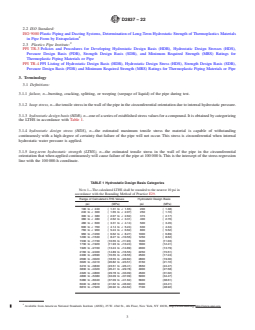
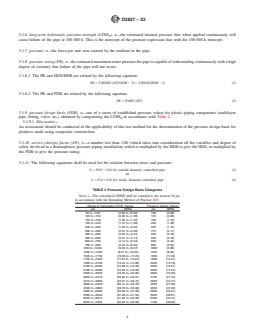
TABLE 1 Hydrostatic Design Basis Categories TABLE 2 Pressure Design Basis Categories
NOTE 1—The calculated LTHS shall be rounded to the nearest 10 psi in NOTE 1—The calculated LTHSP shall be rounded to the nearest 10 psi
accordance with the Rounding Method of Practice E29. in accordance with the Rounding Method of Practice E29.
Range of Calculated LTHS Values Hydrostatic Design Basis Range of Calculated LTHS Values Pressure Design Values
P
psi (MPa) psi (MPA)
psi (MPa) psi (MPa)
96 to <120 (0.66 to <0.82) 100 (0.68)
190 to < 240 ( 1.31 to < 1.65) 200 ( 1.38)
120 to <153 (0.82 to <1.05) 125 (0.86)
240 to < 300 ( 1.65 to < 2.07) 250 ( 1.72)
153 to <190 (1.05 to <1.32) 160 (1.10)
300 to < 380 ( 2.07 to < 2.62) 315 ( 2.17)
190 to <240 (1.31 to <1.65) 200 (1.38)
380 to < 480 ( 2.62 to < 3.31) 400 ( 2.76)
240 to <300 (1.65 to <2.07) 250 (1.72)
480 to < 600 ( 3.31 to < 4.14) 500 ( 3.45)
300 to <380 (2.07 to <2.62) 315 (2.17)
600 to < 760 ( 4.14 to < 5.24) 630 ( 4.34)
380 to <480 (2.62 to <3.31) 400 (2.76)
760 to < 960 ( 5.24 to < 6.62) 800 ( 5.52)
480 to <600 (3.31 to <4.14) 500 (3.45)
960 to <1200 ( 6.62 to < 8.27) 1000 ( 6.89)
600 to <760 (4.14 to <5.24) 630 (4.34)
1200 to <1530 ( 8.27 to <10.55) 1250 ( 8.62)
760 to <960 (5.24 to <6.62) 800 (5.52)
1530 to <1730 (10.55 to <11.93) 1600 (11.03)
960 to <1200 (6.62 to <8.27) 1000 (6.89)
1730 to <1920 (11.93 to <13.24) 1800 (12.41)
1200 to <1530 (8.27 to <10.55) 1250 (8.62)
1920 to <2160 (13.24 to <14.89) 2000 (13.79)
1530 to <1730 (10.55 to <11.93) 1600 (11.03)
2160 to <2400 (14.89 to <16.55) 2250 (15.51)
1730 to <1920 (11.93 to <13.24) 1800 (12.41)
2400 to <2690 (16.55 to <18.55) 2500 (17.24)
1920 to <2160 (13.24 to <14.89) 2000 (13.79)
2690 to <3020 (18.55 to <20.82) 2800 (19.30)
2160 to <2400 (14.89 to <16.55) 2250 (15.51)
3020 to <3410 (20.82 to <23.51) 3150 (21.72)
2400 to <2690 (16.55 to <18.55) 2500 (17.24)
3410 to <3830 (23.51 to <26.41) 3550 (24.47)
2690 to <3020 (18.55 to <20.82) 2800 (19.30)
3830 to <4320 (26.41 to <29.78) 4000 (27.58)
3020 to <3410 (20.82 to <23.51) 3150 (21.72)
4320 to <4800 (29.78 to <33.09) 4500 (31.02)
3410 to <3830 (23.51 to <26.41) 3550 (24.47)
4800 to <5380 (33.09 to <37.09) 5000 (34.47)
3830 to <4320 (26.41 to <29.78) 4000 (27.58)
5380 to <6040 (37.09 to <41.62) 5600 (38.61)
4320 to <4800 (29.78 to <33.09) 4500 (31.02)
6040 to <6810 (41.62 to <46.92) 6300 (43.41)
4800 to <5380 (33.09 to <37.09) 5000 (34.47)
6810 to <7920 (46.92 to <54.62) 7100 (48.92)
5380 to <6040 (37.09 to <41.62) 5600 (38.61)
6040 to <6810 (41.62 to <46.92) 6300 (43.41)
6810 to <7920 (46.92 to <54.62) 7100 (48.92)
3.1.6 long-term hydrostatic pressure-strength (LTHS ),
P
n—the estimated internal pressure that when applied continu-
3.1.11 Thefollowingequationsshallbeusedfortherelation
ously will cause failure of the pipe at 100 000 h. This is the
between stress and pressure:
intercept of the pressure regression line with the 100 000-h
S 5 P~D 2 t!/2t for outsidediameter controlled pipe (3)
intercept.
or
3.1.7 pressure, n—the force per unit area exerted by the
S 5 P d1t /2t for inside diametercontrolled pipe (4)
~ !
medium in the pipe.
where:
3.1.8 pressure rating (PR), n—the estimated maximum wa-
S = stress,
ter pressure the pipe is capable of withstanding continuously
P = pressure,
with a high degree of certainty that failure of the pipe will not
D = average outside diameter,
occur.
d = average inside diameter, and
3.1.8.1 The PR and HDS/HDB are related by the following
t = minimum wall thickness.
equation.
PR 5 2 ~HDB!~DF!/~SDR 2 1! 5 2 ~HDS!/~SDR 2 1! (1) 4. Significance and Use
4.1 The procedure for estimating long-term hydrostatic
3.1.8.2 The PR and PDB are related by the following
strength or pressure-strength is essentially an extrapolation
equation:
withrespecttotimeofastress-timeorpressure-timeregression
PR 5 PDB DF (2)
~ !~ !
line based on data obtained in accordance with Test Method
3.1.9 pressure design basis (PDB), n—one of a series of
D1598. Stress or pressure-failure time plots are obtained for
established pressure values for plastic piping components
the selected temperature and environment: the extrapolation is
(multilayer pipe, fitting, valve, etc.) obtained by categorizing
made in such a manner that the long-term hydrostatic strength
the LTHS in accordance with Table 2.
or pressure strengthis estimated for these conditions.
P
3.1.9.1 Discussion—An assessment should be conducted of
NOTE 3—Test temperatures should preferably be selected from the
theapplicabilityofthistestmethodforthedeterminationofthe
following: 68°F (20°C), 73°F (23°C), 140°F (60°C), 176°F (80°C),
pressure design basis for products made using composite
180°F (82°C), and 200°F (93°C). It is strongly recommended that data
construction. be generated at 73°F (23°C) for comparative purposes.
3.1.10 service (design) factor (DF), n—a number less than 4.2 The hydrostatic or pressure design basis is determined
1.00 (which takes into consideration all the variables and by considering the following items and evaluating them in
degree of safety involved in a thermoplastic pressure piping accordance with 5.4.
installation) which is multiplied by the HDB to give the HDS, 4.2.1 Long-term hydrostatic strength or hydrostatic
or multiplied by the PDB to give the pressure rating. pressure-strength at 100000 h,
D2837 − 22
4.2.2 Long-term hydrostatic strength or hydrostatic islessthanthehoursthespecimenhasbeenundertest,thenuse
pressure-strength at 50 years, and the point. Determine the final line for extrapolation by the
4.2.3 Stress that will give 5% expansion at 100000 h. method of least squares using the failure points along with
4.2.4 The intent is to make allowance for the basic stress- those non-failure points selected by the method described
strain characteristics of the material, as they relate to time. above. Unless it can be demonstrated that they are part of the
same regression line, do not use failure points for stresses or
4.3 Results obtained at one temperature cannot, with any
pressures that have failure times less than 10 h. Include failure
certainty, be used to estimate values for other temperatures.
points excluded from the calculation by this operation in the
Therefore, it is essential that hydrostatic or pressure design
report, and identify them as being in this category. Refer also
bases be determined for each specific kind and type of plastic
to Appendix 9.
compound and each temperature. Estimates of long-term
strengths of materials can be made for a specific temperature
NOTE5—Itshouldbenotedthatcontrarytothecustominmathematics,
it has been the practice of those testing plastics pipe to plot the
provided that calculated values, based on experimental data,
independent variable (stress) on the vertical (y) axis and the dependent
are available for temperatures both above and below the
variable (time-to-failure) on the horizontal (x) axis. The procedure in
temperature of interest.
Appendix X2 treats stress as an independent variable.
4.4 Hydrostatic design stresses are obtained by multiplying
5.2.3 Determine the suitability of the data for use in
thehydrostaticdesignbasisvaluesbyaservice(design)factor.
determining the long-term hydrostatic strength or hydrostatic
4.5 Pressure ratings for pipe may be calculated from the
pressure-strength and hydrostatic or pressure design basis of
hydrostatic design stress (HDS) value for the specific material
plastic pipe as follows:
used to make the pipe, and its dimensions using the equations
5.2.3.1 Extrapolate the data by the method given in Appen-
in 3.1.11.
dix X2, to 100000 h and 50 years, and record the extrapolated
4.5.1 Pressure ratings for multilayer pipe may be calculated
stress or pressure values (4.2.1 and 4.2.2), and
by multiplying the pressure design basis (PDB) by the appro-
5.2.3.2 Calculate, by the method given in Appendix X3, the
priate design factor (DF).
lower confidence value of stress at 100 000 h.
5.2.3.3 If the lower confidence value at 100 000 h differs
5. Procedure
from the extrapolated LTHS/LTHS value by more than 15%
P
5.1 General—Generated data in accordance with Test
of the latter, or M in Appendix X3 is zero or negative, or b in
Method D1598.
theequation h= a+ bfinAppendixX2ispositive,considerthe
data unsuitable.
5.2 Stress Rupture—Obtain the data required for 4.2.1 and
4.2.2 as follows:
5.3 Circumferential Expansion—Obtain the data required
5.2.1 Obtain a minimum of 18 failure stress/pressure-time
for 4.2.3 as follows:
points for each environment. Distribute these data points as
5.3.1 Initially test at least three specimens at a stress of
follows:
50% of the long-term hydrostatic strength determined in
Hours Failure Points
5.2.3.1 until the circumferential expansion exceeds 5% or for
<1000 At least 6
2000 h, whichever occurs first. Measure the expansion of the
10 to 1000 At least 3
1000 to 6000 At least 3 circumferenceinthecenterofthatsectionofthepipespecimen
After 6000 At least 3
thatisundertesttothenearest0.02mm(0.001in.)periodically
After 10 000 At least 1
(Note 6) during the test, unless the expansion at some other
NOTE 4—When the long-term stress regression line of a compound is
point is greater, in which case measure the section with the
known, this method may be used, using fewer points and shorter times, to
maximum expansion. Calculate the changes in circumference
confirm material characteristics, or to evaluate minor process or formu-
for each specimen as a percentage of the initial outside
lation changes. See also PPI TR-3, “Policies and Procedures for Devel-
oping HDB, SDB, PDB, and MRS Ratings for Thermoplastic Piping circumference. Calculate the expansion at 100 000 h for each
Materials or Pipe.”
specimen by the method given in Appendix X4 or by the
plotting technique described in 5.3.3. If the calculated expan-
5.2.2 Analyze the test results by using, for each specimen,
sionforoneormoreofthespecimenstestedexceeds5%,then
the logarithm of the stress in psi or pressure in psig and the
use the hydrostatic stress as determined from circumferential
logarithm of the time-to-failure in hours as described in
expansion measurements as the stress value to be categorized
Appendix X2 (Note 5). Calculate the strength at 100 000 h.
to establish the hydrostatic design basis.
Includeasfailuresattheconclusionofthetestthosespecimens
which have not failed after being under test for more than
NOTE 6—It is suggested that these measurements be made once every
10000hiftheyincreasethevalueoftheextrapolatedstrength.
24 h during the first 5 days, once every 3 days during the next 6 days, and
Accomplish this by first obtaining the linear log-log regression once a week thereafter. The periods shall be selected on the basis of past
experiencewiththetypeofpipesothattheywillbereasonablydistributed
equation for only the specimens that failed, by the method of
to obtain a good plot.
least squares as described in Appendix X2.Then use the stress
inpsiorpressureinpsigforeachspecimenthathasbeenunder 5.3.2 The stresses and distribution of specimens used to
test for more than 10 000 h, and that has not failed, with this determine hydrostatic stress from circumferential expansion
regression equation to calculate the time in hours. If this time measurements shall be as follows:
D2837 − 22
the manufacturing and testing variables, specifically normal
Approximate Percent of Long-Term Minimum Number of
Hydrostatic Strength (see 5.2) Specimens
variations in the material, manufacture, dimensions, good
20 3
handling techniques, and in the evaluation procedures in this
30 3
test method and in Test Method D1598 (Note 8). The second
40 3
50 3
groupconsiderstheapplicationoruse,specificallyinstallation,
60 3
environment, temperature, hazard involved, life expectancy
Subject the specimens to test until the circumferential
desired, and the degree of reliability selected (Note 9). Select
expansion exceeds 5% or for 2000 h, whichever occurs first.
the service factor so that the hydrostatic design stress obtained
5.3.3 Theresultsmaybecalculatedbythemethodsgivenin
provides a service life for an indefinite period beyond the
Appendix X4 and Appendix X5 or plotted by the following
actual test period.
procedures. Plot the percent changes in circumference against
NOTE 8—Experience to date, based on data submitted to PPI, indicates
time in hours on log-log graph paper. Draw a straight line by
that variation due to this group of conditions are usually within 610%,
the method of least squares, with time as the independent
for any specific compound.
variable as described in Appendix X4. Calculate the expansion
NOTE 9—It is not the intent of this standard to give service (design)
ofthecircumferenceinpercentat100000hforeachspecimen
factors. The service (design) factor should be selected by the design
by the equation from Appendix X4: engineer after evaluating fully the service conditions and the engineering
properties of the specific plastics under consideration. Alternatively, it
c 5 a'15.00 b' (5)
may be specified by the authority having jurisdiction.
It is recommended that numbers selected from ANSI Standard Z17.1-
Do not use extrapolations of curves for specimens that
1973forPreferredNumbers,intheR10series(25%increments)beused,
expandmorethan5%inlessthan1000h.Plotthecorrespond-
namely, 0.80, 0.63, 0.50, 0.40, 0.32, 0.25, 0.20, 0.16, 0.12, or 0.10. If
ing expansion-stress points from the 100000 h intercept on
smallerstepsseemnecessaryitisrecommendedthattheR20series(12%
increments)beused,namely,0.90,0.80,0.71,0.63,0.56,0.50,0.45,0.40,
log-log graph paper and draw a line representative of these
0.36, 0.32, 0.28, 0.25, 0.22, 0.20, 0.18, 0.16, 0.14, 0.12, 0.112, or 0.10.
points by the method of least squares with stress as the
independent variable as described in Appendix X5.
5.6 Determination or Validation of the HDB for Polyethyl-
5.3.4 Calculatethestresscorrespondingtoacircumferential
ene Materials, or Both—Apply any of the following proce-
expansion of 5.00% in accordance with 5.3.3 and Appendix dures to PE material to validate its HDB at any temperature.
X5. The stress is the antilog of r in the equation c5a"1b" r in
When an elevated temperature HDB is validated, all lower
Appendix X5. Use the values for a" and b" as calculated in temperature HDB’s are considered validated for that material.
Appendix X5 and 0.6990 for c.This stress may be obtained by
If a brittle failure occurs before 10000 h when testing in
calculation or read from the circumferential expansion-stress accordance with 5.2, theAlternate Method (Procedure I) shall
plot obtained in 5.3.3. In cases of disagreement, use the
be used. Procedure I may also be used to determine the HDB
calculation procedure. at elevated temperatures for some PE materials.
5.6.1 Alternate Method Procedure I:
5.4 Hydrostatic Design Basis—The procedure for determin-
5.6.1.1 Develop stress rupture data in accordance with 5.2
ing the HDB shall be as follows (see also Appendix X8):
forthetemperatureatwhichanHDBisdesired.Usingonlythe
5.4.1 Calculate the hydrostatic strength at 100 000 h
ductile failures, determine the linear regression equation. The
(LTHS) in accordance with 5.2.
failure point data must be spread over at least two log decades.
5.4.2 Calculate the hydrostatic strength at 50 years in
The stress intercept at 100000-h using this equation is the
accordance with 5.2.3.1.
“ductile” LTHS.
5.4.3 Estimate the long-term hydrostatic strength using
5.6.1.2 To determine the brittle failure performance, solve
expansion test data and in accordance with 5.3.
forthethreecoefficientsoftherateprocessmethodequationas
NOTE 7—For all the presently used stress rated thermoplastic pipe
follows:
materials in North America, the 5% expansion strengths are not the
(1)Select an elevated temperature appropriate for the
limiting factor. Therefore, this measurement is not required for such
polyethylene material. The maximum temperature chosen
materials.
should not be greater than 95°C (203°F).
5.4.4 Determine the hydrostatic design basis (HDB) by
(2)Select a stress at this temperature at which all failures
categorizing, in accordance with Table 1, the applicable hy-
occurinthebrittlemode(acrackthroughthepipewallwithno
drostatic strength value as specified below:
5.4.4.1 UsetheLTHSvalue(5.4.1)ifitislessthan125%of
the 50-year value (5.4.2), and less than the expansion strength
value (5.4.3).
TABLE 3 Validation of 73 °F (23 °C) HDB
5.4.4.2 Use the 50-year value if it is less than 80% of the
HDB to be 193 °F (90 °C) Test Temperature / 176 °F (80 °C) Test
LTHS value, and less than the expansion strength value.
Validated (psi) Temperature
5.4.4.3 Usetheexpansionstrengthvalueifitislessthanthe
Stress (psi) Time (h) Stress (psi) Time (h)
1600 735 70 825 200
LTHS and 50-year values.
1250 575 70 645 200
5.5 Hydrostatic Design Stress—Obtain the hydrostatic de- 1000 460 70 515 200
800 365 70 415 200
sign stress by multiplying the hydrostatic design basis by a
630 290 70 325 200
service (design) factor selected for the application on the basis
500 230 70 260 200
of two general groups of conditions. The first group considers
D2837 − 22
TABLE 4 Validation of 100 °F (38 °C) HDB
T = absolute temperature, °K (K=C+273),
HDB to be 193 °F (90 °C) Test Temperature /
S = hoop stress, psi, and
Validated (psi) 176 °F (80 °C) Test Temperature
A, B, C = constants.
Stress (psi) Time (h) Stress (psi) Time (h)
(6) Usingthismodel,calculatethestressinterceptvalueat
1600 850 300 960 1000
1250 670 300 750 1000
100000 h for the temperature at which the HDB is desired.
1000 600 300 600 1000
This resulting stress intercept is the “brittle” LTHS.
800 535 300 480 1000
NOTE 10—The ISO 9080 four coefficient model may be used if it has
630 340 300 380 1000
a better statistical fit to the data.
500 265 300 300 1000
5.6.1.3 Use the lower value of the ductile failure LTHS (see
5.6.1.1) or the brittle failure LTHS (see 5.6.1.2) to determine
TABLE 5 Validation of 120 °F (49 °C) HDB
the HDB category per Table 1 for this PE material. The HDB
HDB to be 193 °F (90 °C) Test Temperature /
determined by this procedure is considered validated.
Validated (psi) 176 °F (80 °C) Test Temperature
5.6.2 Standard Method (Procedure II)—The HDB for a PE
Stress (psi) Time (h) Stress (psi) Time (h)
material at a desired temperature is validated when the follow-
1600 970 1100 1090 3400
1250 760 1100 850 3400
ing criterion is met:
1000 610 1100 685 3400
5.6.2.1 Develop stress rupture data in accordance with 5.2
800 490 1100 545 3400
630 385 1100 430 3400 for the temperature at which an HDB is desired. Analyze the
500 305 1100 345 3400
data to determine the linear regression equation. Extrapolate
this equation to 100000 h to determine the LTHS. Use Table 1
to determine the HDB category at this temperature.
TABLE 6 Validation of 140 °F (60 °C) HDB
5.6.2.2 Use Tables 3-7 to define the time and stress require-
HDB to be 193 °F (90 °C) Test Temperature /
ments needed to validate this HDB.Test at least six specimens
Validated (psi) 176 °F (80 °C) Test Temperature
at the stress level determined by the tables. These specimens
Stress (psi) Time (h) Stress (psi) Time (h)
1250 860 3800 970 11300
must have a minimum log average time exceeding the value
1000 690 3800 775 11300
shown in the table to validate the HDB. For example, to
800 550 3800 620 11300
validate an HDB of 1000 psi at 140°F (60°C), this required
630 435 3800 490 11300
500 345 3800 390 11300
time is 3800 h at 193°F (90°C)⁄690 psi or 11300 h at 176°F
400 275 3800 310 11300
(80°C)⁄775 psi.
5.6.2.3 If a temperature/stress condition in the tables results
in a premature ductile failure for a particular PE material, the
TABLE 7 Validation of 160 °F (71 °C) HDB
stress at that temperature may be lowered by 15%. The
HDB to be 193 °F (90 °C) Test Temperature /
corresponding required time for this lowered stress is then six
Validated (psi) 176 °F (80 °C) Test Temperature
times the value in the table. For example, when validating an
Stress (psi) Time (h) Stress (psi) Time (h)
1250 975 12600 1100 37500
HDB of 1600 psi at 73°F, if testing at 80°C⁄825 psi results in
1000 780 12600 885 37500
ductile failures, lower the stress to 700 psi and retest. The
800 625 12600 705 37500
630 495 12600 550 37500 required time to validate using this condition is now 1200 h. If
500 390 12600 440 37500
ductilefailuresstilloccur,thestressmaybeloweredto595psi
400 315 12600 350 37500
and the corresponding time is increased to 7200 h.
5.6.3 Rate Process Method (Procedure III)—If there are no
brittle failures before 10 000 h when developing the data
according to 5.2, this rate process method may be used to
visible evidence of material deformation).This set of tempera-
validate the HDB.
ture and stress is called Condition I. Test at least six pipe
5.6.3.1 Develop data for the brittle failure performance as
specimens at this Condition I until failure.
described in 5.6.1.2, except use the data from Condition I,
(3)At the same temperature, select another stress about 75
Condition II, and the LTHS value at 100 000 h determined
to 150 psi lower than for Condition I. Test at least six pipe
from the linear regression model to calculate the A, B, and C
specimens at this Condition II until failure.
coefficients for the rate process model.
(4)Select a temperature 10°C (18°F) to 20°C (36°F)
5.6.3.2 Using this model, calculate the mean estimated
lower than the one in Condition I and use the same stress as
failure time for the temperature and stress used in Condition
Condition I. This is Condition III. Test at least six pipe
III. When the average time (log basis) for the six specimens
specimens at this Condition III until failure.
tested at Condition III has reached this time, the extrapolation
(5)Using all these brittle failure data points from Condi-
to100000htoobtaintheLTHShasbeenvalidated.(Examples
tions I, II, and III, calculate theA, B, and C coefficients for the
are shown in Appendix X9.)
following three-coefficient rate process method equation:
5.6.4 ISO 9080 Based Method for Validation of 140 °F
B ClogS
(60 °C) HDB (Procedure IV)—With some PE compounds the
logt 5 A1 1 (6)
T T
where: For additional information contact the Plastics Pipe Institute Hydrostatic Stress
Board Chairman, 105 Decker Court, Suite 825, Irving, TX 75062, http://
t = time, h,
www.plasticpipe.org
D2837 − 22
NOTE 11—The Long-Term Hydrostatic Strength at 50 years (LTHS50)
rate process method may result in very long test times to
is not to be used for pressure rating calculations. The maximum stress is
generate brittle failures. This method may also be used to
stillcalculatedusingtheHDB(withtheappropriatedesignservicefactors)
validateaHDBat140°F(60°C).Itcannotbeusedifthereare
obtained from the LTHS at 100000 h. PE materials meeting this
brittle failures before 10 000 h when developing the data
additional substantiation of the 73°F (23°C) extrapolation shall be
according to 5.2 to establish the HDB at 140°F.
denoted by an asterisk (*) in PPI TR-4.
5.6.4.1 Develop a linear regression according to 5.2 based
5.8 Pressure Rating—Calculate the pressure rating for each
on ductile stress-rupture data at either 80°C or 90°C. Use
diameterandwallthicknessofpipefromthehydrostaticdesign
Table 8 to determine the appropriate data level for the
stress(hydrostaticdesignbasis×servicefactor)forthespecific
temperature to be validated. The regression data must satisfy
material in the pipe by means of the equations in 3.1.11.
the following requirements:
5.9 Pressure Design Basis—The procedure for determining
(1)The 97.5% LCL ratio for these data must be greater
the PDB shall be as follows:
than 90%.
5.9.1 Calculate the hydrostatic pressure-strength at 100 000
(2)Non-failed specimens at the longest running times may
h (LTHS ) in accordance with 5.2.
P
be included in the regression provided their inclusion does not
5.9.2 Calculate the hydrostatic pressure-strength at 50 years
decrease the LTHS (see 5.2.2).
in accordance with 5.2.3.1.
5.6.4.2 The log average of the five longest running times
5.9.3 Determine the pressure design basis (PDB) by
(used in the regression) must exceed the minimum time t
max
categorizing, in accordance with Table 2, the applicable hy-
indicated in Table 8 to validate the HDB at 140°F (60°C)
drostatic pressure-strength value as specified below:
(Example shown in Appendix X9).
5.9.4 Use the LTHS value (5.9.1) if it is less than 125 % of
P
5.7 Substantiation of the HDB for Polyethylene Materials—
the 50-year value (5.9.2).
When it is desired to show that a PE material has additional
5.9.4.1 Use the 50-year value if it is less than 80 % of the
ductile performance capacity than is required by validation of
LTHSP value.
the73°F(23°C)time/stresscurveto100000hours,oneofthe
following three procedures may be used to further substantiate
6. Report
thatthestressregressioncurveislineartothe50year(438000
6.1 The report shall include the following:
h) intercept.
6.1.1 Complete identification of the sample, including ma-
5.7.1 If the HDB at 140°F (60°C) or higher temperature
terialtype,source,manufacturer’snameandcodenumber,and
has been validated by 5.6.2 or 5.6.4, then linear extrapolation
previous significant history, if any,
of the 73°F (23°C) stress regression curve to 50 years
6.1.2 Pipe dimensions including nominal size, average and
(438000 h) is substantiated.
minimum wall thickness, and average outside diameter,
5.7.2 If the HDB at 73°F (23°C) has been validated by
6.1.3 Test temperature,
5.6.3,usethetwelvedatapointsfromConditionIandII,along
6.1.4 Test environment inside and outside of the pipe,
with the 50 year (438000 h) intercept value, to solve for the
6.1.5 Atable of the stresses in pounds-force per square inch
three-coefficient rate process extrapolation equation. Then
or pressures in pounds-force per square inch gage and the
usingthisnewmodel,calculatethemeanestimatedfailuretime
time-to-failureinhoursforallthespecimenstested.Specimens
forConditionIII.Whenthelogaveragetimeforsixspecimens
thataredesignatedasfailuresaftertheyhavebeenunderstress
tested at Condition III has reached this time, linear extrapola-
or pressure for more than 10000 h shall be indicated,
tion of the 73°F (23°C) stress regression curve to 50 years
6.1.6 The estimated long-term hydrostatic strength or
(438000 hours) is substantiated.
pressure-strength,
5.7.3 If the HDB at 73°F (23°C) has been validated by
6.1.7 The estimated stress at 50 years,
5.6.2, linear extrapolation of the stress regression curve to 50
6.1.8 A table of the percent circumferential expansion
years (438000 hours) is substantiated when the log average
versus time data and the estimated stress at 5.00% expansion.
failure time of six test specimens at 176°F (80°C) surpasses
Thisitemneednotbereportedifprevioustestresultsshowthat
6000 h, or at 193°F (90°C) surpasses 2400 h at a stress of no
the stress calculated for 5% expansion is significantly greater
more than 100 psi below where all failures are ductile. A
than that reported in 6.1.6 or 6.1.7, or for PDB values.
ductile failure reference stress shall be established by 3
6.1.9 The hydrostatic design basis or pressure design basis,
specimens all failing in the ductile mode at the same tempera-
6.1.10 The nature of each of the failures observed shall be
ture.
included in the table of stresses or pressures and times-to-
failurementionedin6.1.5(referto3.1.1forfailuretypes,other
descriptors may also be used),
TABLE 8 Validation of HDB at 140 °F
6.1.11 Any unusual behavior observed in the tests, as well
193 °F (90 °C) 176 °F (80 °C)
as any data for specimens that were not included in the
Temperature to be Regression Regression
regression analysis in a separate table and the reason why they
validated °F Data Min Data Min.
A B A B
Level .t Level t
were excluded (for example: nonfailure/on-test, stopped
max max
140 °F E-6 5500 E-10+ 17 000
testing, equipment problems, less than 10 h or not part of
(60 °C)
regression),
A
Per data interval requirements in PPI TR-3.
B 6.1.12 If the material is polyethylene, the results of the
t = log average of 5 longest test times (included in regression)
max
validation in accordance with 5.6,
D2837 − 22
6.1.13 Dates of test, and design basis since the result merely states whether there is
6.1.14 Name of laboratory and supervisor of the tests. conformance to the criteria for success specified in the proce-
dure.
7. Precision and Bias
7.1 No statement is made about either the precision or the
bias of Test Method D2837 for measuring the hydrostatic
APPENDIXES
(Nonmandatory Information)
X1. METHODOLOGY FOR THE FORECASTING OF THE LONGER-TERM HYDROSTATIC STRENGTH OF THERMOPLAS-
TIC PIPING MATERIALS IN CONSIDERATION OF THE NATURE OF THEIR STRESS-RUPTURE BEHAVIOR
X1.1 Similartowhathasbeenobservedformetalsathigher is a gradual “downturn,” or a relatively sharp “knee”) in the
temperatures, the stress-rupture data obtained on thermoplas- slope of the initially defined stress-rupture line. In such cases,
tics piping materials generally yields a relatively straight line the stress-rupture data can best be characterized by means of
when plotted on log stress versus log time-to-fail coordinates. twostraightlines:aninitiallineoffairlyflatslope;followedby
By means of regression analysis, such straight-line behavior a second line of steeper slope. The change in slope from the
can readily be represented by a mathematical equation. Using firsttothesecondlinecanbeminimal,inwhichcasethestress
this equation, the long-term strength of a material for a time rupture behavior is generally sufficiently well-characterized by
under load much beyond the longest time over which the data a single average line; or, the change can be significant, in
were obtained can be determined by extrapolation. This which case, it is more accurately represented by two straight
straight-linebehaviorhasbeenobservedtoholdtruefornearly lines, each with a different slope (see Fig. X1.1). Should there
all plastic piping materials, provided failures always occur by occur a significant downward trend in slope, the extrapolation
the same mechanism. However, it has also been observed that of the trend solely defined by the earlier stage of stress-rupture
when the cause of failure transitions from one mechanism to behavior may result in an excessive overestimation of a
another, that is, from failure caused by excessive ductile material’sactualLTHS.Foramoreaccurateforecast,itshould
deformation to a failure resulting by the initiation and growth be made based on the trend exhibited by the second straight
of a crack, this may result in a significant downward shift (that line, a trend that may not always be evidenced by the data
FIG. X1.1 Schematic of the Stress-Rupture Characteristics of a Material Which Exhibits Two Stages in Stress-Rupture Properties, and of
the Shift in the Stress-Rupture Lines that Results by Increasing the Test Temperature.
D2837 − 22
collected during the minimum testing period of 10000 h, as thermoplastic piping materials that are chemically and physi-
required by this test method. cally similar to the material of interest. Another kind is very
extensive field experience with specific kinds and grades of
X1.2 Studies conducted on polyolefin pipes indicate that,
materials. For example, as previously mentioned, it is well-
exclusiveofpotentialeffectsofpolymerchemicaldegradation,
established both through testing and very extensive experience
or aging, that may occur in consequence of the effects of
that rigid PVC piping materials which have been formulated
environments that are aggressive to the polymer, stress-rupture
usingPVCresinsofcertainminimummolecularweightexhibit
failurescanoccurovertwostages.Inthefirststage,failuresare
no “downturn” at ambient temperatures through at least
ofaductilenature,but,inthesecond,theyaretheconsequence
100000 h when tested using water or air as the pressure
of the initiation an
...
This document is not an ASTM standard and is intended only to provide the user of an ASTM standard an indication of what changes have been made to the previous version. Because
it may not be technically possible to adequately depict all changes accurately, ASTM recommends that users consult prior editions as appropriate. In all cases only the current version
of the standard as published by ASTM is to be considered the official document.
Designation: D2837 − 21 D2837 − 22
Standard Test Method for
Obtaining Hydrostatic Design Basis for Thermoplastic Pipe
Materials or Pressure Design Basis for Thermoplastic Pipe
Products
This standard is issued under the fixed designation D2837; the number immediately following the designation indicates the year of
original adoption or, in the case of revision, the year of last revision. A number in parentheses indicates the year of last reapproval. A
superscript epsilon (´) indicates an editorial change since the last revision or reapproval.
1. Scope*
1.1 This test method describes two essentially equivalent procedures: one for obtaining a long-term hydrostatic strength category
based on stress, referred to herein as the hydrostatic design basis (HDB); and the other for obtaining a long-term hydrostatic
strength category based on pressure, referred to herein as the pressure design basis (PDB). The HDB is based on the material’s
long-term hydrostatic strength (LTHS),and the PDB is based on the product’s long-term hydrostatic pressure-strength (LTHS ).
P
The HDB is a material property and is obtained by evaluating stress rupture data derived from testing pipe made from the subject
material. The PDB is a product specific property that reflects not only the properties of the material(s) from which the product is
made, but also the influence on product strength by product design, geometry, and dimensions and by the specific method of
manufacture. The PDB is obtained by evaluating pressure rupture data. The LTHS is determined by analyzing stress versus
time-to-rupture (that is, stress-rupture) test data that cover a testing period of not less than 10 000 h and that are derived from
sustained pressure testing of pipe made from the subject material. The data are analyzed by linear regression to yield a best-fit
log-stress versus log time-to-fail straight-line equation. Using this equation, the material’s mean strength at the 100 000-h intercept
(LTHS) is determined by extrapolation. The resultant value of the LTHS determines the HDB strength category to which the
material is assigned. The LTHS is similarly determined except that the determination is based on pressure versus time data that
P
are derived from a particular product. The categorized value of the LTHS is the PDB. An HDB/PDB is one of a series of preferred
P
long-term strength values. This test method is applicable to all known types of thermoplastic pipe materials and thermoplastic
piping products. It is also applicable for any practical temperature and medium that yields stress-rupture data that exhibit an
essentially straight-line relationship when plotted on log stress (pound-force per square inch) or log pressure (pound-force per
square in. gage) versus log time-to-fail (hours) coordinates, and for which this straight-line relationship is expected to continue
uninterrupted through at least 100 000 h.
1.2 Unless the experimentally obtained data approximate a straight line, when calculated using log-log coordinates, it is not
possible to assign an HDB/PDB to the material. Data that exhibit high scatter or a “knee” (a downward shift, resulting in a
subsequently steeper stress-rupture slope than indicated by the earlier data) but which meet the requirements of this test method
tend to give a lower forecast of LTHS/LTHS . In the case of data that exhibit excessive scatter or a pronounced “knee,” the lower
P
confidence limit requirements of this test method are not met and the data are classified as unsuitable for analysis.
1.3 A fundamental premise of this test method is that when the experimental data define a straight-line relationship in accordance
with this test method’s requirements, this straight line may be assumed to continue beyond the experimental period, through at least
100 000 h (the time intercept at which the material’s LTHS/LTHS is determined). In the case of polyethylene piping materials,
P
this test method includes a supplemental requirement for the “validating” of this assumption. No such validation requirements are
This test method is under the jurisdiction of ASTM Committee F17 on Plastic Piping Systems and is the direct responsibility of Subcommittee F17.40 on Test Methods.
Current edition approved Feb. 1, 2021March 15, 2022. Published February 2021April 2022. Originally approved in 1969. Last previous edition approved in 20132021
ɛ1
as D2837 – 13D2837 – 21. . DOI: 10.1520/D2837-21.10.1520/D2837-22.
*A Summary of Changes section appears at the end of this standard
Copyright © ASTM International, 100 Barr Harbor Drive, PO Box C700, West Conshohocken, PA 19428-2959. United States
D2837 − 22
included for other materials (see Note 1). Therefore, in all these other cases, it is up to the user of this test method to determine
based on outside information whether this test method is satisfactory for the forecasting of a material’s LTHS/LTHS for each
P
particular combination of internal/external environments and temperature.
NOTE 1—Extensive long-term data that have been obtained on commercial pressure pipe grades of polyvinyl chloride (PVC), polybutylene (PB), and cross
linked polyethylene (PEX) materials have shown that this assumption is appropriate for the establishing of HDB’s for these materials for water and for
ambient temperatures. Refer to Note 2 and Appendix X1 for additional information.
1.4 The experimental procedure to obtain individual data points shall be as described in Test Method D1598, which forms a part
of this test method. When any part of this test method is not in agreement with Test Method D1598, the provisions of this test
method shall prevail.
1.5 General references are included at the end of this test method.
1.6 This standard does not purport to address all of the safety concerns, if any, associated with its use. It is the responsibility
of the user of this standard to establish appropriate safety, health, and environmental practices and determine the applicability of
regulatory limitations prior to use.
1.7 The values stated in inch-pound units are to be regarded as the standard. The values given in parentheses are for information
only and are not considered the standard.
NOTE 2—Over 3000 sets of data, obtained with thermoplastic pipe and piping assemblies tested with water, natural gas, and compressed air, have been
analyzed by the Plastic Pipe Institute’s (PPI) Hydrostatic Stress Board . None of the currently commercially offered compounds included in PPI TR-4,
“PPI Listing of Hydrostatic Design Basis (HDB), Hydrostatic Design Stress (HDS), Strength Design Basis (SDB), Pressure Design Basis (PDB) and
Minimum Required Strength (MRS) Ratings for Thermoplastic Piping Materials or Pipe” exhibit knee-type plots at the listed temperature, that is, deviate
from a straight line in such a manner that a marked drop occurs in stress at some time when plotted on equiscalar log-log coordinates. Ambient temperature
stress-rupture data that have been obtained on a number of the listed materials and that extend for test periods over 120 000 h give no indication of
“knees.” However, stress-rupture data which have been obtained on some thermoplastic compounds that are not suitable or recommended for piping
compounds have been found to exhibit a downward trend at 23 °C (73 °F) in which the departure from linearity appears prior to this test method’s
minimum testing period of 10 000 h. In these cases, very low results are obtained or the data are found unsuitable for extrapolation when they are analyzed
by this test method.
Extensive evaluation of stress-rupture data by PPI and others has also indicated that in the case of some materials and under certain test conditions,
generally at higher test temperatures, a departure from linearity, or “down-turn”, may occur beyond this test method’s minimum required data collection
period of 10 000 h. A PPI study has shown that in the case of polyethylene piping materials that are projected to exhibit a “down-turn” prior to 100 000
h at 73°F,73 °F, the long-term field performance of these materials is prone to more problems than in the case of materials which have a projected
“down-turn” that lies beyond the 100 000-h intercept. In response to these observations, a supplemental “validation” requirement for PE materials has
been added to this test method in 1988. This requirement is designed to reject the use of this test method for the estimating of the long-term strength of
any PE material for which supplemental elevated temperature testing fails to validate this test method’s inherent assumption of continuing straight-line
stress-rupture behavior through at least 100 000 h at 23 °C (73 °F).
When applying this test method to other materials, appropriate consideration should be given to the possibility that for the particular grade of material
under evaluation and for the specific conditions of testing, particularly, when higher test temperatures and aggressive environments are involved, there
may occur a substantial “down-turn” at some point beyond the data collection period. The ignoring of this possibility may lead to an overstatement by
this test method of a material’s actual LTHS/LTHS . To obtain sufficient assurance that this test method’s inherent assumption of continuing linearity
P
through at least 100 000 h is appropriate, the user should consult and consider information outside this test method, including very long-term testing or
extensive field experience with similar materials. In cases for which there is insufficient assurance of the continuance of the straight-line behavior that
is defined by the experimental data, the use of other test methods for the forecasting of long-term strength should be considered (see Appendix X1).
1.8 This international standard was developed in accordance with internationally recognized principles on standardization
established in the Decision on Principles for the Development of International Standards, Guides and Recommendations issued
by the World Trade Organization Technical Barriers to Trade (TBT) Committee.
2. Referenced Documents
2.1 ASTM Standards:
D1243 Test Method for Dilute Solution Viscosity of Vinyl Chloride Polymers
D1598 Test Method for Time-to-Failure of Plastic Pipe Under Constant Internal Pressure
E29 Practice for Using Significant Digits in Test Data to Determine Conformance with Specifications
Available from Plastics Pipe Institute (PPI), 105 Decker Court, Suite 825, Irving, TX 75062, http://www.plasticpipe.org.
For referenced ASTM standards, visit the ASTM website, www.astm.org, or contact ASTM Customer Service at service@astm.org. For Annual Book of ASTM Standards
volume information, refer to the standard’s Document Summary page on the ASTM website.
D2837 − 22
2.2 ISO Standard:
ISO 9080 Plastic Piping and Ducting Systems, Determination of Long-Term Hydrostatic Strength of Thermoplastics Materials
in Pipe Form by Extrapolation
2.3 Plastics Pipe Institute:
PPI TR-3 Policies and Procedures for Developing Hydrostatic Design Basis (HDB), Hydrostatic Design Stresses (HDS),
Pressure Design Basis (PDB), Strength Design Basis (SDB), and Minimum Required Strength (MRS) Ratings for
Thermoplastic Piping Materials or Pipe
PPI TR-4 PPI Listing of Hydrostatic Design Basis (HDB), Hydrostatic Design Stress (HDS), Strength Design Basis (SDB),
Pressure Design Basis (PDB) and Minimum Required Strength (MRS) Ratings for Thermoplastic Piping Materials or Pipe
3. Terminology
3.1 Definitions:
3.1.1 failure, n—bursting, cracking, splitting, or weeping (seepage of liquid) of the pipe during test.
3.1.2 hoop stress, n—the tensile stress in the wall of the pipe in the circumferential orientation due to internal hydrostatic pressure.
3.1.3 hydrostatic design basis (HDB), n—one of a series of established stress values for a compound. It is obtained by categorizing
the LTHS in accordance with Table 1.
3.1.4 hydrostatic design stress (HDS), n—the estimated maximum tensile stress the material is capable of withstanding
continuously with a high degree of certainty that failure of the pipe will not occur. This stress is circumferential when internal
hydrostatic water pressure is applied.
3.1.5 long-term hydrostatic strength (LTHS), n—the estimated tensile stress in the wall of the pipe in the circumferential
orientation that when applied continuously will cause failure of the pipe at 100 000 h. This is the intercept of the stress regression
line with the 100 000-h coordinate.
TABLE 1 Hydrostatic Design Basis Categories
NOTE 1—The calculated LTHS shall be rounded to the nearest 10 psi in
accordance with the Rounding Method of Practice E29.
Range of Calculated LTHS Values Hydrostatic Design Basis
psi (MPa) psi (MPa)
190 to < 240 ( 1.31 to < 1.65) 200 ( 1.38)
240 to < 300 ( 1.65 to < 2.07) 250 ( 1.72)
300 to < 380 ( 2.07 to < 2.62) 315 ( 2.17)
380 to < 480 ( 2.62 to < 3.31) 400 ( 2.76)
480 to < 600 ( 3.31 to < 4.14) 500 ( 3.45)
600 to < 760 ( 4.14 to < 5.24) 630 ( 4.34)
760 to < 960 ( 5.24 to < 6.62) 800 ( 5.52)
960 to <1200 ( 6.62 to < 8.27) 1000 ( 6.89)
1200 to <1530 ( 8.27 to <10.55) 1250 ( 8.62)
1530 to <1730 (10.55 to <11.93) 1600 (11.03)
1730 to <1920 (11.93 to <13.24) 1800 (12.41)
1920 to <2160 (13.24 to <14.89) 2000 (13.79)
2160 to <2400 (14.89 to <16.55) 2250 (15.51)
2400 to <2690 (16.55 to <18.55) 2500 (17.24)
2690 to <3020 (18.55 to <20.82) 2800 (19.30)
3020 to <3410 (20.82 to <23.51) 3150 (21.72)
3410 to <3830 (23.51 to <26.41) 3550 (24.47)
3830 to <4320 (26.41 to <29.78) 4000 (27.58)
4320 to <4800 (29.78 to <33.09) 4500 (31.02)
4800 to <5380 (33.09 to <37.09) 5000 (34.47)
5380 to <6040 (37.09 to <41.62) 5600 (38.61)
6040 to <6810 (41.62 to <46.92) 6300 (43.41)
6810 to <7920 (46.92 to <54.62) 7100 (48.92)
Available from American National Standards Institute (ANSI), 25 W. 43rd St., 4th Floor, New York, NY 10036, http://www.ansi.org.http://www.ansi.org.
D2837 − 22
3.1.6 long-term hydrostatic pressure-strength (LTHS ), n—the estimated internal pressure that when applied continuously will
P
cause failure of the pipe at 100 000 h. This is the intercept of the pressure regression line with the 100 000-h intercept.
3.1.7 pressure, n—the force per unit area exerted by the medium in the pipe.
3.1.8 pressure rating (PR), n—the estimated maximum water pressure the pipe is capable of withstanding continuously with a high
degree of certainty that failure of the pipe will not occur.
3.1.8.1 The PR and HDS/HDB are related by the following equation.
PR 5 2 ~HDB! ~DF!/~SDR 2 1!5 2 ~HDS!/~SDR 2 1! (1)
3.1.8.2 The PR and PDB are related by the following equation:
PR 5 ~PDB! ~DF! (2)
3.1.9 pressure design basis (PDB), n—one of a series of established pressure values for plastic piping components (multilayer
pipe, fitting, valve, etc.) obtained by categorizing the LTHS in accordance with Table 2.
P
3.1.9.1 Discussion—
An assessment should be conducted of the applicability of this test method for the determination of the pressure design basis for
products made using composite construction.
3.1.10 service (design) factor (DF), n—a number less than 1.00 (which takes into consideration all the variables and degree of
safety involved in a thermoplastic pressure piping installation) which is multiplied by the HDB to give the HDS, or multiplied by
the PDB to give the pressure rating.
3.1.11 The following equations shall be used for the relation between stress and pressure:
S 5 P D 2t /2t for outside diameter controlled pipe (3)
~ !
or
S 5 P~d1t!/2t for inside diameter controlled pipe (4)
TABLE 2 Pressure Design Basis Categories
NOTE 1—The calculated LTHSP shall be rounded to the nearest 10 psi
in accordance with the Rounding Method of Practice E29.
Range of Calculated LTHS Values Pressure Design Values
P
psi (MPa) psi (MPA)
96 to <120 (0.66 to <0.82) 100 (0.68)
120 to <153 (0.82 to <1.05) 125 (0.86)
153 to <190 (1.05 to <1.32) 160 (1.10)
190 to <240 (1.31 to <1.65) 200 (1.38)
240 to <300 (1.65 to <2.07) 250 (1.72)
300 to <380 (2.07 to <2.62) 315 (2.17)
380 to <480 (2.62 to <3.31) 400 (2.76)
480 to <600 (3.31 to <4.14) 500 (3.45)
600 to <760 (4.14 to <5.24) 630 (4.34)
760 to <960 (5.24 to <6.62) 800 (5.52)
960 to <1200 (6.62 to <8.27) 1000 (6.89)
1200 to <1530 (8.27 to <10.55) 1250 (8.62)
1530 to <1730 (10.55 to <11.93) 1600 (11.03)
1730 to <1920 (11.93 to <13.24) 1800 (12.41)
1920 to <2160 (13.24 to <14.89) 2000 (13.79)
2160 to <2400 (14.89 to <16.55) 2250 (15.51)
2400 to <2690 (16.55 to <18.55) 2500 (17.24)
2690 to <3020 (18.55 to <20.82) 2800 (19.30)
3020 to <3410 (20.82 to <23.51) 3150 (21.72)
3410 to <3830 (23.51 to <26.41) 3550 (24.47)
3830 to <4320 (26.41 to <29.78) 4000 (27.58)
4320 to <4800 (29.78 to <33.09) 4500 (31.02)
4800 to <5380 (33.09 to <37.09) 5000 (34.47)
5380 to <6040 (37.09 to <41.62) 5600 (38.61)
6040 to <6810 (41.62 to <46.92) 6300 (43.41)
6810 to <7920 (46.92 to <54.62) 7100 (48.92)
D2837 − 22
where:
S = stress,
P = pressure,
D = average outside diameter,
d = average inside diameter, and
t = minimum wall thickness.
4. Significance and Use
4.1 The procedure for estimating long-term hydrostatic strength or pressure-strength is essentially an extrapolation with respect
to time of a stress-time or pressure-time regression line based on data obtained in accordance with Test Method D1598. Stress or
pressure-failure time plots are obtained for the selected temperature and environment: the extrapolation is made in such a manner
that the long-term hydrostatic strength or pressure strengthis estimated for these conditions.
NOTE 3—Test temperatures should preferably be selected from the following: 68 °F (20 °C), 73 °F (23 °C), 140 °F (60 °C), 176 °F (80 °C), 180 °F
(82 °C), and 200 °F (93 °C). It is strongly recommended that data be generated at 73 °F (23 °C) for comparative purposes.
4.2 The hydrostatic or pressure design basis is determined by considering the following items and evaluating them in accordance
with 5.4.
4.2.1 Long-term hydrostatic strength or hydrostatic pressure-strength at 100 000 h,
4.2.2 Long-term hydrostatic strength or hydrostatic pressure-strength at 50 years, and
4.2.3 Stress that will give 5 % expansion at 100 000 h.
4.2.4 The intent is to make allowance for the basic stress-strain characteristics of the material, as they relate to time.
4.3 Results obtained at one temperature cannot, with any certainty, be used to estimate values for other temperatures. Therefore,
it is essential that hydrostatic or pressure design bases be determined for each specific kind and type of plastic compound and each
temperature. Estimates of long-term strengths of materials can be made for a specific temperature provided that calculated values,
based on experimental data, are available for temperatures both above and below the temperature of interest.
4.4 Hydrostatic design stresses are obtained by multiplying the hydrostatic design basis values by a service (design) factor.
4.5 Pressure ratings for pipe may be calculated from the hydrostatic design stress (HDS) value for the specific material used to
make the pipe, and its dimensions using the equations in 3.1.11.
4.5.1 Pressure ratings for multilayer pipe may be calculated by multiplying the pressure design basis (PDB) by the appropriate
design factor (DF).
5. Procedure
5.1 General—Generated data in accordance with Test Method D1598.
5.2 Stress Rupture—Obtain the data required for 4.2.1 and 4.2.2 as follows:
5.2.1 Obtain a minimum of 18 failure stress/pressure-time points for each environment. Distribute these data points as follows:
Hours Failure Points
<1000 At least 6
10 to 1000 At least 3
1000 to 6000 At least 3
After 6000 At least 3
After 10 000 At least 1
NOTE 4—When the long-term stress regression line of a compound is known, this method may be used, using fewer points and shorter times, to confirm
D2837 − 22
material characteristics, or to evaluate minor process or formulation changes. See also PPI TR-3, “Policies and Procedures for Developing HDB, SDB,
PDB, and MRS Ratings for Thermoplastic Piping Materials or Pipe.”
5.2.2 Analyze the test results by using, for each specimen, the logarithm of the stress in psi or pressure in psig and the logarithm
of the time-to-failure in hours as described in Appendix X2 (Note 5). Calculate the strength at 100 000 h. Include as failures at
the conclusion of the test those specimens which have not failed after being under test for more than 10 000 h if they increase the
value of the extrapolated strength. Accomplish this by first obtaining the linear log-log regression equation for only the specimens
that failed, by the method of least squares as described in Appendix X2. Then use the stress in psi or pressure in psig for each
specimen that has been under test for more than 10 000 h, and that has not failed, with this regression equation to calculate the
time in hours. If this time is less than the hours the specimen has been under test, then use the point. Determine the final line for
extrapolation by the method of least squares using the failure points along with those non-failure points selected by the method
described above. Unless it can be demonstrated that they are part of the same regression line, do not use failure points for stresses
or pressures that have failure times less than 10 h. Include failure points excluded from the calculation by this operation in the
report, and identify them as being in this category. Refer also to Appendix 9.
NOTE 5—It should be noted that contrary to the custom in mathematics, it has been the practice of those testing plastics pipe to plot the independent
variable (stress) on the vertical (y) axis and the dependent variable (time-to-failure) on the horizontal (x) axis. The procedure in Appendix X2 treats stress
as an independent variable.
5.2.3 Determine the suitability of the data for use in determining the long-term hydrostatic strength or hydrostatic pressure-
strength and hydrostatic or pressure design basis of plastic pipe as follows:
5.2.3.1 Extrapolate the data by the method given in Appendix X2, to 100 000 h and 50 years, and record the extrapolated stress
or pressure values (4.2.1 and 4.2.2), and
5.2.3.2 Calculate, by the method given in Appendix X3, the lower confidence value of stress at 100 000 h.
5.2.3.3 If the lower confidence value at 100 000 h differs from the extrapolated LTHS/LTHS value by more than 15 % of the
P
latter, or M in Appendix X3 is zero or negative, or b in the equation h = a + bf in Appendix X2 is positive, consider the data
unsuitable.
5.3 Circumferential Expansion—Obtain the data required for 4.2.3 as follows:
5.3.1 Initially test at least three specimens at a stress of 50 % of the long-term hydrostatic strength determined in 5.2.3.1 until the
circumferential expansion exceeds 5 % or for 2000 h, whichever occurs first. Measure the expansion of the circumference in the
center of that section of the pipe specimen that is under test to the nearest 0.02 mm (0.001 in.) periodically (Note 6) during the
test, unless the expansion at some other point is greater, in which case measure the section with the maximum expansion. Calculate
the changes in circumference for each specimen as a percentage of the initial outside circumference. Calculate the expansion at
100 000 h for each specimen by the method given in Appendix X4 or by the plotting technique described in 5.3.3. If the calculated
expansion for one or more of the specimens tested exceeds 5 %, then use the hydrostatic stress as determined from circumferential
expansion measurements as the stress value to be categorized to establish the hydrostatic design basis.
NOTE 6—It is suggested that these measurements be made once every 24 h during the first 5 days, once every 3 days during the next 6 days, and once
a week thereafter. The periods shall be selected on the basis of past experience with the type of pipe so that they will be reasonably distributed to obtain
a good plot.
5.3.2 The stresses and distribution of specimens used to determine hydrostatic stress from circumferential expansion measure-
ments shall be as follows:
Approximate Percent of Long-Term Minimum Number of
Hydrostatic Strength (see 5.2) Specimens
20 3
30 3
40 3
50 3
60 3
Subject the specimens to test until the circumferential expansion exceeds 5 % or for 2000 h, whichever occurs first.
5.3.3 The results may be calculated by the methods given in Appendix X4 and Appendix X5 or plotted by the following
D2837 − 22
procedures. Plot the percent changes in circumference against time in hours on log-log graph paper. Draw a straight line by the
method of least squares, with time as the independent variable as described in Appendix X4. Calculate the expansion of the
circumference in percent at 100 000 h for each specimen by the equation from Appendix X4:
c 5 a'15.00 b' (5)
Do not use extrapolations of curves for specimens that expand more than 5 % in less than 1000 h. Plot the corresponding
expansion-stress points from the 100 000 h intercept on log-log graph paper and draw a line representative of these points by the
method of least squares with stress as the independent variable as described in Appendix X5.
5.3.4 Calculate the stress corresponding to a circumferential expansion of 5.00 % in accordance with 5.3.3 and Appendix X5. The
stress is the antilog of r in the equation c5a"1b" r in Appendix X5. Use the values for a" and b" as calculated in Appendix X5
and 0.6990 for c. This stress may be obtained by calculation or read from the circumferential expansion-stress plot obtained in
5.3.3. In cases of disagreement, use the calculation procedure.
5.4 Hydrostatic Design Basis—The procedure for determining the HDB shall be as follows (see also Appendix X8):
5.4.1 Calculate the hydrostatic strength at 100 000 h (LTHS) in accordance with 5.2.
5.4.2 Calculate the hydrostatic strength at 50 years in accordance with 5.2.3.1.
5.4.3 Estimate the long-term hydrostatic strength using expansion test data and in accordance with 5.3.
NOTE 7—For all the presently used stress rated thermoplastic pipe materials in North America, the 5 % expansion strengths are not the limiting factor.
Therefore, this measurement is not required for such materials.
5.4.4 Determine the hydrostatic design basis (HDB) by categorizing, in accordance with Table 1, the applicable hydrostatic
strength value as specified below:
5.4.4.1 Use the LTHS value (5.4.1) if it is less than 125 % of the 50-year value (5.4.2), and less than the expansion strength value
(5.4.3).
5.4.4.2 Use the 50-year value if it is less than 80 % of the LTHS value, and less than the expansion strength value.
5.4.4.3 Use the expansion strength value if it is less than the LTHS and 50-year values.
5.5 Hydrostatic Design Stress—Obtain the hydrostatic design stress by multiplying the hydrostatic design basis by a service
(design) factor selected for the application on the basis of two general groups of conditions. The first group considers the
manufacturing and testing variables, specifically normal variations in the material, manufacture, dimensions, good handling
techniques, and in the evaluation procedures in this test method and in Test Method D1598 (Note 8). The second group considers
the application or use, specifically installation, environment, temperature, hazard involved, life expectancy desired, and the degree
of reliability selected (Note 9). Select the service factor so that the hydrostatic design stress obtained provides a service life for
an indefinite period beyond the actual test period.
NOTE 8—Experience to date, based on data submitted to PPI, indicates that variation due to this group of conditions are usually within 610 %, for any
specific compound.
NOTE 9—It is not the intent of this standard to give service (design) factors. The service (design) factor should be selected by the design engineer after
evaluating fully the service conditions and the engineering properties of the specific plastics under consideration. Alternatively, it may be specified by
the authority having jurisdiction.
It is recommended that numbers selected from ANSI Standard Z17.1-1973 for Preferred Numbers, in the R10 series (25 % increments) be used, namely,
0.80, 0.63, 0.50, 0.40, 0.32, 0.25, 0.20, 0.16, 0.12, or 0.10. If smaller steps seem necessary it is recommended that the R20 series (12 % increments) be
used, namely, 0.90, 0.80, 0.71, 0.63, 0.56, 0.50, 0.45, 0.40, 0.36, 0.32, 0.28, 0.25, 0.22, 0.20, 0.18, 0.16, 0.14, 0.12, 0.112, or 0.10.
5.6 Determination or Validation of the HDB for Polyethylene Materials, or Both—Apply any of the following procedures to PE
material to validate its HDB at any temperature. When an elevated temperature HDB is validated, all lower temperature HDB’s
are considered validated for that material. If a brittle failure occurs before 10 000 h when testing in accordance with 5.2, the
Alternate Method (Procedure I) shall be used. Procedure I may also be used to determine the HDB at elevated temperatures for
some PE materials.
D2837 − 22
TABLE 3 Validation of 73 °F (23 °C) HDB
HDB to be 193 °F (90 °C) Test Temperature / 176 °F (80 °C) Test
Validated (psi) Temperature
Stress (psi) Time (h) Stress (psi) Time (h)
1600 735 70 825 200
1250 575 70 645 200
1000 460 70 515 200
800 365 70 415 200
630 290 70 325 200
500 230 70 260 200
TABLE 4 Validation of 100 °F (38 °C) HDB
HDB to be 193 °F (90 °C) Test Temperature /
Validated (psi) 176 °F (80 °C) Test Temperature
Stress (psi) Time (h) Stress (psi) Time (h)
1600 850 300 960 1000
1250 670 300 750 1000
1000 600 300 600 1000
800 535 300 480 1000
630 340 300 380 1000
500 265 300 300 1000
TABLE 5 Validation of 120 °F (49 °C) HDB
HDB to be 193 °F (90 °C) Test Temperature /
Validated (psi) 176 °F (80 °C) Test Temperature
Stress (psi) Time (h) Stress (psi) Time (h)
1600 970 1100 1090 3400
1250 760 1100 850 3400
1000 610 1100 685 3400
800 490 1100 545 3400
630 385 1100 430 3400
500 305 1100 345 3400
TABLE 6 Validation of 140 °F (60 °C) HDB
HDB to be 193 °F (90 °C) Test Temperature /
Validated (psi) 176 °F (80 °C) Test Temperature
Stress (psi) Time (h) Stress (psi) Time (h)
1250 860 3800 970 11300
1000 690 3800 775 11300
800 550 3800 620 11300
630 435 3800 490 11300
500 345 3800 390 11300
400 275 3800 310 11300
TABLE 7 Validation of 160 °F (71 °C) HDB
HDB to be 193 °F (90 °C) Test Temperature /
Validated (psi) 176 °F (80 °C) Test Temperature
Stress (psi) Time (h) Stress (psi) Time (h)
1250 975 12600 1100 37500
1000 780 12600 885 37500
800 625 12600 705 37500
630 495 12600 550 37500
500 390 12600 440 37500
400 315 12600 350 37500
5.6.1 Alternate Method Procedure I:
5.6.1.1 Develop stress rupture data in accordance with 5.2 for the temperature at which an HDB is desired. Using only the ductile
failures, determine the linear regression equation. The failure point data must be spread over at least two log decades. The stress
intercept at 100 000-h using this equation is the “ductile” LTHS.
5.6.1.2 To determine the brittle failure performance, solve for the three coefficients of the rate process method equation as follows:
D2837 − 22
(1) Select an elevated temperature appropriate for the polyethylene material. The maximum temperature chosen should not be
greater than 95 °C (203 °F).
(2) Select a stress at this temperature at which all failures occur in the brittle mode (a crack through the pipe wall with no
visible evidence of material deformation). This set of temperature and stress is called Condition I. Test at least six pipe specimens
at this Condition I until failure.
(3) At the same temperature, select another stress about 75 to 150 psi lower than for Condition I. Test at least six pipe
specimens at this Condition II until failure.
(4) Select a temperature 10 °C (18 °F) to 20 °C (36 °F) lower than the one in Condition I and use the same stress as Condition
I. This is Condition III. Test at least six pipe specimens at this Condition III until failure.
(5) Using all these brittle failure data points from Conditions I, II, and III, calculate the A, B, and C coefficients for the
following three-coefficient rate process method equation:
B ClogS
logt 5 A1 1 (6)
T T
where:
t = time, h,
T = absolute temperature, °K (K = C + 273),
S = hoop stress, psi, and
A, B, C = constants.
(6) Using this model, calculate the stress intercept value at 100 000 h for the temperature at which the HDB is desired. This
resulting stress intercept is the “brittle” LTHS.
NOTE 10—The ISO 9080 four coefficient model may be used if it has a better statistical fit to the data.
5.6.1.3 Use the lower value of the ductile failure LTHS (see 5.6.1.1) or the brittle failure LTHS (see 5.6.1.2) to determine the HDB
category per Table 1 for this PE material. The HDB determined by this procedure is considered validated.
5.6.2 Standard Method (Procedure II)—The HDB for a PE material at a desired temperature is validated when the following
criterion is met:
5.6.2.1 Develop stress rupture data in accordance with 5.2 for the temperature at which an HDB is desired. Analyze the data to
determine the linear regression equation. Extrapolate this equation to 100 000 h to determine the LTHS. Use Table 1 to determine
the HDB category at this temperature.
5.6.2.2 Use Tables 3-7 to define the time and stress requirements needed to validate this HDB. Test at least six specimens at the
stress level determined by the tables. These specimens must have a minimum log average time exceeding the value shown in the
table to validate the HDB. For example, to validate an HDB of 1000 psi at 140 °F (60 °C), this required time is 3800 h at 193 °F
(90 °C) ⁄690 psi or 11 300 h at 176 °F (80 °C) ⁄775 psi.
5.6.2.3 If a temperature/stress condition in the tables results in a premature ductile failure for a particular PE material, the stress
at that temperature may be lowered by 15 %. The corresponding required time for this lowered stress is then six times the value
in the table. For example, when validating an HDB of 1600 psi at 73 °F, if testing at 80 °C ⁄825 psi results in ductile failures, lower
the stress to 700 psi and retest. The required time to validate using this condition is now 1200 h. If ductile failures still occur, the
stress may be lowered to 595 psi and the corresponding time is increased to 7200 h.
5.6.3 Rate Process Method (Procedure III)—If there are no brittle failures before 10 000 h when developing the data according
to 5.2, this rate process method may be used to validate the HDB.
5.6.3.1 Develop data for the brittle failure performance as described in 5.6.1.2, except use the data from Condition I, Condition
II, and the LTHS value at 100 000 h determined from the linear regression model to calculate the A, B, and C coefficients for the
rate process model.
5.6.3.2 Using this model, calculate the mean estimated failure time for the temperature and stress used in Condition III. When the
average time (log basis) for the six specimens tested at Condition III has reached this time, the extrapolation to 100 000 h to obtain
the LTHS has been validated. (Examples are shown in Appendix X9.)
For additional information contact the Plastics Pipe Institute Hydrostatic Stress Board Chairman, 105 Decker Court, Suite 825, Irving, TX 75062, http://
www.plasticpipe.org
D2837 − 22
5.6.4 ISO 9080 Based Method for Validation of 140°F (60°C)140 °F (60 °C) HDB (Procedure IV)—With some PE compounds the
rate process method may result in very long test times to generate brittle failures. This method may also be used to validate a HDB
at 140 °F (60 °C). It can not be used if there are brittle failures before 10 000 h when developing the data according to 5.2 to
establish the HDB at 140°F.
5.6.4.1 Develop a linear regression according to 5.2 based on ductile stress-rupture data at either 80 °C or 90 °C. Use Table 8 to
determine the appropriate data level for the temperature to be validated. The regression data must satisfy the following
requirements:
(1) The 97.5 % LCL ratio for these data must be greater than 90 %.
(2) Non-failed specimens at the longest running times may be included in the regression provided their inclusion does not
decrease the LTHS (see 5.2.2).
5.6.4.2 The log average of the five longest running times (used in the regression) must exceed the minimum time t indicated
max
in Table 8 to validate the HDB at 140 °F (60 °C) (Example shown in Appendix X9).
5.7 Substantiation of the HDB for Polyethylene Materials—When it is desired to show that a PE material has additional ductile
performance capacity than is required by validation of the 73 °F (23 °C) time/stress curve to 100 000 hours, one of the following
three procedures may be used to further substantiate that the stress regression curve is linear to the 50 year (438 000 h) intercept.
5.7.1 If the HDB at 140 °F (60 °C) or higher temperature has been validated by 5.6.2 or 5.6.4, then linear extrapolation of the
73 °F (23 °C) stress regression curve to 50 years (438 000 h) is substantiated.
5.7.2 If the HDB at 73 °F (23 °C) has been validated by 5.6.3, use the twelve data points from Condition I and II, along with the
50 year (438 000 h) intercept value, to solve for the three-coefficient rate process extrapolation equation. Then using this new
model, calculate the mean estimated failure time for Condition III. When the log average time for six specimens tested at Condition
III has reached this time, linear extrapolation of the 73 °F (23 °C) stress regression curve to 50 years (438 000 hours) is
substantiated.
5.7.3 If the HDB at 73 °F (23 °C) has been validated by 5.6.2, linear extrapolation of the stress regression curve to 50 years
(438 000 hours) is substantiated when the log average failure time of six test specimens at 176 °F (80 °C) surpasses 6000 h, or at
193 °F (90 °C) surpasses 2400 h at a stress of no more than 100 psi below where all failures are ductile. A ductile failure reference
stress shall be established by 3 specimens all failing in the ductile mode at the same temperature.
NOTE 11—The Long-Term Hydrostatic Strength at 50 years (LTHS50) is not to be used for pressure rating calculations. The maximum stress is still
calculated using the HDB (with the appropriate design service factors) obtained from the LTHS at 100 000 h. PE materials meeting this additional
substantiation of the 73 °F (23 °C) extrapolation shall be denoted by an asterisk (*) in PPI TR-4.
5.8 Pressure Rating—Calculate the pressure rating for each diameter and wall thickness of pipe from the hydrostatic design stress
(hydrostatic design basis × service factor) for the specific material in the pipe by means of the equations in 3.1.11.
5.9 Pressure Design Basis—The procedure for determining the PDB shall be as follows:
5.9.1 Calculate the hydrostatic pressure-strength at 100 000 h (LTHS ) in accordance with 5.2.
P
5.9.2 Calculate the hydrostatic pressure-strength at 50 years in accordance with 5.2.3.1.
TABLE 8 Validation of HDB at 140°F140 °F
193 °F (90 °C) 176 °F (80 °C)
Temperature to be Regression Regression
validated °F Data Min Data Min.
A B A B
Level . t Level t
max max
140°F E-6 5500 E-10+ 17 000
(60°C)
140 °F E-6 5500 E-10+ 17 000
(60 °C)
A
Per data interval requirements in PPI TR-3.
B
t = log average of 5 longest test times (included in regression)
max
D2837 − 22
5.9.3 Determine the pressure design basis (PDB) by categorizing, in accordance with Table 2, the applicable hydrostatic
pressure-strength value as specified below:
5.9.4 Use the LTHS value (5.9.1) if it is less than 125 % of the 50-year value (5.9.2).
P
5.9.4.1 Use the 50-year value if it is less than 80 % of the LTHSP value.
6. Report
6.1 The report shall include the following:
6.1.1 Complete identification of the sample, including material type, source, manufacturer’s name and code number, and previous
significant history, if any,
6.1.2 Pipe dimensions including nominal size, average and minimum wall thickness, and average outside diameter,
6.1.3 Test temperature,
6.1.4 Test environment inside and outside of the pipe,
6.1.5 A table of the stresses in pounds-force per square inch or pressures in pounds-force per square inch gage and the
time-to-failure in hours for all the specimens tested. Specimens that are designated as failures after they have been under stress
or pressure for more than 10 000 h shall be indicated,
6.1.6 The estimated long-term hydrostatic strength or pressure-strength,
6.1.7 The estimated stress at 50 years,
6.1.8 A table of the percent circumferential expansion versus time data and the estimated stress at 5.00 % expansion. This item
need not be reported if previous test results show that the stress calculated for 5 % expansion is significantly greater than that
reported in 6.1.6 or 6.1.7, or for PDB values.
6.1.9 The hydrostatic design basis or pressure design basis,
6.1.10 The nature of each of the failures observed shall be included in the table of stresses or pressures and times-to-failure
mentioned in 6.1.5 (refer to 3.1.1 for failure types, other descriptors may also be used),
6.1.11 Any unusual behavior observed in the tests, as well as any data for specimens that were not included in the regression
analysis in a separate table and the reason why they were excluded (for example: nonfailure/on-test, stopped testing, equipment
problems, less than 10 h or not part of regression),
6.1.12 If the material is polyethylene, the results of the validation in accordance with 5.6,
6.1.13 Dates of test, and
6.1.14 Name of laboratory and supervisor of the tests.
7. Precision and Bias
7.1 No statement is made about either the precision or the bias of Test Method D2837 for measuring the hydrostatic design basis
since the result merely states whether there is conformance to the criteria for success specified in the procedure.
D2837 − 22
APPENDIXES
(Nonmandatory Information)
X1. METHODOLOGY FOR THE FORECASTING OF THE LONGER-TERM HYDROSTATIC STRENGTH OF THERMOPLAS-
TIC PIPING MATERIALS IN CONSIDERATION OF THE NATURE OF THEIR STRESS-RUPTURE BEHAVIOR
X1.1 Similar to what has been observed for metals at higher temperatures, the stress-rupture data obtained on thermoplastics
piping materials generally yields a relatively straight line when plotted on log stress versus log time-to-fail coordinates. By means
of regression analysis, such straight-line behavior can readily be represented by a mathematical equation. Using this equation, the
long-term strength of a material for a time under load much beyond the longest time over which the data were obtained can be
determined by extrapolation. This straight-line behavior has been observed to hold true for nearly all plastic piping materials,
provided failures always occur by the same mechanism. However, it has also been observed that when the cause of failure
transitions from one mechanism to another, that is, from failure caused by excessive ductile deformation to a failure resulting by
the initiation and growth of a crack, this may result in a significant downward shift (that is a gradual “downturn,” or a relatively
sharp “knee”) in the slope of the initially defined stress-rupture line. In such cases, the stress-rupture data can best be characterized
by means of two straight lines: an initial line of fairly flat slope; followed by a second line of steeper slope. The change in slope
from the first to the second line can be minimal, in which case the stress rupture behavior is generally sufficiently
well-characterized by a single average line; or, the change can be significant, in which case, it is more accurately represented by
two straight lines, each with a different slope (see Fig. X1.1). Should there occur a significant downward trend in slope, the
extrapolation of the trend solely defined by the earlier stage of stress-rupture behavior may result in an excessive overestimation
of a material’s actual LTHS. For a more accurate forecast, it should be made based on the trend exhibited by the second straight
line, a trend that may not always be evidenced by the data collected during
...