

ASTM D8271-21
(Test Method)Standard Test Method for the Direct Measurement of Surface Profile of Prepared Concrete
General Information
- Abstract
SIGNIFICANCE AND USE
4.1 Proper bonding of coatings and linings to concrete surfaces requires proper cleaning and frequently requires the concrete to be roughened to increase the surface area. The roughness, also known as surface profile, can be imparted into concrete by abrasive blast cleaning, acid etching or various impact/scarifying power tools. The resulting surface profile depth can influence coating/lining adhesion and performance. Coating/lining manufacturers or facility owners, or both, frequently specify cleaning and roughening of the concrete surface prior to product installation. The procedure described herein enables the user to quantitatively determine the profile directly from the prepared concrete surface in multiple locations. The procedure is similar to that described in Method B of Test Methods D4417, which addresses measurement of surface profile on abrasive blast cleaned steel surfaces.
SCOPE
1.1 This test method is suitable for both field and laboratory use to quantify the depth of surface profile of prepared concrete. It may also be used on unprepared concrete surfaces.
1.2 The values stated in SI units are to be regarded as standard. The values given in parentheses after SI units are provided for information only and are not considered standard.
1.3 This standard does not purport to address all of the safety concerns, if any, associated with its use. It is the responsibility of the user of this standard to establish appropriate safety, health, and environmental practices and determine the applicability of regulatory limitations prior to use.
1.4 This international standard was developed in accordance with internationally recognized principles on standardization established in the Decision on Principles for the Development of International Standards, Guides and Recommendations issued by the World Trade Organization Technical Barriers to Trade (TBT) Committee.
- Status
- Published
- Publication Date
- 31-Jan-2021
- Technical Committee
- D01 - Paint and Related Coatings, Materials, and Applications
- Drafting Committee
- D01.46 - Industrial Protective Coatings
Buy Documents


ASTM D8271-21 - Standard Test Method for the Direct Measurement of Surface Profile of Prepared Concrete
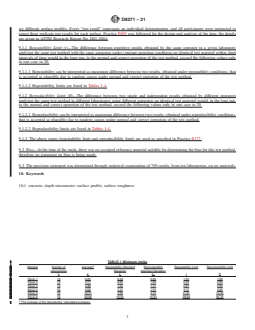

REDLINE ASTM D8271-21 - Standard Test Method for the Direct Measurement of Surface Profile of Prepared Concrete
Overview
ASTM D8271-21, Standard Test Method for the Direct Measurement of Surface Profile of Prepared Concrete, is a critical ASTM standard developed to quantify the surface profile-or roughness-of concrete substrates. Ensuring the correct surface profile is essential for optimal adhesion and performance of coatings, linings, and other treatments applied to concrete. This internationally recognized method outlines quantitative measurement procedures suitable for both field and laboratory applications, supporting quality assurance in construction, maintenance, and industrial projects.
Key Topics
- Surface Profile Measurement: The standard details a step-by-step method for directly measuring the depth of surface profile on prepared or unprepared concrete surfaces. Using a depth micrometer with a fine pointed probe, multiple readings are taken from various locations and averaged to determine the profile characteristics.
- Preparation Methods: A variety of processes can be used to achieve the desired surface profile, including abrasive blasting, acid etching, and mechanical scarifying tools. The standard provides guidance on evaluating surface preparation for improved coating/lining adhesion.
- Precision and Reporting: The method ensures repeatable and reproducible results through clearly defined measurement, reporting, and verification requirements. Guidance is provided for calibration, location selection, and statistical handling of outlier data.
- International Applicability: ASTM D8271-21 complies with global principles for standardization, allowing its use in projects subject to international regulations and quality standards.
Applications
ASTM D8271-21 is widely used across industries where concrete coatings and linings serve critical structural or protective functions. Key applications include:
- Quality Control in Concrete Preparation: Contractors, asset owners, and manufacturers rely on this standard to verify that concrete substrates meet specified roughness prior to installing coatings or linings, ensuring optimal adhesion and longevity.
- Construction and Maintenance: The method supports infrastructure projects-such as bridges, industrial floors, parking structures, and water containment facilities-by providing a standardized approach to surface profiling.
- Compliance with Specifications: Facility owners, engineers, and quality assurance professionals utilize ASTM D8271-21 to document compliance with industry or project-specific requirements, reducing the risk of coating failures due to improper surface preparation.
- Laboratory and Field Testing: The flexibility of the method supports both field surveys and laboratory testing for comparative studies, materials research, or dispute resolution.
Related Standards
ASTM D8271-21 interfaces with a network of standards to provide comprehensive guidance on surface preparation and measurement:
- ASTM D4417: Test Methods for Field Measurement of Surface Profile of Blast Cleaned Steel. This standard is referenced for its similarity in methodology and utility in comparing prep quality in both steel and concrete substrates.
- ASTM E177: Practice for Use of the Terms Precision and Bias in ASTM Test Methods, supporting uniform data reporting and analysis.
- ASTM E178: Practice for Dealing With Outlying Observations, offering statistical techniques for handling anomalous test results.
- ASTM E691: Practice for Conducting an Interlaboratory Study to Determine the Precision of a Test Method, which underpins the precision and reproducibility assurance of ASTM D8271-21.
Keywords: surface profile, concrete surface preparation, ASTM D8271, roughness measurement, coatings adhesion, depth micrometer, field testing, surface roughness, industrial coatings, construction standards
By adhering to ASTM D8271-21, project stakeholders ensure accurate surface characterization, dependable coating performance, and alignment with industry best practices.
Relations
- Effective Date
- 01-Dec-2019
- Effective Date
- 01-Jun-2016
- Effective Date
- 01-May-2014
- Effective Date
- 01-May-2013
- Effective Date
- 01-May-2013
- Effective Date
- 01-Nov-2011
- Effective Date
- 01-Nov-2011
- Effective Date
- 01-Oct-2010
- Effective Date
- 01-Oct-2008
- Effective Date
- 01-Oct-2008
- Effective Date
- 01-Oct-2008
- Refers
ASTM E177-06b - Standard Practice for Use of the Terms Precision and Bias in ASTM Test Methods - Effective Date
- 15-Nov-2006
- Refers
ASTM E177-06a - Standard Practice for Use of the Terms Precision and Bias in ASTM Test Methods - Effective Date
- 01-Nov-2006
- Effective Date
- 01-Nov-2005
- Refers
ASTM E177-04e1 - Standard Practice for Use of the Terms Precision and Bias in ASTM Test Methods - Effective Date
- 01-Nov-2004
Buy Documents
ASTM D8271-21 - Standard Test Method for the Direct Measurement of Surface Profile of Prepared Concrete
REDLINE ASTM D8271-21 - Standard Test Method for the Direct Measurement of Surface Profile of Prepared Concrete
Get Certified
Connect with accredited certification bodies for this standard

DIBt (Deutsches Institut für Bautechnik)
German Institute for Building Technology.
DIN CERTCO
DIN Group product certification.

Aboma Certification B.V.
Specialized in construction, metal, and transport sectors.
Sponsored listings
Frequently Asked Questions
ASTM D8271-21 is a standard published by ASTM International. Its full title is "Standard Test Method for the Direct Measurement of Surface Profile of Prepared Concrete". This standard covers: SIGNIFICANCE AND USE 4.1 Proper bonding of coatings and linings to concrete surfaces requires proper cleaning and frequently requires the concrete to be roughened to increase the surface area. The roughness, also known as surface profile, can be imparted into concrete by abrasive blast cleaning, acid etching or various impact/scarifying power tools. The resulting surface profile depth can influence coating/lining adhesion and performance. Coating/lining manufacturers or facility owners, or both, frequently specify cleaning and roughening of the concrete surface prior to product installation. The procedure described herein enables the user to quantitatively determine the profile directly from the prepared concrete surface in multiple locations. The procedure is similar to that described in Method B of Test Methods D4417, which addresses measurement of surface profile on abrasive blast cleaned steel surfaces. SCOPE 1.1 This test method is suitable for both field and laboratory use to quantify the depth of surface profile of prepared concrete. It may also be used on unprepared concrete surfaces. 1.2 The values stated in SI units are to be regarded as standard. The values given in parentheses after SI units are provided for information only and are not considered standard. 1.3 This standard does not purport to address all of the safety concerns, if any, associated with its use. It is the responsibility of the user of this standard to establish appropriate safety, health, and environmental practices and determine the applicability of regulatory limitations prior to use. 1.4 This international standard was developed in accordance with internationally recognized principles on standardization established in the Decision on Principles for the Development of International Standards, Guides and Recommendations issued by the World Trade Organization Technical Barriers to Trade (TBT) Committee.
SIGNIFICANCE AND USE 4.1 Proper bonding of coatings and linings to concrete surfaces requires proper cleaning and frequently requires the concrete to be roughened to increase the surface area. The roughness, also known as surface profile, can be imparted into concrete by abrasive blast cleaning, acid etching or various impact/scarifying power tools. The resulting surface profile depth can influence coating/lining adhesion and performance. Coating/lining manufacturers or facility owners, or both, frequently specify cleaning and roughening of the concrete surface prior to product installation. The procedure described herein enables the user to quantitatively determine the profile directly from the prepared concrete surface in multiple locations. The procedure is similar to that described in Method B of Test Methods D4417, which addresses measurement of surface profile on abrasive blast cleaned steel surfaces. SCOPE 1.1 This test method is suitable for both field and laboratory use to quantify the depth of surface profile of prepared concrete. It may also be used on unprepared concrete surfaces. 1.2 The values stated in SI units are to be regarded as standard. The values given in parentheses after SI units are provided for information only and are not considered standard. 1.3 This standard does not purport to address all of the safety concerns, if any, associated with its use. It is the responsibility of the user of this standard to establish appropriate safety, health, and environmental practices and determine the applicability of regulatory limitations prior to use. 1.4 This international standard was developed in accordance with internationally recognized principles on standardization established in the Decision on Principles for the Development of International Standards, Guides and Recommendations issued by the World Trade Organization Technical Barriers to Trade (TBT) Committee.
ASTM D8271-21 is classified under the following ICS (International Classification for Standards) categories: 17.040.20 - Properties of surfaces; 91.100.30 - Concrete and concrete products. The ICS classification helps identify the subject area and facilitates finding related standards.
ASTM D8271-21 has the following relationships with other standards: It is inter standard links to ASTM D4417-19, ASTM E178-16, ASTM E177-14, ASTM E691-13, ASTM E177-13, ASTM D4417-11, ASTM E691-11, ASTM E177-10, ASTM E691-08, ASTM E177-08, ASTM E178-08, ASTM E177-06b, ASTM E177-06a, ASTM E691-05, ASTM E177-04e1. Understanding these relationships helps ensure you are using the most current and applicable version of the standard.
ASTM D8271-21 is available in PDF format for immediate download after purchase. The document can be added to your cart and obtained through the secure checkout process. Digital delivery ensures instant access to the complete standard document.
Standards Content (Sample)
This international standard was developed in accordance with internationally recognized principles on standardization established in the Decision on Principles for the
Development of International Standards, Guides and Recommendations issued by the World Trade Organization Technical Barriers to Trade (TBT) Committee.
Designation: D8271 −21
Standard Test Method for
the Direct Measurement of Surface Profile of Prepared
Concrete
This standard is issued under the fixed designation D8271; the number immediately following the designation indicates the year of
original adoption or, in the case of revision, the year of last revision. A number in parentheses indicates the year of last reapproval. A
superscript epsilon (´) indicates an editorial change since the last revision or reapproval.
1. Scope 3. Summary of Test Method
3.1 The depth of profile is measured using a fine pointed
1.1 This test method is suitable for both field and laboratory
probe at a predetermined number of locations, and the range
use to quantify the depth of surface profile of prepared
and arithmetic mean of the maximum peak-to-valley distances
concrete. It may also be used on unprepared concrete surfaces.
is determined.
1.2 The values stated in SI units are to be regarded as
standard. The values given in parentheses after SI units are 4. Significance and Use
provided for information only and are not considered standard.
4.1 Proper bonding of coatings and linings to concrete
surfaces requires proper cleaning and frequently requires the
1.3 This standard does not purport to address all of the
concrete to be roughened to increase the surface area. The
safety concerns, if any, associated with its use. It is the
roughness, also known as surface profile, can be imparted into
responsibility of the user of this standard to establish appro-
concrete by abrasive blast cleaning, acid etching or various
priate safety, health, and environmental practices and deter-
impact/scarifying power tools. The resulting surface profile
mine the applicability of regulatory limitations prior to use.
depth can influence coating/lining adhesion and performance.
1.4 This international standard was developed in accor-
Coating/lining manufacturers or facility owners, or both, fre-
dance with internationally recognized principles on standard-
quently specify cleaning and roughening of the concrete
ization established in the Decision on Principles for the
surface prior to product installation. The procedure described
Development of International Standards, Guides and Recom-
herein enables the user to quantitatively determine the profile
mendations issued by the World Trade Organization Technical
directly from the prepared concrete surface in multiple loca-
Barriers to Trade (TBT) Committee.
tions.TheprocedureissimilartothatdescribedinMethodBof
Test Methods D4417, which addresses measurement of surface
2. Referenced Documents
profile on abrasive blast cleaned steel surfaces.
2.1 ASTM Standards:
5. Apparatus
D4417 Test Methods for Field Measurement of Surface
Profile of Blast Cleaned Steel
5.1 A depth micrometer fitted with a remote pointed probe.
E177 Practice for Use of the Terms Precision and Bias in
The probe point is machined at a 60° included angle with a
ASTM Test Methods
nominal radius of 500 µm at the tip and exerting a minimum
E178 Practice for Dealing With Outlying Observations
force of 75 g.The base of the probe has a surface area diameter
E691 Practice for Conducting an Interlaboratory Study to
between 20 mm and 25 mm. This base rests on the tops of the
Determine the Precision of a Test Method
peaks of the surface profile while the spring-loaded tip,
protruding from the probe face projects into the valleys. The
distance that the tip projects into the valley relative to the tops
1 of the peaks is displayed.
This test method is under the jurisdiction of ASTM Committee D01 on Paint
and Related Coatings, Materials, andApplications and is the direct responsibility of
5.2 The depth micrometer must have a minimum upper
Subcommittee D01.46 on Industrial Protective Coatings.
range of 6 mm (250 mils) and a manufacturer stated accuracy
Current edition approved Feb. 1, 2021. Published February 2021. Originally
of 61 % or greater.
approved in 2019. Last previous edition approved in 2019 as D8271 – 19. DOI:
10.1520/D8271-21.
For referenced ASTM standards, visit the ASTM website, www.astm.org, or 6. Test Surface
contact ASTM Customer Service at service@astm.org. For Annual Book of ASTM
6.1 Any concrete/masonry surface that is free of loose
Standards volume information, refer to the standard’s Document Summary page on
the ASTM website. surface interference material, dirt, dust, and abrasive residue.
Copyright © ASTM International, 100 Barr Harbor Drive, PO Box C700, West Conshohocken, PA 19428-2959. United States
D8271 − 21
The instrument probe must sit flush on the concrete surface; 9. Precision and Bias
care should be taken when measuring on curved surfaces.
9.1 The precision of this test method is based on an
interlaboratory study of ASTM D8271, Test Method for the
7. Procedure
Direct Measurement of Surface Profile of Prepared Concrete,
7.1 Verify instrument accuracy prior to each period of use
conducted in 2020. Each of ten volunteer laboratories were
by measuring a metal shim of known thickness placed onto
asked to test six different surface profiles. Every “test result”
plate float glass (see 7.2). Both are usually supplied by the
represents an individual determination, and all participants
instrument manufacturer. Certified standards are also available.
were instructed to report three replicate test results for each
If the average of at least three measurements is not within the
surface. Practice E691 was followed for the design and
combined tolerance of the instrument and the shim or certified
analysis of the data; the details are given in ASTM Research
standards , follow the instrument manufacturer’s instructions
Report No. D01-2004.
for adjustment or repair.
9.1.1 Repeatability Limit (r)—The difference between re-
petitive results obtained by the same operator in a given
7.2 Prior to use, verify that the gauge reads zero by placing
laboratory applying the same test method with the same
its probe on a piece of plate float glass (zero plate). Hold the
apparatus under constant operating conditions on identical test
gauge by its base and press firmly against the glass. If the
material within short intervals of time would in the long run, in
average of at least three measurements is not within the
the normal and correct operation of the test method, exceed the
tolerance of the instrument, adjust the instrument to zero by
following values only in one case i
...
This document is not an ASTM standard and is intended only to provide the user of an ASTM standard an indication of what changes have been made to the previous version. Because
it may not be technically possible to adequately depict all changes accurately, ASTM recommends that users consult prior editions as appropriate. In all cases only the current version
of the standard as published by ASTM is to be considered the official document.
Designation: D8271 − 19 D8271 − 21
Standard Test Method for
the Direct Measurement of Surface Profile of Prepared
Concrete
This standard is issued under the fixed designation D8271; the number immediately following the designation indicates the year of
original adoption or, in the case of revision, the year of last revision. A number in parentheses indicates the year of last reapproval. A
superscript epsilon (´) indicates an editorial change since the last revision or reapproval.
1. Scope
1.1 This test method is suitable for both field and laboratory use to quantify the depth of surface profile of prepared concrete. It
may also be used on unprepared concrete surfaces.
1.2 The values stated in SI units are to be regarded as standard. The values given in parentheses after SI units are provided for
information only and are not considered standard.
1.3 This standard does not purport to address all of the safety concerns, if any, associated with its use. It is the responsibility
of the user of this standard to establish appropriate safety, health, and environmental practices and determine the applicability of
regulatory limitations prior to use.
1.4 This international standard was developed in accordance with internationally recognized principles on standardization
established in the Decision on Principles for the Development of International Standards, Guides and Recommendations issued
by the World Trade Organization Technical Barriers to Trade (TBT) Committee.
2. Referenced Documents
2.1 ASTM Standards:
D4417 Test Methods for Field Measurement of Surface Profile of Blast Cleaned Steel
E177 Practice for Use of the Terms Precision and Bias in ASTM Test Methods
E178 Practice for Dealing With Outlying Observations
E691 Practice for Conducting an Interlaboratory Study to Determine the Precision of a Test Method
3. Summary of Test Method
3.1 The depth of profile is measured using a fine pointed probe at a predetermined number of locations, and the range and
arithmetic mean of the maximum peak-to-valley distances is determined.
4. Significance and Use
4.1 Proper bonding of coatings and linings to concrete surfaces requires proper cleaning and frequently requires the concrete to
be roughened to increase the surface area. The roughness, also known as surface profile, can be imparted into concrete by abrasive
This test method is under the jurisdiction of ASTM Committee D01 on Paint and Related Coatings, Materials, and Applications and is the direct responsibility of
Subcommittee D01.46 on Industrial Protective Coatings.
Current edition approved Aug. 1, 2019Feb. 1, 2021. Published August 2019February 2021. Originally approved in 2019. Last previous edition approved in 2019 as
D8271 – 19. DOI: 10.1520/D8271-19.10.1520/D8271-21.
For referenced ASTM standards, visit the ASTM website, www.astm.org, or contact ASTM Customer Service at service@astm.org. For Annual Book of ASTM Standards
volume information, refer to the standard’s Document Summary page on the ASTM website.
Copyright © ASTM International, 100 Barr Harbor Drive, PO Box C700, West Conshohocken, PA 19428-2959. United States
D8271 − 21
blast cleaning, acid etching or various impact/scarifying power tools. The resulting surface profile depth can influence
coating/lining adhesion and performance. Coating/lining manufacturers and/or facility owners or facility owners, or both,
frequently specify cleaning and roughening of the concrete surface prior to product installation. The procedure described herein
enables the user to quantitatively determine the profile directly from the prepared concrete surface in multiple locations. The
procedure is similar to that described in Method B of ASTM Test Methods D4417, which addresses measurement of surface profile
on abrasive blast cleaned steel surfaces.
5. Apparatus
5.1 A depth micrometer fitted with a remote pointed probe. The probe point is machined at a 60° included angle with a nominal
radius of 500 μm at the tip and exerting a minimum force of 75 g. The base of the probe has a surface area diameter between
2020 mm and 25 mm. This base rests on the tops of the peaks of the surface profile while the spring-loaded tip, protruding from
the probe face projects into the valleys. The distance that the tip projects into the valley relative to the tops of the peaks is displayed.
5.2 The depth micrometer must have a minimum upper range of 6 mm (250 mils) and a manufacturer stated accuracy of 61 %
or greater.
6. Test Surface
6.1 Any concrete/masonry surface that is free of loose surface interference material, dirt, dust, and abrasive residue. The
instrument probe must sit flush on the concrete surface; care should be taken when measuring on curved surfaces.
7. Procedure
7.1 Verify instrument accuracy prior to each period of use by measuring a metal shim of known thickness placed onto plate float
glass (see 7.2). Both are usually supplied by the instrument manufacturer. Certified standards are also available. If the average of
at least three measurements is not within the combined tolerance of the instrument and the shim or certified standards , follow the
instrument manufacturer’s instructions for adjustment or repair.
7.2 Prior to use, verify that the gauge reads zero by placing its probe on a piece of plate float glass (zero plate). Hold the gauge
by its base and press firmly against the glass. If the average of at least three measurements is not within the tolerance of the
instrument, adjust the instrument to zero by following the instrument manufacturer’s instructions.
7.3 Position and hold the probe firmly against the prepared substrate to obtain readings of the roughened concrete. Do not drag
the probe across the surface between readings or the spring-loaded tip may become worn, leading to false readings. Avoid air voids
and other surface irregularities that may generate false readings.
7.4 Measure the profile of the prepared surfaces at a sufficient number of locations to characterize the surface, as specified or
agreed upon between the interested parties. At each location obtain 15 readings within a 15 cm by 15 cm (6 in. by 6 in.) area,
discard any unusually high or low readings that are not representative of the area (outliers, as defined by ASTMPractice E178),
obtain replacement readings for those discarded, and record the average of the 15 readings. Calculate the range and mean for each
location and the range and mean of all the l
...