

ASTM F3390-20
(Specification)Standard Specification for 3 through 24 in. Lined Flexible Corrugated Polyethylene Pipe for Land Drainage Applications
General Information
- Abstract
SCOPE
1.1 This specification covers requirements and test methods for flexible annular, corrugated profile wall polyethylene pipe with an interior liner. It covers nominal sizes 3 in. (75 mm), 4 in. (100 mm), 5 in. (125 mm), 6 in. (150 mm), 8 in. (200 mm), 10 in. (250 mm), 12 in. (300 mm), 15 in. (375 mm), 18 in (450 mm), and 24 in (600 mm).
1.2 The requirements of this specification are intended to provide non-pressure (gravity flow) lined flexible annular corrugated polyethylene pipe for subsurface and land drainage systems, such as agricultural or foundations, which do not operate under surcharge pressure heads.
Note 1: Pipe produced in accordance with this specification is to be installed in compliance with Practice F449. Lined flexible annular corrugated polyethylene provides axial flexibility allowing for subsurface installation using tile plows and allows the pipe to be coiled for storage and transport.
Note 2: Subsurface and land drainage systems pertain principally to agricultural applications for water table control.
Note 3: Lined flexible pipe provided in coiled lengths will experience distortion or folding in the interior pipe liner which may adversely affect flow characteristics, contact the pipe manufacturer for hydraulic design guidance for the coiled lined flexible pipe.
1.3 This specification permits the use of recycled materials for pipe in accordance with the requirements in Section 5.
1.4 The values stated in inch-pound units are to be regarded as standard. The values given in parentheses are mathematical conversions to SI units that are provided for information only and are not considered standard.
1.5 This standard does not purport to address all of the safety concerns, if any, associated with its use. It is the responsibility of the user of this standard to establish appropriate safety, health, and environmental practices and determine the applicability of regulatory limitations prior to use.
1.6 This international standard was developed in accordance with internationally recognized principles on standardization established in the Decision on Principles for the Development of International Standards, Guides and Recommendations issued by the World Trade Organization Technical Barriers to Trade (TBT) Committee.
- Status
- Published
- Publication Date
- 31-Jan-2020
- Technical Committee
- F17 - Plastic Piping Systems
- Drafting Committee
- F17.65 - Land Drainage
Overview
ASTM F3390-20 is an international standard developed by ASTM International, specifying the requirements and test methods for 3 through 24 inch lined flexible corrugated polyethylene (PE) pipe with an interior liner, intended for land drainage applications. The standard covers various sizes from 3 inches (75 mm) to 24 inches (600 mm) and addresses materials, manufacturing, performance, dimensions, and quality control relevant to gravity flow, non-pressure land and subsurface water management systems. Typical applications include agricultural drainage, foundation and land drainage, and water table control where flexible and durable plastic piping is required.
Key Topics
Scope of Application
- Covers nominal pipe sizes 3 in. (75 mm) to 24 in. (600 mm)
- Lined flexible annular corrugated PE pipe with an interior liner
- Designed for gravity flow (non-pressure) subsurface and land drainage, especially in agriculture and foundation settings
Material and Construction
- Pipes manufactured using virgin or certified recycled polyethylene compounds
- Exterior corrugated wall and interior liner must meet defined physical and mechanical property requirements
- UV stabilization required for outdoor storage and durability
- Allows the use of recycled materials under strict testing and quality conditions
Physical and Performance Requirements
- Pipe must meet minimum requirements for stiffness, impact resistance, flattening, and dimensional tolerance
- Minimum inner liner thickness and inside diameter specified by size
- Perforation patterns and inlet area requirements for drainage as specified by the user
Testing and Quality Assurance
- Includes reference to standard ASTM test methods for plastic pipe (D618, D638, D790, D792, D1238, etc.)
- Pipe and fittings are subjected to performance tests for slow-crack growth, density, tensile strength, and impact resistance
- Requirements for marking, inspection, and retesting procedures to ensure compliance
Installation and Handling
- Pipe is designed to allow coiling, enabling efficient transport and installation, often using tile plows for subsurface placement
- Special guidance for installation practices (as per ASTM Practice F449)
- Fittings and joining systems to maintain integrity and soil tightness
Applications
ASTM F3390-20 lined flexible corrugated polyethylene pipes are suited for diverse land and subsurface drainage needs, particularly where corrosion resistance, durability, and flexibility are critical. Key areas of use include:
- Agricultural Drainage: Effective water table control in cropland, pasture, and irrigation systems to enhance soil productivity and prevent waterlogging
- Foundation and Land Drainage: Used around buildings and structures to manage runoff, prevent water accumulation, and protect infrastructure
- Subsurface Water Management: Installation in athletic fields, golf courses, and landscaped areas for efficient underground water control
- Roadway and Highway Drainage: Used by local, state, and federal agencies for roadway subgrade drainage to maintain road stability
- Rehabilitation and Upgrades: Ideal for replacing or upgrading older drainage systems, offering easy handling due to pipe flexibility and coilable lengths
The lined flexible design provides enhanced hydraulic flow, resistance to environmental and mechanical stresses, and versatility in installation, making it a reliable choice for modern drainage needs.
Related Standards
- ASTM F449: Practice for Subsurface Installation of Corrugated Polyethylene Pipe for Agricultural Drainage or Water Table Control
- ASTM F667: Specification for Corrugated Polyethylene Pipe and Fittings in similar size ranges
- ASTM D3350: Specification for Polyethylene Plastics Pipe and Fittings Materials
- ASTM F477: Specification for Elastomeric Seals (Gaskets) for Joining Plastic Pipe
- AASHTO LRFD Bridge Design Specifications: For structural analysis and performance requirements
- ISO 15270: Guidelines for the recovery and recycling of plastic waste
- NCHRP Reports 631 & 870: For design methods and performance of corrugated pipe with recycled content
Understanding and referencing these related standards helps ensure correct product selection, compliance with installation guidelines, and achievement of optimal system performance.
Keywords: ASTM F3390, lined flexible corrugated polyethylene pipe, land drainage, PE pipe, agricultural drainage, subsurface drainage, non-pressure pipe, water table control, pipe standard, recycled polyethylene, plastic drainage pipe.
Relations
- Effective Date
- 01-Feb-2024
- Refers
ASTM D1238-23a - Standard Test Method for Melt Flow Rates of Thermoplastics by Extrusion Plastometer - Effective Date
- 15-Nov-2023
- Effective Date
- 01-Oct-2023
- Effective Date
- 01-Apr-2020
- Effective Date
- 01-Feb-2020
- Effective Date
- 01-Feb-2020
- Effective Date
- 01-Jan-2019
- Effective Date
- 01-Apr-2018
- Effective Date
- 15-Feb-2018
- Effective Date
- 15-Nov-2017
- Effective Date
- 01-Aug-2017
- Effective Date
- 01-Jul-2017
- Effective Date
- 01-Feb-2017
- Effective Date
- 15-Nov-2016
- Effective Date
- 01-Aug-2016
Get Certified
Connect with accredited certification bodies for this standard

Institut za varilstvo d.o.o. (Welding Institute)
Slovenia's leading welding institute since 1952. ISO 3834, EN 1090, pressure equipment certification, NDT personnel, welder qualification. Only IIW Au
Sponsored listings
Frequently Asked Questions
ASTM F3390-20 is a technical specification published by ASTM International. Its full title is "Standard Specification for 3 through 24 in. Lined Flexible Corrugated Polyethylene Pipe for Land Drainage Applications". This standard covers: SCOPE 1.1 This specification covers requirements and test methods for flexible annular, corrugated profile wall polyethylene pipe with an interior liner. It covers nominal sizes 3 in. (75 mm), 4 in. (100 mm), 5 in. (125 mm), 6 in. (150 mm), 8 in. (200 mm), 10 in. (250 mm), 12 in. (300 mm), 15 in. (375 mm), 18 in (450 mm), and 24 in (600 mm). 1.2 The requirements of this specification are intended to provide non-pressure (gravity flow) lined flexible annular corrugated polyethylene pipe for subsurface and land drainage systems, such as agricultural or foundations, which do not operate under surcharge pressure heads. Note 1: Pipe produced in accordance with this specification is to be installed in compliance with Practice F449. Lined flexible annular corrugated polyethylene provides axial flexibility allowing for subsurface installation using tile plows and allows the pipe to be coiled for storage and transport. Note 2: Subsurface and land drainage systems pertain principally to agricultural applications for water table control. Note 3: Lined flexible pipe provided in coiled lengths will experience distortion or folding in the interior pipe liner which may adversely affect flow characteristics, contact the pipe manufacturer for hydraulic design guidance for the coiled lined flexible pipe. 1.3 This specification permits the use of recycled materials for pipe in accordance with the requirements in Section 5. 1.4 The values stated in inch-pound units are to be regarded as standard. The values given in parentheses are mathematical conversions to SI units that are provided for information only and are not considered standard. 1.5 This standard does not purport to address all of the safety concerns, if any, associated with its use. It is the responsibility of the user of this standard to establish appropriate safety, health, and environmental practices and determine the applicability of regulatory limitations prior to use. 1.6 This international standard was developed in accordance with internationally recognized principles on standardization established in the Decision on Principles for the Development of International Standards, Guides and Recommendations issued by the World Trade Organization Technical Barriers to Trade (TBT) Committee.
SCOPE 1.1 This specification covers requirements and test methods for flexible annular, corrugated profile wall polyethylene pipe with an interior liner. It covers nominal sizes 3 in. (75 mm), 4 in. (100 mm), 5 in. (125 mm), 6 in. (150 mm), 8 in. (200 mm), 10 in. (250 mm), 12 in. (300 mm), 15 in. (375 mm), 18 in (450 mm), and 24 in (600 mm). 1.2 The requirements of this specification are intended to provide non-pressure (gravity flow) lined flexible annular corrugated polyethylene pipe for subsurface and land drainage systems, such as agricultural or foundations, which do not operate under surcharge pressure heads. Note 1: Pipe produced in accordance with this specification is to be installed in compliance with Practice F449. Lined flexible annular corrugated polyethylene provides axial flexibility allowing for subsurface installation using tile plows and allows the pipe to be coiled for storage and transport. Note 2: Subsurface and land drainage systems pertain principally to agricultural applications for water table control. Note 3: Lined flexible pipe provided in coiled lengths will experience distortion or folding in the interior pipe liner which may adversely affect flow characteristics, contact the pipe manufacturer for hydraulic design guidance for the coiled lined flexible pipe. 1.3 This specification permits the use of recycled materials for pipe in accordance with the requirements in Section 5. 1.4 The values stated in inch-pound units are to be regarded as standard. The values given in parentheses are mathematical conversions to SI units that are provided for information only and are not considered standard. 1.5 This standard does not purport to address all of the safety concerns, if any, associated with its use. It is the responsibility of the user of this standard to establish appropriate safety, health, and environmental practices and determine the applicability of regulatory limitations prior to use. 1.6 This international standard was developed in accordance with internationally recognized principles on standardization established in the Decision on Principles for the Development of International Standards, Guides and Recommendations issued by the World Trade Organization Technical Barriers to Trade (TBT) Committee.
ASTM F3390-20 is classified under the following ICS (International Classification for Standards) categories: 23.040.05 - Pipeline and its parts for external sewage systems; 23.040.20 - Plastics pipes. The ICS classification helps identify the subject area and facilitates finding related standards.
ASTM F3390-20 has the following relationships with other standards: It is inter standard links to ASTM F2136-18(2024), ASTM D1238-23a, ASTM D2565-23, ASTM F412-20, ASTM F449-20, ASTM D4218-20, ASTM F412-19, ASTM D7399-18, ASTM F2136-18, ASTM D2444-17, ASTM F412-17a, ASTM D790-17, ASTM F412-17, ASTM F412-16a, ASTM F412-16. Understanding these relationships helps ensure you are using the most current and applicable version of the standard.
ASTM F3390-20 is available in PDF format for immediate download after purchase. The document can be added to your cart and obtained through the secure checkout process. Digital delivery ensures instant access to the complete standard document.
Standards Content (Sample)
This international standard was developed in accordance with internationally recognized principles on standardization established in the Decision on Principles for the
Development of International Standards, Guides and Recommendations issued by the World Trade Organization Technical Barriers to Trade (TBT) Committee.
Designation:F3390 −20
Standard Specification for
3 through 24 in. Lined Flexible Corrugated Polyethylene
Pipe for Land Drainage Applications
This standard is issued under the fixed designation F3390; the number immediately following the designation indicates the year of
original adoption or, in the case of revision, the year of last revision. A number in parentheses indicates the year of last reapproval. A
superscript epsilon (´) indicates an editorial change since the last revision or reapproval.
1. Scope Development of International Standards, Guides and Recom-
mendations issued by the World Trade Organization Technical
1.1 This specification covers requirements and test methods
Barriers to Trade (TBT) Committee.
for flexible annular, corrugated profile wall polyethylene pipe
with an interior liner. It covers nominal sizes 3 in. (75 mm), 4
2. Referenced Documents
in. (100 mm), 5 in. (125 mm), 6 in. (150 mm), 8 in. (200 mm),
2.1 ASTM Standards:
10 in. (250 mm), 12 in. (300 mm), 15 in. (375 mm), 18 in (450
D618 Practice for Conditioning Plastics for Testing
mm), and 24 in (600 mm).
D638 Test Method for Tensile Properties of Plastics
1.2 The requirements of this specification are intended to
D790 Test Methods for Flexural Properties of Unreinforced
provide non-pressure (gravity flow) lined flexible annular
and Reinforced Plastics and Electrical Insulating Materi-
corrugated polyethylene pipe for subsurface and land drainage
als
systems, such as agricultural or foundations, which do not
D792 Test Methods for Density and Specific Gravity (Rela-
operate under surcharge pressure heads.
tive Density) of Plastics by Displacement
D1238 Test Method for Melt Flow Rates of Thermoplastics
NOTE 1—Pipe produced in accordance with this specification is to be
installed in compliance with Practice F449. Lined flexible annular
by Extrusion Plastometer
corrugated polyethylene provides axial flexibility allowing for subsurface
D1505 Test Method for Density of Plastics by the Density-
installation using tile plows and allows the pipe to be coiled for storage
Gradient Technique
and transport.
D2122 Test Method for Determining Dimensions of Ther-
NOTE 2—Subsurface and land drainage systems pertain principally to
agricultural applications for water table control. moplastic Pipe and Fittings
NOTE 3—Lined flexible pipe provided in coiled lengths will experience
D2412 Test Method for Determination of External Loading
distortion or folding in the interior pipe liner which may adversely affect
Characteristics of Plastic Pipe by Parallel-Plate Loading
flow characteristics, contact the pipe manufacturer for hydraulic design
D2444 Practice for Determination of the Impact Resistance
guidance for the coiled lined flexible pipe.
of Thermoplastic Pipe and Fittings by Means of a Tup
1.3 This specification permits the use of recycled materials
(Falling Weight)
for pipe in accordance with the requirements in Section 5.
D2565 Practice for Xenon-Arc Exposure of Plastics In-
1.4 The values stated in inch-pound units are to be regarded
tended for Outdoor Applications
as standard. The values given in parentheses are mathematical
D3350 Specification for Polyethylene Plastics Pipe and Fit-
conversions to SI units that are provided for information only
tings Materials
and are not considered standard.
D3895 Test Method for Oxidative-Induction Time of Poly-
olefins by Differential Scanning Calorimetry
1.5 This standard does not purport to address all of the
D4218 Test Method for Determination of Carbon Black
safety concerns, if any, associated with its use. It is the
Content in Polyethylene Compounds by the Muffle-
responsibility of the user of this standard to establish appro-
Furnace Technique
priate safety, health, and environmental practices and deter-
D5630 Test Method for Ash Content in Plastics
mine the applicability of regulatory limitations prior to use.
D7399 Test Method for Determination of the Amount of
1.6 This international standard was developed in accor-
Polypropylene in Polypropylene/Low Density Polyethyl-
dance with internationally recognized principles on standard-
ene Mixtures Using Infrared Spectrophotometry
ization established in the Decision on Principles for the
F412 Terminology Relating to Plastic Piping Systems
This specification is under the jurisdiction ofASTM Committee F17 on Plastic
Piping Systems and is the direct responsibility of Subcommittee F17.65 on Land For referenced ASTM standards, visit the ASTM website, www.astm.org, or
Drainage. contact ASTM Customer Service at service@astm.org. For Annual Book of ASTM
Current edition approved Feb. 1, 2020. Published May 2020. DOI: 10.1520/ Standards volume information, refer to the standard’s Document Summary page on
F3390–20 the ASTM website.
Copyright © ASTM International, 100 Barr Harbor Drive, PO Box C700, West Conshohocken, PA 19428-2959. United States
F3390−20
F449 Practice for Subsurface Installation of Corrugated 2.7 USDA Standard:
Polyethylene Pipe for Agricultural Drainage or Water Reference, Engineering Standard 606
Table Control
F477 Specification for Elastomeric Seals (Gaskets) for Join- 3. Terminology
ing Plastic Pipe
3.1 Definitions—Definitions used in this specification are in
F667 Specification for 3 through 24 in. Corrugated Polyeth-
accordance with Terminology F412 unless otherwise noted.
ylene Pipe and Fittings
3.2 Definitions:
F2136 Test Method for Notched, Constant Ligament-Stress
3.2.1 boot—theprotectingapparatuslinkedtotherearofthe
(NCLS) Test to Determine Slow-Crack-Growth Resis-
installation machine in a manner which allows placement of
tance of HDPE Resins or HDPE Corrugated Pipe
the pipe on the trench bottom, protection of work person, and
F3181 Test Method for The Un-notched, Constant Ligament
placement of envelope or filter material or both.
Stress CrackTest (UCLS) for HDPE Materials Containing
Post- Consumer Recycled HDPE 3.2.2 coiled pipe—Pipe which has been produced and
wrapped around a central radius for storage and transportation
F3308 Practice for Sampling and Testing Frequency for
Recycled Materials in Polyethylene (PE) Pipe for Non- foragreaterlengthofpipeinacompactfootprintversussticks.
Pressure Applications 3.2.2.1 Discussion—The length of pipe in a coil varies by
G154 Practice for Operating Fluorescent Ultraviolet (UV) diameter and manufacturer, and coils can contain several
Lamp Apparatus for Exposure of Nonmetallic Materials hundred feet of pipe.
G155 Practice for Operating XenonArc LightApparatus for
3.2.3 coextruded pipe—pipe consisting of two or more
Exposure of Non-Metallic Materials
layers of compatible material bonded together in processing by
2.2 AASHTO Standard:
any combination of temperature, pressure, grafting or adhe-
AASHTO LRFD Bridge Design Specifications
sion.
2.3 Federal Standard:
3.2.4 crease—a deformation that cannot be removed like a
Fed. Std. No. 123 Marking for Shipment (Civil Agencies)
dent: generally associated with wall buckling.
2.4 Military Standard:
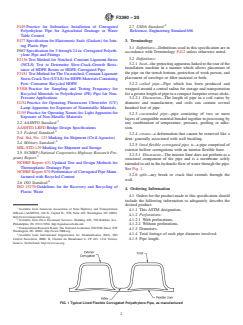
3.2.5 lined flexible corrugated pipe, n—a pipe comprised of
MIL-STD-129 Marking for Shipment and Storage
exterior hollow corrugations with an interior flexible liner.
2.5 NCHRP (National Cooperative Highway Research Pro-
3.2.5.1 Discussion—The interior liner does not perform as a
gram) Report:
structural component of the pipe and is a membrane solely
NCHRP Report 631 Updated Test and Design Methods for
intended to aid in the hydraulic flow of water through the pipe.
Thermoplastic Drainage Pipe
See Fig. 1.
NCHRPReport 870 Performance of Corrugated Pipe Manu-
3.2.6 split—any break or crack that extends through the
factured with Recycled Content
wall.
2.6 ISO Standard:
ISO 15270 Guidelines for the Recovery and Recycling of
4. Ordering Information
Plastic Waste
4.1 Orders for the product made to this specification should
include the following information to adequately describe the
desired product:
Available from American Association of State Highway and Transportation
4.1.1 This ASTM designation,
Officials (AASHTO), 444 N. Capitol St., NW, Suite 249, Washington, DC 20001,
4.1.2 Perforations:
http://www.transportation.org.
4.1.2.1 With perforations,
Available from DLA Document Services, Building 4/D, 700 Robbins Ave.,
Philadelphia, PA 19111-5094, http://quicksearch.dla.mil.
4.1.2.2 Without perforations,
Transportation Research Board, The NationalAcademies 500 Fifth Street, NW
4.1.3 Diameters,
Washington, DC 20001. http://www.TRB.org.
6 4.1.4 Total footage of each pipe diameter involved.
Available from International Organization for Standardization (ISO), ISO
4.1.5 Pipe length.
Central Secretariat, BIBC II, Chemin de Blandonnet 8, CP 401, 1214 Vernier,
Geneva, Switzerland, http://www.iso.org.
FIG. 1Typical Lined Flexible Corrugated Polyethylene Pipe, as manufactured
F3390−20
5. Materials and Manufacture 5.1.2 Interior Liner—Virgin Polyethylene compounds used
for the manufacture of the interior pipe liner shall meet the
5.1 Pipe—The coextruded pipe shall be made of polyethyl-
material requirements in Table 1. The liner shall be colored or
ene compounds meeting the following requirements for the
black. When carbon black is used, the carbon black content
exterior pipe corrugations and interior pipe liner.
shall be equal or greater than 2 % but not exceed 4 % when
5.1.1 Pipe Exterior—Polyethylene compounds used for the
tested in accordance with Test Method D4218. Colored poly-
manufacture of the exterior corrugated wall of the pipe shall be
ethylene compounds shall be protected from Ultraviolet (UV)
made of virgin PE plastic compounds or PE compounds
degradation with UV stabilizers.
containing post-consumer or industrial recycled PE materials
5.1.2.1 For slow crack-growth resistance, pipe liner resins
as defined in Guide ISO 15720. PE compounds shall meet the
shall be evaluated using the notched constant ligament stress
material requirements of the following cell classifications as
(NCLS) test according to the procedure described in 7.9. The
and described in Specification D3350:
average failure time of the five test specimens shall exceed 12
5.1.1.1 Pipe Diameter 3 through 10 in.—Cell Class
h with no single test specimen’s failure time less than 9 h. The
424400C or 424400E,
pipe liner and exterior material samples shall be collected
5.1.1.2 Pipe Diameter 12 through 24 in.—Cell Class
separately to prevent comingling.
435400C or 435400E.
5.1.1.3 Compounds that have higher cell classification in
NOTE 4—Pipe users should consult with the pipe manufacturer about
the outdoor exposure life of the product under consideration. Evaluation
one or more properties shall be permitted provided the density
of UV stabilizer in Code E color PE compound using Practice D2565,
does not exceed 0.955 g/cm , and all other product require-
Practice G154, or Practice G155 may be useful for this purpose. Exposure
ments are met. When carbon black is used, the carbon black
to sunlight during normal construction periods is not harmful. It is good
content shall be equal or greater than 2 % but not exceed 4 %
practice to store pipe and fittings under suitable cover prior to installation.
when tested in accordance with Test Method D4218. Colored
5.2 Rework Material—Clean rework material, generated
polyethylene compounds shall be protected from Ultraviolet
from the manufacturer’s own production of the product, may
(UV) degradation with UV stabilizers.
be used by the manufacturer provided that the tubing produced
5.1.1.4 For slow crack-growth resistance, pipe exterior shall
to meet all requirements of this specification.
be evaluated using the notched constant ligament stress
(NCLS) test according to the procedure described in 7.9. The
6. General Requirements
average failure time of the five test specimens shall exceed
6.1 Workmanship—The pipe shall be uniform in color,
12 h with no single test specimen’s failure time less than 9 h.
opacity, and density. The inside and outside surfaces shall be
The pipe liner and exterior material samples shall be collected
semimatte or glossy in appearance and free of chalking, sticky,
separately to prevent comingling.
or tacky material. The pipe walls shall be free of cracks, holes,
5.1.1.5 For PE compounds comprising recycled content,
blisters, voids, foreign inclusions, or other defects that are
crack initiation shall also be evaluated using the un-notched
visible to the naked eye, and that may affect the wall integrity.
constant ligament stress (UCLS) test according to the proce-
There shall be no delamination or separation of the inner liner
dure described in 7.10. The average failure time of the five
and the profile. Holes deliberately placed in perforated pipe are
specimens shall exceed 22 h with no single test specimen’s
acceptable.
failure time less than 12 h. Maximum level of polypropylene
6.1.1 Visible defects, cracks, creases, splits, obstruction to
present by volume shall not be greater than 5 % when tested in
flow in perforations or in the pipe are not permissible.
accordance with the procedures in 7.11. Maximum ash content
6.2 Dimensions and Tolerance:
shall not be more than 2 % in accordance with the procedures
6.2.1 Nominal Size—The nominal size for the pipe shall be
in 7.12.
the inside diameter shown in Table 2.
5.1.1.6 For PE compounds comprising recycled content
6.2.2 Inside Diameter—The average inside diameter for
shall be tested for Oxidative-Induction time in accordance with
pipe shall not vary more than -1 % and +5.5 % from the Pipe
Test Method D3895. Samples shall have a minimum
Inside Diameter shown in Table 2, when measured in accor-
Oxidative-Induction time of 20 min and a break strain of
dance with 7.5.1.
150 % when tested in accordance with Test Method D638.
5.1.1.7 For PE compounds comprising recycled content all
NOTE 5—The outside diameters and the corrugation pitch of the
sample and testing frequency shall be in accordance with
products manufactured to this specification are not specified; therefore,
Practice F3308. compatibility between pipe from different manufacturers or the same
TABLE 1 Interior Liner Virgin Material Compound Properties
Property ASTM Test Method Units (SI Units) Minimum Value Maximum Value
Melt Flow Rate D1238 g/10 min 0.10 at 190 °C .
3 3
Density D792, D1505 lb/in. (g/cm ) 0.0318 (0.880) 0.0338 (0.935)
Tensile Strength at Yield D638 psi (N/mm ) 1500 (10) 4000 (28)
Elongation at Yield D638 % 10 .
Flexural Modulus (1% secant) D790, Procedure B psi (N/mm ) 35 000 (241) 90 000 (621)
A
Notched Constant Ligament F2136 hour 12h .
Stress
A
The average of five samples shall not be less than 12h with no single test specimen’s failure less than 9h.
F3390−20
TABLE 2 Pipe Stiffness and Pipe Dimensions
Pipe Inside Diameter Minimum Inside Diameter Minimum Pipe Stiffness at 5% Minimum Inner Liner Thickness
Deflection
in. mm in. mm lb/in./in. kPa in. mm
3 75 2.97 75 50 345 0.020 0.5
4 100 3.96 101 50 345 0.020 0.5
5 125 4.95 126 50 345 0.020 0.5
6 150 5.94 151 50 345 0.020 0.5
8 200 7.92 201 50 345 0.024 0.6
10 250 9.9 251 50 345 0.024 0.6
12 300 11.88 302 50 345 0.030 0.8
15 375 14.85 377 42 290 0.035 0.9
18 450 17.82 453 40 275 0.040 1.0
24 600 23.76 604 34 235 0.048 1.2
manufacturer should be verified.
tionatthejoints.Bellandspigot,externalsnaporsplitcouplers
are examples of typical designs. Joints shall meet the require-
6.2.3 Minimum Inside Diameter—The minimum inside di-
ments of a soil-tight joint unless otherwise specified by the
ameter shall be as shown in Table 2 when measured in
owner ⁄ designer.
accordance with 7.5.2.
6.6.3 Soil-tight joints are specified as a function of opening
6.2.4 Length—The pipe may be sold in any length agreeable
size, channel length, and backfill particle size. If the size of the
to the user. Length shall not be less than 99 % of the stated
opening exceeds 0.12 in. (3 mm), the length of the channel
quantity when measured in accordance with 7.5.3.
shall be at least four times the size of the opening. A backfill
6.2.5 Minimum Inner Liner Thickness—The minimum
material containing a high percentage of find-graded soils
inner-liner thickness of the pipe shall meet the requirements
requires investigation for the specific type of joint to be used to
given in Table 2 when measured in accordance with 7.5.4.
guard against soil infiltration. When gaskets are used, they
NOTE 6—The inner pipe liner is a membrane solely intended to aid in
shall meet the requirements of Specification F477.
thehydraulicflowofwaterasanimprovementoversinglewallcorrugated
pipe. Pipe that has been coiled will not provide the same hydraulic
7. Test Methods
performance as dual wall corrugated plastic pipe.
6.2.6 Perforations—When perforations are necessary, they 7.1 Conditioning:
shall be cleanly cut, placed in the valley of the corrugation rib 7.1.1 Referee Testing—When conditioning is required for
and uniformly spaced along the length and circumference of referee tests, condition the specimens in accordance with
the pipe in size, shape, and pattern suited to the needs of the ProcedureAofPracticeD618at73 64°F(23 62 °C)at50 %
user. The inlet area of the perforations shall be a minimum of relative humidity for not less than 24 hours prior to testing.
2 2
1 in. /ft (21 cm /m) of pipe, unless otherwise specified by the Conduct tests under the same conditions of temperature.
user.Allmeasurementsshallbemadeinaccordancewith7.5.5. 7.1.2 Quality Control Testing—Condition specimens prior
to testing at 73 6 4 °F (23 6 2 °C) for a minimum of 4 h
6.3 Pipe Stiffness—Minimum pipe stiffness at 5 % deflec-
without regard to relative humidity or1hin water.
tion shall meet the requirements given in Table 2 when tested
in accordance with 7.6. 7.2 Test Conditions—Conduct tests in a laboratory atmo-
sphere of 73 6 4 °F (23 6 2 °C) and 50 6 5 % relative
NOTE 7—The 5 % deflection criterion, selected for testing convenience,
humidity in the referenced test method or in this specification.
is not a limitation with respect to in-use deflection. The engineer is
responsible for establishing the acceptable deflection limit.
7.3 Sampling—The selection of the sample or samples of
6.4 Pipe Flattening—There shall be no evidence of the pipe shall be as agreed upon by the owner and the seller.
splitting, cracking, braking, separation of corrugation seams, Samples of pipe sufficient to determine conformance with this
separation of the valley and liner, or combinations thereof, on specification shall be taken at random from stock by the testing
any specimen when tested in accordance with 7.7. agency. Samples shall be representative of the product type
under consideration.
6.5 Pipe Impact Strength—There shall be no evidence of
splitting,cracking,breaking,separationofseams,separationof 7.4 Retest and Rejection—If any test failure occurs, the pipe
the outer and inner wall, or combinations thereof, when tested or fitting may be retested to establish conformity.The test shall
in accordance with 7.8. be repeated on two additional samples from the same lot or
shipment. If either of these two additional samples fails, the
6.6 Fittings and Joining Systems:
pipe or fitting does not comply with this specification.
6.6.1 Only fittings supplied or recommended by the pipe
manufacturer shall be used. Fittings shall be installed in 7.5 Dimensions:
accordance with the manufacturer’s recommendations. The 7.5.1 Inside Diameter—Pipe shall be measured prior to
fittings shall not reduce or impair the overall integrity or coiling and shall be
...