

ASTM E3332-23
(Test Method)Standard Test Method for Determining Trash and/or Debris Capture Performance of Stormwater Control Measures
General Information
- Abstract
SIGNIFICANCE AND USE
5.1 This standard, used in conjunction with a verification protocol can be used to gain certification for the purposes of the removal of trash and/or debris from stormwater runoff in order to meet regulatory and permit needs.
SCOPE
1.1 The scope of this standard is to provide test criteria for the evaluation of Stormwater Control Measures (SCM), especially Manufactured stormwater Treatment Devices (MTDs), for the removal of trash and/or debris greater than 5 mm in at least two dimensions in a laboratory setting. The use of this standard in conjunction with an appropriate verification program allows for the publication of verified reporting for use in gaining certification by Authorities Having Jurisdiction (AHJs).
1.2 For the purpose of this method, a Trash Capture Device (TCD) is an SCM that has the capacity to capture and retain trash and or debris. This may be the primary objective of the device or it may be a secondary feature of a device designed primarily as a Hydrodynamic Separator (HDS) or a filter for capturing sediment particles. This protocol does not address the sediment removal of such devices.
1.3 Units—The values stated in inch-pound units are to be regarded as standard, except for methods to establish and report sediment concentration and particle size. It is convention to exclusively describe sediment concentration in mg/L and particle size in mm or μm, both of which are SI units. The SI units given in parentheses are mathematical conversions, which are provided for information purposes only and are not considered standard. Reporting of test results in units other than inch-pound units shall not be regarded as non-conformance with this test method.
1.4 Acceptance of test results attained according to this specification may be subject to specific requirements set by a Quality Assurance Project Plan (QAPP), a specific verification protocol, or AHJ. It is advised to review one or all of the above to ensure compliance
1.5 This standard does not purport to address all of the safety concerns, if any, associated with its use. It is the responsibility of the user of this standard to establish appropriate safety, health, and environmental practices and determine the applicability of regulatory limitations prior to use.
1.6 This international standard was developed in accordance with internationally recognized principles on standardization established in the Decision on Principles for the Development of International Standards, Guides and Recommendations issued by the World Trade Organization Technical Barriers to Trade (TBT) Committee.
- Status
- Published
- Publication Date
- 31-Dec-2022
- Technical Committee
- E64 - Stormwater Control Measures
- Drafting Committee
- E64.01 - Lab Evaluation
Buy Documents
ASTM E3332-23 - Standard Test Method for Determining Trash and/or Debris Capture Performance of Stormwater Control Measures
REDLINE ASTM E3332-23 - Standard Test Method for Determining Trash and/or Debris Capture Performance of Stormwater Control Measures
Overview
ASTM E3332-23: Standard Test Method for Determining Trash and/or Debris Capture Performance of Stormwater Control Measures provides a robust testing protocol for evaluating the ability of Stormwater Control Measures (SCMs), particularly Manufactured Treatment Devices (MTDs), to capture and retain trash and debris greater than 5 mm in at least two dimensions in a controlled laboratory environment. This standard is essential for organizations seeking certification for their trash capture devices to meet regulatory requirements and permit needs related to stormwater quality management.
The test methodology outlined in ASTM E3332-23 serves as a basis for verified performance reporting, helping manufacturers, engineers, and regulatory authorities assess compliance and functionality of various trash capture and stormwater filtration technologies.
Key Topics
Scope of Testing:
- Focuses on evaluating SCMs, including both purpose-built Trash Capture Devices (TCDs) and multipurpose units such as Hydrodynamic Separators.
- Applies to debris and trash larger than 5 mm, aligning with common regulatory benchmarks like California Total Maximum Daily Load (TMDL) standards.
Test Procedures:
- Six defined procedures: hydraulic evaluation, restriction versus flow, trash mass loading, trash and debris mass loading, scour evaluation, and bead retention testing.
- Not all procedures are mandatory; selection depends on the needs of the Authority Having Jurisdiction (AHJ) or the verification protocol in use.
Laboratory-Scale Assessment:
- Simulates real-world operational conditions using custom test loops that replicate SCM installation and field use.
- Emphasizes repeatability, accuracy of measurements, and the use of representative trash and debris materials.
Certification and Compliance:
- Enables manufacturers to gain certification for their products by generating verified performance data.
- Data interpretation and success criteria are determined by the regulatory body or specific program requirements.
Applications
Product Certification:
- Supports manufacturers seeking to certify stormwater treatment devices for regulatory acceptance and market positioning.
- Provides clear, standardized documentation that facilitates approval by authorities, including meeting stormwater permit requirements.
Municipal and Civil Engineering:
- Assists specifiers in selecting SCMs that have demonstrated trash and debris capture performance.
- Ensures that stormwater systems meet local, state, or regional water quality mandates.
Third-party Verification:
- Serves as a benchmark for independent labs, verification programs, or quality assurance initiatives.
- Allows consistent evaluation of multiple devices, supporting fair comparison and credible product claims.
Environmental Compliance:
- Helps municipalities and property owners comply with regulations such as the Clean Water Act, National Pollutant Discharge Elimination System (NPDES) permits, and localized trash TMDL requirements.
Related Standards
- ASTM E3318 - Terminology for Standards Relating to Stormwater Control Measures: Provides essential definitions for terms used in stormwater management and testing.
- CTSW-RT-05-73-18.1 - Laboratory Testing Of Gross Solids Removal Devices: Offers additional guidance for laboratory evaluation of stormwater treatment devices.
- Caltrans Document CT-SW-RT-00-013 - Litter Management Pilot Study: Reference for real-world application and assessment of litter removal devices.
Keywords
stormwater control measures, trash capture, debris removal, manufactured treatment devices, ASTM E3332-23, stormwater quality, regulatory compliance, certification testing
Relations
- Effective Date
- 01-Jan-2024
Buy Documents
ASTM E3332-23 - Standard Test Method for Determining Trash and/or Debris Capture Performance of Stormwater Control Measures
REDLINE ASTM E3332-23 - Standard Test Method for Determining Trash and/or Debris Capture Performance of Stormwater Control Measures
Get Certified
Connect with accredited certification bodies for this standard

CIS Institut d.o.o.
Personal Protective Equipment (PPE) certification body. Notified Body NB-2890 for EU Regulation 2016/425 PPE.

Kiwa BDA Testing
Building and construction product certification.
Kmetijski inštitut Slovenije
Agricultural Institute of Slovenia. Soil testing, plant health, agricultural product analysis.
Sponsored listings
Frequently Asked Questions
ASTM E3332-23 is a standard published by ASTM International. Its full title is "Standard Test Method for Determining Trash and/or Debris Capture Performance of Stormwater Control Measures". This standard covers: SIGNIFICANCE AND USE 5.1 This standard, used in conjunction with a verification protocol can be used to gain certification for the purposes of the removal of trash and/or debris from stormwater runoff in order to meet regulatory and permit needs. SCOPE 1.1 The scope of this standard is to provide test criteria for the evaluation of Stormwater Control Measures (SCM), especially Manufactured stormwater Treatment Devices (MTDs), for the removal of trash and/or debris greater than 5 mm in at least two dimensions in a laboratory setting. The use of this standard in conjunction with an appropriate verification program allows for the publication of verified reporting for use in gaining certification by Authorities Having Jurisdiction (AHJs). 1.2 For the purpose of this method, a Trash Capture Device (TCD) is an SCM that has the capacity to capture and retain trash and or debris. This may be the primary objective of the device or it may be a secondary feature of a device designed primarily as a Hydrodynamic Separator (HDS) or a filter for capturing sediment particles. This protocol does not address the sediment removal of such devices. 1.3 Units—The values stated in inch-pound units are to be regarded as standard, except for methods to establish and report sediment concentration and particle size. It is convention to exclusively describe sediment concentration in mg/L and particle size in mm or μm, both of which are SI units. The SI units given in parentheses are mathematical conversions, which are provided for information purposes only and are not considered standard. Reporting of test results in units other than inch-pound units shall not be regarded as non-conformance with this test method. 1.4 Acceptance of test results attained according to this specification may be subject to specific requirements set by a Quality Assurance Project Plan (QAPP), a specific verification protocol, or AHJ. It is advised to review one or all of the above to ensure compliance 1.5 This standard does not purport to address all of the safety concerns, if any, associated with its use. It is the responsibility of the user of this standard to establish appropriate safety, health, and environmental practices and determine the applicability of regulatory limitations prior to use. 1.6 This international standard was developed in accordance with internationally recognized principles on standardization established in the Decision on Principles for the Development of International Standards, Guides and Recommendations issued by the World Trade Organization Technical Barriers to Trade (TBT) Committee.
SIGNIFICANCE AND USE 5.1 This standard, used in conjunction with a verification protocol can be used to gain certification for the purposes of the removal of trash and/or debris from stormwater runoff in order to meet regulatory and permit needs. SCOPE 1.1 The scope of this standard is to provide test criteria for the evaluation of Stormwater Control Measures (SCM), especially Manufactured stormwater Treatment Devices (MTDs), for the removal of trash and/or debris greater than 5 mm in at least two dimensions in a laboratory setting. The use of this standard in conjunction with an appropriate verification program allows for the publication of verified reporting for use in gaining certification by Authorities Having Jurisdiction (AHJs). 1.2 For the purpose of this method, a Trash Capture Device (TCD) is an SCM that has the capacity to capture and retain trash and or debris. This may be the primary objective of the device or it may be a secondary feature of a device designed primarily as a Hydrodynamic Separator (HDS) or a filter for capturing sediment particles. This protocol does not address the sediment removal of such devices. 1.3 Units—The values stated in inch-pound units are to be regarded as standard, except for methods to establish and report sediment concentration and particle size. It is convention to exclusively describe sediment concentration in mg/L and particle size in mm or μm, both of which are SI units. The SI units given in parentheses are mathematical conversions, which are provided for information purposes only and are not considered standard. Reporting of test results in units other than inch-pound units shall not be regarded as non-conformance with this test method. 1.4 Acceptance of test results attained according to this specification may be subject to specific requirements set by a Quality Assurance Project Plan (QAPP), a specific verification protocol, or AHJ. It is advised to review one or all of the above to ensure compliance 1.5 This standard does not purport to address all of the safety concerns, if any, associated with its use. It is the responsibility of the user of this standard to establish appropriate safety, health, and environmental practices and determine the applicability of regulatory limitations prior to use. 1.6 This international standard was developed in accordance with internationally recognized principles on standardization established in the Decision on Principles for the Development of International Standards, Guides and Recommendations issued by the World Trade Organization Technical Barriers to Trade (TBT) Committee.
ASTM E3332-23 is classified under the following ICS (International Classification for Standards) categories: 13.030.99 - Other standards related to wastes; 13.060.99 - Other standards related to water quality. The ICS classification helps identify the subject area and facilitates finding related standards.
ASTM E3332-23 has the following relationships with other standards: It is inter standard links to ASTM E3318-24. Understanding these relationships helps ensure you are using the most current and applicable version of the standard.
ASTM E3332-23 is available in PDF format for immediate download after purchase. The document can be added to your cart and obtained through the secure checkout process. Digital delivery ensures instant access to the complete standard document.
Standards Content (Sample)
This international standard was developed in accordance with internationally recognized principles on standardization established in the Decision on Principles for the
Development of International Standards, Guides and Recommendations issued by the World Trade Organization Technical Barriers to Trade (TBT) Committee.
Designation: E3332 − 23
Standard Test Method for
Determining Trash and/or Debris Capture Performance of
Stormwater Control Measures
This standard is issued under the fixed designation E3332; the number immediately following the designation indicates the year of
original adoption or, in the case of revision, the year of last revision. A number in parentheses indicates the year of last reapproval. A
superscript epsilon (´) indicates an editorial change since the last revision or reapproval.
1. Scope priate safety, health, and environmental practices and deter-
mine the applicability of regulatory limitations prior to use.
1.1 The scope of this standard is to provide test criteria for
1.6 This international standard was developed in accor-
the evaluation of Stormwater Control Measures (SCM), espe-
dance with internationally recognized principles on standard-
cially Manufactured stormwater Treatment Devices (MTDs),
ization established in the Decision on Principles for the
for the removal of trash and/or debris greater than 5 mm in at
Development of International Standards, Guides and Recom-
least two dimensions in a laboratory setting. The use of this
mendations issued by the World Trade Organization Technical
standard in conjunction with an appropriate verification pro-
Barriers to Trade (TBT) Committee.
gram allows for the publication of verified reporting for use in
gaining certification by Authorities Having Jurisdiction
2. Referenced Documents
(AHJs).
2.1 ASTM Standards:
1.2 For the purpose of this method, a Trash Capture Device
E3318 Terminology for Standards Relating to Stormwater
(TCD) is an SCM that has the capacity to capture and retain
Control Measures
trash and or debris. This may be the primary objective of the
device or it may be a secondary feature of a device designed
2.2 Other Documents:
primarily as a Hydrodynamic Separator (HDS) or a filter for CTSW-RT-05-73-18.1 Laboratory Testing Of Gross Solids
capturing sediment particles. This protocol does not address
Removal Devices
the sediment removal of such devices. Caltrans Document No. CT-SW-RT-00-013 California De-
partment of Transportation (Caltrans) District 7 Litter
1.3 Units—The values stated in inch-pound units are to be
Management Pilot Study
regarded as standard, except for methods to establish and
reportsedimentconcentrationandparticlesize.Itisconvention
3. Terminology
to exclusively describe sediment concentration in mg/L and
particle size in mm or µm, both of which are SI units. The SI
3.1 Definitions:
units given in parentheses are mathematical conversions,
3.1.1 Fordefinitionsofcommontechnicaltermsusedinthis
which are provided for information purposes only and are not
standard, refer to Terminology E3318.
considered standard. Reporting of test results in units other
NOTE1—Thetermsanddefinitionsrelatedtothisstandardalsorelateto
than inch-pound units shall not be regarded as non-
other standards currently being balloted. As such they are being balloted
conformance with this test method.
separately in a single terminology document ASTM E3318.
1.4 Acceptance of test results attained according to this
3.2 Definitions of Terms Specific to This Standard:
specification may be subject to specific requirements set by a
3.2.1 Catch Basin Insert (CBI), n—a device that is installed
QualityAssurance Project Plan (QAPP), a specific verification
within a catch basin.
protocol, orAHJ. It is advised to review one or all of the above
3.2.1.1 Discussion—Aside from dimensioning, the opera-
to ensure compliance
tion of the CBI is independent of the hydraulic operation of the
1.5 This standard does not purport to address all of the structure but may be dependent on the presence of sumps or
inverted outlets.
safety concerns, if any, associated with its use. It is the
responsibility of the user of this standard to establish appro-
1 2
This test method is under the jurisdiction of ASTM Committee E64 on For referenced ASTM standards, visit the ASTM website, www.astm.org, or
Stormwater Control Measures and is the direct responsibility of Subcommittee contact ASTM Customer Service at service@astm.org. For Annual Book of ASTM
E64.01 on Lab Evaluation. Standards volume information, refer to the standard’s Document Summary page on
Current edition approved Jan. 1, 2023. Published January 2023. Originally the ASTM website.
approved in 2022. Last previous edition approved in 2022 as E3332 – 22. DOI: Available from: http://www.dot.ca.gov/hq/env/stormwater/pdf/CTSW-RT-05-
10.1520/E3332-23. 073-18-1.pdf
Copyright © ASTM International, 100 Barr Harbor Drive, PO Box C700, West Conshohocken, PA 19428-2959. United States
E3332 − 23
3.2.2 mesh, n—inthisdocument,meshreferstoascreen,net 4.1.5 Scour Evaluation Test (see 9.5)—Applies high flow
or filter that consists of openings of a defined size; in this rates to a fully loaded device to evaluate how extreme flows
document, the size of the mesh refers to the size of the largest mayormaynotresuspendandpassT&Dthroughtheoverflow.
opening. 4.1.6 Bead Test (see 9.6)—Uses 0.2 in. (5.0 mm) beads to
establish that a unit can capture beads of 0.2 in. (5.0 mm)
3.2.3 trash, n—solids of anthropogenic origins greater than
diameterofwhichequalportionsarefloatingandsinkingatfull
0.2 in. (5.0 mm) in at least two dimensions.
design flow prior to bypass.
3.2.3.1 Discussion—Examples include plastic, paper, glass,
metal. Trash can be floatable, neutrally buoyant or sinkable.
5. Significance and Use
3.2.3.2 Discussion—In this case, due to the California
TMDL, 5.0 mm is the standard and 0.2 in. is actually the 5.1 This standard, used in conjunction with a verification
mathematical conversion.
protocolcanbeusedtogaincertificationforthepurposesofthe
removal of trash and/or debris from stormwater runoff in order
3.2.4 Trash Capture Device (TCD), n—an MTD that is
to meet regulatory and permit needs.
designed to remove trash and debris from stormwater runoff
and, in some cases, wind-blown or saltating trash and debris.
6. Test Apparatus
3.2.5 T&D, n—trash and debris
6.1 The test loop shall consist of a water source, such as a
4. Summary of Test Method water supply tank, a pump, an inlet pipe with an opening for
adding trash/debris/beads, and an outlet tank, with the TCD to
4.1 There are six test procedures described in this standard.
be tested configured to simulate a typical installation between
Completion of all six procedures is not required for confor-
the inlet pipe and the outlet tank. The pump must be of
mance to the standard, it is up to the AHJ to determine which
sufficient capacity to achieve the required flow rates. A
procedures are followed.
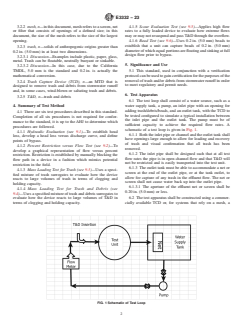
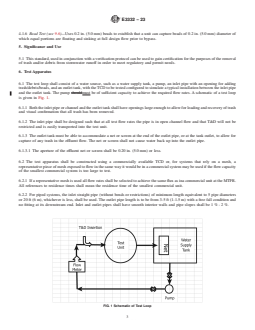
schematic of a test loop is given in Fig. 1.
4.1.1 Hydraulic Evaluation (see 9.1)—To establish head
6.1.1 Both the inlet pipe or channel and the outlet tank shall
loss, develop a head loss versus discharge curve, and define
have openings large enough to allow for loading and recovery
points of bypass.
of trash and visual confirmation that all trash has been
4.1.2 Percent Restriction versus Flow Test (see 9.2)—To
removed.
develop a graphical representation of flow versus percent
6.1.2 The inlet pipe shall be designed such that at all test
restriction. Restriction is established by manually blocking the
flow rates the pipe is in open channel flow and that T&D will
flow path in a device in a fashion which mimics potential
not be restricted and is easily transported into the test unit.
restriction in the field.
6.1.3 The outlet tank must be able to accommodate a net or
4.1.3 Mass Loading Test for Trash (see 9.3)—Uses a speci-
screen at the end of the outlet pipe, or at the tank outlet, to
fied mixture of trash surrogates to evaluate how the device
allow for capture of any trash in the effluent flow. The net or
reacts to large volumes of trash in terms of clogging and
screen shall not cause water back up into the outlet pipe.
holding capacity.
6.1.3.1 The aperture of the effluent net or screen shall be
4.1.4 Mass Loading Test for Trash and Debris (see
0.20 in. (5.0 mm) or less.
9.4)—Usesaspecifiedmixtureoftrashanddebrissurrogatesto
evaluate how the device reacts to large volumes of T&D in 6.2 The test apparatus shall be constructed using a commer-
terms of clogging and holding capacity. cially available TCD or, for systems that rely on a mesh, a
FIG. 1 Schematic of Test Loop
E3332 − 23
representative piece of mesh exposed to flow in the same way 6.4 Flow Measurement—A flow meter must be located
it would be in a commercial system may be used if the flow upstream of the TCD in a full pipe condition. If a standpipe or
capacity of the smallest commercial system is too large to test. similar is used, the head level in this tank must also be
reported.
6.2.1 If a representative mesh is used all flow rates shall be
selected to achieve the same flux as ina commercial unit at the
6.4.1 Flow measurements shall be made to an accuracy of
MTFR. All references to residence times shall mean the
61 % of measured flow. The average flow rate shall be within
residence time of the smallest commercial unit.
610 %ofthetargetvalueforcontrolledlaboratorytesting.The
6.2.2 For piped systems, the inlet straight pipe (without
acceptable coefficient of variation of measurements is 0.03.All
bends or restrictions) of minimum length equivalent to 5 pipe
flow meters must be located a sufficient distance away from
diameters or 20 ft (6 m), whichever is less, shall be used. The
any velocity or turbulence increasing devices (valves, pumps,
outlet pipe length is to be from 3-5 ft (1-1.5 m) with a free fall
elbows, flanges, etc.) to allow for proper operation, and
condition and no fitting at its downstream end. Inlet and outlet
mounted as required by the instrument manufacturer.
pipes shall have smooth interior walls and pipe slopes shall be
6.4.2 Allflowmetersusedinthismethodmustbecalibrated
1%-2%.
annually and copies of flow meter calibrations shall be in-
6.2.3 For curbed inlet systems or similar devices designed
cluded in the final report. The flow meter data logger must
to receive sheet flow, an artificial streetscape will be at the
record flows at a minimum of once per minute. The average
upstream end of the TCD inlet pipe referenced above and
flow rate over the test duration shall be reported.
connected to the TCD. The streetscape will typically be a 4 by
6.5 Water Surface Elevation (WSE)—Pressure heads or
8 ft (1.2 by 2.4 m), or smaller, sheet of plywood or polymer
water elevations shall be recorded to a minimum accuracy of
with sidewalls to contain flow. Gutter slope shall be at
0.25 in. (6 mm) for each condition tested to determine the head
1% 6 0.5 % longitudinal and 2 % 6 0.5 % cross slope. The
elevations. The locations of elevation measurements shall be
TCD outlet pipe is to be in a standard configuration (for
fixed for all flow conditions. Elevation measurements shall be
example, with or without a sump, inverted elbow) and
recorded in the influent and effluent pipes at locations 1-2 pipe
equipped with the minimum outlet pipe diameter normally
diameters upstream and downstream of the unit. Internal
associatedwiththedevice.Thestreetscapemustbedesignedto
measurements shall be recorded at a location that allows
direct the flow to the inlet without dead zones which allow for
determinationofbypassflow.Measurementsaretoberecorded
the capture of test material on the streetscape.
using a data acquisition (DA) system and differential pressure
6.2.4 For CBIs, the geometry of the supporting catch basin
(DP)cellorpoint-gagesystemorpressuretransdcuersadjusted
must be consistent with manufacturers design and installation
to a known reference. Manual measurements using an engi-
guidelines.
neer’sscaleareacceptableforestimatedelevationsandshallbe
6.3 Water source can be recirculated municipal water, well
recorded as such.
water, clear water from ponds, lakes, streams or rivers.
NOTE 2—When supercritical flow occurs in the outlet pipe, the energy
6.3.1 For water from ponds, lakes or streams, background
headattheoutletmayappeartoexceedtheenergyheadattheinletleading
particles greater than 0.04 in. (1 mm) are not allowed.
to erroneous determination of a loss coefficient. Under this condition, the
6.3.2 The presence and/or use of surfactants, flocculants or
critical depth at the outlet shall be determined and used for calculation of
other added chemicals is not allowed. the unit loss coefficient.
TABLE 1 Trash Removal Testing Materials
Component Description Dimensions % by Dry Mass
±10 %
Cigarette Filter regular cigarette filters (ex. OCB 0.28 in. (7 mm) diameter by 0.59 in. 14
brand) ~0.32 oz (9.15 g)/100 filters (15 mm)
A
Disposable wipes Standard baby wipes 7.5 in. by 2 in. 17
(19cmby5cm)
Wood Popsicle sticks 4.3 in. by 0.37 in. by 0.08 in. 11
(11cmby0.95cmby0.2cm)
Plastic-Moldable PET/ PETE plastic, 0.01 in. - 0.02 in. 3.5 in. by 1.0 in. 23
(0.3 - 0.5 mm) thick, cut in strips (9 cm by 2.5 cm)
Plastic-Film Plastic shopping bag split in half and 15.7inx3.1in 8
cut in strips (40cmx8cm)
Cardboard/Chipboard Cardboard box cut in strips 9 in. by 1 in. 10
(23cmby2.5cm)
Cloth Cotton linen fabric cut in strips 13.8 in. by 2 in. 6
(35cmby5cm)
Metal – Foil, Molded Rigid aluminum, 0.01 in. - 0.02 in. 4 in. by 1 in. 7
(0.3-0.5 mm) thick, cut in strips (10cmby2.5cm)
Styrofoam Standard “S”-shaped peanut packing 1.2 in. by 1.4 in. by 0.7 in. 4
material, non-disintegrating (3 cm by 3.5 cm by 1.5 cm)
A
Disposable wipes can be weighed as they come from the package, drying is not necessary.
...
This document is not an ASTM standard and is intended only to provide the user of an ASTM standard an indication of what changes have been made to the previous version. Because
it may not be technically possible to adequately depict all changes accurately, ASTM recommends that users consult prior editions as appropriate. In all cases only the current version
of the standard as published by ASTM is to be considered the official document.
Designation: E3332 − 22 E3332 − 23
Standard Test Method for
Determining Trash and/or Debris Capture Performance of
Stormwater Control Measures
This standard is issued under the fixed designation E3332; the number immediately following the designation indicates the year of
original adoption or, in the case of revision, the year of last revision. A number in parentheses indicates the year of last reapproval. A
superscript epsilon (´) indicates an editorial change since the last revision or reapproval.
1. Scope
1.1 The scope of this standard is to provide test criteria for the evaluation of Stormwater Control Measures (SCM), especially
Manufactured stormwater Treatment Devices (MTDs), for the removal of trash and/or debris greater than 5 mm in at least two
dimensions in a laboratory setting. The use of this standard in conjunction with an appropriate verification program allows for the
publication of verified reporting for use in gaining certification by Authorities Having Jurisdiction (AHJs).
1.2 For the purpose of this method, a Trash Capture Device (TCD) is an SCM that has the capacity to capture and retain trash
and or debris. This may be the primary objective of the device or it may be a secondary feature of a device designed primarily
as a Hydrodynamic Separator (HDS) or a filter for capturing sediment particles. This protocol does not address the sediment
removal of such devices.
1.3 Units—The values stated in inch-pound units are to be regarded as standard, except for methods to establish and report
sediment concentration and particle size. It is convention to exclusively describe sediment concentration in mg/L and particle size
in mm or μm, both of which are SI units. The SI units given in parentheses are mathematical conversions, which are provided for
information purposes only and are not considered standard. Reporting of test results in units other than inch-pound units shall not
be regarded as non-conformance with this test method.
1.4 Acceptance of test results attained according to this specification may be subject to specific requirements set by a Quality
Assurance Project Plan (QAPP), a specific verification protocol, or AHJ. It is advised to review one or all of the above to ensure
compliance
1.5 This standard does not purport to address all of the safety concerns, if any, associated with its use. It is the responsibility
of the user of this standard to establish appropriate safety, health, and environmental practices and determine the applicability of
regulatory limitations prior to use.
1.6 This international standard was developed in accordance with internationally recognized principles on standardization
established in the Decision on Principles for the Development of International Standards, Guides and Recommendations issued
by the World Trade Organization Technical Barriers to Trade (TBT) Committee.
2. Referenced Documents
2.1 ASTM Standards:
This test method is under the jurisdiction of ASTM Committee E64 on Stormwater Control Measures and is the direct responsibility of Subcommittee E64.01 on Lab
Evaluation.
Current edition approved April 15, 2022Jan. 1, 2023. Published May 2022January 2023. Originally approved in 2022. Last previous edition approved in 2022 as
E3332 – 22. DOI: 10.1520/E3332-2210.1520/E3332-23.
For referenced ASTM standards, visit the ASTM website, www.astm.org, or contact ASTM Customer Service at service@astm.org. For Annual Book of ASTM Standards
volume information, refer to the standard’s Document Summary page on the ASTM website.
Copyright © ASTM International, 100 Barr Harbor Drive, PO Box C700, West Conshohocken, PA 19428-2959. United States
E3332 − 23
E3318 Terminology for Standards Relating to Stormwater Control Measures
2.2 Other Documents:
CTSW-RT-05-73-18.1 Laboratory Testing Of Gross Solids Removal Devices
Caltrans Document No. CT-SW-RT-00-013 California Department of Transportation (Caltrans) District 7 Litter Management
Pilot Study
3. Terminology
3.1 Definitions:
3.1.1 For definitions of common technical terms used in this standard, refer to Terminology E3318.
NOTE 1—The terms and definitions related to this standard also relate to other standards currently being balloted. As such they are being balloted
separately in a single terminology document ASTM E3318.
3.2 Definitions of Terms Specific to This Standard:
3.2.1 Catch Basin Insert (CBI), n—a device that is installed within a catch basin.
3.2.1.1 Discussion—
Aside from dimensioning, the operation of the CBI is independent of the hydraulic operation of the structure but may be dependent
on the presence of sumps or inverted outlets.
3.2.2 mesh, n—in this document, mesh refers to a screen, net or filter that consists of openings of a defined size; in this document,
the size of the mesh refers to the size of the largest opening.
3.2.3 trash, n—solids of anthropogenic origins greater than 0.2 in. (5.0 mm) in at least two dimensions.
3.2.3.1 Discussion—
Examples include plastic, paper, glass, metal. Trash can be floatable, neutrally buoyant or sinkable.
3.2.3.2 Discussion—
In this case, due to the California TMDL, 5.0 mm is the standard and 0.2 in. is actually the mathematical conversion.
3.2.4 Trash Capture Device (TCD), n—an MTD that is designed to remove trash and debris from stormwater runoff and, in some
cases, wind-blown or saltating trash and debris.
3.2.5 T&D, n—trash and debris
4. Summary of Test Method
4.1 There are six test procedures described in this standard. Completion of all six procedures is not required for conformance to
the standard, it is up to the AHJ to determine which procedures are followed.
4.1.1 Hydraulic Evaluation (see 9.1)—To establish head loss, develop a head loss versus discharge curve, and define points of
bypass.
4.1.2 Percent Restriction versus Flow Test (see 9.2)—To develop a graphical representation of flow versus percent restriction.
Restriction is established by manually blocking the flow path in a device in a fashion which mimics potential restriction in the field.
4.1.3 Mass Loading Test for Trash (see 9.3)—Uses a specified mixture of trash surrogates to evaluate how the device reacts to large
volumes of trash in terms of clogging and holding capacity.
4.1.4 Mass Loading Test for Trash and Debris (see 9.4)—Uses a specified mixture of trash and debris surrogates to evaluate how
the device reacts to large volumes of T&D in terms of clogging and holding capacity.
4.1.5 Scour Evaluation Test (see 9.5)—Applies high flow rates to a fully loaded device to evaluate how extreme flows may or may
not resuspend and pass T&D through the overflow.
Available from: http://www.dot.ca.gov/hq/env/stormwater/pdf/CTSW-RT-05-073-18-1.pdf
E3332 − 23
4.1.6 Bead Test (see 9.6)—Uses 0.2 in. (5.0 mm) beads to establish that a unit can capture beads of 0.2 in. (5.0 mm) diameter of
which equal portions are floating and sinking at full design flow prior to bypass.
5. Significance and Use
5.1 This standard, used in conjunction with a verification protocol can be used to gain certification for the purposes of the removal
of trash and/or debris from stormwater runoff in order to meet regulatory and permit needs.
6. Test Apparatus
6.1 The test loop shall consist of a water source, such as a water supply tank, a pump, an inlet pipe with an opening for adding
trash/debris/beads, and an outlet tank, with the TCD to be tested configured to simulate a typical installation between the inlet pipe
and the outlet tank. The pump shouldmust be of sufficient capacity to achieve the required flow rates. A schematic of a test loop
is given in Fig. 1.
6.1.1 Both the inlet pipe or channel and the outlet tank shall have openings large enough to allow for loading and recovery of trash
and visual confirmation that all trash has been removed.
6.1.2 The inlet pipe shall be designed such that at all test flow rates the pipe is in open channel flow and that T&D will not be
restricted and is easily transported into the test unit.
6.1.3 The outlet tank must be able to accommodate a net or screen at the end of the outlet pipe, or at the tank outlet, to allow for
capture of any trash in the effluent flow. The net or screen shall not cause water back up into the outlet pipe.
6.1.3.1 The aperture of the effluent net or screen shall be 0.20 in. (5.0 mm) or less.
6.2 The test apparatus shall be constructed using a commercially available TCD or, for systems that rely on a mesh, a
representative piece of mesh exposed to flow in the same way it would be in a commercial system may be used if the flow capacity
of the smallest commercial system is too large to test.
6.2.1 If a representative mesh is used all flow rates shall be selected to achieve the same flux as ina commercial unit at the MTFR.
All references to residence times shall mean the residence time of the smallest commercial unit.
6.2.2 For piped systems, the inlet straight pipe (without bends or restrictions) of minimum length equivalent to 5 pipe diameters
or 20 ft (6 m), whichever is less, shall be used. The outlet pipe length is to be from 3-5 ft (1-1.5 m) with a free fall condition and
no fitting at its downstream end. Inlet and outlet pipes shall have smooth interior walls and pipe slopes shall be 1 % - 2 %.
FIG. 1 Schematic of Test Loop
E3332 − 23
6.2.3 For curbed inlet systems or similar devices designed to receive sheet flow, an artificial streetscape will be at the upstream
end of the TCD inlet pipe referenced above and connected to the TCD. The streetscape will typically be a 4 by 8 ft (1.2 by 2.4
m), or smaller, sheet of plywood or polymer with sidewalls to contain flow. Gutter slope shall be at 1 % 6 0.5 % longitudinal and
2 % 6 0.5 % cross slope. The TCD outlet pipe is to be in a standard configuration (for example, with or without a sump, inverted
elbow) and equipped with the minimum outlet pipe diameter normally associated with the device. The streetscape must be designed
to direct the flow to the inlet without dead zones which allow for the capture of test material on the streetscape.
6.2.4 For CBIs, the geometry of the supporting catch basin must be consistent with manufacturers design and installation
guidelines.
6.3 Water source can be recirculated municipal water, well water, clear water from ponds, lakes, streams or rivers.
6.3.1 For water from ponds, lakes or streams, background particles greater than 0.04 in. (1 mm) are not allowed.
6.3.2 The presence and/or use of surfactants, flocculants or other added chemicals is not allowed.
6.4 Flow Measurement—A flow meter must be located upstream of the TCD in a full pipe condition. If a standpipe or similar is
used, the head level in this tank must also be reported.
6.4.1 Flow measurements shall be made to an accuracy of 61 % of measured flow. The average flow rate shall be within 610 %
of the target value for controlled laboratory testing. The acceptable coefficient of variation of measurements is 0.03. All flow meters
must be located a sufficient distance away from any velocity or turbulence increasing devices (valves, pumps, elbows, flanges, etc.)
to allow for proper operation, and mounted as required by the instrument manufacturer.
6.4.2 All flow meters used in this method must be calibrated annually and copies of flow meter calibrations shall be included in
the final report. The flow meter data logger must record flows at a minimum of once per minute. The average flow rate over the
test duration shall be reported.
6.5 Water Surface Elevation (WSE)—Pressure heads or water elevations shall be recorded to a minimum accuracy of 0.25 in.
(6 mm) for each condition tested to determine the head elevations. The locations of elevation measurements shall be fixed for all
flow conditions. Elevation measurements shall be recorded in the influent and effluent pipes at locations 1-2 pipe diameters
upstream and downstream of the unit. Internal measurements shall be recorded at a location that allows determination of bypass
flow. Measurements are to be recorded using a data acquisition (DA) system and differential pressure (DP) cell or point-gage
system or pressure transdcuers adjusted to a known reference. Manual measurements using an engineer’s scale are acceptable for
estimated elevations and shall be recorded as such.
NOTE 2—When supercritical flow occurs in the outlet pipe, the energy head at the outlet may appear to exceed the energy head at the inlet leading to
erroneous determination of a loss coefficient. Under this condition, the critical depth at the outlet shall be determined and used for calculation of the unit
loss coefficient.
6.6 Materials:
6.6.1 The materials in Tables 1-3 are used to simulate Trash or Debris:
7. Preparation of Test Loop
7.1 Prior to commencement of the tests the test loop should be constructed and tested to be in compliance with this standard
including:
7.1.1 Enough hydraulic capacity to convey the maximum test flows.
7.1.2 All instruments are operating within parameters set by this standard.
7.1.3 All data loggers are operational.
E3332 − 23
TABLE 1 Trash Removal Testing Materials
Component Description Dimensions % by Dry Mass
±10 %
Cigarette Filter regular cigarette filters (ex. OCB 0.28 in. (7 mm) diameter by 0.59 in. 14
brand) ~0.32 oz (9.15 g)/100 filters (15 mm)
A
Disposable wipes Standard baby wipes 7.5 in. by 2 in. 17
(19 cm by 5 cm)
Wood Popsicle sticks 4.3 in. by 0.37 in. by 0.08 in. 11
(11 cm by 0.95 cm by 0.2 cm)
Plastic-Moldable PET/ PETE plastic, 0.01 in. - 0.02 in. 3.5 in. by 1.0 in. 23
(0.3 - 0.5 mm) thick, cut in strips (9 cm by 2.5 cm)
Plastic-Film Plastic shopping bag split in half and 15.7
...