

ASTM B1023-22
(Test Method)Standard Test Method for Abrasion Resistance of Hard Anodic Coatings by a Taber-Type Abraser
General Information
- Abstract
SIGNIFICANCE AND USE
5.1 Hard anodic oxidation coatings are often used to obtain improved resistance to abrasion, and have been used in such applications as valves, sliding parts, hinge mechanisms, cams, gears, swivel joints, pistons, insulation plates, blast shields, etc.
5.2 This abrasion resistance test method may be useful for acceptance testing of a hard anodic coating, and it can be used to evaluate the effects of processing variables such as substrate preparation before coating, surface texture, coating technique variables, and post coating treatments.
5.3 Results may be used for process control, comparative ranking, or to correlate with end-use performance. The resistance of material surfaces to abrasion, as measured on a testing machine in the laboratory, is generally only one of several factors contributing to wear performance as experienced in the actual use of the material. Other factors may need to be considered in any calculation of predicted life from specific abrasion data.
5.4 The properties and characteristics of hard anodic oxidation coatings are significantly affected by both the alloy and the method of production.
Note 2: Hard anodizing will usually result in a dimensional increase on each surface equal to about 50 % of the coating thickness. Normal thickness for wear applications tends to be 40 µm to 60 µm; however the thickness of anodized coatings often ranges between 8 µm to 150 µm.
5.5 The resistance of hard anodic coatings to abrasion may be affected by factors including test conditions, type of abradant, pressure between the specimen and abradant, composition of the alloy, thickness of the coating, and the conditions of anodizing or sealing, or both.
Note 3: The resistance to abrasion is generally measured on unsealed anodic oxidation coatings. While corrosion resistance is often increased by sealing the coating, it has been observed that sealing or dyeing can reduce the resistance to abrasion by over 50 %.
5.6 The outer surface of the anod...
SCOPE
1.1 This test method quantifies the abrasion resistance of electrolytically formed hard anodic oxidation coatings on a plane, rigid surface of aluminum or aluminum alloy.
1.2 This test uses a Taber-type abraser,2 which generates a combination of rolling and rubbing to cause wear to the coating surface. Wear is quantified as cumulative mass loss or loss in mass per thousand cycles of abrasion.
1.3 Units—The values stated in SI units are to be regarded as standard. No other units of measurement are included in this standard.
Note 1: The procedure described in Method A is similar to MIL-PRF-8625 (paragraph 4.5.5) and SAE AMS 2469 (paragraph 3.3.4). The procedure described in Method B includes a break-in period of 1000 cycles and is similar to ISO 10074 Annex B. When no procedure is specified, Method A shall be the default procedure. Although the procedures described in this method may be similar, they are not equivalent to Specification B893 or Test Method D4060.
1.4 This standard does not purport to address all of the safety concerns, if any, associated with its use. It is the responsibility of the user of this standard to establish appropriate safety, health, and environmental practices and determine the applicability of regulatory limitations prior to use.
1.5 This international standard was developed in accordance with internationally recognized principles on standardization established in the Decision on Principles for the Development of International Standards, Guides and Recommendations issued by the World Trade Organization Technical Barriers to Trade (TBT) Committee.
- Status
- Published
- Publication Date
- 31-Jul-2022
- Technical Committee
- B08 - Metallic and Inorganic Coatings
- Drafting Committee
- B08.10 - Test Methods
Overview
ASTM B1023-22: Standard Test Method for Abrasion Resistance of Hard Anodic Coatings by a Taber-Type Abraser specifies a procedure for quantifying the abrasion resistance of electrolytically formed hard anodic oxidation coatings on plane, rigid surfaces of aluminum or aluminum alloys. Utilizing a Taber-type abraser, this standardized method evaluates wear characteristics by measuring mass loss of coatings subjected to controlled rubbing and rolling actions. The process is essential for the assessment and quality control of hard anodized coatings, widely used for enhancing wear performance in critical engineering components.
Key Topics
- Abrasion Testing: The method employs a Taber-type abraser to simulate wear using controlled conditions of pressure and abrasive action. The rolling and rubbing motion of abrasive wheels across the test specimen yields measurable wear, particularly cumulative mass loss or loss in mass per thousand cycles.
- Acceptance and Process Control: This test serves as an acceptance criterion for hard anodic coatings and allows manufacturers and end-users to evaluate substrate preparation, surface texture, coating variables, and post-coating treatments.
- Impact of Coating and Test Factors: Abrasion resistance varies due to factors like alloy composition, coating thickness, method of anodizing, sealing conditions, and the type and pressure of the abradant used. Notably, sealing or dyeing the coating enhances corrosion resistance but may reduce abrasion resistance by over 50%.
- Measurement and Calculation: Wear index is determined by weighing the specimen before and after abrasion cycles. Two approaches (Method A and Method B) address surface variability and bulk coating performance, using specific calculations for mass loss and wear index as per test requirements.
- Test Environment and Preparation: Sample conditioning at controlled temperature and humidity, proper specimen geometry, and resurfacing of abrasive wheels are crucial for consistent results.
Applications
Hard anodic coatings tested by ASTM B1023-22 are vital for applications demanding superior abrasion resistance, such as:
- Mechanical Components: Valves, gears, cams, pistons, and hinge mechanisms in automotive, aerospace, and industrial equipment.
- Sliding and Rotating Parts: Swivel joints, sliding plates, and insulation plates that frequently encounter abrasive motion or particulates.
- Protective Shields: Blast shields and protective barriers where wear and surface degradation can compromise safety and performance.
This abrasion resistance test method helps manufacturers qualify coatings for rigorous operational environments, supports material selection, and informs maintenance or replacement cycles. It is also crucial for process optimization, comparative analysis of different coatings, and correlation with real-world wear scenarios.
Related Standards
ASTM B1023-22 references several key international and industry standards for context and best practices in anodic coatings testing, including:
- MIL-PRF-8625: Anodic Coatings for Aluminum and Aluminum Alloys
- SAE AMS 2469: Hard Anodic Coating Treatment of Aluminum and Aluminum Alloys
- ISO 10074: Hard Anodic Oxidation Coatings on Aluminium and Its Alloys
- ASTM D4060: Test Method for Abrasion Resistance of Organic Coatings by the Taber Abraser
- ASTM G195: Guide for Conducting Wear Tests Using a Rotary Platform Abraser
- ASTM B893: Specification for Hard-Coat Anodizing of Magnesium for Engineering Applications
Manufacturers and testing laboratories rely on these referenced documents for guidance on test setup, specimen preparation, and interpretation of results, ensuring consistency and global alignment with recognized best practices.
Keywords: abrasion resistance, hard anodic coating, Taber-type abraser, aluminum alloy, wear testing, ASTM B1023-22, process control, anodizing, mass loss, wear index.
Relations
- Effective Date
- 01-May-2014
- Effective Date
- 01-Nov-2013
- Effective Date
- 01-Jul-2013
- Effective Date
- 01-May-2013
- Effective Date
- 01-May-2013
- Effective Date
- 01-May-2013
- Effective Date
- 01-Nov-2011
- Effective Date
- 01-Apr-2011
- Effective Date
- 01-Oct-2010
- Effective Date
- 01-Feb-2010
- Effective Date
- 01-Oct-2008
- Effective Date
- 01-Oct-2008
- Refers
ASTM G195-08 - Standard Guide for Conducting Wear Tests Using a Rotary Platform, Double-Head Abraser - Effective Date
- 01-May-2008
- Effective Date
- 01-Apr-2008
- Effective Date
- 01-Jun-2007
Get Certified
Connect with accredited certification bodies for this standard

BUREAU VERITAS Certification Germany
Bureau Veritas certification in Germany.

DVS-ZERT GmbH
German welding certification society.

Element Materials Technology
Materials testing and product certification.
Sponsored listings
Frequently Asked Questions
ASTM B1023-22 is a standard published by ASTM International. Its full title is "Standard Test Method for Abrasion Resistance of Hard Anodic Coatings by a Taber-Type Abraser". This standard covers: SIGNIFICANCE AND USE 5.1 Hard anodic oxidation coatings are often used to obtain improved resistance to abrasion, and have been used in such applications as valves, sliding parts, hinge mechanisms, cams, gears, swivel joints, pistons, insulation plates, blast shields, etc. 5.2 This abrasion resistance test method may be useful for acceptance testing of a hard anodic coating, and it can be used to evaluate the effects of processing variables such as substrate preparation before coating, surface texture, coating technique variables, and post coating treatments. 5.3 Results may be used for process control, comparative ranking, or to correlate with end-use performance. The resistance of material surfaces to abrasion, as measured on a testing machine in the laboratory, is generally only one of several factors contributing to wear performance as experienced in the actual use of the material. Other factors may need to be considered in any calculation of predicted life from specific abrasion data. 5.4 The properties and characteristics of hard anodic oxidation coatings are significantly affected by both the alloy and the method of production. Note 2: Hard anodizing will usually result in a dimensional increase on each surface equal to about 50 % of the coating thickness. Normal thickness for wear applications tends to be 40 µm to 60 µm; however the thickness of anodized coatings often ranges between 8 µm to 150 µm. 5.5 The resistance of hard anodic coatings to abrasion may be affected by factors including test conditions, type of abradant, pressure between the specimen and abradant, composition of the alloy, thickness of the coating, and the conditions of anodizing or sealing, or both. Note 3: The resistance to abrasion is generally measured on unsealed anodic oxidation coatings. While corrosion resistance is often increased by sealing the coating, it has been observed that sealing or dyeing can reduce the resistance to abrasion by over 50 %. 5.6 The outer surface of the anod... SCOPE 1.1 This test method quantifies the abrasion resistance of electrolytically formed hard anodic oxidation coatings on a plane, rigid surface of aluminum or aluminum alloy. 1.2 This test uses a Taber-type abraser,2 which generates a combination of rolling and rubbing to cause wear to the coating surface. Wear is quantified as cumulative mass loss or loss in mass per thousand cycles of abrasion. 1.3 Units—The values stated in SI units are to be regarded as standard. No other units of measurement are included in this standard. Note 1: The procedure described in Method A is similar to MIL-PRF-8625 (paragraph 4.5.5) and SAE AMS 2469 (paragraph 3.3.4). The procedure described in Method B includes a break-in period of 1000 cycles and is similar to ISO 10074 Annex B. When no procedure is specified, Method A shall be the default procedure. Although the procedures described in this method may be similar, they are not equivalent to Specification B893 or Test Method D4060. 1.4 This standard does not purport to address all of the safety concerns, if any, associated with its use. It is the responsibility of the user of this standard to establish appropriate safety, health, and environmental practices and determine the applicability of regulatory limitations prior to use. 1.5 This international standard was developed in accordance with internationally recognized principles on standardization established in the Decision on Principles for the Development of International Standards, Guides and Recommendations issued by the World Trade Organization Technical Barriers to Trade (TBT) Committee.
SIGNIFICANCE AND USE 5.1 Hard anodic oxidation coatings are often used to obtain improved resistance to abrasion, and have been used in such applications as valves, sliding parts, hinge mechanisms, cams, gears, swivel joints, pistons, insulation plates, blast shields, etc. 5.2 This abrasion resistance test method may be useful for acceptance testing of a hard anodic coating, and it can be used to evaluate the effects of processing variables such as substrate preparation before coating, surface texture, coating technique variables, and post coating treatments. 5.3 Results may be used for process control, comparative ranking, or to correlate with end-use performance. The resistance of material surfaces to abrasion, as measured on a testing machine in the laboratory, is generally only one of several factors contributing to wear performance as experienced in the actual use of the material. Other factors may need to be considered in any calculation of predicted life from specific abrasion data. 5.4 The properties and characteristics of hard anodic oxidation coatings are significantly affected by both the alloy and the method of production. Note 2: Hard anodizing will usually result in a dimensional increase on each surface equal to about 50 % of the coating thickness. Normal thickness for wear applications tends to be 40 µm to 60 µm; however the thickness of anodized coatings often ranges between 8 µm to 150 µm. 5.5 The resistance of hard anodic coatings to abrasion may be affected by factors including test conditions, type of abradant, pressure between the specimen and abradant, composition of the alloy, thickness of the coating, and the conditions of anodizing or sealing, or both. Note 3: The resistance to abrasion is generally measured on unsealed anodic oxidation coatings. While corrosion resistance is often increased by sealing the coating, it has been observed that sealing or dyeing can reduce the resistance to abrasion by over 50 %. 5.6 The outer surface of the anod... SCOPE 1.1 This test method quantifies the abrasion resistance of electrolytically formed hard anodic oxidation coatings on a plane, rigid surface of aluminum or aluminum alloy. 1.2 This test uses a Taber-type abraser,2 which generates a combination of rolling and rubbing to cause wear to the coating surface. Wear is quantified as cumulative mass loss or loss in mass per thousand cycles of abrasion. 1.3 Units—The values stated in SI units are to be regarded as standard. No other units of measurement are included in this standard. Note 1: The procedure described in Method A is similar to MIL-PRF-8625 (paragraph 4.5.5) and SAE AMS 2469 (paragraph 3.3.4). The procedure described in Method B includes a break-in period of 1000 cycles and is similar to ISO 10074 Annex B. When no procedure is specified, Method A shall be the default procedure. Although the procedures described in this method may be similar, they are not equivalent to Specification B893 or Test Method D4060. 1.4 This standard does not purport to address all of the safety concerns, if any, associated with its use. It is the responsibility of the user of this standard to establish appropriate safety, health, and environmental practices and determine the applicability of regulatory limitations prior to use. 1.5 This international standard was developed in accordance with internationally recognized principles on standardization established in the Decision on Principles for the Development of International Standards, Guides and Recommendations issued by the World Trade Organization Technical Barriers to Trade (TBT) Committee.
ASTM B1023-22 is classified under the following ICS (International Classification for Standards) categories: 25.220.99 - Other treatments and coatings; 49.040 - Coatings and related processes used in aerospace industry. The ICS classification helps identify the subject area and facilitates finding related standards.
ASTM B1023-22 has the following relationships with other standards: It is inter standard links to ASTM E177-14, ASTM G195-13a, ASTM G195-13, ASTM E691-13, ASTM B893-98(2013), ASTM E177-13, ASTM E691-11, ASTM B374-06(2011), ASTM E177-10, ASTM D4060-10, ASTM E177-08, ASTM E691-08, ASTM G195-08, ASTM B893-98(2008), ASTM D4060-07. Understanding these relationships helps ensure you are using the most current and applicable version of the standard.
ASTM B1023-22 is available in PDF format for immediate download after purchase. The document can be added to your cart and obtained through the secure checkout process. Digital delivery ensures instant access to the complete standard document.
Standards Content (Sample)
This international standard was developed in accordance with internationally recognized principles on standardization established in the Decision on Principles for the
Development of International Standards, Guides and Recommendations issued by the World Trade Organization Technical Barriers to Trade (TBT) Committee.
Designation: B1023 − 22
Standard Test Method for
Abrasion Resistance of Hard Anodic Coatings by a Taber-
Type Abraser
This standard is issued under the fixed designation B1023; the number immediately following the designation indicates the year of
original adoption or, in the case of revision, the year of last revision. A number in parentheses indicates the year of last reapproval. A
superscript epsilon (´) indicates an editorial change since the last revision or reapproval.
1. Scope B893 Specification for Hard-Coat Anodizing of Magnesium
for Engineering Applications
1.1 This test method quantifies the abrasion resistance of
D4060 Test Method for Abrasion Resistance of Organic
electrolytically formed hard anodic oxidation coatings on a
Coatings by the Taber Abraser
plane, rigid surface of aluminum or aluminum alloy.
E177 Practice for Use of the Terms Precision and Bias in
1.2 This test uses a Taber-type abraser, which generates a
ASTM Test Methods
combinationofrollingandrubbingtocauseweartothecoating
E691 Practice for Conducting an Interlaboratory Study to
surface. Wear is quantified as cumulative mass loss or loss in
Determine the Precision of a Test Method
mass per thousand cycles of abrasion.
G195 Guide for Conducting Wear Tests Using a Rotary
Platform Abraser
1.3 Units—The values stated in SI units are to be regarded
as standard. No other units of measurement are included in this
2.2 ISO Standard:
standard.
ISO 10074 Specification for Hard Anodic Oxidation Coat-
ings on Aluminium and Its Alloys
NOTE 1—The procedure described in MethodAis similar to MIL-PRF-
2.3 SAE Standard:
8625 (paragraph 4.5.5) and SAE AMS 2469 (paragraph 3.3.4). The
procedure described in Method B includes a break-in period of 1000
SAE AMS 2469 Hard Anodic Coating Treatment of Alumi-
cycles and is similar to ISO 10074 Annex B. When no procedure is
num andAluminumAlloys – Processing and Performance
specified, Method A shall be the default procedure. Although the proce-
Requirements
dures described in this method may be similar, they are not equivalent to
Specification B893 or Test Method D4060. 2.4 Other Standard:
MIL-PRF-8625 Anodic Coatings for Aluminum and Alumi-
1.4 This standard does not purport to address all of the
num Alloys
safety concerns, if any, associated with its use. It is the
responsibility of the user of this standard to establish appro-
3. Terminology
priate safety, health, and environmental practices and deter-
mine the applicability of regulatory limitations prior to use.
3.1 Definitions:
1.5 This international standard was developed in accor- 3.1.1 For definitions of terms used in this test method, refer
dance with internationally recognized principles on standard-
to Terminology B374.
ization established in the Decision on Principles for the
3.2 Definitions of Terms Specific to This Standard:
Development of International Standards, Guides and Recom-
3.2.1 abraser, n—a wear testing instrument that is designed
mendations issued by the World Trade Organization Technical
to determine the resistance of surfaces to composite rolling and
Barriers to Trade (TBT) Committee.
rubbing action, also referred to as an abrader.
2. Referenced Documents 3.2.2 abrasion cycle, n—in abrasion testing, one or more
movements of the abradant across a material surface, or the
2.1 ASTM Standards:
material surface across the abradant, that permits a return to its
B374 Terminology Relating to Electroplating
starting position; in the case of a Taber-type abraser test
method, it consists of one complete rotation of the specimen
ThistestmethodisunderthejurisdictionofASTMCommitteeB08onMetallic
turntable platform.
and Inorganic Coatings and is the direct responsibility of Subcommittee B08.10 on
Test Methods.
Current edition approved Aug. 1, 2022. Published September 2022. DOI:
10.1520/B1023-22. Available from International Organization for Standardization (ISO), ISO
Taber is a registered trademark of Taber Industries. Central Secretariat, Chemin de Blandonnet 8, CP 401, 1214 Vernier, Geneva,
For referenced ASTM standards, visit the ASTM website, www.astm.org, or Switzerland, https://www.iso.org.
contact ASTM Customer Service at service@astm.org. For Annual Book of ASTM Available from SAE International (SAE), 400 Commonwealth Dr.,Warrendale,
Standards volume information, refer to the standard’s Document Summary page on PA 15096, http://www.sae.org.
the ASTM website. Available from IHS Markit, https://global.ihs.com/.
Copyright © ASTM International, 100 Barr Harbor Drive, PO Box C700, West Conshohocken, PA 19428-2959. United States
B1023 − 22
3.2.3 resurface, v—the procedure of cleaning and refreshing position of the alloy, thickness of the coating, and the condi-
the running surface of an abrasive wheel prior to use or during tions of anodizing or sealing, or both.
testing.
NOTE 3—The resistance to abrasion is generally measured on unsealed
3.2.4 wear index, n—the average mass loss in milligrams anodicoxidationcoatings.Whilecorrosionresistanceisoftenincreasedby
sealing the coating, it has been observed that sealing or dyeing can reduce
per thousand cycles of abrasion.
the resistance to abrasion by over 50 %.
3.3 Acronyms:
5.6 The outer surface of the anodic coating may be softer or
3.3.1 CAMI—Coated Abrasives Manufacturers Institute
lessdensewhichmaycauseagreatermasslossinthefirst1000
abrasion cycles than the remaining cycles. Two similar proce-
4. Summary of Test Method
dures are described in this test method. Method B does not
4.1 Aspecimenisabradedusingrotaryrubbingactionunder report the first 1000 abrasion cycles, so any surface variation
controlled conditions of pressure and abrasive action. The test
that may exist is reduced and a more representative value for
specimen, mounted on a turntable platform, turns on a vertical the bulk coating is obtained.
axis, against the sliding rotation of two abrasive wheels. The
5.7 Abrasion tests utilizing a Taber-type abraser may be
wheelsaremountedinsuchawaythatwhentheyareincontact
subject to variation due to changes in the abradant during the
with the rotating test specimen, they rotate in opposing
course of specific tests. Depending on abradant type and test
directions. One wheel rubs the specimen outward toward the
specimen,theabrasivewheelsurfacemaybecomecloggeddue
periphery and the other, inward toward the center while a
to the adhesion of wear debris generated during the test to the
vacuum suction system removes wear debris generated during
surface of the wheel. To provide a consistent rate of wear, the
the test.The resulting abrasion marks form a pattern of crossed
abrasive wheels must be resurfaced at defined intervals.
arcs in a circular wear path that covers an area of approxi-
mately 30 cm .
6. Apparatus
4.2 This test method uses a Taber-type abraser with CS-17
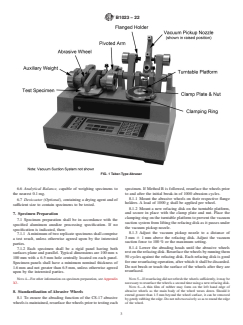
6.1 Abraser, Taber-type abraser as described in Guide G195
abrasive wheels and a load of 1000 g applied per wheel.
(see Fig. 1 and Fig. X2.1) with the auxiliary weights marked
4.3 A wear index may be used to measure the resistance to 1000 g. The auxiliary weight reference is per arm (not com-
abrasive wear, in which the lower the wear index, the better the bined) and includes the load of the pivoted arm and auxiliary
abrasion resistance quality of the material. weight, but not the load of the abrasive wheel.
6.2 Abrasive Wheels, which are attached to the free end of
5. Significance and Use
the pivoted arms and able to rotate freely about horizontal
spindles.
5.1 Hard anodic oxidation coatings are often used to obtain
6.2.1 The abrasive wheels consist of hard particles embed-
improved resistance to abrasion, and have been used in such
ded in a binder material and are manufactured in different
applications as valves, sliding parts, hinge mechanisms, cams,
grades of abrasive quality. Type CS-17 abrasive wheels shall
gears,swiveljoints,pistons,insulationplates,blastshields,etc.
beused,unlessotherwiseagreeduponbytheinterestedparties.
5.2 This abrasion resistance test method may be useful for
The wheels shall not be used after the expiration date stamped
acceptance testing of a hard anodic coating, and it can be used
on them.
to evaluate the effects of processing variables such as substrate
6.2.2 Each abrasive wheel shall be cylindrically shaped;
preparation before coating, surface texture, coating technique
have a diameter between 52.4 mm and 44.4 mm; a width of
variables, and post coating treatments.
12.7 mm 6 0.3 mm; and include an axial hole 16.0 mm 6
5.3 Results may be used for process control, comparative
0.1 mm in diameter to allow the wheel to be mounted to the
ranking, or to correlate with end-use performance. The resis-
flanged holder on the pivoted arms.
tance of material surfaces to abrasion, as measured on a testing
6.3 Refacing Disk, for resurfacing resilient abrasive wheels.
machine in the laboratory, is generally only one of several
The refacing disk shall be silicon carbide coated abrasive with
factors contributing to wear performance as experienced in the
an average particle size of 92 µm (150 grit CAMI grade),
actual use of the material. Other factors may need to be
102 mm diameter with a 7 mm center hole, such as type S-11
considered in any calculation of predicted life from specific
or equivalent.
abrasion data.
6.4 Wheel Refacer (Optional), diamond tool apparatus used
5.4 The properties and characteristics of hard anodic oxida-
for correcting out of round wheels.
tioncoatingsaresignificantlyaffectedbyboththealloyandthe
6.5 Soft Bristle Brush, with non-metallic bristles to remove
method of production.
loose particles from the surface of the specimen after testing.
NOTE 2—Hard anodizing will usually result in a dimensional increase
on each surface equal to about 50 % of the coating thickness. Normal
thickness for wear applications tends to be 40 µm to 60 µm; however the
thickness of anodized coatings often ranges between 8 µm to 150 µm.
The sole source of supply of the apparatus known to the committee at this time
is Taber Industries, 455 Bryant Street, North Tonawanda, NY 14120. If you are
5.5 The resistance of hard anodic coatings to abrasion may
aware of alternative suppliers, please provide this information to ASTM Interna-
be affected by factors including test conditions, type of
tional Headquarters.Your comments will receive careful consideration at a meeting
abradant, pressure between the specimen and abradant, com- of the responsible technical committee, which you may attend.
B1023 − 22
FIG. 1 Taber-Type Abraser
6.6 Analytical Balance, capable of weighing specimens to specimen. If Method B is followed, resurface the wheels prior
the nearest 0.1 mg. to and after the initial break-in of 1000 abrasion cycles.
8.1.1 Mount the abrasive wheels on their respective flange
6.7 Desiccator (Optional), containing a drying agent and of
holders. A load of 1000 g shall be applied per wheel.
sufficient size to contain specimens to be tested.
8.1.2 Mount a new refacing disk on the turntable platform,
7. Specimen Preparation and secure in place with the clamp plate and nut. Place the
clamping ring on the turntable platform to prevent the vacuum
7.1 Specimen preparation shall be in accordance with the
suction system from lifting the refacing disk as it passes under
specified aluminum anodize processing specification. If no
the vacuum pickup nozzle.
specification is indicated, then:
8.1.3 Adjust the vacuum pickup nozzle to a distance of
7.1.1 Aminimum of two replicate specimens shall comprise
3mm 6 1 mm above the refacing disk. Adjust the vacuum
a test result, unless otherwise agreed upon by the interested
suction force to 100 % or the maximum setting.
parties.
8.1.4 Lower the abrading heads until the abrasive wheels
7.1.2 Each specimen shall be a rigid panel having both
restontherefacingdisk.Resurfacethewheelsbyrunningthem
surfaces plane and parallel. Typical dimensions are 100 mm x
50 cycles against the refacing disk. Each refacing disk is good
100 mm with a 6.5 mm hole centrally located on each panel.
for one resurfacing operation, after which it shall be discarded.
Specimen panels shall have a minimum nominal thickness of
Do not brush or touch the surface of the wheels after they are
1.6 mm and not greater than 6.5 mm, unless otherwise agreed
resurfaced.
upon by the interested parties.
NOTE 5—If resurfacing did not refresh the wheels sufficiently, it may be
NOTE 4—For other information on specimen preparation, see Appendix
necessarytoresurfacethewheelsasecondtimeusinganewrefacingdisk.
X3.
NOTE 6—A thin film of rubber may form on the left hand edge of
abrasive wheels as the main body of the wheel wears down. Should it
8. Standardization of Abrasive Wheels
extend greater than 1.5 mm beyond the wheel surface, it can be removed
8.1 To ensure the abrading function of the CS-17 abrasive
bygentlyrubbingtheedge.Donotrubexcessivelysoastoroundtheedge
wheels is maintained, resurface the wheels prior to testing each of the wheel.
B1023 − 22
NOTE 7—A wheel refacer may be used to correct out of round
10.9 Unless otherwise agreed upon by the interested parties
conditions with the abrasive wheels. This condition is typically evidenced
or if quantity is indicated by the process specification, perform
by an up-and-down movement of one or both of the pivoted arms. After
a minimum of one additional replicate test following 10.1 –
correcting this condition, the abrasive wheels should be resurfaced
10.8.
according to 8.1.1 – 8.1.4.
11. Calculation of Results – Method A
9. Conditioning
11.1 Compute the mass loss, L (change in mass caused by
A
9.1 Conditioning—Unless otherwise agreed upon between
abrasion, in mg), as follows:
the interested parties, condition the specimens at 23 °C 65°C
L 5 W 2 W (1)
~ !
A 0 2
and no greater than 60 % relative humidity for a minimum of
24 h. Conduct the test in the same environment or immediately where:
on removal therefrom. Specimens may be placed in a desicca-
W = mass of test specimen before abrasion, mg, and
tor prior to and following the test.
W = mass of test specimen after abrasion, mg.
11.2 Compute the wear index, I (average mass loss per
NOTE8—Thefrictionbetweentheabrasivewheelsandspecimenduring
A
the test causes an increase in specimen temperature. As a result, it is not
thousand cycles, in mg), of a test specimen as follows:
critical to test or condition the specimen in a tightly controlled environ-
W 2 W 1000
~ !
0 2
ment.
I 5 (2)
A
C
9.1.1 If required by the interested parties, record tempera-
where:
ture and humidity during conditioning or testing, or both.
W = mass of test specimen before abrasion, mg,
W = mass of test specimen after abrasion, mg, and
10. Procedure – Method A
C = number of abrasion cycles recorded.
10.1 Condition the specimen according to 9.1.
12. Procedure – Method B
10.2 Just prior to testing, determine the mass of the test
12.1 Condition the specimen according to 9.1.
specimen to the nearest 0.1 mg and record this as W .
12.2 Follow the procedure outlined in 10.3 – 10.5.
10.3 Mount the test specimen on the turntable platform with
12.3 Lower the abrading heads and subject the test speci-
the side to be abraded facing up. Secure the specimen to the
men to an initial break-in of 1000 abrasion cycles. Remove the
turntable platform using the clamp plate and nut.
specimen from the turntable platform and use a soft bristle
10.4 Ensuretheauxiliaryweightsmarked1000 gareaffixed
brushorcleandrycompressedair,orboth,toremoveanyloose
to the weight mounts of the pivoted arms; and the vacuum
debris and abraded material.
suction and dist
...