

ASTM F3456-22
(Guide)Standard Guide for Powder Reuse Schema in Powder Bed Fusion Processes for Medical Applications for Additive Manufacturing Feedstock Materials
General Information
- Abstract
SIGNIFICANCE AND USE
4.1 In PBF systems, powder is often reused to increase feedstock efficiency by reducing waste. While in many applications the customer can rely on the manufacturer’s validation and verification activities to ensure their PBF process produces parts of the appropriate quality, some medical device regulatory bodies ask for the powder reuse schema to ensure that any effect of powder reuse on final device performance is assessed.5 The intention of this guide is to provide manufacturers, customers, and regulatory bodies concise terminology to describe powder feedstock reuse schema for PBF using metal or polymer feedstock. Additionally, a well-defined powder reuse schema may reduce the risk of feedstock contamination and associated defects within the manufacturer’s quality management system. Each schema represents a broad reuse strategy and is intended to be used as the starting point in describing a powder strategy to customers and regulatory bodies. While the focus of this guide is for medical applications, the schema referenced can be used for non-medical applications.
SCOPE
1.1 This guide provides a concise approach for users of powder bed fusion (PBF) processes to communicate the method(s) in which feedstock powders are controlled throughout the feedstock lifecycle.
1.1.1 Regulatory bodies may require descriptions of used powder reuse schemes in a submission. This is because a medical device's performance can be affected by the condition of the powder feedstock and current regulations are not prescriptive to powder.
1.1.2 This guide is intended for users of both polymer and metal feedstock powders.
1.2 This guide does not cover powder specifications, recycling strategy, blending processes, lot control, or address contamination prevention.
1.3 This standard does not purport to address all of the safety concerns, if any, associated with its use. It is the responsibility of the user of this standard to establish appropriate safety, health, and environmental practices and determine the applicability of regulatory limitations prior to use.
1.4 This international standard was developed in accordance with internationally recognized principles on standardization established in the Decision on Principles for the Development of International Standards, Guides and Recommendations issued by the World Trade Organization Technical Barriers to Trade (TBT) Committee.
- Status
- Published
- Publication Date
- 31-Mar-2022
- Technical Committee
- F42 - Additive Manufacturing Technologies
- Drafting Committee
- F42.07 - Applications
Overview
ASTM F3456-22 is a standard guide that defines a clear and concise schema for powder reuse in powder bed fusion (PBF) additive manufacturing processes, specifically for medical applications. This standard focuses on how feedstock powders-both metal and polymer-are managed throughout their lifecycle, supporting quality management and regulatory compliance for medical devices. Effective powder reuse strategies are critical in reducing material waste, controlling manufacturing costs, and ensuring consistent, high-quality performance of medical and non-medical devices produced by PBF techniques.
This document provides a vital framework for manufacturers, regulatory bodies, and customers to communicate powder reuse strategies in a standardized manner. Adopting a well-defined reuse schema can also help mitigate the risk of feedstock contamination and defects, supporting robust quality management systems aligned with regulatory requirements.
Key Topics
- Powder Reuse Schemas: The guide outlines several powder reuse strategies, including no reuse, discrete and continuous reuse, in-process reuse, and strategies that involve refreshing used powder with virgin powder.
- Traceability: Emphasizes the importance of traceability and naming conventions for powder lots, which is a regulatory and quality system requirement for medical device manufacturers.
- Sieving and Storage: Highlights considerations for sieving powders before use and validates procedures for handling powders during storage and transfer to prevent contamination.
- Assessment of Used Powder: Details the need to assess the exposure levels and thermal history of used powders, ensuring that their reuse does not detrimentally impact final product performance.
- Regulatory Context: Addresses specific documentation needs of regulatory bodies who may require disclosure of powder management strategies during device submissions, emphasizing that powder quality can affect device performance.
Applications
The practical value of ASTM F3456-22 extends across several areas:
- Medical Device Manufacturing: Provides guidance to medical device manufacturers using PBF additive manufacturing to communicate powder lifecycle processes clearly and align with quality management requirements such as those in ISO 13485 and FDA 21 CFR 820.60.
- Process Transparency for Regulators: Enables manufacturers to effectively describe and document powder reuse methods for regulatory submissions, which may be necessary to demonstrate that powder reuse does not compromise the safety or performance of medical devices.
- Quality Assurance: Supports the development and maintenance of robust powder management processes, improving traceability and reducing the risk of contamination or material property defects in finished parts.
- Non-Medical Applications: While focused on the medical sector, the powder reuse schemas presented can be applied to other industries utilizing powder bed fusion, such as aerospace and automotive manufacturing, to improve resource efficiency and part quality.
Related Standards
ASTM F3456-22 references and aligns with several key standards and regulatory requirements:
- ISO/ASTM 52900: General principles and fundamental terminology for additive manufacturing.
- ASTM B213, B214, B215, B822, B964: Standards addressing powder flow rate, sieve analysis, sampling, and particle size distribution for metal powders.
- ANSI/AAMI/ISO 13485: Quality management systems requirements for medical devices.
- 21 CFR 820.60 (FDA): Quality system regulation for identification and traceability of materials in medical device manufacturing.
These related standards provide complementary guidance for powder characterization, quality management, and regulatory compliance, supporting the holistic application of ASTM F3456-22 in the additive manufacturing industry.
Keywords: ASTM F3456-22, powder reuse schema, powder bed fusion, additive manufacturing, feedstock powder, medical devices, quality management, regulatory compliance, ISO/ASTM standards.
Relations
- Refers
ASTM B213-20 - Standard Test Methods for Flow Rate of Metal Powders Using the Hall Flowmeter Funnel - Effective Date
- 01-Apr-2020
- Refers
ASTM B213-13 - Standard Test Methods for Flow Rate of Metal Powders Using the Hall Flowmeter Funnel - Effective Date
- 01-Apr-2013
- Refers
ASTM B213-11 - Standard Test Methods for Flow Rate of Metal Powders Using the Hall Flowmeter Funnel - Effective Date
- 15-Nov-2011
- Effective Date
- 01-Oct-2011
- Effective Date
- 01-Dec-2010
- Effective Date
- 01-May-2010
- Effective Date
- 01-Apr-2009
- Effective Date
- 01-Nov-2008
- Effective Date
- 01-Jan-2007
- Effective Date
- 01-Oct-2004
- Effective Date
- 01-Oct-2003
- Effective Date
- 10-Apr-2002
- Effective Date
- 10-Apr-2002
- Effective Date
- 10-Apr-1999
- Effective Date
- 01-Jan-1997
Get Certified
Connect with accredited certification bodies for this standard

BSI Group
BSI (British Standards Institution) is the business standards company that helps organizations make excellence a habit.

TÜV Rheinland
TÜV Rheinland is a leading international provider of technical services.

TÜV SÜD
TÜV SÜD is a trusted partner of choice for safety, security and sustainability solutions.
Sponsored listings
Frequently Asked Questions
ASTM F3456-22 is a guide published by ASTM International. Its full title is "Standard Guide for Powder Reuse Schema in Powder Bed Fusion Processes for Medical Applications for Additive Manufacturing Feedstock Materials". This standard covers: SIGNIFICANCE AND USE 4.1 In PBF systems, powder is often reused to increase feedstock efficiency by reducing waste. While in many applications the customer can rely on the manufacturer’s validation and verification activities to ensure their PBF process produces parts of the appropriate quality, some medical device regulatory bodies ask for the powder reuse schema to ensure that any effect of powder reuse on final device performance is assessed.5 The intention of this guide is to provide manufacturers, customers, and regulatory bodies concise terminology to describe powder feedstock reuse schema for PBF using metal or polymer feedstock. Additionally, a well-defined powder reuse schema may reduce the risk of feedstock contamination and associated defects within the manufacturer’s quality management system. Each schema represents a broad reuse strategy and is intended to be used as the starting point in describing a powder strategy to customers and regulatory bodies. While the focus of this guide is for medical applications, the schema referenced can be used for non-medical applications. SCOPE 1.1 This guide provides a concise approach for users of powder bed fusion (PBF) processes to communicate the method(s) in which feedstock powders are controlled throughout the feedstock lifecycle. 1.1.1 Regulatory bodies may require descriptions of used powder reuse schemes in a submission. This is because a medical device's performance can be affected by the condition of the powder feedstock and current regulations are not prescriptive to powder. 1.1.2 This guide is intended for users of both polymer and metal feedstock powders. 1.2 This guide does not cover powder specifications, recycling strategy, blending processes, lot control, or address contamination prevention. 1.3 This standard does not purport to address all of the safety concerns, if any, associated with its use. It is the responsibility of the user of this standard to establish appropriate safety, health, and environmental practices and determine the applicability of regulatory limitations prior to use. 1.4 This international standard was developed in accordance with internationally recognized principles on standardization established in the Decision on Principles for the Development of International Standards, Guides and Recommendations issued by the World Trade Organization Technical Barriers to Trade (TBT) Committee.
SIGNIFICANCE AND USE 4.1 In PBF systems, powder is often reused to increase feedstock efficiency by reducing waste. While in many applications the customer can rely on the manufacturer’s validation and verification activities to ensure their PBF process produces parts of the appropriate quality, some medical device regulatory bodies ask for the powder reuse schema to ensure that any effect of powder reuse on final device performance is assessed.5 The intention of this guide is to provide manufacturers, customers, and regulatory bodies concise terminology to describe powder feedstock reuse schema for PBF using metal or polymer feedstock. Additionally, a well-defined powder reuse schema may reduce the risk of feedstock contamination and associated defects within the manufacturer’s quality management system. Each schema represents a broad reuse strategy and is intended to be used as the starting point in describing a powder strategy to customers and regulatory bodies. While the focus of this guide is for medical applications, the schema referenced can be used for non-medical applications. SCOPE 1.1 This guide provides a concise approach for users of powder bed fusion (PBF) processes to communicate the method(s) in which feedstock powders are controlled throughout the feedstock lifecycle. 1.1.1 Regulatory bodies may require descriptions of used powder reuse schemes in a submission. This is because a medical device's performance can be affected by the condition of the powder feedstock and current regulations are not prescriptive to powder. 1.1.2 This guide is intended for users of both polymer and metal feedstock powders. 1.2 This guide does not cover powder specifications, recycling strategy, blending processes, lot control, or address contamination prevention. 1.3 This standard does not purport to address all of the safety concerns, if any, associated with its use. It is the responsibility of the user of this standard to establish appropriate safety, health, and environmental practices and determine the applicability of regulatory limitations prior to use. 1.4 This international standard was developed in accordance with internationally recognized principles on standardization established in the Decision on Principles for the Development of International Standards, Guides and Recommendations issued by the World Trade Organization Technical Barriers to Trade (TBT) Committee.
ASTM F3456-22 is classified under the following ICS (International Classification for Standards) categories: 11.120.10 - Medicaments; 25.030 - Additive manufacturing. The ICS classification helps identify the subject area and facilitates finding related standards.
ASTM F3456-22 has the following relationships with other standards: It is inter standard links to ASTM B213-20, ASTM B213-13, ASTM B213-11, ASTM B214-07(2011), ASTM B215-10, ASTM B822-10, ASTM B964-09, ASTM B215-08, ASTM B214-07, ASTM B215-04, ASTM B213-03, ASTM B822-97, ASTM B822-02, ASTM B214-99, ASTM B213-97. Understanding these relationships helps ensure you are using the most current and applicable version of the standard.
ASTM F3456-22 is available in PDF format for immediate download after purchase. The document can be added to your cart and obtained through the secure checkout process. Digital delivery ensures instant access to the complete standard document.
Standards Content (Sample)
This international standard was developed in accordance with internationally recognized principles on standardization established in the Decision on Principles for the
Development of International Standards, Guides and Recommendations issued by the World Trade Organization Technical Barriers to Trade (TBT) Committee.
Designation: F3456 − 22
Standard Guide for
Powder Reuse Schema in Powder Bed Fusion Processes for
Medical Applications for Additive Manufacturing Feedstock
Materials
This standard is issued under the fixed designation F3456; the number immediately following the designation indicates the year of
original adoption or, in the case of revision, the year of last revision. A number in parentheses indicates the year of last reapproval. A
superscript epsilon (´) indicates an editorial change since the last revision or reapproval.
1. Scope 2.2 ASTM Standards:
B213 Test Methods for Flow Rate of Metal Powders Using
1.1 This guide provides a concise approach for users of
the Hall Flowmeter Funnel
powder bed fusion (PBF) processes to communicate the
B214 Test Method for Sieve Analysis of Metal Powders
method(s) in which feedstock powders are controlled through-
B215 Practices for Sampling Metal Powders
out the feedstock lifecycle.
B822 Test Method for Particle Size Distribution of Metal
1.1.1 Regulatory bodies may require descriptions of used
Powders and Related Compounds by Light Scattering
powder reuse schemes in a submission. This is because a
B964 Test Methods for Flow Rate of Metal Powders Using
medical device’s performance can be affected by the condition
the Carney Funnel
of the powder feedstock and current regulations are not
2.3 ANSI/AAMI/ISO Standard:
prescriptive to powder.
ANSI/AAMI/ISO 13485 Medical devices — Quality man-
1.1.2 This guide is intended for users of both polymer and
agementsystems—Requirementsforregulatorypurposes
metal feedstock powders.
2.4 U.S. Food and Drug Administration:
1.2 This guide does not cover powder specifications, recy-
21 CFR 820.60 Quality System Regulation — Identification
cling strategy, blending processes, lot control, or address
contamination prevention.
3. Terminology
1.3 This standard does not purport to address all of the
3.1 Definitions:
safety concerns, if any, associated with its use. It is the
3.1.1 Terminology relating to additive manufacturing in
responsibility of the user of this standard to establish appro-
Terminology ISO/ASTM 52900 shall apply.
priate safety, health, and environmental practices and deter-
3.2 Definitions:
mine the applicability of regulatory limitations prior to use.
3.2.1 overflow powder, n—excess powder that does not
1.4 This international standard was developed in accor-
remain in the build volume, but instead is deposited into the
dance with internationally recognized principles on standard-
overflow region of an additive manufacturing machine.
ization established in the Decision on Principles for the
3.2.1.1 Discussion—Because of its exposure to the build
Development of International Standards, Guides and Recom-
volumeandpreviouslyconsolidatedmaterial,overflowpowder
mendations issued by the World Trade Organization Technical
is considered used powder in the context of reuse.
Barriers to Trade (TBT) Committee.
3.2.2 powder lot, n—a lot as defined in ISO/ASTM 52900,
2. Referenced Documents
where the feedstock is powder.
2 3.2.2.1 Discussion—The machine user may develop addi-
2.1 ISO/ASTM Standards:
tional naming/labeling conventions if a single powder lot is
52900 Additive manufacturing — General principles —
permanently subdivided between different machines or to keep
Fundamentals and Vocabulary
track of how many times the powder has been reused. The
machine user can choose the exact naming convention pro-
1 vided the convention maintains appropriate traceability and
This guide is under the jurisdiction of ASTM Committee F42 on Additive
Manufacturing Technologies and is the direct responsibility of Subcommittee does not create ambiguity in the description of the schema.
F42.07 on Applications.
Current edition approved April 1, 2022. Published May 2022. DOI: 10.1520/
F3456-22.
2 3
For referenced ASTM standards, visit the ASTM website, www.astm.org, or Available fromAmerican National Standards Institute (ANSI), 25 W. 43rd St.,
contact ASTM Customer Service at service@astm.org. For Annual Book of ASTM 4th Floor, New York, NY 10036, http://www.ansi.org.
Standards volume information, refer to the standard’s Document Summary page on Available from U.S. Food and Drug Administration (FDA), 10903 New
the ASTM website. Hampshire Ave., Silver Spring, MD 20993, http://www.fda.gov.
Copyright © ASTM International, 100 Barr Harbor Drive, PO Box C700, West Conshohocken, PA 19428-2959. United States
F3456 − 22
3.2.3 refreshed powder batch, n—powder blend of used and 5.3 Powder Storage—Whenever powder is stored or
virgin powder. handled external to the machine, procedures should be vali-
3.2.3.1 Discussion—If a strategy of refreshing a batch of dated that prevent feedstock contamination during blending,
used powder with virgin powder is adopted, the user’s naming sieving, and container transfer.
convention must retain traceability for both sources of powder
5.4 Used Powder—Used powder can have different process
and not create ambiguity. Additionally, the exact ratio of the
exposurelevels(forexample,proximitytoenergysource,build
blend is left to the machine user.
chamber environment, overflow bins) that can affect powder
properties. The different exposure levels from part cake,
4. Significance and Use
overflow, and powder feed bin may result in material that has
4.1 In PBF systems, powder is often reused to increase
different thermal history and should be assessed by the ma-
feedstock efficiency by reducing waste. While in many appli-
chine user to ensure the different conditions do not adversely
cations the customer can rely on the manufacturer’s validation
affect final product performance.
and verification activities to ensure their PBF process produces
6. Powder Reuse Schema
parts of the appropriate quality, some medical device regula-
tory bodies ask for the powder reuse schema to ensure that any
6.1 No refreshing with virgin powder.
effect of powder reuse on final device performance is as-
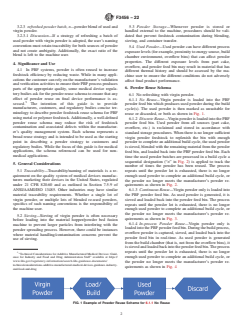
6.1.1 No Reuse—Virgin powder is loaded into the PBF
sessed. The intention of this guide is to provide
powder feed bin which produces used powder during the build
manufacturers, customers, and regulatory bodies concise ter-
cycle(s). The used powder is then marked as unsuitable for
minology to describe powder feedstock reuse schema for PBF
reuse or discarded, or both as shown in Fig. 1.
using metal or polymer feedstock.Additionally, a well-defined
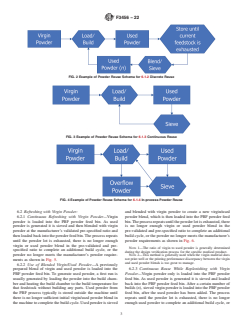
6.1.2 Discrete Reuse—Virgin powder is loaded into the PBF
powder reuse schema may reduce the risk of feedstock
powder feed bin. Used powder from all sources (part cake,
contamination and associated defects within the manufactur-
overflow, etc.) is reclaimed and stored in accordance with
er’s quality management system. Each schema represents a
standard storage procedures.When there is no longer sufficient
broad reuse strategy and is intended to be used as the starting
virgin powder feedstock to replenish the bin with enough
point in describing a powder strategy to customers and
powder to complete an additional build cycle, the used powder
regulatory bodies. While the focus of this guide is for medical
issieved,blendedwiththeremainingmaterialfromthepowder
applications, the schema referenced can be used for non-
feed bin, and loaded back into the PBF powder feed bin. Each
medical applications.
time the used powder batches are processed in a build cycle a
sequential designation (“n”in Fig. 2) is applied to track the
5. General Considerations
number of times the powder has been reused. The process
5.1 Traceability—Traceability/naming of materials is a re- repeats until the powder lot is exhausted, there is no long
...