

ASTM B213-20
(Test Method)Standard Test Methods for Flow Rate of Metal Powders Using the Hall Flowmeter Funnel
General Information
- Abstract
SIGNIFICANCE AND USE
5.1 The rate and uniformity of die cavity filling are related to flow properties, which thus influence production rates and uniformity of compacted parts.
5.2 The ability of a powder to flow is a function of interparticle friction. As interparticle friction increases, flow is slowed. Fine powders may not flow. Some powders, often fine powders and lubricated powder mixtures, may not flow through the Hall Flowmeter funnel. Nevertheless, if a larger orifice is provided, such as in the Carney Flowmeter funnel of Test Methods B964, a meaningful flow rate may be determined, providing specific information for certain applications.
5.3 Test Methods B213, using the Hall Flowmeter funnel, are the preferred methods for determining the flowability of metal powders and powder mixtures. The Carney Flowmeter funnel of Test Methods B964 should only be used when powder will not flow through the Hall Flowmeter funnel.
5.4 Humidity and moisture content influence flow rate. Wet or moist powders may not flow.
5.5 These test methods are based on flow of a specified mass of powder. If flow of a specific volume of powder is preferred, Test Method B855 may be used for powders that flow readily through the Hall Flowmeter funnel.
5.6 This test method may be part of the purchase agreement between powder manufacturers and powder metallurgy (PM) part producers, or it can be an internal quality control test by either the producer or the end user.
SCOPE
1.1 This test method covers the determination of a flow rate, by the use of the Hall Flowmeter funnel of metal powders and powder mixtures. It is suitable only for those powders that will flow unaided through the Hall Flowmeter funnel.
1.2 Units—With the exception of the values for density and the mass used to determine density, for which the use of the gram per cubic centimetre (g/cm3) and gram (g) units is the long-standing industry practice, the values in inch-pound units are to be regarded as standard. The values given in parentheses are mathematical conversions to SI units that are provided for information only, and are not considered standard.
1.3 This standard does not purport to address all of the safety concerns, if any, associated with its use. It is the responsibility of the user of this standard to establish appropriate safety, health, and environmental practices and determine the applicability of regulatory limitations prior to use.
1.4 This international standard was developed in accordance with internationally recognized principles on standardization established in the Decision on Principles for the Development of International Standards, Guides and Recommendations issued by the World Trade Organization Technical Barriers to Trade (TBT) Committee.
- Status
- Published
- Publication Date
- 31-Mar-2020
- Technical Committee
- B09 - Metal Powders and Metal Powder Products
- Drafting Committee
- B09.02 - Base Metal Powders
Buy Documents

ASTM B213-20 - Standard Test Methods for Flow Rate of Metal Powders Using the Hall Flowmeter Funnel
REDLINE ASTM B213-20 - Standard Test Methods for Flow Rate of Metal Powders Using the Hall Flowmeter Funnel
Overview
ASTM B213-20: Standard Test Methods for Flow Rate of Metal Powders Using the Hall Flowmeter Funnel is a widely recognized standard in the field of powder metallurgy. Published by ASTM International, this standard provides precise, repeatable procedures for determining the flow rate of metal powders and powder mixtures using the Hall flowmeter funnel. The ability of metal powders to flow is a key quality parameter that affects production rates, uniformity of compacted parts, and overall efficiency in powder metallurgy operations.
The method described under ASTM B213-20 is specifically designed for powders that will flow unaided through the Hall flowmeter funnel, providing a critical measurement of powder flowability. This test is routinely used by powder producers and end users for quality control and is often referenced in purchase agreements within the industry.
Key Topics
- Flow Characteristics of Metal Powders: The standard addresses the influence of interparticle friction, humidity, moisture content, and particle size on powder flow rate. Increased friction or moisture can significantly impede flow.
- Preferred Test Methods: ASTM B213-20 outlines the Hall flowmeter funnel as the preferred instrument for most flowability measurements. In cases where powders do not flow through the Hall funnel, alternative methods such as the Carney funnel (referenced in ASTM B964) may be considered.
- Test Precision and Consistency: The standard describes repeatable methods, including requirements for apparatus (calibrated funnels, balances, timing devices), calibration procedures, and sample handling to minimize variability.
- Applications in Quality Control and Contracts: These procedures support both internal quality control activities and formal agreements between powder producers and part manufacturers, helping to ensure that supplied powders meet consistent performance specifications.
Applications
The procedures in ASTM B213-20 are essential in numerous practical contexts within the powder metallurgy and metal powder industry, providing substantial value in the following ways:
- Quality Control Testing: Manufacturers rely on the flow rate test to monitor consistency and quality of metal powders, enabling rapid adjustments in production processes if out-of-spec powders are detected.
- Material Specification in Procurement: Powder flowability, established per ASTM B213, is a frequent requirement in technical specifications between suppliers and buyers to guarantee reliable, repeatable part manufacture and performance.
- Process Optimization: Understanding the flow characteristics of powders allows process engineers to enhance die filling, optimize pressing and sintering steps, and improve yield and part uniformity.
- R&D and Comparative Studies: Researchers use the standard to benchmark new powder formulations, additives, or blending techniques, allowing direct comparison of flow rates and their effects on final properties.
Related Standards
Several standards are referenced within ASTM B213-20 and may be relevant for comprehensive powder characterization:
- ASTM B215: Practices for Sampling Metal Powders - covers methods for obtaining representative powder samples.
- ASTM B243: Terminology of Powder Metallurgy - provides definitions for terms used in powder metallurgy.
- ASTM B855: Test Method for Volumetric Flow Rate of Metal Powders Using the Arnold Meter and Hall Flowmeter Funnel - for users who prefer volumetric, rather than gravimetric, flow measurements.
- ASTM B964: Test Methods for Flow Rate of Metal Powders Using the Carney Funnel - an alternative for powders that do not flow through the Hall funnel.
Keywords: ASTM B213, Hall flowmeter funnel, metal powder flow rate, powder metallurgy, flowability test, quality control, powder standardization, ASTM standards, metal powder testing, die filling uniformity.
Relations
- Replaces
ASTM B213-17 - Standard Test Methods for Flow Rate of Metal Powders Using the Hall Flowmeter Funnel - Effective Date
- 01-Apr-2020
- Effective Date
- 01-Oct-2018
- Effective Date
- 01-Jul-2016
- Effective Date
- 01-Nov-2013
- Effective Date
- 15-Jul-2012
- Effective Date
- 15-Nov-2011
- Effective Date
- 15-Nov-2011
- Effective Date
- 01-Dec-2010
- Effective Date
- 15-Jan-2010
- Effective Date
- 15-Dec-2009
- Effective Date
- 01-Apr-2009
- Effective Date
- 01-Jan-2009
- Effective Date
- 01-Nov-2008
- Effective Date
- 15-Mar-2008
- Effective Date
- 01-Feb-2008
Buy Documents
ASTM B213-20 - Standard Test Methods for Flow Rate of Metal Powders Using the Hall Flowmeter Funnel
REDLINE ASTM B213-20 - Standard Test Methods for Flow Rate of Metal Powders Using the Hall Flowmeter Funnel
Get Certified
Connect with accredited certification bodies for this standard

Element Materials Technology
Materials testing and product certification.

Inštitut za kovinske materiale in tehnologije
Institute of Metals and Technology. Materials testing, metallurgical analysis, NDT.
Sponsored listings
Frequently Asked Questions
ASTM B213-20 is a standard published by ASTM International. Its full title is "Standard Test Methods for Flow Rate of Metal Powders Using the Hall Flowmeter Funnel". This standard covers: SIGNIFICANCE AND USE 5.1 The rate and uniformity of die cavity filling are related to flow properties, which thus influence production rates and uniformity of compacted parts. 5.2 The ability of a powder to flow is a function of interparticle friction. As interparticle friction increases, flow is slowed. Fine powders may not flow. Some powders, often fine powders and lubricated powder mixtures, may not flow through the Hall Flowmeter funnel. Nevertheless, if a larger orifice is provided, such as in the Carney Flowmeter funnel of Test Methods B964, a meaningful flow rate may be determined, providing specific information for certain applications. 5.3 Test Methods B213, using the Hall Flowmeter funnel, are the preferred methods for determining the flowability of metal powders and powder mixtures. The Carney Flowmeter funnel of Test Methods B964 should only be used when powder will not flow through the Hall Flowmeter funnel. 5.4 Humidity and moisture content influence flow rate. Wet or moist powders may not flow. 5.5 These test methods are based on flow of a specified mass of powder. If flow of a specific volume of powder is preferred, Test Method B855 may be used for powders that flow readily through the Hall Flowmeter funnel. 5.6 This test method may be part of the purchase agreement between powder manufacturers and powder metallurgy (PM) part producers, or it can be an internal quality control test by either the producer or the end user. SCOPE 1.1 This test method covers the determination of a flow rate, by the use of the Hall Flowmeter funnel of metal powders and powder mixtures. It is suitable only for those powders that will flow unaided through the Hall Flowmeter funnel. 1.2 Units—With the exception of the values for density and the mass used to determine density, for which the use of the gram per cubic centimetre (g/cm3) and gram (g) units is the long-standing industry practice, the values in inch-pound units are to be regarded as standard. The values given in parentheses are mathematical conversions to SI units that are provided for information only, and are not considered standard. 1.3 This standard does not purport to address all of the safety concerns, if any, associated with its use. It is the responsibility of the user of this standard to establish appropriate safety, health, and environmental practices and determine the applicability of regulatory limitations prior to use. 1.4 This international standard was developed in accordance with internationally recognized principles on standardization established in the Decision on Principles for the Development of International Standards, Guides and Recommendations issued by the World Trade Organization Technical Barriers to Trade (TBT) Committee.
SIGNIFICANCE AND USE 5.1 The rate and uniformity of die cavity filling are related to flow properties, which thus influence production rates and uniformity of compacted parts. 5.2 The ability of a powder to flow is a function of interparticle friction. As interparticle friction increases, flow is slowed. Fine powders may not flow. Some powders, often fine powders and lubricated powder mixtures, may not flow through the Hall Flowmeter funnel. Nevertheless, if a larger orifice is provided, such as in the Carney Flowmeter funnel of Test Methods B964, a meaningful flow rate may be determined, providing specific information for certain applications. 5.3 Test Methods B213, using the Hall Flowmeter funnel, are the preferred methods for determining the flowability of metal powders and powder mixtures. The Carney Flowmeter funnel of Test Methods B964 should only be used when powder will not flow through the Hall Flowmeter funnel. 5.4 Humidity and moisture content influence flow rate. Wet or moist powders may not flow. 5.5 These test methods are based on flow of a specified mass of powder. If flow of a specific volume of powder is preferred, Test Method B855 may be used for powders that flow readily through the Hall Flowmeter funnel. 5.6 This test method may be part of the purchase agreement between powder manufacturers and powder metallurgy (PM) part producers, or it can be an internal quality control test by either the producer or the end user. SCOPE 1.1 This test method covers the determination of a flow rate, by the use of the Hall Flowmeter funnel of metal powders and powder mixtures. It is suitable only for those powders that will flow unaided through the Hall Flowmeter funnel. 1.2 Units—With the exception of the values for density and the mass used to determine density, for which the use of the gram per cubic centimetre (g/cm3) and gram (g) units is the long-standing industry practice, the values in inch-pound units are to be regarded as standard. The values given in parentheses are mathematical conversions to SI units that are provided for information only, and are not considered standard. 1.3 This standard does not purport to address all of the safety concerns, if any, associated with its use. It is the responsibility of the user of this standard to establish appropriate safety, health, and environmental practices and determine the applicability of regulatory limitations prior to use. 1.4 This international standard was developed in accordance with internationally recognized principles on standardization established in the Decision on Principles for the Development of International Standards, Guides and Recommendations issued by the World Trade Organization Technical Barriers to Trade (TBT) Committee.
ASTM B213-20 is classified under the following ICS (International Classification for Standards) categories: 77.160 - Powder metallurgy. The ICS classification helps identify the subject area and facilitates finding related standards.
ASTM B213-20 has the following relationships with other standards: It is inter standard links to ASTM B213-17, ASTM B243-18, ASTM B243-16, ASTM B243-13, ASTM B243-12, ASTM B855-11, ASTM B243-11, ASTM B215-10, ASTM B243-10, ASTM B243-09a, ASTM B964-09, ASTM B243-09, ASTM B215-08, ASTM B243-08a, ASTM B243-08. Understanding these relationships helps ensure you are using the most current and applicable version of the standard.
ASTM B213-20 is available in PDF format for immediate download after purchase. The document can be added to your cart and obtained through the secure checkout process. Digital delivery ensures instant access to the complete standard document.
Standards Content (Sample)
This international standard was developed in accordance with internationally recognized principles on standardization established in the Decision on Principles for the
Development of International Standards, Guides and Recommendations issued by the World Trade Organization Technical Barriers to Trade (TBT) Committee.
Designation: B213 − 20
Standard Test Methods for
Flow Rate of Metal Powders Using the Hall Flowmeter
Funnel
This standard is issued under the fixed designation B213; the number immediately following the designation indicates the year of
original adoption or, in the case of revision, the year of last revision. A number in parentheses indicates the year of last reapproval. A
superscript epsilon (´) indicates an editorial change since the last revision or reapproval.
This standard has been approved for use by agencies of the U.S. Department of Defense.
1. Scope* B964 Test Methods for Flow Rate of Metal Powders Using
the Carney Funnel
1.1 This test method covers the determination of a flow rate,
by the use of the Hall Flowmeter funnel of metal powders and
3. Terminology
powder mixtures. It is suitable only for those powders that will
flow unaided through the Hall Flowmeter funnel. 3.1 Definitions—Definitions of powder metallurgy terms
can be found in Terminology B243.
1.2 Units—With the exception of the values for density and
3.2 Definitions of Terms Specific to This Standard:
the mass used to determine density, for which the use of the
3.2.1 Hall flow rate (FR ), n—the time required for a metal
H
gram per cubic centimetre (g/cm ) and gram (g) units is the
powder sample of specified mass to flow through the orifice in
long-standing industry practice, the values in inch-pound units
a Hall Flowmeter funnel according to a specified procedure.
are to be regarded as standard.The values given in parentheses
are mathematical conversions to SI units that are provided for
4. Summary of Test Method
information only, and are not considered standard.
4.1 Aweighed mass (50.0 g) of metal powder is timed as it
1.3 This standard does not purport to address all of the
flowsthroughtheorificeofacalibratedHallFlowmeterfunnel.
safety concerns, if any, associated with its use. It is the
responsibility of the user of this standard to establish appro-
5. Significance and Use
priate safety, health, and environmental practices and deter-
mine the applicability of regulatory limitations prior to use.
5.1 The rate and uniformity of die cavity filling are related
1.4 This international standard was developed in accor-
to flow properties, which thus influence production rates and
dance with internationally recognized principles on standard-
uniformity of compacted parts.
ization established in the Decision on Principles for the
5.2 The ability of a powder to flow is a function of
Development of International Standards, Guides and Recom-
interparticle friction.As interparticle friction increases, flow is
mendations issued by the World Trade Organization Technical
slowed. Fine powders may not flow. Some powders, often fine
Barriers to Trade (TBT) Committee.
powders and lubricated powder mixtures, may not flow
through the Hall Flowmeter funnel. Nevertheless, if a larger
2. Referenced Documents
orifice is provided, such as in the Carney Flowmeter funnel of
2.1 ASTM Standards:
Test Methods B964, a meaningful flow rate may be
B215 Practices for Sampling Metal Powders
determined, providing specific information for certain applica-
B243 Terminology of Powder Metallurgy
tions.
B855 Test Method for Volumetric Flow Rate of Metal
5.3 Test Methods B213, using the Hall Flowmeter funnel,
Powders Using the Arnold Meter and Hall Flowmeter
are the preferred methods for determining the flowability of
Funnel
metal powders and powder mixtures. The Carney Flowmeter
funnel of Test Methods B964 should only be used when
These test methods are under the jurisdiction of ASTM Committee B09 on
powder will not flow through the Hall Flowmeter funnel.
Metal Powders and Metal Powder Products and are the direct responsibility of
Subcommittee B09.02 on Base Metal Powders.
5.4 Humidity and moisture content influence flow rate. Wet
Current edition approved April 1, 2020. Published April 2020. Originally
or moist powders may not flow.
approved in 1946. Last previous edition approved in 2017 as B213 – 17. DOI:
10.1520/B0213-20.
5.5 Thesetestmethodsarebasedonflowofaspecifiedmass
For referenced ASTM standards, visit the ASTM website, www.astm.org, or
of powder. If flow of a specific volume of powder is preferred,
contact ASTM Customer Service at service@astm.org. For Annual Book of ASTM
Test Method B855 may be used for powders that flow readily
Standards volume information, refer to the standard’s Document Summary page on
the ASTM website. through the Hall Flowmeter funnel.
*A Summary of Changes section appears at the end of this standard
Copyright © ASTM International, 100 Barr Harbor Drive, PO Box C700, West Conshohocken, PA 19428-2959. United States
B213 − 20
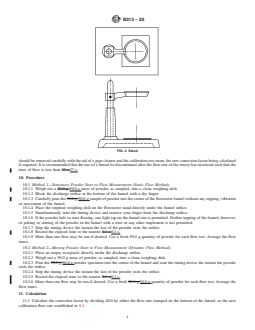
FIG. 2 Stand
6.1.1 The funnel shall be made of a non-magnetic,
corrosion-resistantmetallicmaterialhavingsufficientthickness
and hardness to withstand distortion and excessive wear.
6.2 The dimensions shown for the flowmeter funnel, includ-
ing the orifice, are not to be considered controlling factors.
Calibration with emery, as specified in Section 9, determines
the working flow rate of the funnel.
6.3 Stand —A stand (Fig. 2) to support the powder flow-
meter funnel.
6.4 Workbench—A level, vibration free table or workbench
to support the powder flowmeter stand.
6.5 Timing Device—A stopwatch or other suitable device
capable of measuring to the nearest 0.1 s.
6.6 Chinese Emery —An emery powder used to calibrate
the flowmeter funnel.
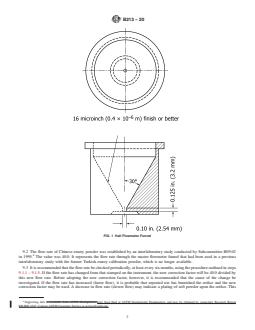
FIG. 1 Hall Flowmeter Funnel
6.7 Balance—A balance readable to 0.01 g suitable for
weighing at least 50.0 g.
5.6 This test method may be part of the purchase agreement
7. Sampling
between powder manufacturers and powder metallurgy (PM)
part producers, or it can be an internal quality control test by
7.1 Asample of powder sufficient to run the desired number
either the producer or the end user.
of flow tests shall be obtained in accordance with Practices
B215.
6. Apparatus
7.2 Individual test portions, each of approximately the
6.1 Powder Flowmeter Funnel —A calibrated flowmeter
required mass, shall be obtained from the test sample in
funnel (Fig. 1) having a nominal orifice of 0.10 in. (2.54 mm)
accordance with Practices B215.
in diameter.
8. Preparation of Apparatus
8.1 Clean the funnel with clean dry toweling paper.
The flowmeter funnel, stand, and Chinese emery are available from ACuPow-
der International, LLC. 8.2 Clean the funnel orifice with a clean dry pipe cleaner.
B213 − 20
9. Calibration of Apparatus 10.1.4 Place the emptied weighing dish on the flowmeter
stand directly under the funnel orifice.
9.1 The manufacturer supplies the powder flowmeter funnel
10.1.5 Simultaneously start the timing device and remove
calibrated as follows:
your finger from the discharge orifice.
9.1.1 Heat an open glass jar of Chinese emery in a drying
10.1.6 If the powder fails to start flowing, one light tap on
oven at a temperature of 102 °C to 107 °C (215 °F to 225 °F)
the funnel rim is permitted. Further tapping of the funnel,
for 1 h.
however, or poking or stirring of the powder in the funnel with
9.1.2 Cool the emery to room temperature in a desiccator.
a wire or any other implement is not permitted.
9.1.3 Follow the procedure outlined in steps10.1.1 – 10.1.8.
10.1.7 Stop the timing device the instant the last of the
9.1.4 Repeat steps 10.1.2 – 10.1.8 using the identical 50.0 g
powder exits the orifice.
mass of emery for all the tests until 5 flow times, the extremes
10.1.8 Record the elapsed time to the nearest 0.1 s.
of which shall not differ by more than 0.4 s, have been
10.1.9 More than one flow may be run if desired. Use a
recorded.
fresh 50.0 g quantity of powder for each flow test.Average the
NOTE 1—The flow rate of Chinese emery calibration powder is
flow times.
sensitive
...
This document is not an ASTM standard and is intended only to provide the user of an ASTM standard an indication of what changes have been made to the previous version. Because
it may not be technically possible to adequately depict all changes accurately, ASTM recommends that users consult prior editions as appropriate. In all cases only the current version
of the standard as published by ASTM is to be considered the official document.
Designation: B213 − 17 B213 − 20
Standard Test Methods for
Flow Rate of Metal Powders Using the Hall Flowmeter
Funnel
This standard is issued under the fixed designation B213; the number immediately following the designation indicates the year of
original adoption or, in the case of revision, the year of last revision. A number in parentheses indicates the year of last reapproval. A
superscript epsilon (´) indicates an editorial change since the last revision or reapproval.
This standard has been approved for use by agencies of the U.S. Department of Defense.
1. Scope*
1.1 This test method covers the determination of a flow rate, by the use of the Hall Flowmeter funnel of metal powders and
powder mixtures. It is suitable only for those powders that will flow unaided through the Hall Flowmeter funnel.
1.2 Units—With the exception of the values for density and the mass used to determine density, for which the use of the gram
per cubic centimetre (g/cm ) and gram (g) units is the long-standing industry practice, the values in inch-pound units are to be
regarded as standard. The values given in parentheses are mathematical conversions to SI units that are provided for information
only, and are not considered standard.
1.3 This standard does not purport to address all of the safety concerns, if any, associated with its use. It is the responsibility
of the user of this standard to establish appropriate safety safety, health, and healthenvironmental practices and determine the
applicability of regulatory limitations prior to use.
1.4 This international standard was developed in accordance with internationally recognized principles on standardization
established in the Decision on Principles for the Development of International Standards, Guides and Recommendations issued
by the World Trade Organization Technical Barriers to Trade (TBT) Committee.
2. Referenced Documents
2.1 ASTM Standards:
B215 Practices for Sampling Metal Powders
B243 Terminology of Powder Metallurgy
B855 Test Method for Volumetric Flow Rate of Metal Powders Using the Arnold Meter and Hall Flowmeter Funnel
B964 Test Methods for Flow Rate of Metal Powders Using the Carney Funnel
3. Terminology
3.1 Definitions—Definitions of powder metallurgy terms can be found in Terminology B243.
3.2 Definitions of Terms Specific to This Standard:
), n—the time required for a metal powder sample of specified mass to flow through the orifice in a
3.2.1 Hall flow rate (FR
H
Hall Flowmeter funnel according to a specified procedure.
4. Summary of Test Method
4.1 A weighed mass (50.0 g) (50.0 g) of metal powder is timed as it flows through the orifice of a calibrated Hall Flowmeter
funnel.
5. Significance and Use
5.1 The rate and uniformity of die cavity filling are related to flow properties, which thus influence production rates and
uniformity of compacted parts.
ThisThese test method ismethods are under the jurisdiction of ASTM Committee B09 on Metal Powders and Metal Powder Products and isare the direct responsibility
of Subcommittee B09.02 on Base Metal Powders.
Current edition approved April 1, 2017April 1, 2020. Published April 2017April 2020. Originally approved in 1946. Last previous edition approved in 20132017 as
B213 – 13.B213 – 17. DOI: 10.1520/B0213-17.10.1520/B0213-20.
For referenced ASTM standards, visit the ASTM website, www.astm.org, or contact ASTM Customer Service at service@astm.org. For Annual Book of ASTM Standards
volume information, refer to the standard’s Document Summary page on the ASTM website.
*A Summary of Changes section appears at the end of this standard
Copyright © ASTM International, 100 Barr Harbor Drive, PO Box C700, West Conshohocken, PA 19428-2959. United States
B213 − 20
5.2 The ability of a powder to flow is a function of interparticle friction. As interparticle friction increases, flow is slowed. Fine
powders may not flow. Some powders, often fine powders and lubricated powder mixtures, may not flow through the Hall
Flowmeter funnel. Nevertheless, if a larger orifice is provided, such as in the Carney Flowmeter funnel of Test MethodMethods
B964, a meaningful flow rate may be determined, providing specific information for certain applications.
5.3 Test MethodMethods B213, using the Hall Flowmeter funnel, isare the preferred methodmethods for determining the
flowability of metal powders and powder mixtures. The Carney Flowmeter funnel of Method Test Methods B964 should only be
used when powder will not flow through the Hall Flowmeter funnel.
5.4 Humidity and moisture content influence flow rate. Wet or moist powders may not flow.
5.5 These test methods are based on flow of a specified mass of powder. If flow of a specific volume of powder is preferred,
Test Method B855 may be used for powders that flow readily through the Hall Flowmeter funnel.
5.6 This test method may be part of the purchase agreement between powder manufacturers and powder metallurgy (PM) part
producers, or it can be an internal quality control test by either the producer or the end user.
6. Apparatus
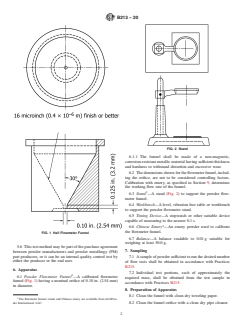
6.1 Powder Flowmeter Funnel —A calibrated flowmeter funnel (Fig. 1) having a nominal orifice of 0.10 in. (2.54 mm) in
diameter.
6.1.1 The funnel shall be made of a non-magnetic, corrosion-resistant metallic material having sufficient thickness and hardness
to withstand distortion and excessive wear.
6.2 The dimensions shown for the flowmeter funnel, including the orifice, are not to be considered controlling factors.
Calibration with emery, as specified in Section 9, determines the working flow rate of the funnel.
6.3 Stand —A stand (Fig. 2) to support the powder flowmeter funnel.
6.4 Workbench—A level, vibration free table or workbench to support the powder flowmeter stand.
6.5 Timing Device—A stopwatch or other suitable device capable of measuring to the nearest 0.1 s.0.1 s.
6.6 Chinese Emery —An emery powder used to calibrate the flowmeter funnel.
6.7 Balance—A balance readable to 0.01 g 0.01 g suitable for weighing at least 50.0 g to the nearest 0.1 g.50.0 g.
7. Sampling
7.1 A sample of powder sufficient to run the desired number of flow tests shall be obtained in accordance with PracticePractices
B215.
7.2 Individual test portions, each of approximately the required mass, shall be obtained from the test sample in accordance with
PracticePractices B215.
8. Preparation of Apparatus
8.1 Clean the funnel with clean dry toweling paper.
8.2 Clean the funnel orifice with a clean dry pipe cleaner.
9. Calibration of Apparatus
9.1 The manufacturer supplies the powder flowmeter funnel calibrated as follows:
9.1.1 Heat an open glass jar of Chinese emery in a drying oven at a temperature of 102° to 107 °C (215° to 225 °F) for 1h.102 °C
to 107 °C (215 °F to 225 °F) for 1 h.
9.1.2 Cool the emery to room temperature in a desiccator.
9.1.3 Follow the procedure outlined in steps 10.1.1 – 10.1.8.
9.1.4 Repeat steps 10.1.2 – 10.1.8 using the identical 50.0 g 50.0 g mass of emery for all the tests until 5 flow times, the
extremes of which shall not differ by more than 0.4 s, have been recorded.
NOTE 1—The flow rate of Chinese emery calibration powder is sensitive to moisture. Starting from the dried condition, it will absorb moisture from
the ambient air as five (or more) flow tests are performed. Flow times can vary dependent upon the humidity of the test area.
9.1.5 The average of these five flow times is stamped on the bottom of the funnel. The flow time for a new funnel shall be 40.0
6 0.5 s. The correction factor for the unused flowmeter funnel is 40.0 divided by this number.
The flowmeter funnel, stand, and Chinese emery are available from ACuPowder International, LLC.
B213 − 20
FIG. 1 Hall Flowmeter Funnel
9.2 The flow rate of Chinese emery powder was established by an interlaboratory study conducted by Subcommittee B09.02
in 1995. The value was 40.0. It represents the flow rate through the master flowmeter funnel that had been used in a previous
interlaboratory study with the former Turkish emery calibration powder, which is no longer available.
9.3 It is recommended that the flow rate be checked periodically, at least every six months, using the procedure outlined in steps
9.1.1 – 9.1.5. If the flow rate has changed from that stamped on the instrument, the new correction factor will be 40.0
...