

ASTM E2579-23b
(Practice)Standard Practice for Specimen Preparation and Mounting of Wood Products to Assess Surface Burning Characteristics
General Information
- Abstract
SIGNIFICANCE AND USE
5.1 The surface burning characteristics of wood products are often evaluated with Test Method E84 to comply with code requirements. This practice describes specimen preparation and mounting procedures for such materials and systems.
5.2 If it can be demonstrated that none of the methods described in this practice are applicable to a particular wood product, other mounting methods shall be permitted to be used. This information shall be included in the report.
5.3 The limitations for this procedure are those associated with Test Method E84.
SCOPE
1.1 This practice describes procedures for specimen preparation and mounting when testing wood products to assess flames spread and smoke development as surface burning characteristics using Test Method E84 or Test Method E2768.
1.1.1 Test Method E2768 uses the same test equipment as Test Method E84.
1.2 This practice applies also to laminated products factory-produced with a wood substrate (see 8.6). This practice does not apply to wood veneers or facings intended to be applied on site over a wood substrate, which are covered by Practice E2404.
1.3 Testing is conducted with Test Method E84 or with Test Method E2768.
1.4 Testing for the reporting of the moisture content of the test specimen is conducted with Test Methods D4442.
1.5 This practice does not provide pass/fail criteria that can be used as a regulatory tool.
1.6 Units—Use the values stated in inch-pound units as the standard, in referee decisions. The values in the SI system of units are given in parentheses, for information only; see IEEE/ASTM SI-10 for further details.
1.7 This fire standard cannot be used to provide quantitative measures.
1.8 The text of this standard references notes and footnotes which provide explanatory materials. These notes and footnotes shall not be considered requirements of the standard.
1.9 Fire testing of products and materials is inherently hazardous, and adequate safeguards for personnel and property shall be employed in conducting these tests. Fire testing involves hazardous materials and equipment. This standard gives instructions on specimen preparation and mounting, but the fire-test-response method is given in Test Method E84, or in Test Method E2768, as appropriate. See also Section 10.
1.10 This standard does not purport to address all of the safety concerns, if any, associated with its use. It is the responsibility of the user of this standard to establish appropriate safety, health, and environmental practices and determine the applicability of regulatory limitations prior to use.
1.11 This international standard was developed in accordance with internationally recognized principles on standardization established in the Decision on Principles for the Development of International Standards, Guides and Recommendations issued by the World Trade Organization Technical Barriers to Trade (TBT) Committee.
- Status
- Published
- Publication Date
- 31-Oct-2023
- Technical Committee
- E05 - Fire Standards
- Drafting Committee
- E05.22 - Surface Burning
Buy Documents
ASTM E2579-23b - Standard Practice for Specimen Preparation and Mounting of Wood Products to Assess Surface Burning Characteristics
REDLINE ASTM E2579-23b - Standard Practice for Specimen Preparation and Mounting of Wood Products to Assess Surface Burning Characteristics
Overview
ASTM E2579-23b: Standard Practice for Specimen Preparation and Mounting of Wood Products to Assess Surface Burning Characteristics provides comprehensive guidelines for preparing and mounting wood products intended for fire testing. This ASTM standard supports accurate determination of flame spread and smoke development on wood products, in accordance with building code requirements for surface burning characteristics. Testing is typically performed using ASTM E84 or ASTM E2768, which are well-established methods for evaluating the fire-test response of building materials.
The practice is applicable to both solid and factory-laminated wood products with a wood substrate but excludes wood veneers or facings applied on-site, which are covered under ASTM E2404. It establishes uniform procedures for specimen conditioning, preparation, and mounting to ensure consistent and reproducible results, but does not assign regulatory pass/fail criteria.
Key Topics
- Specimen Preparation: Details on specimen sizes, preparation for pressure-treated and untreated wood, and special requirements for laminates, veneers, panel products, and wood shingles or shakes.
- Mounting Procedures: Specific mounting instructions for:
- Panel products that support themselves
- Wood veneers lacking structural integrity
- Products applied over gypsum board or wood substrates
- Shingles and shakes mounted on plywood or as specified by the manufacturer
- Fire Testing Methods: Testing is conducted using ASTM E84 or ASTM E2768 protocols.
- Moisture Content Determination: Outlines procedures for measuring specimen moisture using ASTM D4442, and the importance of using oven dry methods for accuracy.
- Safety Considerations: Emphasizes the inherent hazards of fire testing and the necessity for appropriate safety measures during all procedures.
- Reporting Requirements: Specifies mandatory details for test reports, including preparation and mounting methods, moisture content, specimen description, and observed fire performance results.
- International Standardization: Developed in accordance with internationally recognized protocols to facilitate global acceptance.
Applications
This standard practice is essential for laboratories, manufacturers, and regulatory agencies seeking to determine the surface burning characteristics of wood products used in construction. Practical applications include:
- Building Code Compliance: Supports compliance with requirements regarding flame spread and smoke development, helping manufacturers and designers select appropriate building materials.
- Product Certification: Used by third-party testing agencies and manufacturers as part of certification protocols for fire-resistant wood materials.
- Product Development: Assists manufacturers in refining wood and wood-based products to meet fire safety standards.
- Research and Development: Provides a foundation for comparative studies on different wood treatments and their impact on fire response.
Related Standards
This standard should be used in conjunction with other relevant ASTM and international standards, including:
- ASTM E84 - Test Method for Surface Burning Characteristics of Building Materials
- ASTM E2768 - Test Method for Extended Duration Surface Burning Characteristics of Building Materials
- ASTM D4442 - Standard Test Methods for Direct Moisture Content Measurement of Wood and Wood-Based Materials
- ASTM E2404 - Practice for Specimen Preparation and Mounting of Textile, Paper, Polymeric, and Wood Wall or Ceiling Coverings to Assess Surface Burning Characteristics
- ASTM C1396/C1396M - Specification for Gypsum Board
- IEEE/ASTM SI-10 - International System of Units (SI)
- CSA O121 - Douglas Fir Plywood
- ANSI/HPVA HP-1 - American National Standard for Hardwood and Decorative Plywood
- NIST PS 1 - Voluntary Product Standard for Structural Plywood
By following ASTM E2579-23b, stakeholders in the wood products industry can achieve standardized, reproducible, and internationally recognized fire testing results for specimen preparation and mounting, helping ensure building safety and regulatory compliance.
Relations
- Effective Date
- 01-Nov-2023
- Effective Date
- 01-Jan-2024
- Effective Date
- 01-Dec-2023
- Effective Date
- 01-Sep-2023
- Effective Date
- 01-Aug-2023
- Effective Date
- 01-Dec-2021
- Effective Date
- 01-Nov-2023
- Effective Date
- 01-Nov-2023
Buy Documents
ASTM E2579-23b - Standard Practice for Specimen Preparation and Mounting of Wood Products to Assess Surface Burning Characteristics
REDLINE ASTM E2579-23b - Standard Practice for Specimen Preparation and Mounting of Wood Products to Assess Surface Burning Characteristics
Get Certified
Connect with accredited certification bodies for this standard

CIS Institut d.o.o.
Personal Protective Equipment (PPE) certification body. Notified Body NB-2890 for EU Regulation 2016/425 PPE.
Gozdarski inštitut Slovenije
Slovenian Forestry Institute. Forest management certification support, timber testing.

Kiwa BDA Testing
Building and construction product certification.
Sponsored listings
Frequently Asked Questions
ASTM E2579-23b is a standard published by ASTM International. Its full title is "Standard Practice for Specimen Preparation and Mounting of Wood Products to Assess Surface Burning Characteristics". This standard covers: SIGNIFICANCE AND USE 5.1 The surface burning characteristics of wood products are often evaluated with Test Method E84 to comply with code requirements. This practice describes specimen preparation and mounting procedures for such materials and systems. 5.2 If it can be demonstrated that none of the methods described in this practice are applicable to a particular wood product, other mounting methods shall be permitted to be used. This information shall be included in the report. 5.3 The limitations for this procedure are those associated with Test Method E84. SCOPE 1.1 This practice describes procedures for specimen preparation and mounting when testing wood products to assess flames spread and smoke development as surface burning characteristics using Test Method E84 or Test Method E2768. 1.1.1 Test Method E2768 uses the same test equipment as Test Method E84. 1.2 This practice applies also to laminated products factory-produced with a wood substrate (see 8.6). This practice does not apply to wood veneers or facings intended to be applied on site over a wood substrate, which are covered by Practice E2404. 1.3 Testing is conducted with Test Method E84 or with Test Method E2768. 1.4 Testing for the reporting of the moisture content of the test specimen is conducted with Test Methods D4442. 1.5 This practice does not provide pass/fail criteria that can be used as a regulatory tool. 1.6 Units—Use the values stated in inch-pound units as the standard, in referee decisions. The values in the SI system of units are given in parentheses, for information only; see IEEE/ASTM SI-10 for further details. 1.7 This fire standard cannot be used to provide quantitative measures. 1.8 The text of this standard references notes and footnotes which provide explanatory materials. These notes and footnotes shall not be considered requirements of the standard. 1.9 Fire testing of products and materials is inherently hazardous, and adequate safeguards for personnel and property shall be employed in conducting these tests. Fire testing involves hazardous materials and equipment. This standard gives instructions on specimen preparation and mounting, but the fire-test-response method is given in Test Method E84, or in Test Method E2768, as appropriate. See also Section 10. 1.10 This standard does not purport to address all of the safety concerns, if any, associated with its use. It is the responsibility of the user of this standard to establish appropriate safety, health, and environmental practices and determine the applicability of regulatory limitations prior to use. 1.11 This international standard was developed in accordance with internationally recognized principles on standardization established in the Decision on Principles for the Development of International Standards, Guides and Recommendations issued by the World Trade Organization Technical Barriers to Trade (TBT) Committee.
SIGNIFICANCE AND USE 5.1 The surface burning characteristics of wood products are often evaluated with Test Method E84 to comply with code requirements. This practice describes specimen preparation and mounting procedures for such materials and systems. 5.2 If it can be demonstrated that none of the methods described in this practice are applicable to a particular wood product, other mounting methods shall be permitted to be used. This information shall be included in the report. 5.3 The limitations for this procedure are those associated with Test Method E84. SCOPE 1.1 This practice describes procedures for specimen preparation and mounting when testing wood products to assess flames spread and smoke development as surface burning characteristics using Test Method E84 or Test Method E2768. 1.1.1 Test Method E2768 uses the same test equipment as Test Method E84. 1.2 This practice applies also to laminated products factory-produced with a wood substrate (see 8.6). This practice does not apply to wood veneers or facings intended to be applied on site over a wood substrate, which are covered by Practice E2404. 1.3 Testing is conducted with Test Method E84 or with Test Method E2768. 1.4 Testing for the reporting of the moisture content of the test specimen is conducted with Test Methods D4442. 1.5 This practice does not provide pass/fail criteria that can be used as a regulatory tool. 1.6 Units—Use the values stated in inch-pound units as the standard, in referee decisions. The values in the SI system of units are given in parentheses, for information only; see IEEE/ASTM SI-10 for further details. 1.7 This fire standard cannot be used to provide quantitative measures. 1.8 The text of this standard references notes and footnotes which provide explanatory materials. These notes and footnotes shall not be considered requirements of the standard. 1.9 Fire testing of products and materials is inherently hazardous, and adequate safeguards for personnel and property shall be employed in conducting these tests. Fire testing involves hazardous materials and equipment. This standard gives instructions on specimen preparation and mounting, but the fire-test-response method is given in Test Method E84, or in Test Method E2768, as appropriate. See also Section 10. 1.10 This standard does not purport to address all of the safety concerns, if any, associated with its use. It is the responsibility of the user of this standard to establish appropriate safety, health, and environmental practices and determine the applicability of regulatory limitations prior to use. 1.11 This international standard was developed in accordance with internationally recognized principles on standardization established in the Decision on Principles for the Development of International Standards, Guides and Recommendations issued by the World Trade Organization Technical Barriers to Trade (TBT) Committee.
ASTM E2579-23b is classified under the following ICS (International Classification for Standards) categories: 13.220.40 - Ignitability and burning behaviour of materials and products; 79.080 - Semi-manufactures of timber. The ICS classification helps identify the subject area and facilitates finding related standards.
ASTM E2579-23b has the following relationships with other standards: It is inter standard links to ASTM E2579-23a, ASTM E176-24, ASTM E84-23d, ASTM E84-23c, ASTM E84-23b, ASTM E176-21ae1, ASTM E3202-19e1, ASTM E2404-22. Understanding these relationships helps ensure you are using the most current and applicable version of the standard.
ASTM E2579-23b is available in PDF format for immediate download after purchase. The document can be added to your cart and obtained through the secure checkout process. Digital delivery ensures instant access to the complete standard document.
Standards Content (Sample)
This international standard was developed in accordance with internationally recognized principles on standardization established in the Decision on Principles for the
Development of International Standards, Guides and Recommendations issued by the World Trade Organization Technical Barriers to Trade (TBT) Committee.
Designation: E2579 − 23b An American National Standard
Standard Practice for
Specimen Preparation and Mounting of Wood Products to
Assess Surface Burning Characteristics
This standard is issued under the fixed designation E2579; the number immediately following the designation indicates the year of
original adoption or, in the case of revision, the year of last revision. A number in parentheses indicates the year of last reapproval. A
superscript epsilon (´) indicates an editorial change since the last revision or reapproval.
1. Scope* the fire-test-response method is given in Test Method E84, or in
Test Method E2768, as appropriate. See also Section 10.
1.1 This practice describes procedures for specimen prepa-
1.10 This standard does not purport to address all of the
ration and mounting when testing wood products to assess
safety concerns, if any, associated with its use. It is the
flames spread and smoke development as surface burning
responsibility of the user of this standard to establish appro-
characteristics using Test Method E84 or Test Method E2768.
priate safety, health, and environmental practices and deter-
1.1.1 Test Method E2768 uses the same test equipment as
mine the applicability of regulatory limitations prior to use.
Test Method E84.
1.11 This international standard was developed in accor-
1.2 This practice applies also to laminated products factory-
dance with internationally recognized principles on standard-
produced with a wood substrate (see 8.6). This practice does
ization established in the Decision on Principles for the
not apply to wood veneers or facings intended to be applied on
Development of International Standards, Guides and Recom-
site over a wood substrate, which are covered by Practice
mendations issued by the World Trade Organization Technical
E2404.
Barriers to Trade (TBT) Committee.
1.3 Testing is conducted with Test Method E84 or with Test
2. Referenced Documents
Method E2768.
2.1 ASTM Standards:
1.4 Testing for the reporting of the moisture content of the
C1396/C1396M Specification for Gypsum Board
test specimen is conducted with Test Methods D4442.
D9 Terminology Relating to Wood and Wood-Based Prod-
1.5 This practice does not provide pass/fail criteria that can
ucts
be used as a regulatory tool.
D1038 Terminology Relating to Veneer, Plywood, and Wood
Structural Panels
1.6 Units—Use the values stated in inch-pound units as the
D1554 Terminology Relating to Wood-Base Fiber and Par-
standard, in referee decisions. The values in the SI system of
ticle Panel Materials
units are given in parentheses, for information only; see
D4442 Test Methods for Direct Moisture Content Measure-
IEEE/ASTM SI-10 for further details.
ment of Wood and Wood-Based Materials
1.7 This fire standard cannot be used to provide quantitative
D4444 Test Method for Laboratory Standardization and
measures.
Calibration of Hand-Held Moisture Meters
1.8 The text of this standard references notes and footnotes D7438 Practice for Field Calibration and Application of
which provide explanatory materials. These notes and foot- Hand-Held Moisture Meters
notes shall not be considered requirements of the standard. E84 Test Method for Surface Burning Characteristics of
Building Materials
1.9 Fire testing of products and materials is inherently
E176 Terminology of Fire Standards
hazardous, and adequate safeguards for personnel and prop-
E2404 Practice for Specimen Preparation and Mounting of
erty shall be employed in conducting these tests. Fire testing
Textile, Paper or Polymeric (Including Vinyl) and Wood
involves hazardous materials and equipment. This standard
Wall or Ceiling Coverings, Facings and Veneers, to Assess
gives instructions on specimen preparation and mounting, but
Surface Burning Characteristics
E2768 Test Method for Extended Duration Surface Burning
Characteristics of Building Materials (30 min Tunnel Test)
This practice is under the jurisdiction of ASTM Committee E05 on Fire
Standards and is the direct responsibility of Subcommittee E05.22 on Surface
Burning. For referenced ASTM standards, visit the ASTM website, www.astm.org, or
Current edition approved Nov. 1, 2023. Published November 2023. Originally contact ASTM Customer Service at service@astm.org. For Annual Book of ASTM
approved in 2007. Last previous edition approved in 2023 as E2579 – 23a. DOI: Standards volume information, refer to the standard’s Document Summary page on
10.1520/E2579-23B. the ASTM website.
*A Summary of Changes section appears at the end of this standard
Copyright © ASTM International, 100 Barr Harbor Drive, PO Box C700, West Conshohocken, PA 19428-2959. United States
E2579 − 23b
IEEE/ASTM SI-10 International System of Units (SI): The 8.1.1 Wood products shall be representative of the materials
Modern Metric System which the test is intended to examine.
2.2 CSA Standard: 8.1.2 The preparation of test specimens of wood products
CSA O121 Douglas Fir Plywood treated by pressure impregnation or by other means shall be
identical to that specified for untreated wood products.
2.3 HPVA Standard:
ANSI/HPVA HP-1 American National Standard for Hard- 8.1.3 Test specimens for wood products shall be prepared as
required by 8.1.3.1 – 8.1.3.7.
wood and Decorative Plywood
2.4 NIST Standard: 8.1.3.1 Test specimens for Panel Products with Sufficient
Structural Integrity to Support Themselves shall comply with
Voluntary Product Standard PS 1 Structural Plywood
8.3.
3. Terminology
8.1.3.2 Test specimens for Wood Veneers and Panel Prod-
ucts with Insufficient Structural Integrity to Support Them-
3.1 Definitions—For definitions of terms used in this prac-
selves shall comply with 8.4.
tice refer to the terminology contained in Terminologies E176,
8.1.3.3 Test specimens for Wood Veneers and Panel Prod-
D9, D1038, D1554, and ANSI/HPVA HP-1.
ucts Intended to be Applied over Gypsum Board shall comply
4. Summary of Practice
with 8.5.
8.1.3.4 Test specimens for Laminated Products Factory-
4.1 This practice describes procedures for specimen
Produced with a Wood Substrate shall comply with 8.6.
preparation, mounting, and reporting, when testing wood
8.1.3.5 Test specimens for Wood Veneers or Facings In-
products to assess flame spread and smoke development as
tended to be Applied on Site over a Wood Substrate shall
surface burning characteristics using Test Method E84.
comply with 8.7.
5. Significance and Use
8.1.3.6 Test specimens for Wood Shingles and Shakes shall
comply with 8.8.
5.1 The surface burning characteristics of wood products
8.1.3.7 Test specimens for all other wood products shall
are often evaluated with Test Method E84 to comply with code
comply with 8.2.
requirements. This practice describes specimen preparation
and mounting procedures for such materials and systems.
8.2 Wood Products Not Required to Comply With 8.1.3.1 –
8.1.3.6:
5.2 If it can be demonstrated that none of the methods
8.2.1 General construction outline for decks made of wood
described in this practice are applicable to a particular wood
products not covered in 8.3 through 8.8 is shown in Fig. 1.
product, other mounting methods shall be permitted to be used.
8.2.2 The thickness of the test material pieces shall be
This information shall be included in the report.
representative of the material which the test is intended to
5.3 The limitations for this procedure are those associated
examine.
with Test Method E84.
8.2.3 Batten strips shall be nominal 2 by ⁄16 in. (51 by
5 mm) and shall be constructed of metal.
6. Conditioning
8.2.4 Use either cement coated nails or No. 8, 10 or 12 wood
6.1 The test specimens shall be conditioned as described in
screws, two per wood piece per batten, and of sufficient length
the section on specimen conditioning in Test Method E84.
to penetrate through the battens and not less than 75 % of the
test material.
7. Test Specimens
8.2.5 For outside edges, use the longest available wood
7.1 The test specimen sizes shall comply with those de-
product strips. If shorter than 96 in. (2.44 m), use 6 in.
scribed in the test specimen section of Test Method E84. The
(152 mm) long batten strips. Do not use wood product strips
test specimens shall be butted against the vent end of the fire
less than 24 in. (610 mm) long on outside edges.
test chamber and shall consist of a continuous, unbroken
8.2.6 Allow 6 in. (152 mm) minimum distance between
length, or of sections joined or butted end-to-end. The test
other joints on adjacent wood product strips.
specimens shall have a width of 20 to 24 in. (510 to 610 mm),
8.2.7 While fastening with nails or screws, use cabinet
a length of 24 ft + 12 in. – 6 in. (7.32 m + 305 mm – 152 mm)
clamps or other suitable means to ensure there are no cracks, or
and a maximum thickness of 4 in. (101 mm).
gaps between the wood product strips in the deck surface.
7.2 Wood product test specimens shall be prepared as 8.2.8 Mount the specimens on the ledges of the Test Method
described in Section 8.
E84 furnace without using additional means of support.
8.3 Panel Products with Suffıcient Structural Integrity to
8. Test Specimen Preparation
Support Themselves:
8.1 General:
8.3.1 Panel products with sufficient structural integrity to
support themselves shall be cut to the width of the fire test
chamber, butted end-to-end, and mounted on the ledges of the
Available from Canadian Standards Association (CSA), 178 Rexdale Blvd.,
Toronto, ON Canada M9W 1R3.
Test Method E84 furnace without using additional means of
Available from the Decorative Hardwoods Association, 42777 Trade West Dr,
support.
Sterling, VA 20166, www.decorativehardwoods.org.
8.3.2 Panel products ⁄4 in. (6.3 mm) or less in thickness not
Available from National Institute of Standards and Technology (NIST), 100
Bureau Dr., Stop 3460, Gaithersburg, MD 20899-3460. intended to be applied over gypsum board or a wood substrate
E2579 − 23b
FIG. 1 General Construction Outline for Decks Made of Wood Products Covered in 8.2
shall be cut to the width of the fire test chamber, butted 8.6 Laminated Products Factory-Produced with a Wood
end-to-end, and mounted on the ledges of the Test Method E84 Substrate:
furnace without additional means of support if they have 8.6.1 If the factory-produced laminated product includes a
sufficient integrity to support themselves within the test cham- facing or wood veneer applied over a wood substrate, the
ber without sagging ⁄16 in. (1.5 mm) or more when measured specimens shall comply with 8.6.1.1 as well as with 8.6.1.2.
at the centre-line of the test chamber. 8.6.1.1 The specimens shall consist of the finished product,
namely the combination of the facing, panel product or wood
8.4 Wood Veneers and Panel Products with Insuffıcient
veneer, the adhesive used and the specific wood substrate that
Structural Integrity to Support Themselves:
will be used. Mount the specimens on the ledges of the Test
8.4.1 Wood veneers and panel prod
...
This document is not an ASTM standard and is intended only to provide the user of an ASTM standard an indication of what changes have been made to the previous version. Because
it may not be technically possible to adequately depict all changes accurately, ASTM recommends that users consult prior editions as appropriate. In all cases only the current version
of the standard as published by ASTM is to be considered the official document.
Designation: E2579 − 23a E2579 − 23b An American National Standard
Standard Practice for
Specimen Preparation and Mounting of Wood Products to
Assess Surface Burning Characteristics
This standard is issued under the fixed designation E2579; the number immediately following the designation indicates the year of
original adoption or, in the case of revision, the year of last revision. A number in parentheses indicates the year of last reapproval. A
superscript epsilon (´) indicates an editorial change since the last revision or reapproval.
1. Scope*
1.1 This practice describes procedures for specimen preparation and mounting when testing wood products to assess flames spread
and smoke development as surface burning characteristics using Test Method E84 or Test Method E2768.
1.1.1 Test Method E2768 uses the same test equipment as Test Method E84.
1.2 This practice applies also to laminated products factory-produced with a wood substrate (see 8.6). This practice does not apply
to wood veneers or facings intended to be applied on site over a wood substrate, which are covered by Practice E2404.
1.3 Testing is conducted with Test Method E84 or with Test Method E2768.
1.4 Testing for the reporting of the moisture content of the test specimen is conducted with Test Methods D4442.
1.5 This practice does not provide pass/fail criteria that can be used as a regulatory tool.
1.6 Units—Use the values stated in inch-pound units as the standard, in referee decisions. The values in the SI system of units are
given in parentheses, for information only; see IEEE/ASTM SI-10 for further details.
1.7 This fire standard cannot be used to provide quantitative measures.
1.8 The text of this standard references notes and footnotes which provide explanatory materials. These notes and footnotes shall
not be considered requirements of the standard.
1.9 Fire testing of products and materials is inherently hazardous, and adequate safeguards for personnel and property shall be
employed in conducting these tests. Fire testing involves hazardous materials and equipment. This standard gives instructions on
specimen preparation and mounting, but the fire-test-response method is given in Test Method E84, or in Test Method E2768, as
appropriate. See also Section 10.
1.10 This standard does not purport to address all of the safety concerns, if any, associated with its use. It is the responsibility
of the user of this standard to establish appropriate safety, health, and environmental practices and determine the applicability of
regulatory limitations prior to use.
This practice is under the jurisdiction of ASTM Committee E05 on Fire Standards and is the direct responsibility of Subcommittee E05.22 on Surface Burning.
Current edition approved March 1, 2023Nov. 1, 2023. Published March 2023November 2023. Originally approved in 2007. Last previous edition approved in 2023 as
E2579 – 23.E2579 – 23a. DOI: 10.1520/E2579-23A.10.1520/E2579-23B.
*A Summary of Changes section appears at the end of this standard
Copyright © ASTM International, 100 Barr Harbor Drive, PO Box C700, West Conshohocken, PA 19428-2959. United States
E2579 − 23b
1.11 This international standard was developed in accordance with internationally recognized principles on standardization
established in the Decision on Principles for the Development of International Standards, Guides and Recommendations issued
by the World Trade Organization Technical Barriers to Trade (TBT) Committee.
2. Referenced Documents
2.1 ASTM Standards:
C1396/C1396M Specification for Gypsum Board
D9 Terminology Relating to Wood and Wood-Based Products
D1038 Terminology Relating to Veneer, Plywood, and Wood Structural Panels
D1554 Terminology Relating to Wood-Base Fiber and Particle Panel Materials
D4442 Test Methods for Direct Moisture Content Measurement of Wood and Wood-Based Materials
D4444 Test Method for Laboratory Standardization and Calibration of Hand-Held Moisture Meters
D7438 Practice for Field Calibration and Application of Hand-Held Moisture Meters
E84 Test Method for Surface Burning Characteristics of Building Materials
E176 Terminology of Fire Standards
E2404 Practice for Specimen Preparation and Mounting of Textile, Paper or Polymeric (Including Vinyl) and Wood Wall or
Ceiling Coverings, Facings and Veneers, to Assess Surface Burning Characteristics
E2768 Test Method for Extended Duration Surface Burning Characteristics of Building Materials (30 min Tunnel Test)
IEEE/ASTM SI-10 International System of Units (SI): The Modern Metric System
2.2 CSA Standard:
CSA O121 Douglas Fir Plywood
2.3 HPVA Standard:
ANSI/HPVA HP-1 American National Standard for Hardwood and Decorative Plywood
2.4 NIST Standard:
Voluntary Product Standard PS 1 Structural Plywood
3. Terminology
3.1 Definitions—For definitions of terms used in this practice refer to the terminology contained in Terminologies E176, D9,
D1038, D1554, and ANSI/HPVA HP-1.
4. Summary of Practice
4.1 This practice describes procedures for specimen preparation, mounting, and reporting, when testing wood products to assess
flame spread and smoke development as surface burning characteristics using Test Method E84.
5. Significance and Use
5.1 The surface burning characteristics of wood products are often evaluated with Test Method E84 to comply with code
requirements. This practice describes specimen preparation and mounting procedures for such materials and systems.
5.2 If it can be demonstrated that none of the methods described in this practice are applicable to a particular wood product, other
mounting methods shall be permitted to be used. This information shall be included in the report.
5.3 The limitations for this procedure are those associated with Test Method E84.
6. Conditioning
6.1 The test specimens shall be conditioned as described in the section on specimen conditioning in Test Method E84.
For referenced ASTM standards, visit the ASTM website, www.astm.org, or contact ASTM Customer Service at service@astm.org. For Annual Book of ASTM Standards
volume information, refer to the standard’s Document Summary page on the ASTM website.
Available from Canadian Standards Association (CSA), 178 Rexdale Blvd., Toronto, ON Canada M9W 1R3.
Available from the Decorative Hardwoods Association, 42777 Trade West Dr, Sterling, VA 20166, www.decorativehardwoods.org.
Available from National Institute of Standards and Technology (NIST), 100 Bureau Dr., Stop 3460, Gaithersburg, MD 20899-3460.
E2579 − 23b
7. Test Specimens
7.1 The test specimen sizes shall comply with those described in the test specimen section of Test Method E84. The test specimens
shall be butted against the vent end of the fire test chamber and shall consist of a continuous, unbroken length, or of sections joined
or butted end-to-end. The test specimens shall have a width of 20 to 24 in. (510 to 610 mm), a length of 24 ft + 12 in. – 6 in. (7.32
m + 305 mm – 152 mm) and a maximum thickness of 4 in. (101 mm).
7.2 Wood product test specimens shall be prepared as described in Section 8.
8. Test Specimen Preparation
8.1 General:
8.1.1 Wood products shall be representative of the materials which the test is intended to examine.
8.1.2 The preparation of test specimens of wood products treated by pressure impregnation or by other means shall be identical
to that specified for untreated wood products.
8.1.3 Test specimens for wood products shall be prepared as required by 8.1.3.1 – 8.1.3.7.
8.1.3.1 Test specimens for Panel Products with Sufficient Structural Integrity to Support Themselves shall comply with 8.3.
8.1.3.2 Test specimens for Wood Veneers and Panel Products with Insufficient Structural Integrity to Support Themselves shall
comply with 8.4.
8.1.3.3 Test specimens for Wood Veneers and Panel Products Intended to be Applied over Gypsum Board shall comply with 8.5.
8.1.3.4 Test specimens for Laminated Products Factory-Produced with a Wood Substrate shall comply with 8.6.
8.1.3.5 Test specimens for Wood Veneers or Facings Intended to be Applied on Site over a Wood Substrate shall comply with 8.7.
8.1.3.6 Test specimens for Wood Shingles and Shakes shall comply with 8.8.
8.1.3.7 Test specimens for all other wood products shall comply with 8.2.
8.2 Wood Products Not Required to Comply With 8.1.3.1 – 8.1.3.6:
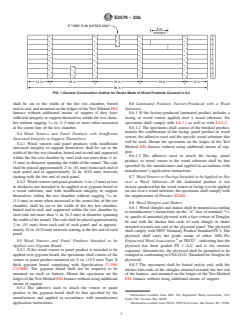
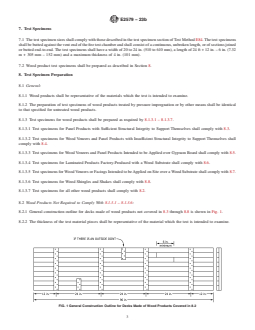
8.2.1 General construction outline for decks made of wood products not covered in 8.3 through 8.8 is shown in Fig. 1.
8.2.2 The thickness of the test material pieces shall be representative of the material which the test is intended to examine.
FIG. 1 General Construction Outline for Decks Made of Wood Products Covered in 8.2
E2579 − 23b
8.2.3 Batten strips shall be nominal 2 by ⁄16 in. (51 by 5 mm) 5 mm) and shall be constructed of metal.
8.2.4 Use either cement coated nails or No. 8, 10 or 12 wood screws, two per wood piece per batten, and of sufficient length to
penetrate through the battens and not less than 75 % of the test material.
8.2.5 For outside edges, use the longest available wood product strips. If shorter than 96 in. (2.44 m), use 6 in. (152 mm) (152 mm)
long batten strips. Do not use wood product strips less than 24 in. (610 mm) 24 in. (610 mm) long on outside edges.
8.2.6 Allow 6 in. (152 mm) minimum distance between other joints on adjacent wood product strips.
8.2.7 While fastening with nails or screws, use cabinet clamps or other suitable means to ensure there are no cracks, or gaps
between the wood product strips in the deck surface.
8.2.8 Mount the specimens on the ledges of the Test Method E84 furnace without using additional means of support.
8.3 Panel Products with Suffıcient Structural Integrity to Support Themselves:
8.3.1 Panel products with sufficient structural integrity to support themselves shall be cut to the width of the fire test chamber,
butted end-to-end, and mounted on the ledges of the Test Method E84 furnace without using additional means of support.
8.3.2 Panel products ⁄4 in. (6.3 mm) or less in thickness not intended to be applied over gypsum board or a wood substrate shall
be cut to the width of the fire test chamber, butted end-to-end, and mounted on the ledges of the Test Method E84 furnace without
additional means of support if they have sufficient integrity to support themselves within the test chamber without sagging ⁄16 in.
(1.5 mm) or more when measured at the centre-line of the test chamber.
8.4 Wood Veneers and Panel Products with Insuffıcient Structural Integrity to Support Themselves:
8.4.1 Wood veneers and panel products with insufficient structural integrity to support themselves shall be cut to the width of the
fire test chamber, butted end-to-end and supported within the fire test chamber by steel rods not more than ⁄8 in. (3 mm) in diameter
spanning the width of the tunnel. The rods shall be placed approximately 2 in. (51-mm)(51 mm) from each end of each panel and
at approximately 24 in. (610 mm) intervals starting with the fire end of each panel.
8.4.2 Wood veneers and panel products ⁄8 in. (3 mm) or less in thickness not intended to be applied over gypsum board or a w
...