

ASTM D2050-23
(Terminology)Standard Terminology Relating to Fastener Subassemblies Used in the Manufacture of Textiles
General Information
- Abstract
SCOPE
1.1 This standard identifies terminology related to subassemblies which are categorized as any component that is used in the construction or assembly of a textile product. Subassemblies can be in the form of components used as closures (for example, slide fasteners, buttons, snap fasteners, hook and loop (touch) fasteners) or methods used to join textile sections (for example, stitches and seams).
1.2 Terms relating to Buttons are found in Section 3.
1.3 Terms relating to Hook and Loop (Touch) fasteners are in Section 4.
1.4 Terms relating to Snap Fasteners are found in Section 5.
1.5 Terms relating to Slide Fasteners are found in Section 6.
1.6 For other terms related to textiles, refer to Terminology D123.
1.7 This standard does not purport to address all of the safety concerns, if any, associated with its use. It is the responsibility of the user of this standard to establish appropriate safety, health, and environmental practices and determine the applicability of regulatory limitations prior to use.
1.8 This international standard was developed in accordance with internationally recognized principles on standardization established in the Decision on Principles for the Development of International Standards, Guides and Recommendations issued by the World Trade Organization Technical Barriers to Trade (TBT) Committee.
- Status
- Published
- Publication Date
- 31-May-2023
- Technical Committee
- D13 - Textiles
- Drafting Committee
- D13.54 - Subassemblies
Buy Documents
ASTM D2050-23 - Standard Terminology Relating to Fastener Subassemblies Used in the Manufacture of Textiles
REDLINE ASTM D2050-23 - Standard Terminology Relating to Fastener Subassemblies Used in the Manufacture of Textiles
Overview
ASTM D2050-23: Standard Terminology Relating to Fastener Subassemblies Used in the Manufacture of Textiles is an international standard developed by ASTM International. This terminology standard provides an authoritative framework for terminology associated with fastener subassemblies commonly used in textile manufacturing. Fastener subassemblies covered by ASTM D2050-23 include components such as buttons, snap fasteners, hook and loop fasteners, and slide fasteners. These parts are integral to the construction, functionality, and durability of various textile products.
By standardizing vocabulary within textile manufacturing, ASTM D2050-23 ensures improved communication and quality control among manufacturers, suppliers, designers, and testing laboratories worldwide. It also assists in establishing requirements for textile fasteners and their related testing, supporting compliance with both industry and international practices.
Key Topics
ASTM D2050-23 covers terminology related to the following major fastener subassembly types used in textile manufacturing:
- Buttons: Defines terms for different button types, manufacturing processes (e.g., injection molding, compression molding), features (e.g., shank, flange, holes), and properties like launderability and drycleanability.
- Hook and Loop Fasteners: Offers definitions describing components, mechanics (hooks and loops interface), and performance metrics such as shear strength.
- Snap Fasteners: Clarifies terms for various snap designs, including prong-ring types, components (socket, stud), and functional characteristics like holding strength and snap action.
- Slide Fasteners (Zippers): Explains the components of zippers, including sliders, stringers, elements, and types (continuous or individual element fasteners), as well as terms related to their assembly and performance.
- Joining Methods: References key methods for joining textile sections, such as stitches and seams.
Each section provides specific, standardized definitions to prevent misinterpretation, facilitating precise communication and documentation within the global textile industry.
Applications
ASTM D2050-23 is applicable across a wide spectrum of textile-related activities:
- Textile Manufacturing: Provides manufacturers with standardized terms for fastener subassemblies and connection methods used in garments, upholstery, and other fabric-based products.
- Quality Control and Testing: Enables consistent identification and specification of fastener parts during product testing, inspection, and certification processes.
- Product Design and Development: Assists designers and engineers in selecting appropriate fastener components for specific textile applications, improving product performance and user experience.
- Procurement and Supply Chain Management: Eases procurement processes by ensuring that specification documents, purchase orders, and contracts use consistent, universally understood terminology for textile fasteners.
- International Trade and Compliance: Supports adherence to international trade agreements and regulatory frameworks by adopting language that aligns with globally recognized standards.
Related Standards
ASTM D2050-23 regularly references and complements several other ASTM textile standards:
- ASTM D123: Terminology Relating to Textiles - the general standard for textile-related terms.
- ASTM D1230: Test Method for Flammability of Apparel Textiles.
- ASTM D2060: Test Methods for Measuring Zipper Dimensions.
- ASTM D2061: Test Methods for Strength Tests for Zippers.
- ASTM D3657: Specification for Zipper Dimensions.
- ASTM D4846: Test Method for Resistance to Unsnapping of Snap Fasteners.
- ASTM D5169: Test Method for Shear Strength (Dynamic Method) of Hook and Loop Fasteners.
- ASTM D5171: Test Method for Impact Resistance of Plastic Sew-Through Buttons.
- ASTM D5646: Terminology Relating to Seams and Stitches Used in Home Sewing.
- ASTM D7142: Test Method for Holding Strength of Prong-Ring Attached Snap Fasteners.
By employing the terminology set forth in ASTM D2050-23, textile professionals can ensure clarity, compatibility, and reliability when dealing with fastener subassemblies, thus enhancing product quality and facilitating global trade in textile goods.
Relations
- Refers
ASTM D5171-15(2020) - Standard Test Method for Impact Resistance of Plastic Sew-Through Buttons - Effective Date
- 01-Feb-2020
- Effective Date
- 01-Mar-2017
- Effective Date
- 15-Sep-2015
- Effective Date
- 01-Sep-2015
- Effective Date
- 01-Apr-2015
- Effective Date
- 15-Jan-2015
- Effective Date
- 01-Feb-2014
- Effective Date
- 15-Jun-2013
- Effective Date
- 15-Jun-2013
- Effective Date
- 15-May-2013
- Effective Date
- 01-Feb-2012
- Effective Date
- 01-Feb-2012
- Effective Date
- 01-Jan-2011
- Effective Date
- 01-Jan-2011
- Effective Date
- 01-Jun-2010
Buy Documents
ASTM D2050-23 - Standard Terminology Relating to Fastener Subassemblies Used in the Manufacture of Textiles
REDLINE ASTM D2050-23 - Standard Terminology Relating to Fastener Subassemblies Used in the Manufacture of Textiles
Frequently Asked Questions
ASTM D2050-23 is a standard published by ASTM International. Its full title is "Standard Terminology Relating to Fastener Subassemblies Used in the Manufacture of Textiles". This standard covers: SCOPE 1.1 This standard identifies terminology related to subassemblies which are categorized as any component that is used in the construction or assembly of a textile product. Subassemblies can be in the form of components used as closures (for example, slide fasteners, buttons, snap fasteners, hook and loop (touch) fasteners) or methods used to join textile sections (for example, stitches and seams). 1.2 Terms relating to Buttons are found in Section 3. 1.3 Terms relating to Hook and Loop (Touch) fasteners are in Section 4. 1.4 Terms relating to Snap Fasteners are found in Section 5. 1.5 Terms relating to Slide Fasteners are found in Section 6. 1.6 For other terms related to textiles, refer to Terminology D123. 1.7 This standard does not purport to address all of the safety concerns, if any, associated with its use. It is the responsibility of the user of this standard to establish appropriate safety, health, and environmental practices and determine the applicability of regulatory limitations prior to use. 1.8 This international standard was developed in accordance with internationally recognized principles on standardization established in the Decision on Principles for the Development of International Standards, Guides and Recommendations issued by the World Trade Organization Technical Barriers to Trade (TBT) Committee.
SCOPE 1.1 This standard identifies terminology related to subassemblies which are categorized as any component that is used in the construction or assembly of a textile product. Subassemblies can be in the form of components used as closures (for example, slide fasteners, buttons, snap fasteners, hook and loop (touch) fasteners) or methods used to join textile sections (for example, stitches and seams). 1.2 Terms relating to Buttons are found in Section 3. 1.3 Terms relating to Hook and Loop (Touch) fasteners are in Section 4. 1.4 Terms relating to Snap Fasteners are found in Section 5. 1.5 Terms relating to Slide Fasteners are found in Section 6. 1.6 For other terms related to textiles, refer to Terminology D123. 1.7 This standard does not purport to address all of the safety concerns, if any, associated with its use. It is the responsibility of the user of this standard to establish appropriate safety, health, and environmental practices and determine the applicability of regulatory limitations prior to use. 1.8 This international standard was developed in accordance with internationally recognized principles on standardization established in the Decision on Principles for the Development of International Standards, Guides and Recommendations issued by the World Trade Organization Technical Barriers to Trade (TBT) Committee.
ASTM D2050-23 is classified under the following ICS (International Classification for Standards) categories: 01.040.61 - Clothing industry (Vocabularies); 61.040 - Headgear. Clothing accessories. Fastening of clothing. The ICS classification helps identify the subject area and facilitates finding related standards.
ASTM D2050-23 has the following relationships with other standards: It is inter standard links to ASTM D5171-15(2020), ASTM D123-17, ASTM D123-15b, ASTM D123-15a, ASTM D123-15, ASTM D5171-15, ASTM D2060-14, ASTM D123-13a, ASTM D123-13ae1, ASTM D123-13, ASTM D123-12, ASTM D123-12e1, ASTM D4846-96(2011), ASTM D7142-05(2011), ASTM D5169-98(2010). Understanding these relationships helps ensure you are using the most current and applicable version of the standard.
ASTM D2050-23 is available in PDF format for immediate download after purchase. The document can be added to your cart and obtained through the secure checkout process. Digital delivery ensures instant access to the complete standard document.
Standards Content (Sample)
This international standard was developed in accordance with internationally recognized principles on standardization established in the Decision on Principles for the
Development of International Standards, Guides and Recommendations issued by the World Trade Organization Technical Barriers to Trade (TBT) Committee.
Designation: D2050 − 23
Standard Terminology Relating to
Fastener Subassemblies Used in the Manufacture of
Textiles
This standard is issued under the fixed designation D2050; the number immediately following the designation indicates the year of
original adoption or, in the case of revision, the year of last revision. A number in parentheses indicates the year of last reapproval. A
superscript epsilon (´) indicates an editorial change since the last revision or reapproval.
1. Scope D2060 Test Methods for Measuring Zipper Dimensions
D2061 Test Methods for Strength Tests for Zippers
1.1 This standard identifies terminology related to subas-
D3657 Specification for Zipper Dimensions
semblies which are categorized as any component that is used
D4846 Test Method for Resistance to Unsnapping of Snap
in the construction or assembly of a textile product. Subassem-
Fasteners
blies can be in the form of components used as closures (for
D5169 Test Method for Shear Strength (Dynamic Method)
example, slide fasteners, buttons, snap fasteners, hook and loop
of Hook and Loop Touch Fasteners
(touch) fasteners) or methods used to join textile sections (for
D5171 Test Method for Impact Resistance of Plastic Sew-
example, stitches and seams).
Through Buttons
1.2 Terms relating to Buttons are found in Section 3.
D7142 Test Method for Holding Strength of Prong-Ring
1.3 Terms relating to Hook and Loop (Touch) fasteners are Attached Snap Fasteners
in Section 4.
3. Terminology
1.4 Terms relating to Snap Fasteners are found in Section 5.
RELATING TO BUTTONS
1.5 Terms relating to Slide Fasteners are found in Section 6.
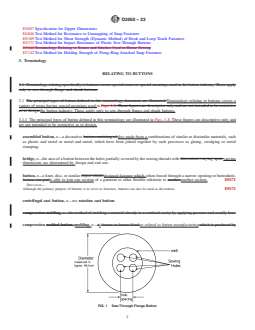
3.1 Terminology relating to buttons covers a variety of
1.6 For other terms related to textiles, refer to Terminology
terms having special meanings used in the button industry.
D123.
These apply only to sew-through flange and shank buttons.
1.7 This standard does not purport to address all of the
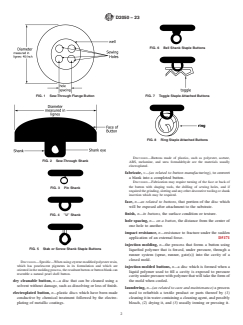
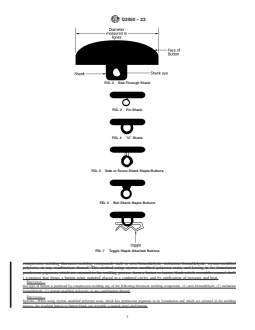
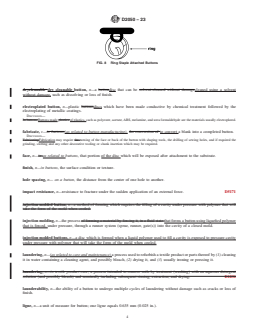
3.1.1 The principal types of button defined in this terminol-
safety concerns, if any, associated with its use. It is the
ogy are illustrated in Figs. 1-8. These figures are descriptive
responsibility of the user of this standard to establish appro-
only and are not intended to be restrictive as to design.
priate safety, health, and environmental practices and deter-
assembled button, n—a decorative disc made from a combi-
mine the applicability of regulatory limitations prior to use.
nations of similar or dissimilar materials, such as plastic and
1.8 This international standard was developed in accor-
metal or metal and metal, which have been joined together
dance with internationally recognized principles on standard-
by such processes as gluing, swedging or metal stamping.
ization established in the Decision on Principles for the
Development of International Standards, Guides and Recom- bridge, n—the area of a button between the holes partially
mendations issued by the World Trade Organization Technical covered by the sewing threads with varying dimensions are
determined by design and end use.
Barriers to Trade (TBT) Committee.
button, n—a knot, disc, or similar designed fastener which,
2. Referenced Documents
when forced through a narrow opening or buttonhole, is able
2.1 ASTM Standards:
to join one section of a garment or other flexible substrate to
D123 Terminology Relating to Textiles
another section. D5171
DISCUSSION—Although the primary purpose of buttons is to serve as
fasteners, buttons can also be used as decoration. D5171
This terminology is under the jurisdiction of ASTM Committee D13 on Textiles
and is the direct responsibility of Subcommittee D13.54 on Subassemblies. These
centrifugal cast button, n—see rotation cast button.
definitions were developed in cooperation with the American Fastener and Closure
Assn. Inc. compression molding, n—(as related to button manufactur-
Current edition approved June 1, 2023. Published September 2023. Originally
ing) a process that forms a button using material placed in a
approved in 1961. Last previous edition approved in 2019 as D2050 – 19. DOI:
confined cavity, and by application of pressure and heat.
10.1520/D2050-23.
DISCUSSION—this type of button is produced by compression molding
For referenced ASTM standards, visit the ASTM website, www.astm.org, or
any of the following thermoset molding compounds: (1) urea-
contact ASTM Customer Service at service@astm.org. For Annual Book of ASTM
formaldehyde; (2) melamine formaldehyde; (3) styrene-modified poly-
Standards volume information, refer to the standard’s Document Summary page on
the ASTM website. ester; or any combination thereof.
Copyright © ASTM International, 100 Barr Harbor Drive, PO Box C700, West Conshohocken, PA 19428-2959. United States
D2050 − 23
FIG. 6 Bell Shank Staple Buttons
FIG. 7 Toggle Staple Attached Buttons
FIG. 1 Sew-Through Flange Button
FIG. 8 Ring Staple Attached Buttons
DISCUSSION—Buttons made of plastics, such as polyester, acetate,
FIG. 2 Sew-Through Shank
ABS, melamine, and urea formaldehyde are the materials usually
electroplated.
fabricate, v—(as related to button manufacturing), to convert
a blank into a completed button.
DISCUSSION—Fabrication may require turning of the face or back of
the button with shaping tools, the drilling of sewing holes, and if
FIG. 3 Pin Shank
required the grinding, slotting and any other decorative tooling or shank
insertion which may be required.
face, n—as related to buttons, that portion of the disc which
will be exposed after attachment to the substrate.
finish, n—in buttons, the surface condition or texture.
FIG. 4 ”U” Shank
hole spacing, n— on a button, the distance from the center of
one hole to another.
impact resistance, n—resistance to fracture under the sudden
application of an external force. D5171
injection molding, n—the process that forms a button using
FIG. 5 Stab or Screw Shank Staple Buttons
liquefied polymer that is forced, under pressure, through a
runner system (sprue, runner, gate(s)) into the cavity of a
closed mold.
DISCUSSION—Specific—When using styrene modified polyester resin,
which has pearlescent pigments in its formulation and which are
injection molded buttons, n—a disc which is formed when a
oriented in the molding process, the resultant button or button blank can
liquid polymer used to fill a cavity is exposed to pressure
resemble a natural pearl shell button.
cavity under pressure with polymer that will take the form of
dry cleanable button, n—a disc that can be cleaned using a the mold when cooled.
solvent without damage, such as dissolving or loss of finish.
laundering, n—(as related to care and maintenance) a process
electroplated button, n—plastic discs which have been made used to refurbish a textile product or parts thereof by (1)
conductive by chemical treatment followed by the electro- cleaning it in water containing a cleaning agent, and possibly
plating of metallic coatings. bleach, (2) drying it, and (3) usually ironing or pressing it.
D2050 − 23
launderability, n—the ability of a button to undergo multiple sew-through shank button, n—a disc attached to one part of
cycles of laundering without damage such as cracks or loss a flexible substrate by means of needle and thread passed
of finish. through a hole or loop in the integral shank and through the
substrate. (Compare sew-through flange button.) (See Fig.
ligne, n—a unit of measure for button; one ligne equals 0.635
2.) D5171
mm (0.025 in.).
shank, n—in buttons, , the extension positioned perpendicular
luster, n—in buttons, the degree of brilliance exhibited in
to the surface of disc, designed as either a ring or a toggle at
pearlized or pearl buttons.
the center back of the flange, and having a hole or loop for
use in attaching the button to one part of a flexible substrate
metal cast button, n—a disc produced by placing molten
using a needle and thread. (See Figs. 3-6.)
metals and metal alloys into either a single-cavity or
multiple-cavity molds.
shank eye, n—the hole or loop in the perpendicular positioned
DISCUSSION—Cast metal buttons can be electroplated and treated to
shank that permits the button to be joined to one part of a
produce other finishes.
flexible substrate using a staple.
orientation, n—in buttons, the degree of order and spatial
sheet cast button, n—fastener fabricated from a disk blank and
alignment of pearlescent pigment crystals internally or in a
a cast sheet of formulated styrene-modified polyester resin.
coating.
DISCUSSION——The formulated polyester resin mix is poured into
gasketed open molds or between gasketed sheets of glass. After
pearlized, n—(as related to buttons), the addition of synthetic
stiffening the sheet is stripped from the mold and die cut into multiple
or natural pearlescent pigments to the button resin formula-
button blanks. The blanks are then cured (fully polymerized) and
tion or to the formulation used for coating.
fabricated into buttons. This method is best for buttons produced with
DISCUSSION—Buttons exhibiting a pearl-like luster are made in either oriented pearlescent pigments or opaque white pigments. (See rotation
of two ways: (1) by incorporating pearlescent pigments into the resin cast button.)
formulation prior to casting or molding the button, or (2) by applying
staple, n—in buttons, a looped metal shank fastener securely
to the button an external coating containing pearlescent pigments either
by spraying or dipping. positioned perpendicular to and at center back of the button
flange used to attach the button to one part of a flexible
ring, attached button, n—a circular connector used to fasten
substrate by means of a needle and thread, a ring, or a toggle.
a staple attached button to the substrate.
toggle, n—a clip used to fasten a staple button to the flexible
rod cast button, n—a fastener fabricated by cutting or sewing
substrate.
a disc from a rod made from formulated styrene-modified
polyester resin. toggle attached staple button, n—a button attached to one
part of a flexible substrate by using a toggle rather than a
DISCUSSION—(as related to manufacturing) a formulated styrene-
modified polyester resin is placed into aluminum or glass tubes which
needle and thread.
are sealed at one end. The flaccid or rigid rod formed after gelation is
DISCUSSION—The staple button passes through an eyelet in the
removed from the tube and sliced or sawed into button blanks. The
flexible substrate and is secured by the toggle that passes through the
blanks are then fully polymerized (cured) in hot brine solution and
staple eye. (See Fig. 7 and Fig. 8.
fabricated into buttons. This method is used for buttons which are
mottled, and multicolored. two-front button, n—a disc in which the shape of both the face
and back are identical.
rotation cast button, n—a disc fabricated from a partially
DISCUSSION—Identical faces allow for easier feeding of buttons in
polymerized sheet formed in a rotating cylinder [Synonym-
automatic sewing machines without the use of a well for side-selection
centrifugal cast button; wheel cast button]
vacuum plated button, n—a disc that is made with a flash
DISCUSSION—A resin mix prepared with catalyzed, promoted, and
metal, coated in a vacuum chamber and subsequently col-
pigmented styrene-modified polyester resin is poured into a rotating
cylinder to form a sheet of uniform layer. When gelled (polymerized) ored to simulate other metallic finish appearances.
the flexible sheet is sliced in the cylinder for removal from the cylinder.
DISCUSSION—This is the least durable of metallized finishes.
The flaccid sheet is dye cut, with a multi-cutter tool, into button blanks.
well, n—as related to buttons, a recess in center of sew-through
The blanks are then cured, usually in hot brine solutions, and fabricated
into buttons. This method is best for buttons produced with oriented
flange button that give aesthetics and identifies the face side.
pearlescent pigments, opaque white pigments, and multilayer combi-
wheel cast button, n—see rotation cast button.
nation of colors and mottles.
sewing hole, n—an opening in either the flange or shank of a
4. Terminology
button used to attach the button to the substrate using needle
and thread.
Related to Hook and Loop (Touch) Fasteners
sew-through flange button, n——a disc attached to one part hook and loop fasteners, n—a touch fastener, comprised of
of a flexible substrate by means of needle and thread which two flexible mating strips, the surface of one mating strip
are passed through two or more holes in its flange, and being covered with tiny, stiff protrusions shaped liked hooks
through the substrate. (Compare sew-through flange but- which engage the other mating strip which is covered with
ton.) (See Fig. 1.) D5171 pliable loops.
D2050 − 23
DISCUSSION—This fastener comprises a non-adhesive method of
fastener that penetrates through fabric to mechanically set a
joining two materials where ready adjustment and removal is desirable
matching socket on one side of a closure, a matching stud on
and fastening is accomplished by pressing the mating strips together
the facing closure which allow the outer and inner closure
and separation is accomplished by peeling the tapes apart. Hook and
facings to be snapped together. (See Fig. 9.) D7142
loop fastening systems can have other types of hook tape component
designs which demonstrates a higher fastening strength in the shear
snap action, n—the force required to disengage a snap fastener
direction. D5169
resulting from a pull exerted perpendicular to the plane of
material to which the snap fastener is attached. (See force.)
shear strength, n—the resistance to forces that cause, or tend
D4846
to cause, two contiguous parts of a body to slide relatively to
each other in a direction parallel to their plane of contact.
snap fastener, n—a device for attaching one material to
D5169
another consisting of matching male and female parts, each
DISCUSSION—Shear strength can be tested in the lengthwise direction
of which is attached to a separate material so that the parts
or in the lateral direction on the two contiguous parts. D5169
can be joined by a low compressive force and separated by
a low perpendicular tensile force. D4846
5. Terminology
socket, n—in snap fasteners, the female functional part of the
Related to Snap Fasteners
fastener which engages with the stud part of the fastener to
5.1 Terminology relating specifically to snap fasteners in-
form the closure of two parts of the item on which the
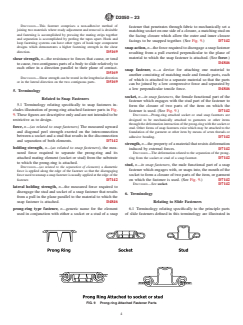
cludes illustration of prong-ring attached fastener parts in Fig.
fastener is used. (See Fig. 9.) D7142
9. These figures are descriptive only and are not intended to be
DISCUSSION—Prong-ring attached socket or stud snap fasteners are
restrictive as to design. designed to be mechanically attached to garments or other items
through the deformation interaction of the prong-ring with the socket or
force, n—(as related to snap fasteners) The measured upward
stud. Other forms of snap fasteners exist which may be attached to the
and diagonal peel strength exerted on the interconnection
foundation of the garment or other item by means of sewn threads or
between a socket and a stud that results in the disconnection
adhesive bonding. D7142
and separation of both elements. D7142
strength, n—the property of a material that resists deformation
holding strength, n—(as related to snap fasteners), the mea-
induced by external forces. D7142
sured force required to separate the prong-ring and its DISCUSSION—The deformation related to the separation of the prong-
attached mating element (socket or stud) from the substrate ring from the socket or stud of a snap fastener. D7142
to which the prong-ring is attached.
stud, n—in snap fasteners, the male functional part of a snap
DISCUSSION—(as related to the separation of elements) a diametric
fastener which engages with, or snaps into, the mouth of the
force is applied along the edge of the fastener so that the disengaging
socket to form a closure of two parts of the item, or garment
force used to unsnap a snap fastener is usually applied at the edge of the
on which the fastener is used. (See Fig. 9.) D7142
fastener. D7142
DISCUSSION—See socket. D7142
lateral holding strength, n—the measured force required to
disengage the stud and socket of a snap fastener that results
6. Terminology
from a pull in the plane parallel to the material to which the
snap fastener is attached. D4846
Relating to Slide Fasteners
prong-ring type fastener, n—generic name for the element 6.1 Terminology relating specifically to the principle parts
used in conjunction with either a socket or a stud of a snap of slide fasteners defined in this terminology are illustrated in
FIG. 9 Prong-ring Attached Fastener Parts
D2050 − 23
Figs. 10-19. These figures are descriptive only and are not
intended to be restrictive as to design.
automatic lock slider, n—a slider that provides involuntary,
positive locking action on the chain when the pull is released
restricting the movement of the slider to open the chain
unless a stress is applie
...
This document is not an ASTM standard and is intended only to provide the user of an ASTM standard an indication of what changes have been made to the previous version. Because
it may not be technically possible to adequately depict all changes accurately, ASTM recommends that users consult prior editions as appropriate. In all cases only the current version
of the standard as published by ASTM is to be considered the official document.
Designation: D2050 − 19 D2050 − 23
Standard Terminology Relating to
Fastener Subassemblies Used in the Manufacture of
Textiles
This standard is issued under the fixed designation D2050; the number immediately following the designation indicates the year of
original adoption or, in the case of revision, the year of last revision. A number in parentheses indicates the year of last reapproval. A
superscript epsilon (´) indicates an editorial change since the last revision or reapproval.
1. Scope
1.1 This standard identifies terminology related to subassemblies used in the construction of textiles both general and specific and
can be which are categorized as any component or structure that is used in the construction or assembly of a textile product.
Subassemblies can be in the form of components used as closures (for example, slide fasteners, buttons, snap fasteners, hook and
loop (touch) fastners) or methods of joining fasteners) or methods used to join textile sections (for example, stitches and seams).
1.2 The subassembly terms Terms relating to Buttons are found in Terminology Section 3.
1.3 The subassembly terms Terms relating to Hook and Loop (Touch) fasteners are in Terminology Section 4.
1.4 The subassembly terms Terms relating to Snap Fasteners are found in Terminology Section 5.
1.5 The subassembly terms Terms relating to Slide Fasteners are found in Terminology Section 6.
1.6 For other terms associated withrelated to textiles, refer to Terminology D123.
1.7 This standard does not purport to address all of the safety concerns, if any, associated with its use. It is the responsibility
of the user of this standard to establish appropriate safety, health, and environmental practices and determine the applicability of
regulatory limitations prior to use.
1.8 This international standard was developed in accordance with internationally recognized principles on standardization
established in the Decision on Principles for the Development of International Standards, Guides and Recommendations issued
by the World Trade Organization Technical Barriers to Trade (TBT) Committee.
2. Referenced Documents
2.1 ASTM Standards:
D123 Terminology Relating to Textiles
D1230 Test Method for Flammability of Apparel Textiles
D2060 Test Methods for Measuring Zipper Dimensions
D2061 Test Methods for Strength Tests for Zippers
This terminology is under the jurisdiction of ASTM Committee D13 on Textiles and is the direct responsibility of Subcommittee D13.54 on Subassemblies. These
definitions were developed in cooperation with the American Fastener and Closure Assn. Inc.
Current edition approved Jan. 15, 2019June 1, 2023. Published February 2019September 2023. Originally approved in 1961. Last previous edition approved in 20112019
ɛ1
as D2050 – 11D2050 – 19. . DOI: 10.1520/D2050-19.10.1520/D2050-23.
For referenced ASTM standards, visit the ASTM website, www.astm.org, or contact ASTM Customer Service at service@astm.org. For Annual Book of ASTM Standards
volume information, refer to the standard’s Document Summary page on the ASTM website.
Copyright © ASTM International, 100 Barr Harbor Drive, PO Box C700, West Conshohocken, PA 19428-2959. United States
D2050 − 23
D3657 Specification for Zipper Dimensions
D4846 Test Method for Resistance to Unsnapping of Snap Fasteners
D5169 Test Method for Shear Strength (Dynamic Method) of Hook and Loop Touch Fasteners
D5171 Test Method for Impact Resistance of Plastic Sew-Through Buttons
D5646 Terminology Relating to Seams and Stitches Used in Home Sewing
D7142 Test Method for Holding Strength of Prong-Ring Attached Snap Fasteners
3. Terminology
RELATING TO BUTTONS
3.1 Terminology relating specifically to buttons covers special terms or special meanings used in the button industry. These apply
only to sew-through flange and shank buttons.
3.1 The principal types of button defined in this terminology document are illustrated Terminology relating to buttons covers a
variety of terms having special meanings used in Figs. 1-8. These figures are descriptive only and are not intended to be restrictive
as to design.the button industry. These apply only to sew-through flange and shank buttons.
3.1.1 The principal types of button defined in this terminology are illustrated in Figs. 1-8. These figures are descriptive only and
are not intended to be restrictive as to design.
assembled button, n—a decorative button consisting of disc made from a combinations of similar or dissimilar materials, such
as plastic and metal or metal and metal, which have been joined together by such processes as gluing, swedging or metal
stamping.
bridge, n—the area of a button between the holes partially covered by the sewing threads with dimensions varying upon varying
dimensions are determined by design and end use.
button, n—a knot, disc, or similar object which designed fastener which, when forced through a narrow opening or buttonhole,
fastens one partis able to join one section of a garment or other flexible substrate to another.another section. D5171
DISCUSSION—
Although the primary purpose of buttons is to serve as fasteners, buttons can also be used as decoration. D5171
centrifugal cast button, n—see rotation cast button.
compression molding, n—the method of molding a material already in a confined cavity by applying pressure and usually heat.
compression molded button, molding, n—a( button or button blankas related to button manufacturing which is produced by
FIG. 1 Sew-Through Flange Button
D2050 − 23
FIG. 2 Sew-Through Shank
FIG. 3 Pin Shank
FIG. 4 ”U” Shank
FIG. 5 Stab or Screw Shank Staple Buttons
FIG. 6 Bell Shank Staple Buttons
FIG. 7 Toggle Staple Attached Buttons
compression molding thermoset-molding compounds such as urea-formaldehyde, melamine-formaldehyde, styrene-modified
polyester, or any combination thereof. This method using styrene modified polyester resin, and having in its formulation
pearlescent pigments which are oriented in the molding process, form a button or button blank which resembles natural shell.
) a process that forms a button using material placed in a confined cavity, and by application of pressure and heat.
DISCUSSION—
this type of button is produced by compression molding any of the following thermoset molding compounds: (1) urea-formaldehyde; (2) melamine
formaldehyde; (3) styrene-modified polyester; or any combination thereof.
DISCUSSION—
Specific—When using styrene modified polyester resin, which has pearlescent pigments in its formulation and which are oriented in the molding
process, the resultant button or button blank can resemble a natural pearl shell button.
D2050 − 23
FIG. 8 Ring Staple Attached Buttons
drycleanable dry cleanable button, n—a buttondisc that can be solvent-cleaned without damagecleaned using a solvent
without damage, such as dissolving or loss of finish.
electroplated button, n—plastic buttonsdiscs which have been made conductive by chemical treatment followed by the
electroplating of metallic coatings.
DISCUSSION—
In buttons,Buttons made plastics of plastics, such as polyester, acetate, ABS, melamine, and urea formaldehyde are the materials usually electroplated.
fabricate, v—in buttons,(as related to button manufacturing), the conversion of to convert a blank into a completed button.
DISCUSSION—
FabricatingFabrication may require the turning of the face or back of the button with shaping tools, the drilling of sewing holes, and if required the
grinding, slotting and any other decorative tooling or shank insertion which may be required.
face, n—in as related to buttons, that portion of the disc which will be exposed after attachment to the substrate.
finish, n—in buttons, the surface condition or texture.
hole spacing, n— on a button, the distance from the center of one hole to another.
impact resistance, n—resistance to fracture under the sudden application of an external force. D5171
injection molded button, n—a method of forming which requires the filling of a cavity under pressure with polymer that will
take the form of the mold when cooled.
injection molding, n—the process of forming a material by forcing it, in a fluid state that forms a button using liquefied polymer
that is forced, under pressure, through a runner system (sprue, runner, gate(s)) into the cavity of a closed mold.
injection molded buttons, n—a disc which is formed when a liquid polymer used to fill a cavity is exposed to pressure cavity
under pressure with polymer that will take the form of the mold when cooled.
laundering, n—(as related to care and maintenance) a process used to refurbish a textile product or parts thereof by (1) cleaning
it in water containing a cleaning agent, and possibly bleach, (2) drying it, and (3) usually ironing or pressing it.
laundering, n—in textile product care, a process intended to remove soils by treatment (washing) with an aqueous detergent
solution (and possibly bleach) and nominally including subsequent rinsing, extraction, and drying. D1230
launderability, n—the ability of a button to undergo multiple cycles of laundering without damage such as cracks or loss of
finish.
ligne, n—a unit of measure for button; one ligne equals 0.635 mm (0.025 in.).
D2050 − 23
luster, n—in buttons, the degree of brilliance exhibited in pearlized or pearl buttons.
metal cast button, n—a buttondisc produced by the casting of placing molten metals and metal alloys into either a single-cavity
or multiple-cavity molds.
DISCUSSION—
Cast metal buttons can be electroplated and treated to produce other finishes.
orientation, n—in buttons, the degree of order and spatial alignment of pearlescent pigment crystals internally or in a coating.
pearlized, n—in buttons,(as related to buttons), the addition of synthetic or natural pearlescent pigments to the button resin
formulation or to the formulation used for coating.
DISCUSSION—
Buttons exhibiting a pearl-like luster are made in either of two ways: (1) by incorporating pearlescent pigments into the resin formulation prior to
casting or molding the button, or (2) by applying to the button an external coating containing pearlescent pigments either by spraying or dipping.
ring, attached button, n—in buttons,a split ringcircular connector used to fasten a staple attached button to the substrate.
rod cast button, n—a button fabricated from a disk sliced or sawed from a cast rod of fastener fabricated by cutting or sewing
a disc from a rod made from formulated styrene-modified polyester resin.
DISCUSSION—
Formulated (as related to manufacturing) a formulated styrene-modified polyester resin is castplaced into aluminum or glass tubes which are sealed
at one end. The flaccid or rigid rod formed after gelation is removed from the tube and sliced or sawed into button blanks. The blanks are then fully
polymerized (cured) in hot brine solution and fabricated into buttons. This method is used for buttons which are mottled, and multicolored.
rotation cast button, n—a buttondisc fabricated from a disk blanked from a partially polymerized sheet formed in a rotating
cylinder (also [known Synonymascentrifugal casting andcast button; wheel casting).cast button]
DISCUSSION—
A resin mix prepared with catalyzed, promoted, and pigmented styrene-modified polyester resin is poured into a rotating cylinder to form a sheet of
uniform layer. When gelled (polymerized) the flexible sheet is sliced in the cylinder for removal from the cylinder. The flaccid sheet is dye cut, with
a multi-cutter tool, into button blanks. The blanks are then cured, usually in hot brine solutions, and fabricated into buttons. This method is best for
buttons produced with oriented pearlescent pigments, opaque white pigments, and multilayer combination of colors and mottles.
sewing hole, n—a holean opening in either the flange or shank of a button used to attach the button to the substrate by means
of a using needle and thread.
sew-through flange button, n—a button—a disc attached to one part of a flexible substrate by means of needle and thread which
are passed through two or more holes in its flange, and through the substrate. (Compare sew-through flange button.) (See Fig.
1.) D5171
sew-through shank button, n—a buttondisc attached to one part of a flexible substrate by means of needle and thread passed
through a hole or loop in the integral shank and through the substrate. (Compare sew-through flange button.) (See Fig. 2.)
D5171
shank, n—in buttons, that part , the extension positioned perpendicular to and the surface of disc, designed as either a ring or
a toggle at the center back of the flange, and having a hole or loop for use in attaching the button to one part of a flexible substrate
by means of a needle or thread, a ring, or a toggle. using a needle and thread. (See Figs. 3-6.)
shank eye, n—in buttons,the hole or loop in the shank of a sew-through shank button or the hole in the loop of the staple of
a staple button. perpendicular positioned shank that permits the button to be joined to one part of a flexible substrate using a
staple.
D2050 − 23
sheet cast button, n—a button fastener fabricated from a disk blanked fromblank and a cast sheet of formulated
styrene-modified polyester resin.
DISCUSSION—
The—The formulated polyester resin mix (see rotation cast buttons) is poured into gasketed open molds or between gasketed sheets of glass. After
gelationstiffening the sheet is stripped from the mold and die cut into multiple button blanks. The blanks are then cured (fully polymerized) and
fabricated into buttons. This method is best for buttons produced with oriented pearlescent pigments or opaque white pigments. (See rotation cast
button.)
staple, n—in buttons, a looped metal shank fastener securely positioned perpendicular to and at center back of the button flange
for use in attaching used to attach the button to one part of a flexible substrate by means of a needle and thread, a ring, or a toggle.
toggle, n—in buttons,a clip used to fasten a staple button to the flexible substrate.
ring or toggle attached staple button, n—a button attached to one part of a flexible substrate by means of a ring or using a
toggle rather than a needle or thread. The staple passes through an eyelet in the flexible substrate and is secured by the ring or
toggle that passes through the staple eye. (See and thread. Fig. 7 and Fig. 8.
DISCUSSION—
The staple button passes through an eyelet in the flexible substrate and is secured by the toggle that passes through the staple eye. (See Fig. 7 and Fig.
8.
two-front button, n—a buttondisc in which the shape of both the face and back shape are identical.
DISCUSSION—
Identical faces allow for easier feeding of buttons in automatic sewing machines without the use of a well for side-selection. side-selection
vacuum plated button, n—a buttondisc that is flash metal coated in vacuum chambersmade with a flash metal, coated in a
vacuum chamber and subsequently colored to simulate other metal finishes.metallic finish appearances.
DISCUSSION—
This is the least durable of metallized finishes.
well, n—in as related to buttons, a recess in center of sew-through flange button that give aesthetics and identifies the face side.
wheel cast button, n—see rotation cast button.
4. Terminology
RELATING TO HOOK AND LOOP FASTENERSRelated to Hook and Loop (Touch) Fasteners
hook and loop fasteners, n—a touch fastener, comprised of two flexible mating strips, the surface of one mating strip being
covered with tiny, stiff protrusions shaped liked hooks which engage the other mating strip which is covered with pliable loops.
D5169
DISCUSSION—
This fastener comprises a non-adhesive method of joining two materials where ready adjustment and removal is desirable and fastening is
accomplished by pressing the mating strips together and separation is accomplished by simply peeling apart. Terms herein referring to hook the tapes
apart. Hook and loop fastening systems shall be construed to include can have other types of touch fasteners in which the hook tape component designs
which demonstrates a higher fastening strength in the shear mode (that is, against forces applied in the plane of the fastener) substantially exceeds the
fastening strength in the peel mode (that is, against forces applied perpendicular to the planes of the two components of the fastener).direction. D5169
shear strength, n—the resistance to forces that cause, or tend to cause, two contiguous parts of a body to slide relatively to each
other in a direction parallel to their plane of contact. D5169
DISCUSSION—
Shear strength can be tested in the lengthwise direction or in the lateral direction on the two contiguous parts. D5169
D2050 − 23
5. Terminology
RELATING TO SNAP FASTENERSRelated to Snap Fasteners
5.1 Terminology relating specifically to snap fasteners includes illustration of prong-ring attached fastener parts in Fig. 9. These
figures are descriptive only and are not intended to be restrictive as to design.
force, n—a physical influence exerted by(as related to snap fasteners) one body on another which produces acceleration of
bodies that are free to move and deformation of bodies that are not free to move.The measured upward and diagonal peel strength
exerted on the interconnection between a socket and a stud that results in the disconnection and separation of both elements.
D7142
holding strength, n—(in snap fasteners,as related to snap fasteners), the measured force required to separate the prong-ring
fromand its attached mating part (socket or stud).element (socket or stud) from the substrate to which the prong-ring is attached.
DISCUSSION—
In( this test method, as related to the separation of elements) a diametric force is applied which simulates the diametric biting or pinching of a child;
however, in practice, along the edge of the fastener so that the disengaging force used to unsnap a snap fastener is usually applied at the edge of the
fastener. D7142
lateral holding strength, n—the measured force required to disengage the stud and socket of a snap fastener resulting that
results from a pull in the plane parallel to the material to which the snap fastener is attached. D4846
prong-ring type fastener, n—generic name for snap fasteners which use a multi-pronged ring to penetrate the element used in
conjunction with either a socket or a stud of a snap fastener that penetrates through fabric to mechanically set a matching socket
on one side of a closure and to set closure, a matching stud on the facing closure allowing which allow the outer and inner closure
facings to be snapped together. (See Fig. 9.) D7142
snap action, n—the force required to disengage a snap fastener resulting from a pull exerted perpendicular to the plane of
material to which the snap fastener is attached. (See force.) D4846
snap fastener, n—a device for attaching one material to another consisting of matching male and female parts, each of which
is attached to a separate material so that the parts can be joined by a low compressive force and separated by a low perpendicular
tensile force. D4846
socket, n—in snap fasteners, the female functional part of the fastener which engages with the stud part of the fastener to form
the closure of two parts of the item on which the fastener is used. (See Fig. 9.) D7142
FIG. 9 Prong-ring Attached Fastener Parts
D2050 − 23
DISCUSSION—
Prong-ring attached socket or stud snap fasteners are designed to be mechanically attached to garments or other items through the deformation
interaction of the prong-ring with the socket or stud. Other forms of snap fasteners exist which may be attached to the foundation of the garment or
other item by means of sewn threads or adhesive bonding. D7142
strength, n—the property of a material that resists deformation induced by external forces. D7142
DISCUSSION—
In this standard, the deformation is The deformation related to the separation of the prong-ring from the socket or stud of a snap fastener. D7142
stud, n—in snap fasteners, the male functional part of a snap fastener which engages with, or snaps into, the mouth of the socket
to form a closure of two parts of the item, or garment on which the fastener is used. (See Fig. 9.) D7142
DISCUSSION—
See discussion for socket. D7142
6. Terminology
RELATING TO SLIDE FASTENERSRelating to Slide Fasteners
6.1 Terminology relating specifically to the textile joining structures (seams and stitches) are discussed in detail in Terminology
D5646.
6.1 Terminology relating specifically to the principle parts of slide fasteners defined in this terminology are illustrated in Figs.
10-19. These figures are descriptive only and are not intended to be restrictive as to design.
automatic lock slider, n—a slider that provides involu
...