

ASTM F2795-18
(Test Method)Standard Test Method for Performance of Self-Contained Soft Serve and Shake Freezers
General Information
- Abstract
SIGNIFICANCE AND USE
5.1 The freeze-down energy consumption and duration can be used to determine time and energy required for a freezer to be ready to serve when loaded with mix.
5.2 The minimum dispensing interval determination is used to determine the rate at which the product will be dispensed during the Heavy-Use Energy Consumption and Production Capacity Test (10.5). Measuring overrun during this test is critical to determining production capacity rating in gallons per hour.
5.3 Heavy-use energy consumption can be used by an operator to determine energy consumption during peak usage when selecting a soft-serve freezer. Measuring overrun during this test is critical to determining production capacity rating in gallons per hour.
5.4 Production capacity can be used by an operator in selecting a soft-serve or shake freezer that meets their production requirements. Measuring overrun during this test is critical to determining production capacity rating in gallons per hour.
5.5 Impact draw is used to determine the peak rate at which servable quality product (as defined in 10.2.5) can be dispensed from a soft-serve or shake freezer.
5.6 Idle energy rate is a precise indicator of a soft serve freezer’s energy performance under a stabilized ready-to-serve operating condition. This information enables the food service operator to consider energy performance when selecting soft-serve or shake equipment.
5.7 Stand-by (night mode) energy rate is a precise indicator of a soft-serve or shake freezer’s energy performance under a simulated overnight operating condition. This information enables the food service operator to consider energy performance when selecting soft-serve or shake equipment, if applicable.
5.8 Heat Treat cycle energy consumption is a precise indicator of a soft serve or shake freezer’s energy performance when operated in a heat treatment cycle. This information can be used by an operator to consider the energy requirement of using a heat treat cycle, if ap...
SCOPE
1.1 This test method evaluates the energy consumption and performance of soft serve ice cream and shake freezers. The food service operator can use this test to evaluate and select an appropriate soft serve or shake freezer and understand its energy consumption and production capabilities.
1.2 This test method applies to the following types of soft serve and shake freezers: (any of which may or may not have a reservoir for liquid mix). Included in these test methods are conventional and heat-treatment freezers. The unit may include separate refrigeration systems for the frozen product and fresh mix and may be either air-cooled or water-cooled.
1.3 The soft serve/shake freezers will be tested for the following (where applicable):
1.3.1 Maximum power input, or maximum current draw,
1.3.2 Initial freeze-down energy consumption and duration,
1.3.3 Heavy-use energy consumption,
1.3.4 Production capacity,
1.3.5 Overrun,
1.3.6 Impact performance,
1.3.7 Idle energy rate, and
1.3.8 Heat treat cycle energy consumption (if applicable).
1.4 The values stated in inch-pound units are to be regarded as standard. The values given in parentheses are mathematical conversions to SI units that are provided for information only and are not considered standard.
1.5 This standard does not purport to address all of the safety concerns, if any, associated with its use. It is the responsibility of the user of this standard to establish appropriate safety, health, and environmental practices and determine the applicability of regulatory limitations prior to use.
1.6 This international standard was developed in accordance with internationally recognized principles on standardization established in the Decision on Principles for the Development of International Standards, Guides and Recommendations issued by the World Trade Organization Technical Barriers to Trade (TBT) Committee.
- Status
- Published
- Publication Date
- 31-Aug-2018
- Technical Committee
- F26 - Food Service Equipment
- Drafting Committee
- F26.06 - Productivity and Energy Protocol
Buy Documents
ASTM F2795-18 - Standard Test Method for Performance of Self-Contained Soft Serve and Shake Freezers
REDLINE ASTM F2795-18 - Standard Test Method for Performance of Self-Contained Soft Serve and Shake Freezers
Overview
ASTM F2795-18 provides a standardized test method for evaluating the performance and energy consumption of self-contained soft serve and shake freezers. Developed by ASTM International, this standard helps food service operators make informed decisions when selecting equipment by offering clear benchmarks on energy usage, production capacity, and dispensing performance. The test applies to various freezer types, including conventional and heat-treatment varieties, and covers models with or without liquid mix reservoirs, as well as air-cooled and water-cooled systems.
Key Topics
- Energy Consumption: The standard measures key operational energy data including freeze-down energy usage, heavy-use and idle phase consumption, and, where applicable, heat treat cycle energy demand. This helps operators assess the total cost of ownership and environmental impact.
- Production Capacity: By quantifying overrun (a measure of air incorporation into frozen product) and the rate of product dispensing, the test defines a freezers’ production capacity in gallons per hour-a core metric for high-volume food service.
- Dispensing Intervals and Impact Draw: The minimum dispensing interval is established to determine how quickly a freezer can serve consecutive portions without compromising product quality. The impact draw test measures the peak rate at which servable product can be dispensed, critical for peak-service periods.
- Idle and Standby Performance: Idle energy rate (ready-to-serve mode) and standby or night mode consumption are evaluated, allowing users to compare equipment energy efficiency during low-demand times.
- Heat Treatment Evaluation: For models with heat treatment capabilities, the standard measures the energy used during the sanitation cycle-a factor in both food safety and energy efficiency.
Applications
The ASTM F2795-18 standard offers practical value for various stakeholders:
- Foodservice Operators: Enables evidence-based equipment selection by providing standardized performance and energy consumption data, ensuring freezers match operational requirements for volume and efficiency.
- Equipment Manufacturers: Provides a clear protocol for demonstrating product compliance, supporting marketing claims and regulatory submissions.
- Facility Managers and Designers: Facilitates comparisons between freezer models based on reliable, replicable test data, aiding in specifying energy-efficient, high-performance appliances.
- Regulatory and Certification Bodies: Offers a recognized framework for evaluating compliance with energy and food safety requirements in ice cream production environments.
Related Standards
- ASTM F1604 - Specification for Freezers, Ice Cream, Soft Serve, Shake
- NSF/ANSI 6 - Dispensing Freezers: Covers sanitation standards for dispensing freezers.
- 21 CFR 135.110 - Code of Federal Regulations on ice cream and frozen custard.
- ASHRAE Guideline 2 - Engineering analysis of experimental performance data.
Summary
Adopting ASTM F2795-18 enables data-driven selection, operation, and management of soft serve and shake freezers in commercial environments, providing assurance of energy efficiency, production capability, and consistent product quality. Use of this standard supports best practices in food service equipment procurement and operation, aligning with modern priorities of cost-efficiency, sustainability, and food safety. For those looking to enhance commercial soft serve and shake operations, referencing ASTM F2795-18 ensures equipment meets rigorous and internationally recognized performance benchmarks.
Relations
- Replaces
ASTM F2795-15 - Standard Test Method for Performance of Self-Contained Soft Serve and Shake Freezers - Effective Date
- 01-Sep-2018
- Effective Date
- 01-Nov-2015
- Effective Date
- 01-Oct-2009
- Effective Date
- 10-Mar-2002
- Effective Date
- 10-Mar-2002
- Effective Date
- 01-Sep-2018
- Referred By
ASTM F1604-15(2020)e1 - Standard Specification for Freezers, Ice Cream, Soft Serve, Shake - Effective Date
- 01-Sep-2018
Buy Documents
ASTM F2795-18 - Standard Test Method for Performance of Self-Contained Soft Serve and Shake Freezers
REDLINE ASTM F2795-18 - Standard Test Method for Performance of Self-Contained Soft Serve and Shake Freezers
Get Certified
Connect with accredited certification bodies for this standard

BSI Group
BSI (British Standards Institution) is the business standards company that helps organizations make excellence a habit.

Bureau Veritas
Bureau Veritas is a world leader in laboratory testing, inspection and certification services.

DNV
DNV is an independent assurance and risk management provider.
Sponsored listings
Frequently Asked Questions
ASTM F2795-18 is a standard published by ASTM International. Its full title is "Standard Test Method for Performance of Self-Contained Soft Serve and Shake Freezers". This standard covers: SIGNIFICANCE AND USE 5.1 The freeze-down energy consumption and duration can be used to determine time and energy required for a freezer to be ready to serve when loaded with mix. 5.2 The minimum dispensing interval determination is used to determine the rate at which the product will be dispensed during the Heavy-Use Energy Consumption and Production Capacity Test (10.5). Measuring overrun during this test is critical to determining production capacity rating in gallons per hour. 5.3 Heavy-use energy consumption can be used by an operator to determine energy consumption during peak usage when selecting a soft-serve freezer. Measuring overrun during this test is critical to determining production capacity rating in gallons per hour. 5.4 Production capacity can be used by an operator in selecting a soft-serve or shake freezer that meets their production requirements. Measuring overrun during this test is critical to determining production capacity rating in gallons per hour. 5.5 Impact draw is used to determine the peak rate at which servable quality product (as defined in 10.2.5) can be dispensed from a soft-serve or shake freezer. 5.6 Idle energy rate is a precise indicator of a soft serve freezer’s energy performance under a stabilized ready-to-serve operating condition. This information enables the food service operator to consider energy performance when selecting soft-serve or shake equipment. 5.7 Stand-by (night mode) energy rate is a precise indicator of a soft-serve or shake freezer’s energy performance under a simulated overnight operating condition. This information enables the food service operator to consider energy performance when selecting soft-serve or shake equipment, if applicable. 5.8 Heat Treat cycle energy consumption is a precise indicator of a soft serve or shake freezer’s energy performance when operated in a heat treatment cycle. This information can be used by an operator to consider the energy requirement of using a heat treat cycle, if ap... SCOPE 1.1 This test method evaluates the energy consumption and performance of soft serve ice cream and shake freezers. The food service operator can use this test to evaluate and select an appropriate soft serve or shake freezer and understand its energy consumption and production capabilities. 1.2 This test method applies to the following types of soft serve and shake freezers: (any of which may or may not have a reservoir for liquid mix). Included in these test methods are conventional and heat-treatment freezers. The unit may include separate refrigeration systems for the frozen product and fresh mix and may be either air-cooled or water-cooled. 1.3 The soft serve/shake freezers will be tested for the following (where applicable): 1.3.1 Maximum power input, or maximum current draw, 1.3.2 Initial freeze-down energy consumption and duration, 1.3.3 Heavy-use energy consumption, 1.3.4 Production capacity, 1.3.5 Overrun, 1.3.6 Impact performance, 1.3.7 Idle energy rate, and 1.3.8 Heat treat cycle energy consumption (if applicable). 1.4 The values stated in inch-pound units are to be regarded as standard. The values given in parentheses are mathematical conversions to SI units that are provided for information only and are not considered standard. 1.5 This standard does not purport to address all of the safety concerns, if any, associated with its use. It is the responsibility of the user of this standard to establish appropriate safety, health, and environmental practices and determine the applicability of regulatory limitations prior to use. 1.6 This international standard was developed in accordance with internationally recognized principles on standardization established in the Decision on Principles for the Development of International Standards, Guides and Recommendations issued by the World Trade Organization Technical Barriers to Trade (TBT) Committee.
SIGNIFICANCE AND USE 5.1 The freeze-down energy consumption and duration can be used to determine time and energy required for a freezer to be ready to serve when loaded with mix. 5.2 The minimum dispensing interval determination is used to determine the rate at which the product will be dispensed during the Heavy-Use Energy Consumption and Production Capacity Test (10.5). Measuring overrun during this test is critical to determining production capacity rating in gallons per hour. 5.3 Heavy-use energy consumption can be used by an operator to determine energy consumption during peak usage when selecting a soft-serve freezer. Measuring overrun during this test is critical to determining production capacity rating in gallons per hour. 5.4 Production capacity can be used by an operator in selecting a soft-serve or shake freezer that meets their production requirements. Measuring overrun during this test is critical to determining production capacity rating in gallons per hour. 5.5 Impact draw is used to determine the peak rate at which servable quality product (as defined in 10.2.5) can be dispensed from a soft-serve or shake freezer. 5.6 Idle energy rate is a precise indicator of a soft serve freezer’s energy performance under a stabilized ready-to-serve operating condition. This information enables the food service operator to consider energy performance when selecting soft-serve or shake equipment. 5.7 Stand-by (night mode) energy rate is a precise indicator of a soft-serve or shake freezer’s energy performance under a simulated overnight operating condition. This information enables the food service operator to consider energy performance when selecting soft-serve or shake equipment, if applicable. 5.8 Heat Treat cycle energy consumption is a precise indicator of a soft serve or shake freezer’s energy performance when operated in a heat treatment cycle. This information can be used by an operator to consider the energy requirement of using a heat treat cycle, if ap... SCOPE 1.1 This test method evaluates the energy consumption and performance of soft serve ice cream and shake freezers. The food service operator can use this test to evaluate and select an appropriate soft serve or shake freezer and understand its energy consumption and production capabilities. 1.2 This test method applies to the following types of soft serve and shake freezers: (any of which may or may not have a reservoir for liquid mix). Included in these test methods are conventional and heat-treatment freezers. The unit may include separate refrigeration systems for the frozen product and fresh mix and may be either air-cooled or water-cooled. 1.3 The soft serve/shake freezers will be tested for the following (where applicable): 1.3.1 Maximum power input, or maximum current draw, 1.3.2 Initial freeze-down energy consumption and duration, 1.3.3 Heavy-use energy consumption, 1.3.4 Production capacity, 1.3.5 Overrun, 1.3.6 Impact performance, 1.3.7 Idle energy rate, and 1.3.8 Heat treat cycle energy consumption (if applicable). 1.4 The values stated in inch-pound units are to be regarded as standard. The values given in parentheses are mathematical conversions to SI units that are provided for information only and are not considered standard. 1.5 This standard does not purport to address all of the safety concerns, if any, associated with its use. It is the responsibility of the user of this standard to establish appropriate safety, health, and environmental practices and determine the applicability of regulatory limitations prior to use. 1.6 This international standard was developed in accordance with internationally recognized principles on standardization established in the Decision on Principles for the Development of International Standards, Guides and Recommendations issued by the World Trade Organization Technical Barriers to Trade (TBT) Committee.
ASTM F2795-18 is classified under the following ICS (International Classification for Standards) categories: 55.230 - Distribution and vending machines; 67.260 - Plants and equipment for the food industry. The ICS classification helps identify the subject area and facilitates finding related standards.
ASTM F2795-18 has the following relationships with other standards: It is inter standard links to ASTM F2795-15, ASTM F1604-15, ASTM F1604-09, ASTM F1604-02, ASTM F1604-95, ASTM F2687-13(2019), ASTM F1604-15(2020)e1. Understanding these relationships helps ensure you are using the most current and applicable version of the standard.
ASTM F2795-18 is available in PDF format for immediate download after purchase. The document can be added to your cart and obtained through the secure checkout process. Digital delivery ensures instant access to the complete standard document.
Standards Content (Sample)
This international standard was developed in accordance with internationally recognized principles on standardization established in the Decision on Principles for the
Development of International Standards, Guides and Recommendations issued by the World Trade Organization Technical Barriers to Trade (TBT) Committee.
Designation: F2795 − 18 An American National Standard
Standard Test Method for
Performance of Self-Contained Soft Serve and Shake
Freezers
This standard is issued under the fixed designation F2795; the number immediately following the designation indicates the year of
original adoption or, in the case of revision, the year of last revision.Anumber in parentheses indicates the year of last reapproval.A
superscript epsilon (´) indicates an editorial change since the last revision or reapproval.
1. Scope mendations issued by the World Trade Organization Technical
Barriers to Trade (TBT) Committee.
1.1 This test method evaluates the energy consumption and
performance of soft serve ice cream and shake freezers. The
2. Referenced Documents
food service operator can use this test to evaluate and select an
2.1 ASTM Standards:
appropriate soft serve or shake freezer and understand its
F1604Specification for Freezers, Ice Cream, Soft Serve,
energy consumption and production capabilities.
Shake
1.2 This test method applies to the following types of soft
2.2 Code of Federal Regulations:
serve and shake freezers: (any of which may or may not have
21 CFR 135.110Ice cream and frozen custard
a reservoir for liquid mix). Included in these test methods are
2.3 NSF/ANSI Standard:
conventionalandheat-treatmentfreezers.Theunitmayinclude
NSF/ANSI 6Dispensing freezers
separate refrigeration systems for the frozen product and fresh
2.4 ASHRAE Guideline:
mix and may be either air-cooled or water-cooled.
ASHRAE Guideline 2 - 2005 (RA90)EngineeringAnalysis
1.3 The soft serve/shake freezers will be tested for the
of Experimental Data
following (where applicable):
1.3.1 Maximum power input, or maximum current draw,
3. Terminology
1.3.2 Initial freeze-down energy consumption and duration,
3.1 Definitions:
1.3.3 Heavy-use energy consumption,
3.1.1 air cooled, n—a freezer which uses air passing over a
1.3.4 Production capacity,
main condenser in the freezer cylinder refrigeration system.
1.3.5 Overrun,
1.3.6 Impact performance, 3.1.2 combination, n—a freezer employing two main com-
1.3.7 Idle energy rate, and
pressors and two main condensers with one or two condenser
1.3.8 Heat treat cycle energy consumption (if applicable). fan motors and two separate freezer doors (that is, one for soft
serve and another for shake), designed to dispense shake and
1.4 The values stated in inch-pound units are to be regarded
soft serve product in the same footprint.
as standard. The values given in parentheses are mathematical
conversions to SI units that are provided for information only 3.1.3 freeze-down energy, n—amount of energy consumed
(kWh) by the soft serve or shake freezer while cooling the
and are not considered standard.
product to a servable temperature.
1.5 This standard does not purport to address all of the
3.1.4 freeze-down time, n—time required for the soft serve
safety concerns, if any, associated with its use. It is the
responsibility of the user of this standard to establish appro- or shake freezer while cooling the product to a servable
temperature.
priate safety, health, and environmental practices and deter-
mine the applicability of regulatory limitations prior to use.
1.6 This international standard was developed in accor-
For referenced ASTM standards, visit the ASTM website, www.astm.org, or
dance with internationally recognized principles on standard-
contact ASTM Customer Service at service@astm.org. For Annual Book of ASTM
ization established in the Decision on Principles for the
Standards volume information, refer to the standard’s Document Summary page on
Development of International Standards, Guides and Recom-
the ASTM website.
AvailablefromU.S.GovernmentPrintingOfficeSuperintendentofDocuments,
732 N. Capitol St., NW, Mail Stop: SDE, Washington, DC 20401, http://
This test method is under the jurisdiction of ASTM Committee F26 on Food www.access.gpo.gov.
Service Equipment and is the direct responsibility of Subcommittee F26.06 on Available fromAmerican National Standards Institute (ANSI), 25 W. 43rd St.,
Productivity and Energy Protocol. 4th Floor, New York, NY 10036, http://www.ansi.org.
Current edition approved Sept. 1, 2018. Published December 2018. Originally Available from American Society of Heating, Refrigerating, and Air-
approved in 2011. Last previous edition approved in 2015 as F2795–15. DOI: Conditioning Engineers, Inc. (ASHRAE), 1791 Tullie Circle, NE, Atlanta, GA
10.1520/F2795-18. 30329, http://www.ashrae.org.
Copyright © ASTM International, 100 Barr Harbor Drive, PO Box C700, West Conshohocken, PA 19428-2959. United States
F2795 − 18
3.1.5 heat treat–cool phase, n—portion of the heat treat condenser fan motors and a freezer door (3 spout) which the
cycle which involves cooling the product from ≥150°F center spout draws from both freezer cylinders.
(≥65°C) to ≤41°F (≤5°C) within a period of 120 min or less.
3.1.22 twin twist freezer “B”, n—a freezer with single main
compressor, single main condenser fan motor, with a freezer
3.1.6 heat treat–heat phase, n—portion of the heat treat
cycle which involves elevating product temperature from door (3 spout) which the center spout draws product from both
freezer cylinders.
≤41°F (5°C) to ≥150°F (66°C) within a period of 90 min.
3.1.23 uncertainty, n—a measure of systematic and preci-
3.1.7 heat treat–hold phase, n—portion of the heat treat
sion errors in specified instrumentation or measure of repeat-
cycle which involves holding the product above a ≥150°F
ability of a recorded test result.
(≥66°C) for a period of at least 30 min.
3.1.24 water cooled, n—a freezer which uses water passing
3.1.8 heat-treatment freezers, n—as defined in Specification
through a twin tube condenser in the freezer cylinder refrig-
F1604, operate as conventional freezers and heat all product to
eration system.
150°F (66°C) minimum for at least 30 min daily to destroy
undesirable microorganisms.
4. Summary of Test Method
3.1.9 ice cream or ice-cream (originally, iced cream), n—a
frozen dessert made from dairy products, such as milk and 4.1 This test method is designed to address freezers which
cream, combined with flavorings and sweeteners, such as have self-contained refrigeration system(s) for the main freez-
sugar, and possible other ingredients. (21 CFR 135.110) ing cylinder(s) and may or may not contain a mix storage
system as part of the unit.
3.1.10 idle energy rate, n—the rate of energy consumed
(kWh) by the soft serve or shake freezer while holding or 4.2 Power input is determined to confirm that the soft serve
maintaining the product in a ready-to-serve state without
orshakefreezerisoperatingbelowmaximumnameplatepower
dispensing product. rating.
3.1.11 interval, n—lengthoftimeforoneoperatortodrawa
4.3 The mix storage and freezing cylinder are loaded with
portion of product from a soft serve or shake freezer.
36 6 2°F (2.2 6 0.5°C) mix. The time and energy required to
freeze down the product to an acceptable serving condition is
3.1.12 mix, n—a fluid that contains 4 to 6 % butterfat and is
monitored (as defined in 10.2.2).
a vanilla flavor.
4.4 Minimum Dispensing Interval Determination (as de-
3.1.13 overrun, n—the increase in volume due to incorpo-
fined in 10.4).
rationofairwhilefreezingsoftserveandshakeproductsunder
agitation, calculated by this formula:
4.5 Heavy-Use Power Rating, Energy Consumption and
Production Capacity Test (as defined in 10.5).
Weightofliquidmix 2 Weightoffrozenproduct
~ !
Overrun 5 (1)
Weightoffrozenproduct
4.6 Ready-to-Serve Idle Test (as defined in 10.6).
3.1.14 product, n—mix that is frozen under agitation to
4.7 Standby (Night Mode) Idle Test (as defined in 10.7).
specific temperature without syrup that is ready to serve.
4.8 Heat Treat Cycle Energy Consumption Test (if appli-
3.1.15 shake,n—asweet,coldbeveragewhichismadefrom
cable) (as defined in 10.8).
milk, ice cream, and flavorings or sweeteners such as fruit
syrup or chocolate sauce.
5. Significance and Use
3.1.16 spout adaptor, n—a device which is attached to the
5.1 The freeze-down energy consumption and duration can
freezer door spout to assist in the filling of sampling container.
be used to determine time and energy required for a freezer to
3.1.17 standby idle energy, n—the rate of energy consumed
be ready to serve when loaded with mix.
(kWh) by the soft serve or shake freezer while holding or
5.2 The minimum dispensing interval determination is used
maintaining the product ≤41°F (≤5°C) without dispensing
to determine the rate at which the product will be dispensed
product. Also referred to as night mode in NSF/ANSI 6.
during the Heavy-Use Energy Consumption and Production
3.1.18 test method, n—a definitive procedure for the
Capacity Test (10.5). Measuring overrun during this test is
identification, measurement, and evaluation of one or more
criticaltodeterminingproductioncapacityratingingallonsper
qualities, characteristics, or properties of a material, product,
hour.
system, or service that produces test results.
5.3 Heavy-use energy consumption can be used by an
3.1.19 single spout freezer, n—freezer employing a single
operator to determine energy consumption during peak usage
spout with a single spout freezer door and dispense cylinder.
when selecting a soft-serve freezer. Measuring overrun during
this test is critical to determining production capacity rating in
3.1.20 twin single spout freezer, n—a freezer employing
gallons per hour.
either of the above configurations (Twin Twist freezer “A” or
“B”) but with two single spout doors which can only dispense
5.4 Production capacity can be used by an operator in
from one Freezer Cylinder.
selecting a soft-serve or shake freezer that meets their produc-
3.1.21 twin twist freezer “A”, n—a freezer using two main tionrequirements.Measuringoverrunduringthistestiscritical
compressors and two main condensers with one or two to determining production capacity rating in gallons per hour.
F2795 − 18
5.5 Impact draw is used to determine the peak rate at which circle without touching.Thermocouples used in the wand shall
servablequalityproduct(asdefinedin10.2.5)canbedispensed be wired together, to produce a single, averaged temperature
from a soft-serve or shake freezer. reading.
5.6 Idle energy rate is a precise indicator of a soft serve 6.5 Watt-Hour Meter, for measuring the electrical energy
freezer’s energy performance under a stabilized ready-to-serve
consumption, shall have a resolution of at least 10 Wh and a
operating condition. This information enables the food service maximum uncertainty no greater than 1.5 % of the measured
operator to consider energy performance when selecting soft- valueforanydemandgreaterthan100W.Foranydemandless
serve or shake equipment. than100W,themetershallhavearesolutionofatleast10Wh
and a maximum uncertainty no greater than 10 %.
5.7 Stand-by (night mode) energy rate is a precise indicator
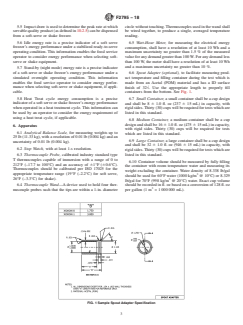
of a soft-serve or shake freezer’s energy performance under a 6.6 Spout Adapter (optional), to facilitate measuring prod-
simulated overnight operating condition. This information
uct temperature and filling container during the test which is
enables the food service operator to consider energy perfor- made from an Acetal (POM) material and has a ID surface
mance when selecting soft-serve or shake equipment, if appli-
finish of 32√. Use the appropriate length to properly fill
cable.
containers from the bottom. See Fig. 1.
5.8 Heat Treat cycle energy consumption is a precise
6.7 Small Container, a small container shall be a cup design
indicator of a soft serve or shake freezer’s energy performance
and shall be 8 6 1.0 fl. oz (237 6 15 mL) in capacity, with
when operated in a heat treatment cycle. This information can
rigidsides.Thirty(30)cupswillberequiredfortestswhichare
be used by an operator to consider the energy requirement of
listed in this standard.
using a heat treat cycle, if applicable.
6.8 Medium Container, a medium container shall be a cup
design and shall be 16 6 1.0 fl. oz (475 6 15 mL) in capacity,
6. Apparatus
with rigid sides. Thirty (30) cups will be required for tests
6.1 Analytical Balance Scale, for measuring weights up to
which are listed in this standard.
25 lb (11.33 kg), with a resolution of 0.01 lb (0.004 kg) and an
6.9 Large Container, a large container shall be a cup design
uncertainty of 0.01 lb (0.004 kg).
and shall be 32 6 1.0 fl. oz (946 6 15 mL) in capacity, with
6.2 Stop Watch, with at least 1-s resolution.
rigidsides.Thirty(30)cupswillberequiredfortestswhichare
6.3 Thermocouple Probe, calibrated industry standard type listed in this standard.
T thermocouples capable of immersion with a range of 0 to
6.10 Container volume should be measured by fully filling
212°F (–17.7 to 100°C) and an accuracy of 61°F (60.6°C).
the container with room temperature water and measuring its
Thermocouples should be calibrated per ISO 17025 for the
weight excluding the container. Water density of 8.338 lb/gal
appropriate temperature range (19°F (–2.2°C) for soft serve, 3
should be used for 60°F water (1000 kg/m @ 10°C) or 8.329
26°F (–3.3°C) for shake). 3
lb/gal for 70°F (998 kg/m @ 20°C) water. Exact cup volume
6.4 Thermocouple Wand—A device used to hold four ther- should be recorded in fl. oz based on a conversion of 128 fl. oz
mocouple probes such that the tips are within a 1-in. diameter per gallon (1 m = 1000000 mL).
FIG. 1 Sample Spout Adapter Specification
F2795 − 18
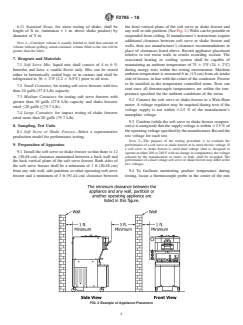
6.11 Standard Straw, for straw testing of shake, shall be the front vertical plane of the soft serve or shake freezer and
length of X in. (minimum + 1 in. above shake product) by anywallorsidepartition.(SeeFig.2.)Wallscanbeportableor
diameter of Y in. suspended from ceiling. If manufacturer’s instructions require
additional clearance between soft serve or shake freezer and
NOTE 1—Container volume is usually labeled to hold that amount of
walls, then use manufacturer’s clearance recommendations in
volume without spilling; actual container volume filled to the rim will be
place of clearances listed above. Record appliance placement
greater than the label.
relative to test room walls in results recording section. The
7. Reagents and Materials
associated heating or cooling system shall be capable of
maintaining an ambient temperature of 75 6 3°F (24 6 2°C)
7.1 Soft Serve Mix, liquid mix shall consist of 4 to 6 %
butterfat and have a vanilla flavor only. Mix can be stored during energy tests within the testing environment. Machine
ambient temperature is measured 6 in. (15 cm) from air intake
either in hermetically sealed bags or in cartons and shall be
refrigerated to 36 6 2°F (2.2 6 0.5°C) prior to all tests. sideoffreezer,inlinewiththecenterofthecondenser.Freezer
to be installed in the temperature controlled room. Tests can
7.2 Small Container, for testing soft serve freezers with less
start once all thermocouple temperatures are within the tem-
than 10 gal/h (37.8 L/h) capacity.
perature specified for the ambient conditions of the room.
7.3 Medium Container, for testing soft serve freezers with
9.2 Connect the soft serve or shake freezer to a Watt-Hour
greater than 10 gal/h (37.8 L/h) capacity and shake freezers
meter. A voltage regulator may be required during tests if the
rated ≤20 gal/h (≤75.7 L/h).
voltage supply is not within 62.5 % of the manufacturer’s
7.4 Large Container, for impact testing of shake freezers
nameplate voltage.
rated more than 20 gal/h (75.7 L/h).
9.3 Confirm (while the soft serve or shake freezer compres-
8. Sampling, Test Units
sor(s)isenergized)thatthesupplyvoltageiswithin 62.5%of
theoperatingvoltagespecifiedbythemanufacturer.Recordthe
8.1 Soft Serve or Shake Freezer—Select a representative
test voltage for each test.
production model for performance testing.
NOTE 2—The purpose of the testing procedure is to evaluate the
performanceofasoftserveorshakefreezeratitsratedelectricvoltage.If
9. Preparation of Apparatus
a soft serve or shake freezer is rated dual voltage (that is, designed to
9.1 Install the soft serve or shake freezer so that there is 12
operateateither208or240Vwithnochangeincomponents),thevoltage
selected by the manufacturer or tester, or both, shall be recorded. The
in. (30.48 cm) clearance maintained between a back wall and
performanceofadualvoltagesoftserveorshakefreezermaydifferatthe
the back vertical plane of the soft serve freezer. Both sides of
two voltages.
the soft serve freezer shall be a minimum of 1 ft (30.48 cm)
from any side wall, side partition, or other operating soft serve 9.4 To facilitate monitoring product temperature during
freezer and a minimum of 3 ft (91.44 cm) clearance between testing, locate a thermocouple probe in the center of the mix
FIG. 2 Example of Appliance Placement
F2795 − 18
storagecontainer(s),1 60.1in.(25 62mm)abovethebottom 10.2.3 Recordthetemperatureofthemixinthecenterofthe
surface of the storage container(s). For all draw tests, locate an mix storage container, 1 in. (25 mm) above the bottom surface
additional thermocouple probe in the geometric center of the of the mix storage container. Start the initial freezing process.
draw spout adapter(s). For all non-draw tests, locate an
10.2.4 Freeze-down per manufacturer’s instructions, in ab-
additionalthermocoupleprobeintheproductholdingareaofat
senceofspecificinstruction,isjudgedcompletewhenthemain
least one of the dispenser heads (per NSF/ANSI 6).
compressor(s) or beater drive motor(s), or both, for freezing
cylinder(s) have cycled off.
9.5 For water cooled soft serve or shake freezers, the
10.2.5 Confirmthatthefreezerisreadytoservebydispens-
supplied water for the main condensing system must be 70 6
ing one 8 fl. oz (236.6 mL) portion of product. Record the
2°F (21 6 1.1°C).
stabilized temperature in the geometric center of the receiving
container within 30 s from the end of the draw using the
10. Procedure
thermocouple wand. The wand shall be used to vigorously stir
10.1 General:
the dispensed product before the measurement is taken. For
10.1.1 The following shall be obtained and recorded for
softserve,thetemperatureofthedispensedproductshallbe18
each run of every test.
6 3°F (–7.5 6 1.5°C). For soft serve, invert the cup for 5 s
10.1.1.1 Voltage.
before taking temperature. If the soft serve remains in the cup,
theservingisacceptableifalsowithintemperature.Forshakes,
10.1.1.2 Average air temperature over the complete test
period. thetemperatureofthedispensedproductshallbe26 62°F(–3
61°C).Forshakes,placeastrawnearthecenterofthecupand
10.1.1.3 Average relative humidity over the complete test
submerge to the bottom of the filled cup. If the straw remains
period.
in place for 5 s, the serving is acceptable if also within
10.1.1.4 Water consumed (where applicable for water
temperature. If the product temperature is above the threshold
cooled freezers).
criteria, repeat 10.2.1 – 10.2.4, adding an additional main
10.1.1.5 Averageincomingwatertemperatureoverthecom-
compressor cycle (on then off again). If the temperature of the
plete test period (where applicable for water cooled freezers).
product is outside the specified limits stated above adjust the
10.1.1.6 Average exit water temperature over the complete
temperature or equipment settings and repeat 10.2.1 – 10.2.4.
test period (where applicable for water cooled freezers).
Note in test record that another compressor cycle or adjust-
10.1.1.7 Temperature of mix.
ments were part of this test.
10.1.1.8 Temperature of dispensed product.
10.2.6 Record energy consumption, elapsed time, and final
10.1.1.9 Weight of frozen product in the cup, when appli-
mixstoragecontainertemperaturewhenthemotor(s)andmain
cable.
compressor(s) for freezing cylinder(s) has cycled off and
10.1.2 For each test run, confirm that the maximum 10-s
verified that product is in the appropriate serving temperature
continuous amperage draw rate is not >110 % of the rated
range.
nameplate amperage. After 10 s, if the measured amperage is
10.3 Draw Rate:
>110 % of the rated nameplate maximum amperage, terminate
10.3.1 If the freezer door has an adjustable draw handle, set
testing and contact the manufacturer. The manufacturer may
the draw rate to the manufacturer’s recommended setting and
make appropriate changes or adjustments to the soft serve or
record the draw rate. In the absence of the manufacturer’s
shake freezer.
recommendation, start with the draw handle set to the maxi-
10.2 Freeze-Down Energy Consumption and Duration:
mum draw rate. If the draw rate is not adjustable, record the
draw rate. In the event of barrel starvation, refer to 10.3.5
NOTE 3—The freeze-down test should be conducted prior to all tests. It
through 10.3.9 before continuing.
istheintentofthisproceduretodeterminetheenergyandtimeittakesthe
soft serve or shake freezer to freeze mix to a servable product.
NOTE 5—Some soft serve freezers will suffer from a phenomenon
10.2.1 Before every freeze-down, the soft serve hopper and
known as barrel starvation, which is caused by an air-to-mix ratio that is
too high, causing the draw rate to significantly drop. In this event, extra
barrels must be filled with water (75 6 3°F) and allowed to
stepsmustbetakeninordertoproperlyadjustthedrawhandleforthisand
stabilize for 15 min.
all subsequent tests.
NOTE 4—The purpose of the step described in 10.2.1 is to ensure that
10.3.2 Tare the selected container on the scale. Dispense
the internal components of the soft serve freezer are all stabilized at a
product continuously for 10 s into the selected container.
consistent temperature in order to enhance repeatability in freeze-down
data.
10.3.3 Dividetheweightofthedispensedproductby10and
record this as the draw rate (weight oz/s or g/s). Wait for the
10.2.2 Follow the manufacturer’s recommended instruc-
compressor to cycle off.
tions for priming the soft serve or shake freezer prior to the
10.3.4 Repeat 10.3.1 and 10.3.2 five more times and record
freezedowntest.Subsequenttestingandresultsarenotvalidif
the draw rate each time for a total of six draw events.Take the
the manufacturer’s operating instructions are not completed.
sum of the last three events and divide by three. Record this
Start with the unit in a room at 75 6 3°F (23.9 6 2°C), fill the
number as the average draw rate.
mix storage and freezing cylinder with refrigerated mix (36 6
2°F (2.2 6 1.1°C)) to the manufacturer’s recommended level. 10.3.5 Record the minimum temperature of the product in
During all tests, refill mix if the “Mix Low” indicator appears. the sixth container as described in 10.2.6 to make sure it is at
F2795 − 18
18 6 3°F (–7.5 6 1.5°C ) for soft serve product and 26 6 2°F 10.4.5 Draw product into the appropriate container by
(–3 6 1°C) for shake freezers (without syrup) product. holding the container close to the bottom of the spout adapter
to prevent forming air pockets. In the absence of a spout
10.3.6 With the draw handle set to maximum, tare the
adapter, steps shall be taken to minimize the formation of air
selected container on the scale. Dispense product continuously
pockets during the draw event. Slightly overfill the cup to
for 5 s (5-s draw duration) into the selected container and
assure it is full of product. Skim off excess amount above rim
record the weight of the dispensed product.
withastraightedge,levelingthesoftservetocompletelyfillthe
10.3.7 Repeat 10.3.6 five more times and record the draw
cup to the upper surface of the container lip. Scrape the excess
rate each time for a total of six draw events. Take the average
into the next container. Measure and record the weight of the
weights of the last three tests and record it as the Five-Second
dispensed product.
Weight (W5, oz). Divide the Five-Second Weight by 5 and
10.4.6 Maintain the manufacturer’s recommended interval
record this as the Sector A Draw Rate (DA, oz/s).
(or use a 30-s interval if not specified by the manufacturer)
10.3.8 Cleanthemachinewithwaterandbeginanewfreeze
between the start of each draw. Monitor and record the
down.
minimum temperature of the soft serve or shake in each cup
10.3.9 Repeat two additional sets of the steps described in
and number of cups drawn.
10.3.6 through 10.3.8 using draw durations of 10 and 15 s and
record weights W10 and W15, respectively. Take the Ten- NOTE 7—Product temperature in spout adaptor between draws may
exceed the maximum temperature, but will not affect the success of the
SecondWeight(W10),subtractfromittheFive-SecondWeight
test.
(W5), and divide by 5 to get the Sector B Draw Rate (D ).
B
Similarly, take the Fifteen-Second Weight (W15), subtract
10.4.7 If the dispensed product temperature exceeds the
from it the Ten-Second Weight (W10), and divide by 5 to get maximum serving temperature (21°F (–6°C) for soft serve or
the Sector C Draw Rate (D ). Generically, the calculation is as
28°F (–2°C) for shakes) for three consecutive draws, stop
C
follows: testing and record the elapsed time, number of total draws and
final temperature. In the case of freezers meeting the definition
W 2 W
n n25
D 5 (2)
in3.1.22,ifthedispensedproductonagivenspoutexceedsthe
i
maximum serving temperature (21°F (–6°C) for soft serve or
where:
28°F (–2°C) for shakes), stop testing and record the elapsed
n = 5, 10, or 15, and time,numberoftotaldraws,andfinaltemperature.Increasethe
i = index indicating the sector number (A, B, or C).
interval between draws, as appropriate, clean and stabilize the
machine, and repeat 10.4.1 through 10.4.6.
10.3.10 Systematically advance the screw on the draw
10.4.8 Systematically decrease the interval between succes-
handle and repeat the steps described in 10.3.6 through 10.3.9
sive draws (by 2 or 5-s increments) and repeat the steps
untiltheSectorCDrawRate(D )iswithin15%oftheSector
C
described in 10.4.1 through 10.4.7 until the unit fails to
B Draw Rate (D ) and record this draw handle setting for use
B
produce 30 acceptable draws (that is, drawn product tempera-
in all subsequent tests.
ture exceeds maximum serving temperature for three consecu-
10.4 Minimum Dispensing Interval Determination:
tive draws on a given spout).
10.4.9 Calculate the overrun based on the successful inter-
NOTE 6—It is the intent of this procedure to determine the shortest
val test (refer to 3.1.13 for formula).
intervalbetweenconsecutivedrawsthatstillproducesacceptableproduct.
Forfreezersmeetingthedefinitionin3.1.21,drawingofproductistotake
10.4.10 Notetheshortesttimeintervalthatstillproduced30
placefromeithertheleftorrightspoutwithoppositesiderunninginready
acceptable cups of product. This interval will be used in the
to serve mode (do not alternate). For freezers meeting the definition in
heavy-use energy consumption and production capacity test.
3.1.22,drawingofproductistotakeplacealternatingbetweentheleftand
right spout (product not to be drawn from center spout).
10.5 Heavy-Use Energy Consumption and Production Ca-
pacity Test:
10.4.1 Determine the appropriate container size (small,
medium or large) for the minimum dispensing interval test, as
NOTE 8—It is the intent of this procedure to determine the energy
determined in 7.2 – 7.4.
consumption and production capacity of the soft serve or shake freezer
during heavy use.
10.4.2 After stabilizing the unit and performing a freeze
NOTE9—Forfreezersmeetingthedefinitionundersection3.1.22,draw
down as described in 10.2.1, fill the mix storage to the
product alternating between the left and right spout (product not to be
manufacturer’s recommended full level with refrigerated mix
drawnfromthecenterspout).Forfreezersmeetingthedefinitionin3.1.21
[36 6 2°F (2.2 6 1°C)]. During all tests, refill the mix if the
and having two power sources, draw product from the side which has the
“Mix Low” indicator appears. Record the temperature of the
highest rated amperage draw (refer to name plate/data label for freezer
mix in the center of the mix storage container, 1 in. (25 mm) ratings).
above the bottom of the mix storage container.
10.5.1 Fill the mix storage to the manufacturer’s recom-
10.4.3 Allow the freezer to stabilize for 30 6 2 min, in its
mended full level with refrigerated mix [36 6 2°F (2.2 6
ready to serve idle mode. If the main compressor is running at
1.1°C)] after the freeze-down cycle has completed. During all
the end of the 30 6 2 min, allow the main compressor to cycle
tests,refillthemixifthe“MixLow”indicatorappears.Record
off before starting the test.
the temperature of the mix in the center of the mix storage, 1
10.4.4 Starting the dispensing test at the lower end of the in. (25 mm) above the bottom surface of the mix stora
...
This document is not an ASTM standard and is intended only to provide the user of an ASTM standard an indication of what changes have been made to the previous version. Because
it may not be technically possible to adequately depict all changes accurately, ASTM recommends that users consult prior editions as appropriate. In all cases only the current version
of the standard as published by ASTM is to be considered the official document.
Designation: F2795 − 15 F2795 − 18 An American National Standard
Standard Test Method for
Performance of Self-Contained Soft Serve and Shake
Freezers
This standard is issued under the fixed designation F2795; the number immediately following the designation indicates the year of
original adoption or, in the case of revision, the year of last revision. A number in parentheses indicates the year of last reapproval. A
superscript epsilon (´) indicates an editorial change since the last revision or reapproval.
1. Scope
1.1 This test method evaluates the energy consumption and performance of soft serve ice cream and shake freezers. The food
service operator can use this test to evaluate and select an appropriate soft serve or shake freezer and understand its energy
consumption and production capabilities.
1.2 This test method applies to the following types of soft serve and shake freezers: (any of which may or may not have a
reservoir for liquid mix). Included in these test methods are conventional and heat-treatment freezers. The unit may include
separate refrigeration systems for the frozen product and fresh mix and may be either air-cooled or water-cooled.
1.3 The soft serve/shake freezers will be tested for the following (where applicable):
1.3.1 Maximum power input, or maximum current draw,
1.3.2 Initial freeze-down energy consumption and duration,
1.3.3 Heavy-use energy consumption,
1.3.4 Production capacity,
1.3.5 Overrun,
1.3.6 Impact performance,
1.3.7 Idle energy rate, and
1.3.8 Heat treat cycle energy consumption (if applicable).
1.4 The values stated in inch-pound units are to be regarded as standard. The values given in parentheses are mathematical
conversions to SI units that are provided for information only and are not considered standard.
1.5 This standard does not purport to address all of the safety concerns, if any, associated with its use. It is the responsibility
of the user of this standard to establish appropriate safety safety, health, and healthenvironmental practices and determine the
applicability of regulatory limitations prior to use.
1.6 This international standard was developed in accordance with internationally recognized principles on standardization
established in the Decision on Principles for the Development of International Standards, Guides and Recommendations issued
by the World Trade Organization Technical Barriers to Trade (TBT) Committee.
2. Referenced Documents
2.1 ASTM Standards:
F1604 Specification for Freezers, Ice Cream, Soft Serve, Shake
2.2 Code of Federal Regulations:
21 CFR 135.110 Ice cream and frozen custard
2.3 NSF/ANSI Standard:
NSF/ANSI 6 Dispensing freezers
This test method is under the jurisdiction of ASTM Committee F26 on Food Service Equipment and is the direct responsibility of Subcommittee F26.06 on Productivity
and Energy Protocol.
Current edition approved March 1, 2015Sept. 1, 2018. Published April 2015December 2018. Originally approved in 2011. Last previous edition approved in 20112015
as F2795 – 11.F2795 – 15. DOI: 10.1520/F2795-15.10.1520/F2795-18.
For referenced ASTM standards, visit the ASTM website, www.astm.org, or contact ASTM Customer Service at service@astm.org. For Annual Book of ASTM Standards
volume information, refer to the standard’s Document Summary page on the ASTM website.
Available from U.S. Government Printing Office Superintendent of Documents, 732 N. Capitol St., NW, Mail Stop: SDE, Washington, DC 20401, http://
www.access.gpo.gov.
Available from American National Standards Institute (ANSI), 25 W. 43rd St., 4th Floor, New York, NY 10036, http://www.ansi.org.
Copyright © ASTM International, 100 Barr Harbor Drive, PO Box C700, West Conshohocken, PA 19428-2959. United States
F2795 − 18
2.4 ASHRAE Guideline:
ASHRAE Guideline 2 - 2005 (RA90) Engineering Analysis of Experimental Data
3. Terminology
3.1 Definitions:
3.1.1 air cooled, n—a freezer which uses air passing over a main condenser in the freezer cylinder refrigeration system.
3.1.2 combination, n—a freezer employing two main compressors and two main condensers with one or two condenser fan
motors and two separate freezer doors (that is, one for soft serve and another for shake), designed to dispense shake and soft serve
product in the same footprint.
3.1.3 freeze-down energy, n—amount of energy consumed (kWh) by the soft serve or shake freezer while cooling the product
to a servable temperature.
3.1.4 freeze-down time, n—time required for the soft serve or shake freezer while cooling the product to a servable temperature.
3.1.5 heat treat–cool phase, n—portion of the heat treat cycle which involves cooling the product from ≥150°F (≥65°C) to
≤41°F (≤5°C) within a period of 120 min or less.
3.1.6 heat treat–heat phase, n—portion of the heat treat cycle which involves elevating product temperature from ≤41°F (5°C)
to ≥150°F (66°C) within a period of 90 min.
3.1.7 heat treat–hold phase, n—portion of the heat treat cycle which involves holding the product above a ≥150°F (≥66°C) for
a period of at least 30 min.
3.1.8 heat-treatment freezers, n—as defined in Specification F1604, operate as conventional freezers and heat all product to
150°F (66°C) minimum for at least 30 min daily to destroy undesirable microorganisms.
3.1.9 ice cream or ice-cream (originally, iced cream), n—a frozen dessert made from dairy products, such as milk and cream,
combined with flavorings and sweeteners, such as sugar, and possible other ingredients. (21 CFR 135.110)
3.1.10 idle energy rate, n—the rate of energy consumed (kWh) by the soft serve or shake freezer while holding or maintaining
the product in a ready-to-serve state without dispensing product.
3.1.11 interval, n—length of time for one operator to draw a portion of product from a soft serve or shake freezer.
3.1.12 mix, n—a fluid that contains 4 to 6 % butterfat and is a vanilla flavor.
3.1.13 overrun, n—the increase in volume due to incorporation of air while freezing soft serve and shake products under
agitation, calculated by this formula:
~Weight of liquid mix 2 Weight of frozen product!
Overrun 5 (1)
Weight of frozen product
3.1.14 product, n—mix that is frozen under agitation to specific temperature without syrup that is ready to serve.
3.1.15 shake, n—a sweet, cold beverage which is made from milk, ice cream, and flavorings or sweeteners such as fruit syrup
or chocolate sauce.
3.1.16 single spout freezer, n—freezer employing a single spout with a single spout freezer door and dispense cylinder.
3.1.16 spout adaptor, n—a device which is attached to the freezer door spout to assist in the filling of sampling container.
3.1.17 standby idle energy, n—the rate of energy consumed (kWh) by the soft serve or shake freezer while holding or
maintaining the product ≤41°F (≤5°C) without dispensing product. Also referred to as night mode in NSF/ANSI 6.
3.1.18 test method, n—a definitive procedure for the identification, measurement, and evaluation of one or more qualities,
characteristics, or properties of a material, product, system, or service that produces test results.
3.1.19 single spout freezer, n—freezer employing a single spout with a single spout freezer door and dispense cylinder.
3.1.20 twin single spout freezer, n—a freezer employing either of the above configurations (Twin Twist freezer “A” or “B”) but
with two single spout doors which can only dispense from one Freezer Cylinder.
3.1.21 twin twist freezer “A”, n—a freezer using two main compressors and two main condensers with one or two condenser
fan motors and a freezer door (3 spout) which the center spout draws from both freezer cylinders.
3.1.22 twin twist freezer “B”, n—a freezer with single main compressor, single main condenser fan motor, with a freezer door
(3 spout) which the center spout draws product from both freezer cylinders.
3.1.23 uncertainty, n—a measure of systematic and precision errors in specified instrumentation or measure of repeatability of
a recorded test result.
Available from American Society of Heating, Refrigerating, and Air-Conditioning Engineers, Inc. (ASHRAE), 1791 Tullie Circle, NE, Atlanta, GA 30329,
http://www.ashrae.org.
F2795 − 18
3.1.24 water cooled, n—a freezer which uses water passing through a twin tube condenser in the freezer cylinder refrigeration
system.
4. Summary of Test Method
4.1 This test method is designed to address freezers which have self-contained refrigeration system(s) for the main freezing
cylinder(s) and may or may not contain a mix storage system as part of the unit.
4.2 Power input is determined to confirm that the soft serve or shake freezer is operating below maximum nameplate power
rating.
4.3 The mix storage and freezing cylinder are loaded with 36 6 2°F (2.2 6 1°C)0.5°C) mix. The time and energy required to
freeze down the product to an acceptable serving condition is monitored (as defined in 10.2.2).
4.4 Minimum Dispensing Interval Determination (as defined in 10.4).
4.5 Heavy-Use Power Rating, Energy Consumption and Production Capacity Test (as defined in 10.5).
4.6 Impact Draw Test (as defined in 10.6).
4.6 Ready-to-Serve Idle Test (as defined in 10.710.6).
4.7 Standby (Night Mode) Idle Test (as defined in 10.810.7).
4.8 Heat Treat Cycle Energy Consumption Test (if applicable) (as defined in 10.910.8).
5. Significance and Use
5.1 The freeze-down energy consumption and duration can be used to determine time and energy required for a freezer to be
ready to serve when loaded with mix.
5.2 The minimum dispensing interval determination is used to determine the rate at which the product will be dispensed during
the Heavy-Use Energy Consumption and Production Capacity Test (10.5). Measuring overrun during this test is critical to
determining production capacity rating in gallons per hour.
5.3 Heavy-use energy consumption can be used by an operator to determine energy consumption during peak usage when
selecting a soft-serve freezer. Measuring overrun during this test is critical to determining production capacity rating in gallons per
hour.
5.4 Production capacity can be used by an operator in selecting a soft-serve or shake freezer that meets their production
requirements. Measuring overrun during this test is critical to determining production capacity rating in gallons per hour.
5.5 Impact draw is used to determine the peak rate at which servable quality product (as defined in 10.2.210.2.5) can be
dispensed from a soft-serve or shake freezer.
5.6 Idle energy rate is a precise indicator of a soft serve or shake freezer’s energy performance under a stabilized ready-to-serve
operating condition. This information enables the food service operator to consider energy performance when selecting soft-serve
or shake equipment.
5.7 Stand-by (night mode) energy rate is a precise indicator of a soft-serve or shake freezer’s energy performance under a
simulated overnight operating condition. This information enables the food service operator to consider energy performance when
selecting soft-serve or shake equipment, if applicable.
5.8 Heat Treat cycle energy consumption is a precise indicator of a soft serve or shake freezer’s energy performance when
operated in a heat treatment cycle. This information can be used by an operator to consider the energy requirement of using a heat
treat cycle, if applicable.
6. Apparatus
6.1 Analytical Balance Scale, for measuring weights up to 25 lb (11.33 kg), with a resolution of 0.01 lb (0.004 kg) and an
uncertainty of 0.01 lb (0.004 kg).
6.2 Stop Watch, with at least 1-s resolution.
6.3 Thermocouple Probe, calibrated industry standard type T thermocouples capable of immersion with a range of 0 to 212°F
(–17.7 to 100°C) and an accuracy of 61°F (60.6°C). Thermocouples should be calibrated per ISO 17025 for the appropriate
temperature range (19°F (–2.2°C) for soft serve, 26°F (–3.3°C) for shake).
6.4 Thermocouple Wand—A device used to hold four thermocouple probes such that the tips are within a 1-in. diameter circle
without touching. Thermocouples used in the wand shall be wired together, to produce a single, averaged temperature reading.
6.5 Watt-Hour Meter, for measuring the electrical energy consumption, shall have a resolution of at least 10 Wh and a maximum
uncertainty no greater than 1.5 % of the measured value for any demand greater than 100 W. For any demand less than 100 W,
the meter shall have a resolution of at least 10 Wh and a maximum uncertainty no greater than 10 %.
F2795 − 18
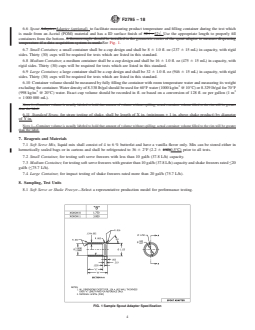
6.6 Spout Adapter, Adapter (optional), to facilitate measuring product temperature and filling container during the test which
is made from an Acetal (POM) material and has a ID surface finish of 32√ . 32√. Use the appropriate length to properly fill
containers from the bottom. A thermocouple should be installed in the geometric center of the spout adapter to measure dispensing
temperature if a data acquisition system is used. See Fig. 1.
6.7 Small Container, a small container shall be a cup design and shall be 8 6 1.0 fl. oz (237 6 15 mL) in capacity, with rigid
sides. Thirty (30) cups will be required for tests which are listed in this standard.
6.8 Medium Container, a medium container shall be a cup design and shall be 16 6 1.0 fl. oz (475 6 15 mL) in capacity, with
rigid sides. Thirty (30) cups will be required for tests which are listed in this standard.
6.9 Large Container, a large container shall be a cup design and shall be 32 6 1.0 fl. oz (946 6 15 mL) in capacity, with rigid
sides. Thirty (30) cups will be required for tests which are listed in this standard.
6.10 Container volume should be measured by fully filling the container with room temperature water and measuring its weight
excluding the container. Water density of 8.338 lb/gal should be used for 60°F water (1000 kg/m @ 10°C) or 8.329 lb/gal for 70°F
3 3
(998 kg/m @ 20°C) water. Exact cup volume should be recorded in fl. oz based on a conversion of 128 fl. oz per gallon (1 m
= 1 000 000 mL).
NOTE 1—Container volume is usually labeled to hold that amount of volume without spilling; actual container volume filled to the rim will be greater
than the label.
6.11 Standard Straw, for straw testing of shake, shall be length of X in. (minimum + 1 in. above shake product) by diameter
of Y in.
NOTE 1—Container volume is usually labeled to hold that amount of volume without spilling; actual container volume filled to the rim will be greater
than the label.
7. Reagents and Materials
7.1 Soft Serve Mix, liquid mix shall consist of 4 to 6 % butterfat and have a vanilla flavor only. Mix can be stored either in
hermetically sealed bags or in cartons and shall be refrigerated to 36 6 2°F (2.2 6 1°C)0.5°C) prior to all tests.
7.2 Small Container, for testing soft serve freezers with less than 10 gal/h (37.8 L/h) capacity.
7.3 Medium Container, for testing soft serve freezers with greater than 10 gal/h (37.8 L/h) capacity and shake freezers rated ≤20
gal/h (≤75.7 L/h).
7.4 Large Container, for impact testing of shake freezers rated more than 20 gal/h (75.7 L/h).
8. Sampling, Test Units
8.1 Soft Serve or Shake Freezer—Select a representative production model for performance testing.
FIG. 1 Sample Spout Adapter Specification
F2795 − 18
9. Preparation of Apparatus
9.1 Install the soft serve or shake freezer so that there is 1 ft12 in. (30.48 cm) clearance maintained between a back wall and
the back vertical plane of the soft serve or shake freezer. Both sides of the soft serve or shake freezer shall be a minimum of 1
ft (30.48 cm) from any side wall, side partition, or other operating soft serve freezer and a minimum of 3 ft (91.44 cm) clearance
between the front vertical plane of the soft serve or shake freezer and any wall or side partition. (See Fig. 2.) Walls can be portable
or suspended from ceiling. If manufacturer’s instructions require additional clearance between soft serve or shake freezer and
walls, then use manufacturer’s clearance recommendations in place of clearances listed above. Record appliance placement relative
to test room walls in results recording section. The associated heating or cooling system shall be capable of maintaining an ambient
temperature of 75 6 3°F (24 6 2°C) during energy tests within the testing environment. Machine ambient temperature is measured
6 in. (15 cm) from air intake side of freezer, in line with the center of the condenser. Freezer to be installed in the temperature
controlled room. Tests can start once all thermocouple temperatures are within the temperature specified for the ambient conditions
of the room.
9.2 Connect the soft serve or shake freezer to a Watt-Hour meter. A voltage regulator may be required during tests if the voltage
supply is not within 62.5 % of the manufacturer’s nameplate voltage.
9.3 Confirm (while the soft serve or shake freezer compressor(s) is energized) that the supply voltage is within 62.5 % of the
operating voltage specified by the manufacturer. Record the test voltage for each test.
NOTE 2—The purpose of the testing procedure is to evaluate the performance of a soft serve or shake freezer at its rated electric voltage. If a soft serve
or shake freezer is rated dual voltage (that is, designed to operate at either 208 or 240 V with no change in components), the voltage selected by the
manufacturer or tester, or both, shall be recorded. The performance of a dual voltage soft serve or shake freezer may differ at the two voltages.
9.4 To facilitate monitoring product temperature during testing, locate a thermocouple probe in the center of the mix storage
container(s), 1 6 0.1 in. (25 6 2 mm) above the bottom surface of the storage container(s). For all draw tests, locate an additional
thermocouple probe in the geometric center of the draw spout adapter(s). For all non-draw tests, locate an additional thermocouple
probe in the product holding area of at least one of the dispenser heads (per NSF/ANSI 6).
9.5 For water cooled soft serve or shake freezers, the supplied water for the main condensing system must be 70 6 2°F (21 6
1°C).1.1°C).
10. Procedure
10.1 General:
10.1.1 The following shall be obtained and recorded for each run of every test.
10.1.1.1 Voltage.
10.1.1.2 Average air temperature over the complete test period.
FIG. 2 Example of Appliance Placement
F2795 − 18
10.1.1.3 Average relative humidity over the complete test period.
10.1.1.4 Water consumed (where applicable for water cooled freezers).
10.1.1.5 Average incoming water temperature over the complete test period (where applicable for water cooled freezers).
10.1.1.6 Average exit water temperature over the complete test period (where applicable for water cooled freezers).
10.1.1.7 Temperature of mix.
10.1.1.8 Temperature of dispensed product.
10.1.1.9 Weight of frozen product in the cup, when applicable.
10.1.2 For each test run, confirm that the maximum 10-s continuous amperage draw rate is not >110 % of the rated nameplate
amperage. After 10 s, if the measured amperage is >110 % of the rated nameplate maximum amperage, terminate testing and
contact the manufacturer. The manufacturer may make appropriate changes or adjustments to the soft serve or shake freezer.
10.2 Freeze-Down Energy Consumption and Duration:
NOTE 3—The freeze-down test should be conducted prior to soft serve or shake freezer operation on the day of the test. all tests. It is the intent of this
procedure to determine the energy and time it takes the soft serve or shake freezer to freeze mix to a servable product.
10.2.1 Before every freeze-down, the soft serve hopper and barrels must be filled with water (75 6 3°F) and allowed to stabilize
for 15 min.
NOTE 4—The purpose of the step described in 10.2.1 is to ensure that the internal components of the soft serve freezer are all stabilized at a consistent
temperature in order to enhance repeatability in freeze-down data.
10.2.2 Follow the manufacturer’s recommended instructions for priming the soft serve or shake freezer prior to the freeze down
test. Subsequent testing and results are not valid if the manufacturer’s operating instructions are not completed. Start with the unit
in a room at 75 6 3°F (24(23.9 6 2°C), fill the mix storage and freezing cylinder with refrigerated mix (36 6 2°F (2.2 6
1°C))1.1°C)) to the manufacturer’s recommended level. During all tests, refill mix if the “Mix Low” indicator appears.
10.2.3 Record the temperature of the mix in the center of the mix storage container, 1 in. (25 mm) above the bottom surface
of the mix storage container. Start the initial freezing process.
10.2.4 Freeze-down per manufacturer’s instructions, in absence of specific instruction, is judged complete when the main
compressor(s) or beater drive motor(s), or both, for freezing cylinder(s) have cycled off.
10.2.5 Confirm that the freezer is ready to serve by dispensing one 8 fl. oz (236.6 mL) portion of product. Record the
coldeststabilized temperature in the spout adapter while dispensing or in the geometric center of the receiving container. If not
using thermocouple in spout adapter, temperature measurement is acceptable within 30 s from the end of the draw. container within
30 s from the end of the draw using the thermocouple wand. The wand shall be used to vigorously stir the dispensed product before
the measurement is taken. For soft serve, the temperature of the dispensed product shall be 1918 6 2°F (–7 6 1°C); for 3°F (–7.5
6 1.5°C). For soft serve, invert the cup for 5 s before taking temperature. If the soft serve remains in the cup, the serving is
acceptable if also within temperature. For shakes, the temperature of the dispensed product shall be 26 6 2°F (–3 6 1°C). If the
For shakes, place a straw near the center of the cup and submerge to the bottom of the filled cup. If the straw remains in place
for 5 s, the serving is acceptable if also within temperature. If the product temperature is above the threshold criteria, repeat 10.2.1
– 10.2.510.2.4, adding an additional main compressor cycle (on then off again). If the temperature of the product is outside the
specified limits stated above adjust the temperature or equipment settings and repeat 10.2.1 – 10.2.510.2.4. Note in test record that
another compressor cycle or adjustments were part of this test.
10.2.6 Record energy consumption, elapsed time, and final mix storage container temperature when the motor(s) and main
compressor(s) for freezing cylinder(s) has cycled off and verified that product is in the appropriate serving temperature range.
10.3 Draw Rate:
10.3.1 If the freezer door has an adjustable draw handle, set the draw rate to the manufacturer’s recommended setting and record
the draw rate. In the absence of the manufacturer’s recommendation, start with the draw handle set to the maximum draw rate.
If the draw rate is not adjustable, record the draw rate. In the event of barrel starvation, refer to 10.3.5 through 10.3.9 before
continuing.
NOTE 5—Some soft serve freezers will suffer from a phenomenon known as barrel starvation, which is caused by an air-to-mix ratio that is too high,
causing the draw rate to significantly drop. In this event, extra steps must be taken in order to properly adjust the draw handle for this and all subsequent
tests.
10.3.2 Tare the selected container on the scale. Dispense product continuously for 10 s into the selected container.
10.3.3 Divide the weight of the dispensed product by 10 and record this as the draw rate (weight oz/s or g/s). Wait for the
compressor to cycle off.
10.3.4 Repeat steps10.3.1 10.3.1 and 10.3.210.3.2 twofive more times and record the draw rate each time. time for a total of
six draw events. Take the sum of the last three testsevents and divide by three. Record this number as the average draw rate.
10.3.5 Record the minimum temperature of the product in the third container sixth container as described in 10.2.6 to make sure
it is at 1918 6 2°F (–73°F (–7.5 6 1°C1.5°C ) for soft serve product and 26 6 2°F (–3 6 1°C) for shake freezers (without syrup)
product.
F2795 − 18
10.3.6 With the draw handle set to maximum, tare the selected container on the scale. Dispense product continuously for 5 s
(5-s draw duration) into the selected container and record the weight of the dispensed product.
10.3.7 Repeat 10.3.6 five more times and record the draw rate each time for a total of six draw events. Take the average weights
of the last three tests and record it as the Five-Second Weight (W5, oz). Divide the Five-Second Weight by 5 and record this as
the Sector A Draw Rate (DA, oz/s).
10.3.8 Clean the machine with water and begin a new freeze down.
10.3.9 Repeat two additional sets of the steps described in 10.3.6 through 10.3.8 using draw durations of 10 and 15 s and record
weights W10 and W15, respectively. Take the Ten-Second Weight (W10), subtract from it the Five-Second Weight (W5), and
divide by 5 to get the Sector B Draw Rate (D ). Similarly, take the Fifteen-Second Weight (W15), subtract from it the Ten-Second
B
Weight (W10), and divide by 5 to get the Sector C Draw Rate (D ). Generically, the calculation is as follows:
C
2 W
W
n n25
D 5 (2)
i
where:
n = 5, 10, or 15, and
i = index indicating the sector number (A, B, or C).
10.3.10 Systematically advance the screw on the draw handle and repeat the steps described in 10.3.6 through 10.3.9 until the
Sector C Draw Rate (D ) is within 15 % of the Sector B Draw Rate (D ) and record this draw handle setting for use in all
C B
subsequent tests.
10.4 Minimum Dispensing Interval Determination:
NOTE 6—It is the intent of this procedure to determine the shortest interval between consecutive draws that still produces acceptable product. For
freezers meeting the definition in 3.1.21, drawing of product is to take place from either the left or right spout with opposite side running in ready to serve
mode (do not alternate). For freezers meeting the definition in 3.1.22, drawing of product is to take place alternating between the left and right spout
(product not to be drawn from center spout).
10.4.1 Determine the appropriate container size (small, medium or large) for the minimum dispensing interval test, as
determined in 7.2 – 7.4.
10.4.2 Fill the After stabilizing the unit and performing a freeze down as described in 10.2.1, fill the mix storage to the
manufacturer’s recommended full level with refrigerated mix [36 6 2°F (2.2 6 1°C)] after the freeze - down cycle has completed.
1°C)]. During all tests, refill the mix if the “Mix Low” indicator appears. Record the temperature of the mix in the center of the
mix storage container, 1 in. (25 mm) above the bottom of the mix storage container.
10.4.3 Allow the freezer to stabilize for 30 6 2 min, in its ready to serve idle mode. If the main compressor is running at the
end of the 30 6 2 min, allow the main compressor to cycle off before starting the test.
10.4.4 Starting the dispensing test at the lower end of the acceptable temperature range is recommended.
10.4.5 Draw product into the appropriate container by holding the container close to the bottom of the spout adapter to prevent
forming air pockets. In the absence of a spout adapter, steps shall be taken to minimize the formation of air pockets during the
draw event. Slightly overfill the cup to assure it is full of product. Skim off excess amount above rim with a straightedge, leveling
the soft serve to completely fill the cup to the upper surface of the container lip. Scrape the excess into the next container .
container. Measure and record the weight of the dispensed product.
10.4.6 Maintain the manufacturer’s recommended interval (or use a 30-s interval if not specified by the manufacturer) between
the start of each draw. Monitor and record the minimum temperature of the soft serve or shake in each cup and number of cups
drawn.
NOTE 7—Product temperature in spout adaptor between draws may exceed the maximum temperature, but will not affect the success of the test.
10.4.7 If the dispensed product temperature exceeds the maximum serving temperature (21°F (–6°C) for soft serve or 28°F
(–2°C) for shakes) for three consecutive draws, then stop testing and record the elapsed time, number of total draws and final
temperature. In the case of freezers meeting the definition in 3.1.22, if the dispensed product on a given spout exceeds the
maximum serving temperature (21°F (–6°C) for soft serve or 28°F (–2°C) for shakes), stop testing and record the elapsed time,
number of total draws, and final temperature. Increase the interval between draws, as appropriate and appropriate, clean and
stabilize the machine, and repeat 10.4.1 through 10.4.6.
10.4.8 Systematically decrease the interval between successive draws (by 2 or 5-s increments) and repeat the steps described
in 10.4.1 through 10.4.7 until the unit fails to produce 30 acceptable draws (that is, drawn product temperature exceeds maximum
serving temperature for three consecutive draws).draws on a given spout).
10.4.9 Calculate the overrun based on the successful interval test (refer to 3.1.13 for formula).
10.4.10 Note the shortest time interval that still produced 30 acceptable cups of product. This interval will be used in the
heavy-use energy consumption and production capacity test.
10.5 Heavy-Use Energy Consumption and Production Capacity Test:
F2795 − 18
NOTE 8—It is the intent of this procedure to determine the energy consumption and production capacity of the soft serve or shake freezer during heavy
use.
NOTE 9—For freezers meeting the definition under section 3.1.22, draw product alternating between the left and right spout (product not to be drawn
from the center spout). For freezers meeting the definition in 3.1.21 and having two power sources, draw product from the side which has the highest
rated amperage draw (refer to name plate/data label for freezer ratings).
10.5.1 Fill the mix storage to the manufacturer’s recommended full level with refrigerated mix [36 6 2°F (2.2 6 1°C)]1.1°C)]
after the freeze-down cycle has completed. During all tests, refill the mix if the “Mix Low” indicator appears. Record the
temperature of the mix in the center of the mix storage, 1 in. (25 mm) above the bottom surface of the mix storage container.
10.5.2 Begin recording elapsed time and energy consumption as soon as the unit cycles off.
10.5.3 Draw 30 successive times using the interval between draws determined in 10.4.
10.5.4 Measure and record the lowest Record the temperature in the spout adaptor or in each container of dispensed
product.receiving container using the thermocouple wand as described in 10.2.5.
10.5.5 Measure and record the weight of each container of product.
10.5.6 If the dispensed product temperature exceeds the maximum serving temperature (21°F (–6°C) for soft serve or 28°F
(–2°C) for shakes) for three consecutive draws, the test is invalid and must be repeated. Adjust the interval between draws as
appropriate and restart the testing procedure.
10.5.7 After 30 successive draws have been dispensed, record the total elapsed time, and energy consumption for the production
capacity.
10.5.8 Record the time and energy consumption until the main compressor(s) or beater drive motor(s), or both, for freezing
cylinder(s) have cycled off after the last draw. This is the recovery time and energy.
10.5.9 Repeat the test two more times following steps 10.5.1 – 10.5.7. Additional test runs may be
...