

ASTM C119-23
(Terminology)Standard Terminology Relating to Dimension Stone
General Information
- Abstract
- Status
- Published
- Publication Date
- 31-May-2023
- Technical Committee
- C18 - Dimension Stone
- Drafting Committee
- C18.91 - Nomenclature and Definitions
Overview
ASTM C119-23 - Standard Terminology Relating to Dimension Stone is a critical reference document published by ASTM International. This standard provides clear definitions and consistent terminology for dimension stone-a natural stone material selected and fabricated to specific sizes or shapes for applications such as building facings, paving, curbing, monuments, and memorials. Dimension stone, distinct from crushed or broken stone, is considered essential in construction, architecture, and various industrial uses due to its unique properties, durability, and aesthetic appeal.
The scope of ASTM C119-23 covers nomenclature, definitions, and descriptions of materials, finishes, and industry practices relevant to natural dimension stone. This standard brings clarity and consistency for stone specifiers, fabricators, builders, architects, and regulatory agencies.
Key Topics
- Definitions and Nomenclature: Establishes standard terminology for natural dimension stone types (granite, marble, limestone, sandstone, slate, travertine, serpentine, and more), finishes, and industry processes.
- Classification of Stone Materials: Distinguishes between commercial and scientific definitions for granite, marble, sandstone, limestone, and other stone groups.
- Stone Finishes and Texture: Describes a range of stone finishes, such as polished, honed, sandblasted, bush-hammered, tumbled, flamed, split face, and more, including their typical appearances and applications.
- Key Industry Terms: Defines vital terminology used in design and construction, including anchor, anchorage, arris, coping, cladding, panel, veneer, texture, and others.
- Material Characteristics: Provides descriptions of stone properties such as durability, strength, veining, grain, and weathering, which impact suitability for specific environments and uses.
Applications
ASTM C119-23 offers essential value to professionals working with dimension stone across a variety of sectors:
- Architectural Design and Construction: Ensures clear communication and specification of material types, surface finishes, and installation methods for use in facades, flooring, paving, cladding, monuments, copings, and memorials.
- Material Selection and Procurement: Assists project teams, fabricators, and suppliers in identifying and sourcing the correct stone, finish, and characteristics based on standardized definitions.
- Compliance and Quality Control: Supports builders, inspectors, and regulatory agencies in verifying that materials meet project requirements and industry standards.
- Documentation and Shop Drawings: Guides the preparation of detailed drawings, specifications, and installation documents by defining standard terms and industry practices.
By using standardized terminology, professionals minimize misunderstandings, reduce risk, and ensure quality across all phases of a dimension stone project.
Related Standards
Professionals referencing ASTM C119-23 may also need to consult the following related ASTM standards for comprehensive compliance and best practice:
- ASTM C503 – Specification for Marble Dimension Stone
- ASTM C568 – Specification for Limestone Dimension Stone
- ASTM C615 – Specification for Granite Dimension Stone
- ASTM C616 – Specification for Quartz-Based Dimension Stone
- ASTM C629 – Specification for Slate Dimension Stone
- ASTM C1528 – Guide for Selection of Dimension Stone for Exterior Use
These standards provide additional requirements and guidance for testing, performance, selection, and installation of natural stone materials in building and industrial contexts.
Using clear and consistent terminology from ASTM C119-23 enhances project outcomes, ensures compliance, and contributes to the enduring performance and visual appeal of dimension stone in construction and design.
Get Certified
Connect with accredited certification bodies for this standard

DIBt (Deutsches Institut für Bautechnik)
German Institute for Building Technology.
DIN CERTCO
DIN Group product certification.

Aboma Certification B.V.
Specialized in construction, metal, and transport sectors.
Sponsored listings
Frequently Asked Questions
ASTM C119-23 is a standard published by ASTM International. Its full title is "Standard Terminology Relating to Dimension Stone". This standard covers: Standard Terminology Relating to Dimension Stone
Standard Terminology Relating to Dimension Stone
ASTM C119-23 is classified under the following ICS (International Classification for Standards) categories: 01.040.91 - Construction materials and building (Vocabularies); 73.020 - Mining and quarrying; 91.100.15 - Mineral materials and products. The ICS classification helps identify the subject area and facilitates finding related standards.
ASTM C119-23 is available in PDF format for immediate download after purchase. The document can be added to your cart and obtained through the secure checkout process. Digital delivery ensures instant access to the complete standard document.
Standards Content (Sample)
This international standard was developed in accordance with internationally recognized principles on standardization established in the Decision on Principles for the
Development of International Standards, Guides and Recommendations issued by the World Trade Organization Technical Barriers to Trade (TBT) Committee.
Designation: C119 − 23
Standard Terminology Relating to
Dimension Stone
This standard is issued under the fixed designation C119; the number immediately following the designation indicates the year of
original adoption or, in the case of revision, the year of last revision. A number in parentheses indicates the year of last reapproval. A
superscript epsilon (´) indicates an editorial change since the last revision or reapproval.
This standard has been approved for use by agencies of the U.S. Department of Defense.
INTRODUCTION
Dimension stone, as used here, is natural stone that has been selected and fabricated to specific sizes
or shapes, with or without one or more mechanically dressed or finished surfaces, for use as building
facing, curbing, paving stone, monuments and memorials, and various industrial products. The term
dimension stone is in contradistinction to crushed and broken stone, such as is used for aggregate,
roadstone, fill, or chemical raw materials. Because all stone is a natural material, the definition
excludes all manmade materials that simulate stone. In common practice, some dimension stones are
reinforced, filled, or surface treated.
Terms used in definitions and nomenclature shall be interpreted in accordance with commonly
accepted scientific and technical terms of the geological sciences except as otherwise specifically
noted.
Examples of such exceptions are the broader commercial definitions of granite and marble, which
have become well established in the dimension stone industry and trade. Definitions and terms
included in these definitions have been formulated in accordance with common industrial usage where
this is not in conflict with current scientific usage.
GENERAL TERMS building stone—natural rock of adequate quality to be quar-
ried and cut as dimension stone as it exists in nature, as used
anchor—in general, a metal shape inserted into a slot or hole
in the construction industry.
in the stone that provides for the transfer of loads from the
stone to the building structure, either directly or through an
chip—an irregularly shaped fragment dislodged from a stone
intermediate structure.
surface.
anchorage—the system consisting of stone, anchor and pri-
cladding—nonload-bearing stone used as the facing material
mary structure, secondary structure or back-up preventing
in wall construction that contains other materials.
lateral movement of the stone.
coping—dimension stone used as the top course of a masonry
arris—the junction of two planes of the same stone forming an
wall, often sloped to shed water.
external edge.
ashlar—(1) a squared block of building stone; (2) a masonry crack—a partial break in the stone (see fracture, microcrack,
of such stones; (3) a thin-dressed rectangle of stone for seam).
facing of walls (often called ashlar veneer).
cubic stock—in general, a thick dimension stone unit which is
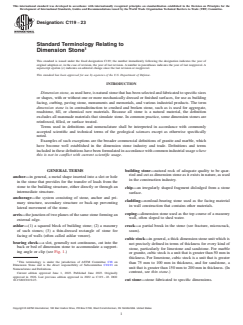
bearing check—a slot, generally not continuous, cut into the
not precisely defined in terms of thickness for every kind of
back or bed of dimension stone to accommodate a support-
stone, particularly for limestone and sandstone. For marble
ing angle or clip (see Fig. 1.)
or granite, cubic stock is a unit that is greater than 50 mm in
thickness. For limestone, cubic stock is a unit that is greater
This terminology is under the jurisdiction of ASTM Committee C18 on
than 75 mm to 100 mm in thickness, and for sandstone, a
Dimension Stone and is the direct responsibility of Subcommittee C18.91 on
unit that is greater than 150 mm to 200 mm in thickness. (In
Nomenclature and Definitions.
contrast, see thin stone.)
Current edition approved June 1, 2023. Published June 2023. Originally
approved in 1926. Last previous edition approved in 2022 as C119 – 22. DOI:
10.1520/C0119-23. cut stone—stone fabricated to specific dimensions.
Copyright © ASTM International, 100 Barr Harbor Drive, PO Box C700, West Conshohocken, PA 19428-2959. United States
C119 − 23
fleuri-cut (cross-cut), adj—describes stone that is cut parallel
to the natural veining.
flooring—stone used as in interior pedestrian wearing surface.
fracture—a complete break in the stone (see crack,
microcrack, seam).
freestone—a stone having little or no preferential direction of
splitting which may be cut freely in any direction without
fracture or splitting.
gage/gauge—grinding (or otherwise processing) stone to a
uniform or precise thickness for tolerance or accuracy.
grain—(1) a distinguishable rock constituent which itself has
a distinct identity, for example, a mineral crystal, an oolith,
a rock fragment (in sedimentary rocks), or clast.
(2) a direction in a rock body along which it is more easily
FIG. 1 Bearing Check
broken, split, or cut. See rift.
granular—composed of particles visible to the unaided eye.
dimension stone—natural stone that has been selected and
For sedimentary stone, the predominant particle distribution
fabricated to specific sizes or shapes.
is less than 4 mm in size.
DISCUSSION—The term dimension stone is in contradistinction to
crushed and broken stone, such as is used for aggregate, roadstone, fill,
hysteresis—the residual strain in stone after the stress causing
or chemical raw materials. In common practice, some dimension stones
such strain is changed.
are reinforced, filled, or surface treated.
installation—the process of assembling dimension stone into a
dressed stone—See cut stone, finished stone.
structure.
drip/drip edge, n—a groove cut on the underside of a sill or
projecting stone, designed to direct water away from the
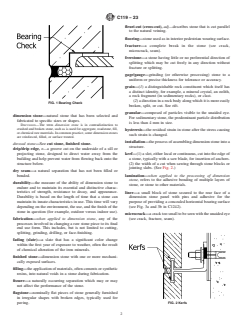
kerf—(1) a slot, either local or continuous, cut into the edge of
building and help prevent water from flowing back onto the a stone, typically with a saw blade, for insertion of anchors.
structure below.
(2) the width of a cut when sawing through stone blocks or
jointing slabs. (See Fig. 2.)
dry seam—a natural separation that has not been filled or
bonded.
lamination—when applied to the processing of dimension
stone, refers to the adhesive bonding of multiple layers of
durability—the measure of the ability of dimension stone to
stone, or stone to other materials.
endure and to maintain its essential and distinctive charac-
teristics of strength, resistance to decay, and appearance. liner—a small block of stone secured to the rear face of a
Durability is based on the length of time that a stone can dimension stone panel with pins and adhesive for the
maintain its innate characteristics in use. This time will vary purpose of providing a concealed horizontal bearing surface
depending on the environment, the use, and the finish of the (see Fig. 3a and 3b in C1242).
stone in question (for example, outdoor versus indoor use).
microcrack—a crack too small to be seen with the unaided eye
fabrication—when applied to dimension stone, any of the (see crack, fracture, seam).
processes involved in changing a raw stone piece to its final
end use form. This includes, but is not limited to cutting,
splitting, grinding, drilling, or face-finishing.
fading (slate)—a slate that has a significant color change
within the first year of exposure to weather, often the result
of chemical alteration of the iron minerals.
finished stone—dimension stone with one or more mechani-
cally exposed surfaces.
filling—the application of materials, often cements or synthetic
resins, into natural voids in a stone during fabrication.
fissure—a naturally occurring separation which may or may
not affect the performance of the stone.
flagstone—nominally flat pieces of stone generally furnished
in irregular shapes with broken edges, typically used for
paving. FIG. 2 Kerfs
C119 − 23
microfissure—a fissure that cannot be seen with the unaided ribbon—in some slate, narrow bands of contrasting color or
eye. appearance differing in some degree in chemical composi-
tion from the main body.
monumental stone—rock of adequate quality to be quarried
and cut as dimension stone as it exists in nature, as used in rift—(1) a consistent direction or trend in a rock body along
the monument and memorial industry. which the rock is most easily split or broken.
(2) The grain orientation in stone, particularly in sedimen-
open seams—unfilled fissures or naturally occurring cracks in
tary stones, showing more or less clearly how the stone was
stone.
originally bedded, and with or without color or grain-size
changes or voids.
panel—cut stone with face dimensions large in relation to its
thickness, for placement in a building structure or frame
rock—a naturally occurring, consolidated aggregation of one
assembly.
or more minerals constituting the crust of the Earth.
paving—dimension stone that is used as the finished surface of
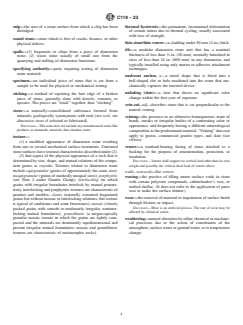
rustication (or reveal)—a continuous groove cut within the
horizontal pedestrian or vehicular traffic areas, such as
face or along the edge of a dimension stone panel, usually
plazas, terraces, patios, walkways and driveways. Generally
for the purpose of visually imitating or accentuating a joint
refers to exterior applications (for interior applications, see
location (see Fig. 4).
flooring).
sample—a small part or quantity of stone, usually a slab,
pits—small depressions, voids or pinholes in stone, especially
panel, or ashlar, that is cut from a larger block of stone.
on a finished surface.
seam—a naturally filled or bonded feature in the stone, such as
polished finish—a surface that has high luster and strong
a streak or a vein, which may or may not adversely affect the
reflection of incident light.
strength of a stone (see crack, fracture, microcrack).
processing—the work involved in transforming quarry blocks
shaped stone—dimension stone processed by carving,
into dimension stone, including sawing, drilling, grinding,
grinding, sawing, or other means into specific nonplanar
honing, polishing, carving, and all other operations neces-
configurations.
sary for installation.
shop drawings—when applied to dimension stone, a highly
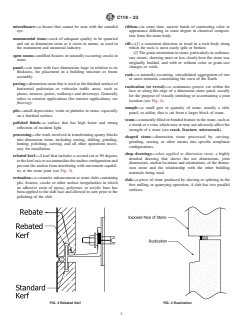
rebated kerf—A kerf that includes a second cut at 90 degrees
detailed drawing that shows the net dimensions, joint
to the kerf axis to accommodate the anchor configuration and
dimensions, anchor locations and orientations, of the dimen-
prevent the anchor from interfering with movement capabil-
sion stone and the relationship with the other building
ity at the stone joint (see Fig. 3).
materials being used.
resination—a cosmetic enhancement to stone slabs containing
slab—a piece of stone produced by shaving or splitting in the
pits, fissures, cracks or other surface irregularities in which
first milling or quarrying operation. A slab has two parallel
an adhesive resin of epoxy, polyester, or acrylic base has
surfaces.
been applied to the slab face and allowed to cure prior to the
polishing of the slab.
FIG. 3 Rebated Kerf FIG. 4 Rustication
C119 − 23
snip—the area of a stone surface from which a chip has been thermal hysteresis—the permanent, incremental deformation
dislodged. of certain stones due to thermal cycling, usually associated
with loss of strength.
sound stone—stone which is free of cracks, fissures, or other
thin stone/thin veneer—a cladding under 50 mm (2-in.) thick.
physical defects.
tile—a modular dimension stone unit that has a nominal
spalls—(1) fragments or chips from a piece of dimension
thickness of less than ⁄4 in. (20 mm), normally furnished in
stone. (2) waste stone usually of small size from the
sizes of less than 24 in. (600 mm) in any dimension, and
quarrying and milling of dimension limestone.
typically installed using only mortar or adhesive attachment
specifying authority—party requiring testing of dimension
techniques.
stone material.
undercut anchor, n—a metal shape that is fitted into a
bell-shaped slot or hole machined into the stone that me-
specimen—an individual piece of stone that is cut from a
sample to be used for physical or mechanical testing. chanically captures the inserted device.
unfading (slate)—a slate that shows no significant color
sticking—a method of repairing the butt edge of a broken
change within the first year of exposure.
piece of stone, generally done with dowels, cements, or
epoxies. The pieces are “stuck” together, thus “sticking”.
vein-cut, adj—describes stone that is cut perpendicular to the
natural veining.
stone—a naturally-consolidated substance formed from
minerals, geologically synonymous with rock (see rock, see
veining—the presence in an otherwise homogeneous stone of
dimension stone if selected or fabricated).
bands, streaks or irregular bodies of a contrasting color or
DISCUSSION—This term does not include any manufactured stone-like
appearance, and frequently having a different mineralogical
products or manmade materials that simulate stone.
composition to the predominant material. “Veining” does not
apply to gneiss, commercial granite types, and slate (see
texture—
ribbon).
(1) a modified appearance of dimension stone resulting
from one or several mechanical surface treatments. Untreated
veneer—a nonload-bearing facing of stone attached to a
stone surfaces have textural characteristics described under (2).
backing for the purpose of ornamentation, protection, or
(2) that aspect of the physical appearance of a rock that is
insulation.
determined by size, shape, and mutual relations of the compo- DISCUSSION—Veneer shall support no vertical load other than its own
weight and possibly the vertical dead load of veneer above.
nent grains or crystals. Textures related to dimension stone
include equigranular (grains of approximately the same size);
walls, veneered—See veneer.
inequigranular (grains of markedly unequal sizes); porphyritic
waxing—the practice of filling minor surface voids in stone
(see Note 2 under Granite Group); interlocking (in which
with certain polyester compounds, cabinetmaker’s wax, or
grains with irregular boundaries interlock by mutual penetra-
melted shellac. (It does not refer to the application of paste
tion); interlocking and porphyritic textures are characteristic of
wax to make the surface shinier.)
granites and marbles; clastic (naturally cemented fragmental
wear—the removal of material or impairment of surface finish
grains but without mosaic or interlocking relations; this texture
through friction or impact.
is typical of sandstones and some limestones); mosaic (closely
DISCUSSION—Wear is an artificial process. The rate of wear may be
packed grains with smooth to moderately irregular, noninter-
affected by chemical action.
locking mutual boundaries); granoblastic (a megascopically
granular mosaic texture in which the grains are tightly com- weathering—natural alteration by either chemical or mechani-
pacted and the minerals are dominantly equidimensional and cal processes due to the action of constituents of the
present irregular mutual boundaries; mosaic and granoblastic atmosphere, surface water or ground water, or to temperature
textures are characteristic of metamorphic rocks). change.
C119 − 23
DISCUSSION—Changes by weathering are not necessarily undesirable
hand-rubbed—a non-reflective surface with a slight stipple
or harmful; rather they may enhance the texture and color of the stone.
pattern, produced by hand-applied abrasive pads or hand-
held machines.
STONE FINISHES—BY FAMILY
AGED FINISHES
Every material used in construction has a finish or surface;
(less than 3 mm [ ⁄8 in.] of surface variation)
dimension stone has a plethora of finishes. This section de-
scribes common finishes and classifies them into a number
acid-washed—a worn surface produced by applying acid.
of families by relief or roughness. The finishes in each fam-
ily are also arranged from the least relief to the most relief. antiqued—a worn surface produced by applying abrasive
Stone finishes are a complex matter for a number of rea- tools, sometimes in combination with acid and/or wet/dry
sons. New manufacturing or finishing methods or variations abrasive.
or combinations of other methods of finishing stone are con-
tumbled—a worn surface produced by rotating stone objects
tinually being developed. Stone finish names sometimes
(like tiles) in a drum, sometimes with sand or aggregate
overlap or are variations of other finishes.
stone, until the faces and edges become eroded.
Finish options for any kind of stone vary by the geologic
category of the stone (whether igneous, metamorphic, or
SAWN FINISHES
1 3
sedimentary) and the unique combination of geological or
(1 mm to 5 mm [ ⁄32 in. to ⁄16 in.] of surface variation)
physical properties of the stone type. This means that any
diamond sawn—a surface with a very low-relief pattern of
particular finish cannot be put on every type of stone (see
linear and/or curved grooves, produced by diamond saw
Applicability of Finishes for Various Stone Types Table in
blades (either circular, belt, or gang).
Guide C1528 for Selection of Dimension Stone for Exterior
Use). The individual definitions are sometimes nonspecific or
wire sawn—a surface with a pattern of linear and/or curved
nearly overlap. In practice, a detailed definition of a specific
grooves produced by a wire saw.
stone finish is established between the producer and designer
chat sawn—a surface with shallow linear grooves, produced
through dialogue, or reference sample(s), or both.
by gangsawing with coarse chat sand.
The family or individual title “finish” will be used uni-
formly throughout this section for ease of reference, al-
shot sawn—a surface with random grooves and markings,
though the term “surface” would be more accurate when no
produced by gangsawing with chilled steel shot.
work has been done on it and no improvements made
TEXTURED FINISHES
postquarry (as in certain rough finishes; see Note 2). “Sur-
1 1
(1 mm to 6 mm [ ⁄32 in. to ⁄4 in.] of surface variation)
face” will be used uniformly in the sense of the outward
appearance or face of the stone. Thus we have the Least
sandblasted—an irregular, pitted surface produced by impact-
Textured Finishes (family) and the Polished (finish)—a
ing sand particles at high velocity against a stone surface.
highly-reflective surface, and so forth.
DISCUSSION—The resulting texture will vary, depending on the stone
Surface Variation
type and the pressure and concentration of impacts. The size and depths
of the pits can range from nearly invisible to very pronounced.
The dimensions of variation in surface profile given in the
following definitions are for indicative purposes only. The
plucked—a machined surface with occasional pits, obtained
values do not denote acceptable tolerances or minimum or
by rough planing the stone surface, thus breaking or “pluck-
maximum values of surface variation for any given finish.
ing” out small particles.
LEAST TEXTURED FINISHES
thermal (or flamed)—a roughly textured surface produced by
(less than 1 mm [ ⁄32 in.] of surface variation)
brief exposure to a high-temperature flame resulting in
exfoliation of the stone surface.
polished—a highly-reflective surface, produced by mechanical
DISCUSSION—The resulting appearance will vary, depending on
...
This document is not an ASTM standard and is intended only to provide the user of an ASTM standard an indication of what changes have been made to the previous version. Because
it may not be technically possible to adequately depict all changes accurately, ASTM recommends that users consult prior editions as appropriate. In all cases only the current version
of the standard as published by ASTM is to be considered the official document.
Designation: C119 − 22 C119 − 23
Standard Terminology Relating to
Dimension Stone
This standard is issued under the fixed designation C119; the number immediately following the designation indicates the year of
original adoption or, in the case of revision, the year of last revision. A number in parentheses indicates the year of last reapproval. A
superscript epsilon (´) indicates an editorial change since the last revision or reapproval.
This standard has been approved for use by agencies of the U.S. Department of Defense.
INTRODUCTION
Dimension stone, as used here, is natural stone that has been selected and fabricated to specific sizes
or shapes, with or without one or more mechanically dressed or finished surfaces, for use as building
facing, curbing, paving stone, monuments and memorials, and various industrial products. The term
dimension stone is in contradistinction to crushed and broken stone, such as is used for aggregate,
roadstone, fill, or chemical raw materials. Because all stone is a natural material, the definition
excludes all manmade materials that simulate stone. In common practice, some dimension stones are
reinforced, filled, or surface treated.
Terms used in definitions and nomenclature shall be interpreted in accordance with commonly
accepted scientific and technical terms of the geological sciences except as otherwise specifically
noted.
Examples of such exceptions are the broader commercial definitions of granite and marble, which
have become well established in the dimension stone industry and trade. Definitions and terms
included in these definitions have been formulated in accordance with common industrial usage where
this is not in conflict with current scientific usage.
GENERAL TERMS
anchor—in general, a metal shape inserted into a slot or hole in the stone that provides for the transfer of loads from the stone
to the building structure, either directly or through an intermediate structure.
anchorage—the system consisting of stone, anchor and primary structure, secondary structure or back-up preventing lateral
movement of the stone.
arris—the junction of two planes of the same stone forming an external edge.
ashlar—(1) a squared block of building stone; (2) a masonry of such stones; (3) a thin-dressed rectangle of stone for facing of
walls (often called ashlar veneer).
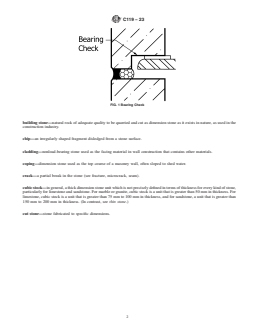
bearing check—a slot, generally not continuous, cut into the back or bed of dimension stone to accommodate a supporting angle
or clip (see Fig. 1.)
This terminology is under the jurisdiction of ASTM Committee C18 on Dimension Stone and is the direct responsibility of Subcommittee C18.91 on Nomenclature and
Definitions.
Current edition approved Aug. 1, 2022June 1, 2023. Published April 2020June 2023. Originally approved in 1926. Last previous edition approved in 20192022 as
C119 – 19.C119 – 22. DOI: 10.1520/C0119-20.10.1520/C0119-23.
Copyright © ASTM International, 100 Barr Harbor Drive, PO Box C700, West Conshohocken, PA 19428-2959. United States
C119 − 23
FIG. 1 Bearing Check
building stone—natural rock of adequate quality to be quarried and cut as dimension stone as it exists in nature, as used in the
construction industry.
chip—an irregularly shaped fragment dislodged from a stone surface.
cladding—nonload-bearing stone used as the facing material in wall construction that contains other materials.
coping—dimension stone used as the top course of a masonry wall, often sloped to shed water.
crack—a partial break in the stone (see fracture, microcrack, seam).
cubic stock—in general, a thick dimension stone unit which is not precisely defined in terms of thickness for every kind of stone,
particularly for limestone and sandstone. For marble or granite, cubic stock is a unit that is greater than 50 mm in thickness. For
limestone, cubic stock is a unit that is greater than 75 mm to 100 mm in thickness, and for sandstone, a unit that is greater than
150 mm to 200 mm in thickness. (In contrast, see thin stone.)
cut stone—stone fabricated to specific dimensions.
C119 − 23
dimension stone—natural stone that has been selected and fabricated to specific sizes or shapes.
DISCUSSION—
The term dimension stone is in contradistinction to crushed and broken stone, such as is used for aggregate, roadstone, fill, or chemical raw materials.
In common practice, some dimension stones are reinforced, filled, or surface treated.
dressed stone—See cut stone, finished stone.
drip/drip edge, n—a groove cut on the underside of a sill or projecting stone, designed to direct water away from the building
and help prevent water from flowing back onto the structure below.
dry seam—a natural separation that has not been filled or bonded.
durability—the measure of the ability of dimension stone to endure and to maintain its essential and distinctive characteristics
of strength, resistance to decay, and appearance. Durability is based on the length of time that a stone can maintain its innate
characteristics in use. This time will vary depending on the environment, the use, and the finish of the stone in question (for
example, outdoor versus indoor use).
fabrication—when applied to dimension stone, any of the processes involved in changing a raw stone piece to its final end use
form. This includes, but is not limited to cutting, splitting, grinding, drilling, or face-finishing.
fading (slate)—a slate that has a significant color change within the first year of exposure to weather, often the result of chemical
alteration of the iron minerals.
finished stone—dimension stone with one or more mechanically exposed surfaces.
filling—the application of materials, often cements or synthetic resins, into natural voids in a stone during fabrication.
fissure—a naturally occurring separation which may or may not affect the performance of the stone.
flagstone—nominally flat pieces of stone generally furnished in irregular shapes with broken edges, typically used for paving.
fleuri-cut (cross-cut), adj—describes stone that is cut parallel to the natural veining.
flooring—stone used as in interior pedestrian wearing surface.
fracture—a complete break in the stone (see crack, microcrack, seam).
freestone—a stone having little or no preferential direction of splitting which may be cut freely in any direction without fracture
or splitting.
gage/gauge—grinding (or otherwise processing) stone to a uniform or precise thickness for tolerance or accuracy.
grain—(1) a distinguishable rock constituent which itself has a distinct identity, for example, a mineral crystal, an oolith, a rock
fragment (in sedimentary rocks), or clast.
(2) a direction in a rock body along which it is more easily broken, split, or cut. See rift.
granular—composed of particles visible to the unaided eye. For sedimentary stone, the predominant particle distribution is less
than 4 mm in size.
C119 − 23
hysteresis—the residual strain in stone after the stress causing such strain is changed.
installation—the process of assembling dimension stone into a structure.
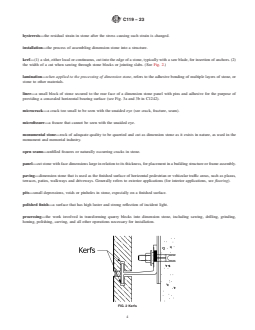
kerf—(1) a slot, either local or continuous, cut into the edge of a stone, typically with a saw blade, for insertion of anchors. (2)
the width of a cut when sawing through stone blocks or jointing slabs. (See Fig. 2.)
lamination—when applied to the processing of dimension stone, refers to the adhesive bonding of multiple layers of stone, or
stone to other materials.
liner—a small block of stone secured to the rear face of a dimension stone panel with pins and adhesive for the purpose of
providing a concealed horizontal bearing surface (see Fig. 3a and 3b in C1242).
microcrack—a crack too small to be seen with the unaided eye (see crack, fracture, seam).
microfissure—a fissure that cannot be seen with the unaided eye.
monumental stone—rock of adequate quality to be quarried and cut as dimension stone as it exists in nature, as used in the
monument and memorial industry.
open seams—unfilled fissures or naturally occurring cracks in stone.
panel—cut stone with face dimensions large in relation to its thickness, for placement in a building structure or frame assembly.
paving—dimension stone that is used as the finished surface of horizontal pedestrian or vehicular traffic areas, such as plazas,
terraces, patios, walkways and driveways. Generally refers to exterior applications (for interior applications, see flooring).
pits—small depressions, voids or pinholes in stone, especially on a finished surface.
polished finish—a surface that has high luster and strong reflection of incident light.
processing—the work involved in transforming quarry blocks into dimension stone, including sawing, drilling, grinding,
honing, polishing, carving, and all other operations necessary for installation.
FIG. 2 Kerfs
C119 − 23
rebated kerf—A kerf that includes a second cut at 90 degrees to the kerf axis to accommodate the anchor configuration and
prevent the anchor from interfering with movement capability at the stone joint (see Fig. 3).
resination—a cosmetic enhancement to stone slabs containing pits, fissures, cracks or other surface irregularities in which an
adhesive resin of epoxy, polyester, or acrylic base has been applied to the slab face and allowed to cure prior to the polishing
of the slab.
ribbon—in some slate, narrow bands of contrasting color or appearance differing in some degree in chemical composition from
the main body.
rift—(1) a consistent direction or trend in a rock body along which the rock is most easily split or broken.
(2) The grain orientation in stone, particularly in sedimentary stones, showing more or less clearly how the stone was
originally bedded, and with or without color or grain-size changes or voids.
rock—a naturally occurring, consolidated aggregation of one or more minerals constituting the crust of the Earth.
rustication (or reveal)—a continuous groove cut within the face or along the edge of a dimension stone panel, usually for the
purpose of visually imitating or accentuating a joint location (see Fig. 4).
sample—a small part or quantity of stone, usually a slab, panel, or ashlar, that is cut from a larger block of stone.
seam—a naturally filled or bonded feature in the stone, such as a streak or a vein, which may or may not adversely affect the
strength of a stone (see crack,fracture,microcrack).
shaped stone—dimension stone processed by carving, grinding, sawing, or other means into specific nonplanar configurations.
shop drawings—when applied to dimension stone, a highly detailed drawing that shows the net dimensions, joint dimensions,
anchor locations and orientations, of the dimension stone and the relationship with the other building materials being used.
FIG. 3 Rebated Kerf
C119 − 23
FIG. 4 Rustication
slab—a piece of stone produced by shaving or splitting in the first milling or quarrying operation. A slab has two parallel
surfaces.
snip—the area of a stone surface from which a chip has been dislodged.
sound stone—stone which is free of cracks, fissures, or other physical defects.
spalls—(1) fragments or chips from a piece of dimension stone. (2) waste stone usually of small size from the quarrying and
milling of dimension limestone.
specifying authority—party requiring testing of dimension stone material.
specimen—an individual piece of stone that is cut from a sample to be used for physical or mechanical testing.
sticking—a method of repairing the butt edge of a broken piece of stone, generally done with dowels, cements, or epoxies. The
pieces are “stuck” together, thus “sticking”.
stone—a naturally-consolidated substance formed from minerals, geologically synonymous with rock (see rock, see dimension
stone if selected or fabricated).
DISCUSSION—
This term does not include any manufactured stone-like products or manmade materials that simulate stone.
texture—
(1) a modified appearance of dimension stone resulting from one or several mechanical surface treatments. Untreated stone
surfaces have textural characteristics described under (2).
(2) that aspect of the physical appearance of a rock that is determined by size, shape, and mutual relations of the component
grains or crystals. Textures related to dimension stone include equigranular (grains of approximately the same size);
inequigranular (grains of markedly unequal sizes); porphyritic (see Note 2 under Granite Group); interlocking (in which grains
with irregular boundaries interlock by mutual penetration); interlocking and porphyritic textures are characteristic of granites and
marbles; clastic (naturally cemented fragmental grains but without mosaic or interlocking relations; this texture is typical of
C119 − 23
sandstones and some limestones); mosaic (closely packed grains with smooth to moderately irregular, noninterlocking mutual
boundaries); granoblastic (a megascopically granular mosaic texture in which the grains are tightly compacted and the minerals
are dominantly equidimensional and present irregular mutual boundaries; mosaic and granoblastic textures are characteristic of
metamorphic rocks).
thermal hysteresis—the permanent, incremental deformation of certain stones due to thermal cycling, usually associated with
loss of strength.
thin stone/thin veneer—a cladding under 50 mm (2-in.) thick.
tile—a modular dimension stone unit that has a nominal thickness of less than ⁄4 in. (20 mm), normally furnished in sizes of
less than 24 in. (600 mm) in any dimension, and typically installed using only mortar or adhesive attachment techniques.
undercut anchor, n—a metal shape that is fitted into a bell-shaped slot or hole machined into the stone that mechanically
captures the inserted device.
unfading (slate)—a slate that shows no significant color change within the first year of exposure.
vein-cut, adj—describes stone that is cut perpendicular to the natural veining.
veining—the presence in an otherwise homogeneous stone of bands, streaks or irregular bodies of a contrasting color or
appearance, and frequently having a different mineralogical composition to the predominant material. “Veining” does not apply
to gneiss, commercial granite types, and slate (see ribbon).
veneer—a nonload-bearing facing of stone attached to a backing for the purpose of ornamentation, protection, or insulation.
DISCUSSION—
Veneer shall support no vertical load other than its own weight and possibly the vertical dead load of veneer above.
walls, veneered—See veneer.
waxing—the practice of filling minor surface voids in stone with certain polyester compounds, cabinetmaker’s wax, or melted
shellac. (It does not refer to the application of paste wax to make the surface shinier.)
wear—the removal of material or impairment of surface finish through friction or impact.
DISCUSSION—
Wear is an artificial process. The rate of wear may be affected by chemical action.
weathering—natural alteration by either chemical or mechanical processes due to the action of constituents of the atmosphere,
surface water or ground water, or to temperature change.
DISCUSSION—
Changes by weathering are not necessarily undesirable or harmful; rather they may enhance the texture and color of the stone.
C119 − 23
STONE FINISHES—BY FAMILY
Every material used in construction has a finish or surface; dimension stone has a plethora of finishes. This section de-
scribes common finishes and classifies them into a number of families by relief or roughness. The finishes in each family are
also arranged from the least relief to the most relief.
Stone finishes are a complex matter for a number of reasons. New manufacturing or finishing methods or variations or com-
binations of other methods of finishing stone are continually being developed. Stone finish names sometimes overlap or are
variations of other finishes.
Finish options for any kind of stone vary by the geologic category of the stone (whether igneous, metamorphic, or sedimen-
tary) and the unique combination of geological or physical properties of the stone type. This means that any particular finish
cannot be put on every type of stone (see Applicability of Finishes for Various Stone Types Table in Guide C1528 for Selec-
tion of Dimension Stone for Exterior Use). The individual definitions are sometimes nonspecific or nearly overlap. In practice,
a detailed definition of a specific stone finish is established between the producer and designer through dialogue, or reference
sample(s), or both.
The family or individual title “finish” will be used uniformly throughout this section for ease of reference, although the
term “surface” would be more accurate when no work has been done on it and no improvements made postquarry (as in cer-
tain rough finishes; see Note 2). “Surface” will be used uniformly in the sense of the outward appearance or face of the stone.
Thus we have the Least Textured Finishes (family) and the Polished (finish)—a highly-reflective surface, and so forth.
Surface Variation
The dimensions of variation in surface profile given in the following definitions are for indicative purposes only. The values
do not denote acceptable tolerances or minimum or maximum values of surface variation for any given finish.
LEAST TEXTURED FINISHES
(less than 1 mm [ ⁄32 in.] of surface variation)
polished—a highly-reflective surface, produced by mechanical abrasion and buffing.
honed—a non-reflective to semi-reflective superfine satin-like surface with no surface pattern, produced by mechanical
abrasion.
smooth—a non-reflective surface with a barely-visible surface pattern of random markings, produced by mechanical abrasion.
machine gauged—a process by which stone material is removed (see Note 1) to a specified thickness, incidentally resulting in
a finish.
NOTE 1—The resulting coarsely ground surface can be produced by a number of methods.
hand-rubbed—a non-reflective surface with a slight stipple pattern, produced by hand-applied abrasive pads or hand-held
machines.
AGED FINISHES
(less than 3 mm [ ⁄8 in.] of surface variation)
acid-washed—a worn surface produced by applying acid.
antiqued—a worn surface produced by applying abrasive tools, sometimes in combination with acid and/or wet/dry abrasive.
tumbled—a worn surface produced by rotating stone objects (like tiles) in a drum, sometimes with sand or aggregate stone, until
the faces and edges become eroded.
C119 − 23
SAWN FINISHES
1 3
(1 mm to 5 mm [ ⁄32 in. to ⁄16 in.] of surface variation)
diamond sawn—a surface with a very low-relief pattern of linear and/or curved grooves, produced by diamond saw blades
(either circular, belt, or gang).
wire sawn—a surface with a pattern of linear and/or curved grooves produced by a wire saw.
chat sawn—a surface with shallow linear grooves, produced by gangsawing with coarse chat sand.
shot sawn—a surface with random grooves and markings, produced by gangsawing with chilled steel shot.
TEXTURED FINISHES
1 1
(1 mm to 6 mm [ ⁄32 in. to ⁄4 in.] of surface variation)
sandblasted—an irregular, pitted
...