

ASTM D7001-20
(Specification)Standard Specification for Geocomposites for Pavement Edge Drains and Other High-Flow Applications
General Information
- Abstract
SCOPE
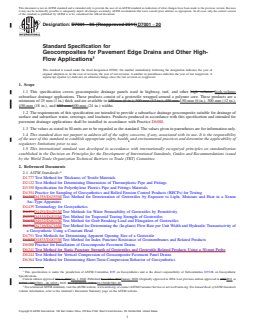
1.1 This specification covers geocomposite drainage panels used in highway, turf, and other high-volume subsurface drainage applications. These products consist of a geotextile wrapped around a polymer core. These products are a minimum of 25 mm (1 in.) thick and are available in 150-mm (6 in.), 300-mm (12 in.), 450-mm (18 in.), and 600-mm (24 in.) widths.
1.2 The requirements of this specification are intended to provide a subsurface drainage geocomposite suitable for drainage of surface and subsurface water, sewerage, and leachates. Products produced in accordance with this specification and intended for pavement drainage applications shall be installed in accordance with Practice D6088.
1.3 The values as stated in SI units are to be regarded as the standard. The values given in parentheses are for information only.
1.4 This standard does not purport to address all of the safety concerns, if any, associated with its use. It is the responsibility of the user of this standard to establish appropriate safety, health, and environmental practices and determine the applicability of regulatory limitations prior to use.
1.5 This international standard was developed in accordance with internationally recognized principles on standardization established in the Decision on Principles for the Development of International Standards, Guides and Recommendations issued by the World Trade Organization Technical Barriers to Trade (TBT) Committee.
- Status
- Published
- Publication Date
- 31-Dec-2019
- Technical Committee
- D35 - Geosynthetics
- Drafting Committee
- D35.06 - Geosynthetic Specifications
Buy Documents
ASTM D7001-20 - Standard Specification for Geocomposites for Pavement Edge Drains and Other High-Flow Applications
REDLINE ASTM D7001-20 - Standard Specification for Geocomposites for Pavement Edge Drains and Other High-Flow Applications
Overview
ASTM D7001-20 sets the requirements for geocomposite drainage panels intended for high-flow subsurface drainage in highway, turf, and similar civil engineering applications. These geocomposites consist of a geotextile filter wrapped around a polymeric core and are used primarily for pavement edge drains, subsurface water management, sewerage, and leachate control. The standard specifies material properties, manufacturing requirements, physical characteristics, and installation guidelines for these products to ensure effective and reliable drainage in demanding environments.
Key Topics
- Product Composition: Defines geocomposites as assemblies of a geotextile layer encasing a polymer core, typically made of polyethylene with defined cell classification for durability.
- Dimensional Requirements: Standardizes minimum product thickness at 25 mm (1 in.) and typical widths at 150 mm (6 in.), 300 mm (12 in.), 450 mm (18 in.), and 600 mm (24 in.), ensuring compatibility with common civil engineering practices.
- Performance Criteria:
- Water flow capacity and hydraulic transmissivity for efficient drainage under load.
- Mechanical properties for compression strength, grab tensile strength, seam strength, puncture resistance, and tear resistance.
- Consistent durability, chemical resistance, and resilience to ultraviolet exposure to maintain long-term performance in soil environments.
- Classification:
- Class A: Open core with a geotextile wrap providing structure and filtration.
- Class B: Fully enclosed core with geotextile acting as a filter only.
- Manufacturing & Quality Assurance:
- Detailed marking, quality control, and certification practices to guarantee compliance.
- Definitions for sampling, test frequency, and documentation.
Applications
ASTM D7001-20 geocomposites are tailored for high-volume drainage needs across a variety of infrastructure and environmental settings:
- Pavement Edge Drains: Installed along highways and roads to effectively channel surface and subsurface water away from pavements, reducing structural weakening and prolonging pavement life.
- Subsurface Drainage: Used in sports turf, landscaped areas, and under building slabs to manage water and control moisture, preventing waterlogging and structural damage.
- Sewerage and Leachate Management: Employed in landfill caps and similar projects to collect and direct leachates efficiently, assisting in environmental containment efforts.
- Slope and Embankment Protection: Helps stabilize embankments and slopes by relieving hydrodynamic pressure and controlling groundwater movement.
- Transition Fittings: Includes molded or fabricated fittings to connect panels and interface with round or flat pipe systems for integrated drainage solutions.
Related Standards
To ensure comprehensive compliance and compatibility, ASTM D7001-20 references and works alongside other geosynthetics and geotextile standards:
- ASTM Practice D6088: Installation practice for geocomposite pavement drains.
- ASTM D4355: Testing geotextile deterioration due to light, moisture, and heat.
- ASTM D4491: Water permeability (permittivity) of geotextiles by permittivity.
- ASTM D4632: Grab breaking load and elongation for geotextiles.
- ASTM D4751: Apparent opening size determination for geotextiles.
- ASTM D6710: Specification for circular-knit geotextile for subsurface drainage.
- AASHTO M288: Guideline for geotextile material selection in transportation projects.
Keywords: ASTM D7001-20, geocomposite drainage panel, pavement edge drain, high-flow drainage, geotextile, geosynthetic, subsurface drainage, standard specification, polymer core drainage, road water management
Relations
- Effective Date
- 01-Jan-2020
- Effective Date
- 01-Feb-2024
- Effective Date
- 01-Jun-2020
- Effective Date
- 01-May-2020
- Effective Date
- 01-Jan-2020
- Effective Date
- 01-Jul-2019
- Effective Date
- 15-Feb-2019
- Effective Date
- 15-Apr-2018
- Effective Date
- 01-Feb-2018
- Effective Date
- 01-Feb-2018
- Effective Date
- 01-Aug-2017
- Refers
ASTM D4491/D4491M-17 - Standard Test Methods for Water Permeability of Geotextiles by Permittivity - Effective Date
- 01-Jan-2017
- Effective Date
- 01-Jul-2016
- Refers
ASTM D4491/D4491M-16 - Standard Test Methods for Water Permeability of Geotextiles by Permittivity - Effective Date
- 01-Jul-2016
- Effective Date
- 01-Jan-2016
Buy Documents
ASTM D7001-20 - Standard Specification for Geocomposites for Pavement Edge Drains and Other High-Flow Applications
REDLINE ASTM D7001-20 - Standard Specification for Geocomposites for Pavement Edge Drains and Other High-Flow Applications
Get Certified
Connect with accredited certification bodies for this standard

Control Union Certifications
Global certification for agriculture and sustainability.

Hohenstein Institut
Textile testing and certification.

Bureau Veritas Bangladesh
Bureau Veritas certification services in Bangladesh.
Sponsored listings
Frequently Asked Questions
ASTM D7001-20 is a technical specification published by ASTM International. Its full title is "Standard Specification for Geocomposites for Pavement Edge Drains and Other High-Flow Applications". This standard covers: SCOPE 1.1 This specification covers geocomposite drainage panels used in highway, turf, and other high-volume subsurface drainage applications. These products consist of a geotextile wrapped around a polymer core. These products are a minimum of 25 mm (1 in.) thick and are available in 150-mm (6 in.), 300-mm (12 in.), 450-mm (18 in.), and 600-mm (24 in.) widths. 1.2 The requirements of this specification are intended to provide a subsurface drainage geocomposite suitable for drainage of surface and subsurface water, sewerage, and leachates. Products produced in accordance with this specification and intended for pavement drainage applications shall be installed in accordance with Practice D6088. 1.3 The values as stated in SI units are to be regarded as the standard. The values given in parentheses are for information only. 1.4 This standard does not purport to address all of the safety concerns, if any, associated with its use. It is the responsibility of the user of this standard to establish appropriate safety, health, and environmental practices and determine the applicability of regulatory limitations prior to use. 1.5 This international standard was developed in accordance with internationally recognized principles on standardization established in the Decision on Principles for the Development of International Standards, Guides and Recommendations issued by the World Trade Organization Technical Barriers to Trade (TBT) Committee.
SCOPE 1.1 This specification covers geocomposite drainage panels used in highway, turf, and other high-volume subsurface drainage applications. These products consist of a geotextile wrapped around a polymer core. These products are a minimum of 25 mm (1 in.) thick and are available in 150-mm (6 in.), 300-mm (12 in.), 450-mm (18 in.), and 600-mm (24 in.) widths. 1.2 The requirements of this specification are intended to provide a subsurface drainage geocomposite suitable for drainage of surface and subsurface water, sewerage, and leachates. Products produced in accordance with this specification and intended for pavement drainage applications shall be installed in accordance with Practice D6088. 1.3 The values as stated in SI units are to be regarded as the standard. The values given in parentheses are for information only. 1.4 This standard does not purport to address all of the safety concerns, if any, associated with its use. It is the responsibility of the user of this standard to establish appropriate safety, health, and environmental practices and determine the applicability of regulatory limitations prior to use. 1.5 This international standard was developed in accordance with internationally recognized principles on standardization established in the Decision on Principles for the Development of International Standards, Guides and Recommendations issued by the World Trade Organization Technical Barriers to Trade (TBT) Committee.
ASTM D7001-20 is classified under the following ICS (International Classification for Standards) categories: 59.080.70 - Geotextiles. The ICS classification helps identify the subject area and facilitates finding related standards.
ASTM D7001-20 has the following relationships with other standards: It is inter standard links to ASTM D7001-06(2011), ASTM D4439-24, ASTM D4833/D4833M-07(2020), ASTM D4354-12(2020), ASTM D4751-20, ASTM D1777-96(2019), ASTM D6707/D6707M-06(2019), ASTM D4439-18, ASTM D6244-06(2018), ASTM D6364-06(2018), ASTM D4439-17, ASTM D4491/D4491M-17, ASTM D4751-16, ASTM D4491/D4491M-16, ASTM D6707/D6707M-06(2016)e1. Understanding these relationships helps ensure you are using the most current and applicable version of the standard.
ASTM D7001-20 is available in PDF format for immediate download after purchase. The document can be added to your cart and obtained through the secure checkout process. Digital delivery ensures instant access to the complete standard document.
Standards Content (Sample)
This international standard was developed in accordance with internationally recognized principles on standardization established in the Decision on Principles for the
Development of International Standards, Guides and Recommendations issued by the World Trade Organization Technical Barriers to Trade (TBT) Committee.
Designation:D7001 −20
Standard Specification for
Geocomposites for Pavement Edge Drains and Other High-
Flow Applications
This standard is issued under the fixed designation D7001; the number immediately following the designation indicates the year of
original adoption or, in the case of revision, the year of last revision. A number in parentheses indicates the year of last reapproval. A
superscript epsilon (´) indicates an editorial change since the last revision or reapproval.
1. Scope D2122 Test Method for Determining Dimensions of Ther-
moplastic Pipe and Fittings
1.1 This specification covers geocomposite drainage panels
D3350 Specification for Polyethylene Plastics Pipe and Fit-
used in highway, turf, and other high-volume subsurface
tings Materials
drainage applications. These products consist of a geotextile
D4354 Practice for Sampling of Geosynthetics and Rolled
wrapped around a polymer core. These products are a mini-
Erosion Control Products (RECPs) for Testing
mum of 25 mm (1 in.) thick and are available in 150-mm
D4355/D4355M Test Method for Deterioration of Geotex-
(6 in.),300-mm(12in.),450-mm(18in.),and600-mm(24in.)
tiles by Exposure to Light, Moisture and Heat in a Xenon
widths.
Arc-Type Apparatus
1.2 The requirements of this specification are intended to
D4439 Terminology for Geosynthetics
provide a subsurface drainage geocomposite suitable for drain-
D4491/D4491M Test Methods for Water Permeability of
age of surface and subsurface water, sewerage, and leachates.
Geotextiles by Permittivity
Products produced in accordance with this specification and
D4533/D4533M Test Method for Trapezoid Tearing
intended for pavement drainage applications shall be installed
Strength of Geotextiles
in accordance with Practice D6088.
D4632/D4632M Test Method for Grab Breaking Load and
Elongation of Geotextiles
1.3 The values as stated in SI units are to be regarded as the
standard. The values given in parentheses are for information D4716/D4716M TestMethodforDeterminingthe(In-plane)
Flow Rate per Unit Width and Hydraulic Transmissivity
only.
of a Geosynthetic Using a Constant Head
1.4 This standard does not purport to address all of the
D4751 Test Methods for Determining Apparent Opening
safety concerns, if any, associated with its use. It is the
Size of a Geotextile
responsibility of the user of this standard to establish appro-
D4833/D4833M Test Method for Index Puncture Resistance
priate safety, health, and environmental practices and deter-
of Geomembranes and Related Products
mine the applicability of regulatory limitations prior to use.
D6088 Practice for Installation of Geocomposite Pavement
1.5 This international standard was developed in accor-
Drains
dance with internationally recognized principles on standard-
D6241 Test Method for Static Puncture Strength of Geotex-
ization established in the Decision on Principles for the
tiles and Geotextile-Related Products Using a 50-mm
Development of International Standards, Guides and Recom-
Probe
mendations issued by the World Trade Organization Technical
D6244 Test Method for Vertical Compression of Geocom-
Barriers to Trade (TBT) Committee.
posite Pavement Panel Drains
D6364 Test Method for Determining Short-Term Compres-
2. Referenced Documents
2 sion Behavior of Geosynthetics
2.1 ASTM Standards:
D6707/D6707M Specification for Circular-Knit Geotextile
D1777 Test Method for Thickness of Textile Materials
for Use in Subsurface Drainage Applications
2.2 Other Document:
This specification is under the jurisdiction of ASTM Committee D35 on
AASHTO M288 Geotextile Materials
Geosynthetics and is the direct responsibility of Subcommittee D35.06 on Geosyn-
thetic Specifications.
3. Terminology
Current edition approved Jan. 1, 2020. Published January 2020. Originally
approved in 2004. Last previous edition approved in 2011 as D7001 – 06 (2011).
3.1 Definitions:
DOI: 10.1520/D7001-20.
For referenced ASTM standards, visit the ASTM website, www.astm.org, or
contact ASTM Customer Service at service@astm.org. For Annual Book of ASTM
Standards volume information, refer to the standard’s Document Summary page on Available from American Association of State Highway and Transportation
the ASTM website. Officials (AASHTO), 444 N. Capitol St., NW, Suite 249, Washington, DC 20001.
Copyright © ASTM International, 100 Barr Harbor Drive, PO Box C700, West Conshohocken, PA 19428-2959. United States
D7001−20
3.1.1 For definitions of terms relating to geotextiles, refer to except for density, which must be cell Class 4, provided the
Terminology D4439. product requirements are met.
3.1.2 geocomposite, n—a product composed of two or more 6.1.2 Reworked Materials—Clean rework material, gener-
materials, at least one of which is a geosynthetic. D4439 ated from the manufacturer’s own production, may be used by
the manufacturer provided that the core and fittings produced
3.1.3 geosynthetic, n—a planar product manufactured from
meet all requirements of this specification.
polymeric material used with foundation, soil, rock, earth, or
6.1.3 Geotextile Materials—Fibers used in the manufacture
any other geotechnical engineering related material as an
of geotextiles shall consist of long-chain synthetic polymers
integral part of a man-made project, structure, or system.
composed of at least 95 % by weight of polyolefins or
D4439
polyesters.
4. Classification
6.2 Manufacture and Assembly—The geocomposite shall be
assembled from the permitted core structures and the geotex-
4.1 General—Thisspecificationcoversgeocompositedrain-
tile.
age products or structures intended for high flow volume
6.2.1 Core—The core structure shall be manufactured by
subsurfacedrainageapplications.Twodistinctlydifferentprod-
continuous extrusion and forming and cut to size.
uct designs are included in this specification, a ClassAproduct
6.2.2 Fittings—The core fittings shall be blow molded,
composed of a cuspated or sheet and post core wrapped with a
injection molded, rotational molded, thermoformed, or fabri-
geotextile serving as the outer boundary and a drainage fabric,
cated by extrusion or hot plate welding.
andaClassBproductcomposedofaseriesofsmallroundpipe
6.2.3 Geotextile—The geotextile may be knitted, needle-
connected together or a flat pipe design consisting of a
punched nonwoven, or spun-bonded nonwoven.
full-circumference core with the geotextile acting only as a
6.2.4 Assembly—The geotextile must be attached to the
drainage fabric.
Class A core by heat bonding or gluing; or, for Class B cores,
4.1.1 Fittings covered by this application are normally
may be formed into a sleeve and placed around the core. The
molded. Fittings may be fabricated from sections of the
geotextile sleeve may be seamed by sewing, gluing, or thermal
drainage core by thermal welding.
bonding, or may be a tubular knit.
4.1.2 Fittings intended to outlet these products often transi-
tion into pipe systems. These transition fittings are included,
7. Physical Properties
but the pipe is not.
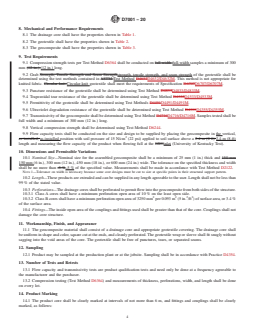
7.1 The geocomposite materials covered by this specifica-
tion shall have a nominal thickness of 25 mm (1 in.) and a
5. Ordering Information
nominal width of 150 mm, 300 mm, 450 mm, and 600 mm
5.1 When ordering material in accordance with this
(6 in., 12 in., 18 in., and 24 in.) wide. Product length shall be
specification, the following should be specified:
as agreed to by the customer and the manufacturer.
5.1.1 The product size (150 mm, 300 mm, 450 mm, or
7.2 The geocomposite products covered by this standard are
600 mm) (6 in., 12 in., 18 in., or 24 in.).
available in two distinctly different forms, an open core with a
5.1.2 The geocomposite class (Tables 2 and 3).
geotextile wrap that acts as part of the structure as well as a
5.1.3 The geotextile component class (Table 2).
filter, listed as Class A; and a fully enclosed core with a
5.1.4 Fittings required. Fittings may be required to couple
geotextile wrap that acts only as a filter, listed as Class B.
sections together and to provide outlets, typically transitioning
to round pipe.
8. Mechanical and Performance Requirements
8.1 The drainage core shall have the properties shown in
6. Materials and Manufacture
Table 1.
6.1 Basic Materials—These products are composites of two
8.2 The geotextile shall have the properties shown in Table
or more materials, typically a drainage core and a geotextile
2.
filter.
6.1.1 Core Materials—Compounds used in the manufacture
8.3 The geocomposite shall have the properties shown in
of the drainage core and fittings shall be polyethylene with a
Table 3.
minimum cell classification of 424420C as defined and de-
9. Test Requirements
scribed in Specification D3350. Compounds that have a higher
cell classification in one or more properties are acceptable,
9.1 CompressionstrengthtestsperTestMethodD6364shall
be conducted on full-width samples a minimum of 300 mm
(12 in.) long.
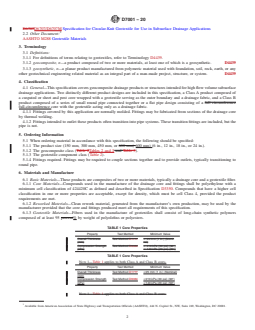
TABLE 1 Core Properties
9.2 Grab strength, tensile strength, and seam strength of the
geotextileshallbedeterminedusingthetestmethodscontained
NOTE 1—Table 1 applies to both Class A and Class B cores.
in Test Method D4632/D4632M. This method is not appropri-
Property Test Method Minimum Value
ate for knitted fabric. Circular-knit geotextile shall meet the
Overall Thickness Test Method D1777 $25 mm (1 in.) (Nominal)
requirements of Specification D6707/D6707M.
(mm)
Compression Strength Test Method D6364 $210 kPa (30 psi) (90°)
9.3 Punctureresistanceofthegeotextileshallbedetermined
(kPa) $140 kPa (20 psi) (50°)
using Test Method D4833/D4833M.
D7001−20
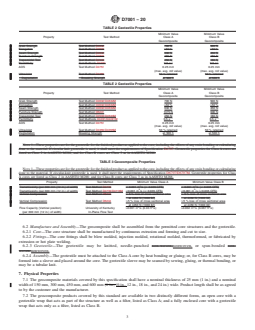
TABLE 2 Geotextile Properties
Minimum Value Minimum Value
Property Test Method Class A Class B
Geocomposite Geocomposite
Grab Strength Test Method D4632/D4632M 700 N 500 N
Elongation Test Method D4632/D4632M >50 % >50 %
Seam Strength Test Method D4632/D4632M 630 N 450 N
Puncture Strength Test Method D6241 1375 N 990 N
Trapezoidal Tear Test Method D4533/D4533M 250 N 180 N
–1 –1
Permittivity Test Methods D4491/D4491M 0.5 s 0.5 s
AOS Test Method D4751 0.25 mm (max. avg. roll value) 0.25 mm (max. avg. roll value)
U
...
This document is not an ASTM standard and is intended only to provide the user of an ASTM standard an indication of what changes have been made to the previous version. Because
it may not be technically possible to adequately depict all changes accurately, ASTM recommends that users consult prior editions as appropriate. In all cases only the current version
of the standard as published by ASTM is to be considered the official document.
Designation: D7001 − 06 (Reapproved 2011) D7001 − 20
Standard Specification for
Geocomposites for Pavement Edge Drains and Other High-
Flow Applications
This standard is issued under the fixed designation D7001; the number immediately following the designation indicates the year of
original adoption or, in the case of revision, the year of last revision. A number in parentheses indicates the year of last reapproval. A
superscript epsilon (´) indicates an editorial change since the last revision or reapproval.
1. Scope
1.1 This specification covers geocomposite drainage panels used in highway, turf, and other high volume high-volume
subsurface drainage applications. These products consist of a geotextile wrapped around a polymer core. These products are a
minimum of 25 mm (1 in.) thick and are available in 150 mm (6 in.), 300 mm (12 in.), 450 mm 150-mm (6 in.), 300-mm (12 in.),
450-mm (18 in.), and 600 mm 600-mm (24 in.) widths.
1.2 The requirements of this specification are intended to provide a subsurface drainage geocomposite suitable for drainage of
surface and subsurface water, sewerage, and leachates. Products produced in accordance with this specification and intended for
pavement drainage applications shall be installed in accordance with Practice D6088.
1.3 The values as stated in SI units are to be regarded as the standard. The values given in parentheses are for information only.
1.4 This standard does not purport to address all of the safety concerns, if any, associated with its use. It is the responsibility
of the user of this standard to establish appropriate safety, health, and environmental practices and determine the applicability of
regulatory limitations prior to use.
1.5 This international standard was developed in accordance with internationally recognized principles on standardization
established in the Decision on Principles for the Development of International Standards, Guides and Recommendations issued
by the World Trade Organization Technical Barriers to Trade (TBT) Committee.
2. Referenced Documents
2.1 ASTM Standards:
D1777 Test Method for Thickness of Textile Materials
D2122 Test Method for Determining Dimensions of Thermoplastic Pipe and Fittings
D3350 Specification for Polyethylene Plastics Pipe and Fittings Materials
D4354 Practice for Sampling of Geosynthetics and Rolled Erosion Control Products (RECPs) for Testing
D4355D4355/D4355M Test Method for Deterioration of Geotextiles by Exposure to Light, Moisture and Heat in a Xenon
Arc-Type Apparatus
D4439 Terminology for Geosynthetics
D4491D4491/D4491M Test Methods for Water Permeability of Geotextiles by Permittivity
D4533D4533/D4533M Test Method for Trapezoid Tearing Strength of Geotextiles
D4632D4632/D4632M Test Method for Grab Breaking Load and Elongation of Geotextiles
D4716D4716/D4716M Test Method for Determining the (In-plane) Flow Rate per Unit Width and Hydraulic Transmissivity of
a Geosynthetic Using a Constant Head
D4751 Test Methods for Determining Apparent Opening Size of a Geotextile
D4833D4833/D4833M Test Method for Index Puncture Resistance of Geomembranes and Related Products
D6088 Practice for Installation of Geocomposite Pavement Drains
D6241 Test Method for Static Puncture Strength of Geotextiles and Geotextile-Related Products Using a 50-mm Probe
D6244 Test Method for Vertical Compression of Geocomposite Pavement Panel Drains
D6364 Test Method for Determining Short-Term Compression Behavior of Geosynthetics
This specification is under the jurisdiction of ASTM Committee D35 on Geosynthetics and is the direct responsibility of Subcommittee D35.06 on Geosynthetic
Specifications.
Current edition approved Oct. 1, 2011Jan. 1, 2020. Published November 2011January 2020. Originally approved in 2004. Last previous edition approved in 20062011 as
D7001 – 06.D7001 – 06 (2011). DOI: 10.1520/D7001-06R11.10.1520/D7001-20.
For referenced ASTM standards, visit the ASTM website, www.astm.org, or contact ASTM Customer Service at service@astm.org. For Annual Book of ASTM Standards
volume information, refer to the standard’s Document Summary page on the ASTM website.
Copyright © ASTM International, 100 Barr Harbor Drive, PO Box C700, West Conshohocken, PA 19428-2959. United States
D7001 − 20
D6707D6707/D6707M Specification for Circular-Knit Geotextile for Use in Subsurface Drainage Applications
2.2 Other Document:
AASHTO M288 Geotextile Materials
3. Terminology
3.1 Definitions:
3.1.1 For definitions of terms relating to geotextiles, refer to Terminology D4439.
3.1.2 geocomposite, n—a product composed of two or more materials, at least one of which is a geosynthetic. D4439
3.1.3 geosynthetic, n—a planar product manufactured from polymeric material used with foundation, soil, rock, earth, or any
other geotechnical engineering related material as an integral part of a man-made project, structure, or system. D4439
4. Classification
4.1 General—This specification covers geocomposite drainage products or structures intended for high flow volume subsurface
drainage applications. Two distinctly different product designs are included in this specification, a Class A product composed of
a cuspated or sheet and post core wrapped with a geotextile serving as the outer boundary and a drainage fabric, and a Class B
product composed of a series of small round pipe connected together or a flat pipe design consisting of a full circumference
full-circumference core with the geotextile acting only as a drainage fabric.
4.1.1 Fittings covered by this application are normally molded. Fittings may be fabricated from sections of the drainage core
by thermal welding.
4.1.2 Fittings intended to outlet these products often transition into pipe systems. These transition fittings are included, but the
pipe is not.
5. Ordering Information
5.1 When ordering material in accordance with this specification, the following should be specified:
5.1.1 The product size (150 mm, 300 mm, 450 mm, or 600 mm) 600 mm) (6 in., 12 in., 18 in., or 24 in.).
5.1.2 The geocomposite class (Table 2Tables 2 and 3 and Table 3).
5.1.3 The geotextile component class (Table 2).
5.1.4 Fittings required. Fittings may be required to couple sections together and to provide outlets, typically transitioning to
round pipe.
6. Materials and Manufacture
6.1 Basic Materials—These products are composites of two or more materials, typically a drainage core and a geotextile filter.
6.1.1 Core Materials—Compounds used in the manufacture of the drainage core and fittings shall be polyethylene with a
minimum cell classification of 424420C as defined and described in Specification D3350. Compounds that have a higher cell
classification in one or more properties are acceptable, except for density, which must be cell Class 4, provided the product
requirements are met.
6.1.2 Reworked Materials—Clean rework material, generated from the manufacturer’s own production, may be used by the
manufacturer provided that the core and fittings produced meet all requirements of this specification.
6.1.3 Geotextile Materials—Fibers used in the manufacture of geotextiles shall consist of long-chain synthetic polymers
composed of at least 95 percent% by weight of polyolefins or polyesters.
TABLE 1 Core Properties
Property Test Method Minimum Value
Overall Thickness Test Method D1777 $ 25 mm (1 in.) (Nomi-
(mm) nal)
Compression Strength Test Method D6364 $ 210 kPa (30 psi) (90°)
(kPa) $ 140 kPa (20 psi) (50°)
TABLE 1 Core Properties
NOTE 1—Table 1 applies to both Class A and Class B cores.
Property Test Method Minimum Value
Overall Thickness Test Method D1777 $25 mm (1 in.) (Nominal)
(mm)
Compression Strength Test Method D6364 $210 kPa (30 psi) (90°)
(kPa) $140 kPa (20 psi) (50°)
NOTE 1—Table 1 applies to both Class A and Class B cores.
Available from American Association of State Highway and Transportation Officials (AASHTO), 444 N. Capitol St., NW, Suite 249, Washington, DC 20001.
D7001 − 20
TABLE 2 Geotextile Properties
Minimum Value Minimum Value
Property Test Method Class A Class B
Geocomposite Geocomposite
Grab Strength Test Method D4632 700 N 500 N
Elongation Test Method D4632 >50 % >50 %
Seam Strength Test Method D4632 630 N 450 N
Puncture Strength Test Method D4833 250 N 180 N
Trapezoidal Tear Test Method D4533 250 N 180 N
-1 -1
Permittivity Test Methods D4491 0.5 s 0.5 s
AOS Test Method D4751 0.25 mm 0.25 mm
(max. avg. roll value) (max. avg. roll value)
Ultraviolet Test Method D4355 50 % retained 50 % retained
Degradation Breaking Strength at 500 h at 500 h
TABLE 2 Geotextile Properties
Minimum Value Minimum Value
Property Test Method Class A Class B
Geocomposite Geocomposite
Grab Strength Test Method D4632/D4632M 700 N 500 N
Elongation Test Method D4632/D4632M >50 % >50 %
Seam Strength Test Method D4632/D4632M 630 N 450 N
Puncture Strength Test Method D6241 1375 N 990 N
Trapezoidal Tear Test Method D4533/D4533M 250 N 180 N
–1 –1
Permittivity Test Methods D4491/D4491M 0.5 s 0.5 s
AOS Test Method D4751 0.25 mm 0.25 mm
(max. avg. roll value) (max. avg. roll value)
Ultraviolet Test Method D4355/D4355M 50 % retained 50 % retained
Degradation Breaking Strength at 500 h at 500 h
NOTE 1—These properties are for the geotextile for the finished product as applied to the core, including the effects of any resin bonding or calendaring
done to the material. If circular knit geotextile is used, it shall meet the requirements of Specification D6707. Geotextile properties for Class A cores are
listed as Class 2 in AASHTO M288; and for Class B cores are Class 3 as in AASHTO M288.
TABLE 3 Geocomposite Properties
NOTE 1—These properties are for the geotextile for the finished product as applied to the core, including the effects of any resin bonding or calendaring
done to the material. If circular-knit geotextile is used, it shall meet the requirements of Specification D6707/D6707M. Geotextile properties for Class
A cores are listed as Class 2 in AASHTO M288; and for Class B cores are Class 3 as in AASHTO M288.
Property Test Method Minimum Value Class A Minimum Value Class B
3 3
Transmissivity (per 300 mm (12 in.) of width) Test Method D4716 $ 0.001 m /s ($ 0.035 CFS) $ 0.001 m /s ($ 0.035 CFS)
3 3
Transmissivity (per 300 mm (12 in.) of width) Test Method D4716/D4716M $0.001 m /s ($ 0.035 CFS) $0.001 m /s ($0.035 CFS)
Vertical Compression Test Method D6244 # 5 % loss of cross sectional area # 5 % loss of cross sectional area
at 4450 N (1000 lbf) at 4450 N (1000 lbf)
Vertical Compression Test Method D6244 #5 % loss of cross sectional area #5 % loss of cross sectional area
at 4450 N (1000 lbf) at 4450 N (1000 lbf)
3 3 3 3
Flow Capacity (Vertical position) University of Kentucky >0.001 m /s (0.03 ft /s) >0.002 m /s (0.067 ft /s)
(per 300 mm (12 in.) of width) In-Plane Flow Test
6.2 Manufacture and Assembly—The geocomposite shall be assembled from the permitted core structures and the geotextile.
6.2.1 Core—The core structure shall be manufactured by continuous extrusion and forming and cut to size.
6.2.2 Fittings—The core fittings shall be blow molded, injection molded, rotational molded, thermoformed, or fabricated
...