

ASTM D6244-06(2018)
(Test Method)Standard Test Method for Vertical Compression of Geocomposite Pavement Panel Drains
General Information
- Abstract
SIGNIFICANCE AND USE
5.1 The vertical compression test for geocomposite pavement panel drains is intended to simulate vertical, horizontal, and eccentric loading resulting from an applied vertical load. The results of the analyses, including vertical strain of the panels and core area change, may be used as an index test. The vertical compression test may be used to evaluate core area change for a given load.
5.2 The vertical compression test may be used to evaluate percent vertical strain for a given load.
5.3 This test method may be modified to evaluate core area change and vertical strain under various backfill conditions.
SCOPE
1.1 This test method covers vertical strain and core area change of geocomposite pavement drains, such as those included in Specification D7001, under vertical compression.
1.2 The values as stated in SI units are to be regarded as the standard. The values given in parentheses are for information only.
1.3 This standard does not purport to address all of the safety concerns, if any, associated with its use. It is the responsibility of the user of this standard to establish appropriate safety, health, and environmental practices and determine the applicability of regulatory limitations prior to use.
1.4 This international standard was developed in accordance with internationally recognized principles on standardization established in the Decision on Principles for the Development of International Standards, Guides and Recommendations issued by the World Trade Organization Technical Barriers to Trade (TBT) Committee.
- Status
- Published
- Publication Date
- 31-Jan-2018
- Technical Committee
- D35 - Geosynthetics
- Drafting Committee
- D35.01 - Mechanical Properties
Overview
ASTM D6244-06(2018): Standard Test Method for Vertical Compression of Geocomposite Pavement Panel Drains is an internationally recognized standard developed by ASTM International. It provides guidelines for testing the vertical strain and core area change of geocomposite pavement drains under vertical compression. This test method simulates load conditions such as vertical, horizontal, and eccentric forces that pavement drains experience during service. The resulting data is vital for evaluating the mechanical performance and durability of geocomposite materials used in civil engineering projects, particularly for subsurface drainage in pavements.
Key Topics
- Geocomposite Pavement Panel Drains: Engineered products combining geotextiles with a plastic core, commonly used to enhance drainage efficiency under roads and pavements.
- Vertical Compression Testing: Assessment of geocomposite drains for vertical strain and change in core area when subjected to compressive loads. Results serve as an index to compare products and predict in-field performance.
- Load Simulation: The procedure replicates realistic loading conditions that geocomposites face once installed beneath road surfaces, including varying backfill conditions.
- Performance Metrics: Measurements include percent vertical strain, change in height, and core area reduction at various stress increments.
- Index Test Utility: The standard test method provides a consistent basis for comparing product performance and verifying compliance with technical specifications like those in ASTM D7001.
- Laboratory Practice: Covers specimen preparation, conditioning, and the use of specialized compression chambers and measuring equipment to ensure reliable, repeatable results.
Applications
ASTM D6244 is essential in several civil engineering applications where the performance of geocomposite panel drains affects project quality and longevity:
- Quality Control in Manufacturing: Ensures geocomposite panel drains meet mechanical property standards before shipment and installation.
- Design and Specification: Assists engineers in selecting suitable products by providing comparative data on core stability and deformation under load.
- Construction Inspection: Serves as a reference for verifying installed products match specified requirements, reducing the risk of premature pavement failure due to inadequate drainage.
- Research and Development: Facilitates development of new geosynthetic designs by providing standardized test results to guide innovation.
- Performance Monitoring: Informs maintenance and replacement schedules by allowing stakeholders to anticipate product lifespan based on laboratory test outcomes.
Related Standards
For comprehensive implementation and understanding, the following ASTM standards are frequently referenced alongside ASTM D6244:
- ASTM D7001: Specification for Geocomposites for Pavement Edge Drains and Other High-Flow Applications
- ASTM D1566: Terminology Relating to Rubber
- ASTM D4354: Practice for Sampling of Geosynthetics and Rolled Erosion Control Products (RECPs) for Testing
- ASTM D4439: Terminology for Geosynthetics
Practical Value
Implementing ASTM D6244-06(2018) helps ensure that geocomposite pavement panel drains can withstand real-world stress environments, maintain adequate core area for drainage flow, and provide reliable long-term service. By following this standard, manufacturers, engineers, and quality assurance personnel enhance infrastructure performance, minimize risks associated with inadequate drainage, and meet international expectations for standardization and regulatory compliance.
Relations
- Effective Date
- 01-Feb-2018
- Effective Date
- 01-Feb-2024
- Effective Date
- 01-May-2020
- Effective Date
- 15-Apr-2018
- Effective Date
- 01-Aug-2017
- Effective Date
- 01-Sep-2015
- Effective Date
- 01-Jul-2015
- Effective Date
- 01-Mar-2014
- Effective Date
- 01-Jul-2012
- Effective Date
- 01-Oct-2011
- Effective Date
- 01-Oct-2011
- Effective Date
- 15-Jan-2009
- Effective Date
- 01-Jan-2006
- Effective Date
- 01-Nov-2004
- Effective Date
- 01-Jun-2004
Get Certified
Connect with accredited certification bodies for this standard

Institut za varilstvo d.o.o. (Welding Institute)
Slovenia's leading welding institute since 1952. ISO 3834, EN 1090, pressure equipment certification, NDT personnel, welder qualification. Only IIW Au
Zavod za gradbeništvo Slovenije (ZAG) - Inšpekcija
ZAG inspection body for construction products, structures, and materials.
Sponsored listings
Frequently Asked Questions
ASTM D6244-06(2018) is a standard published by ASTM International. Its full title is "Standard Test Method for Vertical Compression of Geocomposite Pavement Panel Drains". This standard covers: SIGNIFICANCE AND USE 5.1 The vertical compression test for geocomposite pavement panel drains is intended to simulate vertical, horizontal, and eccentric loading resulting from an applied vertical load. The results of the analyses, including vertical strain of the panels and core area change, may be used as an index test. The vertical compression test may be used to evaluate core area change for a given load. 5.2 The vertical compression test may be used to evaluate percent vertical strain for a given load. 5.3 This test method may be modified to evaluate core area change and vertical strain under various backfill conditions. SCOPE 1.1 This test method covers vertical strain and core area change of geocomposite pavement drains, such as those included in Specification D7001, under vertical compression. 1.2 The values as stated in SI units are to be regarded as the standard. The values given in parentheses are for information only. 1.3 This standard does not purport to address all of the safety concerns, if any, associated with its use. It is the responsibility of the user of this standard to establish appropriate safety, health, and environmental practices and determine the applicability of regulatory limitations prior to use. 1.4 This international standard was developed in accordance with internationally recognized principles on standardization established in the Decision on Principles for the Development of International Standards, Guides and Recommendations issued by the World Trade Organization Technical Barriers to Trade (TBT) Committee.
SIGNIFICANCE AND USE 5.1 The vertical compression test for geocomposite pavement panel drains is intended to simulate vertical, horizontal, and eccentric loading resulting from an applied vertical load. The results of the analyses, including vertical strain of the panels and core area change, may be used as an index test. The vertical compression test may be used to evaluate core area change for a given load. 5.2 The vertical compression test may be used to evaluate percent vertical strain for a given load. 5.3 This test method may be modified to evaluate core area change and vertical strain under various backfill conditions. SCOPE 1.1 This test method covers vertical strain and core area change of geocomposite pavement drains, such as those included in Specification D7001, under vertical compression. 1.2 The values as stated in SI units are to be regarded as the standard. The values given in parentheses are for information only. 1.3 This standard does not purport to address all of the safety concerns, if any, associated with its use. It is the responsibility of the user of this standard to establish appropriate safety, health, and environmental practices and determine the applicability of regulatory limitations prior to use. 1.4 This international standard was developed in accordance with internationally recognized principles on standardization established in the Decision on Principles for the Development of International Standards, Guides and Recommendations issued by the World Trade Organization Technical Barriers to Trade (TBT) Committee.
ASTM D6244-06(2018) is classified under the following ICS (International Classification for Standards) categories: 23.040.50 - Pipes and fittings of other materials; 93.080.20 - Road construction materials. The ICS classification helps identify the subject area and facilitates finding related standards.
ASTM D6244-06(2018) has the following relationships with other standards: It is inter standard links to ASTM D6244-06(2011), ASTM D4439-24, ASTM D4354-12(2020), ASTM D4439-18, ASTM D4439-17, ASTM D4439-15a, ASTM D4439-15, ASTM D4439-14, ASTM D4354-12, ASTM D4439-11, ASTM D7001-06(2011), ASTM D4354-99(2009), ASTM D7001-06, ASTM D4354-99(2004), ASTM D4439-04. Understanding these relationships helps ensure you are using the most current and applicable version of the standard.
ASTM D6244-06(2018) is available in PDF format for immediate download after purchase. The document can be added to your cart and obtained through the secure checkout process. Digital delivery ensures instant access to the complete standard document.
Standards Content (Sample)
This international standard was developed in accordance with internationally recognized principles on standardization established in the Decision on Principles for the
Development of International Standards, Guides and Recommendations issued by the World Trade Organization Technical Barriers to Trade (TBT) Committee.
Designation: D6244 − 06 (Reapproved 2018)
Standard Test Method for
Vertical Compression of Geocomposite Pavement Panel
Drains
This standard is issued under the fixed designation D6244; the number immediately following the designation indicates the year of
original adoption or, in the case of revision, the year of last revision. A number in parentheses indicates the year of last reapproval. A
superscript epsilon (´) indicates an editorial change since the last revision or reapproval.
1. Scope 3.1.2 compressive strain, n—the ratio of compressive defor-
mation to the gage length of the test specimen, expressed as a
1.1 This test method covers vertical strain and core area
dimensionless ratio (new).
change of geocomposite pavement drains, such as those
3.1.3 gage length, n—the known distance between two
included in Specification D7001, under vertical compression.
benchmarks (see Terminology D1566).
1.2 The values as stated in SI units are to be regarded as the
3.1.3.1 Discussion—In compression testing of
standard. The values given in parentheses are for information
geosynthetics, gage length is the measured thickness of the test
only.
specimen under specified compressional force, expressed in
1.3 This standard does not purport to address all of the
units of length.
safety concerns, if any, associated with its use. It is the
3.1.4 geosynthetic, n—a planar product manufactured from
responsibility of the user of this standard to establish appro-
polymeric material used with foundation, soil, rock, earth, or
priate safety, health, and environmental practices and deter-
any other geotechnical engineering-related materials as an
mine the applicability of regulatory limitations prior to use.
integral part of a manmade project, structure, or system (see
1.4 This international standard was developed in accor-
Terminology D4439).
dance with internationally recognized principles on standard-
3.1.5 index test, n—a test procedure which may contain a
ization established in the Decision on Principles for the
known bias but which may be used to order a set of specimens
Development of International Standards, Guides and Recom-
with respect to the property of interest (see Terminology
mendations issued by the World Trade Organization Technical
D4439).
Barriers to Trade (TBT) Committee.
4. Summary of Test Method
2. Referenced Documents
4.1 Geocomposite pavement edge drains are placed into a
2.1 ASTM Standards:
304.8-mm (12-in.) long, 106.7-mm (4.20-in.) wide, and
D1566 Terminology Relating to Rubber
610-mm (24-in.) tall glass and aluminum compression cham-
D4354 Practice for Sampling of Geosynthetics and Rolled
ber. The geocomposites are placed against the wall of the
Erosion Control Products (RECPs) for Testing
chamber. The remainder of the chamber is then backfilled with
D4439 Terminology for Geosynthetics
a specified sand. A vertical load is applied at a constant rate.
D7001 Specification for Geocomposites for Pavement Edge
The vertical strains of the panels and change in core area and
Drains and Other High-Flow Applications
height is recorded at 1112.5-N (250-lb) increments. The test is
3. Terminology
discontinued at 4450 N (1000 lb) or 156.5 kPa (22.7 psi). The
change in vertical strain, core height, and core area is deter-
3.1 Definitions of Terms Specific to This Standard:
mined.
3.1.1 compressive deformation, n—the decrease in gage
length produced in the test specimen by a compressive load,
5. Significance and Use
expressed in units of length (new).
5.1 The vertical compression test for geocomposite pave-
ment panel drains is intended to simulate vertical, horizontal,
This test method is under the jurisdiction of ASTM Committee D35 on
and eccentric loading resulting from an applied vertical load.
Geosynthetics and is the direct responsibility of Subcommittee D35.01 on Mechani-
cal Properties.
The results of the analyses, including vertical strain of the
Current edition approved Feb. 1, 2018. Published February 2018. Originally
panels and core area change, may be used as an index test. The
approved in 1998. Last previous edition approved in 2011 as D6244 – 06 (2011).
vertical compression test may be used to evaluate core area
DOI: 10.1520/D6244-06R18.
For referenced ASTM standards, visit the ASTM website, www.astm.org, or change for a given load.
contact ASTM Customer Service at service@astm.org. For Annual Book of ASTM
5.2 The vertical compression test may be used to evaluate
Standards volume information, refer to the standard’s Document Summary page on
the ASTM website. percent vertical strain for a given load.
Copyright © ASTM International, 100 Barr Harbor Drive, PO Box C700, West Conshohocken, PA 19428-2959. United States
D6244 − 06 (2018)
5.3 This test method may be modified to evaluate core area machine must be capable of loading at a rate of 445 N
change and vertical strain under various backfill conditions. (100 lb)⁄min, and maintaining a constant load for an indefinite
period.
6. Apparatus
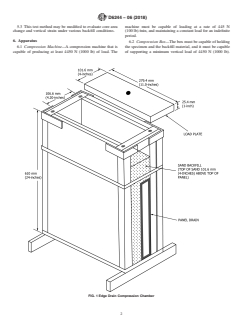
6.2 Compression Box—The box must be capable of holding
6.1 Compression Machine—A compression machine that is the specimen and the backfill material, and it must be capable
capable of producing at least 4450 N (1000 lb) of load. The of supporting a minimum vertical load of 4450 N (1000 lb).
FIG. 1 Edge Drain Compression Chamber
D6244 − 06 (2018)
TABLE 1 Backfill Gradation
The design of the box and the loading plate shall conform to
A
Fig. 1. The box shall be rigid enough to resist deformation. Sieve Size Percent Passing
9.5mm( ⁄8 in.) 100
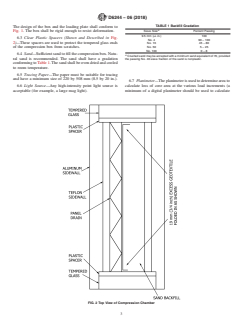
6.3 Clear Plastic Spacers (Shown and Described in Fig.
No. 4 90 – 100
2)—These spacers are used to protect the tempered glass ends
No. 16 45 – 80
No. 50 5 – 25
of the compression box from scratches.
No. 100 0 – 8
6.4 Sand—Sufficient sand to fill the compression box. Natu-
A
Crushed sand may be accepted with a minimum sand equivalent of 70, provided
ral sand is recommended. The sand shall have a gradation
the passing No. 40 sieve fraction of the sand is nonplastic.
conformingtoTable1.Thesandshallbeovendriedandcooled
to room temperature.
6.5 Tracing Paper—The paper must be suitable for tracing
and have a minimum size of 220 by 508 mm (8.5 by 20 in.).
6.7 Planimeter—Theplanimeterisusedtodetermineareato
6.6 Light Source—Any high-intensity point light source is calculate loss of core area at the various load increments (a
acceptable (for example, a large mag light). minimum of a digital planimeter should be used to calculate
FIG. 2 Top View of Compression Chamber
D6244 − 06 (2018)
core area). If computer digitizing equipment or scanning shall be oriented in the chamber in the same manner as
equipment is available, this may be used in lieu of the recommended by the manufacturer to be placed in the field,
planimeter. with the inside walls of the chamber being considered, first, the
pavement side of the trench, and second, the shoulder side of
6.8 Scale (Length Measuring Device)—A minimum range
thetrench.Thesampleshallbeplacedintothechamberinsuch
of 450 mm (18 in.), and an accuracy of 1 mm ( ⁄16 in.).
a way that the maximum core area of the panel is visible
through the ends of the box. If necessary, the samples shall be
7. Sampling
snugged into place with thin panes of plexiglass; 3.2 mm
7.1 Lot Sample—Divide the product into lots and take the
(0.125 in.) and 6.4 mm (0.25 in.) are recommended, to ensure
lot sample as directed in Practice D4354.
proper tightness on the walls of the chamber.
7.2 Laboratory Sample—Consider the units in the lot
NOTE 5—The panes shall not be forced into place. This could cause
sample as the units in the laboratory sample for the lot to be
compression or misalignment in the sample.
tested.Takeforalaboratorysampleasampleextendingthefull
9.3 The 19-mm ( ⁄4-in.) excess geotextile at the ends of the
width of the geocomposite edge drain, of sufficient length so
core shall be lapped as shown in Fig. 2. This helps to prevent
that the requirements in 7.3 are met.
sand from flowing between the end of the core and the glass
NOTE 1—Thi
...