

ASTM D1777-96(2019)
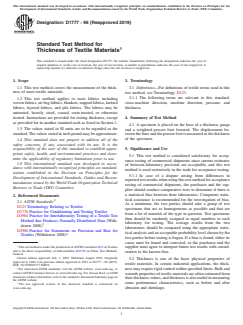
(Test Method)Standard Test Method for Thickness of Textile Materials
General Information
- Abstract
SIGNIFICANCE AND USE
5.1 This test method is considered satisfactory for acceptance testing of commercial shipments since current estimates of between-laboratory precision are acceptable, and this test method is used extensively in the trade for acceptance testing.
5.1.1 In case of a dispute arising from differences in reported test results when using this test method for acceptance testing of commercial shipments, the purchaser and the supplier should conduct comparative tests to determine if there is a statistical bias between their laboratories. Competent statistical assistance is recommended for the investigation of bias. As a minimum, the two parties should take a group of test specimens that are as homogeneous as possible and that are from a lot of material of the type in question. Test specimens then should be randomly assigned in equal numbers to each laboratory for testing. The average results from the two laboratories should be compared using the appropriate statistical analysis and an acceptable probability level chosen by the two parties before testing is begun. If a bias is found, either its cause must be found and corrected, or the purchaser and the supplier must agree to interpret future test results with consideration to the known bias.
5.2 Thickness is one of the basic physical properties of textile materials. In certain industrial applications, the thickness may require rigid control within specified limits. Bulk and warmth properties of textile materials are often estimated from their thickness values, and thickness is also useful in measuring some performance characteristics, such as before and after abrasion and shrinkage.
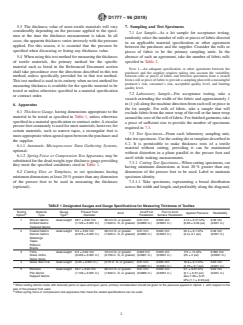
5.3 The thickness value of most textile materials will vary considerably depending on the pressure applied to the specimen at the time the thickness measurement is taken. In all cases, the apparent thickness varies inversely with the pressure applied. For this reason, it is essential that the pressure be specified when discussing or listi...
SCOPE
1.1 This test method covers the measurement of the thickness of most textile materials.
1.2 This test method applies to most fabrics including woven fabrics, air bag fabrics, blankets, napped fabrics, knitted fabrics, layered fabrics, and pile fabrics. The fabrics may be untreated, heavily sized, coated, resin-treated, or otherwise treated. Instructions are provided for testing thickness, except as provided for in another standard such as listed in Section 2.
1.3 The values stated in SI units are to be regarded as the standard. The values stated in inch-pound may be approximate.
1.4 This standard does not purport to address all of the safety concerns, if any, associated with its use. It is the responsibility of the user of this standard to establish appropriate safety, health, and environmental practices and determine the applicability of regulatory limitations prior to use.
1.5 This international standard was developed in accordance with internationally recognized principles on standardization established in the Decision on Principles for the Development of International Standards, Guides and Recommendations issued by the World Trade Organization Technical Barriers to Trade (TBT) Committee.
- Status
- Published
- Publication Date
- 30-Jun-2019
- Technical Committee
- D13 - Textiles
- Drafting Committee
- D13.59 - Fabric Physical Test Methods A
Overview
ASTM D1777-96(2019), Standard Test Method for Thickness of Textile Materials, is an internationally recognized method for measuring the thickness of a wide range of textile materials. Developed by ASTM International, this standard is widely adopted for quality control, acceptance testing, and performance assessment of textile products. The method applies to various fabrics, including woven, knitted, coated, and pile fabrics, among others, whether untreated or treated.
This test method ensures consistent, precise measurement of textile thickness, which is crucial for manufacturers, suppliers, and purchasers across the textile industry. The procedure accounts for various fabric types and conditions under standardized testing atmospheres, supporting reliable comparison of test results between laboratories.
Key Topics
Significance of Thickness Measurement
- Thickness is a fundamental physical property of textiles, impacting product bulk, warmth, and other performance characteristics.
- In certain applications, precise thickness control within specified limits is required by industry stakeholders.
Standardized Testing Procedure
- Test specimens are conditioned to standard atmospheric conditions before measurement.
- A thickness gauge with a specified presser foot and applied pressure measures the displacement caused by the fabric's thickness.
Precision and Reliability
- The test method is considered satisfactory for acceptance testing of commercial shipments due to its demonstrated between-laboratory precision.
- Procedures are recommended for resolving discrepancies in test results, including comparative testing and statistical analysis.
Sampling and Bias Prevention
- Detailed sampling guidelines help ensure that test results represent the overall material lot.
- Minimum sample sizes, specimen preparation instructions, and random assignment reduce the risk of bias and increase data reliability.
Pressure Specification
- Apparent thickness varies inversely with pressure; therefore, the test method requires that the applied pressure always be specified when reporting results.
Applications
Acceptance Testing in Textile Trade
- Used extensively to verify product compliance upon receipt and shipment, ensuring that materials meet contract or specification requirements.
Quality Control in Manufacturing
- Monitors consistency during textile production, enabling early detection of process deviations or material defects.
Product Development and Research
- Supports the design of new textile materials where physical thickness directly influences performance characteristics such as insulation, wear resistance, and comfort.
Evaluation of Treated and Coated Fabrics
- Applies to textiles with a wide range of treatments, including coatings, finishes, and resin applications, helping assess the impact of such processes on thickness.
Performance Testing
- Thickness measurements are also relevant before and after performance tests such as abrasion or laundering to assess dimensional stability.
Related Standards
ASTM D123 – Terminology Relating to Textiles
- Provides definitions for terms used in the measurement of textile properties.
ASTM D1776 – Practice for Conditioning and Testing Textiles
- Specifies procedures for bringing textiles to moisture equilibrium before testing.
Other Test Methods
- Related standards may exist for specific textile types or for alternative thickness measurement methods. The referenced method takes precedence unless otherwise specified.
Practical Value
Adhering to ASTM D1777-96(2019) for textile thickness measurement ensures standardized, reproducible, and defendable results. Its wide acceptance by industry, clarity in sampling and testing procedure, and adaptability to a variety of textile forms make it an essential tool for manufacturers, suppliers, and laboratories seeking reliable fabric thickness data. This helps drive informed decision-making, quality assurance, and strengthens trust within the textile supply chain.
Keywords: textile thickness, ASTM D1777, fabric testing, textile material testing, textile standards, thickness measurement, quality control in textiles
Relations
- Effective Date
- 01-Jul-2019
- Effective Date
- 01-Mar-2017
- Effective Date
- 15-Sep-2015
- Effective Date
- 01-Sep-2015
- Effective Date
- 01-Apr-2015
- Effective Date
- 15-Jun-2013
- Effective Date
- 15-Jun-2013
- Effective Date
- 15-May-2013
- Effective Date
- 01-Feb-2012
- Effective Date
- 01-Feb-2012
- Effective Date
- 15-Jan-2009
- Effective Date
- 15-Jan-2009
- Effective Date
- 15-Jan-2009
- Effective Date
- 01-Aug-2008
- Effective Date
- 01-Aug-2008
Get Certified
Connect with accredited certification bodies for this standard

Control Union Certifications
Global certification for agriculture and sustainability.

Hohenstein Institut
Textile testing and certification.

Bureau Veritas Bangladesh
Bureau Veritas certification services in Bangladesh.
Sponsored listings
Frequently Asked Questions
ASTM D1777-96(2019) is a standard published by ASTM International. Its full title is "Standard Test Method for Thickness of Textile Materials". This standard covers: SIGNIFICANCE AND USE 5.1 This test method is considered satisfactory for acceptance testing of commercial shipments since current estimates of between-laboratory precision are acceptable, and this test method is used extensively in the trade for acceptance testing. 5.1.1 In case of a dispute arising from differences in reported test results when using this test method for acceptance testing of commercial shipments, the purchaser and the supplier should conduct comparative tests to determine if there is a statistical bias between their laboratories. Competent statistical assistance is recommended for the investigation of bias. As a minimum, the two parties should take a group of test specimens that are as homogeneous as possible and that are from a lot of material of the type in question. Test specimens then should be randomly assigned in equal numbers to each laboratory for testing. The average results from the two laboratories should be compared using the appropriate statistical analysis and an acceptable probability level chosen by the two parties before testing is begun. If a bias is found, either its cause must be found and corrected, or the purchaser and the supplier must agree to interpret future test results with consideration to the known bias. 5.2 Thickness is one of the basic physical properties of textile materials. In certain industrial applications, the thickness may require rigid control within specified limits. Bulk and warmth properties of textile materials are often estimated from their thickness values, and thickness is also useful in measuring some performance characteristics, such as before and after abrasion and shrinkage. 5.3 The thickness value of most textile materials will vary considerably depending on the pressure applied to the specimen at the time the thickness measurement is taken. In all cases, the apparent thickness varies inversely with the pressure applied. For this reason, it is essential that the pressure be specified when discussing or listi... SCOPE 1.1 This test method covers the measurement of the thickness of most textile materials. 1.2 This test method applies to most fabrics including woven fabrics, air bag fabrics, blankets, napped fabrics, knitted fabrics, layered fabrics, and pile fabrics. The fabrics may be untreated, heavily sized, coated, resin-treated, or otherwise treated. Instructions are provided for testing thickness, except as provided for in another standard such as listed in Section 2. 1.3 The values stated in SI units are to be regarded as the standard. The values stated in inch-pound may be approximate. 1.4 This standard does not purport to address all of the safety concerns, if any, associated with its use. It is the responsibility of the user of this standard to establish appropriate safety, health, and environmental practices and determine the applicability of regulatory limitations prior to use. 1.5 This international standard was developed in accordance with internationally recognized principles on standardization established in the Decision on Principles for the Development of International Standards, Guides and Recommendations issued by the World Trade Organization Technical Barriers to Trade (TBT) Committee.
SIGNIFICANCE AND USE 5.1 This test method is considered satisfactory for acceptance testing of commercial shipments since current estimates of between-laboratory precision are acceptable, and this test method is used extensively in the trade for acceptance testing. 5.1.1 In case of a dispute arising from differences in reported test results when using this test method for acceptance testing of commercial shipments, the purchaser and the supplier should conduct comparative tests to determine if there is a statistical bias between their laboratories. Competent statistical assistance is recommended for the investigation of bias. As a minimum, the two parties should take a group of test specimens that are as homogeneous as possible and that are from a lot of material of the type in question. Test specimens then should be randomly assigned in equal numbers to each laboratory for testing. The average results from the two laboratories should be compared using the appropriate statistical analysis and an acceptable probability level chosen by the two parties before testing is begun. If a bias is found, either its cause must be found and corrected, or the purchaser and the supplier must agree to interpret future test results with consideration to the known bias. 5.2 Thickness is one of the basic physical properties of textile materials. In certain industrial applications, the thickness may require rigid control within specified limits. Bulk and warmth properties of textile materials are often estimated from their thickness values, and thickness is also useful in measuring some performance characteristics, such as before and after abrasion and shrinkage. 5.3 The thickness value of most textile materials will vary considerably depending on the pressure applied to the specimen at the time the thickness measurement is taken. In all cases, the apparent thickness varies inversely with the pressure applied. For this reason, it is essential that the pressure be specified when discussing or listi... SCOPE 1.1 This test method covers the measurement of the thickness of most textile materials. 1.2 This test method applies to most fabrics including woven fabrics, air bag fabrics, blankets, napped fabrics, knitted fabrics, layered fabrics, and pile fabrics. The fabrics may be untreated, heavily sized, coated, resin-treated, or otherwise treated. Instructions are provided for testing thickness, except as provided for in another standard such as listed in Section 2. 1.3 The values stated in SI units are to be regarded as the standard. The values stated in inch-pound may be approximate. 1.4 This standard does not purport to address all of the safety concerns, if any, associated with its use. It is the responsibility of the user of this standard to establish appropriate safety, health, and environmental practices and determine the applicability of regulatory limitations prior to use. 1.5 This international standard was developed in accordance with internationally recognized principles on standardization established in the Decision on Principles for the Development of International Standards, Guides and Recommendations issued by the World Trade Organization Technical Barriers to Trade (TBT) Committee.
ASTM D1777-96(2019) is classified under the following ICS (International Classification for Standards) categories: 59.080.30 - Textile fabrics. The ICS classification helps identify the subject area and facilitates finding related standards.
ASTM D1777-96(2019) has the following relationships with other standards: It is inter standard links to ASTM D1777-96(2015), ASTM D123-17, ASTM D123-15b, ASTM D123-15a, ASTM D123-15, ASTM D123-13a, ASTM D123-13ae1, ASTM D123-13, ASTM D123-12e1, ASTM D123-12, ASTM D123-09e2, ASTM D123-09e1, ASTM D123-09, ASTM D1776-08e1, ASTM D1776-08. Understanding these relationships helps ensure you are using the most current and applicable version of the standard.
ASTM D1777-96(2019) is available in PDF format for immediate download after purchase. The document can be added to your cart and obtained through the secure checkout process. Digital delivery ensures instant access to the complete standard document.
Standards Content (Sample)
This international standard was developed in accordance with internationally recognized principles on standardization established in the Decision on Principles for the
Development of International Standards, Guides and Recommendations issued by the World Trade Organization Technical Barriers to Trade (TBT) Committee.
Designation:D1777 −96 (Reapproved 2019)
Standard Test Method for
Thickness of Textile Materials
This standard is issued under the fixed designation D1777; the number immediately following the designation indicates the year of
original adoption or, in the case of revision, the year of last revision. A number in parentheses indicates the year of last reapproval. A
superscript epsilon (´) indicates an editorial change since the last revision or reapproval.
1. Scope 3. Terminology
1.1 This test method covers the measurement of the thick-
3.1 Definitions—For definitions of textile terms used in this
ness of most textile materials.
test method, see Terminology D123.
1.2 This test method applies to most fabrics including 3.1.1 The following terms are relevant to this standard:
cross-machine direction, machine direction, pressure, and
wovenfabrics,airbagfabrics,blankets,nappedfabrics,knitted
fabrics, layered fabrics, and pile fabrics. The fabrics may be thickness.
untreated, heavily sized, coated, resin-treated, or otherwise
treated. Instructions are provided for testing thickness, except 4. Summary of Test Method
as provided for in another standard such as listed in Section 2.
4.1 A specimen is placed on the base of a thickness gauge
1.3 The values stated in SI units are to be regarded as the
and a weighted presser foot lowered. The displacement be-
standard.Thevaluesstatedininch-poundmaybeapproximate.
tweenthebaseandthepresserfootismeasuredasthethickness
of the specimen.
1.4 This standard does not purport to address all of the
safety concerns, if any, associated with its use. It is the
5. Significance and Use
responsibility of the user of this standard to establish appro-
priate safety, health, and environmental practices and deter-
5.1 This test method is considered satisfactory for accep-
mine the applicability of regulatory limitations prior to use.
tance testing of commercial shipments since current estimates
1.5 This international standard was developed in accor-
of between-laboratory precision are acceptable, and this test
dance with internationally recognized principles on standard-
method is used extensively in the trade for acceptance testing.
ization established in the Decision on Principles for the
5.1.1 In case of a dispute arising from differences in
Development of International Standards, Guides and Recom-
reported test results when using this test method for acceptance
mendations issued by the World Trade Organization Technical
testing of commercial shipments, the purchaser and the sup-
Barriers to Trade (TBT) Committee.
plier should conduct comparative tests to determine if there is
a statistical bias between their laboratories. Competent statis-
2. Referenced Documents
tical assistance is recommended for the investigation of bias.
2.1 ASTM Standards:
As a minimum, the two parties should take a group of test
D123 Terminology Relating to Textiles
specimens that are as homogeneous as possible and that are
D1776 Practice for Conditioning and Testing Textiles
from a lot of material of the type in question. Test specimens
D2904 Practice for Interlaboratory Testing of a Textile Test
then should be randomly assigned in equal numbers to each
Method that Produces Normally Distributed Data (With-
laboratory for testing. The average results from the two
drawn 2008)
laboratories should be compared using the appropriate statis-
D2906 Practice for Statements on Precision and Bias for
tical analysis and an acceptable probability level chosen by the
Textiles (Withdrawn 2008)
two parties before testing is begun. If a bias is found, either its
cause must be found and corrected, or the purchaser and the
This test method is under the jurisdiction ofASTM Committee D13 on Textiles
supplier must agree to interpret future test results with consid-
and is the direct responsibility of Subcommittee D13.59 on Fabric Test Methods,
eration to the known bias.
General.
Current edition approved July 1, 2019. Published August 2019. Originally
5.2 Thickness is one of the basic physical properties of
approved in 1960. Last previous edition approved in 2015 as D1777 – 96 (2015).
textile materials. In certain industrial applications, the thick-
DOI: 10.1520/D1777-96R19.
ness may require rigid control within specified limits. Bulk and
For referenced ASTM standards, visit the ASTM website, www.astm.org, or
contact ASTM Customer Service at service@astm.org. For Annual Book of ASTM
warmth properties of textile materials are often estimated from
Standards volume information, refer to the standard’s Document Summary page on
theirthicknessvalues,andthicknessisalsousefulinmeasuring
the ASTM website.
some performance characteristics, such as before and after
The last approved version of this historical standard is referenced on
www.astm.org. abrasion and shrinkage.
Copyright © ASTM International, 100 Barr Harbor Drive, PO Box C700, West Conshohocken, PA 19428-2959. United States
D1777−96 (2019)
5.3 The thickness value of most textile materials will vary 7. Sampling and Test Specimens
considerably depending on the pressure applied to the speci-
7.1 Lot Sample—As a lot sample for acceptance testing,
men at the time the thickness measurement is taken. In all
randomly select the number of rolls or pieces of fabric directed
cases, the apparent thickness varies inversely with the pressure
in an applicable material specification or other agreement
applied. For this reason, it is essential that the pressure be
between the purchaser and the supplier. Consider the rolls or
specified when discussing or listing any thickness value.
pieces of fabric to be the primary sampling units. In the
absence of such an agreement, take the number of fabric rolls
5.4 Whenusingthistestmethodformeasuringthethickness
specifed in Table 2.
of textile materials, the primary method for the specific
material such as listed in the Referenced Document section
NOTE 1—An adequate specification or other agreement between the
shall take precedence over the directions described in this test
purchaser and the supplier requires taking into account the variability
method, unless specifically provided for in that test method. between rolls or pieces of fabric and between specimens from a swatch
from a roll or piece of fabric to provide a sampling plan with a meaningful
This test method is used in its entirety when no test method for
producer’s risk, consumer’s risk, acceptable quality level, and limiting
measuring thickness is available for the specific material to be
quality level.
tested or unless otherwise specified in a material specification
7.2 Laboratory Sample—For acceptance testing, take a
or contract order.
swatch extending the width of the fabric and approximately 1
m (1 yd) along the machine direction from each roll or piece in
6. Apparatus
the lot sample. For rolls of fabric, take a sample that will
6.1 Thickness Gauge, having dimensions appropriate to the
exclude fabric from the outer wrap of the roll or the inner wrap
material to be tested as specified in Table 1, unless otherwise
aroundthecoreoftherolloffabric.Forfinishedgarments,take
specifiedinamaterialspecificationorcontractorder.Acircular
a piece of sufficient size to provide the number of specimens
presserfootcommonlyisusedformostmaterials;however,for
required in 7.3.
certain materials, such as narrow tapes, a rectangular foot is
7.3 Test Specimens—From each laboratory sampling unit,
moreappropriatewhenagreeduponbetweenthepurchaserand
taketenspecimens.Usethecuttingdieortemplatedescribedin
the supplier.
6.2. It is permissible to make thickness tests of a textile
6.1.1 Automatic Microprocessor Data Gathering Systems,
material without cutting, providing it can be maintained
optional.
without distortion in a plane parallel to the presser foot and
6.1.2 Spring Force or Compression Test Apparatus, may be
anvil while making measurements.
substituted for the dead-weight-type thickness gauge providing
7.3.1 Cutting Test Specimens—When cutting specimens, cut
they meet the specified conditions cited in Table 1.
having minimum dimensions at least 20 % greater than any
6.2 Cutting Dies or Templates, to cut specimens having dimension of the presser foot to be used. Label to maintain
minimum dimensions at least 20 % greater than any dimension specimen identity.
of the presser foot to be used in measuring the thickness 7.3.1.1 Take specimens, representing a broad distribution
(optional). across the width and length, and preferably along the diagonal,
TABLE 1 Designated Gauges and Gauge Specifications for Measuring Thickness of Textiles
Testing Material Gauge Presser Foot Anvil/Foot Foot to Anvil
Anvil Applied Pressure Readability
A B
Option Type Type Diameter Parallelism Surface Parallelism
1 Woven fabrics dead-weight 28.7 ± 0.02 mm 38 mm D, or greater 0.01 mm 0.002 mm 4.14 ± 0.21 kPa 0.02 mm
Knitted fabrics (1.129 ± 0.001 in.) (1.629 in. D, or greater) (0.0005 in.) (0.0001 in.) (0.60 ± 0.03 psi) (0.001 in.)
Textured fabrics
2 Coated fabrics dead-weight 9.5 ± 0.02 mm 38 mm D, or greater 0.01 mm 0.002 mm 23.4 ± 0.7 kPa 0.02 mm
Narrow fabrics (0.375 ± 0.001 in.) (1.629 in. D, or greater) (0.0005 in.) (0.0001 in.) (3.4± 0.1 psi) (0.001 in.)
Webbings
Tapes
Ribbons
Braids
3 Films dead-weight 6.3 ± 0.02 mm 19 mm D, or greater 0.002 mm 0.002 mm 172 ± 14 kPa 0.002 mm
Glass cloths (0.250 ± 0.001 in.) (0.750 in. D, or greater) (0.0001 in.) (0.0001 in.) (25±2psi) (0.0001 in.)
Glass tapes
4 Glass fiber mat dead-weight (2.25 ± 0.001 in.) (2.75 in. D, or greater) 0.01 mm 0.002 mm 18.9 ± 0.7 kPa 0.02 mm
(0.0005 in.) (0.0001 in.) (2.75 ± 0.1 psi) (0.001 in.)
5 Blankets dead-weight 28.7 ± 0.02 mm 38 mm D, or greater 0.01 mm 0.002 mm 0.7 ± 0.07 kPa 0.02 mm
Pile fabrics (1.129 ± 0.001 in.) (1.629 in. D, or greater) (0.0005 in.) (0.0001 in.) (0.1 ± 0.01 psi) (0.001 in.)
Napped fabrics also 7.58 ± 0.21
kPa (1.1 ± 0.03 psi)
A
When testing fabrics made with textured yarns or open-end spun yarns, primary consideration should be given to the pressure applied in Option 1, with respect to the
size of the presser foot used.
B
Other spring force or compression test apparatus that meet the stated specifications can be used.
D1777−96 (2019)
TABLE 2 Number of Rolls or Pieces of Fabric in the Lot Sample TABLE 3 Thickness of Fabrics, mils
Number of Rolls or Pieces Number of Rolls or Pie
...