

ASTM E3073-22
(Guide)Standard Guide for Development of Waste Management Plan for Construction, Deconstruction, or Demolition Projects
General Information
- Abstract
SIGNIFICANCE AND USE
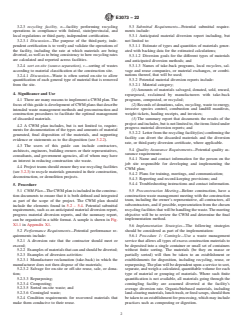
4.1 There are many reasons to implement a CWM plan. The focus of this guide is development of CWM plans that describe intended waste management methods and preconstruction and construction procedures to facilitate the optimal management of discarded materials.
4.2 A CWM plan includes, but is not limited to, requirements for documentation of the types and amounts of material generated, final disposition of the materials, and supporting evidence or statements as to the disposition (see 3.2.2).
4.3 The users of this guide can include contractors, architects, engineers, building owners or their representatives, consultants, and government agencies, all of whom may have an interest in reducing construction site waste.
4.4 Project teams should ensure they use recycling facilities (see 3.2.3) to recycle materials generated in their construction, deconstruction, or demolition projects.
SCOPE
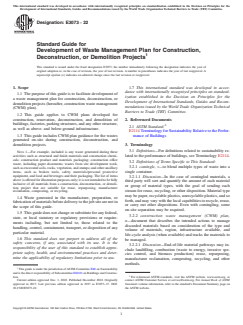
1.1 The purpose of this guide is to facilitate development of a waste management plan for construction, deconstruction, or demolition projects (hereafter, construction waste management (CWM) plan).
1.2 This guide applies to CWM plans developed for construction, renovation, deconstruction, and demolition of buildings, factories, parking structures, and any other structure, as well as above- and below-ground infrastructure.
1.3 This guide includes CWM plan guidance for the wastes generated on-site during construction, deconstruction, and demolition projects.
Note 1: For example, included is any waste generated during these activities such as structural and finish materials and construction chemicals; construction product and materials packaging; construction office waste, including paper documents; wastes from site development work, such as excavated soils, rocks, vegetation, and stumps; and other ancillary items, such as broken tools, safety materials/personal protective equipment, and food and beverages and their packaging. The list of items above is offered for illustration purposes only; it is not intended to be fully inclusive of all materials from a construction, deconstruction, or demolition project that are suitable for reuse, repurposing, manufacturer reclamation, composting, or recycling.
1.4 Waste generated in the manufacture, preparation, or fabrication of materials before delivery to the job site are not in the scope of this guide.
1.5 This guide does not change or substitute for any federal, state, or local statutory or regulatory provisions or requirements including, but not limited to, those related to the handling, control, containment, transport, or disposition of any particular material.
1.6 This standard does not purport to address all of the safety concerns, if any, associated with its use. It is the responsibility of the user of this standard to establish appropriate safety, health, and environmental practices and determine the applicability of regulatory limitations prior to use.
1.7 This international standard was developed in accordance with internationally recognized principles on standardization established in the Decision on Principles for the Development of International Standards, Guides and Recommendations issued by the World Trade Organization Technical Barriers to Trade (TBT) Committee.
- Status
- Published
- Publication Date
- 30-Nov-2022
- Technical Committee
- E60 - Sustainability
- Drafting Committee
- E60.01 - Buildings and Construction
Buy Documents
ASTM E3073-22 - Standard Guide for Development of Waste Management Plan for Construction, Deconstruction, or Demolition Projects
REDLINE ASTM E3073-22 - Standard Guide for Development of Waste Management Plan for Construction, Deconstruction, or Demolition Projects
Overview
ASTM E3073-22: Standard Guide for Development of Waste Management Plan for Construction, Deconstruction, or Demolition Projects provides comprehensive guidance aimed at developing effective construction waste management (CWM) plans. Published by ASTM International, this standard addresses the planning, implementation, and documentation methods necessary for the responsible management of waste generated during construction, renovation, deconstruction, and demolition activities.
The standard helps stakeholders - including contractors, architects, engineers, building owners, consultants, and governmental agencies - reduce waste, improve resource efficiency, and promote sustainable practices. It emphasizes documentation, recycling, and end-of-life material pathways, ensuring both environmental responsibility and compliance with relevant regulations.
Key Topics
- Scope of CWM Plans: The guide applies to the development of waste management plans for any type of built structure, including buildings, factories, parking structures, and both above- and below-ground infrastructure.
- Documentation Requirements: A CWM plan should clearly outline the types and amounts of waste generated, final disposition of materials, and supporting evidence such as receipts or diversion certificates.
- Material Diversion Methods: Encourages disposal alternatives such as recycling, reuse, repurposing, manufacturer reclamation, and composting.
- Waste Sorting Procedures:
- Comingle: Allows mixed waste types in a single container for off-site sorting and disposition.
- On-site Sorting: Waste is separated by material type at the site to facilitate quantification and directed recycling or reuse.
- Performance and Quality Assurance: The standard outlines expected diversion rates, documentation of responsibilites, communication plans, and oversight protocols to ensure performance and compliance.
Applications
ASTM E3073-22 is valuable for project teams involved in:
- Construction and Renovation Projects: Provides a structured approach to handling waste materials generated on-site, including structural and finish materials, construction chemicals, packaging, office waste, excavation debris, and ancillary items.
- Deconstruction and Demolition: Offers guidance on sorting, recycling, and documentation for projects involving selective dismantling or full-scale demolition.
- Sustainable Building Initiatives: Assists with achieving sustainability certifications and green building requirements by systematically accounting for waste diversion and management.
- Regulatory Compliance: Supports project documentation aligned with local, state, and federal statutes, as well as voluntary sustainability programs.
- Quality Assurance in Waste Management: Requires the designation of responsible parties, training protocols, and robust reporting practices to ensure the waste management plan is effectively implemented and monitored.
Related Standards
ASTM E3073-22 references and aligns with several other prominent standards and guidelines, including:
- ASTM E2114: Terminology for Sustainability Relative to the Performance of Buildings
- ASTM E2432: Guide for General Principles of Sustainability Relative to Buildings
- ANSI/ASHRAE/USGBC/IES Standard 189.1: Standard for the Design of High-Performance Green Buildings
- International Green Construction Code (IgCC): Waste provisions for sustainable construction practices
- LEED v4 Construction Waste Management (USGBC): Alignment with green building certification standards
By implementing ASTM E3073-22, project teams can improve construction waste tracking, enhance diversion rates, and support sustainability goals while meeting the expectations of clients and regulatory agencies. The practical procedures outlined ensure that waste is managed responsibly and that full documentation is available for ongoing improvement and regulatory compliance.
Relations
- Refers
ASTM E2114-17 - Standard Terminology for Sustainability Relative to the Performance of Buildings - Effective Date
- 01-Feb-2017
- Refers
ASTM E2114-08 - Standard Terminology for Sustainability Relative to the Performance of Buildings - Effective Date
- 01-Nov-2008
- Refers
ASTM E2114-06a - Standard Terminology for Sustainability Relative to the Performance of Buildings - Effective Date
- 01-Dec-2006
- Refers
ASTM E2114-06 - Standard Terminology for Sustainability Relative to the Performance of Buildings - Effective Date
- 15-Feb-2006
- Refers
ASTM E2114-05a - Standard Terminology for Sustainability Relative to the Performance of Buildings - Effective Date
- 01-Jun-2005
- Refers
ASTM E2114-05 - Standard Terminology for Sustainability Relative to the Performance of Buildings - Effective Date
- 01-Feb-2005
- Refers
ASTM E2114-04 - Standard Terminology for Sustainability Relative to the Performance of Buildings - Effective Date
- 01-Dec-2004
- Refers
ASTM E2114-00a - Standard Terminology for Sustainability Relative to the Performance of Buildings - Effective Date
- 10-Feb-2001
- Refers
ASTM E2114-01 - Standard Terminology for Sustainability Relative to the Performance of Buildings - Effective Date
- 10-Feb-2001
Buy Documents
ASTM E3073-22 - Standard Guide for Development of Waste Management Plan for Construction, Deconstruction, or Demolition Projects
REDLINE ASTM E3073-22 - Standard Guide for Development of Waste Management Plan for Construction, Deconstruction, or Demolition Projects
Get Certified
Connect with accredited certification bodies for this standard

DIBt (Deutsches Institut für Bautechnik)
German Institute for Building Technology.
DIN CERTCO
DIN Group product certification.

Kiwa BDA Testing
Building and construction product certification.
Sponsored listings
Frequently Asked Questions
ASTM E3073-22 is a guide published by ASTM International. Its full title is "Standard Guide for Development of Waste Management Plan for Construction, Deconstruction, or Demolition Projects". This standard covers: SIGNIFICANCE AND USE 4.1 There are many reasons to implement a CWM plan. The focus of this guide is development of CWM plans that describe intended waste management methods and preconstruction and construction procedures to facilitate the optimal management of discarded materials. 4.2 A CWM plan includes, but is not limited to, requirements for documentation of the types and amounts of material generated, final disposition of the materials, and supporting evidence or statements as to the disposition (see 3.2.2). 4.3 The users of this guide can include contractors, architects, engineers, building owners or their representatives, consultants, and government agencies, all of whom may have an interest in reducing construction site waste. 4.4 Project teams should ensure they use recycling facilities (see 3.2.3) to recycle materials generated in their construction, deconstruction, or demolition projects. SCOPE 1.1 The purpose of this guide is to facilitate development of a waste management plan for construction, deconstruction, or demolition projects (hereafter, construction waste management (CWM) plan). 1.2 This guide applies to CWM plans developed for construction, renovation, deconstruction, and demolition of buildings, factories, parking structures, and any other structure, as well as above- and below-ground infrastructure. 1.3 This guide includes CWM plan guidance for the wastes generated on-site during construction, deconstruction, and demolition projects. Note 1: For example, included is any waste generated during these activities such as structural and finish materials and construction chemicals; construction product and materials packaging; construction office waste, including paper documents; wastes from site development work, such as excavated soils, rocks, vegetation, and stumps; and other ancillary items, such as broken tools, safety materials/personal protective equipment, and food and beverages and their packaging. The list of items above is offered for illustration purposes only; it is not intended to be fully inclusive of all materials from a construction, deconstruction, or demolition project that are suitable for reuse, repurposing, manufacturer reclamation, composting, or recycling. 1.4 Waste generated in the manufacture, preparation, or fabrication of materials before delivery to the job site are not in the scope of this guide. 1.5 This guide does not change or substitute for any federal, state, or local statutory or regulatory provisions or requirements including, but not limited to, those related to the handling, control, containment, transport, or disposition of any particular material. 1.6 This standard does not purport to address all of the safety concerns, if any, associated with its use. It is the responsibility of the user of this standard to establish appropriate safety, health, and environmental practices and determine the applicability of regulatory limitations prior to use. 1.7 This international standard was developed in accordance with internationally recognized principles on standardization established in the Decision on Principles for the Development of International Standards, Guides and Recommendations issued by the World Trade Organization Technical Barriers to Trade (TBT) Committee.
SIGNIFICANCE AND USE 4.1 There are many reasons to implement a CWM plan. The focus of this guide is development of CWM plans that describe intended waste management methods and preconstruction and construction procedures to facilitate the optimal management of discarded materials. 4.2 A CWM plan includes, but is not limited to, requirements for documentation of the types and amounts of material generated, final disposition of the materials, and supporting evidence or statements as to the disposition (see 3.2.2). 4.3 The users of this guide can include contractors, architects, engineers, building owners or their representatives, consultants, and government agencies, all of whom may have an interest in reducing construction site waste. 4.4 Project teams should ensure they use recycling facilities (see 3.2.3) to recycle materials generated in their construction, deconstruction, or demolition projects. SCOPE 1.1 The purpose of this guide is to facilitate development of a waste management plan for construction, deconstruction, or demolition projects (hereafter, construction waste management (CWM) plan). 1.2 This guide applies to CWM plans developed for construction, renovation, deconstruction, and demolition of buildings, factories, parking structures, and any other structure, as well as above- and below-ground infrastructure. 1.3 This guide includes CWM plan guidance for the wastes generated on-site during construction, deconstruction, and demolition projects. Note 1: For example, included is any waste generated during these activities such as structural and finish materials and construction chemicals; construction product and materials packaging; construction office waste, including paper documents; wastes from site development work, such as excavated soils, rocks, vegetation, and stumps; and other ancillary items, such as broken tools, safety materials/personal protective equipment, and food and beverages and their packaging. The list of items above is offered for illustration purposes only; it is not intended to be fully inclusive of all materials from a construction, deconstruction, or demolition project that are suitable for reuse, repurposing, manufacturer reclamation, composting, or recycling. 1.4 Waste generated in the manufacture, preparation, or fabrication of materials before delivery to the job site are not in the scope of this guide. 1.5 This guide does not change or substitute for any federal, state, or local statutory or regulatory provisions or requirements including, but not limited to, those related to the handling, control, containment, transport, or disposition of any particular material. 1.6 This standard does not purport to address all of the safety concerns, if any, associated with its use. It is the responsibility of the user of this standard to establish appropriate safety, health, and environmental practices and determine the applicability of regulatory limitations prior to use. 1.7 This international standard was developed in accordance with internationally recognized principles on standardization established in the Decision on Principles for the Development of International Standards, Guides and Recommendations issued by the World Trade Organization Technical Barriers to Trade (TBT) Committee.
ASTM E3073-22 is classified under the following ICS (International Classification for Standards) categories: 13.030.99 - Other standards related to wastes; 91.200 - Construction technology. The ICS classification helps identify the subject area and facilitates finding related standards.
ASTM E3073-22 has the following relationships with other standards: It is inter standard links to ASTM E2114-17, ASTM E2114-08, ASTM E2114-06a, ASTM E2114-06, ASTM E2114-05a, ASTM E2114-05, ASTM E2114-04, ASTM E2114-00a, ASTM E2114-01. Understanding these relationships helps ensure you are using the most current and applicable version of the standard.
ASTM E3073-22 is available in PDF format for immediate download after purchase. The document can be added to your cart and obtained through the secure checkout process. Digital delivery ensures instant access to the complete standard document.
Standards Content (Sample)
This international standard was developed in accordance with internationally recognized principles on standardization established in the Decision on Principles for the
Development of International Standards, Guides and Recommendations issued by the World Trade Organization Technical Barriers to Trade (TBT) Committee.
Designation: E3073 − 22
Standard Guide for
Development of Waste Management Plan for Construction,
Deconstruction, or Demolition Projects
This standard is issued under the fixed designation E3073; the number immediately following the designation indicates the year of
original adoption or, in the case of revision, the year of last revision. A number in parentheses indicates the year of last reapproval. A
superscript epsilon (´) indicates an editorial change since the last revision or reapproval.
1. Scope 1.7 This international standard was developed in accor-
dance with internationally recognized principles on standard-
1.1 The purpose of this guide is to facilitate development of
ization established in the Decision on Principles for the
a waste management plan for construction, deconstruction, or
Development of International Standards, Guides and Recom-
demolition projects (hereafter, construction waste management
mendations issued by the World Trade Organization Technical
(CWM) plan).
Barriers to Trade (TBT) Committee.
1.2 This guide applies to CWM plans developed for
construction, renovation, deconstruction, and demolition of
2. Referenced Documents
buildings,factories,parkingstructures,andanyotherstructure,
2.1 ASTM Standard:
as well as above- and below-ground infrastructure.
E2114 Terminology for Sustainability Relative to the Perfor-
1.3 This guide includes CWM plan guidance for the wastes
mance of Buildings
generated on-site during construction, deconstruction, and
3. Terminology
demolition projects.
3.1 Definitions—For definitions related to sustainability re-
NOTE 1—For example, included is any waste generated during these
activities such as structural and finish materials and construction chemi- lated to the performance of buildings, see Terminology E2114.
cals; construction product and materials packaging; construction office
3.2 Definitions of Terms Specific to This Standard:
waste, including paper documents; wastes from site development work,
3.2.1 comingle, v—to blend multiple types of waste into a
such as excavated soils, rocks, vegetation, and stumps; and other ancillary
items, such as broken tools, safety materials/personal protective single container.
equipment, and food and beverages and their packaging. The list of items
3.2.1.1 Discussion—In the case of comingled materials, a
above is offered for illustration purposes only; it is not intended to be fully
third party will sort and quantify the amount of each material
inclusive of all materials from a construction, deconstruction, or demoli-
or group of material types, with the goal of sending each
tion project that are suitable for reuse, repurposing, manufacturer
stream for reuse, recycling, or other disposition. Material type
reclamation, composting, or recycling.
may be paper, recyclable plastics, unrecyclable plastics, and so
1.4 Waste generated in the manufacture, preparation, or
forth,andmayvarywiththelocalcapabilitiestorecycle,reuse,
fabricationofmaterialsbeforedeliverytothejobsitearenotin
or carry out other dispositions. Even with comingling, some
the scope of this guide.
on-site separation may be required.
1.5 This guide does not change or substitute for any federal,
3.2.2 construction waste management (CWM) plan,
state, or local statutory or regulatory provisions or require-
n—document that describes the intended actions to manage
ments including, but not limited to, those related to the
discarded materials based on consideration of the type and
handling, control, containment, transport, or disposition of any
volume of materials, region, infrastructure available, and
particular material.
life-cycle analysis (when available) and tracks the materials to
1.6 This standard does not purport to address all of the
be managed.
safety concerns, if any, associated with its use. It is the
3.2.2.1 Discussion—End-of-life material pathways may in-
responsibility of the user of this standard to establish appro-
clude landfilling, combustion (waste to energy, invasive spe-
priate safety, health, and environmental practices and deter-
cies control, and biomass production) reuse, repurposing,
mine the applicability of regulatory limitations prior to use.
manufacturer reclamation, composting, recycling, and other
methods.
This guide is under the jurisdiction ofASTM Committee E60 on Sustainability
and is the direct responsibility of Subcommittee E60.01 on Buildings and Construc-
tion. For referenced ASTM standards, visit the ASTM website, www.astm.org, or
Current edition approved Dec. 1, 2022. Published December 2022. Originally contact ASTM Customer Service at service@astm.org. For Annual Book of ASTM
approved in 2017. Last previous edition approved in 2017 as E3073–17. DOI: Standards volume information, refer to the standard’s Document Summary page on
10.1520/E3073-22. the ASTM website.
Copyright © ASTM International, 100 Barr Harbor Drive, PO Box C700, West Conshohocken, PA 19428-2959. United States
E3073 − 22
3.2.3 recycling facility, n—facility performing recycling 5.3 Submittal Requirements—Potential submittal require-
operations in compliance with federal, state/provincial, and ments include:
local regulations or third-party, independent certification.
5.3.1 Anticipated material diversion report including, but
3.2.3.1 Discussion—The purpose of the third-party, inde- not limited to:
pendent certification is to verify and validate the operations of
5.3.1.1 Estimate of types and quantities of materials gener-
the facility, including the rate at which materials are being
ated with backing data for the estimated calculations;
diverted, as well as to bring consistency to how recycling rates
5.3.1.2 Diversion goals for the different types of materials
are calculated and reported across facilities.
and anticipated diversion methods; and
3.2.4 sort on-site (source-separation), v—sorting of wastes 5.3.1.3 Names of take-back programs, local recyclers, sal-
vage and reuse companies, or material exchanges, or combi-
according to material classification at the construction site.
nations thereof, that will be used;
3.2.4.1 Discussion—Waste is often sorted on-site to allow
quantification of each general type of material that is removed 5.3.2 Potential material diversion reports include:
from the site.
5.3.2.1 Material category;
(1) Amounts of materials salvaged, donated, sold, reused,
4. Significance and Use
repurposed, reclaimed by manufacturers with take-back
programs, composted, or recycled;
4.1 There are many reasons to implement a CWM plan.The
focus of this guide is development of CWM plans that describe (2) Records of donations, sales, recycling, waste to energy,
intended waste management methods and preconstruction and invasive species control, combustion and landfill manifests,
weight tickets, hauling receipts, and invoices;
construction procedures to facilitate the optimal management
of discarded materials. (3) The summary report that documents the results of the
projectandincludes,butisnotlimitedto,theitemslistedunder
4.2 A CWM plan includes, but is not limited to, require-
progress material diversion reports; and
ments for documentation of the types and amounts of material
5.3.2.2 Letter from the recycling facility(ies) confirming the
generated, final disposition of the materials, and supporting
facility can divert the discarded materials and the diversion
evidence or statements as to the disposition (see 3.2.2).
rate, or third-party diversion certificate, where applicable.
4.3 The users of this guide can include contractors,
5.4 Quality Assurance Requirements—Potential quality as-
architects, engineers, building owners or their representatives,
surance requirements:
consultants, and government agencies, all of whom may have
5.4.1 Name and contact information for the person on the
an interest in reducing construction site waste.
job site responsible for developing and implementing the
4.4 Project teams should ensure they use recycling facilities
CWM plan;
(see 3.2.3) to recycle materials generated in their construction,
5.4.2 Plans for training, meetings,
...
This document is not an ASTM standard and is intended only to provide the user of an ASTM standard an indication of what changes have been made to the previous version. Because
it may not be technically possible to adequately depict all changes accurately, ASTM recommends that users consult prior editions as appropriate. In all cases only the current version
of the standard as published by ASTM is to be considered the official document.
Designation: E3073 − 17 E3073 − 22
Standard Guide for
Development of Waste Management Plan for Construction,
Deconstruction, or Demolition Projects
This standard is issued under the fixed designation E3073; the number immediately following the designation indicates the year of
original adoption or, in the case of revision, the year of last revision. A number in parentheses indicates the year of last reapproval. A
superscript epsilon (´) indicates an editorial change since the last revision or reapproval.
1. Scope
1.1 The purpose of this guide is to facilitate development of a waste management plan for construction, deconstruction, or
demolition projects (hereafter, construction waste management (CWM) plan).
1.2 This guide applies to CWM plans developed for construction, renovation, deconstruction, and demolition of buildings,
factories, parking structures, and any other structure, as well as above- and below-ground infrastructure.
1.3 This guide includes CWM plan guidance for the wastes generated on-site during construction, deconstruction, and demolition
projects.
NOTE 1—For example, included is any waste generated during these activities such as structural and finish materials and construction chemicals;
construction product and materials packaging; construction office waste, including paper documents; wastes from site development work, such as
excavated soils, rocks, vegetation, and stumps; and other ancillary items, such as broken tools, safety materials/personal protective equipment, and food
and beverages and their packaging. The list of items above is offered for illustration purposes only; it is not intended to be fully inclusive of all materials
from a construction, deconstruction, or demolition project that are suitable for reuse, repurposing, manufacturer reclamation, composting, andor recycling.
1.4 Waste generated in the manufacture, preparation, or fabrication of materials before delivery to the job site are not in the scope
of this guide.
1.5 This guide does not change or substitute for any federal, state, or local statutory or regulatory provisions or requirements
including, but not limited to, those related to the handling, control, containment, transport, or disposition of any particular material.
1.6 This standard does not purport to address all of the safety concerns, if any, associated with its use. It is the responsibility
of the user of this standard to establish appropriate safety, health, and environmental practices and determine the applicability of
regulatory limitations prior to use.
1.7 This international standard was developed in accordance with internationally recognized principles on standardization
established in the Decision on Principles for the Development of International Standards, Guides and Recommendations issued
by the World Trade Organization Technical Barriers to Trade (TBT) Committee.
2. Referenced Documents
2.1 ASTM Standard:
This guide is under the jurisdiction of ASTM Committee E60 on Sustainability and is the direct responsibility of Subcommittee E60.01 on Buildings and Construction.
Current edition approved Dec. 1, 2017Dec. 1, 2022. Published January 2018December 2022. Originally approved in 2017. Last previous edition approved in 2017 as
E3073–17. DOI: 10.1520/E3073-17.10.1520/E3073-22.
For referenced ASTM standards, visit the ASTM website, www.astm.org, or contact ASTM Customer Service at service@astm.org. For Annual Book of ASTM Standards
volume information, refer to the standard’s Document Summary page on the ASTM website.
Copyright © ASTM International, 100 Barr Harbor Drive, PO Box C700, West Conshohocken, PA 19428-2959. United States
E3073 − 22
E2114 Terminology for Sustainability Relative to the Performance of Buildings
3. Terminology
3.1 Definitions—For definitions related to sustainability related to the performance of buildings, see Terminology E2114.
3.2 Definitions of Terms Specific to This Standard:
3.2.1 comingle, v—to blend multiple types of waste into a single container.
3.2.1.1 Discussion—
In the case of comingled materials, a third party will sort and quantify the amount of each material or group of material types, with
the goal of sending each stream for reuse, recycling, or other disposition. Material type may be paper, recyclable plastics,
unrecyclable plastics, and so forth, and may vary with the local capabilities to recycle, reuse, or carry out other dispositions. Even
with comingling, some on-site separation may be required.
3.2.2 construction waste management (CWM) plan, n—document that describes the intended actions to manage discarded
materials based on consideration of the type and volume of materials, region, infrastructure available, and life-cycle analysis (when
available) and tracks the materials to be managed.
3.2.2.1 Discussion—
TrackedEnd-of-life material pathways may include landfills,landfilling, combustion facilities (waste to energy, invasive species
control, and biomass production facilities) production) reuse, repurposing, manufacturer reclamation, composting, recycling, and
other methods.
3.2.3 recycling facility, n—facility performing recycling operations in compliance with federal, state/provincial, and local
regulations or third-party, independent certification.
3.2.3.1 Discussion—
The purpose of the third-party, independent certification is to verify and validate the operations of the facility, including the rate
at which materials are being diverted, as well as to bring consistency to how recycling rates are calculated and reported across
facilities.
3.2.4 sort on-site (source-separation), v—sorting of wastes according to material classification at the construction site.
3.2.4.1 Discussion—
Waste is often sorted on-site to allow quantification of each general type of material that is removed from the site.
4. Significance and Use
4.1 There are many reasons to implement a CWM plan. The focus of this guide is development of CWM plans that describe
intended waste management methods and preconstruction and construction procedures to facilitate the optimal handlingmanage-
ment of discarded materials.
4.2 A CWM plan includes, but is not limited to, requirements for documentation of the types and amounts of material generated,
final disposition of the materials, and supporting evidence or statements as to the disposition (see 3.2.2).
4.3 The users of this guide can include contractors, architects, engineers, building owners or their representatives, consultants, and
government agencies, all of whom may have an interest in reducing construction site waste.
4.4 Project teams should ensure they use recycling facilities (see 3.2.3) to recycle materials generated in their construction,
deconstruction, or demolition projects.
5. Procedure
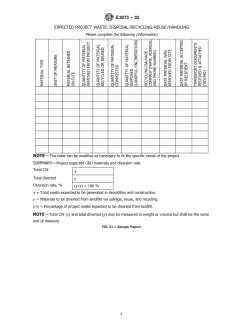
5.1 CWM Plan—The CWM plan is included in the construction documents to ensure that it is both defined and integrated as part
of the scope of the project. The CWM plan should include the elements found in 5.2 – 5.4. Potential submittal requirements, such
as an anticipated material diversion report, progress material diversion reports, and the summary report, can be organized in a table
format. A sample is shown in Fig. X1.1 in Appendix X1.
5.2 Performance Requirements—Potential performance requirements include:
E3073 − 22
5.2.1 A diversion rate that the contractor should meet or exceed;
5.2.2 Examples of materials that can and should be diverted;
5.2.3 Examples of diversion activities:
5.2.3.1 Manufacturer reclamation (take-back) in which the manufacturer does not then dispose of the materials;
5.2.3.2 Salvage for on-site or off-site reuse, sale, or donation;
5.2.3.3 Repurposing;
5.2.3.4 Composting;
5.2.3.5 Sorted on-site waste; and
5.2.3.6 Comingled waste;
5.2.4 Condition requirements for recovered materials that make them conducive to their reuse.
5.3 Submittal Requirements—Potential submittal requirements include:
5.3.1 Anticipated material diversion report, includingreport including, but not limited to:
5.3.1.1 Estimate of types and quantities of materials generated with backing data for the estimated calculatio
...