

ASTM F3517-21
(Practice)Standard Practice for Movement Tests When Using an Exoskeleton
General Information
- Abstract
SIGNIFICANCE AND USE
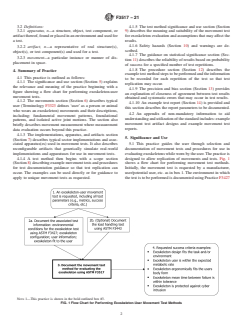
5.1 This practice guides the user through selection and documentation of movement tests and procedures for use in evaluating exoskeletons while worn by the user. The practice is designed to allow replication of movements and tests. Fig. 1 shows a flow chart for performing movement test methods. Initially, the movement test is requested by a manufacturer, user/potential user, etc. as in box 1. The environment in which the test is to be performed is documented using Practice F3427 as in box 2a. If the movement test will also include an optional load handling test (for example, walking while carrying a load), the load handling portion of the test is documented using Practice F3443 as in box 2b. This practice is shown in box 3 where documentation of the movement and test results occurs. Evaluation of results occurs after the test has been completed as in box 4.
FIG. 1 Flow Chart for Performing Exoskeleton-User Movement Test Methods
Note 1: This practice is shown in the bold outlined box #3.
5.2 It is expected that this practice provides test guidance for many, although not all, movement activities using exoskeletons that may occur. However, the test method (see Section 8) provides examples to be used directly or as guidance for developing additional movement artifacts and movement tests.
SCOPE
1.1 This practice provides a structure for documenting test methods used to evaluate exoskeleton success criteria during a requested movement task and to ensure the movements can be completed to the criteria specified by the test requestor. The practice describes movement tasks, such as walking, running, transitioning, crawling, climbing, jumping, and combinations thereof, while not wearing and wearing an exoskeleton and while not handling or handling loads. The practice does not describe all movement tasks, types, or methods. Instead, this standard provides exoskeleton manufacturers and users with example movement test procedures for common movement tasks and a method to record movement and test parameters so that movement tasks can be replicated. The practice includes designs for a movement apparatus, and the appendix provides design details.
1.2 The test requestor shall provide input to the evaluation and provide the evaluation method, which may come from another standard, and should include, for example: precision, statistical validity, population selection criteria, and environmental conditions.
1.3 Output of the evaluation, that is, success criteria, are provided by the requestor. Movement tests may include success criteria for the user, such as: move to a goal, continuously move, or combinations thereof.
1.4 User movements may contain single or multiple joints.
1.5 Movements may include the user being within or outside of the exoskeleton during the test and may include the exoskeleton moving the user, or the user moving the exoskeleton, or combinations thereof.
1.6 If possible, tests using real or artifact test spaces and loads should be replicable and performed under environmental conditions representative of a real-world movement implementation.
1.7 The values stated in SI units are to be regarded as the standard. The values given in parentheses are not precise mathematical conversions to imperial units. They are close approximate equivalents for the purpose of specifying material dimensions or quantities that are readily available to avoid excessive fabrication costs of test apparatuses while maintaining repeatability and reproducibility of the test method results. These values given in parentheses are provided for information only and are not considered standard.
1.8 This standard does not purport to address all of the safety concerns, if any, associated with its use. It is the responsibility of the user of this standard to establish appropriate safety, health, and environmental practices and determine the applicability of regulatory limitations prior to use.
1.9 ...
- Status
- Published
- Publication Date
- 14-Jun-2021
- Technical Committee
- F48 - Exoskeletons and Exosuits
- Drafting Committee
- F48.03 - Task Performance and Environmental Considerations
Overview
ASTM F3517-21: Standard Practice for Movement Tests When Using an Exoskeleton, provides a comprehensive framework for the selection, documentation, and execution of standardized movement tests to evaluate exoskeleton performance. Developed by ASTM, this standard ensures that movement tests for exoskeleton users are replicable, well-documented, and tailored to specific criteria set by the test requestor. It covers a variety of fundamental and complex human movements, both with and without exoskeletons, in diverse environments and sectors, enhancing the validity and comparability of test results.
Key Topics
- Test Selection and Documentation: Offers clear guidance for selecting appropriate movement tasks (such as walking, running, crawling, climbing, and jumping) and properly documenting procedures, apparatus, and results.
- Replication and Reproducibility: Emphasizes the use of detailed recording methods to ensure that movement tests can be repeated under similar environmental conditions for consistency and accuracy.
- Customization: Allows the test requestor to define success criteria according to their specific needs. Tests can be tailored to assess single or multi-joint movements, and whether the exoskeleton or the user initiates movement.
- User and Environmental Input: Requires input from the test requestor on aspects such as statistical validity, test populations, and test environments. Environmental conditions are documented according to referenced standards.
- Movement Apparatus and Artifacts: Provides example designs for testing apparatus and artifacts that realistically simulate real-world scenarios, including confined spaces, ramps, and manhole passages.
- Objective and Subjective Measurement: Supports both quantifiable data collection (such as motion capture, physiological metrics) and subjective assessments (including user-perceived exertion or comfort).
Applications
The practical value of ASTM F3517-21 extends across a variety of sectors utilizing exoskeleton technology:
- Industrial and Occupational Safety: Evaluating exoskeletons for material handling, manual labor, and warehouse logistics to enhance worker safety and efficiency.
- Medical and Rehabilitation: Assessing assistive exoskeleton devices for physical therapy, rehabilitation of gait disorders, and improving mobility among patients with neurological or physical disabilities.
- Military and Emergency Response: Testing exoskeletons for soldiers or first responders in tasks such as carrying loads, traversing obstacles, or moving victims in rescue scenarios.
- Recreational and Sports: Application in sports training or recreational activities, where enhancing user performance and reducing fatigue are key goals.
- Research and Product Development: Providing manufacturers and researchers with a reliable reference framework for product comparisons, improvement, and certification.
Related Standards
To ensure comprehensive testing and documentation, ASTM F3517-21 references and works in conjunction with other key standards:
- ASTM F3427: Practice for Documenting Environmental Conditions for Utilization with Exoskeleton Test Methods.
- ASTM F3443: Practice for Load Handling When Using an Exoskeleton.
- ASTM F3474: Practice for Establishing Exoskeleton Functional Ergonomic Parameters and Test Metrics.
- ASTM F3323: Terminology for Exoskeletons and Exosuits.
- ISO 13482:2014: Robots and Robotic Devices – Safety Requirements for Personal Care Robots.
Summary
ASTM F3517-21 is an essential international standard for anyone involved in the design, testing, or implementation of exoskeleton systems. By standardizing movement tests, it supports safer, more effective exoskeleton deployment, fosters innovation, and advances user acceptance and product reliability in real-world applications. Whether in workplace safety, healthcare rehabilitation, or other sectors, this standard serves as a foundation for consistent, credible, and meaningful evaluation of exoskeleton technologies.
Relations
- Effective Date
- 15-Jun-2020
- Effective Date
- 01-Mar-2020
- Effective Date
- 01-Oct-2019
- Effective Date
- 01-Apr-2019
- Effective Date
- 01-Sep-2018
Get Certified
Connect with accredited certification bodies for this standard

BSI Group
BSI (British Standards Institution) is the business standards company that helps organizations make excellence a habit.

TÜV Rheinland
TÜV Rheinland is a leading international provider of technical services.

TÜV SÜD
TÜV SÜD is a trusted partner of choice for safety, security and sustainability solutions.
Sponsored listings
Frequently Asked Questions
ASTM F3517-21 is a standard published by ASTM International. Its full title is "Standard Practice for Movement Tests When Using an Exoskeleton". This standard covers: SIGNIFICANCE AND USE 5.1 This practice guides the user through selection and documentation of movement tests and procedures for use in evaluating exoskeletons while worn by the user. The practice is designed to allow replication of movements and tests. Fig. 1 shows a flow chart for performing movement test methods. Initially, the movement test is requested by a manufacturer, user/potential user, etc. as in box 1. The environment in which the test is to be performed is documented using Practice F3427 as in box 2a. If the movement test will also include an optional load handling test (for example, walking while carrying a load), the load handling portion of the test is documented using Practice F3443 as in box 2b. This practice is shown in box 3 where documentation of the movement and test results occurs. Evaluation of results occurs after the test has been completed as in box 4. FIG. 1 Flow Chart for Performing Exoskeleton-User Movement Test Methods Note 1: This practice is shown in the bold outlined box #3. 5.2 It is expected that this practice provides test guidance for many, although not all, movement activities using exoskeletons that may occur. However, the test method (see Section 8) provides examples to be used directly or as guidance for developing additional movement artifacts and movement tests. SCOPE 1.1 This practice provides a structure for documenting test methods used to evaluate exoskeleton success criteria during a requested movement task and to ensure the movements can be completed to the criteria specified by the test requestor. The practice describes movement tasks, such as walking, running, transitioning, crawling, climbing, jumping, and combinations thereof, while not wearing and wearing an exoskeleton and while not handling or handling loads. The practice does not describe all movement tasks, types, or methods. Instead, this standard provides exoskeleton manufacturers and users with example movement test procedures for common movement tasks and a method to record movement and test parameters so that movement tasks can be replicated. The practice includes designs for a movement apparatus, and the appendix provides design details. 1.2 The test requestor shall provide input to the evaluation and provide the evaluation method, which may come from another standard, and should include, for example: precision, statistical validity, population selection criteria, and environmental conditions. 1.3 Output of the evaluation, that is, success criteria, are provided by the requestor. Movement tests may include success criteria for the user, such as: move to a goal, continuously move, or combinations thereof. 1.4 User movements may contain single or multiple joints. 1.5 Movements may include the user being within or outside of the exoskeleton during the test and may include the exoskeleton moving the user, or the user moving the exoskeleton, or combinations thereof. 1.6 If possible, tests using real or artifact test spaces and loads should be replicable and performed under environmental conditions representative of a real-world movement implementation. 1.7 The values stated in SI units are to be regarded as the standard. The values given in parentheses are not precise mathematical conversions to imperial units. They are close approximate equivalents for the purpose of specifying material dimensions or quantities that are readily available to avoid excessive fabrication costs of test apparatuses while maintaining repeatability and reproducibility of the test method results. These values given in parentheses are provided for information only and are not considered standard. 1.8 This standard does not purport to address all of the safety concerns, if any, associated with its use. It is the responsibility of the user of this standard to establish appropriate safety, health, and environmental practices and determine the applicability of regulatory limitations prior to use. 1.9 ...
SIGNIFICANCE AND USE 5.1 This practice guides the user through selection and documentation of movement tests and procedures for use in evaluating exoskeletons while worn by the user. The practice is designed to allow replication of movements and tests. Fig. 1 shows a flow chart for performing movement test methods. Initially, the movement test is requested by a manufacturer, user/potential user, etc. as in box 1. The environment in which the test is to be performed is documented using Practice F3427 as in box 2a. If the movement test will also include an optional load handling test (for example, walking while carrying a load), the load handling portion of the test is documented using Practice F3443 as in box 2b. This practice is shown in box 3 where documentation of the movement and test results occurs. Evaluation of results occurs after the test has been completed as in box 4. FIG. 1 Flow Chart for Performing Exoskeleton-User Movement Test Methods Note 1: This practice is shown in the bold outlined box #3. 5.2 It is expected that this practice provides test guidance for many, although not all, movement activities using exoskeletons that may occur. However, the test method (see Section 8) provides examples to be used directly or as guidance for developing additional movement artifacts and movement tests. SCOPE 1.1 This practice provides a structure for documenting test methods used to evaluate exoskeleton success criteria during a requested movement task and to ensure the movements can be completed to the criteria specified by the test requestor. The practice describes movement tasks, such as walking, running, transitioning, crawling, climbing, jumping, and combinations thereof, while not wearing and wearing an exoskeleton and while not handling or handling loads. The practice does not describe all movement tasks, types, or methods. Instead, this standard provides exoskeleton manufacturers and users with example movement test procedures for common movement tasks and a method to record movement and test parameters so that movement tasks can be replicated. The practice includes designs for a movement apparatus, and the appendix provides design details. 1.2 The test requestor shall provide input to the evaluation and provide the evaluation method, which may come from another standard, and should include, for example: precision, statistical validity, population selection criteria, and environmental conditions. 1.3 Output of the evaluation, that is, success criteria, are provided by the requestor. Movement tests may include success criteria for the user, such as: move to a goal, continuously move, or combinations thereof. 1.4 User movements may contain single or multiple joints. 1.5 Movements may include the user being within or outside of the exoskeleton during the test and may include the exoskeleton moving the user, or the user moving the exoskeleton, or combinations thereof. 1.6 If possible, tests using real or artifact test spaces and loads should be replicable and performed under environmental conditions representative of a real-world movement implementation. 1.7 The values stated in SI units are to be regarded as the standard. The values given in parentheses are not precise mathematical conversions to imperial units. They are close approximate equivalents for the purpose of specifying material dimensions or quantities that are readily available to avoid excessive fabrication costs of test apparatuses while maintaining repeatability and reproducibility of the test method results. These values given in parentheses are provided for information only and are not considered standard. 1.8 This standard does not purport to address all of the safety concerns, if any, associated with its use. It is the responsibility of the user of this standard to establish appropriate safety, health, and environmental practices and determine the applicability of regulatory limitations prior to use. 1.9 ...
ASTM F3517-21 is classified under the following ICS (International Classification for Standards) categories: 11.040.60 - Therapy equipment. The ICS classification helps identify the subject area and facilitates finding related standards.
ASTM F3517-21 has the following relationships with other standards: It is inter standard links to ASTM F3443-20, ASTM F3427-20, ASTM F3323-19a, ASTM F3323-19, ASTM F3323-18. Understanding these relationships helps ensure you are using the most current and applicable version of the standard.
ASTM F3517-21 is available in PDF format for immediate download after purchase. The document can be added to your cart and obtained through the secure checkout process. Digital delivery ensures instant access to the complete standard document.
Standards Content (Sample)
This international standard was developed in accordance with internationally recognized principles on standardization established in the Decision on Principles for the
Development of International Standards, Guides and Recommendations issued by the World Trade Organization Technical Barriers to Trade (TBT) Committee.
Designation: F3517 − 21
Standard Practice for
Movement Tests When Using an Exoskeleton
This standard is issued under the fixed designation F3517; the number immediately following the designation indicates the year of
original adoption or, in the case of revision, the year of last revision.Anumber in parentheses indicates the year of last reapproval.A
superscript epsilon (´) indicates an editorial change since the last revision or reapproval.
1. Scope mathematical conversions to imperial units. They are close
approximate equivalents for the purpose of specifying material
1.1 This practice provides a structure for documenting test
dimensions or quantities that are readily available to avoid
methods used to evaluate exoskeleton success criteria during a
excessive fabrication costs of test apparatuses while maintain-
requested movement task and to ensure the movements can be
ing repeatability and reproducibility of the test method results.
completed to the criteria specified by the test requestor. The
Thesevaluesgiveninparenthesesareprovidedforinformation
practice describes movement tasks, such as walking, running,
only and are not considered standard.
transitioning, crawling, climbing, jumping, and combinations
1.8 This standard does not purport to address all of the
thereof, while not wearing and wearing an exoskeleton and
safety concerns, if any, associated with its use. It is the
while not handling or handling loads. The practice does not
responsibility of the user of this standard to establish appro-
describe all movement tasks, types, or methods. Instead, this
priate safety, health, and environmental practices and deter-
standard provides exoskeleton manufacturers and users with
mine the applicability of regulatory limitations prior to use.
example movement test procedures for common movement
1.9 This international standard was developed in accor-
tasks and a method to record movement and test parameters so
dance with internationally recognized principles on standard-
that movement tasks can be replicated. The practice includes
ization established in the Decision on Principles for the
designs for a movement apparatus, and the appendix provides
Development of International Standards, Guides and Recom-
design details.
mendations issued by the World Trade Organization Technical
1.2 The test requestor shall provide input to the evaluation
Barriers to Trade (TBT) Committee.
and provide the evaluation method, which may come from
another standard, and should include, for example: precision,
2. Referenced Documents
statistical validity, population selection criteria, and environ-
2.1 ASTM Standards:
mental conditions.
F3323Terminology for Exoskeletons and Exosuits
1.3 Output of the evaluation, that is, success criteria, are
F3427Practice for Documenting Environmental Conditions
provided by the requestor. Movement tests may include suc-
for Utilization with Exoskeleton Test Methods
cess criteria for the user, such as: move to a goal, continuously
F3443Practice for Load Handling When Using an Exoskel-
move, or combinations thereof.
eton
1.4 User movements may contain single or multiple joints.
F3474Practice for Establishing Exoskeleton Functional Er-
gonomic Parameters and Test Metrics
1.5 Movements may include the user being within or
2.2 Other Standards:
outside of the exoskeleton during the test and may include the
ISO 13482:2014Robots and robotic devices -- Safety re-
exoskeleton moving the user, or the user moving the
quirements for personal care robots
exoskeleton, or combinations thereof.
1.6 If possible, tests using real or artifact test spaces and
3. Terminology
loads should be replicable and performed under environmental
3.1 General terminology for ASTM Committee F48 stan-
conditionsrepresentativeofareal-worldmovementimplemen-
dardsarelistedinTerminologyF3323.Terminologyspecificto
tation.
this standard are shown in this section.
1.7 The values stated in SI units are to be regarded as the
standard. The values given in parentheses are not precise
For referenced ASTM standards, visit the ASTM website, www.astm.org, or
contact ASTM Customer Service at service@astm.org. For Annual Book of ASTM
This practice is under the jurisdiction of ASTM Committee F48 on Exoskel- Standards volume information, refer to the standard’s Document Summary page on
etons and Exosuits and is the direct responsibility of Subcommittee F48.03 on Task the ASTM website.
Performance and Environmental Considerations. Available from International Organization for Standardization (ISO), ISO
Current edition approved June 15, 2021. Published July 2021. DOI: 10.1520/ Central Secretariat, Chemin de Blandonnet 8, CP 401, 1214 Vernier, Geneva,
F3517-21. Switzerland, https://www.iso.org.
Copyright © ASTM International, 100 Barr Harbor Drive, PO Box C700, West Conshohocken, PA 19428-2959. United States
F3517 − 21
3.2 Definitions: 4.1.5 The test method significance and use section (Section
3.2.1 apparatus, n—a structure, object, test component, or 9) describes the meaning and suitability of the movement test
artifactthereof,foundorplacedinanenvironmentandusedfor forexoskeletonevaluationandassumptionsthatmayaffectthe
a test. results.
4.1.6 Safety hazards (Section 10) and warnings are de-
3.2.2 artifact, n—a representative of real structure(s),
scribed.
object(s), or test component(s) and used for a test.
4.1.7 The guidance on statistical significance section (Sec-
3.2.3 movement—a particular instance or manner of dis-
tion 11) describes the reliability of results based on probability
placement in space.
of success for a specified number of test repetitions.
4.1.8 The procedure section (Section 12) describes the
4. Summary of Practice
exampletestmethodstepstobeperformedandtheinformation
4.1 This practice is outlined as follows:
to be recorded for each repetition of the test so that test
4.1.1 The significance and use section (Section 5) explains
replication may occur.
the relevance and meaning of the practice beginning with a
4.1.9 The precision and bias section (Section 13) provides
figure showing a flow chart for performing exoskeleton-user
an explanation of closeness of agreement between test results
movement tests.
obtained and systematic errors that may occur in test results.
4.1.2 The movements section (Section 6) describes typical
4.1.10 An example test report (Section 14) is provided and
user (Terminology F3323 defines ‘user’as a person or animal
this section describes the report parameters to be documented.
who wears an exoskeleton) movements and their descriptions,
4.2 An appendix of non-mandatory information to aid
including: fundamental movement patterns, foundational
understandingandutilizationofthestandardincludes:example
patterns, and isolated active joint motions. The section also
movement test artifact designs and example movement test
briefly describes movement measurement where measurement
reports.
data evaluation occurs beyond this practice.
4.1.3 The implementations, apparatus, and artifacts section
5. Significance and Use
(Section 7) describes typical sector implementations and asso-
ciated apparatus(es) used in movement tests. It also describes 5.1 This practice guides the user through selection and
reconfigurable artifacts that generically simulate real-world documentation of movement tests and procedures for use in
implementations and apparatuses for use in movement tests. evaluatingexoskeletonswhilewornbytheuser.Thepracticeis
4.1.4 A test method then begins with a scope section designed to allow replication of movements and tests. Fig. 1
(Section8)describingexamplemovementtestsandprocedures shows a flow chart for performing movement test methods.
for test documentation guidance so that test replication can Initially, the movement test is requested by a manufacturer,
occur. The examples can be used directly or for guidance to user/potential user, etc. as in box 1. The environment in which
apply to unique movement tests as requested. thetestistobeperformedisdocumentedusingPracticeF3427
NOTE 1—This practice is shown in the bold outlined box #3.
FIG. 1 Flow Chart for Performing Exoskeleton-User Movement Test Methods
F3517 − 21
asinbox2a.Ifthemovementtestwillalsoincludeanoptional 6.3.5 Perturbations—Moving the extremities one at a time
load handling test (for example, walking while carrying a or in some combination to reach for something or exaggerate a
load),theloadhandlingportionofthetestisdocumentedusing weight shift, such as moving a hand or foot away from the
Practice F3443 as in box 2b. This practice is shown in box 3 body; and
where documentation of the movement and test results occurs.
6.3.6 Dissociation—Moving the shoulders separately from
Evaluation of results occurs after the test has been completed
the hips, or postures where the shoulders are not stacked
as in box 4.
directly above the hips.
5.2 It is expected that this practice provides test guidance
6.4 Isolated Active Joint Motions—The fundamental and
for many, although not all, movement activities using exoskel-
foundational movement patterns in 6.2 and 6.3 can also be
etonsthatmayoccur.However,thetestmethod(seeSection8)
broken down into isolated active joint motions which are well
provides examples to be used directly or as guidance for
documented in anatomy and physiology texts, for example
developing additional movement artifacts and movement tests.
Reference (2). Examples of isolated active joint movements
include, but are not limited to, the following:
6. Movements
6.4.1 Flexion and Extension—Decreasing (flexion) and in-
6.1 The following subsections include typical movements creasing (extension) the angle between two body parts as
viewed in the sagittal plane;
and the applicable movement portions of the body that can
occur when not wearing or wearing an exoskeleton. At any
6.4.2 Lateral Flexion (also known as side-bending)—Active
stage of its development, an exoskeleton can be tested using
or passive bending movement of a body part in the coronal
the generic movements described. The movements provide a
plane;
generic list where, in many cases, combinations of movements
6.4.3 Abduction and Adduction—Motions of the limbs,
can occur.
hand,fingers,ortoesinthecoronal(medial-lateral)planeaway
from the body (abduction) or towards or across the midline of
6.2 Fundamental Movement Patterns:
the body, or brings the fingers or toes together (adduction) (3);
6.2.1 Push—Any pressing movement that involves displac-
ing something away from the body (includes reaching for 6.4.4 Circumduction—Movement of the limb, hand, or fin-
gers in a circular pattern, using the sequential combination of
objects which involves pushing the hand toward the object).
flexion, adduction, extension, and abduction motions (3);
6.2.2 Pull—Moving something toward the body.
6.2.3 Hinge—Rotating the hip joint to perform movements 6.4.5 Rotation—Rotation of the head/torso on the longitu-
dinal axis of the spine (4);
suchasdeadlifts,swings,andcertainchoppingandhammering
movements with little or no knee flexion.
6.4.6 Internal and External Rotation—Movement of a joint,
6.2.4 Squat—Amovementinvolvingastandingpersonlow- arounditslongaxis,towards(internal)oraway(external)from
ering to a position in which the torso is erect and the knees are
the midline of the body (5);
deeply bent and then rising to an upright position (1).
6.4.7 Supination and Pronation—Act of turning the body to
6.2.5 Lunge—A movement involving a standing person
a supine position or of turning the horizontal forearm so that
stepping forward into a position in which the front knee is
the palm of the hand faces upward (supination); the act of
deeply bent while keeping the torso erect and then returning to
assuming the prone position, or the state of being prone
the starting position.
(pronation) (5);
6.2.6 Twist—Rotating the body (includes resisting rotation,
6.4.8 Dorsiflexion and Plantarflexion—Backwardflexionor
also known as anti-rotation).
bending, as of the hand or foot (dorsiflexion); extension of the
6.2.7 Gait—Patterns involving stepping, walking, or run-
ankle, pointing of the foot and toes (plantarflexion) (5);
ning.
6.4.9 Inversion and Eversion—Turning inward, upside
down, or in any direction contrary to the existing one (inver-
6.3 Foundational Patterns—The fundamental movement
sion); a turning inside out; a turning outward (eversion) (5);
patterns in 6.2 can be broken down further into the following
foundational patterns required to perform each: 6.4.10 Protraction and Retraction—Moving the shoulder
blades (scapula) towards (protraction) or away from (retrac-
6.3.1 Breathing—Inhaling and exhaling;
tion) the spine;
6.3.2 Head Movement—Controllingandmovingtheheadin
response to environmental stimuli in any posture; 6.4.11 DepressionandElevation—Lowering(depression)or
raising(elevation)ofabodypartabovethehorizontalmidline;
6.3.3 Pushing Down—Utilizing ground reactions forces
fromanyposturebypushingdownintotheground/implement/
6.4.12 Medial and Lateral Excursion—Movement towards
artifact;
the midline (medial excursion) and away from the midline
6.3.4 Weight Shifting—Transferring weight between any (lateral excursion) (4);
point of contact with a supporting structure in any plane
6.4.13 Superior and Inferior Rotation—Rotation of the
(sagittal, coronal, transverse, or some combination of these);
scapula during abduction: the glenoid cavity moves upward as
the medial end of the scapular spine moves downward (supe-
rior rotation) and the glenoid cavity moves downward as the
medial end of the scapular spine moves upward (inferior
The boldface numbers in parentheses refer to a list of references at the end of
this standard. rotation) (4); and
F3517 − 21
6.4.14 Opposition and Reposition—Movement and rotation 7.2 Examples of typical apparatuses that are in real-world
of the thumb’s tip towards (opposition) or away (reposition) exoskeleton implementations or used for testing exoskeletons
from that of any other finger (4). in various sectors, or both, are shown in Table 1. The actual
apparatus an exoskeleton user would interact with and the
6.5 Movement Measurement:
actual environment where someone would use an exoskeleton
6.5.1 Measurement of the effects of movement on the body
can be used for the movement test. For test replication, record
can be found in Practice F3474, Section 4. These include two
exact details of the apparatus (for example, location, model
measurement areas:
number, dimensions, etc.). Alternatively, it may be more
6.5.1.1 Objective measures (for example, maximal oxygen
appropriate to test the exoskeleton with artifacts that simulate
uptake (VO2), blood pressure, blood-oxygen saturation, mo-
some or all of the apparatuses the exoskeleton user interacts
tion capture); and
with. See 7.3.
6.5.1.2 Subjective measures (for example, rating of per-
ceived exertion (RPE), rating of pain, soreness, discomfort, or
7.3 Artifacts—An artifact can be any object that reasonably
comfort, or combinations thereof).
simulates the loads, tools, or equipment with which an exo-
6.5.2 Physical body movement measurement devices can
skeleton user would interact (for example, see Table 1). In
includesensorssuchas:opticaltracking,inertial,camera,light
general, the artifact should have the same size, mass, and mass
detection and ranging (LIDAR), global positioning system
distribution as the object it represents. In addition, the artifact
(GPS), mechanical, and acoustic.
should be reproducible so others can use it in testing. An
artifact can also be something that closely simulates the
7. Implementations, Apparatus, and Artifacts
environment where someone would use an exoskeleton. As-
pects of the environment that can be simulated include things
7.1 Exoskeleton implementations vary across sectors that
such as temperature and humidity, terrain, and the physical
apply exoskeletons for a variety of tasks. An exoskeleton
space.An environmental chamber is an example of an artifact
implementation for one sector (for example, industrial/
tosimulateaspectssuchastemperatureandhumidity.Artifacts
occupational material handling) may be quite different than in
can also be constructed to simulate terrains and aspects of the
another sector (for example, military material handling), in-
physicalspacewhereanexoskeletonwillbeused(forexample,
cluding different apparatuses, although may include the same
seeTable1).Anexampleartifactisconfinedspacethatmaynot
exoskeleton used in different environments (see Practice
bereadilyavailableforexoskeletonmanufacturersandusersto
F3427). A non-exhaustive list of sector implementations in-
perform repeatable and reconfigurable tests. Other useful
cludes:
artifacts may also be added to this standard in the future. Two
7.1.1 Industrial/Occupational—Warehouses, manufacturing
standard confined-space artifacts are therefore provided here
plants, hospitals;
and labeled from the movement direction (that is, horizontal
7.1.2 Military—Combat, logistics warehousing, mainte-
and vertical) of the exoskeleton-user. References for standard
nance;
sized openings are provided in (6-8). Detailed designs to
7.1.3 Response—Rescue, firefighting, bomb disposal;
replicate the artifacts are provided in Appendix X1.
7.1.4 Medical—Rehabilitation, physical therapy, surgery;
7.3.1 Confined Pass-Through: Horizontal Movement:
and
7.1.5 Recreational/Entertainment—Skiing, sport field/court 7.3.1.1 Fig. 2 shows a confined pass-through: horizontal
setup/maintenance. movement artifact (a) as a wall and (b) as an aisle.The artifact
TABLE 1 Typical Movement Apparatuses for Each Sector that Exoskeleton Users may Encounter
Industrial/Occupational Military Response Medical Recreation/Entertainment
Carried loads, including:
lumber, packages, parts for ammunition, weapons, jaws of life, stretcher objects used in daily living, equipment bag
assembly, patient carriers, rucksack crutches, walker, cane
tires/wheels
Gross Tools, including:
drill, saw, screwdriver, wrench skis and poles, golf clubs, bats
Precision Tools, including:
jewelers screwdriver, small soldering iron scalpel, dental drill fishing lures and string
Wheeled, load carrying equipment, including:
pallet jack, forklift, load cart, equipment cart, rough medical response cart, rolling walker sporting equipment cart
wheelchair, gurney terrain container handler/ gurney
forklift
Stairs, steps, railings
Doorways, door knobs, aisles, hallways
Indoor/outdoor obstacles and surfaces, including:
walkway debris, furniture, curbs, walkway debris, undulating surfaces walkway debris, furniture, sporting equipment
equipment equipment
manholes, floor access panels, windows, ship hatches, vehicle doors car doors
carpet, concrete, asphalt sand, gravel, rubble, floor gaps carpet, concrete, asphalt, concrete/wood court, snow, dirt, sand
treadmill
F3517 − 21
FIG. 2 Confined Pass-Through: Horizontal Movement Artifact (a) Wall and (b) Aisle
can simulate, for example, a ship door, an automobile door, or with pins in the holes spaced vertically along the doors. A
an aircraft fuselage aisle. The 3.7 m wide × 2.4 m high × 1.2 lowerbarisusedtopassunderoroverandanupperbarisused
m deep artifact includes right and left sliding doors each to pass under.
measuring2.3mhigh×0.8mwide×5cmthickandsupported 7.3.1.2 Vertical walls can optionally be added to the rear of
by an upper metal rail and metal ground guide. The opening the doors to create an aisle or hallway.
covered by the doors measures 2.1 m high × 1.8 m wide. 7.3.1.3 Movement of the height bars as the user passes
Unless stated, the materials are intended to be off-the-shelf, through can be detected visually by the test technician or by
cost-effective, common wood or plastic standard thicknesses. electronic methods, for example, laser lines along the bars or
The doors define the opening width of the pass-through. As tape switches attached to the bars and walls, or a combination
depicted in Fig. 2, plastic pipe height bars can be placed at thereof.
various heights across the opening between the doors. The 7.3.2 Confined Pass-Through: Vertical Movement:
heightbarsaresupportedbymetalanglesattachedtothedoors 7.3.2.1 Fig. 3 shows a confined pass-through: vertical
FIG. 3 Confined Pass-Through: Vertical Movement Artifact
(a) Manhole (stair rails are removed for clarity, although are required for safety) and (b) Adjustable-size Rectangle Floor Access
F3517 − 21
movement artifact (a) manhole (stair rails are removed for diametertubetotheinsertopeningcanbeadded.Accesstothe
clarity,althougharerequiredforsafety)and(b)adjustable-size tubefromthegroundlevelcanalsobeadded.Astandardladder
rectangle floor access insert. The artifact simulates, for is attached to the insert and the floor or the deck structure,
example, manhole and floor access passages. Fig. 3(a) shows a providing vertical movement from deck to ground and vice
red insert measuring 1.5 m square by 20 cm thick with a 1.2 m versa.
diameter opening simulating a manhole. The insert can be 7.3.2.2 User contact with insert surfaces as they pass
replacedwithalternativeaccessopenings,forexamplewiththe through can be detected visually by the test technician or by
adjustable-size rectangle floor access insert, with the same electronic methods. Methods such as wet paint or chalk on the
overall dimensions as the manhole insert, shown in Fig. 3(b). inside insert access area will leave marks on the user and
The platform measures 3.7 m square × 2.4 m high and uses exoskeleton (that is, similar to crash dummy testing of auto-
standard decking materials and design (for example, outside mobiles);tapeswitchesontheinsertprovideelectroniccontact
deck rails, joist spacing, material thicknesses, railings, posts, detection, or a combination thereof.
stairs, etc.). For full vertical movement confinement, as with a
manhole and transparently depicted in Fig. 3(a), a similar
TEST METHOD
8. Scope
8.1 This test method, as part of this Practice F3517, de- 8.3.4 In all tests, the fit of the exoskeleton to the user shall
scribes the procedure outlined in Fig. 1, and other relevant be reported. See an example user information table in X2.4.A
informationtoperformmovementtestsasdescribedinSection futurestandardforexoskeletonfittotheuseriscurrentlyunder
6. development.
8.3.5 In all tests, the exoskeleton-user movement test shall
8.2 As there are an infinite number of movement tasks that
be reported. See Section 14 report and an example user
canbeperformedinthereal-worldusingexoskeletons,thistest
information table in X2.4.Afuture standard for exoskeleton fit
methodprovidesaseriesoftestmethodexamplesforguidance
to the user is currently under development.
ondeveloping,documenting,andperformingrepeatablemove-
ment tests by exoskeleton users and manufacturers across 8.3.6 Example 1 – Movement Through a Confined Space –
Horizontal Movement (Industrial/Occupational, Military, Re-
many sectors.
sponse):
8.3 Test Method Examples—The following are examples
8.3.6.1 This test uses an actual car door opening measuring
that can be used as a guide for developing and implementing
48in.wide×48in.highwiththeopeningbottombeing40cm
movement tests when using exoskeletons. The test requestor
above the floor (see Fig. 4(a)). The further confinement of a
and test supervisor should describe in detail the test performed
windshield angle is also noted and no seat confinement is
as provided in these examples.
added (that is, the seat is not installed during this phase of
8.3.1 Inalltests,theenvironmentalconditionsshallbefully
manufacturing). Alternatively, the confined pass-through –
describedusingPracticeF3427.Seeanexampleenvironmental
horizontalmovementartifactshowninFig.2(a)isusedforthis
conditions test report in X2.1. A future standard for exoskel-
test and is fixtured with the door opening matching the actual
eton user information is currently under development.
door opening of 91 cm wide × 122 cm high with the opening
8.3.2 In all tests, the exoskeleton configuration being tested
bottom being 40 cm above the floor. An angled bar matching
shall be identified, uniquely named (for example make, model,
the windshield angle is also added as shown in Fig. 4(b).
configuration), and reported, including all subsystems and
Further confinement shall also be added to the artifact and
components with their respective features and functionalities.
noted if additional opening complexities exist. For example,
See an example exoskeleton configuration table in X2.2.A
curved areas or a raised floor as appropriate for the real
futurestandardforexoskeletonconfigurationiscurrentlyunder
application.
development. The exoskeleton configuration should be repre-
8.3.6.2 Ifcurvedconfinementsexistwithinthepass-through
sentative of a configuration that will be used in its intended
area, they are either (1) added to the confinement pass-through
application. The exoskeleton configuration shall remain the
or(2)alimitingstraightbardefiningthechordbetweenthetwo
same for all relevant tests to enable direct comparison of
points at the most confined location is added to the apparatus.
performance and to identify trade-offs between different con-
Notethat(2)providesaslightlysmallerconfinedpass-through.
figurations. If the configuration is changed during a test, it is
consideredafaultandthetestistoberepeated.Documentation
8.3.6.3 Measurement of success or failure is by observation
should include detailed photographs of the exoskeleton and that confinement apparatus does not move or any part of the
apparatus.
apparatusmoves(forexample,aheightbarlifts).Alternatively,
8.3.3 Inalltests,thesameusershallbeidentifiedandnamed the confined pass-through opening can be lined with a tape
with user information reported that is associated with the switch for electronic contact detection of the apparatus by
exoskeletonandthetest.Seeanexampleuserinformationtable using a laser line emitter/detector sensor, optical tracking,
in X2.3.Afuture standard for exoskeleton user information is cameras, or by other sensing means, any of which provide
currently under development. apparatus movement detection.
F3517 − 21
FIG. 4 Confined Space – Horizontal Movement Test Setup with:
(a) Real Car Door Opening and
(b) Confined Pass-Through – Horizontal Movement Artifact set up as a Car Door Opening
8.3.6.4 The user is instructed to don the exoskeleton and 8.3.7.3 The user is instructed to don the exoskeleton and
stand in front of the opening. stand with a weapon in both hands at the low ready position
8.3.6.5 The user is instructed to carry any appropriate load (Fig. 7).
(for example, tool) that will be used for the real-world 8.3.7.4 The user is instructed to carry any appropriate load
application. (for example, kit which could include body armor, extra
8.3.6.6 The user is instructed to pass through the opening magazines, or other supplies carried on the body) that will be
while carrying the load. The test administrator monitors the used for the real-world application. If the exoskeleton is not
confinement apparatus or artifact, while the user passes compatible with these loads, this should be noted and the test
through the opening, using an agreed-upon measurement continues without the loads.
method as in 8.3.6.3. The test is successful if the user passes 8.3.7.5 The user is instructed to move the weapon from low
through the apparatus or artifact and any part of the apparatus ready, shoulder the rifle, or present the pistol to acquire the
orartifactmoveslessthantheallowedamountassetbythetest target on the test supervisor’s verbal or mechanical cue. Once
requestor. If the apparatus or artifact moves beyond the set the target is acquired by the user, the user will announce
amount, the test is failed. ‘sighted’. If using a laser aim trace, the user will continue to
8.3.6.7 The user is then instructed to pass back through the acquire the target while aim data are collected for the specific
opening following the same guidelines as in 8.3.6.6. period of time (for example, 10s or 15s). After the specified
8.3.6.8 Thetestsupervisornotesallpertinentinformationto time has passed, the test supervisor will announce ‘done’ at
the test on the test report. Relevant photos of the environment, which time the user can return the weapon to low ready.
task, and load shall be attached. 8.3.7.6 Thetestsupervisornotesallpertinentinformationto
8.3.6.9 Metrics are documented for the repetition. the test on the test report. Relevant photos of the environment,
8.3.6.10 The test is repeated 29 times (or as instructed by task, and load shall be attached.
the test requestor). 8.3.7.7 Metrics are documented for the repetition.
8.3.7 Example 2(a) – Static Shooting (Military, Response): 8.3.7.8 Thetestisrepeatedtentimes(orasinstructedbythe
8.3.7.1 This test uses a dummy weapon (rifle or pistol) (see test requestor).
Fig.5)inanopenspace.Apapertargetcouldbeplacedat50m 8.3.8 Example 2(b) – Shooting on the Move (Military,
from the user if desired. The height of the target top should be Response):
placed at 6 ft. 8.3.8.1 Thistestusesadummyweapon(rifleorpistol)inan
8.3.7.2 Measurement of success or failure is by observation open space. A paper target (see Fig. 5) is placed at a distance
that the weapon can be readily moved from low ready to fromtheuserthatwouldallowtheusertotakeatleastsixsteps
shouldered (or presented for pistol) and the user can acquire a toward the target (see Fig. 8). The height of the target should
target.Additionally, a laser sight can be placed on the weapon be placed at 6ft from the ground.
and used to measure weapon aim trace for a designated period 8.3.8.2 Measurement of success or failure is by observation
of time such as 10s or 15s. The maximal horizontal and that the weapon can be readily moved from low ready to
vertical distance would be calculated for each trial (Fig. 6). shouldered (or presented for pistol), and the user can take at
F3517 − 21
FIG. 5 Silhouette Target placed on a Wall at 50 m from the Exoskeleton User
least six steps toward the target while continuing to acquire a 8.3.9 Traversing Terrains – Varying Orientation Ramps
target.Additionally, a laser sight can be placed on the weapon (Industrial/Occupational, Military, Response, Recreational):
and used to measure weapon aim trace while moving towards
8.3.9.1 The subject is requested to traverse a terrain appa-
the target.The maximal horizontal and vertical distance would
ratus made of varying orientation, 15° ramps, as shown in Fig.
be calculated for each trial (see Fig. 6).
9, in a “figure 8” pattern and around barriers placed along the
8.3.8.3 The user is instructed to don the exoskeleton and
apparatus center axis and spaced 2 m between each.
stand with a weapon in both hands at the low ready position
8.3.9.2 Therampterrainisanarrayofindividualrampsthat
(Fig. 7).
form peaks and valleys. Each ramp is independent, measuring
8.3.8.4 The user is instructed to carry any appropriate load
61cmsquareonthegroundsoitcanberotatedinplacetoform
(for example, kit which could include body armor, extra
more difficult terrains. The ramp surface can be made of
magazines, or other supplies carried on the body) that will be
orientedstrandboard(OSB),plywood,orsimilarmaterial.The
used for the real-world application. If the exoskeleton is not
entire apparatus of 4 ramps wide × 12 ramps long measures
compatible with these loads, this should be noted and the test
2.4m wide × 7.3m long when fully assembled.
continues without the loads.
8.3.9.3 Optionally,asinFig.9(a
...