

ASTM E3074/E3074M-24
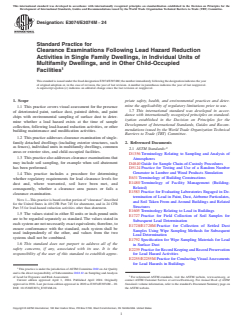
(Practice)Standard Practice for Clearance Examinations Following Lead Hazard Reduction Activities in Single Family Dwellings, in Individual Units of Multifamily Dwellings, and in Other Child-Occupied Facilities
General Information
- Abstract
SIGNIFICANCE AND USE
4.1 A clearance examination of abatement areas and other areas associated with other lead-hazard control activities, or building maintenance or modification activities in single-family detached dwellings, individual units in multifamily dwellings, common areas or exterior sites, and child-occupied facilities is performed to determine that the clearance area is adequately safe for reoccupancy.
4.2 It is the responsibility of the user of this standard to assure that all regulatory, contractual and personnel requirements are met prior to conduct of a clearance examination. At a minimum, users of this standard shall be trained in its use and in safe practices for its conduct.
Note 2: Authorities having jurisdiction may have certification or specific training requirements, or both.
4.3 This practice is one of a set of standards developed for lead hazard management activities. The visual assessment procedures required in this practice are found in Practice E2255/E2255M and the record keeping requirements are found in Practice E2239.
4.4 Although this practice was primarily developed for dwellings and for other child-occupied facilities, this practice may be also applied to nonresidential buildings and related structures by agreement between the client and the individual conducting the clearance examination.
4.5 This practice may be used by owners and property managers, including owner-occupants, and others responsible for maintaining facilities. It may also be used by lead hazard management consultants, construction contractors, labor groups, real estate and financial professionals, insurance organizations, legislators, regulators, and legal professionals.
4.6 This practice does not address whether lead-hazard reduction activities or other building modification or maintenance work were performed properly.
SCOPE
1.1 This practice covers visual assessment for the presence of deteriorated paint, surface dust, painted debris, and paint chips with environmental sampling of surface dust to determine whether a lead hazard exists at the time of sample collection, following lead-hazard reduction activities, or other building maintenance and modification activities.
1.2 This practice addresses clearance examination of single-family detached dwellings (including exterior structures, such as fences), individual units in multifamily dwellings, common areas or exterior sites, and child-occupied facilities.
1.3 This practice also addresses clearance examinations that may include soil sampling, for example when soil abatement has been performed.
1.4 This practice includes a procedure for determining whether regulatory requirements for lead clearance levels for dust and, where warranted, soil have been met, and consequently, whether a clearance area passes or fails a clearance examination.
Note 1: This practice is based on that portion of “clearance” described for the United States in 40 CFR Part 745 for abatement, and in 24 CFR Part 35 for lead-hazard reduction activities other than abatement.
1.5 The values stated in either SI units or inch-pound units are to be regarded separately as standard. The values stated in each system are not necessarily exact equivalents; therefore, to ensure conformance with the standard, each system shall be used independently of the other, and values from the two systems shall not be combined.
1.6 This standard does not purport to address all of the safety concerns, if any, associated with its use. It is the responsibility of the user of this standard to establish appropriate safety, health, and environmental practices and determine the applicability of regulatory limitations prior to use.
1.7 This international standard was developed in accordance with internationally recognized principles on standardization established in the Decision on Principles for the Development of International Standards, Guides and Recommendations issued by the World Tr...
- Status
- Published
- Publication Date
- 31-Mar-2024
- Technical Committee
- D22 - Air Quality
- Drafting Committee
- D22.12 - Sampling and Analysis of Lead for Exposure and Risk Assessment
Buy Documents
ASTM E3074/E3074M-24 - Standard Practice for Clearance Examinations Following Lead Hazard Reduction Activities in Single Family Dwellings, in Individual Units of Multifamily Dwellings, and in Other Child-Occupied Facilities
REDLINE ASTM E3074/E3074M-24 - Standard Practice for Clearance Examinations Following Lead Hazard Reduction Activities in Single Family Dwellings, in Individual Units of Multifamily Dwellings, and in Other Child-Occupied Facilities
Overview
ASTM E3074/E3074M-24 sets out a standard practice for performing clearance examinations after lead hazard reduction activities in single-family dwellings, individual units of multifamily dwellings, and other child-occupied facilities. This standard ensures that, following abatement or maintenance work that may disturb lead-based paint or other materials, the affected areas are safe for reoccupancy. The method involves both visual inspection for deteriorated paint, dust, and debris, and environmental sampling for lead in dust and, where warranted, soil.
Clearance examinations are essential in confirming that lead hazards do not remain after remediation or renovation, protecting residents, especially children, from the risks of lead exposure. This standard is widely referenced by property managers, construction and abatement contractors, lead hazard consultants, and regulatory authorities.
Key Topics
- Clearance Examination Process: Involves a combination of visual assessment and quantitative environmental sampling (dust wipes, soil).
- Scope of Application: Applies to single-family homes, multifamily units, common areas, exteriors (including associated structures like fences), and child-occupied facilities such as schools and daycare centers.
- Regulatory Compliance: Users must ensure all relevant regulatory, contractual, and personnel requirements are satisfied before starting a clearance examination. Jurisdictional authorities may require specific certifications or training.
- Assessment Criteria: Examines areas for deteriorated paint, paint chips, surface dust, and debris through detailed procedures. When required, includes soil sampling, particularly after soil abatement.
- Visual Assessment & Sampling Protocols: Dictates how to select and document sampling locations for floors, windows, and soil, and prescribes the required protocols for both interior and exterior clearances.
- Decision Criteria: Provides a process for determining when a space passes or fails clearance based on regulatory or contracted lead clearance levels for dust and soil.
- Reporting & Record Keeping: Outlines how to document the clearance process, including laboratory results, sample chain-of-custody, and summary reporting, with a strong emphasis on maintenance of records per ASTM E2239.
Applications
The practical applications of ASTM E3074/E3074M-24 are extensive and critical across multiple sectors:
- Residential Property Management: Ensures lead safety in rental homes and multifamily housing, crucial during tenant turnover or after renovation projects.
- Child-Occupied Facilities: Assures parents and guardians that schools and daycare centers are safe environments, particularly after maintenance or renovation.
- Construction & Renovation: Provides clear procedures for contractors to verify their projects meet safety clearance requirements before spaces are reoccupied.
- Lead Hazard Consultants & Inspectors: Standardizes the approach to post-abatement assessments, facilitating uniformity and regulatory compliance.
- Regulatory Bodies: Offers a recognized protocol for lead clearance, supporting health departments and government agencies in public health protection.
- Insurance & Real Estate: Used as a basis for assessing liability and ensuring regulatory due diligence before property transactions.
Related Standards
For organizations and individuals conducting clearance examinations, referencing related ASTM standards enhances compliance:
- ASTM E2255/E2255M: Practice for conducting visual assessments for lead hazards in buildings.
- ASTM E2239: Practice for record keeping and record preservation for lead hazard activities.
- ASTM E1727: Practice for field collection of soil samples for subsequent lead determination.
- ASTM E1728/E1728M: Practice for collection of settled dust samples using wipe sampling methods.
- ASTM E1583: Practice for evaluating laboratories engaged in determination of lead in paint, dust, airborne particulates, and soil.
- ASTM D4840: Guide for sample chain-of-custody procedures.
Additionally, regulatory references in the United States include 40 CFR Part 745 (EPA) and 24 CFR Part 35 (HUD), which relate directly to lead hazard evaluation and control.
Keywords: ASTM E3074, clearance examination, lead hazard reduction, lead abatement, dust sampling, soil lead testing, child-occupied facility safety, post-renovation lead assessment, regulatory compliance, lead clearance levels, property management standards.
Relations
- Effective Date
- 01-Apr-2024
- Effective Date
- 01-Apr-2024
- Effective Date
- 01-Sep-2020
- Referred By
ASTM E2913/E2913M-21 - Standard Practice for Hotplate Digestion of Lead from Composited Wipe Samples - Effective Date
- 01-Apr-2024
- Effective Date
- 01-Apr-2024
- Effective Date
- 01-Apr-2024
- Effective Date
- 01-Apr-2024
- Effective Date
- 01-Apr-2024
- Effective Date
- 01-Apr-2024
- Effective Date
- 01-Apr-2024
- Effective Date
- 01-Apr-2024
- Effective Date
- 01-Apr-2024
- Effective Date
- 01-Apr-2024
- Effective Date
- 01-Apr-2024
Buy Documents
ASTM E3074/E3074M-24 - Standard Practice for Clearance Examinations Following Lead Hazard Reduction Activities in Single Family Dwellings, in Individual Units of Multifamily Dwellings, and in Other Child-Occupied Facilities
REDLINE ASTM E3074/E3074M-24 - Standard Practice for Clearance Examinations Following Lead Hazard Reduction Activities in Single Family Dwellings, in Individual Units of Multifamily Dwellings, and in Other Child-Occupied Facilities
Get Certified
Connect with accredited certification bodies for this standard

DVS-ZERT GmbH
German welding certification society.
CARES (UK Certification Authority for Reinforcing Steels)
UK certification for reinforcing steels and construction.
CIS Institut d.o.o.
Personal Protective Equipment (PPE) certification body. Notified Body NB-2890 for EU Regulation 2016/425 PPE.
Sponsored listings
Frequently Asked Questions
ASTM E3074/E3074M-24 is a standard published by ASTM International. Its full title is "Standard Practice for Clearance Examinations Following Lead Hazard Reduction Activities in Single Family Dwellings, in Individual Units of Multifamily Dwellings, and in Other Child-Occupied Facilities". This standard covers: SIGNIFICANCE AND USE 4.1 A clearance examination of abatement areas and other areas associated with other lead-hazard control activities, or building maintenance or modification activities in single-family detached dwellings, individual units in multifamily dwellings, common areas or exterior sites, and child-occupied facilities is performed to determine that the clearance area is adequately safe for reoccupancy. 4.2 It is the responsibility of the user of this standard to assure that all regulatory, contractual and personnel requirements are met prior to conduct of a clearance examination. At a minimum, users of this standard shall be trained in its use and in safe practices for its conduct. Note 2: Authorities having jurisdiction may have certification or specific training requirements, or both. 4.3 This practice is one of a set of standards developed for lead hazard management activities. The visual assessment procedures required in this practice are found in Practice E2255/E2255M and the record keeping requirements are found in Practice E2239. 4.4 Although this practice was primarily developed for dwellings and for other child-occupied facilities, this practice may be also applied to nonresidential buildings and related structures by agreement between the client and the individual conducting the clearance examination. 4.5 This practice may be used by owners and property managers, including owner-occupants, and others responsible for maintaining facilities. It may also be used by lead hazard management consultants, construction contractors, labor groups, real estate and financial professionals, insurance organizations, legislators, regulators, and legal professionals. 4.6 This practice does not address whether lead-hazard reduction activities or other building modification or maintenance work were performed properly. SCOPE 1.1 This practice covers visual assessment for the presence of deteriorated paint, surface dust, painted debris, and paint chips with environmental sampling of surface dust to determine whether a lead hazard exists at the time of sample collection, following lead-hazard reduction activities, or other building maintenance and modification activities. 1.2 This practice addresses clearance examination of single-family detached dwellings (including exterior structures, such as fences), individual units in multifamily dwellings, common areas or exterior sites, and child-occupied facilities. 1.3 This practice also addresses clearance examinations that may include soil sampling, for example when soil abatement has been performed. 1.4 This practice includes a procedure for determining whether regulatory requirements for lead clearance levels for dust and, where warranted, soil have been met, and consequently, whether a clearance area passes or fails a clearance examination. Note 1: This practice is based on that portion of “clearance” described for the United States in 40 CFR Part 745 for abatement, and in 24 CFR Part 35 for lead-hazard reduction activities other than abatement. 1.5 The values stated in either SI units or inch-pound units are to be regarded separately as standard. The values stated in each system are not necessarily exact equivalents; therefore, to ensure conformance with the standard, each system shall be used independently of the other, and values from the two systems shall not be combined. 1.6 This standard does not purport to address all of the safety concerns, if any, associated with its use. It is the responsibility of the user of this standard to establish appropriate safety, health, and environmental practices and determine the applicability of regulatory limitations prior to use. 1.7 This international standard was developed in accordance with internationally recognized principles on standardization established in the Decision on Principles for the Development of International Standards, Guides and Recommendations issued by the World Tr...
SIGNIFICANCE AND USE 4.1 A clearance examination of abatement areas and other areas associated with other lead-hazard control activities, or building maintenance or modification activities in single-family detached dwellings, individual units in multifamily dwellings, common areas or exterior sites, and child-occupied facilities is performed to determine that the clearance area is adequately safe for reoccupancy. 4.2 It is the responsibility of the user of this standard to assure that all regulatory, contractual and personnel requirements are met prior to conduct of a clearance examination. At a minimum, users of this standard shall be trained in its use and in safe practices for its conduct. Note 2: Authorities having jurisdiction may have certification or specific training requirements, or both. 4.3 This practice is one of a set of standards developed for lead hazard management activities. The visual assessment procedures required in this practice are found in Practice E2255/E2255M and the record keeping requirements are found in Practice E2239. 4.4 Although this practice was primarily developed for dwellings and for other child-occupied facilities, this practice may be also applied to nonresidential buildings and related structures by agreement between the client and the individual conducting the clearance examination. 4.5 This practice may be used by owners and property managers, including owner-occupants, and others responsible for maintaining facilities. It may also be used by lead hazard management consultants, construction contractors, labor groups, real estate and financial professionals, insurance organizations, legislators, regulators, and legal professionals. 4.6 This practice does not address whether lead-hazard reduction activities or other building modification or maintenance work were performed properly. SCOPE 1.1 This practice covers visual assessment for the presence of deteriorated paint, surface dust, painted debris, and paint chips with environmental sampling of surface dust to determine whether a lead hazard exists at the time of sample collection, following lead-hazard reduction activities, or other building maintenance and modification activities. 1.2 This practice addresses clearance examination of single-family detached dwellings (including exterior structures, such as fences), individual units in multifamily dwellings, common areas or exterior sites, and child-occupied facilities. 1.3 This practice also addresses clearance examinations that may include soil sampling, for example when soil abatement has been performed. 1.4 This practice includes a procedure for determining whether regulatory requirements for lead clearance levels for dust and, where warranted, soil have been met, and consequently, whether a clearance area passes or fails a clearance examination. Note 1: This practice is based on that portion of “clearance” described for the United States in 40 CFR Part 745 for abatement, and in 24 CFR Part 35 for lead-hazard reduction activities other than abatement. 1.5 The values stated in either SI units or inch-pound units are to be regarded separately as standard. The values stated in each system are not necessarily exact equivalents; therefore, to ensure conformance with the standard, each system shall be used independently of the other, and values from the two systems shall not be combined. 1.6 This standard does not purport to address all of the safety concerns, if any, associated with its use. It is the responsibility of the user of this standard to establish appropriate safety, health, and environmental practices and determine the applicability of regulatory limitations prior to use. 1.7 This international standard was developed in accordance with internationally recognized principles on standardization established in the Decision on Principles for the Development of International Standards, Guides and Recommendations issued by the World Tr...
ASTM E3074/E3074M-24 is classified under the following ICS (International Classification for Standards) categories: 13.120 - Domestic safety; 25.220.01 - Surface treatment and coating in general. The ICS classification helps identify the subject area and facilitates finding related standards.
ASTM E3074/E3074M-24 has the following relationships with other standards: It is inter standard links to ASTM E3074/E3074M-20, ASTM E1792-24, ASTM E1792-20, ASTM E2913/E2913M-21, ASTM E1729-24, ASTM E1728/E1728M-24, ASTM E1605-22, ASTM E1727-24, ASTM E3203-21, ASTM E2255/E2255M-22, ASTM E2914/E2914M-21, ASTM E3193-23, ASTM D8568-24, ASTM E2271/E2271M-22. Understanding these relationships helps ensure you are using the most current and applicable version of the standard.
ASTM E3074/E3074M-24 is available in PDF format for immediate download after purchase. The document can be added to your cart and obtained through the secure checkout process. Digital delivery ensures instant access to the complete standard document.
Standards Content (Sample)
This international standard was developed in accordance with internationally recognized principles on standardization established in the Decision on Principles for the
Development of International Standards, Guides and Recommendations issued by the World Trade Organization Technical Barriers to Trade (TBT) Committee.
Designation: E3074/E3074M − 24
Standard Practice for
Clearance Examinations Following Lead Hazard Reduction
Activities in Single Family Dwellings, in Individual Units of
Multifamily Dwellings, and in Other Child-Occupied
Facilities
This standard is issued under the fixed designation E3074/E3074M; the number immediately following the designation indicates the year
of original adoption or, in the case of revision, the year of last revision. A number in parentheses indicates the year of last reapproval.
A superscript epsilon (´) indicates an editorial change since the last revision or reapproval.
1. Scope priate safety, health, and environmental practices and deter-
mine the applicability of regulatory limitations prior to use.
1.1 This practice covers visual assessment for the presence
1.7 This international standard was developed in accor-
of deteriorated paint, surface dust, painted debris, and paint
dance with internationally recognized principles on standard-
chips with environmental sampling of surface dust to deter-
ization established in the Decision on Principles for the
mine whether a lead hazard exists at the time of sample
Development of International Standards, Guides and Recom-
collection, following lead-hazard reduction activities, or other
mendations issued by the World Trade Organization Technical
building maintenance and modification activities.
Barriers to Trade (TBT) Committee.
1.2 This practice addresses clearance examination of single-
family detached dwellings (including exterior structures, such
2. Referenced Documents
as fences), individual units in multifamily dwellings, common
2.1 ASTM Standards:
areas or exterior sites, and child-occupied facilities.
D1356 Terminology Relating to Sampling and Analysis of
1.3 This practice also addresses clearance examinations that
Atmospheres
may include soil sampling, for example when soil abatement
D4840 Guide for Sample Chain-of-Custody Procedures
has been performed.
D5124 Practice for Testing and Use of a Random Number
Generator in Lumber and Wood Products Simulation
1.4 This practice includes a procedure for determining
E631 Terminology of Building Constructions
whether regulatory requirements for lead clearance levels for
E1480 Terminology of Facility Management (Building-
dust and, where warranted, soil have been met, and
Related)
consequently, whether a clearance area passes or fails a
E1583 Practice for Evaluating Laboratories Engaged in De-
clearance examination.
termination of Lead in Paint, Dust, Airborne Particulates,
NOTE 1—This practice is based on that portion of “clearance” described
and Soil Taken From and Around Buildings and Related
for the United States in 40 CFR Part 745 for abatement, and in 24 CFR
Structures
Part 35 for lead-hazard reduction activities other than abatement.
E1605 Terminology Relating to Lead in Buildings
1.5 The values stated in either SI units or inch-pound units
E1727 Practice for Field Collection of Soil Samples for
are to be regarded separately as standard. The values stated in
Subsequent Lead Determination
each system are not necessarily exact equivalents; therefore, to
E1728/E1728M Practice for Collection of Settled Dust
ensure conformance with the standard, each system shall be
Samples Using Wipe Sampling Methods for Subsequent
used independently of the other, and values from the two
Lead Determination
systems shall not be combined.
E1792 Specification for Wipe Sampling Materials for Lead
1.6 This standard does not purport to address all of the
in Surface Dust
safety concerns, if any, associated with its use. It is the
E2239 Practice for Record Keeping and Record Preservation
responsibility of the user of this standard to establish appro-
for Lead Hazard Activities
E2255/E2255M Practice for Conducting Visual Assessments
for Lead Hazards in Buildings
This practice is under the jurisdiction of ASTM Committee D22 on Air Quality
and is the direct responsibility of Subcommittee D22.12 on Sampling and Analysis
of Lead for Exposure and Risk Assessment. For referenced ASTM standards, visit the ASTM website, www.astm.org, or
Current edition approved April 1, 2024. Published April 2024. Originally contact ASTM Customer Service at service@astm.org. For Annual Book of ASTM
approved in 2016. Last previous edition approved in 2020 as E3074/E3074M – 20. Standards volume information, refer to the standard’s Document Summary page on
DOI: 10.1520/E3074_E3074M-24. the ASTM website.
Copyright © ASTM International, 100 Barr Harbor Drive, PO Box C700, West Conshohocken, PA 19428-2959. United States
E3074/E3074M − 24
2.2 U.S. Code of Federal Regulations: building maintenance or modification activities in single-
24 CFR Part 35 Department of Housing and Urban Devel- family detached dwellings, individual units in multifamily
opment (HUD), Requirements for Notification, Evaluation dwellings, common areas or exterior sites, and child-occupied
and Reduction of Lead-Based Paint Hazards in Federally facilities is performed to determine that the clearance area is
Owned Residential Property and Housing Receiving Fed- adequately safe for reoccupancy.
eral Assistance (especially subparts B and R)
4.2 It is the responsibility of the user of this standard to
40 CFR Part 745 Environmental Protection Agency (EPA),
assure that all regulatory, contractual and personnel require-
Lead-Based Paint Poisoning Prevention in Certain Resi-
ments are met prior to conduct of a clearance examination. At
dential Structures (especially subparts D, L and Q)
a minimum, users of this standard shall be trained in its use and
in safe practices for its conduct.
3. Terminology
NOTE 2—Authorities having jurisdiction may have certification or
3.1 Definitions:
specific training requirements, or both.
3.1.1 For definitions of terms not appearing here, see
4.3 This practice is one of a set of standards developed for
Terminologies D1356, E631, E1480, and E1605.
lead hazard management activities. The visual assessment
3.2 Definitions of Terms Specific to This Standard:
procedures required in this practice are found in Practice
3.2.1 clearance, n—combined visual and quantitative envi-
E2255/E2255M and the record keeping requirements are found
ronmental evaluation used to determine if a hazardous level of
in Practice E2239.
lead remains after a lead hazard reduction, or other building
4.4 Although this practice was primarily developed for
maintenance or modification activity has been performed.
dwellings and for other child-occupied facilities, this practice
3.2.1.1 Discussion—Usually performed with the idea of
may be also applied to nonresidential buildings and related
determining if the space undergoing the evaluation is safe for
structures by agreement between the client and the individual
reoccupancy.
conducting the clearance examination.
3.2.2 clearance area, n—work area and additional spaces
outside the work area where lead contamination may have 4.5 This practice may be used by owners and property
occurred during lead hazard reduction and other building managers, including owner-occupants, and others responsible
maintenance or modification activities. for maintaining facilities. It may also be used by lead hazard
management consultants, construction contractors, labor
3.2.2.1 Discussion—The spaces outside the work area may
include rooms connected to the work area, egress routes, waste groups, real estate and financial professionals, insurance
organizations, legislators, regulators, and legal professionals.
storage areas, and grounds adjoining exterior work areas.
3.2.3 clearance examination, n—the process of conducting
4.6 This practice does not address whether lead-hazard
a combined visual and quantitative environmental evaluation reduction activities or other building modification or mainte-
used to determine if a hazardous level of lead remains after a
nance work were performed properly.
lead hazard reduction, or other building maintenance or modi-
5. General Requirements
fication activity has been performed.
5.1 Applicable Regulations—The clearance examination
3.2.4 clearance level, n—value, specified by regulation
shall be conducted in accordance with all regulations promul-
from an authority having jurisdiction or by contractual
gated by authorities having jurisdiction. Applicable regulations
agreement, that indicates the maximum amount of lead permit-
are those that are currently in force in jurisdictions where the
ted in dust on a surface following completion of a lead hazard
clearance examination is conducted.
reduction, or other building maintenance or modification ac-
tivity. 5.2 Personnel Qualifications—All persons conducting or
participating in the clearance examination shall be qualified in
3.2.5 work area, n—the interior or exterior space where lead
accordance with regulations promulgated by authorities having
hazard control, or other building maintenance or modification
jurisdiction.
activities are performed.
3.2.5.1 Discussion—The interior workspace may include (1)
NOTE 3—In the United States, 40 CFR Part 745, Subpart L, or 24 CFR
a portion of a room, an entire room, or room equivalent, or (2) Part 35, Subpart R, or both, may apply.
portions of multiple rooms, multiple rooms or room
5.3 Reporting Schedule—Before arriving at the property,
equivalents, depending upon the extent or location, or both, of
determine with the client the schedule for reporting the results
the lead hazard control activity. The exterior workspace may
of the clearance examination. Specify, in hours or days, when
include (1) a portion of a building facade, an entire building
the clearance summary and clearance report are due to the
facade, associated structures, such as fences, and (2) bare soil.
client. Consider in the reporting schedule the following: when
the last sample for the clearance examination is to be collected;
4. Significance and Use
when the results of testing are to be available; and whether and
4.1 A clearance examination of abatement areas and other
how reoccupancy, additional construction, or maintenance
areas associated with other lead-hazard control activities, or
work, or other factors affect the schedule.
5.4 Dust Wipe Sampling Materials—Use only dust wipes
Available from U.S. Government Printing Office, Superintendent of
that meet Specification E1792 to collect samples of surface
Documents, 732 N. Capitol St., NW, Washington, DC 20401-0001, http://
www.access.gpo.gov. dust.
E3074/E3074M − 24
5.5 Dust Sampling Procedure—Collect surface dust wipe 6.3.1.1 Location of the clearance area,
samples in accordance with Practice E1728/E1728M. Record 6.3.1.2 Locations from which samples of soil or surface
the unique location description, unique sample identifier, the dust, or both, were collected prior to a lead hazard or other
dimensions of the area sampled, and all other sample collection building maintenance or modification activity,
information on the paint/dust/debris data form (given in
NOTE 5—These samples of soil or surface dust, or both, may have been
Practice E2255/E2255M).
collected to document lead levels prior to the conduct of abatement, other
lead hazard activities, and other building maintenance or modification
5.6 Soil Sampling Procedure—When required, collect soil
activities.
samples in accordance with Practice E1727. Record the unique
6.3.1.3 Area(s) used for the storage of debris and waste,
location description, unique sample identifier, and all other
6.3.1.4 Route(s) used by workers to walk from the work
sample collection information on the ground data form (given
area to the exterior of the building,
in Practice E2255/E2255M).
6.3.1.5 Locations(s) where deteriorated paint, surface dust,
5.7 Laboratory Selection:
paint chips, and painted or unpainted debris (if any) had been
5.7.1 Use only laboratories that conform to Practice E1583
observed within the work area during visual examination(s).
or hold the accreditations, certifications, and recognitions
6.4 Clearance Examination Initiation:
needed to conduct lead testing services required by regulations
6.4.1 Verify with the client or client’s designee, that the lead
promulgated by authorities having jurisdiction, or both.
hazard reduction or other building maintenance or modification
NOTE 4—In the United States, laboratories are recognized for analysis
activity has been completed before initiating the visual assess-
of lead in soil or dust wipe samples, or both, as applicable, by the U.S.
ment.
Environmental Protection Agency (EPA) through the National Lead
6.4.2 Wait at least 1 h after cleaning has been completed
Laboratory Accreditation Program (NLLAP).
before initiating the visual assessment to allow airborne dust to
6. Activities Conducted Prior to Visual Assessment and
settle.
Sample Collection
7. Protocol for Interior Visual Assessment
6.1 Permissions and Releases—In advance of carrying out
7.1 Conduct visual assessments of all clearance areas in
the Clearance Examination, obtain the following:
each dwelling unit, common area, or exterior site to be
6.1.1 Signed releases permitting entry to the property and
examined in accordance with Practice E2255/E2255M.
conducting the clearance examination, as may be needed, prior
7.1.1 Spaces Outside the Work Area—Assess each space
to attempting entry to the property,
outside the work area but within the clearance area.
6.1.2 Permission to acquire and review available property
7.1.1.1 Rooms Connected to the Work Area—Assess each
construction records and any other records appropriate to the
room connected to the work area for the presence of surface
conduct of the clearance examination, and
dust and painted debris. If no surface dust or painted debris is
6.1.3 Permission to collect samples.
observed, the room connected to the work area passes visual
6.2 Determine Clearance Area—Determine the clearance
assessment. Any observation of surface dust or painted debris
area with the client or client’s designee.
constitutes failure.
6.2.1 For multifamily housing, agree on the specific dwell-
7.1.1.2 Storage Areas—Assess each storage area, if any,
ing units.
where painted debris or other lead hazard reduction or other
6.2.2 If within a specific dwelling unit the location of the
building maintenance or modification waste has been stored. If
interior work area in which the lead hazard reduction or other
no painted debris or other lead hazard reduction or building
building maintenance or modification activity was performed is
maintenance or modification waste is observed, the storage
unknown, the clearance examiner shall assume that the clear-
area passes visual assessment. Any observation of painted
ance area is the entire interior of the dwelling.
debris or lead hazard reduction waste constitutes failure.
6.2.3 If the exterior work area upon which hazard reduction
7.1.1.3 Egress Routes—Assess egress routes for the pres-
or other building maintenance or modification activity was
ence of surface dust and painted debris. If no surface dust or
performed is unknown, the clearance examiner shall assume
painted debris is observed in an egress route, the egress route
that the clearance area is the entire exterior property.
passes visual assessment. Any observation of surface dust or
6.3 Prepare Floor and Site Plan(s): painted debris constitutes failure.
6.3.1 Prepare a floor plan (interior) or property site plan 7.1.2 Work Area—Assess the work area for the presence of
(exterior), or both, to cover all the clearance areas, as deteriorated paint, surface dust, and painted debris. If no
applicable, in accordance with Practice E2255/E2255M for deteriorated paint, surface dust, or painted debris is observed,
each dwelling unit, common area or exterior site to be the work area passes visual assessment. Any observation of
examined. Each plan shall be used to record clearance exami- deteriorated paint, surface dust, or painted debris constitutes
nation activities including, at minimum:
failure.
7.2 If any part of the clearance area does not pass visual
assessment, advise the client or the client’s designee, or both,
For additional information, contact U.S. EPA / Lead Paint Program, Office of
that corrective action, such as recleaning of the area or removal
Pollution Prevention & Toxics, 1200 Pennsylvania Avenue N.W., Mail Code 7404T,
of debris and waste, or both, are required prior to performance
Washington, DC 20460, https://www.epa.gov/lead/national-lead-laboratory-
accreditation-program-nllap. of another visual examination.
E3074/E3074M − 24
7.3 If the entire clearance area passes visual assessment, (2) For the window selected, flip a coin. HEADS means
proceed to collect samples of surface dust. that the entire interior sill (if it exists) is the sample location;
TAILS means that the trough (if it exists and is accessible) is
8. Protocol for Interior Settled Dust Sampling
the sample location.
(3) Continue in the direction determined in 8.3.2.3(1),
8.1 Collect wipe samples of surface dust in accordance with
selecting sampling locations on all windows in the work area,
Practice E1728/E1728M.
alternating between sills and troughs.
8.2 Record on the floor plan locations from which dust wipe
(4) For those windows in which the troughs are selected
samples are collected.
but unavailable to sample, collect an interior sill sample.
8.3 Floor and Windows within the Work Area—Randomly
8.4 Floors Outside of the Work Area:
select (see Practice D5124) sampling locations for collecting
8.4.1 Rooms Connected to the Work Area—As in 8.3.1,
floor and window dust-wipe samples within the work area.
randomly select four sampling locations from the floor of each
NOTE 6—A failed floor clearance analysis result means that the work
portion of a room, entire room, or room equivalent outside of
area floor from which the samples were taken fails clearance. A failed
the work area, or in rooms connected to the work area by a
window sill clearance analysis result means that all window sills in the
doorway, or both. Randomly select two sampling locations
work area fail clearance. A failed window trough clearance analysis result
means that all window troughs in the work area fail clearance.
from the perimeter of the room, entire room, or room
equivalent, and randomly select two sampling locations from
8.3.1 Work Area Floors:
the interior of the room, entire room, or room equivalent. These
8.3.1.1 Randomly select four sampling locations from the
four wipes may be composited to become a single sample for
floor of each portion of a room, entire room, or room
analysis if the laboratory to be used for analysis is recognized
equivalent in the work area. Randomly select two sampling
as capable of performing composite wipe sample analysis.
locations from the perimeter of the room, entire room, or room
equivalent, and randomly select two sampling locations from
NOTE 8—Dust samples are collected outside the work area to assure that
the interior of the room, entire room, or room equivalent. See
leaded dust has not migrated from the work area to adjacent areas.
Annex A1. These four wipes may be composited to become a
8.4.2 Painted Debris and Lead Hazard Reduction Waste
single sample for analysis if the laboratory to be used for
Storage Areas—As in 8.3.1, randomly select four sampling
analysis is recognized as capable of performing composite
locations from the floor of each interior room, entire room, or
wipe sample analysis. See Note 7.
room equivalent where painted debris or lead hazard reduction
NOTE 7—In the United States: Laboratories are recognized for analysis
waste, or both, was stored, if any. Randomly select two
of lead in soil or dust wipe samples, or both, as applicable, by the EPA
sampling locations from the perimeter of the room, entire
through the NLLAP; and laboratories recognized for analysis of compos-
room, or room equivalent, and randomly select two sampling
ited wipe samples hold a specific accreditation for analysis of composited
locations from the interior of the room, entire room, or room
wipe samples shown in their scope of accreditation.
equivalent. These four wipes may be composited to become a
8.3.1.2 For portions of rooms, entire rooms, or room equiva-
2 2
single sample for analysis if the laboratory to be used for
lents larger than 50 m [500 ft ], divide the floor into two or
2 2 analysis is recognized as capable of performing composite
more equal parts of 50 m [500 ft ] or less. Randomly select
wipe sample analysis.
two sampling locations from the perimeter of the room, entire
8.4.3 Egress Routes—Determine one or more sampling
room, or room equivalent, and randomly select two sampling
location(s) approximately halfway along each route that was
locations from the interior of the room, entire room, or room
used by workers to walk from the work area(s) and, if within
equivalent. These four wipes may be composited to become a
the building, lead hazard reduction waste storage area(s), to the
single sample for analysis if the laboratory to be used for
exterior of the building.
analysis is recognized as capable of performing composite
wipe sample analysis. See Note 7.
9. Protocol for Exterior Visual Assessment and Sampling
8.3.2 Windows in the Work Area:
8.3.2.1 No Window within the Work Area—Record that there
9.1 Visual Assessment—Conduct a visual assessment of the
is no window in the work area.
exterior clearance area in accordance with Practice E2255/
8.3.2.2 One Window in a Portion of a Room, Entire Room,
E2255M.
or Room Equivalent—Identify two samplin
...
This document is not an ASTM standard and is intended only to provide the user of an ASTM standard an indication of what changes have been made to the previous version. Because
it may not be technically possible to adequately depict all changes accurately, ASTM recommends that users consult prior editions as appropriate. In all cases only the current version
of the standard as published by ASTM is to be considered the official document.
Designation: E3074/E3074M − 20 E3074/E3074M − 24
Standard Practice for
Clearance Examinations Following Lead Hazard Reduction
Activities in Single Family Dwellings, in Individual Units of
Multifamily Dwellings, and in Other Child-Occupied
Facilities
This standard is issued under the fixed designation E3074/E3074M; the number immediately following the designation indicates the year
of original adoption or, in the case of revision, the year of last revision. A number in parentheses indicates the year of last reapproval.
A superscript epsilon (´) indicates an editorial change since the last revision or reapproval.
1. Scope
1.1 This practice covers visual assessment for the presence of deteriorated paint, surface dust, painted debris, and paint chips with
environmental sampling of surface dust to determine whether a lead hazard exists at the time of sample collection, following
lead-hazard reduction activities, or other building maintenance and modification activities.
1.2 This practice addresses clearance examination of single-family detached dwellings (including exterior structures, such as
fences), individual units in multifamily dwellings, common areas or exterior sites, and child-occupied facilities.
1.3 This practice also addresses clearance examinations that may include soil sampling, for example when soil abatement has been
performed.
1.4 This practice includes a procedure for determining whether regulatory requirements for lead clearance levels for dust and,
where warranted, soil have been met, and consequently, whether a clearance area passes or fails a clearance examination.
NOTE 1—This practice is based on that portion of “clearance” described for the United States in 40 CFR Part 745 for abatement, and in 24 CFR Part 35
for lead-hazard reduction activities other than abatement.
1.5 The values stated in either SI units or inch-pound units are to be regarded separately as standard. The values stated in each
system are not necessarily exact equivalents; therefore, to ensure conformance with the standard, each system shall be used
independently of the other, and values from the two systems shall not be combined.
1.6 This standard does not purport to address all of the safety concerns, if any, associated with its use. It is the responsibility
of the user of this standard to establish appropriate safety, health, and environmental practices and determine the applicability of
regulatory limitations prior to use.
1.7 This international standard was developed in accordance with internationally recognized principles on standardization
established in the Decision on Principles for the Development of International Standards, Guides and Recommendations issued
by the World Trade Organization Technical Barriers to Trade (TBT) Committee.
This practice is under the jurisdiction of ASTM Committee D22 on Air Quality and is the direct responsibility of Subcommittee D22.12 on Sampling and Analysis of
Lead for Exposure and Risk Assessment.
Current edition approved Sept. 1, 2020April 1, 2024. Published September 2020April 2024. Originally approved in 2016. Last previous edition approved in 20162020 as
E3074/E3074M – 16. DOI: 10.1520/E3074_E3074M-20.20. DOI: 10.1520/E3074_E3074M-24.
Copyright © ASTM International, 100 Barr Harbor Drive, PO Box C700, West Conshohocken, PA 19428-2959. United States
E3074/E3074M − 24
2. Referenced Documents
2.1 ASTM Standards:
D1356 Terminology Relating to Sampling and Analysis of Atmospheres
D4840 Guide for Sample Chain-of-Custody Procedures
D5124 Practice for Testing and Use of a Random Number Generator in Lumber and Wood Products Simulation
E631 Terminology of Building Constructions
E1480 Terminology of Facility Management (Building-Related)
E1583 Practice for Evaluating Laboratories Engaged in Determination of Lead in Paint, Dust, Airborne Particulates, and Soil
Taken From and Around Buildings and Related Structures
E1605 Terminology Relating to Lead in Buildings
E1727 Practice for Field Collection of Soil Samples for Subsequent Lead Determination
E1728/E1728M Practice for Collection of Settled Dust Samples Using Wipe Sampling Methods for Subsequent Lead
Determination
E1792 Specification for Wipe Sampling Materials for Lead in Surface Dust
E2239 Practice for Record Keeping and Record Preservation for Lead Hazard Activities
E2255/E2255M Practice for Conducting Visual Assessments for Lead Hazards in Buildings
2.2 U.S. Code of Federal RegulationsRegulations:
24 CFR Part 35 Department of Housing and Urban Development (HUD), Requirements for Notification, Evaluation and
Reduction of Lead-Based Paint Hazards in Federally Owned Residential Property and Housing Receiving Federal Assistance
(especially subparts B and R)
40 CFR Part 745 Environmental Protection Agency (EPA), Lead-Based Paint Poisoning Prevention in Certain Residential
Structures (especially subparts D, L and Q)
3. Terminology
3.1 Definitions:
3.1.1 For definitions of terms not appearing here, see Terminologies D1356, E631, E1480, and E1605.
3.2 Definitions of Terms Specific to This Standard:
3.2.1 clearance, n—combined visual and quantitative environmental evaluation used to determine if a hazardous level of lead
remains after a lead hazard reduction, or other building maintenance or modification activity has been performed.
3.2.1.1 Discussion—
Usually performed with the idea of determining if the space undergoing the evaluation is safe for reoccupancy.
3.2.2 clearance area, n—work area and additional spaces outside the work area where lead contamination may have occurred
during lead hazard reduction and other building maintenance or modification activities.
3.2.2.1 Discussion—
The spaces outside the work area may include rooms connected to the work area, egress routes, waste storage areas, and grounds
adjoining exterior work areas.
3.2.3 clearance examination, n—the process of conducting a combined visual and quantitative environmental evaluation used to
determine if a hazardous level of lead remains after a lead hazard reduction, or other building maintenance or modification activity
has been performed.
3.2.4 clearance level, n—value, specified by regulation from an authority having jurisdiction or by contractual agreement, that
indicates the maximum amount of lead permitted in dust on a surface following completion of a lead hazard reduction, or other
building maintenance or modification activity.
3.2.5 work area, n—the interior or exterior space where lead hazard control, or other building maintenance or modification
activities are performed.
For referenced ASTM standards, visit the ASTM website, www.astm.org, or contact ASTM Customer Service at service@astm.org. For Annual Book of ASTM Standards
volume information, refer to the standard’s Document Summary page on the ASTM website.
Available from U.S. Government Printing Office, Superintendent of Documents, 732 N. Capitol St., NW, Washington, DC 20401-0001, http://www.access.gpo.gov.
E3074/E3074M − 24
3.2.5.1 Discussion—
The interior work space workspace may include (1) a portion of a room, an entire room, or room equivalent, or (2) portions of
multiple rooms, multiple rooms or room equivalents, depending upon the extent or location, or both, of the lead hazard control
activity. The exterior work space workspace may include (1) a portion of a building facade, an entire building facade, associated
structures, such as fences, and (2) bare soil.
4. Significance and Use
4.1 A clearance examination of abatement areas and other areas associated with other lead-hazard control activities, or building
maintenance or modification activities in single-family detached dwellings, individual units in multifamily dwellings, common
areas or exterior sites, and child-occupied facilities is performed to determine that the clearance area is adequately safe for
reoccupancy.
4.2 It is the responsibility of the user of this standard to assure that all regulatory, contractual and personnel requirements are met
prior to conduct of a clearance examination. At a minimum, users of this standard shall be trained in its use and in safe practices
for its conduct.
NOTE 2—Authorities having jurisdiction may have certification or specific training requirements, or both.
4.3 This practice is one of a set of standards developed for lead hazard management activities. The visual assessment procedures
required in this practice are found in Practice E2255/E2255M and the record keeping requirements are found in Practice E2239.
4.4 Although this practice was primarily developed for dwellings and for other child-occupied facilities, this practice may be also
applied to nonresidential buildings and related structures by agreement between the client and the individual conducting the
clearance examination.
4.5 This practice may be used by owners and property managers, including owner-occupants, and others responsible for
maintaining facilities. It may also be used by lead hazard management consultants, construction contractors, labor groups, real
estate and financial professionals, insurance organizations, legislators, regulators, and legal professionals.
4.6 This practice does not address whether lead-hazard reduction activities or other building modification or maintenance work
were performed properly.
5. General Requirements
5.1 Applicable Regulations—The clearance examination shall be conducted in accordance with all regulations promulgated by
authorities having jurisdiction. Applicable regulations are those that are currently in force in jurisdictions where the clearance
examination is conducted.
5.2 Personnel Qualifications—All persons conducting or participating in the clearance examination shall be qualified in
accordance with regulations promulgated by authorities having jurisdiction.
NOTE 3—In the United States, 40 CFR Part 745, Subpart L, or 24 CFR Part 35, Subpart R, or both, may apply.
5.3 Reporting Schedule—Before arriving at the property, determine with the client the schedule for reporting the results of the
clearance examination. Specify, in hours or days, when the clearance summary and clearance report are due to the client. Consider
in the reporting schedule the following: when the last sample for the clearance examination is to be collected; when the results of
testing are to be available; and whether and how reoccupancy, additional construction, or maintenance work, or other factors affect
the schedule.
5.4 Dust Wipe Sampling Materials—Use only dust wipes that meet Specification E1792 to collect samples of surface dust.
5.5 Dust Sampling Procedure—Collect surface dust wipe samples in accordance with Practice E1728/E1728M. Record the unique
location description, unique sample identifier, the dimensions of the area sampled, and all other sample collection information on
the paint/dust/debris data form (given in Practice E2255/E2255M).
E3074/E3074M − 24
5.6 Soil Sampling Procedure—When required, collect soil samples in accordance with Practice E1727. Record the unique location
description, unique sample identifier, and all other sample collection information on the ground data form (given in Practice
E2255/E2255M).
5.7 Laboratory Selection:
5.7.1 Use only laboratories that conform to Practice E1583 or hold the accreditations, certifications, and recognitions needed to
conduct lead testing services required by regulations promulgated by authorities having jurisdiction.jurisdiction, or both.
NOTE 4—In the United States, laboratories are recognized for analysis of lead in soil or dust wipe samples, or both, as applicable, by the U.S.
Environmental Protection Agency (EPA) through the National Lead Laboratory Accreditation Program (NLLAP).
6. Activities Conducted Prior to Visual Assessment and Sample Collection
6.1 Permissions and Releases—In advance of carrying out the Clearance Examination, obtain the following:
6.1.1 Signed releases permitting entry to the property and conducting the clearance examination, as may be needed, prior to
attempting entry to the property,
6.1.2 Permission to acquire and review available property construction records and any other records appropriate to the conduct
of the clearance examination, and
6.1.3 Permission to collect samplessamples.
6.2 Determine Clearance Area—Determine the clearance area with the client or client’s designee.
6.2.1 For multifamily housing, agree on the specific dwelling units.
6.2.2 If within a specific dwelling unit the location of the interior work area in which the lead hazard reduction or other building
maintenance or modification activity was performed is unknown, the clearance examiner shall assume that the clearance area is
the entire interior of the dwelling.
6.2.3 If the exterior work area upon which hazard reduction or other building maintenance or modification activity was performed
is unknown, the clearance examiner shall assume that the clearance area is the entire exterior property.
6.3 Prepare Floor and Site Plan(s):
6.3.1 Prepare a floor plan (interior) or property site plan (exterior), or both, to cover all the clearance areas, as applicable, in
accordance with Practice E2255/E2255M for each dwelling unit, common area or exterior site to be examined. Each plan shall be
used to record clearance examination activities including:including, at minimum:
6.3.1.1 Location of the clearance area,
6.3.1.2 Locations from which samples of soil or surface dust, or both, were collected prior to a lead hazard or other building
maintenance or modification activity,
NOTE 5—These samples of soil or surface dust, or both, may have been collected to document lead levels prior to the conduct of abatement, other lead
hazard activities, and other building maintenance or modification activities.
6.3.1.3 Area(s) used for the storage of debris and waste,
6.3.1.4 Route(s) used by workers to walk from the work area to the exterior of the building,
For additional information, contact U.S. EPA / Lead Paint Program, Office of Pollution Prevention & Toxics, 1200 Pennsylvania Avenue N.W., Mail Code 7404T,
Washington, DC 20460, https://www.epa.gov/lead/national-lead-laboratory-accreditation-program-nllap.
E3074/E3074M − 24
6.3.1.5 Locations(s) where deteriorated paint, surface dust, paint chips, and painted or unpainted debris (if any) had been observed
within the work area during visual examination(s).
6.4 Clearance Examination Initiation:
6.4.1 Verify with the client or client’s designee, that the lead hazard reduction or other building maintenance or modification
activity has been completed before initiating the visual assessment.
6.4.2 Wait at least 1 h after cleaning has been completed before initiating the visual assessment to allow airborne dust to settle.
7. Protocol for Interior Visual Assessment
7.1 Conduct visual assessments of all clearance areas in each dwelling unit, common area, or exterior site to be examined in
accordance with Practice E2255/E2255M.
7.1.1 Spaces Outside the Work Area—Assess each space outside the work area but within the clearance area.
7.1.1.1 Rooms Connected to the Work Area—Assess each room connected to the work area for the presence of surface dust and
painted debris. If no surface dust or painted debris is observed, the room connected to the work area passes visual assessment. Any
observation of surface dust or painted debris constitutes failure.
7.1.1.2 Storage Areas—Assess each storage area, if any, where painted debris or other lead hazard reduction or other building
maintenance or modification waste has been stored. If no painted debris or other lead hazard reduction or building maintenance
or modification waste is observed, the storage area passes visual assessment. Any observation of painted debris or lead hazard
reduction waste constitutes failurefailure.
7.1.1.3 Egress Routes—Assess egress routes for the presence of surface dust and painted debris. If no surface dust or painted debris
is observed in an egress route, the egress route passes visual assessment. Any observation of surface dust or painted debris
constitutes failure.
7.1.2 Work Area—Assess the work area for the presence of deteriorated paint, surface dust, and painted debris. If no deteriorated
paint, surface dust, or painted debris is observed, the work area passes visual assessment. Any observation of deteriorated paint,
surface dust, or painted debris constitutes failure.
7.2 If any part of the clearance area does not pass visual assessment, advise the client or the client’s designee, or both, that
corrective action, such as recleaning of the area or removal of debris and waste, or both, are required prior to performance of
another visual examination.
7.3 If the entire clearance area passes visual assessment, proceed to collect samples of surface dust.
8. Protocol for Interior Settled Dust Sampling
8.1 Collect wipe samples of surface dust in accordance with Practice E1728/E1728M.
8.2 Record on the floor plan locations from which dust wipe samples are collected.
8.3 Floor and Windows within the Work Area—Randomly select (see Practice D5124) sampling locations for collecting floor and
window dust-wipe samples within the work area.
NOTE 6—A failed floor clearance analysis result means that the work area floor from which the samples were taken fails clearance. A failed window sill
clearance analysis result means that all window sills in the work area fail clearance. A failed window trough clearance analysis result means that all
window troughs in the work area fail clearance.
8.3.1 Work Area Floors:
8.3.1.1 Randomly select four sampling locations from the floor of each portion of a room, entire room, or room equivalent in the
E3074/E3074M − 24
work area. Randomly select two sampling locations from the perimeter of the room, entire room, or room equivalent, and randomly
select two sampling locations from the interior of the room, entire room, or room equivalent. See Annex A1. These four wipes may
be composited to become a single sample for analysis if the laboratory to be used for analysis is recognized as capable of
performing composite wipe sample analysis. See Note 7.
NOTE 7—In the United States: Laboratories are recognized for analysis of lead in soil or dust wipe samples, or both, as applicable, by the EPA through
the NLLAP; and laboratories recognized for analysis of composited wipe samples hold a specific accreditation for analysis of composited wipe samples
shown in their scope of accreditation.
2 2
8.3.1.2 For portions of rooms, entire rooms, or room equivalents larger than 50 m [500 ft ], divide the floor into two or more equal
2 2
parts of 50 m [500 ft ] or less. Randomly select two sampling locations from the perimeter of the room, entire room, or room
equivalent, and randomly select two sampling locations from the interior of the room, entire room, or room equivalent. These four
wipes may be composited to become a single sample for analysis if the laboratory to be used for analysis is recognized as capable
of performing composite wipe sample analysis. See Note 7.
8.3.2 Windows in the Work Area:
8.3.2.1 No Window within the Work Area—Record that there is no window in the work area.
8.3.2.2 One Window in a Portion of a Room, Entire Room, or Room Equivalent—Identify two sampling locations; one as the entire
interior sill (if one exists) and the other as the entire trough (if one exists). If no interior sill or trough, or both, do not exist, record
so. If the trough surface is inaccessible for sampling (for example, window nailed shut), record so (no trough sample is taken).
8.3.2.3 More Than One Window within the Work Area—Randomly select window sill(s) or trough(s), or both, as sampling
locations.
(1) Stand at the entrance used to enter the room and flip a coin. HEADS selects the first window to the right; TAILS selects
the first window to the left.
(2) For the window selected, flip a coin. HEADS means that the entire interior sill (if it exists) is the sample location; TAILS
means that the trough (if it exists and is accessible) is the sample location.
(3) Continue in the direction determined in 8.3.2.3(1), selecting sampling locations on all windows in the work area, alternating
between sills and troughs.
(4) For those windows in which the troughs are selected but unavailable to sample, collect an interior sill sample.
8.4 Floors Outside of the Work Area:
8.4.1 Rooms Connected to the Work Area—As in 8.3.1, randomly select four sampling locations from the floor of each portion of
a room, entire room, or room equivalent outside of the work area, or in rooms connected to the work area by a doorway, or both.
Randomly select two sampling locations from the perimeter of the room, entire room, or room equivalent, and randomly select two
sampling locations from the interior of the room, entire room, or room equivalent. These four wipes may be composited to become
a single sample for analysis if the laboratory to be used for analysis is recognized as capable of performing composite wipe sample
analysis.
NOTE 8—Dust samples are collected outside the work area to assure that leaded dust has not migrated from the work area to adjacent areas.
8.4.2 Painted Debris and Lead Hazard Reduction Waste Storage Areas—As in 8.3.1, randomly select four sampling locations from
the floor of each interior room, entire room, or room equivalent where painted debris or lead hazard reduction waste, or both, was
stored, if any. Randomly select two sampling locations from the perimeter of the room, entire room, or room equivalent, and
randomly select two sampling locations from the interior of the room, entire room, or room equivalent. These four wipes may be
composited to become a single sample for analysis if the laboratory to be used for analy
...