

ASTM D3556-23
(Guide)Standard Guide for Deposition on Glassware During Mechanical Dishwashing
General Information
- Abstract
SIGNIFICANCE AND USE
3.1 This test method is intended as a laboratory screening test to determine performance of the detergent under actual use conditions, but will not necessarily predict performance under all end-use conditions.
SCOPE
1.1 This guide covers a procedure for measuring performance of a mechanical dishwashing detergent in terms of the buildup of spots and film on glassware. It is designed to evaluate household automatic dishwasher detergents but can be used as a screening test for institutional and commercial dishwashing products.
1.2 This standard does not purport to address all of the safety concerns, if any, associated with its use. It is the responsibility of the user of this standard to establish appropriate safety, health, and environmental practices and determine the applicability of regulatory limitations prior to use.
1.3 This international standard was developed in accordance with internationally recognized principles on standardization established in the Decision on Principles for the Development of International Standards, Guides and Recommendations issued by the World Trade Organization Technical Barriers to Trade (TBT) Committee.
- Status
- Published
- Publication Date
- 31-Dec-2022
- Technical Committee
- D12 - Soaps and Other Detergents
- Drafting Committee
- D12.16 - Hard Surface Cleaning

Overview
ASTM D3556-23: Standard Guide for Deposition on Glassware During Mechanical Dishwashing is an internationally recognized guide developed by ASTM International. This standard provides a laboratory-based procedure for evaluating the performance of mechanical dishwashing detergents, specifically measuring the buildup of spots and films on glassware. The guide is designed for household automatic dishwasher detergents but also serves as a screening tool for institutional and commercial dishwashing products. By establishing a repeatable method for measuring detergent effectiveness under controlled conditions, ASTM D3556-23 helps manufacturers, testers, and regulatory bodies assess product quality and suitability for use.
Key Topics
- Test Methodology: The guide outlines a laboratory screening test that evaluates glassware after multiple washes in a mechanical dishwasher using specified food soils. The primary factors assessed are the presence and extent of spotting and filming on glass tumblers stained during the dishwashing process.
- Apparatus: Recommendations include the use of household automatic dishwashers, clear undecorated glass tumblers, and a light box for visual evaluation. Standard tableware and utensils, as well as options for different types of dishware, are also covered.
- Food Soil Preparation: The procedure specifies compositions for test soils, involving margarine, powdered milk, and optional wheat-based cooked cereal to simulate real use conditions.
- Water Quality and Hardness: The guide emphasizes consistent water hardness and composition, providing formulas for preparing synthetic hard water and advice for handling natural water variations.
- Detergent Usage: Instructions are given for using detergents at manufacturer-recommended concentrations and the importance of testing at different usage levels.
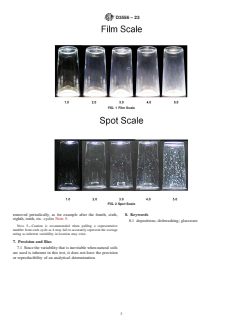
- Evaluation and Rating: Visual assessment is guided by rating scales for film and spotting. The standard recommends multiple trained raters and the use of statistical methods to compare results.
Applications
The ASTM D3556-23 standard is widely used in:
- Product Development: Manufacturers of household and commercial dishwasher detergents use this guide to improve and validate the cleaning performance of their products, ensuring they minimize spotting and filming on glassware under realistic conditions.
- Quality Control: The repeatable nature of the test means companies can routinely check detergent batches for performance consistency.
- Comparative Testing: Laboratories and consumer organizations utilize the standard to benchmark different detergent brands, formulations, and types.
- Institutional Settings: Although designed for consumer products, the guide is applicable for screening institutional and commercial dishwashing detergents for restaurants, cafeterias, and catering services.
- Regulatory Compliance: The method is recognized as an international reference for evaluating detergent effectiveness and as a tool for aligning products with global market requirements.
Related Standards
For comprehensive evaluation and harmonization with industry practices, the following related standards may be relevant:
- ASTM D4009 - Test Method for Spotting and Filming on Glassware in Automatic Dishwashing
- ISO 15883 - Washer-disinfectors for medical instruments
- ASTM D6286 - Guide for Selection of Cleaning Agents for Use in the Pharmaceutical Industry
- EN 60436 - Electric dishwashers for household use - Methods for measuring performance
Keywords: ASTM D3556-23, glassware deposition, mechanical dishwashing, detergent performance, spotting and filming, automatic dishwasher, laboratory screening test, water hardness, detergent testing standards
Adhering to ASTM D3556-23 ensures consistent, fair, and internationally accepted practices for evaluating dishwashing detergents, leading to better glassware cleanliness and improved consumer satisfaction.
Frequently Asked Questions
ASTM D3556-23 is a guide published by ASTM International. Its full title is "Standard Guide for Deposition on Glassware During Mechanical Dishwashing". This standard covers: SIGNIFICANCE AND USE 3.1 This test method is intended as a laboratory screening test to determine performance of the detergent under actual use conditions, but will not necessarily predict performance under all end-use conditions. SCOPE 1.1 This guide covers a procedure for measuring performance of a mechanical dishwashing detergent in terms of the buildup of spots and film on glassware. It is designed to evaluate household automatic dishwasher detergents but can be used as a screening test for institutional and commercial dishwashing products. 1.2 This standard does not purport to address all of the safety concerns, if any, associated with its use. It is the responsibility of the user of this standard to establish appropriate safety, health, and environmental practices and determine the applicability of regulatory limitations prior to use. 1.3 This international standard was developed in accordance with internationally recognized principles on standardization established in the Decision on Principles for the Development of International Standards, Guides and Recommendations issued by the World Trade Organization Technical Barriers to Trade (TBT) Committee.
SIGNIFICANCE AND USE 3.1 This test method is intended as a laboratory screening test to determine performance of the detergent under actual use conditions, but will not necessarily predict performance under all end-use conditions. SCOPE 1.1 This guide covers a procedure for measuring performance of a mechanical dishwashing detergent in terms of the buildup of spots and film on glassware. It is designed to evaluate household automatic dishwasher detergents but can be used as a screening test for institutional and commercial dishwashing products. 1.2 This standard does not purport to address all of the safety concerns, if any, associated with its use. It is the responsibility of the user of this standard to establish appropriate safety, health, and environmental practices and determine the applicability of regulatory limitations prior to use. 1.3 This international standard was developed in accordance with internationally recognized principles on standardization established in the Decision on Principles for the Development of International Standards, Guides and Recommendations issued by the World Trade Organization Technical Barriers to Trade (TBT) Committee.
ASTM D3556-23 is classified under the following ICS (International Classification for Standards) categories: 97.040.40 - Dishwashers; 97.040.60 - Cookware, cutlery and flatware. The ICS classification helps identify the subject area and facilitates finding related standards.
ASTM D3556-23 is available in PDF format for immediate download after purchase. The document can be added to your cart and obtained through the secure checkout process. Digital delivery ensures instant access to the complete standard document.
Standards Content (Sample)
This international standard was developed in accordance with internationally recognized principles on standardization established in the Decision on Principles for the
Development of International Standards, Guides and Recommendations issued by the World Trade Organization Technical Barriers to Trade (TBT) Committee.
Designation: D3556 − 23
Standard Guide for
Deposition on Glassware During Mechanical Dishwashing
This standard is issued under the fixed designation D3556; the number immediately following the designation indicates the year of
original adoption or, in the case of revision, the year of last revision. A number in parentheses indicates the year of last reapproval. A
superscript epsilon (´) indicates an editorial change since the last revision or reapproval.
1. Scope 4.2 Clear Undecorated Glass Tumblers,from8to15per
machine, a larger number being used if it is planned to remove
1.1 This guide covers a procedure for measuring perfor-
one tumbler at intervals throughout the test (see Note 5 in
mance of a mechanical dishwashing detergent in terms of the
Section 6.7.3). Ten tumblers simplify scoring.
buildup of spots and film on glassware. It is designed to
4.2.1 Before each use, even if new, the glass tumblers may
evaluatehouseholdautomaticdishwasherdetergentsbutcanbe
be cleaned in a machine, first in a 1 % solution of citric acid
used as a screening test for institutional and commercial
and then with a household automatic dishwashing detergent at
dishwashing products.
the manufacturer’s recommended use level, each in a normal
1.2 This standard does not purport to address all of the
wash cycle. Use deionized or distilled water for the rinses
safety concerns, if any, associated with its use. It is the
during this cleaning procedure. Do not use the drying cycle of
responsibility of the user of this standard to establish appro-
the machine until the tumblers appear to be free of soil or film.
priate safety, health, and environmental practices and deter-
No “water break” (droplet formation) should be evident when
mine the applicability of regulatory limitations prior to use.
the tumblers have been rinsed.
1.3 This international standard was developed in accor-
4.3 Standard Tableware (Note 2) (optional, see Section 6):
dance with internationally recognized principles on standard-
4.3.1 Suggested tableware is as follows, Dinner plates,
ization established in the Decision on Principles for the
10 in.diameter,Saladplates,7 in.diameter,Cerealbowls,6 in.
Development of International Standards, Guides and Recom-
diameter, Saucers, 6 in. diameter, and Cutlery, stainless steel.
mendations issued by the World Trade Organization Technical
Barriers to Trade (TBT) Committee.
NOTE 1—A mixture of china and plastic dishes is recommended but is
not essential; any standard quality type of dishware is satisfactory.
2. Summary of Test Method
4.3.2 For each machine used, six dinner plates, six knives,
2.1 Glass tumblers are given multiple washes in a mechani-
six forks, and six spoons are required, plus optionally enough
cal dishwasher in the presence of food soil and the levels of
of the other dishes to fill the lower rack of each machine (see
spotting and filming allowed by the detergents under test are
Section 6).
compared visually.
4.4 Light Box for Visual Evaluation of Tumblers—A typical
light box is rectangular, open to the front, and has dead black
3. Significance and Use
insidesurfaces.Itislargeenoughtoholdupto15tumblersside
3.1 This test method is intended as a laboratory screening
by side. Fluorescent lights are mounted in the base of the box
test to determine performance of the detergent under actual use
in such a manner that light passes up through the tumblers. It
conditions, but will not necessarily predict performance under
is preferable to have the light come only through the tumblers
all end-use conditions.
and have the area surrounding them blocked out by suitable
means. Adding dividers between tumblers is also recom-
4. Apparatus
mended to aid in the assessment.
4.1 Automatic Dishwasher(s)—Typical household machines
should be selected. If more than one machine is required, pairs
5. Materials and Manufacture
with consecutive production numbers are recommended. For
5.1 Standard Food Soil Components: nonfat powdered
further refinement, two or more pairs of differing makes,
milk, margarine, and wheat-based cooked cereal (optional).
models, or ages (pair to pair) may be used.
5.2 Standard Food Soil Preparation—A mixture of 80
weight % of margarine and 20 weight % of powdered milk is
This guide is under the jurisdiction of ASTM Committee D12 on Soaps and
prepared.The margarine is warmed until fluid (not over 100 °F
Other Detergents, and is the direct responsibility of Subcommittee D12.16 on Hard
(37.8 °C)) and the powdered milk is sifted in and mixed
Surface Cleaning.
Current edition approved Jan. 1, 2023. Published January 2023. Originally
approved in 1976 as D3556–76 T. Last previous edition approved in 2014 as
D3556–14. DOI: 10.1520/D3556-23. Any commercial brand of these items is satisfactory.
Copyright © ASTM International, 100 Barr Harbor Drive, PO Box C700, West Conshohocken, PA 19428-2959. United States
D3556 − 23
thoroughly.The mixture should be refrigerated when not in use 6.3.1 The calcium/magnesium ratio of hardness minerals
and not kept more than 2 weeks. (expressed as CaCO3) should be adjusted to attain different
water hardness as shown in Table 1.
5.3 Optional Food Soil Preparation—This mixture consists
6.3.2 Hard Water Stock Solution—For a 2:1 ratio, prepare a
of 70 % margarine, 15 % powdered milk, and 15 % cooked
hard water stock solution by dissolving 2.940 g of calcium
cereal. The cooked cereal is separately prepared as follows:
chloride dihydrate (CaCl ·2H O) and 2.033 g of magnesium
2 2
Add 45 g of cereal to 228 g of water, heat to boiling, and boil
chloride hexahydrate (MgCl ·6H O) in deionized (DI) water.
2 2
for 5 min. Dissolve 100 g of powdered milk in 500 g of water
Dilute to a volume of 1 L with additional DI water. This
and stir this solution into the cooked cereal. Continue stirring
solution contains 3000 ppm hardness (expressed as calcium
as portions are removed to be combined with margarine and
carbonate) with a Ca:Mg molar ratio of 2:1. For a 3:1 ratio, use
powdered milk that have been blended as in 5.2. This mixture
4.41gofcalciumchloridedihydrate(CaCl ·2H O)and2.033 g
2 2
should be made up as required. (Use of this optional soil makes
of magnesium chloride hexahydrate (MgCl ·6H O) in DI
2 2
the test more realistic by adding another difficult-to-remove
water. Larger batches or concentrations may be scaled up using
component.)
this ratio of calcium chloride to magnesium chloride. Caution
6. Procedure should be used when storing batches of har
...
This document is not an ASTM standard and is intended only to provide the user of an ASTM standard an indication of what changes have been made to the previous version. Because
it may not be technically possible to adequately depict all changes accurately, ASTM recommends that users consult prior editions as appropriate. In all cases only the current version
of the standard as published by ASTM is to be considered the official document.
Designation: D3556 − 14 D3556 − 23
Standard Guide for
Deposition on Glassware During Mechanical Dishwashing
This standard is issued under the fixed designation D3556; the number immediately following the designation indicates the year of
original adoption or, in the case of revision, the year of last revision. A number in parentheses indicates the year of last reapproval. A
superscript epsilon (´) indicates an editorial change since the last revision or reapproval.
1. Scope
1.1 This guide covers a procedure for measuring performance of a mechanical dishwashing detergent in terms of the buildup of
spots and film on glassware. It is designed to evaluate household automatic dishwasher detergents but can be used as a screening
test for institutional and commercial dishwashing products.
1.2 This standard does not purport to address all of the safety concerns, if any, associated with its use. It is the responsibility
of the user of this standard to establish appropriate safety safety, health, and healthenvironmental practices and determine the
applicability of regulatory limitations prior to use.
1.3 This international standard was developed in accordance with internationally recognized principles on standardization
established in the Decision on Principles for the Development of International Standards, Guides and Recommendations issued
by the World Trade Organization Technical Barriers to Trade (TBT) Committee.
2. Summary of Test Method
2.1 Glass tumblers are given multiple washes in a mechanical dishwasher in the presence of food soil and the levels of spotting
and filming allowed by the detergents under test are compared visually.
3. Significance and Use
3.1 This test method is intended as a laboratory screening test to determine performance of the detergent under actual use
conditions, but will not necessarily predict performance under all end-use conditions.
4. Apparatus
4.1 Automatic Dishwasher(s)—Typical household machines should be selected. If more than one machine is required, pairs with
consecutive production numbers are recommended. For further refinement, two or more pairs of differing makes, models, or ages
(pair to pair) may be used.
4.2 Clear Undecorated Glass Tumblers, from 8 to 15 per machine, a larger number being used if it is planned to remove one
tumbler at intervals throughout the test (see Note 5 in Section 66.7.3). Ten tumblers simplify scoring.
4.2.1 Before each use, even if new, the glass tumblers may be cleaned in a machine, first in a 1 % solution of citric acid and then
with a household automatic dishwashing detergent at the manufacturer’s recommended use level, each in a normal wash cycle. Use
deionized or distilled water for the rinses during this cleaning procedure. Do not use the drying cycle of the machine until the
This guide is under the jurisdiction of ASTM Committee D12 on Soaps and Other Detergents, and is the direct responsibility of Subcommittee D12.16 on Hard Surface
Cleaning.
Current edition approved Nov. 1, 2014Jan. 1, 2023. Published December 2014 January 2023. Originally approved in 1976 as D3556–76 T. Last previous edition approved
in 20092014 as D3556–85(2009).D3556–14. DOI: 10.1520/D3556-14.10.1520/D3556-23.
Copyright © ASTM International, 100 Barr Harbor Drive, PO Box C700, West Conshohocken, PA 19428-2959. United States
D3556 − 23
tumblers appear to be free of soil or film. No “water break” (droplet formation) should be evident when the tumblers have been
rinsed. Any other procedure (such as hand washing and polishing) which yields tumblers that are spot- and film-free may be used.
4.3 Standard Tableware (Note 2) (optional, see Section 6):
4.3.1 Suggested tableware is as follows, Dinner plates, 10-in.10 in. diameter, Salad plates, 7-in.7 in. diameter, Cereal bowls,
6-in.6 in. diameter, Saucers, 6-in.6 in. diameter, and Cutlery, stainless steel.
NOTE 1—A mixture of china and plastic dishes is recommended but is not essential; any standard quality type of dishware is satisfactory.
4.3.2 For each machine used, six dinner plates, six knives, six forks, and six spoons are required, plus optionally enough of the
other dishes to fill the lower rack of each machine (see Section 6).
4.4 Light Box for Visual Evaluation of Tumblers—A typical light box is rectangular, open to the front, and has dead black inside
surfaces. It is large enough to hold up to 15 tumblers side by side. Fluorescent lights are mounted in the base of the box in such
a manner that light passes up through the tumblers. It is preferable to have the light come only through the tumblers and have the
area surrounding them blocked out by suitable means. Adding dividers between tumblers is also recommended to aid in the
assessment.
5. Materials and Manufacture
5.1 Standard Food Soil Components: nonfat nonfat powdered milk, margarine, and wheat-based cooked cereal (optional).
5.2 Standard Food Soil Preparation—A mixture of 80 weight % of margarine and 20 weight % of powdered milk is prepared. The
margarine is warmed until fluid (not over 100°F (37.8°C))100 °F (37.8 °C)) and the powdered milk is sifted in and mixed
thoroughly. The mixture should be refrigerated when not in use and not kept more than 2 weeks.
5.3 Optional Food Soil Preparation—This mixture consists of 70 % margarine, 15 % powdered milk, and 15 % cooked cereal. The
cooked cereal is separately prepared as follows: Add 45 g of cereal to 228 g of water, heat to boiling, and boil for 5 min. Dissolve
100 g of powdered milk in 500 g of water and stir this solution into the cooked cereal. Continue stirring as portions are removed
to be combined with margarine and powdered milk that have been blended as in 5.2. This mixture should be made up as required.
(Use of this optional soil makes the test more realistic by adding another difficult-to-remove component.)
6. Procedure
6.1 Using a spatula or a food brush, distribute a total of 40 g of food soil equally across the six dinner plates, so that each plate
has 6.66 g of soil. Load the machine as follows: In the lower (plate) rack, distribute the six soiled dinner plates uniformly with
the smaller plates and bowls, if used (Note 2), placed alternately about the dinner plates until the rack is fully loaded. In the upper
(glass) rack, distribute the glass tumblers evenly. If eight or ten are used, place them along each side, four or five to a side.
Optionally, use extra tumblers, so that one can be removed periodically for comparative purposes.
NOTE 2—Optionally the smaller chinaware pieces may be omitted and only dinner plates used.
6.1.1 In the silverware rack or holder, place six each of the stainless steel knives, forks, and spoons.
6.2 Water Temperature—Maintain a water temperature of 130130 °F 6 5°F (54.45 °F (54.4 °C 6 3.8°C
...