

ASTM D8356-20
(Test Method)Standard Test Method for Sonic Velocity in Manufactured Carbons and Graphite Materials for use in Obtaining Approximate Elastic Constants: Young’s Modulus, Shear Modulus, and Poisson’s Ratio
General Information
- Abstract
SIGNIFICANCE AND USE
5.1 Sonic velocity measurements are useful for comparing materials with similar elastic properties, dimensions, and microstructure.
5.2 Eq 1 provides an accurate value of Young’s modulus only for isotropic, non-attenuative, non-dispersive materials of infinite dimensions. For non-isotropic graphite Eq 1 can be modified to take into account the Poisson’s ratios in all directions. As graphite is a strongly attenuative material, the value of Young’s modulus obtained with Eq 1 will be dependent on specimen length. If the specimen lateral dimensions are not large compared with the wavelength of the propagated pulse, then the value of Young’s modulus obtained with Eq 1 will be dependent on the specimen lateral dimensions. The accuracy of the Young’s modulus calculated from Eq 1 will also depend upon uncertainty in Poisson’s ratio and its impact on the evaluation of the Poisson’s factor in Eq 2. However, a value for Young’s modulus Eq 1 or Eq 7) can be obtained for many applications, which is often in good agreement with the value obtained by other more accurate methods, such as in Test Method C747. The technical issues and typical values of corresponding uncertainties are discussed in detail in STP 1578.6
5.3 If the grain size of the carbon or graphite is greater than or about equal to the wavelength of the sonic pulse, the method may not provide a value of the Young’s modulus representative of the bulk material. Therefore it would be desirable to test a lower frequency (longer wavelength) to demonstrate that the range of obtained velocity values are within acceptable levels of accuracy. Significant signal attenuation should be expected when grain size of the material is greater than or about equal to the wavelength of the transmitted sonic pulse or the material is more porous than would be expected for as-manufactured graphite.
Note 1: Due to frequency dependent attenuation in graphite, the wavelength of the sonic pulse through the test specimen is not necessaril...
SCOPE
1.1 This test method covers a procedure for measuring the longitudinal and transverse (shear) sonic velocities in manufactured carbon and graphite which can be used to obtain approximate values for the elastic constants: Young’s modulus (E), the shear modulus (G), and Poisson’s ratio (v).
1.2 The values stated in SI units are to be regarded as standard. No other units of measurement are included in this standard.
1.3 This standard does not purport to address all of the safety concerns, if any, associated with its use. It is the responsibility of the user of this standard to establish appropriate safety, health, and environmental practices and determine the applicability of regulatory limitations prior to use.
1.4 This international standard was developed in accordance with internationally recognized principles on standardization established in the Decision on Principles for the Development of International Standards, Guides and Recommendations issued by the World Trade Organization Technical Barriers to Trade (TBT) Committee.
- Status
- Published
- Publication Date
- 30-Sep-2020
- Technical Committee
- D02 - Petroleum Products, Liquid Fuels, and Lubricants
- Drafting Committee
- D02.F0 - Manufactured Carbon and Graphite Products
Overview
ASTM D8356-20 outlines a standard test method for measuring the sonic velocity in manufactured carbons and graphite materials. This method is key for determining approximate elastic constants, specifically Young’s modulus, shear modulus, and Poisson’s ratio, which are essential parameters for understanding the mechanical performance of these materials. By assessing the transmission of sonic pulses through carbon and graphite specimens, users can compare the elastic properties of materials, aiding in material selection and quality control processes.
This test method uses SI units as the standard and is applicable to a range of manufactured carbon and graphite products, making it relevant across industries where these materials are critical, such as nuclear energy, aerospace, and electronics.
Key Topics
- Sonic Velocity Measurements: Provides procedures for determining both longitudinal and shear wave velocities in specimens, which serve as the basis for calculating elastic constants.
- Calculation of Elastic Constants: Enables the estimation of Young’s modulus, shear modulus, and Poisson’s ratio from measured sonic velocities and material density.
- Material Considerations: Recognizes the influence of grain size, porosity, and anisotropy on test results and highlights the need for careful specimen selection and preparation.
- Specimen and Signal Requirements: Details best practices for specimen geometry, transducer coupling, and pulse frequency selection to ensure measurement accuracy.
- Limitations and Accuracy: Discusses sources of uncertainty, such as signal attenuation, grain size effects, and geometric constraints, and provides guidance on mitigating these issues.
- Reporting and Precision: Recommends reporting practices for test results and includes requirements for documenting key variables, such as specimen dimensions, coupling media, and environmental conditions.
Applications
The ASTM D8356-20 standard is widely used in several industries where carbon and graphite materials are essential due to their unique thermal and mechanical properties. Common applications include:
- Nuclear Industry: For assessing graphite blocks and components used in nuclear reactors, where reliable mechanical property data is crucial for safety and performance.
- Aerospace and Defense: In evaluation of lightweight, high-strength carbon-based structural components exposed to dynamic stresses.
- Electronics and Energy Storage: For quality control of graphite used in batteries and fuel cells, where elastic properties affect performance and longevity.
- Research and Development: In material characterization, comparison of new graphite formulations, and validation of manufacturing consistency.
By enabling approximate yet reliable estimates of elastic properties, this test method supports material selection, specification compliance, and quality assurance processes.
Related Standards
Several other ASTM and international standards are referenced and complement ASTM D8356-20, including:
- ASTM C559: Test Method for Bulk Density by Physical Measurements of Manufactured Carbon and Graphite Articles.
- ASTM C747: Test Method for Moduli of Elasticity and Fundamental Frequencies of Carbon and Graphite Materials by Sonic Resonance (a more accurate alternative for modulus measurement).
- ASTM D6300: Practice for Determination of Precision and Bias Data for Use in Test Methods.
- ASTM D4175: Terminology Relating to Petroleum Products, Liquid Fuels, and Lubricants.
- ASTM D7775: Guide for Measurements on Small Graphite Specimens.
- IEEE/ASTM SI 10: Standard for Use of the International System of Units (SI).
- ASTM STP 1578: Provides detailed discussion on technical issues and uncertainties related to sonic testing of graphite.
These related standards help users select appropriate methods, understand terminology, and ensure best practices in laboratory and field measurements for carbon and graphite materials.
Keywords: ASTM D8356-20, sonic velocity, carbon, graphite, elastic constants, Young’s modulus, shear modulus, Poisson’s ratio, material characterization, ultrasonic testing, mechanical properties
Relations
- Effective Date
- 01-Mar-2024
- Refers
ASTM D4175-23a - Standard Terminology Relating to Petroleum Products, Liquid Fuels, and Lubricants - Effective Date
- 15-Dec-2023
- Effective Date
- 01-Dec-2023
- Effective Date
- 01-Oct-2023
- Refers
ASTM D4175-23e1 - Standard Terminology Relating to Petroleum Products, Liquid Fuels, and Lubricants - Effective Date
- 01-Jul-2023
- Effective Date
- 01-May-2020
- Effective Date
- 01-Dec-2019
- Effective Date
- 01-Oct-2016
- Effective Date
- 01-Apr-2016
- Effective Date
- 01-Jan-2016
- Effective Date
- 01-Jun-2015
- Effective Date
- 01-Jun-2015
- Effective Date
- 01-Jun-2014
- Effective Date
- 01-Jun-2014
- Effective Date
- 01-May-2014
Get Certified
Connect with accredited certification bodies for this standard

Control Union Certifications
Global certification for agriculture and sustainability.

ECOCERT
Organic and sustainability certification.

Hohenstein Institut
Textile testing and certification.
Sponsored listings
Frequently Asked Questions
ASTM D8356-20 is a standard published by ASTM International. Its full title is "Standard Test Method for Sonic Velocity in Manufactured Carbons and Graphite Materials for use in Obtaining Approximate Elastic Constants: Young’s Modulus, Shear Modulus, and Poisson’s Ratio". This standard covers: SIGNIFICANCE AND USE 5.1 Sonic velocity measurements are useful for comparing materials with similar elastic properties, dimensions, and microstructure. 5.2 Eq 1 provides an accurate value of Young’s modulus only for isotropic, non-attenuative, non-dispersive materials of infinite dimensions. For non-isotropic graphite Eq 1 can be modified to take into account the Poisson’s ratios in all directions. As graphite is a strongly attenuative material, the value of Young’s modulus obtained with Eq 1 will be dependent on specimen length. If the specimen lateral dimensions are not large compared with the wavelength of the propagated pulse, then the value of Young’s modulus obtained with Eq 1 will be dependent on the specimen lateral dimensions. The accuracy of the Young’s modulus calculated from Eq 1 will also depend upon uncertainty in Poisson’s ratio and its impact on the evaluation of the Poisson’s factor in Eq 2. However, a value for Young’s modulus Eq 1 or Eq 7) can be obtained for many applications, which is often in good agreement with the value obtained by other more accurate methods, such as in Test Method C747. The technical issues and typical values of corresponding uncertainties are discussed in detail in STP 1578.6 5.3 If the grain size of the carbon or graphite is greater than or about equal to the wavelength of the sonic pulse, the method may not provide a value of the Young’s modulus representative of the bulk material. Therefore it would be desirable to test a lower frequency (longer wavelength) to demonstrate that the range of obtained velocity values are within acceptable levels of accuracy. Significant signal attenuation should be expected when grain size of the material is greater than or about equal to the wavelength of the transmitted sonic pulse or the material is more porous than would be expected for as-manufactured graphite. Note 1: Due to frequency dependent attenuation in graphite, the wavelength of the sonic pulse through the test specimen is not necessaril... SCOPE 1.1 This test method covers a procedure for measuring the longitudinal and transverse (shear) sonic velocities in manufactured carbon and graphite which can be used to obtain approximate values for the elastic constants: Young’s modulus (E), the shear modulus (G), and Poisson’s ratio (v). 1.2 The values stated in SI units are to be regarded as standard. No other units of measurement are included in this standard. 1.3 This standard does not purport to address all of the safety concerns, if any, associated with its use. It is the responsibility of the user of this standard to establish appropriate safety, health, and environmental practices and determine the applicability of regulatory limitations prior to use. 1.4 This international standard was developed in accordance with internationally recognized principles on standardization established in the Decision on Principles for the Development of International Standards, Guides and Recommendations issued by the World Trade Organization Technical Barriers to Trade (TBT) Committee.
SIGNIFICANCE AND USE 5.1 Sonic velocity measurements are useful for comparing materials with similar elastic properties, dimensions, and microstructure. 5.2 Eq 1 provides an accurate value of Young’s modulus only for isotropic, non-attenuative, non-dispersive materials of infinite dimensions. For non-isotropic graphite Eq 1 can be modified to take into account the Poisson’s ratios in all directions. As graphite is a strongly attenuative material, the value of Young’s modulus obtained with Eq 1 will be dependent on specimen length. If the specimen lateral dimensions are not large compared with the wavelength of the propagated pulse, then the value of Young’s modulus obtained with Eq 1 will be dependent on the specimen lateral dimensions. The accuracy of the Young’s modulus calculated from Eq 1 will also depend upon uncertainty in Poisson’s ratio and its impact on the evaluation of the Poisson’s factor in Eq 2. However, a value for Young’s modulus Eq 1 or Eq 7) can be obtained for many applications, which is often in good agreement with the value obtained by other more accurate methods, such as in Test Method C747. The technical issues and typical values of corresponding uncertainties are discussed in detail in STP 1578.6 5.3 If the grain size of the carbon or graphite is greater than or about equal to the wavelength of the sonic pulse, the method may not provide a value of the Young’s modulus representative of the bulk material. Therefore it would be desirable to test a lower frequency (longer wavelength) to demonstrate that the range of obtained velocity values are within acceptable levels of accuracy. Significant signal attenuation should be expected when grain size of the material is greater than or about equal to the wavelength of the transmitted sonic pulse or the material is more porous than would be expected for as-manufactured graphite. Note 1: Due to frequency dependent attenuation in graphite, the wavelength of the sonic pulse through the test specimen is not necessaril... SCOPE 1.1 This test method covers a procedure for measuring the longitudinal and transverse (shear) sonic velocities in manufactured carbon and graphite which can be used to obtain approximate values for the elastic constants: Young’s modulus (E), the shear modulus (G), and Poisson’s ratio (v). 1.2 The values stated in SI units are to be regarded as standard. No other units of measurement are included in this standard. 1.3 This standard does not purport to address all of the safety concerns, if any, associated with its use. It is the responsibility of the user of this standard to establish appropriate safety, health, and environmental practices and determine the applicability of regulatory limitations prior to use. 1.4 This international standard was developed in accordance with internationally recognized principles on standardization established in the Decision on Principles for the Development of International Standards, Guides and Recommendations issued by the World Trade Organization Technical Barriers to Trade (TBT) Committee.
ASTM D8356-20 is classified under the following ICS (International Classification for Standards) categories: 59.100.20 - Carbon materials; 71.100.99 - Other products of the chemical industry. The ICS classification helps identify the subject area and facilitates finding related standards.
ASTM D8356-20 has the following relationships with other standards: It is inter standard links to ASTM D6300-24, ASTM D4175-23a, ASTM D6300-23a, ASTM C747-23, ASTM D4175-23e1, ASTM C559-16(2020), ASTM D6300-19a, ASTM C747-16, ASTM D6300-16, ASTM C559-16, ASTM D6300-15, ASTM D7775-11(2015), ASTM D6300-14ae1, ASTM D6300-14a, ASTM D6300-14. Understanding these relationships helps ensure you are using the most current and applicable version of the standard.
ASTM D8356-20 is available in PDF format for immediate download after purchase. The document can be added to your cart and obtained through the secure checkout process. Digital delivery ensures instant access to the complete standard document.
Standards Content (Sample)
This international standard was developed in accordance with internationally recognized principles on standardization established in the Decision on Principles for the
Development of International Standards, Guides and Recommendations issued by the World Trade Organization Technical Barriers to Trade (TBT) Committee.
Designation: D8356 − 20
Standard Test Method for
Sonic Velocity in Manufactured Carbons and Graphite
Materials for use in Obtaining Approximate Elastic
Constants: Young’s Modulus, Shear Modulus, and Poisson’s
Ratio
This standard is issued under the fixed designation D8356; the number immediately following the designation indicates the year of
original adoption or, in the case of revision, the year of last revision. A number in parentheses indicates the year of last reapproval. A
superscript epsilon (´) indicates an editorial change since the last revision or reapproval.
1. Scope C747 Test Method for Moduli of Elasticity and Fundamental
Frequencies of Carbon and Graphite Materials by Sonic
1.1 This test method covers a procedure for measuring the
Resonance
longitudinal and transverse (shear) sonic velocities in manu-
D4175 Terminology Relating to Petroleum Products, Liquid
factured carbon and graphite which can be used to obtain
Fuels, and Lubricants
approximate values for the elastic constants: Young’s modulus
D6300 Practice for Determination of Precision and Bias
(E), the shear modulus (G), and Poisson’s ratio (v).
Data for Use in Test Methods for Petroleum Products,
1.2 The values stated in SI units are to be regarded as
Liquid Fuels, and Lubricants
standard. No other units of measurement are included in this
D7775 Guide for Measurements on Small Graphite Speci-
standard.
mens
1.3 This standard does not purport to address all of the
E691 Practice for Conducting an Interlaboratory Study to
safety concerns, if any, associated with its use. It is the Determine the Precision of a Test Method
responsibility of the user of this standard to establish appro-
IEEE/ASTM SI 10 Standard for Use of the International
priate safety, health, and environmental practices and deter- System of Units (SI) (the Modern Metric System)
mine the applicability of regulatory limitations prior to use.
1.4 This international standard was developed in accor- 3. Terminology
dance with internationally recognized principles on standard-
3.1 Definitions of Terms Specific to This Standard:
ization established in the Decision on Principles for the
3.1.1 end correction time (T ), n—a fixed correction time
e
Development of International Standards, Guides and Recom-
associated with the potential interaction of the couplant me-
mendations issued by the World Trade Organization Technical
dium and the test material.
Barriers to Trade (TBT) Committee.
3.1.2 longitudinal sonic pulse, n—asonicpulseinwhichthe
2. Referenced Documents
displacements are in the direction of propagation of the pulse.
2.1 ASTM Standards: 3.1.3 pulse travel time, (T), n—the total time, measured in
t
C559 Test Method for Bulk Density by Physical Measure- seconds, required for the sonic pulse to traverse the specimen
ments of Manufactured Carbon and Graphite Articles being tested, and for the associated electronic signals to
traversethetransducercouplingmediumandelectroniccircuits
of the pulse-propagation system.
This test method is under the jurisdiction of ASTM Committee D02 on
Petroleum Products, Liquid Fuels, and Lubricants and is the direct responsibility of
3.1.4 shear or transverse sonic pulse, n—a sonic pulse in
Subcommittee D02.F0 on Manufactured Carbon and Graphite Products.
which the displacements are perpendicular to the direction of
Current edition approved Oct. 1, 2020. Published December 2020. DOI:
propagation of the pulse.
10.1520/D8356-20.
For referenced ASTM standards, visit the ASTM website, www.astm.org, or
3.1.5 time of flight (ToF), n—the total time, measured in
contact ASTM Customer Service at service@astm.org. For Annual Book of ASTM
seconds, required for the sonic pulse to traverse the specimen
Standards volume information, refer to the standard’s Document Summary page on
the ASTM website. being tested (T – T ).
t 0
Copyright © ASTM International, 100 Barr Harbor Drive, PO Box C700, West Conshohocken, PA 19428-2959. United States
D8356 − 20
3.1.6 zero time, (T ), n—the travel time (correction factor), 4.7 The shear modulus is given by Eq 3 and a Young’s
measured in seconds, associated with the transducer, coupling modulus, E, can be obtained from Eq 1 and Eq 2 with C
v
medium and electronic circuits in the pulse-propagation sys- calculated using the value of Poisson’s ratio from Eq 4.
tem.
5. Significance and Use
4. Summary of Test Method
5.1 Sonic velocity measurements are useful for comparing
4.1 The velocity of sound waves passing through the test materials with similar elastic properties, dimensions, and
microstructure.
specimen is determined by measuring the distance through the
specimen and dividing by the time lapse, between the trans-
5.2 Eq 1 provides an accurate value of Young’s modulus
3,4
mitted pulse and the received pulse. Provided the wave-
only for isotropic, non-attenuative, non-dispersive materials of
lengthofthetransmittedpulseisasufficientlysmallfractionof
infinite dimensions. For non-isotropic graphite Eq 1 can be
the sample’s lateral dimensions, a value of Young’s modulus
modified to take into account the Poisson’s ratios in all
for isotropic graphite can then be obtained using Eq 1 and 2:
directions. As graphite is a strongly attenuative material, the
E 5 C ρV (1) value of Young’s modulus obtained with Eq 1 will be depen-
v L
dentonspecimenlength.Ifthespecimenlateraldimensionsare
where:
not large compared with the wavelength of the propagated
E = Young’s modulus, Pa,
pulse, then the value of Young’s modulus obtained with Eq 1
ρ = density, kg/m ,
will be dependent on the specimen lateral dimensions. The
V = longitudinal signal velocity, m/s, and
L
accuracy of the Young’s modulus calculated from Eq 1 will
C = Poisson’s factor.
v
also depend upon uncertainty in Poisson’s ratio and its impact
4.2 The Poisson’s factor, C , is related to Poisson’s ratio, v,
on the evaluation of the Poisson’s factor in Eq 2. However, a
v
by the equation:
value for Young’s modulus Eq 1 or Eq 7) can be obtained for
many applications, which is often in good agreement with the
1 1 v 1 2 2 v
~ !~ !
C 5 (2)
v
value obtained by other more accurate methods, such as inTest
1 2 v
Method C747. The technical issues and typical values of
4.3 If the Poisson’s factor is unknown, it can be assumed as
corresponding uncertainties are discussed in detail in STP
an approximation of the method. For nuclear graphites a
1578.
typical Poisson’s ratio of 0.2 corresponds to a Poisson’s factor
5.3 If the grain size of the carbon or graphite is greater than
of 0.9.
oraboutequaltothewavelengthofthesonicpulse,themethod
4.4 If the wavelength is not a small fraction of the samples
may not provide a value of theYoung’s modulus representative
lateral dimensions, and instead is much larger than the speci-
of the bulk material. Therefore it would be desirable to test a
mens lateral dimensions, thenYoung’s modulus, E, is given by
lower frequency (longer wavelength) to demonstrate that the
Eq 1 with C set to unity rather the being determined by Eq 2.
v
range of obtained velocity values are within acceptable levels
4.5 The shear velocity can be obtained from Eq 3:
of accuracy. Significant signal attenuation should be expected
when grain size of the material is greater than or about equal to
G 5 ρV (3)
S
the wavelength of the transmitted sonic pulse or the material is
where:
more porous than would be expected for as-manufactured
G = shear modulus, Pa,
graphite.
ρ = density, kg/m , and
NOTE 1—Due to frequency dependent attenuation in graphite, the
V = shear signal velocity, m/s.
S
wavelength of the sonic pulse through the test specimen is not necessarily
4.6 All of the elastic constants for an isotropic material can
the same wavelength of the transmitting transducer.
be calculated from two wave velocities, the longitudinal wave
5.4 Ifthesampleisonlyafewgrainsthick,theacceptability
velocity and the shear wave velocity and the material density.
of the method’s application should be demonstrated by initially
In particular,
performing measurements on a series of dummy specimens
V covering a range of lengths between the proposed test speci-
S
1 2 2
F S D G
men’s length and a specimen length incorporating sufficient
V
L
Poisson’s ratio, v 5 (4)
V grains to adequately represent the bulk material.
S
2 2 2
F S D G
V
L
6. Apparatus
where V and V are the measured shear and longitudinal
S L
wave velocities (m/s) (see Eq 5 and Eq 6).
6.1 Driving Circuit, consisting of an ultrasonic pulse gen-
erator.
3 6.1.1 The user should select a pulse frequency to suit the
Schreiber, Anderson, and Soga, Elastic Constants and Their Measurement,
McGraw-HillBookCo.,1221AvenueoftheAmericas,NewYork,NY10020,1973. material microstructure and specimen elastic properties and
AmericanInstituteofPhysicsHandbook,3rded.,McGraw-HillBookCo.,1221
Avenue of the Americas, New York 10020, 1972, pp. 3–98ff.
5 6
Blessing, G. V., “The Pulsed Ultrasonic Velocity Method for Determining ASTM Selected Technical Papers, STP 1578, Graphite Testing for Nuclear
Material Dynamic Elastic Moduli,” Dynamic Elastic Modulus Measurement in Applications: The Significance of Test Specimen Volume and Geometry and the
Materials, ASTM STP 1045, A Wolfenden, Ed., American Society for Testing and Statistical Significance of Test Specimen Population, 2014, edited by Tzelepi and
Materials, Philadelphia, PA 1990. Carroll.
D8356 − 20
dimensions being tested. High frequencies are attenuated by uniform in cross section, and free from extraneous liquids.The
carbon and graphite materials and, while typical practicable specimen end faces shall be perpendicular to the specimen
frequencies lie in the range 0.5 MHz to 2.6 MHz, the user may cylindrical surface to within 0.125 mm total indicator reading.
show that frequencies outside this range are acceptable.
7.2 Measurement of Weight and Dimensions—Determine
6.2 Transducer, input, with suitable coupling medium (see theweightandthemeanspecimendimensionsperTestMethod
8.8.1 and Note 4). C559.
7.2.1 For samples outside the specification of Test Method
6.3 Transducer, output, with suitable coupling medium (see
C559, follow the guidance of Guide D7775.
8.8.1 and Note 4).
7.3 Limitations on Dimensions—These cannot be precisely
6.4 Computer, with analogue to digital converter, or
specified as they will depend on the properties of the material
oscilloscope, and external trigger from driving circuit.
being tested. In order to satisfy the theory that supports Eq 1,
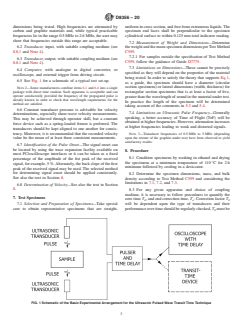
6.5 See Fig. 1 for a schematic of a typical test set-up.
as a guide, the specimen should have a diameter (circular
section specimens) or lateral dimensions (width, thickness) for
NOTE 2—Some manufacturers combine items 6.1 and 6.4 into a single
package with direct time readout. Such apparatus is acceptable and can rectangular section specimens that is at least a factor of five,
operate satisfactorily provided the frequency of the propagated pulse is
greater than the wavelength of sound in the material under test.
already known in order to check that wavelength requirements for the
In practice the length of the specimen will be determined
method are satisfied.
taking account of the comments in 5.3 and 5.4.
6.6 Constant transducer pressure is advisable for velocity
7.4 Limitations on Ultrasonic Pulse Frequency—Generally
determinations, especially shear-wave velocity measurements.
speaking, a better accuracy of Time of Flight (ToF) will be
This may be achieved through operator skill, but a constant
obtained at higher frequencies. However, attenuation increases
force device such as a spring-loaded fixture is preferred. The
at higher frequencies leading to weak and distorted signals.
transducers should be kept aligned to one another for consis-
tency. Moreover, it is recommended that the recorded velocity
NOTE 3—Transducer frequencies of 0.5 MHz to 5 MHz (depending
upon the texture of the graphite under test) have been observed to yield
value be the mean of at least three consistent measurements.
satisfactory results.
6.7 Identification of the Pulse Onset—The signal onset can
be located by using the trace expansion facility available on
8. Procedure
most PC/oscilloscope interfaces or it can be taken as a fixed
8.1 Condition specimens by washing in ethanol and drying
percentage of the amplitude of the fist peak of the received
the specimens at a minimum temperature of 110 °C for 2 h
signal, for example, 5 %.Alternately, the back slope of the first
minimum followed by cooling in a desiccator.
peak of the received signal may be used. The selected method
for determining signal onset should be applied consistently.
8.2 Determine the specimen dimensions, mass, and bulk
See also the text in Section 8. density according to Test Method C559 and considering the
limitations in 7.1, 7.2, and 7.3.
6.8 Determination of Velocity—See also the text in Section
8.
8.3 For any given apparatus and choice of coupling
medium, it is necessary to follow procedures to quantify the
7. Test Specimens
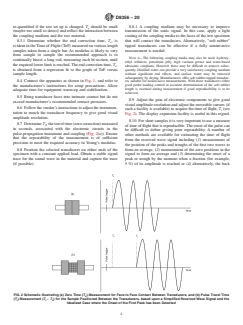
zero time T , and end correction time, T . Correction factor T
0 e 0
7.1 Selection and Preparation of Specimens—Take special will be dependent upon the type of transducers and their
care to obtain representative specimens that are straight, performanceovertimeshouldberegularlychecked.T mustbe
FIG. 1 Schematic of the Basic Experimental Arrangement for the Ultrasonic Pulsed Wave Transit Time Technique
D8356 − 20
re-quantified if the test set up is changed. T should be small 8.8.1 A coupling medium may be necessary to improve
e
(maybe too small to detect) and reflect the interaction between transmission of the sonic signal. In this case, apply a light
the coupling medium and the test material. coating of the coupling media to the faces of the test specimen
8.3.1 Determine whether the end correction time, T,is that will contact the transducers. Alternatively, “soft rubber”
e
evident in theTime of Flight (ToF) measured on various length tipped transducers can be effective if a fully noninvasive
samples taken from a single bar. As modulus is likely to vary measurement is needed.
from sample to sample the recommended approach is to
NOTE 4—The following coupling media may also be used: hydroxy-
continually bisect a long rod, measuring each bi-section, until
ethyl cellulose, petroleum jelly, high vacuum grease and water-based
therequiredlowerlimitisreached.Theendcorrectiontime,T ,
e ultrasonic couplants. However these may be difficult to remove subse-
is obtained from a regression fit to the graph of ToF versus quently. Distilled water can provide a very satisfactory coupling medium
without significant end effects, and surface water may be removed
sample length.
subsequently by drying. Manufacturers offer soft rubber-tipped transduc-
8.4 Connect the apparatus as shown in Fig. 1, and refer to
ers suitable for noninvasive measurements. With these transducers either
the manufacturer’s instructions for setup precautions. Allow good probe loading control or accurate determination of the soft rubber
length is essential during measurement if good reproducibility is to be
adequate time for equipment warm-up and stabilization.
achieved.
8.5 Bring transducer faces into intimate contact but do not
8.9 Adjust the gain of electronic components to give good
exceed manufacturer’s recommended contact pressures.
visual amplitude resolution and adjust the moveable cursers (i
...