

ASTM D6628-23
(Specification)Standard Specification for Color of Retroreflective Pavement Marking Materials
General Information
- Abstract
ABSTRACT
This specification covers the daytime and nighttime color of retroreflective pavement marking materials, both painted and tape lines, including thermoplastic, epoxy and other types, used for traffic control lane markings and symbols on road surfaces. This specification is not applicable to the testing, for quality control purposes, of marking material without added drop-on beads. The performance requirements for which the marking materials shall be tested on and conform accordingly to are the daytime and nighttime chromaticity limits, retroreflectance, and daytime lightness limits (Y tristimulus coordinate).
SCOPE
1.1 This specification covers the daytime and nighttime color of retroreflective pavement marking materials used for traffic control lane markings and symbols on road surfaces.
1.2 This specification applies to all retroreflective pavement markings (markings that include retroreflective optics residing on the surface) except structured pavement markings as defined in 3.2.5.
1.3 This specification is not applicable to pavement markings that do not include retroreflective optics on the surface.
1.4 This specification does not address any requirements other than the color of retroreflective pavement markings.
1.5 The values stated in SI units are to be regarded as standard. No other units of measurement are included in this standard.
1.5.1 Exception—This specification is noted to be an SI document, where angles are generally expressed in radians. However, as angles used in retroreflection have historically been identified in degrees, the International Committee for Weights and Measures (CIPM, Comité International des Poids et Mesures) accepts the use of degrees with SI units, and European Normatives and documents from the International Commission on Illumination (CIE) use degrees for retroreflection geometry.
1.6 This international standard was developed in accordance with internationally recognized principles on standardization established in the Decision on Principles for the Development of International Standards, Guides and Recommendations issued by the World Trade Organization Technical Barriers to Trade (TBT) Committee.
- Status
- Published
- Publication Date
- 31-Oct-2023
- Technical Committee
- D04 - Road and Paving Materials
- Drafting Committee
- D04.38 - Highway Traffic Control Materials
Buy Documents
ASTM D6628-23 - Standard Specification for Color of Retroreflective Pavement Marking Materials
REDLINE ASTM D6628-23 - Standard Specification for Color of Retroreflective Pavement Marking Materials
Overview
ASTM D6628-23: Standard Specification for Color of Retroreflective Pavement Marking Materials defines standardized color requirements for retroreflective pavement marking materials used in traffic control lane markings and road surface symbols. Developed by ASTM International, this standard addresses both painted and tape lines, including materials such as thermoplastic, epoxy, and other types containing retroreflective optics. The specification focuses solely on the daytime and nighttime color characteristics-primarily chromaticity limits and daytime lightness-ensuring consistent visibility and compliance across road marking installations.
Scope Highlights
- Applies to all retroreflective pavement markings with surface optics, excluding structured pavement markings and those without retroreflective features.
- Specifies color performance requirements for both newly applied and in-service pavement markings.
- Relies on SI units, but allows degrees for retroreflection geometry in line with international practices.
Key Topics
Daytime and Nighttime Color Requirements
- Chromaticity Limits: Pavement markings must meet specific chromaticity coordinates for distinct colors (white, yellow, red, blue, purple) under both daylight and nighttime conditions.
- Lightness (Luminance) Factor: Daytime markings must conform to minimum and, for some colors, maximum luminance factor (Y tristimulus value) percentages, as measured by spectrophotometry.
Retroreflective Optics
- Covers materials embedded with glass beads or composite optics to ensure retroreflective performance under vehicle headlights.
- Excludes structured pavement markings that have raised surfaces designed for special effects or enhanced wet visibility.
Measurement & Testing
- Daytime color is measured using 45/0 (or 0/45) geometry with CIE illuminant D65 following ASTM E1349.
- Nighttime color is measured per ASTM E811 or by portable retroreflection colorimeter according to ASTM E2367.
- Testing is intended for installed materials in clean, dry conditions to ensure accurate color assessment.
Performance Throughout Service Life
- The specification provides guidance for evaluating both newly applied and in-service markings, with considerations for factors such as traffic volume, environmental exposure, and pavement type.
- Recognizes that color performance may degrade over time due to wear and environmental impacts.
Applications
- Roadway Safety: Ensures that lane lines, traffic symbols, and other pavement markings remain visible both day and night, aiding in driver guidance and reducing roadway accidents.
- Regulatory Compliance: Supports agencies and contractors in meeting federal and local requirements for pavement marking color, improving consistency in public infrastructure.
- Material Selection & Procurement: Serves as a quality benchmark for selecting and approving road marking materials.
- Maintenance & Inspection: Guides ongoing assessment of in-service markings for compliance, informing maintenance and replacement strategies to uphold visibility standards.
Related Standards
- ASTM D4061: Test Method for Retroreflectance of Horizontal Coatings
- ASTM D4505: Specification for Preformed Retroreflective Pavement Marking Tape for Extended Service Life
- ASTM D4592: Specification for Preformed Retroreflective Pavement Marking Tape for Limited Service Life
- ASTM D7585/D7585M: Practice for Evaluating Retroreflective Pavement Markings with Portable Instruments
- ASTM E284: Terminology of Appearance
- ASTM E308: Practice for Computing the Colors of Objects Using the CIE System
- ASTM E811: Practice for Measuring Colorimetric Characteristics of Retroreflectors under Nighttime Conditions
- ASTM E1349: Test Method for Reflectance Factor and Color by Spectrophotometry
- ASTM E2367: Test Method for Measurement of Nighttime Chromaticity with Portable Colorimeter
- 23 CFR Chapter 1, Part 655: Federal regulations for Traffic Control Devices
Keywords: retroreflective pavement markings, pavement marking color, ASTM D6628, traffic control markings, road marking visibility, chromaticity, luminance factor, reflective pavement materials, marking specification standards.
Relations
- Effective Date
- 01-Nov-2023
- Effective Date
- 01-Nov-2023
- Effective Date
- 01-Nov-2023
- Effective Date
- 01-Nov-2023
- Effective Date
- 01-Nov-2023
- Effective Date
- 01-Nov-2023
- Effective Date
- 01-Nov-2023
- Effective Date
- 01-Nov-2023
Buy Documents
ASTM D6628-23 - Standard Specification for Color of Retroreflective Pavement Marking Materials
REDLINE ASTM D6628-23 - Standard Specification for Color of Retroreflective Pavement Marking Materials
Get Certified
Connect with accredited certification bodies for this standard

Zavod za gradbeništvo Slovenije (ZAG) - Inšpekcija
ZAG inspection body for construction products, structures, and materials.
Sponsored listings
Frequently Asked Questions
ASTM D6628-23 is a technical specification published by ASTM International. Its full title is "Standard Specification for Color of Retroreflective Pavement Marking Materials". This standard covers: ABSTRACT This specification covers the daytime and nighttime color of retroreflective pavement marking materials, both painted and tape lines, including thermoplastic, epoxy and other types, used for traffic control lane markings and symbols on road surfaces. This specification is not applicable to the testing, for quality control purposes, of marking material without added drop-on beads. The performance requirements for which the marking materials shall be tested on and conform accordingly to are the daytime and nighttime chromaticity limits, retroreflectance, and daytime lightness limits (Y tristimulus coordinate). SCOPE 1.1 This specification covers the daytime and nighttime color of retroreflective pavement marking materials used for traffic control lane markings and symbols on road surfaces. 1.2 This specification applies to all retroreflective pavement markings (markings that include retroreflective optics residing on the surface) except structured pavement markings as defined in 3.2.5. 1.3 This specification is not applicable to pavement markings that do not include retroreflective optics on the surface. 1.4 This specification does not address any requirements other than the color of retroreflective pavement markings. 1.5 The values stated in SI units are to be regarded as standard. No other units of measurement are included in this standard. 1.5.1 Exception—This specification is noted to be an SI document, where angles are generally expressed in radians. However, as angles used in retroreflection have historically been identified in degrees, the International Committee for Weights and Measures (CIPM, Comité International des Poids et Mesures) accepts the use of degrees with SI units, and European Normatives and documents from the International Commission on Illumination (CIE) use degrees for retroreflection geometry. 1.6 This international standard was developed in accordance with internationally recognized principles on standardization established in the Decision on Principles for the Development of International Standards, Guides and Recommendations issued by the World Trade Organization Technical Barriers to Trade (TBT) Committee.
ABSTRACT This specification covers the daytime and nighttime color of retroreflective pavement marking materials, both painted and tape lines, including thermoplastic, epoxy and other types, used for traffic control lane markings and symbols on road surfaces. This specification is not applicable to the testing, for quality control purposes, of marking material without added drop-on beads. The performance requirements for which the marking materials shall be tested on and conform accordingly to are the daytime and nighttime chromaticity limits, retroreflectance, and daytime lightness limits (Y tristimulus coordinate). SCOPE 1.1 This specification covers the daytime and nighttime color of retroreflective pavement marking materials used for traffic control lane markings and symbols on road surfaces. 1.2 This specification applies to all retroreflective pavement markings (markings that include retroreflective optics residing on the surface) except structured pavement markings as defined in 3.2.5. 1.3 This specification is not applicable to pavement markings that do not include retroreflective optics on the surface. 1.4 This specification does not address any requirements other than the color of retroreflective pavement markings. 1.5 The values stated in SI units are to be regarded as standard. No other units of measurement are included in this standard. 1.5.1 Exception—This specification is noted to be an SI document, where angles are generally expressed in radians. However, as angles used in retroreflection have historically been identified in degrees, the International Committee for Weights and Measures (CIPM, Comité International des Poids et Mesures) accepts the use of degrees with SI units, and European Normatives and documents from the International Commission on Illumination (CIE) use degrees for retroreflection geometry. 1.6 This international standard was developed in accordance with internationally recognized principles on standardization established in the Decision on Principles for the Development of International Standards, Guides and Recommendations issued by the World Trade Organization Technical Barriers to Trade (TBT) Committee.
ASTM D6628-23 is classified under the following ICS (International Classification for Standards) categories: 93.080.20 - Road construction materials. The ICS classification helps identify the subject area and facilitates finding related standards.
ASTM D6628-23 has the following relationships with other standards: It is inter standard links to ASTM D6628-16, ASTM D4505-12(2022), ASTM D2205-20, ASTM D8367-21, ASTM E2367-05(2019), ASTM D7942-15(2023), ASTM D4592-12(2022), ASTM D713-23. Understanding these relationships helps ensure you are using the most current and applicable version of the standard.
ASTM D6628-23 is available in PDF format for immediate download after purchase. The document can be added to your cart and obtained through the secure checkout process. Digital delivery ensures instant access to the complete standard document.
Standards Content (Sample)
This international standard was developed in accordance with internationally recognized principles on standardization established in the Decision on Principles for the
Development of International Standards, Guides and Recommendations issued by the World Trade Organization Technical Barriers to Trade (TBT) Committee.
Designation: D6628 − 23
Standard Specification for
Color of Retroreflective Pavement Marking Materials
This standard is issued under the fixed designation D6628; the number immediately following the designation indicates the year of
original adoption or, in the case of revision, the year of last revision. A number in parentheses indicates the year of last reapproval. A
superscript epsilon (´) indicates an editorial change since the last revision or reapproval.
1. Scope 2. Referenced Documents
2.1 ASTM Standards:
1.1 This specification covers the daytime and nighttime
D4061 Test Method for Retroreflectance of Horizontal Coat-
color of retroreflective pavement marking materials used for
ings
traffic control lane markings and symbols on road surfaces.
D4505 Specification for Preformed Retroreflective Pave-
1.2 This specification applies to all retroreflective pavement
ment Marking Tape for Extended Service Life
markings (markings that include retroreflective optics residing
D4592 Specification for Preformed Retroreflective Pave-
on the surface) except structured pavement markings as defined
ment Marking Tape for Limited Service Life
in 3.2.5.
D7585/D7585M Practice for Evaluating Retroreflective
Pavement Markings Using Portable Hand-Operated In-
1.3 This specification is not applicable to pavement mark-
struments
ings that do not include retroreflective optics on the surface.
E284 Terminology of Appearance
1.4 This specification does not address any requirements E308 Practice for Computing the Colors of Objects by Using
other than the color of retroreflective pavement markings. the CIE System
E811 Practice for Measuring Colorimetric Characteristics of
1.5 The values stated in SI units are to be regarded as
Retroreflectors Under Nighttime Conditions
standard. No other units of measurement are included in this
E1349 Test Method for Reflectance Factor and Color by
standard.
Spectrophotometry Using Bidirectional (45°:0° or 0°:45°)
1.5.1 Exception—This specification is noted to be an SI
Geometry
document, where angles are generally expressed in radians.
E2367 Test Method for Measurement of Nighttime Chroma-
However, as angles used in retroreflection have historically
ticity of Pavement Marking Materials Using a Portable
been identified in degrees, the International Committee for
Retroreflection Colorimeter
Weights and Measures (CIPM, Comité International des Poids
2.2 CIE Publications:
et Mesures) accepts the use of degrees with SI units, and
No. 15.2 Colorimetry
European Normatives and documents from the International
No. 39.2 Recommendations for Surface Colours for Visual
Commission on Illumination (CIE) use degrees for retroreflec-
Signalling
tion geometry. 4
2.3 Federal Register:
23 CFR Chapter 1, Subchapter G, Part 655, Subpart F Traffic
1.6 This international standard was developed in accor-
Control Devices on Federal-Aid and Other Streets and
dance with internationally recognized principles on standard-
Highways
ization established in the Decision on Principles for the
Development of International Standards, Guides and Recom-
3. Terminology
mendations issued by the World Trade Organization Technical
Barriers to Trade (TBT) Committee.
3.1 Definitions:
3.1.1 Definitions in Practice E308 and of appearance terms
in Terminology E284 are applicable to this specification.
For referenced ASTM standards, visit the ASTM website, www.astm.org, or
contact ASTM Customer Service at service@astm.org. For Annual Book of ASTM
This specification is under the jurisdiction of ASTM Committee D04 on Road Standards volume information, refer to the standard’s Document Summary page on
and Paving Materials and is the direct responsibility of Subcommittee D04.38 on the ASTM website.
Highway Traffic Control Materials. Available from USNC-CIE Publications Office, TLA Lighting Consultants,
Current edition approved Nov. 1, 2023. Published November 2023. Originally Inc., 7 Pond Street, Salem, MA 01970.
approved in 2001. Last previous edition approved in 2016 as D6628 – 16. DOI: Available from U.S. Government Publishing Office (GPO), 732 N. Capitol St.,
10.1520/D6628-23. NW, Washington, DC 20401, http://www.gpo.gov.
Copyright © ASTM International, 100 Barr Harbor Drive, PO Box C700, West Conshohocken, PA 19428-2959. United States
D6628 − 23
3.2 Definitions of Terms Specific to This Standard: viewing conditions. The geometry of the instrument
illumination, with respect to the profiles, can also cause
3.2.1 in-service pavement markings—pavement markings
misleading results. The small illumination field in this type of
that have been applied in the field longer than 30 days.
instrumentation makes the reading sensitive to the positioning
3.2.1.1 Discussion—This specification does not promote or
of the instrument.
condone the requirements of holding these requirements to
in-service pavement markings. If this specification is planned
4. Significance and Use
to be required for longer than 30 days, some precautions are to
be considered. Those are discussed in Appendix X2. 4.1 This specification identifies the color performance re-
quirements for retroreflective pavement markings under day-
3.2.2 luminance factor (daytime luminance, Y), n—ratio of
time and nighttime lighting conditions. Requirements for
the luminance of a specimen to that of a perfect diffuser when
characteristics other than retroreflective color are found in
illuminated and viewed under specified geometric conditions.
other ASTM standards.
3.2.2.1 Discussion—In the CIE 1931 system this quantity is
4.2 Newly applied pavement markings, as defined in 3.2.3,
tristimulus value Y (1991a). For fluorescent media, the lumi-
shall meet the requirements of this specification for both
nance factor is the sum of two quantities, the reflection
daytime and nighttime color.
luminance factor Y and the fluorescence luminance factor Y .
s f
(Y = Y + Y ). Such usage may be assumed unless the above
s f
5. Performance Requirements
definition is specifically required by the context. [CIE]
5.1 Chromaticity Limits—The material must plot within the
3.2.3 newly applied pavement markings—newly applied
boundaries described by the four corner points listed in Tables
pavement markings are those that have been applied and tested
1 and 2 when measured in accordance with the test methods in
after 24 h and before 30 days and from which all excess
Section 7.
retroreflective optics or aggregates have been removed.
5.1.1 Table 1—Daytime (x,y) chromaticity coordinates of
3.2.3.1 Discussion—Excess retroreflective optics and aggre-
the corners of the regions for the colors of white, yellow, blue,
gates contribute to erroneous readings directly after application
purple, and red pavement markings. See Fig. 1.
and are generally not present a few days after application. They
should be removed by strong brushing or by air pressure or
other methods that do not remove the drop-on materials that are
A
TABLE 1 Daytime Color
correctly embedded.
NOTE 1—Daytime, Geometry—45/0 (0/45), CIE illuminant D65 and
3.2.4 retroreflective optics—
the CIE 1931 (2°) standard observer.
(1) glass beads—spherical glass with a typical refractive
Color Daytime Chromaticity Coordinates (Corner Points)
index between 1.5 and 1.95, manufactured for use with 1 2 3 4
x y x y x y x y
pavement marking materials to provide retroreflective proper-
White 0.355 0.355 0.305 0.305 0.285 0.325 0.335 0.375
ties to the marking, allowing them to be visible when viewed
Yellow 0.560 0.440 0.490 0.510 0.420 0.440 0.460 0.400
at night under automobile headlights. Red 0.480 0.300 0.690 0.315 0.620 0.380 0.480 0.360
Blue 0.105 0.100 0.220 0.180 0.200 0.260 0.060 0.220
(2) composite optics—a multi-component retroreflective
Purple 0.300 0.064 0.309 0.260 0.362 0.295 0.475 0.144
particle comprised of a pigmented core (typically white or
A
These chromaticity coordinates are also referenced in 23 CFR Chapter 1,
yellow) covered with very small glass or ceramic beads
Subchapter G, Table 5 to Appendix to Part 655, Subpart F—Daytime Color
typically having a refractive index of between 1.90 and 2.4.
Specification Limits for Retroreflective Pavement Marking Material.
3.2.5 structured pavement markings—a structured pavement
marking has raised faces or edges in a regular or random
pattern to enhance retroreflection in wet or rainy conditions or
5.1.2 Table 2—Nighttime (x,y) chromaticity coordinates of
to produce acoustic or vibrational effects by the passage of
the corners of the regions for the colors of white, yellow, and
wheels, or both. The pattern can be produced by nonuniform
purple pavement markings. See Fig. 2.
application of the material in the liquid state, by reworking the
surface of applied material while still liquid, or by other
suitable means. Pavement markings that are installed in a A
TABLE 2 Nighttime Color
rumble strip pattern are considered to be structured markings
NOTE 1—Nighttime, Geometry—Observation angle of 1.05° and en-
and therefore not applicable to this specification. For visual
trance angle of 88.76°. CIE illuminant A and the CIE 1931 (2°) standard
examples of structured pavement markings, see Appendix X1.
observer.
Road marking tapes with a surface pattern, as defined in
Color Nighttime Chromaticity Coordinates (Corner Points)
Specifications D4505 and D4592, are not considered to be 1 2 3 4
x y x y x y x y
structured pavement markings for the intent of this specifica-
White 0.480 0.410 0.430 0.380 0.405 0.405 0.455 0.435
tion.
Yellow 0.575 0.425 0.508 0.415 0.473 0.453 0.510 0.490
Purple 0.338 0.080 0.425 0.365 0.470 0.385 0.635 0.221
3.2.5.1 Discussion—When measuring color, daytime, or
A
These chromaticity coordinates are also referenced in 23 CFR Chapter 1,
nighttime on non-flat pavement markings, care should be taken
Subchapter G, Table 6 to Appendix to Part 655, Subpart F—Nighttime Color
to minimize the introduction of any stray light into the viewing
Specification Limits for Retroreflective Pavement Marking Material.
area. The introduction of stray light may provide measured
values and results that are different from those under visual
D6628 − 23
non-flat surfaces that may potentially allow stray light into the viewing
area. Structured pavement markings should be tested at the viewing angle
encountered in usage using diffuse illumination and 87.71° viewing angle,
which is not covered in this standard.
NOTE 2—Historically, the term “daytime reflectance” has been used to
describe the luminance factor measured under mid-day daylight condi-
tions (D65) using the pre-1964 observer function (1931, 2°). For the
purpose of this standard, we consider daytime reflectance to be an
equivalent reference to the Y specified in 23 CFR Part 655. Note that
Tristimulus Y is also referred to as Y Brightness, Luminosity Function, or
Y Index, depending on application and use.
A
TABLE 3 Daytime Luminance (Luminance Factor %), Y
With Retroreflective Optics
Color Y Y
Minimum Maximum
White 35 . . .
Yellow 25 . . .
Red 6 15
Blue 5 14
Purple 5 15
A
These values are also referenced in 23 CFR Chapter 1, Subchapter G, Table 5a
to Appendix to Part 655, Subpart F—Daytime Luminance Factors (%) for Retrore-
flective Pavement Marking Material with CIE
...
This document is not an ASTM standard and is intended only to provide the user of an ASTM standard an indication of what changes have been made to the previous version. Because
it may not be technically possible to adequately depict all changes accurately, ASTM recommends that users consult prior editions as appropriate. In all cases only the current version
of the standard as published by ASTM is to be considered the official document.
Designation: D6628 − 16 D6628 − 23
Standard Specification for
Color of Retroreflective Pavement Marking Materials
This standard is issued under the fixed designation D6628; the number immediately following the designation indicates the year of
original adoption or, in the case of revision, the year of last revision. A number in parentheses indicates the year of last reapproval. A
superscript epsilon (´) indicates an editorial change since the last revision or reapproval.
1. Scope
1.1 This specification covers the daytime and nighttime color of retroreflective pavement marking materials used for traffic control
lane markings and symbols on road surfaces. It is intended to apply throughout the service life of the material.
1.2 This specification applies to both painted and tape lines, including thermoplastic, epoxy and other types.all retroreflective
pavement markings (markings that include retroreflective optics residing on the surface) except structured pavement markings as
defined in 3.2.5.
1.3 This specification is not applicable to the testing, for quality control purposes, of marking material without added drop-on
beads. pavement markings that do not include retroreflective optics on the surface.
1.4 In addition, it does not describe This specification does not address any requirements other than color such as
retroreflectance.the color of retroreflective pavement markings.
1.5 The values stated in SI units are to be regarded as standard. No other units of measurement are included in this standard.
1.5.1 Exception—This specification is noted to be aan SI document, where angles are generally expressed in radians. However,
as angles used in retroreflection have historically been identified in degrees, the International Committee for Weights and Measures
(CIPM, Comité International des Poids et Mesures) accepts the use of degrees with SI units, and European Normatives and
documents from the International Commission on Illumination (CIE) use degrees for retroreflection geometry.
1.6 This international standard was developed in accordance with internationally recognized principles on standardization
established in the Decision on Principles for the Development of International Standards, Guides and Recommendations issued
by the World Trade Organization Technical Barriers to Trade (TBT) Committee.
2. Referenced Documents
2.1 ASTM Standards:
D4061 Test Method for Retroreflectance of Horizontal Coatings
D4505 Specification for Preformed Retroreflective Pavement Marking Tape for Extended Service Life
D4592 Specification for Preformed Retroreflective Pavement Marking Tape for Limited Service Life
D7585/D7585M Practice for Evaluating Retroreflective Pavement Markings Using Portable Hand-Operated Instruments
This specification is under the jurisdiction of ASTM Committee D04 on Road and Paving Materials and is the direct responsibility of Subcommittee D04.38 on Highway
Traffic Control Materials.
Current edition approved Oct. 1, 2016Nov. 1, 2023. Published October 2016November 2023. Originally approved in 2001. Last previous edition approved in 20152016
as D6628 – 03 (2015).D6628 – 16. DOI: 10.1520/D6628-16.10.1520/D6628-23.
For referenced ASTM standards, visit the ASTM website, www.astm.org, or contact ASTM Customer Service at service@astm.org. For Annual Book of ASTM Standards
volume information, refer to the standard’s Document Summary page on the ASTM website.
Copyright © ASTM International, 100 Barr Harbor Drive, PO Box C700, West Conshohocken, PA 19428-2959. United States
D6628 − 23
E284 Terminology of Appearance
E308 Practice for Computing the Colors of Objects by Using the CIE System
E811 Practice for Measuring Colorimetric Characteristics of Retroreflectors Under Nighttime Conditions
E1349 Test Method for Reflectance Factor and Color by Spectrophotometry Using Bidirectional (45°:0° or 0°:45°) Geometry
E2367 Test Method for Measurement of Nighttime Chromaticity of Pavement Marking Materials Using a Portable Retrore-
flection Colorimeter
2.2 CIE Publications:
No. 15.2 Colorimetry
No. 39.2 Recommendations for Surface Colours for Visual Signalling
2.3 Federal Register:
23 CFR Chapter 1, Subchapter G, Part 655, Subpart F Traffic Control Devices on Federal-Aid and Other Streets and Highways
3. Terminology
3.1 Definitions:
3.1.1 Definitions in Practice E308 and of appearance terms in Terminology E284 are applicable to this specification.
3.2 Definitions of Terms Specific to This Standard:
3.2.1 in-service pavement markings—pavement markings that have been applied in the field longer than 30 days.
3.2.1.1 Discussion—
This specification does not promote or condone the requirements of holding these requirements to in-service pavement markings.
If this specification is planned to be required for longer than 30 days, some precautions are to be considered. Those are discussed
in Appendix X2.
3.2.2 luminance factor (daytime luminance, Y), n—ratio of the luminance of a specimen to that of a perfect diffuser when
illuminated and viewed under specified geometric conditions.
3.2.2.1 Discussion—
In the CIE 1931 system this quantity is tristimulus value Y (1991a). For fluorescent media, the luminance factor is the sum of two
quantities, the reflection luminance factor Y and the fluorescence luminance factor Y . (Y = Y + Y ). Such usage may be assumed
s f s f
unless the above definition is specifically required by the context. [CIE]
3.2.3 newly applied pavement markings—newly applied pavement markings are those that have been applied and tested after 24 h
and before 30 days and from which all excess retroreflective optics or aggregates have been removed.
3.2.3.1 Discussion—
Excess retroreflective optics and aggregates contribute to erroneous readings directly after application and are generally not present
a few days after application. They should be removed by strong brushing or by air pressure or other methods that do not remove
the drop-on materials that are correctly embedded.
3.2.4 retroreflective optics—
(1) glass beads—spherical glass with a typical refractive index between 1.5 and 1.95, manufactured for use with pavement
marking materials to provide retroreflective properties to the marking, allowing them to be visible when viewed at night under
automobile headlights.
(2) composite optics—a multi-component retroreflective particle comprised of a pigmented core (typically white or yellow)
covered with very small glass or ceramic beads typically having a refractive index of between 1.90 and 2.4.
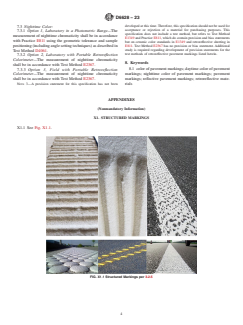
3.2.5 pavement marking structured materials—structured pavement markings—a structured roadpavement marking has raised
faces or edges in a regular or random pattern that are tilted towards the direction of traffic in order to enhance retroreflection in
wet or rainy conditions or to produce acoustic or vibrational effects by the passage of wheels, or both.The both. The pattern can
be produced by non-uniformnonuniform application of the material in the liquid state, by reworking the surface of applied material
while still liquid, or by other suitable means. Pavement markings that are installed in a rumble strip pattern are considered to be
structured markings and therefore not applicable to this specification. For visual examples of structured pavement markings, see
Appendix X1. Road marking tapes with a surface pattern, as defined in Specifications D4505 and D4592, are not considered to
be structured pavement markings for the intent of this specification.
Available from USNC-CIE Publications Office, TLA Lighting Consultants, Inc., 7 Pond Street, Salem, MA 01970.
Available from U.S. Government Publishing Office (GPO), 732 N. Capitol St., NW, Washington, DC 20401, http://www.gpo.gov.
D6628 − 23
3.2.5.1 Discussion—
When measuring color, daytime, or nighttime on non-flat pavement markings, care should be taken to minimize the introduction
of any stray light into the viewing area. The introduction of stray light may provide measured values and results that are different
from those under visual viewing conditions. The geometry of the instrument illumination, with respect to the profiles, can also
cause misleading results. The small illumination field in this type of instrumentation makes the reading sensitive to the positioning
of the instrument.
4. Significance and Use
4.1 This specification is intended for use during the lifetime of the retroreflective pavement marking on the road surface.
Specifications identifies the color performance requirements for retroreflective pavement markings under daytime and nighttime
lighting conditions. Requirements for characteristics other than retroreflective color are found in other ASTM documents.standards.
4.2 Newly applied pavement markings, as defined in 3.2.3, shall meet the requirements of this specification for both daytime and
nighttime color.
5. Performance Requirements
5.1 Chromaticity Limits—The material must plot within the boundaries described by the four corner points listed in Tables 1 and
2Tables 1 and 2 when measured in accordance with the test methods in Section 7.
5.1.1 Table 1—Table 1—Daytime (x,y) chromaticity coordinates of the corners of the regions for the colors of white, yellow, blue
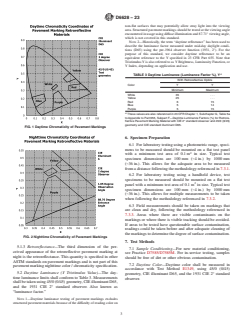
blue, purple, and red pavement markings. See Fig. 1.
5.1.2 Table 2—Table 2—Nighttime (x,y) chromaticity coordinates of the corners of the regions for the colors of white and
yellowwhite, yellow, and purple pavement markings. See Fig. 2.
5.1.3 Chromaticity and Retroreflectance—The third dimension of the perceived appearance of the road retroreflective pavement
marking at night is the retroreflectance. This quantity is specified in other ASTM documentsstandards on pavement markings and
is not part of this pavement marking nighttime color specification. Research has shown that the nighttime color as specified by
chromaticity is sufficient and adequate for the color naming of the material as viewed under nighttime conditions./ chromaticity
specification.
5.2 Daytime Lightness Limits Luminance (Y Tristimulus Coordinate)—Value)—The lightness daytime luminance limits shall
conform to Table 3. (The 45/0 and 0/45 geometry is the current standard practice for these measurements. Table 3. Measurements
shall be taken using 45/0 (0/45) geometry, CIE illuminant D65, and the 1931 CIE 2° standard observer. Also known as “luminance
factor.”
NOTE 1—Daytime luminance factor testing of pavement markings excludes structured materials. They pavement materials because of the difficulty of
reading color on non-flat surfaces that may potentially allow stray light into the viewing area. Structured pavement markings should be tested at the
viewing angle encountered in usage using diffuse illumination and 87.71° viewing angle, which is not covered in this standard.
NOTE 2—Historically, the term “daytime reflectance” has been used to describe the luminance factor measured under mid-day daylight conditions (D65)
using the pre-1964 observer function (1931, 2°). For the purpose of this standard, we consider daytime reflectance to be an equivalent reference to the
A
TABLE 1 Daytime Color
NOTE 1—Daytime, Geometry—45/0 (0/45), CIE illuminant D65 and
the CIE 1931 (2°) standard observer.
Color Daytime Chromaticity Coordinates (Corner Points)
1 2 3 4
x y x y x y x y
White 0.355 0.355 0.305 0.305 0.285 0.325 0.335 0.375
Yellow 0.560 0.440 0.490 0.510 0.420 0.440 0.460 0.400
Red 0.480 0.300 0.690 0.315 0.620 0.380 0.480 0.360
Blue 0.105 0.100 0.220 0.180 0.200 0.260 0.060 0.220
Purple 0.300 0.064 0.309 0.260 0.362 0.295 0.475 0.144
A
These chromaticity coordinates are also referenced in 23 CFR Chapter 1,
Subchapter G, Table 5 to Appendix to Part 655, Subpart F—Daytime Color
Specification Limits for Retroreflective Pavement Marking Material.
D6628 − 23
FIG. 1 Daytime Chromaticity of Pavement Markings
FIG. 2 Nighttime Chromaticity of Pavement Markings
A
TABLE 2 Nighttime Color
NOTE 1—Nighttime, Geometry—observationGeometry—Observation
angle of 1.05° and entrance angle of 88.76°. CIE illuminant A and the CIE
1931 (2°) standard observer.
Color Nighttime Chromaticity Coordinates (Corner Points)
1 2 3 4
x y x y x y x y
White 0.480 0.410 0.430 0.380 0.405 0.405 0.455 0.435
Yellow 0.575 0.425 0.508 0.415 0.473 0.453 0.510 0.490
Purple 0.338 0.080 0.425 0.365 0.470 0.385 0.635 0.221
A
These chromaticity coordinates are also referenced in 23 CFR Chapter 1,
Subchapter G, Table 6 to Appendix to Part 655, Subpart F—Nighttime Color
Specification Limits for Retroreflective Pavement Marking Material.
D66
...