

ASTM E2367-05(2019)
(Test Method)Standard Test Method for Measurement of Nighttime Chromaticity of Pavement Marking Materials Using a Portable Retroreflection Colorimeter
General Information
- Abstract
SIGNIFICANCE AND USE
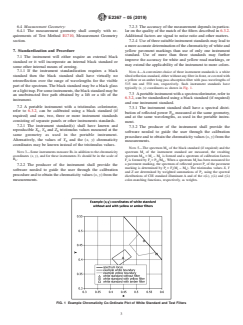
5.1 The chromaticity of the stripe is determined by means of the tristimulus values X, Y and Z for the CIE 1931 (2°) standard observer for CIE standard illuminant A, which are converted to the chromaticity coordinates (x, y) and shown in the CIE 1931 (x, y)-chromaticity diagram. Refer to Practice E308.
5.2 Under the same conditions of illumination and viewing, the chromaticity coordinates (x, y) represent the nighttime color of pavement markings in vehicle headlamp illumination as seen by drivers of the vehicles.
5.3 The chromaticity of pavement (road) markings may change with traffic wear and require periodic measurement to ensure that the chromaticity is maintained within boundaries (see Specification D6628 for examples of color boundaries).
5.4 As specified by CEN EN 1436 and Test Method E1710, the measurement geometry of the instrument is based on a viewing distance of 30 m, a headlamp mounting height of 0.65 m and an eye height of 1.2 m.
5.5 It shall be the responsibility of the user to employ an instrument having the specified observation and entrance angles.
SCOPE
1.1 This test method covers measurement of the nighttime chromaticity coordinates (x, y) of horizontal pavement markings, such as traffic stripes and surface symbols, using a portable retroreflection colorimeter that can be placed on the road delineation to measure the chromaticity at a prescribed geometry.
1.2 The entrance and observation angles of the retrorecolorimeter affect the readings. As specified by the European Committee for Standardization (CEN EN 1436), the entrance and observation angles shall be 88.76° and 1.05°, respectively.
1.3 This test method is intended to be used for field measurement of pavement markings but may be used to measure the chromaticity of materials on sample panels before placing the marking material in the field.
1.4 The portable retroreflection colorimeter may integrate measurement of the coefficient of retroreflected luminance RL in accordance with Test Method E1710 and thus be an integrated retroreflectometer/ retroreflection colorimeter.
1.5 This standard does not purport to address all of the safety concerns, if any, associated with its use. It is the responsibility of the user of this standard to establish appropriate safety, health, and environmental practices and determine the applicability of regulatory limitations prior to use.
1.6 This international standard was developed in accordance with internationally recognized principles on standardization established in the Decision on Principles for the Development of International Standards, Guides and Recommendations issued by the World Trade Organization Technical Barriers to Trade (TBT) Committee.
- Status
- Published
- Publication Date
- 31-Oct-2019
- Technical Committee
- E12 - Color and Appearance
- Drafting Committee
- E12.10 - Retroreflection

Overview
ASTM E2367-05(2019), "Standard Test Method for Measurement of Nighttime Chromaticity of Pavement Marking Materials Using a Portable Retroreflection Colorimeter," is an internationally recognized ASTM standard that defines the method for evaluating the nighttime color properties (chromaticity) of horizontal pavement markings. This standard is essential for assessing the visibility and color quality of road lines and symbols under nighttime driving conditions, ensuring they comply with regulatory requirements and safety standards.
Measuring the chromaticity of pavement markings helps maintain their effectiveness as guiding markings for vehicles during nighttime, using a portable retroreflection colorimeter. This approach reflects real-world viewing geometry by simulating the conditions in which drivers see markings illuminated by headlamps.
Key Topics
Nighttime Chromaticity Measurement
The standard outlines the process for evaluating the color (x, y chromaticity coordinates) of road markings at night using CIE 1931 (2°) standard observer values and CIE standard illuminant A.Portable Retroreflection Colorimeter
Details are provided on the use of portable instruments that measure how road markings reflect vehicle headlamps at prescribed angles, reflecting conditions faced by drivers. Requirements for instrument calibration, geometry (entrance angle 88.76° and observation angle 1.05°), and precautions against stray light are detailed.Instrument Calibration and Standardization
Effective measurement depends on precise calibration using appropriate black and reference standards. The standard describes calibration methods for both tristimulus colorimeters and spectrocolorimeters, ensuring reliable, reproducible results.Field and Laboratory Applications
The method can be used to evaluate installed road markings or to assess materials before application by testing sample panels.Significance for Safety and Maintenance
The standard highlights the importance of periodic testing, as wear and environmental factors can alter marking color, potentially reducing nighttime visibility and safety.
Applications
Road Safety and Traffic Control
Accurate, standardized measurement of pavement marking color is critical for roadway safety. This ensures drivers can properly interpret road markings under vehicle headlights, reducing accident risk.Quality Control for Marking Materials
Regulatory agencies, contractors, and material suppliers utilize this test method to verify the chromaticity and performance of pavement marking materials, both before installation and as part of ongoing maintenance checks.Compliance with International Standards
The prescribed methodology aligns with European standards (CEN EN 1436) and other international practices, enabling harmonization across regions and facilitating global trade of marking materials.Performance Monitoring
Transportation departments use this standard to monitor the durability and performance of installed markings, scheduling maintenance or replacement as needed based on test results.
Related Standards
- ASTM E308 - Practice for Computing the Colors of Objects by Using the CIE System
- ASTM E284 - Terminology of Appearance
- ASTM E811 - Practice for Measuring Colorimetric Characteristics of Retroreflectors Under Nighttime Conditions
- ASTM E1710 - Test Method for Measurement of Retroreflective Pavement Marking Materials with CEN-Prescribed Geometry Using a Portable Retroreflectometer
- ASTM D6628 - Specification for Color of Pavement Marking Materials
- CEN EN 1436 - Road Marking Materials – Road Marking Performance for Road Users
Summary
ASTM E2367-05(2019) provides a practical, standardized approach for measuring and maintaining the nighttime appearance of pavement markings using portable retroreflection colorimeters. It supports road safety, ensures regulatory compliance, and underpins ongoing quality assurance for road marking materials. By referencing and aligning with related ASTM and international standards, it facilitates best practices in road marking visibility assessment worldwide.
Relations
- Effective Date
- 01-Nov-2019
- Refers
ASTM D6628-23 - Standard Specification for Color of Retroreflective Pavement Marking Materials - Effective Date
- 01-Nov-2023
- Effective Date
- 15-Jun-2020
- Effective Date
- 01-Jan-2018
- Effective Date
- 01-May-2017
- Effective Date
- 01-Oct-2016
- Effective Date
- 15-Dec-2015
- Effective Date
- 01-Jul-2015
- Effective Date
- 01-Apr-2015
- Effective Date
- 01-Nov-2013
- Effective Date
- 01-Jun-2013
- Effective Date
- 01-Jan-2013
- Effective Date
- 01-Jul-2012
- Effective Date
- 01-Jul-2012
- Effective Date
- 01-Jun-2011
Get Certified
Connect with accredited certification bodies for this standard

BSMI (Bureau of Standards, Metrology and Inspection)
Taiwan's standards and inspection authority.
Zavod za gradbeništvo Slovenije (ZAG) - Inšpekcija
ZAG inspection body for construction products, structures, and materials.
Sponsored listings
Frequently Asked Questions
ASTM E2367-05(2019) is a standard published by ASTM International. Its full title is "Standard Test Method for Measurement of Nighttime Chromaticity of Pavement Marking Materials Using a Portable Retroreflection Colorimeter". This standard covers: SIGNIFICANCE AND USE 5.1 The chromaticity of the stripe is determined by means of the tristimulus values X, Y and Z for the CIE 1931 (2°) standard observer for CIE standard illuminant A, which are converted to the chromaticity coordinates (x, y) and shown in the CIE 1931 (x, y)-chromaticity diagram. Refer to Practice E308. 5.2 Under the same conditions of illumination and viewing, the chromaticity coordinates (x, y) represent the nighttime color of pavement markings in vehicle headlamp illumination as seen by drivers of the vehicles. 5.3 The chromaticity of pavement (road) markings may change with traffic wear and require periodic measurement to ensure that the chromaticity is maintained within boundaries (see Specification D6628 for examples of color boundaries). 5.4 As specified by CEN EN 1436 and Test Method E1710, the measurement geometry of the instrument is based on a viewing distance of 30 m, a headlamp mounting height of 0.65 m and an eye height of 1.2 m. 5.5 It shall be the responsibility of the user to employ an instrument having the specified observation and entrance angles. SCOPE 1.1 This test method covers measurement of the nighttime chromaticity coordinates (x, y) of horizontal pavement markings, such as traffic stripes and surface symbols, using a portable retroreflection colorimeter that can be placed on the road delineation to measure the chromaticity at a prescribed geometry. 1.2 The entrance and observation angles of the retrorecolorimeter affect the readings. As specified by the European Committee for Standardization (CEN EN 1436), the entrance and observation angles shall be 88.76° and 1.05°, respectively. 1.3 This test method is intended to be used for field measurement of pavement markings but may be used to measure the chromaticity of materials on sample panels before placing the marking material in the field. 1.4 The portable retroreflection colorimeter may integrate measurement of the coefficient of retroreflected luminance RL in accordance with Test Method E1710 and thus be an integrated retroreflectometer/ retroreflection colorimeter. 1.5 This standard does not purport to address all of the safety concerns, if any, associated with its use. It is the responsibility of the user of this standard to establish appropriate safety, health, and environmental practices and determine the applicability of regulatory limitations prior to use. 1.6 This international standard was developed in accordance with internationally recognized principles on standardization established in the Decision on Principles for the Development of International Standards, Guides and Recommendations issued by the World Trade Organization Technical Barriers to Trade (TBT) Committee.
SIGNIFICANCE AND USE 5.1 The chromaticity of the stripe is determined by means of the tristimulus values X, Y and Z for the CIE 1931 (2°) standard observer for CIE standard illuminant A, which are converted to the chromaticity coordinates (x, y) and shown in the CIE 1931 (x, y)-chromaticity diagram. Refer to Practice E308. 5.2 Under the same conditions of illumination and viewing, the chromaticity coordinates (x, y) represent the nighttime color of pavement markings in vehicle headlamp illumination as seen by drivers of the vehicles. 5.3 The chromaticity of pavement (road) markings may change with traffic wear and require periodic measurement to ensure that the chromaticity is maintained within boundaries (see Specification D6628 for examples of color boundaries). 5.4 As specified by CEN EN 1436 and Test Method E1710, the measurement geometry of the instrument is based on a viewing distance of 30 m, a headlamp mounting height of 0.65 m and an eye height of 1.2 m. 5.5 It shall be the responsibility of the user to employ an instrument having the specified observation and entrance angles. SCOPE 1.1 This test method covers measurement of the nighttime chromaticity coordinates (x, y) of horizontal pavement markings, such as traffic stripes and surface symbols, using a portable retroreflection colorimeter that can be placed on the road delineation to measure the chromaticity at a prescribed geometry. 1.2 The entrance and observation angles of the retrorecolorimeter affect the readings. As specified by the European Committee for Standardization (CEN EN 1436), the entrance and observation angles shall be 88.76° and 1.05°, respectively. 1.3 This test method is intended to be used for field measurement of pavement markings but may be used to measure the chromaticity of materials on sample panels before placing the marking material in the field. 1.4 The portable retroreflection colorimeter may integrate measurement of the coefficient of retroreflected luminance RL in accordance with Test Method E1710 and thus be an integrated retroreflectometer/ retroreflection colorimeter. 1.5 This standard does not purport to address all of the safety concerns, if any, associated with its use. It is the responsibility of the user of this standard to establish appropriate safety, health, and environmental practices and determine the applicability of regulatory limitations prior to use. 1.6 This international standard was developed in accordance with internationally recognized principles on standardization established in the Decision on Principles for the Development of International Standards, Guides and Recommendations issued by the World Trade Organization Technical Barriers to Trade (TBT) Committee.
ASTM E2367-05(2019) is classified under the following ICS (International Classification for Standards) categories: 17.180.20 - Colours and measurement of light; 93.080.30 - Road equipment and installations. The ICS classification helps identify the subject area and facilitates finding related standards.
ASTM E2367-05(2019) has the following relationships with other standards: It is inter standard links to ASTM E2367-05(2014), ASTM D6628-23, ASTM E811-09(2020)e1, ASTM E1710-18, ASTM E308-17, ASTM D6628-16, ASTM D6628-03(2015), ASTM E811-09(2015), ASTM E308-15, ASTM E284-13b, ASTM E284-13a, ASTM E284-13, ASTM E308-12, ASTM E284-12, ASTM E1710-11. Understanding these relationships helps ensure you are using the most current and applicable version of the standard.
ASTM E2367-05(2019) is available in PDF format for immediate download after purchase. The document can be added to your cart and obtained through the secure checkout process. Digital delivery ensures instant access to the complete standard document.
Standards Content (Sample)
This international standard was developed in accordance with internationally recognized principles on standardization established in the Decision on Principles for the
Development of International Standards, Guides and Recommendations issued by the World Trade Organization Technical Barriers to Trade (TBT) Committee.
Designation:E2367 −05 (Reapproved 2019)
Standard Test Method for
Measurement of Nighttime Chromaticity of Pavement
Marking Materials Using a Portable Retroreflection
Colorimeter
This standard is issued under the fixed designation E2367; the number immediately following the designation indicates the year of
original adoption or, in the case of revision, the year of last revision.Anumber in parentheses indicates the year of last reapproval.A
superscript epsilon (´) indicates an editorial change since the last revision or reapproval.
1. Scope 2. Referenced Documents
1.1 This test method covers measurement of the nighttime
2.1 ASTM Standards:
chromaticity coordinates (x, y) of horizontal pavement
D6628Specification for Color of Pavement Marking Mate-
markings, such as traffic stripes and surface symbols, using a
rials
portable retroreflection colorimeter that can be placed on the
E284Terminology of Appearance
road delineation to measure the chromaticity at a prescribed
E308PracticeforComputingtheColorsofObjectsbyUsing
geometry.
the CIE System
E811Practice for Measuring Colorimetric Characteristics of
1.2 The entrance and observation angles of the retrorecolo-
Retroreflectors Under Nighttime Conditions
rimeter affect the readings. As specified by the European
E1710Test Method for Measurement of Retroreflective
Committee for Standardization (CEN EN 1436), the entrance
Pavement Marking Materials with CEN-Prescribed Ge-
and observation angles shall be 88.76° and 1.05°, respectively.
ometry Using a Portable Retroreflectometer
1.3 This test method is intended to be used for field
2.2 Other Standard:
measurement of pavement markings but may be used to
CEN EN 1436Road Marking Materials—Road Marking
measure the chromaticity of materials on sample panels before
Performance for Road Users
placing the marking material in the field.
1.4 The portable retroreflection colorimeter may integrate
3. Terminology
measurement of the coefficient of retroreflected luminance R
L
in accordance with Test Method E1710 and thus be an
3.1 The terminology used in this test method generally
integrated retroreflectometer/ retroreflection colorimeter.
agrees with that used in Terminology E284. The definitions
given in Test Method E1710 and Practice E811 apply in this
1.5 This standard does not purport to address all of the
safety concerns, if any, associated with its use. It is the test method as well.
responsibility of the user of this standard to establish appro-
3.2 Definitions:
priate safety, health, and environmental practices and deter-
3.2.1 reflection colorimeter, n—an instrument that illumi-
mine the applicability of regulatory limitations prior to use.
nates a specimen and applies a colorimeter to the light
1.6 This international standard was developed in accor-
reflected.
dance with internationally recognized principles on standard-
ization established in the Decision on Principles for the 3.2.2 retroreflection colorimeter, n—a reflection colorimeter
for which the illumination (influx) and reception (efflux)
Development of International Standards, Guides and Recom-
mendations issued by the World Trade Organization Technical directions are within a few degrees of each other.
Barriers to Trade (TBT) Committee.
1 2
This test method is under the jurisdiction of ASTM Committee E12 on Color For referenced ASTM standards, visit the ASTM website, www.astm.org, or
and Appearance and is the direct responsibility of Subcommittee E12.10 on contact ASTM Customer Service at service@astm.org. For Annual Book of ASTM
Retroreflection. Standards volume information, refer to the standard’s Document Summary page on
Current edition approved Nov. 1, 2019. Published November 2019. Originally the ASTM website.
approved in 2005. Last previous edition approved in 2014 as E2367–05 (2014). Available from European Committee for Standardization (CEN), Avenue
DOI: 10.1520/E2367-05R19. Marnix 17, B-1000, Brussels, Belgium, http://www.cen.eu.
Copyright © ASTM International, 100 Barr Harbor Drive, PO Box C700, West Conshohocken, PA 19428-2959. United States
E2367−05 (2019)
4. Summary of Test Method reading, or both. Alternatively, the retroreflection colorimeter
shallproduceawarningsignalwhenstraylightcouldaffectthe
4.1 This test method involves the use of portable retrore-
reading.
flection colorimeters for determining the chromaticity coordi-
6.1.3 For the convenience of the user, a marking shall be
nates (x, y) of horizontal coatings materials used in pavement
placed on the instrument to permit it to be aligned with the
markings.
directionoftraffic,ortheinstrumentdesignshallitselfindicate
4.2 The entrance angle is fixed at 88.76° (co-entrance angle
the measuring direction in an obvious manner.
e of 1.24°).
6.2 Light Source Requirements:
4.3 The observation angle is fixed at 1.05° (co-viewing
6.2.1 The light source shall comply with requirements of
angle a of 2.29°).
Test Method E1710, Light Source Requirements section con-
4.4 The presentation angle shall be 0° (azimuthal angle b of cerning projection optics and aperture angle.
180°).
6.3 Retroreflection Colorimeter Requirements:
4.5 The retroreflection colorimeters use one or more exter-
6.3.1 The retroreflection colorimeter shall demonstrate the
nalpanelsorotherinstrumentstandardsofknownchromaticity
capabilitytorepeatablyandreproduciblymeasurevaluesofthe
coordinates (x, y), or known spectral distribution of reflected
coefficientofretroreflectedluminanceovertherangefrom100
-2 -1
power P .
Si to 2000 mcd·m ·lx to within 10% of the assigned value. In
exceptional cases, R values can be even higher, up to 3000
4.6 Theportableretroreflectioncolorimeterisplacedsothat L
-2 -1
mcd·m ·lx .
the measurement area of the retroreflection colorimeter fits
6.3.2 The retroreflection colorimeter shall provide X, Y and
withinthewidthofthestripe,andthereadingsdisplayedbythe
Z tristimulus values according to the CIE 1931 (2°) color
retroreflection colorimeter are recorded.
matching functions. The retroreflection colorimeter must be
4.7 Readings shall be taken for the direction of traffic
able to apply illumination condition correction for CIE illumi-
(supplementary azimuthal angle d of 0°). Readings shall be
nant A, and may either be a tristimulus colorimeter or a
taken for each direction of traffic separately for centerlines.
spectrocolorimeter.
6.3.2.1 A tristimulus colorimeter may have filters that can
5. Significance and Use
be inserted individually in front of a receiver to provide
5.1 Thechromaticityofthestripeisdeterminedbymeansof
matches of the combined spectral distribution of the illumina-
thetristimulusvalues X, Yand ZfortheCIE1931(2°)standard
tion and the spectral responsivity of the receiver to the
observerforCIEstandardilluminantA,whichareconvertedto
combinedspectraldistributionofCIEilluminantAandtheCIE
the chromaticity coordinates (x, y) and shown in the CIE 1931
1931 (2°) x¯(λ), y¯(λ) and z¯(λ) color-matching functions, respec-
(x, y)-chromaticity diagram. Refer to Practice E308.
tively. The x¯(λ) function has two distinct lobes. This may be
5.2 Under the same conditions of illumination and viewing,
dealtwithbysplitting x¯(λ)into x¯ (λ)and x¯ (λ),eachwith
short long
the chromaticity coordinates (x, y) represent the nighttime
a separate filter. The filters may be manually or automatically
color of pavement markings in vehicle headlamp illumination
operated.
as seen by drivers of the vehicles.
6.3.2.2 A spectrocolorimeter may measure the spectral re-
flectance in equal wavelength steps covering at least the
5.3 The chromaticity of pavement (road) markings may
wavelength range from 400 to 700 nm, with a maximum half
change with traffic wear and require periodic measurement to
power bandwidth of 10 nm in maximum step increment of 10
ensure that the chromaticity is maintained within boundaries
nm and from these data derive X, Y and Z tristimulus values.
(see Specification D6628 for examples of color boundaries).
5.4 As specified by CEN EN 1436 andTest Method E1710, NOTE 1—It is expected that a future version of this test method will
include measurement of pavement marking chromaticity under lighting
the measurement geometry of the instrument is based on a
systemsotherthantungstenapproximatingCIEstandardilluminantA.For
viewing distance of 30 m, a headlamp mounting height of 0.65
some of these, a 5 nanometer half power bandwidth and 5 nanometer
m and an eye height of 1.2 m.
increment is recommended.
NOTE 2—Use of filters provides larger signals than measurement of the
5.5 It shall be the responsibility of the user to employ an
spectral distribution.
instrument having the specified observation and entrance
6.3.3 The retroreflection colorimeter shall determine the
angles.
chromaticity coordinates (x, y) for CIE A and the CIE 1931
6. Apparatus
Observerofwhiteandyellowpavementmarkingswithavalue
6.1 Portable Retroreflection Colorimeter: of the coefficient of retroreflected luminance R of 100
L
-2 -1
mcd·m ·lx ,orhigher,withaminimumreproduciblyof0.005
6.1.1 The retroreflection colorimeter shall be portable, with
the capability to be placed on various horizontal pavement in both x and y, when calibrated and used according to the
instrument manufacturers instructions.
markings in different locations.
6.1.2 The retroreflection colorimeter shall be constructed so 6.3.4 The retroreflection colorimeter shall comply with
that placement on the highway pavement markings will pre- requirements of Te
...