

ASTM A1040-17(2022)
(Guide)Standard Guide for Specifying Harmonized Standard Grade Compositions for Wrought Carbon, Low-Alloy, and Alloy Steels
General Information
- Abstract
SIGNIFICANCE AND USE
4.1 It is anticipated that the ASTM Subcommittees A01.02, A01.03, A01.06, A01.09, A01.11, A01.15, A01.19, A01.22, and A01.28 will use the standard composition limits listed in this guide for the grades identified in their product specifications unless there is a specific technical justification for doing otherwise.
4.2 The composition limits given in this guide are to be used as guides in determining limits for each of the elements included in the total composition of each grade. The composition limits have been established with the intent that each ASTM subcommittee will find it necessary to require only a minimum number of changes to reflect specific technical effects. Section 5 lists the general guidelines followed for determining the limits for each element; the limits established in this guide are based upon these guidelines.
SCOPE
1.1 This guide covers ASTM Subcommittees A01.02, A01.03, A01.06, A01.09, A01.11, A01.15, A01.19, A01.22, and A01.28 for specifying chemical composition limits of wrought carbon, low-alloy, and alloy steels. It is intended that these recommended grade composition limits be suitable for adoption by other standardization bodies that prepare standards for carbon, low-alloy, and alloy steel products, including discontinued steels.
1.2 Included in this guide are the recommendations for determining the number of significant figures for specifying chemical composition.
1.3 The carbon and alloy steel grades in all standards overseen by the aforementioned ASTM subcommittees have been included, except those grades applicable to restricted special end uses.
1.4 Not addressed are minor composition modifications that a specific ASTM subcommittee may find necessary to accommodate effects of normal processing or to enhance fabricability by the producer or user, or both.
1.5 Also not generally addressed (except where established by ASTM subcommittees) is a complete rationalization of all limits, especially where such would conflict with long-standing practices and is not justified by special technical effect.
1.6 This guide does not address discontinued or formerly standard steel grades. A listing of such steel grades can be found in SAE J1249. Also excluded from this guide are cast materials and welding filler metals.
1.7 In 1995, the AISI made the decision to transfer the responsibility of maintaining its numbering system to the Society of Automotive Engineers (SAE) for carbon and alloy steels (SAE J403 and SAE J404) and to ASTM International for stainless steels (Guide A959 and others). To inform users of this important event, historical information is included in the appendix of this standard.
1.8 The values stated in inch-pound units are to be regarded as standard. The values given in parentheses are mathematical conversions to SI units that are provided for information only and are not considered standard.
1.9 This international standard was developed in accordance with internationally recognized principles on standardization established in the Decision on Principles for the Development of International Standards, Guides and Recommendations issued by the World Trade Organization Technical Barriers to Trade (TBT) Committee.
- Status
- Published
- Publication Date
- 31-Aug-2022
- Technical Committee
- A01 - Steel, Stainless Steel and Related Alloys
- Drafting Committee
- A01.15 - Bars
Overview
ASTM A1040-17(2022): Standard Guide for Specifying Harmonized Standard Grade Compositions for Wrought Carbon, Low-Alloy, and Alloy Steels provides a comprehensive framework for specifying chemical composition limits for various grades of wrought carbon, low-alloy, and alloy steels. Developed by ASTM International, this standard serves as a key reference for the harmonization and specification of steel compositions across a wide range of steel products. The guide is widely used by ASTM subcommittees as well as other standardization organizations involved in steel production standards.
Key Topics
Scope and Purpose
- Specifies chemical composition limits for carbon, low-alloy, and alloy steel grades managed by multiple ASTM subcommittees
- Promotes harmonized specifications for consistency and interchangeability in steel products
- Recommends approaches for defining significant figures in chemical composition statements
- Intended for adoption by international and industry-specific standardization bodies
Composition Guidelines
- Presents standardized composition limits for key elements, including carbon, manganese, phosphorus, sulfur, silicon, nickel, chromium, molybdenum, and others
- Provides tables categorizing steel grades by type and highlighting maximum and minimum limits for chemical constituents
- Allows scope for minor, justified adjustments in composition to address specific technical or manufacturing needs
Coverage and Exclusions
- Covers a broad range of wrought steels but excludes cast materials, welding filler metals, and discontinued or former standard grades (refer to SAE J1249 for obsolete steels)
- Focuses on standard product forms, including bars, rods, wires, tubes, plates, and pipes
International Recognition
- Developed following World Trade Organization Technical Barriers to Trade (TBT) Committee principles for international standardization
- Supports harmonized steel practices globally, facilitating easier trade, specification, and quality assurance
Applications
The practical value of ASTM A1040-17(2022) lies in its role as a harmonization tool that benefits manufacturers, fabricators, and end users of steel products. Key applications include:
Steel Manufacturing and Procurement
- Enables steelmakers and buyers to specify, procure, and verify standardized steel grades confidently, ensuring compatibility and consistency across global supply chains
Product Specification and Quality Control
- Used as a reference in preparing, reviewing, or revising product specifications for various wrought steel forms, aiding in regulatory compliance and quality control
Standardization Projects
- Supports the efforts of ASTM subcommittees and other international bodies in updating or developing new steel standards, minimizing the need for repetitive technical reviews
Engineering and Design
- Assists engineers and designers in selecting appropriate steel grades for diverse applications, such as infrastructure, automotive, machinery, and energy sectors
Related Standards
To optimize harmonization and ensure correct application across industry practices, users are encouraged to consult the following related standards:
- ASTM A941 – Terminology Relating to Steel, Stainless Steel, Related Alloys, and Ferroalloys
- ASTM A959 – Guide for Specifying Harmonized Standard Grade Compositions for Wrought Stainless Steels
- SAE J403 – Chemical Compositions of SAE Carbon Steels
- SAE J404 – Chemical Compositions of SAE Alloy Steels
- SAE J1249 – Former SAE Standard and EX Steels Listing
Conclusion
ASTM A1040-17(2022) is an essential standard guiding the specification of chemical composition for wrought carbon, low-alloy, and alloy steels. By consolidating chemical limits and standardizing element specifications, it plays a vital role in harmonizing global steel practices, supporting manufacturers, engineers, and standardization bodies in ensuring quality, consistency, and interoperability of steel products. Its adoption underpins efficient material selection, production, and international trade in steel components.
Relations
- Effective Date
- 01-Mar-2024
- Effective Date
- 01-Feb-2024
- Effective Date
- 01-Jan-2024
- Effective Date
- 15-Nov-2019
- Effective Date
- 01-Sep-2017
- Effective Date
- 01-Sep-2016
- Effective Date
- 01-May-2016
- Effective Date
- 01-Jan-2016
- Effective Date
- 01-Nov-2015
- Effective Date
- 01-Jan-2015
- Effective Date
- 01-Jun-2013
- Effective Date
- 01-May-2013
- Effective Date
- 01-Apr-2013
- Effective Date
- 01-Jun-2011
- Effective Date
- 01-Jun-2010
Get Certified
Connect with accredited certification bodies for this standard

Element Materials Technology
Materials testing and product certification.

Inštitut za kovinske materiale in tehnologije
Institute of Metals and Technology. Materials testing, metallurgical analysis, NDT.
Sponsored listings
Frequently Asked Questions
ASTM A1040-17(2022) is a guide published by ASTM International. Its full title is "Standard Guide for Specifying Harmonized Standard Grade Compositions for Wrought Carbon, Low-Alloy, and Alloy Steels". This standard covers: SIGNIFICANCE AND USE 4.1 It is anticipated that the ASTM Subcommittees A01.02, A01.03, A01.06, A01.09, A01.11, A01.15, A01.19, A01.22, and A01.28 will use the standard composition limits listed in this guide for the grades identified in their product specifications unless there is a specific technical justification for doing otherwise. 4.2 The composition limits given in this guide are to be used as guides in determining limits for each of the elements included in the total composition of each grade. The composition limits have been established with the intent that each ASTM subcommittee will find it necessary to require only a minimum number of changes to reflect specific technical effects. Section 5 lists the general guidelines followed for determining the limits for each element; the limits established in this guide are based upon these guidelines. SCOPE 1.1 This guide covers ASTM Subcommittees A01.02, A01.03, A01.06, A01.09, A01.11, A01.15, A01.19, A01.22, and A01.28 for specifying chemical composition limits of wrought carbon, low-alloy, and alloy steels. It is intended that these recommended grade composition limits be suitable for adoption by other standardization bodies that prepare standards for carbon, low-alloy, and alloy steel products, including discontinued steels. 1.2 Included in this guide are the recommendations for determining the number of significant figures for specifying chemical composition. 1.3 The carbon and alloy steel grades in all standards overseen by the aforementioned ASTM subcommittees have been included, except those grades applicable to restricted special end uses. 1.4 Not addressed are minor composition modifications that a specific ASTM subcommittee may find necessary to accommodate effects of normal processing or to enhance fabricability by the producer or user, or both. 1.5 Also not generally addressed (except where established by ASTM subcommittees) is a complete rationalization of all limits, especially where such would conflict with long-standing practices and is not justified by special technical effect. 1.6 This guide does not address discontinued or formerly standard steel grades. A listing of such steel grades can be found in SAE J1249. Also excluded from this guide are cast materials and welding filler metals. 1.7 In 1995, the AISI made the decision to transfer the responsibility of maintaining its numbering system to the Society of Automotive Engineers (SAE) for carbon and alloy steels (SAE J403 and SAE J404) and to ASTM International for stainless steels (Guide A959 and others). To inform users of this important event, historical information is included in the appendix of this standard. 1.8 The values stated in inch-pound units are to be regarded as standard. The values given in parentheses are mathematical conversions to SI units that are provided for information only and are not considered standard. 1.9 This international standard was developed in accordance with internationally recognized principles on standardization established in the Decision on Principles for the Development of International Standards, Guides and Recommendations issued by the World Trade Organization Technical Barriers to Trade (TBT) Committee.
SIGNIFICANCE AND USE 4.1 It is anticipated that the ASTM Subcommittees A01.02, A01.03, A01.06, A01.09, A01.11, A01.15, A01.19, A01.22, and A01.28 will use the standard composition limits listed in this guide for the grades identified in their product specifications unless there is a specific technical justification for doing otherwise. 4.2 The composition limits given in this guide are to be used as guides in determining limits for each of the elements included in the total composition of each grade. The composition limits have been established with the intent that each ASTM subcommittee will find it necessary to require only a minimum number of changes to reflect specific technical effects. Section 5 lists the general guidelines followed for determining the limits for each element; the limits established in this guide are based upon these guidelines. SCOPE 1.1 This guide covers ASTM Subcommittees A01.02, A01.03, A01.06, A01.09, A01.11, A01.15, A01.19, A01.22, and A01.28 for specifying chemical composition limits of wrought carbon, low-alloy, and alloy steels. It is intended that these recommended grade composition limits be suitable for adoption by other standardization bodies that prepare standards for carbon, low-alloy, and alloy steel products, including discontinued steels. 1.2 Included in this guide are the recommendations for determining the number of significant figures for specifying chemical composition. 1.3 The carbon and alloy steel grades in all standards overseen by the aforementioned ASTM subcommittees have been included, except those grades applicable to restricted special end uses. 1.4 Not addressed are minor composition modifications that a specific ASTM subcommittee may find necessary to accommodate effects of normal processing or to enhance fabricability by the producer or user, or both. 1.5 Also not generally addressed (except where established by ASTM subcommittees) is a complete rationalization of all limits, especially where such would conflict with long-standing practices and is not justified by special technical effect. 1.6 This guide does not address discontinued or formerly standard steel grades. A listing of such steel grades can be found in SAE J1249. Also excluded from this guide are cast materials and welding filler metals. 1.7 In 1995, the AISI made the decision to transfer the responsibility of maintaining its numbering system to the Society of Automotive Engineers (SAE) for carbon and alloy steels (SAE J403 and SAE J404) and to ASTM International for stainless steels (Guide A959 and others). To inform users of this important event, historical information is included in the appendix of this standard. 1.8 The values stated in inch-pound units are to be regarded as standard. The values given in parentheses are mathematical conversions to SI units that are provided for information only and are not considered standard. 1.9 This international standard was developed in accordance with internationally recognized principles on standardization established in the Decision on Principles for the Development of International Standards, Guides and Recommendations issued by the World Trade Organization Technical Barriers to Trade (TBT) Committee.
ASTM A1040-17(2022) is classified under the following ICS (International Classification for Standards) categories: 77.140.01 - Iron and steel products in general. The ICS classification helps identify the subject area and facilitates finding related standards.
ASTM A1040-17(2022) has the following relationships with other standards: It is inter standard links to ASTM A941-24, ASTM A276/A276M-24a, ASTM A276/A276M-24, ASTM A959-19, ASTM A941-17, ASTM A959-16, ASTM A276/A276M-16a, ASTM A276/A276M-16, ASTM A941-15, ASTM A276/A276M-15, ASTM A941-13b, ASTM A941-13a, ASTM A941-13, ASTM A959-11, ASTM A941-10a. Understanding these relationships helps ensure you are using the most current and applicable version of the standard.
ASTM A1040-17(2022) is available in PDF format for immediate download after purchase. The document can be added to your cart and obtained through the secure checkout process. Digital delivery ensures instant access to the complete standard document.
Standards Content (Sample)
This international standard was developed in accordance with internationally recognized principles on standardization established in the Decision on Principles for the
Development of International Standards, Guides and Recommendations issued by the World Trade Organization Technical Barriers to Trade (TBT) Committee.
Designation: A1040 − 17 (Reapproved 2022)
Standard Guide for
Specifying Harmonized Standard Grade Compositions for
Wrought Carbon, Low-Alloy, and Alloy Steels
This standard is issued under the fixed designation A1040; the number immediately following the designation indicates the year of
original adoption or, in the case of revision, the year of last revision. A number in parentheses indicates the year of last reapproval. A
superscript epsilon (´) indicates an editorial change since the last revision or reapproval.
1. Scope* this important event, historical information is included in the
appendix of this standard.
1.1 This guide covers ASTM Subcommittees A01.02,
A01.03,A01.06,A01.09,A01.11,A01.15,A01.19,A01.22,and 1.8 The values stated in inch-pound units are to be regarded
as standard. The values given in parentheses are mathematical
A01.28 for specifying chemical composition limits of wrought
carbon, low-alloy, and alloy steels. It is intended that these conversions to SI units that are provided for information only
and are not considered standard.
recommended grade composition limits be suitable for adop-
tion by other standardization bodies that prepare standards for
1.9 This international standard was developed in accor-
carbon, low-alloy, and alloy steel products, including discon-
dance with internationally recognized principles on standard-
tinued steels.
ization established in the Decision on Principles for the
Development of International Standards, Guides and Recom-
1.2 Included in this guide are the recommendations for
mendations issued by the World Trade Organization Technical
determining the number of significant figures for specifying
Barriers to Trade (TBT) Committee.
chemical composition.
1.3 The carbon and alloy steel grades in all standards
2. Referenced Documents
overseen by the aforementioned ASTM subcommittees have
2.1 ASTM Standards:
been included, except those grades applicable to restricted
A276/A276M Specification for Stainless Steel Bars and
special end uses.
Shapes
1.4 Not addressed are minor composition modifications that
A941 TerminologyRelatingtoSteel,StainlessSteel,Related
a specific ASTM subcommittee may find necessary to accom-
Alloys, and Ferroalloys
modate effects of normal processing or to enhance fabricability
A959 Guide for Specifying Harmonized Standard Grade
by the producer or user, or both.
Compositions for Wrought Stainless Steels
1.5 Also not generally addressed (except where established
2.2 SAE Standards:
by ASTM subcommittees) is a complete rationalization of all
SAE J403 Chemical Compositions of SAE Carbon Steels
limits,especiallywheresuchwouldconflictwithlong-standing
SAE J404 Chemical Compositions of SAE Alloy Steels
practices and is not justified by special technical effect.
SAE J1013 Measurement of Whole Body Vibration of the
1.6 This guide does not address discontinued or formerly
Seated Operator of Off-Highway Work Machines
standard steel grades. A listing of such steel grades can be SAE J1249 Former SAE Standard and Former SAE EX-
found in SAE J1249. Also excluded from this guide are cast
Steels
materials and welding filler metals.
3. Terminology
1.7 In 1995, the AISI made the decision to transfer the
responsibility of maintaining its numbering system to the
3.1 Definitions of Terms Specific to This Standard:
Society of Automotive Engineers (SAE) for carbon and alloy
3.1.1 long product, n—generic term describing wrought
steels (SAE J403 and SAE J404) and to ASTM International bars, rod, wire, rail, tubing (welded and seamless), plate, and
forstainlesssteels(GuideA959andothers).Toinformusersof
pipe.
1 2
This guide is under the jurisdiction of ASTM Committee A01 on Steel, For referenced ASTM standards, visit the ASTM website, www.astm.org, or
Stainless Steel and Related Alloys and is the direct responsibility of Subcommittee contact ASTM Customer Service at service@astm.org. For Annual Book of ASTM
A01.15 on Bars. Standards volume information, refer to the standard’s Document Summary page on
Current edition approved Sept. 1, 2022. Published September 2022. Originally the ASTM website.
approved in 2004. Last previous edition approved in 2017 as A1040-17. DOI: Available from SAE International (SAE), 400 Commonwealth Dr.,Warrendale,
10.1520/A1040-17R22. PA 15096, http://www.sae.org.
*A Summary of Changes section appears at the end of this standard
Copyright © ASTM International, 100 Barr Harbor Drive, PO Box C700, West Conshohocken, PA 19428-2959. United States
A1040 − 17 (2022)
TABLE 1 Expression of Chemical Composition Limits
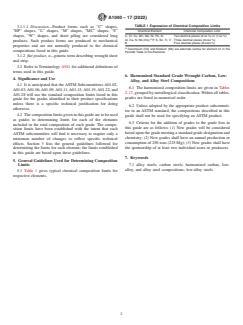
3.1.1.1 Discussion—Product forms such as “C” shapes,
“HP” shapes, “L” shapes, “M” shapes, “MC” shapes, “S” Chemical Element Chemical Composition Limit
shapes, “W” shapes, and sheet piling are considered long C, Cr, Cu, Mn, Mo, Ni, Pb, Si Two decimal places (0.xx %) or (1.xx %)
A
Al, Ca, N, Nb (Cb), P, S, Sn, Ti, V Three decimal places (0.xxx %)
products. Such product forms are produced to mechanical
B Four decimal places (0.xxxx %)
properties and are not normally produced to the chemical
A
Columbium (Cb) and Niobium (Nb) are alternate names for element 41 in the
compositions listed in this guide.
Periodic Table of the Elements.
3.1.2 flat product, n—generic term describing wrought sheet
and strip.
3.2 Refer to Terminology A941 for additional definitions of
terms used in this guide.
6. Harmonized Standard Grade Wrought Carbon, Low-
4. Significance and Use
Alloy, and Alloy Steel Compositions
4.1 It is anticipated that the ASTM Subcommittees A01.02,
6.1 The harmonized composition limits are given in Tables
A01.03,A01.06,A01.09,A01.11,A01.15,A01.19,A01.22,and
2-17, grouped by metallurgical classification. Within all tables,
A01.28 will use the standard composition limits listed in this
grades are listed in numerical order.
guide for the grades identified in their product specifications
unless there is a specific technical justification for doing
6.2 Unless adopted by the appropriate product subcommit-
otherwise.
tee in an ASTM standard, the compositions described in this
4.2 Thecompositionlimitsgiveninthisguidearetobeused
guide shall not be used for specifying an ASTM product.
as guides in determining limits for each of the elements
6.3 Criteria for the addition of grades to the grade lists in
included in the total composition of each grade. The compo-
this guide are as follows: (1) New grades will be considered
sition limits have been established with the intent that each
based upon the grade meeting a standard grade designation and
ASTM subcommittee will find it necessary to require only a
chemistry; (2) New grades shall have an annual production or
minimum number of changes to reflect specific technical
consumption of 250 tons (225 Mg); (3) New grades shall have
effects. Section 5 lists the general guidelines followed for
the sponsorship of at least two individual users or producers.
determining the limits for each element; the limits established
in this guide are based upon these guidelines.
7. Keywords
5. General Guidelines Used for Determining Composition
7.1 alloy steels; carbon steels; harmonized carbon, low-
Limits
alloy, and alloy steel compositions; low-alloy steels
5.1 Table 1 gives typical chemical composition limits for
respective elements.
A1040 − 17 (2022)
TABLE 2 Chemical Composition for Nonresulfurized Carbon Steels
A, B, C
Composition, %
Grade P max S max P max S max
CMn
Long Product Flat Product
1001 0.01 max 0.35 max . . 0.030 0.035
1002 0.02 max 0.35 max . . 0.030 0.035
1003 0.04 max 0.35 max . . 0.030 0.035
1004 0.02/0.06 0.35 max . . 0.030 0.035
1005 0.06 max 0.35 max 0.040 0.050 0.030 0.035
B
1006 0.02/0.08 0.45 max . . 0.030 0.035
D
1006 0.08 max 0.25-0.45 0.040 0.050 . .
E
1006 0.08 max 0.45 max . . 0.030 0.035
1007 0.02/0.10 0.50 max . . 0.030 0.035
D
1008 0.10 max 0.30-0.50 0.040 0.050 . .
E
1008 0.10 max 0.50 max . . 0.030 0.035
1009 0.15 max 0.60 max . . 0.030 0.035
1010 0.08-0.13 0.30-0.60 0.040 0.050 0.030 0.035
1011 0.08-0.13 0.60-0.90 0.040 0.050 . .
1012 0.10-0.15 0.30-0.60 0.040 0.050 0.030 0.035
D, F
1013 0.11-0.16 0.50-0.80 0.040 0.050 . .
E
1013 0.11-0.16 0.30-0.60 . . 0.030 0.035
1015 0.13-0.18 0.30-0.60 0.040 0.050 0.030 0.035
1016 0.13-0.18 0.60-0.90 0.040 0.050 0.030 0.035
1017 0.15-0.20 0.30-0.60 0.040 0.050 0.030 0.035
1018 0.15-0.20 0.60-0.90 0.040 0.050 0.030 0.035
1019 0.15-0.20 0.70-1.00 0.040 0.050 0.030 0.035
1020 0.18-0.23 0.30-0.60 0.040 0.050 0.030 0.035
1021 0.18-0.23 0.60-0.90 0.040 0.050 0.030 0.035
1022 0.18-0.23 0.70-1.00 0.040 0.050 0.030 0.035
1023 0.20-0.25 0.30-0.60 0.040 0.050 0.030 0.035
1024 0.18-0.25 1.30-1.65 0.035 0.035 . .
1025 0.22-0.28 0.30-0.60 0.040 0.050 0.030 0.035
1026 0.22-0.28 0.60-0.90 0.040 0.050 0.030 0.035
1027 0.22-0.29 1.20-1.55 0.035 0.035 . .
1029 0.25-0.31 0.60-0.90 0.040 0.050 . .
1030 0.28-0.34 0.60-0.90 0.040 0.050 0.030 0.035
1033 0.30-0.36 0.70-1.00 0.040 0.050 0.030 0.035
1034 0.32-0.38 0.50-0.80 0.040 0.050 . .
1035 0.32-0.38 0.60-0.90 0.040 0.050 0.030 0.035
1037 0.32-0.38 0.70-1.00 0.040 0.050 0.030 0.035
1038 0.35-0.42 0.60-0.90 0.040 0.050 0.030 0.035
1039 0.37-0.44 0.70-1.00 0.040 0.050 0.030 0.035
1040 0.37-0.44 0.60-0.90 0.040 0.050 0.030 0.035
1042 0.40-0.47 0.60-0.90 0.040 0.050 0.030 0.035
1043 0.40-0.47 0.70-1.00 0.040 0.050 0.030 0.035
1044 0.43-0.50 0.30-0.60 0.040 0.050 . .
1045 0.43-0.50 0.60-0.90 0.040 0.050 0.030 0.035
1046 0.43-0.50 0.70-1.00 0.040 0.050 0.030 0.035
1049 0.46-0.53 0.60-0.90 0.040 0.050 0.030 0.035
1050 0.48-0.55 0.60-0.90 0.040 0.050 0.030 0.035
1053 0.48-0.55 0.70-1.00 0.040 0.050 . .
1055 0.50-0.60 0.60-0.90 0.040 0.050 0.030 0.035
1059 0.55-0.65 0.50-0.80 0.040 0.050 . .
1060 0.55-0.65 0.60-0.90 0.040 0.050 0.030 0.035
1064 0.60-0.70 0.50-0.80 0.040 0.050 0.030 0.035
1065 0.60-0.70 0.60-0.90 0.040 0.050 0.030 0.035
1069 0.65-0.75 0.40-0.70 0.040 0.050 . .
1070 0.65-0.75 0.60-0.90 0.040 0.050 0.030 0.035
G
1070m 0.65-0.75 0.80-1.10 0.025 0.025 . .
1071 0.65-0.70 0.75-1.05 0.040 0.050 . .
1074 0.70-0.80 0.50-0.80 0.040 0.050 0.030 0.035
1075 0.70-0.80 0.40-0.70 0.040 0.050 . .
1078 0.72-0.85 0.30-0.60 0.040 0.050 0.030 0.035
1080 0.75-0.88 0.60-0.90 0.040 0.050 0.030 0.035
1084 0.80-0.93 0.60-0.90 0.040 0.050 0.030 0.035
1085 0.80-0.93 0.70-1.00 0.040 0.050 0.030 0.035
1086 0.80-0.93 0.30-0.50 0.040 0.050 0.030 0.035
A1040 − 17 (2022)
TABLE 2 Continued
A, B, C
Composition, %
Grade P max S max P max S max
CMn
Long Product Flat Product
1090 0.85-0.98 0.60-0.90 0.040 0.050 0.030 0.035
1095 0.90-1.03 0.30-0.50 0.040 0.050 0.030 0.035
A
Where silicon is required, the following ranges and limits are commonly specified: 0.10 % maximum, 0.10 % to 0.20 %, 0.15 % to 0.35 %, 0.15 % to 0.40 %, 0.20 % to
0.40 %, or 0.30 % to 0.60 %.
B
If required, copper can be specified as 0.20 % minimum.
C
Where boron treatment for killed steel is specified for enhanced hardenability, titanium is generally added to shield the boron from oxidation. Boron levels between
0.0005 % and 0.0030 % can be expected for this practice. If the usual titanium addition is not permitted, the steel may contain up to 0.0050 % boron for enhanced
hardenability.
D
Long product.
E
Flat product.
F
SAE J1013 has chemical limits for manganese of 0.30 % to 0.60 %.
G
1070m has chemical limits for silicon, 0.15 % to 0.35 %; chromium, 0.20 % maximum; nickel, 0.25 % maximum; and molybdenum, 0.10 % maximum.
TABLE 3 Chemical Composition for Resulfurized Steels
A, B
Composition, %
Grade
C Mn P max S max
1108 0.08-0.13 0.60-0.80 0.040 0.08-0.13
1109 0.08-0.13 0.60-0.90 0.040 0.08-0.13
1110 0.08-0.13 0.30-0.60 0.040 0.08-0.13
1115 0.13-0.20 0.60-0.90 0.040 0.08-0.13
1116 0.14-0.20 1.10-1.40 0.040 0.16-0.23
1117 0.14-0.20 1.00-1.30 0.040 0.08-0.13
1118 0.14-0.20 1.30-1.60 0.040 0.08-0.13
1119 0.14-0.20 1.00-1.30 0.040 0.24-0.33
1132 0.27-0.32 1.35-1.65 0.040 0.08-0.13
1137 0.32-0.39 1.35-1.65 0.040 0.08-0.13
1139 0.35-0.43 1.35-1.65 0.040 0.13-0.20
1140 0.37-0.44 0.70-1.00 0.040 0.08-0.13
1141 0.37-0.45 1.35-1.65 0.040 0.08-0.13
1144 0.40-0.48 1.35-1.65 0.040 0.24-0.33
1145 0.42-0.49 0.70-1.00 0.040 0.04-0.07
1146 0.42-0.49 0.70-1.00 0.040 0.08-0.13
1151 0.48-0.55 0.70-1.00 0.040 0.08-0.13
A
It is not common practice to produce these steels to specified limits for silicon because of its adverse effect on machinability.
B
Where silicon is required, the following ranges and limits are commonly specified: 0.10 % maximum, 0.10 % to 0.20 %, 0.15 % to 0.35 %, 0.20 % to 0.40 %, or 0.30%
to 0.60 %.
TABLE 4 Chemical Composition for Rephosphorized and Resulfurized Carbon Steels
A, B
Composition, %
Grade
CMn P S
1211 0.13 max 0.60-0.90 0.07-0.12 0.10-0.15
1212 0.13 max 0.70-1.00 0.07-0.12 0.16-0.23
1213 0.13 max 0.70-1.00 0.07-0.12 0.24-0.33
1215 0.09 max 0.75-1.05 0.04-0.09 0.26-0.35
A
It is not common practice to produce these steels to specified limits for silicon because of its adverse effect on machinability.
B
Where silicon is required, the following ranges and limits are commonly specified: 0.10 % maximum, 0.10 % to 0.20 %, 0.15 % to 0.35 %, 0.20 % to 0.40 %, or 0.30%
to 0.60 %.
A1040 − 17 (2022)
TABLE 5 Chemical Composition for High-Manganese Carbon Steels
A, B, C
Composition, %
Grade P max S max P max S max
CMn
Long Product Flat Product
1513 0.10-0.16 1.10-1.40 0.040 0.050 . .
1518 0.15-0.21 1.10-1.40 0.040 0.050 . .
1522 0.18-0.24 1.10-1.40 0.040 0.050 . .
1524 0.19-0.25 1.35-1.65 0.040 0.050 0.030 0.035
1525 0.23-0.29 0.80-1.10 0.040 0.050 . .
1526 0.22-0.29 1.10-1.40 0.040 0.050 . .
1527 0.22-0.29 1.20-1.50 0.040 0.050 0.030 0.035
1536 0.30-0.37 1.20-1.50 0.040 0.050 0.030 0.035
1541 0.36-0.44 1.35-1.65 0.040 0.050 0.030 0.035
1547 0.43-0.51 1.35-1.65 0.040 0.050 . .
1548 0.44-0.52 1.10-1.40 0.040 0.050 0.030 0.035
1551 0.45-0.56 0.85-1.15 0.040 0.050 . .
1552 0.47-0.55 1.20-1.50 0.040 0.050 0.030 0.035
1561 0.55-0.65 0.75-1.05 0.040 0.050 . .
1566 0.60-0.71 0.85-1.15 0.040 0.050 . .
1572 0.65-0.76 1.00-1.30 0.040 0.050 . .
A
Where silicon is required, the following ranges and limits are commonly specified: 0.10 % maximum, 0.10 % to 0.20 %, 0.15 % to 0.35 %, 0.20 % to 0.40 %, or 0.30%
to 0.60 %.
B
If required, copper can be specified as 0.20 % minimum.
C
If lead is required as an added element to a standard steel, a range of 0.15 % to 0.35 % inclusive is specified. Such a steel is identified by inserting the letter “L” between
the second and third numerals of the grade designation, for example, 15L25. A heat analysis is not determinable where lead is added to the ladle stream.
TABLE 6 Chemical Composition for Carbon Steels with Hardenability Requirements
Composition, %
Grade
C Mn P max S max Si
1038H 0.34-0.43 0.50-1.00 0.040 0.050 0.15-0.30
1045H 0.42-0.51 0.50-1.00 0.040 0.050 0.15-0.30
1522H 0.17-0.25 1.00-1.50 0.040 0.050 0.15-0.30
1524H 0.18-0.26 1.25-1.75 0.040 0.050 0.15-0.30
1526H 0.21-0.30 1.00-1.50 0.040 0.050 0.15-0.30
1541H 0.35-0.45 1.25-1.75 0.040 0.050 0.15-0.30
1552H 0.47-0.55 1.00-1.50 0.040 0.050 0.15-0.30
TABLE 7 Chemical Composition for Standard High-Manganese Boron Carbon Steels with Hardenability Requirements
A
Composition, %
Grade
CMn P S Si
15B21H 0.17-0.24 0.70-1.20 0.040 0.050 0.15-0.30
15B35H 0.31-0.39 0.70-1.20 0.040 0.050 0.15-0.30
15B37H 0.30-0.39 1.00-1.50 0.040 0.050 0.15-0.30
15B41H 0.35-0.45 1.25-1.75 0.040 0.050 0.15-0.30
15B48H 0.43-0.53 1.00-1.50 0.040 0.050 0.15-0.30
15B62H 0.54-0.67 1.00-1.50 0.040 0.050 0.15-0.30
A
Where boron treatment for killed steel is specified for enhanced hardenability, titanium is generally added to shield the boron from oxidation. Boron levels between
0.0005 % and 0.0030 % can be expected for this practice. If the usual titanium addition is not permitted, the steel may contain up to 0.0050 % boron for enhanced
hardenability.
TABLE 8 Chemical Composition for Standard High-Manganese Boron Carbon Steels with Restricted Hardenability Requirements
A
Composition, %
Grade
CMn P S Si
15B21 RH 0.17-0.22 0.80-1.10 0.035 0.040 0.15-0.35
15B35 RH 0.33-0.38 0.80-1.10 0.035 0.040 0.15-0.35
A
Where boron treatment for killed steel is specified for enhanced hardenability, titanium is generally added to shield the boron from oxidation. Boron levels between
0.0005 % and 0.0030 % can be expected for this practice. If the usual titanium addition is not permitted, the steel may contain up to 0.0050 % boron for enhanced
hardenability.
A1040 − 17 (2022)
TABLE 9 Chemical Composition for Microalloyed Carbon Steels
A, B
Composition, %
Grade
C Mn P max S V
10V40 0.37-0.44 0.60-0.90 0.040 0.050 max 0.02-0.20
10V45 0.43-0.50 0.60-0.90 0.040 0.050 max 0.02-0.20
11V37 0.32-0.39 1.35-1.65 0.040 0.08-0.13 0.02-0.20
11V41 0.37-0.45 1.35-1.65 0.040 0.08-0.13 0.02-0.20
15V24 0.19-0.25 1.35-1.65 0.040 0.050 max 0.02-0.20
15V41 0.36-0.44 1.35-1.65 0.040 0.050 max 0.02-0.20
A
Where silicon is required, the following ranges and limits are commonly specified: 0.10 % maximum, 0.10 % to 0.20 %, 0.15 % to 0.35 %, 0.20 % to 0.40 %, or 0.30%
to 0.60 %.
B
Microalloyed carbon steels are standardized grades containing vanadium as the microalloying element.
TABLE 10 Chemical Composition for Leaded Carbon Steels
A, B
Composition, %
Grade
CMn P S Pb
11L18 0.14-0.20 1.30-1.60 0.040 max 0.08-0.13 0.15-0.35
12L13 0.13 max 0.70-1.00 0.07-0.12 0.24-0.33 0.15-0.35
12L14 0.15 max 0.85-1.15 0.04-0.09 0.26-0.35 0.15-0.35
12L15 0.09 max 0.75-1.05 0.04-0.09 0.26-0.35 0.15-0.35
A
If lead is required as an added element to a standard steel, a range of 0.15 % to 0.35 % inclusive is specified. Such a steel is identified by inserting the letter “L” between
the second and third numerals of the grade designation, for example, 12L15. A heat analysis is not determinable if lead is added to the ladle stream.
B
The elements bismuth, calcium, selenium, and tellurium may be added as agreed upon between purchaser and supplier.
TABLE 11 Chemical Composition for Merchant Quality M Series Carbon Steels
Composition, %
Grade
A
CMn P max S max
M1008 0.10 max 0.25-0.60 0.040 0.050
M1010 0.07-0.14 0.25-0.60 0.040 0.050
M1012 0.09-0.16 0.25-0.60 0.040 0.050
M1015 0.12-0.19 0.25-0.60 0.040 0.050
M1017 0.14-0.21 0.25-0.60 0.040 0.050
M1020 0.17-0.24 0.25-0.60 0.040 0.050
M1023 0.19-0.27 0.25-0.60 0.040 0.050
M1025 0.20-0.30 0.25-0.60 0.040 0.050
M1031 0.26-0.36 0.25-0.60 0.040 0.050
M1044 0.40-0.50 0.25-0.60 0.040 0.050
A
Unless prohibited by the purchaser, the manganese content may exceed 0.60 % on heat analysis to a maximum of 0.75 %, provided that the carbon range on heat
analysis has the minimum and maximum reduced by 0.01 percentage point for each 0.05 percentage point manganese over 0.60 %.
A1040 − 17 (2022)
TABLE 12 Chemical Composition for Standard Alloy Steels
A, B
Composition, %
Grade P max S max P max S max
Other
C
CMn Si Ni Cr Mo
Elements
Long Product Flat Product
1330 0.28-0.33 1.60-1.80 0.035 0.040 0.035 0.035 0.15-0.35 . . . .
1335 0.33-0.38 1.60-1.90 0.035 0.040 0.035 0.035 0.15-0.35 . . . .
1340 0.38-0.43 1.60-1.90 0.035 0.040 0.035 0.035 0.15-0.35 . . . .
1345 0.43-0.48 1.60-1.90 0.035 0.040 0.035 0.035 0.15-0.35 . . . .
3140 0.38-0.43 0.70-0.90 0.040 0.040 . . 0.15-0.35 1.10-1.40 0.55-0.75 . .
3310 0.08-0.13 0.45-0.60 0.015 0.015 . . 0.15-0.35 3.25-3.75 1.40-1.75 . .
E3310 0.08-0.13 0.45-0.60 0.025 0.025 0.025 0.025 0.15-0.30 3.25-3.75 1.40-1.75 . .
4012 0.09-0.14 0.75-1.00 0.035 0.040 0.040 0.040 0.15-0.30 . . 0.15-0.25 .
4023 0.20-0.25 0.70-0.90 0.035 0.040 . . 0.15-0.35 . . 0.20-0.30 .
4024 0.20-0.25 0.70-0.90 0.035 0.040 . . 0.15-0.35 . . 0.20-0.30 .
4027 0.25-0.30 0.70-0.90 0.035 0.040 . . 0.15-0.35 . . 0.20-0.30 .
4028 0.25-0.30 0.70-0.90 0.035 0.040 . . 0.15-0.35 . . 0.20-0.30 .
4032 0.30-0.35 0.70-0.90 0.035 0.040 . . 0.15-0.35 . . 0.20-0.30 .
4037 0.35-0.40 0.70-0.90 0.035 0.040 . . 0.15-0.35 . . 0.20-0.30 .
4042 0.40-0.45 0.70-0.90 0.035 0.040 . . 0.15-0.35 . . 0.20-0.30 .
4047 0.45-0.50 0.70-0.90 0.035 0.040 . . 0.15-0.35 . . 0.20-0.30 .
4063 0.60-0.67 0.75-1.00 0.040 0.040 . . 0.15-0.35 . . 0.20-0.30 .
4118 0.18-0.23 0.70-0.90 0.035 0.040 0.035 0.035 0.15-0.35 . 0.40-0.60 0.08-0.15 .
4120 0.18-0.23 0.90-1.20 0.035 0.040 . . 0.15-0.35 . 0.40-0.60 0.13-0.20 .
4121 0.18-0.23 0.75-1.00 0.035 0.040 . . 0.15-0.35 . 0.45-0.65 0.20-0.30 .
4130 0.28-0.33 0.40-0.60 0.035 0.040 0.035 0.035 0.15-0.35 . 0.80-1.10 0.15-0.25 .
4135 0.32-0.39 0.65-0.95 0.035 0.040 . . 0.15-0.35 . 0.80-1.10 0.15-0.25 .
4137 0.35-0.40 0.70-0.90 0.035 0.040 . . 0.15-0.35 . 0.80-1.10 0.15-0.25 .
4140 0.38-0.43 0.75-1.00 0.035 0.040 0.035 0.035 0.15-0.35 . 0.80-1.10 0.15-0.25 .
4142 0.40-0.45 0.75-1.00 0.035 0.040 . . 0.15-0.35 . 0.80-1.10 0.15-0.25 .
4145 0.43-0.48 0.75-1.00 0.035 0.040 . . 0.15-0.35 . 0.80-1.10 0.15-0.25 .
4147 0.45-0.50 0.75-1.00 0.035 0.040 . . 0.15-0.35 . 0.80-1.10 0.15-0.25 .
4150 0.48-0.53 0.75-1.00 0.035 0.040 . . 0.15-0.35 . 0.80-1.10 0.15-0.25 .
4161 0.56-0.64 0.75-1.00 0.035 0.040 . . 0.15-0.35 . 0.70-0.90 0.25-0.35 .
4320 0.17-0.22 0.45-0.65 0.035 0.040 0.025 0.025 0.15-0.35 1.65-2.00 0.40-0.60 0.20-0.30 .
4337 0.35-0.40 0.60-0.80 0.040 0.040 . . 0.15-0.35 1.65-2.00 0.70-0.90 0.20-0.30 .
E4337 0.35-0.40 0.65-0.85 0.025 0.025 . . 0.15-0.35 1.65-2.00 0.70-0.90 0.20-0.30 .
4340 0.38-0.43 0.60-0.80 0.035 0.040 0.035 0.035 0.15-0.35 1.65-2.00 0.70-0.90 0.20-0.30 .
E4340 0.38-0.43 0.65-0.85 0.025 0.025 0.025 0.025 0.15-0.35 1.65-2.00 0.70-0.90
...