

ASTM F2725-19
(Guide)Standard Guide for European Union's Registration, Evaluation, and Authorization of Chemicals (REACH) Supply Chain Information Exchange
General Information
- Abstract
SIGNIFICANCE AND USE
5.1 This guide recommends practices and solutions for global supply chain information exchange for substances, preparations, and articles as identified by REACH. The first five annexes of REACH guidance standards serve as a central repository for REACH industry guidance that spans industry sectors and facilitates collaboration across complex global supply chains. Annexes 6-9 provide key EU guidance on information exchange in the supply chain.
5.2 Section 6 outlines the information that is to be exchanged in the supply chain both in the upstream and downstream directions.
SCOPE
1.1 This guide will assist companies that manufacture, buy, or sell, or both, substances, preparations, and articles to ensure that supply chains comply with the European Union’s Registration, Evaluation, and Authorization of Chemicals (REACH) regulation. This is accomplished by identifying the specific information elements that must be specified, requested and exchanged in communication between actors in the supply chain.
1.2 The values stated in SI units are to be regarded as standard. No other units of measurement are included in this standard.
1.3 This standard does not purport to address all of the safety concerns, if any, associated with its use. It is the responsibility of the user of this standard to establish appropriate safety, health, and environmental practices and determine the applicability of regulatory limitations prior to use.
1.4 This international standard was developed in accordance with internationally recognized principles on standardization established in the Decision on Principles for the Development of International Standards, Guides and Recommendations issued by the World Trade Organization Technical Barriers to Trade (TBT) Committee.
- Status
- Published
- Publication Date
- 30-Jun-2019
- Technical Committee
- F40 - Declarable Substances in Materials
- Drafting Committee
- F40.02 - Management Practices and Guides
Buy Documents
ASTM F2725-19 - Standard Guide for European Union's Registration, Evaluation, and Authorization of Chemicals (REACH) Supply Chain Information Exchange
REDLINE ASTM F2725-19 - Standard Guide for European Union's Registration, Evaluation, and Authorization of Chemicals (REACH) Supply Chain Information Exchange
Overview
ASTM F2725-19 is a standard guide developed by ASTM International to support organizations in achieving compliance with the European Union’s Registration, Evaluation, and Authorization of Chemicals (REACH) regulation. The guide is specifically tailored to improve information exchange throughout global supply chains involving substances, preparations, and articles regulated under REACH. By outlining practical approaches to communicating critical data elements both upstream and downstream, ASTM F2725-19 enhances traceability, transparency, and regulatory due diligence across industries.
This guide is particularly relevant to companies that manufacture, import, distribute, or sell chemical products and articles that may enter or exit the EU market. It helps actors in the supply chain identify and exchange the specific information necessary to comply with REACH obligations and avoid disruptions in EU-related business.
Key Topics
- Supply Chain Communication: ASTM F2725-19 defines best practices for the effective exchange of information between manufacturers, importers, downstream users, and other supply chain actors. This cooperation ensures compliance with REACH data-sharing requirements.
- Critical Information Elements: The standard highlights the essential data points required for REACH compliance, including:
- Product identity
- Substance concentration
- Safety Data Sheet (SDS) information
- Classification, labeling, and hazard data
- Authorization and restriction status
- Registration numbers and related details
- Bidirectional Data Flow: The guide emphasizes the necessity for both upstream (supplier to customer) and downstream (customer to supplier) communication, reinforcing the importance of consistent and reliable information flow throughout the supply chain.
- Sector-Specific Guidance: Annexes reference key industry-specific guidelines (e.g., for automotive, aerospace, engineering, fragrance, and semiconductors), supporting tailored approaches to REACH information exchange.
- Use of SI Units: Compliance with SI units for all measurements is stressed, supporting global compatibility and consistency.
Applications
ASTM F2725-19 provides practical value in several business and regulatory contexts:
- Manufacturers & Importers: Ensures that organizations placing substances, preparations, or articles on the EU market provide the necessary data to meet REACH requirements. These actors must register, evaluate, and communicate information on chemical substances above specific tonnage thresholds.
- Downstream Users: Enables businesses using chemical products to fulfill their obligations regarding risk management and to receive necessary safety data and authorization updates from suppliers.
- Global Supply Chains: Guides non-EU companies on supporting EU business partners’ compliance efforts, even if they themselves do not export directly to the EU.
- SVHC Communication: Assists with the identification and reporting of Substances of Very High Concern (SVHCs) in articles and products, ensuring compliance with Article 33 obligations.
- Business Continuity: Helps organizations avoid supply disruptions by proactively gathering needed information and mapping their supply chains for REACH impact.
- Customer and Regulatory Requests: Assures that end-customers and authorities can access accurate, up-to-date information regarding chemical substances in products.
Related Standards
- ASTM F2576: Terminology relating to declarable substances in materials, complementing the communication framework outlined in F2725-19.
- EU Regulations and Directives:
- 67/548/EEC and 1999/45/EC: Directives on the classification and labeling of substances and preparations.
- Regulation (EC) No. 1907/2006 (REACH): The principal EU regulatory framework for chemicals.
- REACH Guidance Standards (Annexes 1-9): Detailed industry guidance supporting compliance in specific sectors and clarifying roles and responsibilities for supply chain communication.
- REACH Implementation Project (RIP) Documents: Practical guidance for data sharing, obligations of downstream users, requirements for articles, and concise regulatory overviews.
ASTM F2725-19 is an essential tool for any organization navigating the complexities of REACH compliance, supporting efficient, standardized, and effective supply chain information exchange. Implementing this guidance streamlines regulatory risk management and fosters collaborative, transparent industry practices worldwide.
Relations
- Effective Date
- 01-Jul-2019
- Effective Date
- 01-Aug-2015
- Effective Date
- 15-May-2015
- Effective Date
- 01-May-2013
- Effective Date
- 01-Dec-2011
- Effective Date
- 15-Jun-2009
- Effective Date
- 01-Dec-2008
- Effective Date
- 01-Oct-2007
- Effective Date
- 01-May-2007
- Effective Date
- 01-Dec-2006
- Effective Date
- 01-Jun-2006
- Effective Date
- 01-Jun-2006
- Effective Date
- 01-Jul-2019
- Effective Date
- 01-Jul-2019
Buy Documents
ASTM F2725-19 - Standard Guide for European Union's Registration, Evaluation, and Authorization of Chemicals (REACH) Supply Chain Information Exchange
REDLINE ASTM F2725-19 - Standard Guide for European Union's Registration, Evaluation, and Authorization of Chemicals (REACH) Supply Chain Information Exchange
Get Certified
Connect with accredited certification bodies for this standard

ECOCERT
Organic and sustainability certification.

Eurofins Food Testing Global
Global leader in food, environment, and pharmaceutical product testing.

Great Wall Tianjin Quality Assurance Center
Established 1993, first batch to receive national accreditation with IAF recognition.
Sponsored listings
Frequently Asked Questions
ASTM F2725-19 is a guide published by ASTM International. Its full title is "Standard Guide for European Union's Registration, Evaluation, and Authorization of Chemicals (REACH) Supply Chain Information Exchange". This standard covers: SIGNIFICANCE AND USE 5.1 This guide recommends practices and solutions for global supply chain information exchange for substances, preparations, and articles as identified by REACH. The first five annexes of REACH guidance standards serve as a central repository for REACH industry guidance that spans industry sectors and facilitates collaboration across complex global supply chains. Annexes 6-9 provide key EU guidance on information exchange in the supply chain. 5.2 Section 6 outlines the information that is to be exchanged in the supply chain both in the upstream and downstream directions. SCOPE 1.1 This guide will assist companies that manufacture, buy, or sell, or both, substances, preparations, and articles to ensure that supply chains comply with the European Union’s Registration, Evaluation, and Authorization of Chemicals (REACH) regulation. This is accomplished by identifying the specific information elements that must be specified, requested and exchanged in communication between actors in the supply chain. 1.2 The values stated in SI units are to be regarded as standard. No other units of measurement are included in this standard. 1.3 This standard does not purport to address all of the safety concerns, if any, associated with its use. It is the responsibility of the user of this standard to establish appropriate safety, health, and environmental practices and determine the applicability of regulatory limitations prior to use. 1.4 This international standard was developed in accordance with internationally recognized principles on standardization established in the Decision on Principles for the Development of International Standards, Guides and Recommendations issued by the World Trade Organization Technical Barriers to Trade (TBT) Committee.
SIGNIFICANCE AND USE 5.1 This guide recommends practices and solutions for global supply chain information exchange for substances, preparations, and articles as identified by REACH. The first five annexes of REACH guidance standards serve as a central repository for REACH industry guidance that spans industry sectors and facilitates collaboration across complex global supply chains. Annexes 6-9 provide key EU guidance on information exchange in the supply chain. 5.2 Section 6 outlines the information that is to be exchanged in the supply chain both in the upstream and downstream directions. SCOPE 1.1 This guide will assist companies that manufacture, buy, or sell, or both, substances, preparations, and articles to ensure that supply chains comply with the European Union’s Registration, Evaluation, and Authorization of Chemicals (REACH) regulation. This is accomplished by identifying the specific information elements that must be specified, requested and exchanged in communication between actors in the supply chain. 1.2 The values stated in SI units are to be regarded as standard. No other units of measurement are included in this standard. 1.3 This standard does not purport to address all of the safety concerns, if any, associated with its use. It is the responsibility of the user of this standard to establish appropriate safety, health, and environmental practices and determine the applicability of regulatory limitations prior to use. 1.4 This international standard was developed in accordance with internationally recognized principles on standardization established in the Decision on Principles for the Development of International Standards, Guides and Recommendations issued by the World Trade Organization Technical Barriers to Trade (TBT) Committee.
ASTM F2725-19 is classified under the following ICS (International Classification for Standards) categories: 03.160 - Law. Administration; 71.100.01 - Products of the chemical industry in general. The ICS classification helps identify the subject area and facilitates finding related standards.
ASTM F2725-19 has the following relationships with other standards: It is inter standard links to ASTM F2725-11, ASTM F2576-15a, ASTM F2576-15, ASTM F2576-13, ASTM F2576-11, ASTM F2576-09, ASTM F2576-08, ASTM F2576-07a, ASTM F2576-07, ASTM F2576-06a, ASTM F2576-06, ASTM F2576-06e1, ASTM E1732-22, ASTM E2882-19. Understanding these relationships helps ensure you are using the most current and applicable version of the standard.
ASTM F2725-19 is available in PDF format for immediate download after purchase. The document can be added to your cart and obtained through the secure checkout process. Digital delivery ensures instant access to the complete standard document.
Standards Content (Sample)
This international standard was developed in accordance with internationally recognized principles on standardization established in the Decision on Principles for the
Development of International Standards, Guides and Recommendations issued by the World Trade Organization Technical Barriers to Trade (TBT) Committee.
Designation: F2725 − 19
Standard Guide for
European Union’s Registration, Evaluation, and
Authorization of Chemicals (REACH) Supply Chain
Information Exchange
This standard is issued under the fixed designation F2725; the number immediately following the designation indicates the year of
original adoption or, in the case of revision, the year of last revision. A number in parentheses indicates the year of last reapproval. A
superscript epsilon (´) indicates an editorial change since the last revision or reapproval.
1. Scope 2006/121/EC Amending Directive 67/548/EEC
Regulation (EC) No. 1907/2006 OF THE EUROPEAN
1.1 This guide will assist companies that manufacture, buy,
PARLIAMENT AND OF THE COUNCIL of 18 Decem-
or sell, or both, substances, preparations, and articles to ensure
ber 2006 concerning the Registration, Evaluation, Au-
that supply chains comply with the European Union’s
thorisation and Restriction of Chemicals (REACH)
Registration, Evaluation, and Authorization of Chemicals
2.3 REACH Guidance Standards:
(REACH) regulation. This is accomplished by identifying the
Annex 1: Automotive Industry Guidance
specific information elements that must be specified, requested
Annex 2: Aerospace Industry Guidance
and exchanged in communication between actors in the supply
Annex3: EuropeanEngineeringIndustries(Orgalime)Guid-
chain.
ance
1.2 The values stated in SI units are to be regarded as
Annex 4: Fragrance Industry Guidance
standard. No other units of measurement are included in this
Annex 5: Semiconductor Industry Guidance
standard.
Annex 14: List of Substances Subject to Authorisation
1.3 This standard does not purport to address all of the
REACH Title II Registration of Substances
safety concerns, if any, associated with its use. It is the
REACH Title IV Information in the Supply Chain
responsibility of the user of this standard to establish appro-
2.4 REACH Implementation Project (RIP) Guidance Docu-
priate safety, health, and environmental practices and deter-
ments:
mine the applicability of regulatory limitations prior to use.
Annex 6: RIP 3.4 Guidance on Data Sharing
1.4 This international standard was developed in accor-
Annex 7: RIP 3.5 Guidance for Downstream Users
dance with internationally recognized principles on standard-
Annex 8: RIP 3.8 Guidance on Requirements for Articles
ization established in the Decision on Principles for the
Annex 9: EU Commission publication: REACH-in-Brief
Development of International Standards, Guides and Recom-
Annex 17: List of Restricted Substances and Conditions of
mendations issued by the World Trade Organization Technical
Restriction
Barriers to Trade (TBT) Committee.
3. Terminology
2. Referenced Documents
3.1 Definitions:
2.1 ASTM Standards:
3.1.1 Terms and definitions related to declarable substances
F2576 Terminology Relating to Declarable Substances in
in materials may be found in Terminology F2576.
Materials
3.1.2 Terms and definitions in this guide not found in
2.2 European Union Directives and Regulations:
Terminology F2576 may be found in a common dictionary or
67/548/EEC Directive on Dangerous Substances
other reference documents such as the ASTM Dictionary of
1999/45/EC Dangerous Preparations Directive
Engineering Science & Technology.
3.2 Definitions of Terms Specific to This Standard:
This guide is under the jurisdiction of ASTM Committee F40 on Declarable
3.2.1 actors in the supply chain, n—all manufacturers,
Substances in Materials and is the direct responsibility of Subcommittee F40.02 on
Management Practices and Guides.
importers, or downstream users in a supply chain.
Current edition approved July 1, 2019. Published July 2019. Originally approved
3.2.2 article, n—object that during production is given a
in 2008. Last previous edition approved in 2011 as F2725 – 11. DOI: 10.1520/
F2725-19. special shape, surface, or design that determines its function to
For referenced ASTM standards, visit the ASTM website, www.astm.org, or
a greater degree than does its chemical composition.
contact ASTM Customer Service at service@astm.org. For Annual Book of ASTM
Standards volume information, refer to the standard’s Document Summary page on
the ASTM website. AvailablefromASTMInternational,100BarrHarborDr.,P.O.BoxC700,West
Available from ec.europa.eu or www.echa.eu. Conshohocken, PA 19428-2959, ASTM Stock Number: DEF00.
Copyright © ASTM International, 100 Barr Harbor Drive, PO Box C700, West Conshohocken, PA 19428-2959. United States
F2725 − 19
3.2.3 candidate list, n—list of substances that are subject to have sufficient background in the practical handling of sub-
appear onAnnex 14 (authorization) list of substances and will stances and the information related to them.
someday require an authorization application for use.
3.2.15 per year, n—per calendar year, unless stated
otherwise, for phase-in substances that have been imported or
3.2.4 chemical safety report (CSR), n—findings of a chemi-
manufactured for at least three consecutive years; quantities
cal safety assessment that shall consider the hazards and risks
per year shall be calculated on the basis of the average
of a substances that is manufactured or imported in quantities
production or import volumes for the three preceding calendar
greater than 10 metric tonnes per year.
years.
3.2.5 community, n—27-member states of the European
3.2.16 phase-in substance, n—this is a substance that meets
Union.
at least one of the following criteria: (1) the substance is listed
3.2.6 downstream user, n—any natural or legal person
in the European Inventory of Existing Commercial Chemical
established within the European Community, other than the
Substances (EINECS) or (2) the substance is manufactured in
manufacturer or the importer, who uses a substance, either on
the community, or in the countries acceding to the European
its own or in a preparation, in the course of his or her industrial
Union on January 1995 or 1 May 2004, but not placed on the
or professional activities.
market by the manufacturer or importer at least once in the 15
3.2.6.1 Discussion—A distributor or a consumer is not a
years before the entry into force of the REACH regulation,
downstream user.Are-importer exempted pursuant to REACH
provided the manufacturer or importer has documentary evi-
Article 2 (7)(c) in Directive 2006/121/EC shall be regarded as
dence of this.
a downstream user.
3.2.16.1 Discussion—Only phase-in substances may be pre-
3.2.7 exposure scenario, n—set of conditions, including
registered under REACH. Non-phase-in substances are sub-
operational conditions and risk management measures, that
stancesthatdonotmeetthedefinitionofphase-insubstancesas
describes how the substance is manufactured or used during its
provided in Article 3(20) of the REACH Regulation. Non-
lifecycle and how the manufacturer or importer controls, or
phase-in substances are therefore normally new substances. It
recommendsdownstreamuserstocontrolexposuresofhumans
is important to proceed with registration as soon as possible
and the environment.
from 1 June 2008 for these substances in order to minimize
3.2.7.1 Discussion—These exposure scenarios may cover
possibledisruptionsofmanufacturingorplacingonthemarket.
one specific process or use or several process or uses as
3.2.17 placing on the market, v—supplying or making
appropriate.
available, whether in return for payment or free of charge, to a
3.2.8 import, v—physical introduction into the customs
third party.
territory of the community.
3.2.17.1 Discussion—Import shall be deemed to be placing
3.2.9 importer, n—any natural or legal entity established
on the market.
who is responsible for the import.
3.2.18 preparation,n—mixtureorsolutioncomposedoftwo
3.2.10 intermediate, n—substance that is manufactured for
or more substances.
and consumed in or used for chemical processing to be
3.2.18.1 Discussion—Preparations can contain several sub-
transformed into another substance.
stances; they are not the same as multiconstituent substances;
3.2.11 manufacturer, n—any natural or legal person estab-
the difference between preparation and multiconstituent sub-
lished within the community who manufactures a substance
stance is that a preparation is gained by blending of two or
within the community.
more substances without any chemical reaction occurring,
3.2.12 manufacturing, v—production or extraction of sub- whereasamulticonstituentsubstanceistheresultofachemical
stances in the natural state for sale or use. reaction; examples of preparations include paints, varnishes,
and inks.
3.2.13 mixture, n—solution or preparation composed of two
3.2.18.2 Discussion—REACH obligations apply individu-
or more substances gained by blending two or more substances
ally to each of those substances depending on whether within
without any chemical reaction occurring.
the scope of REACH. Within the GHS, a preparation is known
3.2.13.1 Discussion—While solution or preparation can
as a “mixture.”
contain several substances, they are not the same as a multi-
3.2.19 producer of an article, n—any natural or legal person
constituent substance, which is the result of a chemical
who makes or assembles an article in the community.
reaction. Examples of preparations include paints, varnishes,
3.2.20 restriction, n—any condition for a prohibition of the
and inks.
manufacture, use, or placing on the market.
3.2.14 only representative, n—a third party established
within the European Community that serves as importer of
3.2.21 safety data sheet, n—hazard and risk information
record on behalf of natural or legal persons established outside
required by community law to be passed on from supplier to
of the European Community.
customer for dangerous substances and dangerous substances
in mixtures above a certain concentration.
3.2.14.1 Discussion—The Only Representative must not
fulfill the obligations required for registering substances but 3.2.22 substance, n—a chemical element and its compounds
must also fulfill all other responsibilities of an importer under in the natural state or obtained by any manufacturing process,
the REACH directive. The only representative is required to including any additive necessary to preserve its stability and
F2725 − 19
assessing your legal obligations under the regulation, please consult the
anyimpurityderivingfromtheprocessused,butexcludingany
documentation in Annex 9. For actual text of REACH, see: http://
solvent that may be separated without affecting the stability of
reach.jrc.it/legislation_en.htm.
the substance or changing its composition.
4.1 What is REACH?
3.2.22.1 Discussion—Substances may be phase-in or non-
4.1.1 Regulation (EC) No. 1907/2006 of the European
phase-in. Pre-registration for phase-in substances ran from 1
Parliament and the Council of 18 December 2006 concerning
June 2008 through 1 December 2008. Manufacturers of
the Registration, Evaluation, Authorisation and Restriction of
phase-in substances can benefit from extended deadlines.
Chemicals (REACH). REACH replaces 40 existing legal acts
Manufacturers of non-phase-in substances must register the
and creates a single system for all chemical substances.
substance as quickly as possible in order to minimize or
4.1.1.1 Registration—Registration requires producers and
eliminate disruption of manufacturing or placing on market.
importers to obtain and submit relevant information on chemi-
Anyphase-insubstancenotpre-registeredby1December2008
cal substances produced in or imported to the EU market in
may not be placed on market in quantities greater than 1 tonne
quantities greater than 1 tonne per year.
per year until registration is complete. REACH applies to all
4.1.1.2 Evaluation—Evaluation allows the regulatory au-
substances with a few exemptions: radioactive substances,
thorities to decide on proposals for further testing and assess
substances under customs supervision, the transport of sub-
whether dossier information provided by industry complies
stances and nonisolated intermediates are not covered under
with the requirements.
REACH. Waste is also specifically exempted. A number of
4.1.1.3 Authorization—Authorization may be required for
other substances are exempted from parts of the provisions of
SVHC (carcinogens; mutagens; reproductive toxins; sub-
REACH, where other equivalent legislation applies (for ex-
stances toxic, persistent, and bioaccumulative; substances very
ample substances used in medicinal products). Polymers are
persistentandverybioaccumulative;andsubstancesgivingrise
for the time being exempted from registration. Special rules
to equivalent concern).
applyforsubstancesusedforresearchanddevelopmentandfor
4.1.1.4 Restriction—The safety net of the system; any sub-
the registration of isolated intermediates. Note that for sub-
stance on its own, in a preparation or in an article may be
stances intended to be released from an article, the substance
subject to community-wide restrictions if its use poses unac-
must be registered for the particular use.
ceptable risks to human health or the environment.
3.2.23 use, n—any processing, formulation, consumption,
4.1.2 Who Are the Actors in the Supply Chain?
storage, keeping, treatment, filling into containers, transferring
4.1.2.1 Manufacturers and importers of substances and
from one container to another, mixing, production of an article,
preparations are obliged to register substances they produce or
or any other utilization.
import in quantities greater than 1 tonne per year. Importers
3.3 Acronyms:
and producers of articles are required to register substances
3.3.1 CAS—Chemical Abstracts Service
imported or produced in amounts greater than 1 tonne per year
3.3.2 ECHA—European Chemicals Agency
that are intentionally released from the articles. Failure to
register means that the substance cannot be manufactured,
3.3.3 EINECS—European Inventory of Existing Commer-
imported, or used in the EU market.
cial Chemical Substances
4.1.2.2 Downstream users of chemicals shall apply the risk
3.3.4 ELINCS—European List of Notified Chemical Sub-
management measures for dangerous substances identified on
stances
the supplier safety data sheets. They shall also ensure that any
3.3.5 ELV—End-of-Life Vehicles Directive
substances they use in quantities greater than 1 tonne per year,
3.3.6 EPA—UnitedStatesEnvironmentalProtectionAgency which are manufactured or imported in quantities greater than
10 tonnes per year, are supported by a chemical safety report
3.3.7 EU—European Union
(CSR).
3.3.8 GHS—Globally Harmonized System of Classification
4.1.2.3 Other actors in the supply chain include distributors,
and Labeling of Chemicals
retailers, and storage providers, all of whom are not classified
3.3.9 IMDS—International Materials Data System
as downstream users.
3.3.10 REACH—Registration, Evaluation, and Authoriza-
4.1.2.4 Consumers are not considered actors in the supply
tion of Chemicals chain, but have certain rights under REACH, including the
right to receive information about the presence of SVHC’s in
3.3.11 RIP—REACH Implementation Project—technical
quantities >0.1 % in articles.
guidance documents published by EU RoHS Restriction of the
Use of Certain Hazardous Substances in Electrical and Elec-
4.2 Why Must REACH Information be Exchanged in Supply
tronic Equipment
Chains?
4.2.1 REACH Title IV, Information in the Supply Chain,
3.3.12 SIEF—Substance Information Exchange Forum
specifically Articles 31 through 34, legally requires manufac-
3.3.13 SVHC—substances of very high concern
turers and their supply chains to exchange certain information.
Information exchange both upstream and downstream in the
4. Summary of Guide
supply chain is also the only way to acquire the information
NOTE 1—This guide does not provide assistance on the legal require-
necessary to meet many other requirements of the REACH
ments of REACH such as registration, evaluation, authorization, and
restrictions. For a basic introduction to REACH and guidance for regulation. Therefore, supply chain communication is both a
F2725 − 19
legal requirement and a necessary activity ancillary to comply- sition. Additionally, Customer D may need to describe their
ing with other aspects of REACH. application to Customer A, who then may desire to provide
4.2.1.1 Because of the often complex nature of global related handling or toxicity information or both if available to
supply chains, a legal requirement falling upon an EU-based help Customer D’s registration process.
importer, manufacturer, or downstream user will often have 4.2.4 Similarly, Fig. 3 depicts an example of “purchasing
both a downstream and upstream ripple effect that will extend out of a supply chain that exports from the EU.” In this
beyond the EU and will require support from the entire supply scenario, you buy from U.S.-based Supplier D, who formulates
chain. Therefore, companies based outside the EU, for a preparation or article from Substances A and B and Prepa-
example, in the United States, with no direct business in ration C.The substances in Preparation C are provided from an
Europe, will be drawn into the supply chain information EU-based exporter. Any of a number of potential issues could
exchange process to support their customers’ requirements to result in an impact, including the following scenarios:
provide information. All global companies may find it helpful 4.2.4.1 Should any of the substances in Preparation C be
to map out their location within supply chains to determine if incorporated into the EU’s candidate for authorization list,
any substances, preparations, or articles are imported into, PreparationC(andhencePreparation/ArticleD)maynolonger
exported out of, or manufactured in the EU and, hence, at risk be available, or at least be subject to substantially increased
of being impacted by REACH. costs.
4.2.2 Fig. 1 illustrates how REACH has the potential to 4.2.4.2 The cost of registration may exceed Supplier C’s
impact all but the most isolated supply chains. Your company desire to continue producing Preparation C.
need not sell product in, or buy products from, the EU to be 4.2.4.3 Supplier C may choose to substitute substances/
impacted, either directly or indirectly. preparations used in Preparation C and may or may not tell
4.2.3 Fig. 2 depicts an example of “selling into a supply Supplier D, who may or may not be able to pass this
chainthatimportsintotheEU.”Notethatthereisnodirectsale information along.
to an EU importer in this scenario, but that you sell to 4.2.5 To avert surprise supply changes or price increases or
CustomerA, who sells to the EU-based Customer D. Customer both, proactively mapping out the supply chain and making a
D’s need for data will be cascaded down to you via the determination about the reliability of Preparation/Article D’s
intermediary, Customer A. For example, Customer D may ask supply is highly recommended. Note that this effort may be
Customer A to identify the substance content of a preparation complicated by the fact that you have no direct contractual
or article. CustomerAmay turn to you as having knowledge of relationship with Supplier C and may therefore need to
this composition. Note that it is conceivable that you will need coordinate the investigation via Supplier D to address confi-
to turn to your own supplier(s) to obtain the chemical compo- dentiality and other concerns adequately.
FIG. 1 Determining Your REACH Obligations
F2725 − 19
NOTE 1—Customer D requirements will be cascaded down to you via tier one supplier (Customer A)
FIG. 2 Example of Selling into a Supply Chain that Imports into EU
NOTE 1—You have a potentially vulnerable material, since Material C is supplied by an EU-based supplier. You will want to know about substances
in Material C and whether they are on the Candidate List.You may have to work via Supplier D who has the direct contractual relationship with Supplier
C.
FIG. 3 Example of Purchasing out of Supply Chain that Exports from EU
5. Significance and Use 6. What Information Shall be Communicated Through
the Supply Chain?
5.1 This guide recommends practices and solutions for
global supply chain information exchange for substances,
6.1 The REACH regulation provides certain obligatory data
preparations, and articles as identified by REACH. The first
elements that shall be exchanged between certain actors in the
five annexes of REACH guidance standards serve as a central
supply chain, but does not stipulate a complete base set of data
repository for REACH industry guidance that spans industry
to be communicated throughout all supply chains for all actors.
sectors and facilitates collaboration across complex global
Rather, REACH’s 15 Titles and 17 Annexes detail a set of
supply chains. Annexes 6-9 provide key EU guidance on
obligations that affect EU-based companies. A collection of
information exchange in the supply chain.
technical guidance documents, the RIPs, then provide general
5.2 Section 6 outlines the information that is to be ex- guidelines as to how companies might meet these obligations
changed in the supply chain both in the upstream and down- through collaborative engagement of their supply chains, both
stream directions. inside and outside of Europe.
F2725 − 19
6.2 If, however, one looks at the dataset that would be (1) Is the substance subject to authorization, restriction or
necessary to make informed decisions regarding the critical registration? If so, what are the details of the plan and status of
the process?
elements of REACH, that is, preregistration, registration,
evaluation, authorization, restriction, notification, testing, (2) Any other risk management information.
6.3.1.3 Article 33—Downstream information requirements
exemptions, hazards, risks, exposure scenarios, alternative
for articles:
substances, and so forth, there are certain key data elements
(1) For SVHC, in articles at above 0.1 weight %, what are
that emerge as having highest priority.
the SVHC and what are the safe use requirements?
6.2.1 Some of these elements are described in the RIPs. For
(2) SVHC information (at a minimum, identity of the
the purpose of supply chain communication of critical data
substance) shall be available to consumers within 45 days of
elements, RIPs 3.4, 3.5, and 3.8, which are included in
any request.
Annexes 6, 7 and 8 of REACH RIP Guidance Documents, are
6.3.1.4 Article 34—Upstream supply chain communication
important in highlighting information exchange needs.
requirements for substances and preparations:
6.3 From the REACH Regulation itself, there are some
(1) New, updated information regarding risks or hazards
directlymandatedinformationexchangerequirementsforcom-
shall be communicated by customers to upstream suppliers as
panies doing business in the EU. Most of the case studies soon as it becomes available to the customers.
contained in the RIPs envision that data will be exchanged on
6.3.1.5 Article 35—Information access for workers:
a product-by-product basis, as products are the most conve- (1) Safety data sheet information (Articles 31 and 32 of
nient units of currency in data exchange throughout the supply REACH) shall be furnished to any workers who may be
chain. However, as REACH regulates substances in products exposed to substances or preparations.
rather than the products themselves, all this product data shall
6.4 Industry Guidance on Information to be Exchanged:
be evaluated at the substance level.
6.4.1 Industry sector REACH guidance has provided lists of
6.3.1 A summary of these requirements follows. Note that
data to be collected from the supply chain. Official industry
this data shall flow bidirectionally up and down the supply
REACH guidance for several industries is given in REACH
chain.
Guidance Standards, Annexes 1-5. Some of these guidance
documents list data that would need to be communicated
6.3.1.1 Article 31—Safety data sheet requirements data
needs: through the supply chain. For example, the Automotive and
European Engineering Industries (Orgalime) Guides both
(1) CAS number
(2) Registration number recommend information content to be gathered from supply
chains for REACH compliance. Many of the data elements
(3) Identity of substance/preparation
found in industry guides are already described in 6.3, as they
(4) EINECS or ELINCS number
were taken directly from the REACH regulation.
(5) Use of substance/preparation
6.4.2 Additional information requirements/supply chain
(6) Company identity
questionsfromtheindustryguidesnotdiscussedin6.3include:
(7) Emergency telephone number
(1) Amount used per year (kg)
(8) Classification and labeling consistent with REACH
(2) Supplier name and address
Title II
(3) Is it imported by you?
(9) Concentration of constituent substances (for
(4) Is the substance critical for your business?
preparations)—shall indicate for at least all hazardous sub-
(5) Have you contacted the supplier about registration for
stances as defined by Directives 1999/45/EC and 67/548/EC
your use?
and for other hazardous substances of equivalent concern
(6) Is there a confidentiality issue regarding specific uses?
(10) First aid measures
(7) Will the substance be preregistered/registered? When?
(11) Fire-fighting measures
(8) Will the substance/preparation continue to be available
(12) Accidental release measures
for purchase?
(13) Handling and storage
(9) Can SVHCs be substituted (if it is likely to be with-
(14) Exposure controls/personal protection
drawn in future)?
(a) Exposure limits
(10) If you need to produce data package for registration,
(b) Occupational exposure controls
what data are necessary?
(c) Environmental exposure controls
(11) Who else supplies the substance or preparation and
(15) Physical properties, that is, boiling point, pH, and
can you form a consortium?
density
(16) Toxicological information
Comments on choosing an SVHC List: If full substance disclosure is not used,
(17) Ecological information
suppliers must list all substances on an SVHC List. Several industries are
(18) Disposal information
developing their own SVHC Lists, however the Candidate List of the European
(19) Transport information
ChemicalsAgency will be the official legally binding list.ThisASTM standard does
(20) Regulatory information (at community level)
not specify any particular industry list; it only specifies that, in the absence of full
substance disclosure, some SVHC List must be referenced. Even if full supplier
6.3.1.2 Article 32—Downstream supply chain communica-
substance disclosure occurs, the customer must still evaluate these substances
tion requirements for substances and preparations that do not
against an SVHC List.
require safety data sheets: Available from www.orgalime.org.
F2725 − 19
(12) Who are your downstream users and for what use do customer and supplier complete these five tables to exchange
they use the substance? data to address their REACH compliance issues.
6.5 A standard REACH dataset to be exchanged within all
7. Keywords
supply chains is suggested in Tables 1-5. To use Tables 1-5,
first, as per Fig. 1, determine your own legal and market
7.1 chemicals; REACH; supply chain
obligations under REACH. Then per Figs. 2 and 3, map out
your entire supply chain in upstream and downstream direc-
tions.Then, approach those actors in your supply chain in both
the upstream and downstream directions.
6.6 Fig.4illustratestheinformationflowpathwaysforthese
data requirements, describing first an exchange initiated by a
customer and then an exchange initiated by a supplier.
6.7 Case Studies 1-3 inX1–X3 illustrate the process of
exchanging data for three representative scenarios. Fig. 4
provides a schematic depicting data flow in the upstream and
downstream directions.Alist of the elements to be included in
this exchange is represented in Tables 1-5 that capture the
necessary data fields for information exchange. Case studies
1-3 in X1–X3 provide three sample scenarios wherein a
FIG. 4 Data Flow Pathway for F40 Supply Chain Communications
F2725 − 19
TABLE 1 UPSTREAM QUESTIONS: Information Request–Upstream Direction,
Supplier would populate for Customer
0. Supplier-provided Data Required or Optional? Expected Response/Comments from the Customer
1.1 Company Name Required Name of supplier/manufacturer.
1.2 Company ID # Required Supplier/Vendor ID #
1.3 Mailing Address Required Physical post-office mailing address of company.
1.4 REACH Responsible Required Name of person whom all REACH communications go
Individual Name to.
1.5 Contact Phone # Required Phone number of this person.
1.6 Contact Fax # Required Fax number of this person.
1.7 Contact Email Required Email address of this person.
2.1 Product Name Required Common trade name.
2.2 Supplier’s Part/Material # Required Supplier’s internal part/material #. May be same as
customer’s part/material #.
2.3 Is product a Substance, Required See REACH definitions.
Preparation or Article?
2.4 If it is an Article, what is Optional, provide Preferably this information is exchanged as customer will
Article’s weight (kg)? justification if omitted need to roll-up substance info and divide by article
weight to determine 0.1% threshold for SVHC’s.
2.5 Are you a Manufacturer or Required See REACH definitions.
Importer of Product in EU?
2.6 Are you a Downstream Required See REACH definitions.
User of Product in EU?
2. Product Information 1. Company Information - Supplier
F2725 − 19
TABLE 1 Continued
0. Supplier-provided Data Required or Optional? Expected Response/Comments from the Customer
3.1 Substance Name Optional, provide Preferably official IUPAC name, but see RIP 3.10 for
justification if omitted substance naming conventions.
3.2 CAS number Optional, provide May not be applicable, as per RIP 3.10, CAS numbers
justification if omitted do not always correspond to unique substances.
3.3 EC Number (EINECS, Optional, provide See http://ecb.jrc.it/esis/ for #’s.
ELINCS or NLP) justification if omitted
3.4 Do you know of any Optional, provide Will rarely be available in early stages of REACH.
company who will register justification if omitted
this substance?
3.5 Is it an SVHC, ECHA. Use Required. Requestor should reference his own list, i.e. aerospace,
Table 5. “LIST OF automotive, EU candidate list, JIG list, or customized list.
SVHC’s”
3.6 Is it a phase-in-substance? Optional, provide Does it already exist on the market, per REACH
justification if omitted definition of “existing substance”?
3.7 If in Preparation or Article, Optional, provide Should be supplied at least for all substances >0.1%
what is wt/wt concentration justification if omitted concentration.
(%) ?
3.8 If in Article, is it Required See REACH definitions.
intentionally released?
3.9 What is Classification and Required See Articles 4 and 6 of 67/548/EEC for categories; also,
Labeling category? see ECHA-published Article 112 Classification and Label-
ing Inventory, when it becomes available.
3.10 Do you plan to register Required If not, should state reason why not.
substance?
3.11 Do you plan to pre-register Required If not, should state reason why not.
substance?
3.12 Envisaged tonnage band/ Required 1-10 t, 10-100 t, 100-1000 t, >1000 t.
registration deadline
3.13 Are there any restricted Required Supplier must inform customer, if and when, any re-
uses for the substance? If stricted use is included in Annex 17 of REACH. Cus-
so, do any prohibit custom- tomer can specify uses on Table 3, List of Uses, Col-
er’s uses per Table 3, List umn C. Responder (supplier) can then answer whether
of Uses? each individual use is restricted in Column E.
Alternatively, supplier can list all restricted uses in Col-
umn H, and customer can then ascertain whether his
uses are restricted per Annex 17. Keep in mind restric-
tions apply to particular substances rather than whole
products.
3.14 Has an authorization appli- Required Supplier should inform customer, if and when an authori-
cation been filed for use of zation is sought. Commenter can specify uses on Table
substance in this product? 3, List of Uses, Column C. Responder (supplier) can
If so, does it cover Cus- then answer whether each individual use has been ap-
tomer’s uses per Table 3, plied for in Column F. Alternatively, supplier can list all
List of Uses? authorization applications in Column I, and customer can
then ascertain whether his uses will be applied for, or
whether he must complete his own application for his
use(s). Keep in mind authorizations apply to particular
substances rather than whole products.
3.15 If substance is subject to Required, if substance For certain Annex 14 substances, if they can be ad-
authorization, can it be is on Annex 14 List. equately controlled, substitution is encouraged, but not
substituted, and, if so, by legally required.
what date do you plan to
do so?
3.16 Have you joined a SIEF or Optional, provide justi- Supplier may have useful information to contribute either
Consortium for this fication if omitted directly to customer or as a third party data holder for the
substance, and, if so, entire SIEF.
would you welcome our
participation?
3.17 Are there any relevant ex- Required Include exemptions from registration, evaluation,
emptions that you are restriction, authorization, communication, etc{and any
aware of for uses of this exemptions from the entire scope of REACH.
substance in this product?
3.18 Do you possess any haz- Required, if supplier The requirements of Section 3.18 can be fully met with a
ard or toxicity data, or possesses any such SDS or CSR, or both. If either of these have been
both, including basic data. Any such data is communicated, Upstream Question 3.18’s answer can
physico-chemical proper- likelytobeina simply reference those documents. However, since
ties of the substance? Un- lengthy report or study SDS’s are not required for articles or for products pur-
less this has been provided format and should be chased outside of EU, and CSR’s are not required for
in an SDS or CSR, or both, delivered separately substances manufactured/imported<10 tonnes/yr, haz-
please indicate possession from the information in ards data will need to be communicated via this question
of such data by placing a this form. for many products.
“Y” in appropriate column
of Table 4, List of Sub-
stances.
3. Substance Information
NOTE: Must iterate through Section 3 for EACH SUBSTANCE IN PRODUCT ABOVE 0.1 % CONCENTRATION BY MASS
F2725 − 19
TABLE 1 Continued
0. Supplier-provided Data Required or Optional? Expected Response/Comments from the Customer
4.1 Will you continue to supply Required If not, should specify when production will cease.
this product as described
in Section 3?
4.2 Will your CSR cover my Response required Requestor (customer) can specify uses on “USAGE”
uses of your Product? See (although covering Sheet, Column C. Responder (supplier) can then answer
“USAGE” Sheet. such uses is not whether each individual use is supported in Column D.
legally required, so Alternatively, supplier can list all uses supported in
answer can be “NO”). Column G, and customer can then ascertain whether his
uses are encompassed in Column G.
5.1 Registrant Name Required if answer to Registrant will be required to provide registration number
3.4 is YES to its customers
5.2 Registrant Physical Required if answer to Registrant will be required to provide registration number
Address 3.4 is YES to its customers
5.3 Registrant Contact Required if answer to Registrant will be required to provide registration number
Individual 3.4 is YES to its customers
5.4 Registrant Phone # Required if answer to Registrant will be required to provide registration number
3.4 is YES to its customers
5.5 Registrant Email Required if answer to Registrant will be required to provide registration number
3.4 is YES to its customers
5.6 Is this Registrant your Only Required if answer to Only Rep will be required to provide registration number
Representative? 3.4 is YES to its customers
5. Only Rep Information 4. Business Information - Supplier
F2725 − 19
TABLE 2 DOWNSTREAM QUESTIONS: Information Request–Downstream Direction,
Customer would populate for Supplier
0. Customer provided Data Required or Optional? Expected Response/Comments from the Supplier
1.1 Company Name Required Name of customer.
1.2 Company ID # Required Customer ID #.
1.3 Mailing Address Required Physical post-office mailing address of company.
1.4 REACH Responsible Required Name of person which all REACH communications go to.
Individual Name
1.5 Contact Phone # Required Phone number of this person.
1.6 Contact Fax # Required Fax number of this person.
1.7 Contact Email Required Email address of this person.
2.1 Product Name Required Common trade name.
2.2 Customer’s Part/Material # Required Customer’s internal part/material #. May be same as
Supplier’s part/material #.
2.3 Are you a Manufacturer of Required See REACH definitions.
Product in EU?
2.4 Are you an Importer or Required See REACH definitions.
Downstream User of
Product in EU?
3.1 Substance Name Required - but supplier Take exact name from “LIST OF SUBSTANCES” Sheet,
should first provide list so will correspond to supplier’s name.
of substances in the
product for the
customer on “LIST OF
SUBSTANCES”
Sheet.
3.2 Do you plan to register this Required - but supplier If not, should state reason why not.
substance? should first provide list
of substances in the
product for the
customer on “LIST OF
SUBSTANCES”
Sheet.
3.3 Do you plan to pre-register Required - but supplier If not, should state reason why not.
this substance? should first provide list
of substances in the
product for the
customer on “LIST OF
SUBSTANCES”
Sheet.
3.4 Envisaged tonnage band/ Required, if answer to 1-10 t, 10-100 t, 100-1000 t, >1000 t.
registration deadline 3.1 or 3.2 is “YES”
3.5 Are there any restricted Required - but supplier Supplier must inform customer, if and when, any
uses for the substance? If should first provide list restricted use is included in Annex 17 of REACH. Re-
so, do any prohibit your of substances in the questor (supplier) can specify restricted uses on “US-
uses per “USAGE” product for the AGE” Sheet, Column H. Responder (customer) can then
Sheet? customer on “LIST OF ascertain whether each individual use is restricted.
SUBSTANCES” Alternatively, customer can list all his uses in Column C,
Sheet. and supplier can then determine and inform customer
whether his uses are restricted per Annex 17, by filling in
Column E. Bear in mind restrictions apply to particular
substances rather than whole products.
3.6 Has an authorization appli- Required - but supplier Supplier should inform customer, if and when an authori-
cation been filed for use of should first provide list zation is sought. Requestor (supplier) can specify
substance in this product? of substances in the applied-for uses on “USAGE” Sheet, Column I. Re-
If so, does it cover your product for the cus- sponder (customer) can then ascertain whether each in-
uses per “USAGE” tomer on “LIST OF dividual has been applied for. Alternatively, customer can
Sheet? SUBSTANCES” list all his uses in Column C, and supplier can then de-
Sheet. termine and inform customer whether his uses are ap-
plied for, by filling in Column F. Bear in mind authoriza-
tions apply to particular substances rather than whole
products.
3. Substance Information—Note: must be iterated for each substance in product.
List of substances in product should be provided by Supplier to Customer, 2. Product Information 1. Company Information - Customer
using “LIST OF SUBSTANCES” Sheet before Customer completes this section.
F2725 − 19
TABLE 2 Continued
0. Customer provided Data Required or Optional? Expected Response/Comments from the Supplier
3.7 If substance is subject to Required, if substance For certain Annex 14 substances, if they can be ad-
authorization, can it be is on Annex 14 List. equately controlled, substitution is encouraged, but not
substituted, and, if so, by legally required.
what date do you plan to
do so?
3.8 Have you joined a SIEF or Optional, provide justi- Customer may have useful information to contribute ei-
Consortium for this fication if omitted ther directly to supplier or as a third-party data holder for
substance, and, if so, the entire SIEF.
would you welcome our
participation?
3.9 Are there any relevant ex- Required - but supplier Include exemptions from registration, evaluation,
emptions that you are should first provide list restriction, authorization, communication, etc{.and any
aware of for uses of this of substances in the exemptions from the entire scope of REACH.
substance in this product? product for the cus-
tomer on “LIST OF
SUBSTANCES”
Sheet.
4.1 Will you cease use of this Required If ending purchases, should specify when purchase will
Product due to REACH? cease.
4.2 Will Supplier’s CSR cover Response required Requestor (supplier) can specify all uses he supports on
Customer’s uses of Prod- (although covering “USAGE” Sheet, Column G, and responder (customer)
uct? See “USAGE” Sheet. such uses is not le- can then ascertain whether his uses are encompassed
gally required, so an- within Column G. Alternatively, responder (customer) can
swer can be “NO”). list all his uses in Column C, then send back to supplier
for the supplier to determine whether each individual
downstream use is supported and to record the answer
in Column D.
TABLE 3 LIST OF USES Referenced in Upstream and Downstream Questions 4.2,
to be completed by both Customer (optionally) and Supplier
TYPICAL PROTOCOL WILL BE FOR CUSTOMER TO FIRST REVEAL USES OR USE CATEGORIES IN COLUMN C TO SUPPLIER, WHO WOULD
THEN ANSWER WHICH OF THESE USES WILL BE COVERED IN COLUMN D. ALTERNATIVELY, SUPPLIER COULD LIST ALL USES SUPPORTED
0. – IN COLUMN E, AND THEN CUSTOMER COULD CHECK TO SEE IF HIS WERE COVERED ON THIS LIST, THEN MERELY ANSWER “YES” OR
“NO” ON UPSTREAM QUESTION 4.2. IF ANSWER IS “NO” AND CUSTOMER DOES NOT WISH TO REVEAL USES, HE MUST CONDUCT HIS
OWN SAFETY ASSESSMENT. NOTE THAT ALL QUESTIONS ARE SUBSTANCE-SPECIFIC.
AB C E F G H
UPSTREAM SUP- UPSTREAM SUP-
PLIER IS AWARE PLIER HAS AP-
DOWNSTREAM UPSTREAM SUP- OF THE FOLLOW- PLIED FOR THE
IS CUSTOMER
CUSTOMER USES IS CUSTOMER IS CUSTOMER PLIER CSR SUP- ING ANNEX 17 RE- FOLLOWING AU-
USE COVERED BY
THIS PRODUCT USE SUPPORTED USE PROHIBITED PORTS THE FOL- STRICTIONS FOR THORIZATIONS
AN AUTHORIZA-
FOR THE BY SUPPLIER BY AN ANNEX 17 LOWING USES SUBSTANCES IN FOR SUBSTANCES
TION APPLICA-
FOLLOWING CSR? RESTRICTION? FOR THIS PROD- THIS PRODUCT IN THIS PRODUCT
TION?
USES: UCT: (LIST NAME OF (LIST NAME OF
SPECIFIC SUB- SPECIFIC SUB-
STANCES ALSO): STANCES ALSO):
(TO BE COM- (TO BE COM- (TO BE COM-
(TO BE COM- (TO BE COM- (TO BE COM- PLETED BY PLETED BY PLETED BY
PLETED BY PLETED BY PLETED BY SUPPLIER, IF CUS- SUPPLIER, IF CUS- SUPPLIER, IF CUS-
(TO BE COM-
SUPPLIER, IF CUS- SUPPLIER, IF CUS- SUPPLIER, IF CUS- TOMER DOES NOT TOMER DOES NOT TOMER DOES NOT
USE # PLETED BY CUS-
TOMER COM- TOMER COM- TOMER COM- WISH TO REVEAL WISH TO REVEAL WISH TO REVEAL
TOMER)
PLETES COLUMN PLETES COLUMN PLETES COLUMN USES BY COM- USES BY COM- USES BY COM-
C) C) C) PLETING COLUMN PLETING COLUMN PLETING COLUMN
C) C) C)
{etc.
4. Business Information
F2725 − 19
TABLE 4 List of Substances
To be populated by supplier.
List of Substances in Product to be
Supplier should place “Y” in any boxes below for any substance for which he possesses hazard data.
provided by Supplier to Customer
substance
substance #
name
3.1.a Use substance name from
Upstream Question 3.1
3.1.b Use substance name from
Upstream Question 3.1
3.1.c Use substance name from
Upstream Question 3.1
3.1.d Use substance name from
Upstream Question 3.1
{etc. {etc.
3.5.a Use substance name from
Downstream Question 3.5
3.5.b Use substance name from
Downstream Question 3.5
3.5.c Use substance name from
Downstream Question 3.5
3.5.d Use substance name from
Downstream Question 3.5
{etc. {etc.
TABLE 5 LIST OF SVHC’s Referenced in Upstream Question 3.5
To be populated by customer.
Disclosure of sub
...
This document is not an ASTM standard and is intended only to provide the user of an ASTM standard an indication of what changes have been made to the previous version. Because
it may not be technically possible to adequately depict all changes accurately, ASTM recommends that users consult prior editions as appropriate. In all cases only the current version
of the standard as published by ASTM is to be considered the official document.
Designation: F2725 − 11 F2725 − 19
Standard Guide for
European Union’s Registration, Evaluation, and
Authorization of Chemicals (REACH) Supply Chain
Information Exchange
This standard is issued under the fixed designation F2725; the number immediately following the designation indicates the year of
original adoption or, in the case of revision, the year of last revision. A number in parentheses indicates the year of last reapproval. A
superscript epsilon (´) indicates an editorial change since the last revision or reapproval.
1. Scope
1.1 This guide will assist companies that manufacture, buy, or sell, or both, substances, preparations, and articles to ensure that
supply chains comply with the European Union’s Registration, Evaluation, and Authorization of Chemicals (REACH) regulation.
This is accomplished by identifying the specific information elements that must be specified, requested and exchanged in
communication between actors in the supply chain.
1.2 The values stated in SI units are to be regarded as standard. No other units of measurement are included in this standard.
1.3 This standard does not purport to address all of the safety concerns, if any, associated with its use. It is the responsibility
of the user of this standard to establish appropriate safety safety, health, and healthenvironmental practices and determine the
applicability of regulatory limitations prior to use.
1.4 This international standard was developed in accordance with internationally recognized principles on standardization
established in the Decision on Principles for the Development of International Standards, Guides and Recommendations issued
by the World Trade Organization Technical Barriers to Trade (TBT) Committee.
2. Referenced Documents
2.1 ASTM Standards:
F2576 Terminology Relating to Declarable Substances in Materials
2.2 European Union Directives and Regulations:
67/548/EEC Directive on Dangerous Substances
1999/45/EC Dangerous Preparations Directive
2006/121/EC Amending Directive 67/548/EEC
Regulation (EC) No. 1907/2006 OF THE EUROPEAN PARLIAMENT AND OF THE COUNCIL of 18 December 2006
concerning the Registration, Evaluation, Authorisation and Restriction of Chemicals (REACH)
2.3 REACH Guidance Standards:
Annex 1: Automotive Industry Guidance
Annex 2: Aerospace Industry Guidance
Annex 3: European Engineering Industries (Orgalime) Guidance
Annex 4: Fragrance Industry Guidance
Annex 5: Semiconductor Industry Guidance
Annex 14: List of Substances Subject to Authorisation
REACH Title II Registration of Substances
REACH Title IV Information in the Supply Chain
2.4 REACH Implementation Project (RIP) Guidance Documents:
Annex 6: RIP 3.4 Guidance on Data Sharing
Annex 7: RIP 3.5 Guidance for Downstream Users
This guide is under the jurisdiction of ASTM Committee F40 on Declarable Substances in Materials and is the direct responsibility of Subcommittee F40.02 on
Management Practices and Guides.
Current edition approved Feb. 1, 2011July 1, 2019. Published March 2011July 2019. Originally approved in 2008. Last previous edition approved in 20082011 as
F2725F2725 – 11.-08. DOI: 10.1520/F2725-11.10.1520/F2725-19.
For referenced ASTM standards, visit the ASTM website, www.astm.org, or contact ASTM Customer Service at service@astm.org. For Annual Book of ASTM Standards
volume information, refer to the standard’s Document Summary page on the ASTM website.
Available from ec.europa.eu or www.echa.eu.
Copyright © ASTM International, 100 Barr Harbor Drive, PO Box C700, West Conshohocken, PA 19428-2959. United States
F2725 − 19
Annex 8: RIP 3.8 Guidance on Requirements for Articles
Annex 9: EU Commission publication: REACH-in-Brief
Annex 17: List of Restricted Substances and Conditions of Restriction
3. Terminology
3.1 Definitions:
3.1.1 Terms and definitions related to declarable substances in materials may be found in Terminology F2576.
3.1.2 Terms and definitions in this guide not found in Terminology F2576 may be found in a common dictionary or other
reference documents such as the ASTM Dictionary of Engineering Science & Technology.
3.2 Definitions of Terms Specific to This Standard:
3.2.1 actors in the supply chain, n—all manufacturers, importers, or downstream users in a supply chain.
3.2.2 article, n—object that during production is given a special shape, surface, or design that determines its function to a greater
degree than does its chemical composition.
3.2.3 candidate list, n—list of substances that are subject to appear on Annex 14 (authorization) list of substances and will
someday require an authorization application for use.
3.2.4 chemical safety report (CSR), n—findings of a chemical safety assessment that shall consider the hazards and risks of a
substances that is manufactured or imported in quantities greater than 10 metric tonnes per year.
3.2.5 community, n—27-member states of the European Union.
3.2.6 downstream user, n—any natural or legal person established within the European Community, other than the manufacturer
or the importer, who uses a substance, either on its own or in a preparation, in the course of his or her industrial or professional
activities.
3.2.6.1 Discussion—
A distributor or a consumer is not a downstream user. A re-importer exempted pursuant to REACH Article 2 (7)(c) in Directive
2006/121/EC shall be regarded as a downstream user.
3.2.7 exposure scenario, n—set of conditions, including operational conditions and risk management measures, that describes
how the substance is manufactured or used during its lifecycle and how the manufacturer or importer controls, or recommends
downstream users to control exposures of humans and the environment.
3.2.7.1 Discussion—
These exposure scenarios may cover one specific process or use or several process or uses as appropriate.
3.2.8 import, v—physical introduction into the customs territory of the community.
3.2.9 importer, n—any natural or legal person established within the community entity established who is responsible for the
import.
3.2.10 intermediate, n—substance that is manufactured for and consumed in or used for chemical processing to be transformed
into another substance.
3.2.11 manufacturer, n—any natural or legal person established within the community who manufactures a substance within the
community.
3.2.12 manufacturing, v—production or extraction of substances in the natural state.state for sale or use.
3.2.13 mixture, n—combinationsolution or solution preparation composed of two or more substances that do not react.gained
by blending two or more substances without any chemical reaction occurring.
3.2.13.1 Discussion—
While solution or preparation can contain several substances, they are not the same as a multiconstituent substance, which is the
result of a chemical reaction. Examples of preparations include paints, varnishes, and inks.
3.2.14 only representative, n—third party who may serve a third party established within the European Community that serves
as importer of record on behalf of natural or legal persons established outside of the community (see European Community-
.preparation).
Available from ASTM International, 100 Barr Harbor Dr., P.O. Box C700, West Conshohocken, PA 19428-2959, ASTM Stock Number: DEF00.
F2725 − 19
3.2.14.1 Discussion—
The Only Representative must not fulfill the obligations required for registering substances but must also fulfill all other
responsibilities of an importer under the REACH directive. The only representative is required to have sufficient background in
the practical handling of substances and the information related to them.
3.2.15 per year, n—per calendar year, unless stated otherwise, for phase-in substances that have been imported or manufactured
for at least three consecutive years; quantities per year shall be calculated on the basis of the average production or import volumes
for the three preceding calendar years.
3.2.16 phase-in substance, n—this is a substance that meets at least one of the following criteria: (1) it the substance is listed
in the European Inventory of Existing Commercial Chemical Substances (EINECS) andor (2) it the substance is manufactured in
the community, or in the countries acceding to the European Union on January 1995 or 1 May 2004, but not placed on the market
by the manufacturer or importer at least once in the 15 years before the entry into force of the REACH regulation, provided the
manufacturer or importer has documentary evidence of this.
3.2.16.1 Discussion—
Only phase-in substances may be pre-registered under REACH. Non-phase-in substances are substances that do not meet the
definition of phase-in substances as provided in Article 3(20) of the REACH Regulation. Non-phase-in substances are therefore
normally new substances. It is important to proceed with registration as soon as possible from 1 June 2008 for these substances
in order to minimize possible disruptions of manufacturing or placing on the market.
3.2.17 placing on the market, v—supplying or making available, whether in return for payment or free of charge, to a third party.
3.2.17.1 Discussion—
Import shall be deemed to be placing on the market.
3.2.18 preparation, n—mixture or solution composed of two or more substances; preparations can contain several substances;
they are not the same as multiconstituent substances; the difference between preparation and multiconstituent substance is that a
preparation is gained by blending of two or more substances without any chemical reaction occurring, whereas a multiconstituent
substance is the result of a chemical reaction; examples of preparations include paints, varnishes, and inks.substances.
3.2.18.1 Discussion—
Preparations can contain several substances; they are not the same as multiconstituent substances; the difference between
preparation and multiconstituent substance is that a preparation is gained by blending of two or more substances without any
chemical reaction occurring, whereas a multiconstituent substance is the result of a chemical reaction; examples of preparations
include paints, varnishes, and inks.
3.2.18.2 Discussion—
REACH obligations apply individually to each of those substances depending on whether within the scope of REACH. Within the
GHS, a preparation is known as a “mixture.”
3.2.19 producer of an article, n—any natural or legal person who makes or assembles an article in the community.
3.2.20 restriction, n—any condition for a prohibition of the manufacture, use, or placing on the market.
3.2.21 safety data sheet, n—hazard and risk information required by community law to be passed on from supplier to customer
for dangerous substances and dangerous substances in mixtures above a certain concentration.
3.2.22 substance, n—a chemical element and its compounds in the natural state or obtained by any manufacturing process,
including any additive necessary to preserve its stability and any impurity deriving from the process used, but excluding any
solvent that may be separated without affecting the stability of the substance or changing its composition.
3.2.22.1 Discussion—
Substances may be phase-in or non-phase-in. Pre-registration for phase-in substances ran from 1 June 2008 through 1 December
2008. Manufacturers of phase-in substances can benefit from extended deadlines. Manufacturers of non-phase-in substances must
register the substance as quickly as possible in order to minimize or eliminate disruption of manufacturing or placing on market.
Any phase-in substance not pre-registered by 1 December 2008 may not be placed on market in quantities greater than 1 tonne
F2725 − 19
per year until registration is complete. REACH applies to all substances with a few exemptions: radioactive substances, substances
under customs supervision, the transport of substances and nonisolated intermediates are not covered under REACH. Waste is also
specifically exempted. A number of other substances are exempted from parts of the provisions of REACH, where other equivalent
legislation applies (for example substances used in medicinal products). Polymers are for the time being exempted from
registration. Special rules apply for substances used for research and development and for the registration of isolated intermediates.
Note that for substances intended to be released from an article, the substance must be registered for the particular use.
3.2.23 use, n—any processing, formulation, consumption, storage, keeping, treatment, filling into containers, transferring from
one container to another, mixing, production of an article, or any other utilization.
3.3 Acronyms:
3.3.1 CAS—Chemical Abstracts Service
3.3.2 ECHA—European Chemicals Agency
3.3.3 EINECS—European Inventory of Existing Commercial Chemical Substances
3.3.4 ELINCS—European List of Notified Chemical Substances
3.3.5 ELV—End-of-Life Vehicles Directive
3.3.6 EPA—United States Environmental Protection Agency
3.3.7 EU—European Union
3.3.8 GHS—Globally Harmonized System of Classification and Labeling of Chemicals
3.3.9 IMDS—International Materials Data System
3.3.10 REACH—Registration, Evaluation, and Authorization of Chemicals
3.3.11 RIP—REACH Implementation Project—technical guidance documents published by EU RoHS Restriction of the Use of
Certain Hazardous Substances in Electrical and Electronic Equipment
3.3.12 SIEF—Substance Information Exchange Forum
3.3.13 SVHC—substances of very high concern
4. Summary of Guide
NOTE 1—This guide does not provide assistance on the legal requirements of REACH such as registration, evaluation, authorization, and restrictions.
For a basic introduction to REACH and guidance for assessing your legal obligations under the regulation, please consult the documentation in Annex
9. For actual text of REACH, see: http://reach.jrc.it/legislation_en.htm.
4.1 What is REACH?
4.1.1 Regulation (EC) No. 1907/2006 of the European Parliament and the Council of 18 December 2006 concerning the
Registration, Evaluation, Authorisation and Restriction of Chemicals (REACH). REACH replaces 40 existing legal acts and creates
a single system for all chemical substances.
4.1.1.1 Registration—Registration requires producers and importers to obtain and submit relevant information on chemical
substances produced in or imported to the EU market in quantities greater than 1 tonne per year.
4.1.1.2 Evaluation—Evaluation allows the regulatory authorities to decide on proposals for further testing and assess whether
dossier information provided by industry complies with the requirements.
4.1.1.3 Authorization—Authorization may be required for SVHC (carcinogens; mutagens; reproductive toxins; substances toxic,
persistent, and bioaccumulative; substances very persistent and very bioaccumulative; and substances giving rise to equivalent
concern).
4.1.1.4 Restriction—The safety net of the system; any substance on its own, in a preparation or in an article may be subject to
community-wide restrictions if its use poses unacceptable risks to human health or the environment.
4.1.2 Who Are the Actors in the Supply Chain?
4.1.2.1 Manufacturers and importers of substances and preparations are obliged to register substances they produce or import
in quantities greater than 1 tonne per year. Importers and producers of articles are required to register substances imported or
produced in amounts greater than 1 tonne per year that are intentionally released from the articles. Failure to register means that
the substance cannot be manufactured, imported, or used in the EU market.
4.1.2.2 Downstream users of chemicals shall apply the risk management measures for dangerous substances identified on the
supplier safety data sheets. They shall also ensure that any substances they use in quantities greater than 1 tonne per year, which
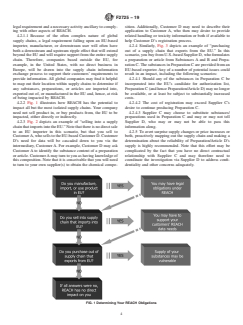
are manufactured or imported in quantities greater than 10 tonnes per year, are supported by a chemical safety report (CSR).
4.1.2.3 Other actors in the supply chain include distributors, retailers, and storage providers, all of whom are not classified as
downstream users.
4.1.2.4 Consumers are not considered actors in the supply chain, but have certain rights under REACH, including the right to
receive information about the presence of SVHC’s in quantities >0.1 % in articles.
4.2 Why Must REACH Information be Exchanged in Supply Chains?
F2725 − 19
4.2.1 REACH Title IV, Information in the Supply Chain, specifically Articles 31 through 34, legally requires manufacturers and
their supply chains to exchange certain information. Information exchange both upstream and downstream in the supply chain is
also the only way to acquire the information necessary to meet many other requirements of the REACH regulation. Therefore,
supply chain communication is both a legal requirement and a necessary activity ancillary to complying with other aspects of
REACH.
4.2.1.1 Because of the often complex nature of global supply chains, a legal requirement falling upon an EU-based importer,
manufacturer, or downstream user will often have both a downstream and upstream ripple effect that will extend beyond the EU
and will require support from the entire supply chain. Therefore, companies based outside the EU, for example, in the United
States, with no direct business in Europe, will be drawn into the supply chain information exchange process to support their
customers’ requirements to provide information. All global companies may find it helpful to map out their location within supply
chains to determine if any substances, preparations, or articles are imported into, exported out of, or manufactured in the EU and,
hence, at risk of being impacted by REACH.
4.2.2 Fig. 1 illustrates how REACH has the potential to impact all but the most isolated supply chains. Your company need not
sell product in, or buy products from, the EU to be impacted, either directly or indirectly.
4.2.3 Fig. 2 depicts an example of “selling into a supply chain that imports into the EU.” Note that there is no direct sale to
an EU importer in this scenario, but that you sell to Customer A, who sells to the EU-based Customer D. Customer D’s need for
data will be cascaded down to you via the intermediary, Customer A. For example, Customer D may ask Customer A to identify
the substance content of a preparation or article. Customer A may turn to you as having knowledge of this composition. Note that
it is conceivable that you will need to turn to your own supplier(s) to obtain the chemical composition. Additionally, Customer D
may need to describe their application to Customer A, who then may desire to provide related handling or toxicity information or
both if available to help Customer D’s registration process.
4.2.4 Similarly, Fig. 3 depicts an example of “purchasing out of a supply chain that exports from the EU.” In this scenario, you
buy from U.S.-based Supplier D, who formulates a preparation or article from Substances A and B and Preparation C. The
substances in Preparation C are provided from an EU-based exporter. Any of a number of potential issues could result in an impact,
including the following scenarios:
4.2.4.1 Should any of the substances in Preparation C be incorporated into the EU’s candidate for authorization list, Preparation
C (and hence Preparation/Article D) may no longer be available, or at least be subject to substantially increased costs.
4.2.4.2 The cost of registration may exceed Supplier C’s desire to continue producing Preparation C.
4.2.4.3 Supplier C may choose to substitute substances/preparations used in Preparation C and may or may not tell Supplier D,
who may or may not be able to pass this information along.
FIG. 1 Determining Your REACH Obligations
F2725 − 19
NOTE 1—Customer D requirements will be cascaded down to you via tier one supplier (Customer A)
FIG. 2 Example of Selling into a Supply Chain that Imports into EU
NOTE 1—You have a potentially vulnerable material, since Material C is supplied by an EU-based supplier. You will want to know about substances
in Material C and whether they are on the Candidate List. You may have to work via Supplier D who has the direct contractual relationship with Supplier
C.
FIG. 3 Example of Purchasing out of Supply Chain that Exports from EU
4.2.5 To avert surprise supply changes or price increases or both, proactively mapping out the supply chain and making a
determination about the reliability of Preparation/Article D’s supply is highly recommended. Note that this effort may be
complicated by the fact that you have no direct contractual relationship with Supplier C and may therefore need to coordinate the
investigation via Supplier D to address confidentiality and other concerns adequately.
5. Significance and Use
5.1 This guide recommends practices and solutions for global supply chain information exchange for substances, preparations,
and articles as identified by REACH. The first five annexes of REACH guidance standards serve as a central repository for REACH
industry guidance that spans industry sectors and facilitates collaboration across complex global supply chains. Annexes 6-9
provide key EU guidance on information exchange in the supply chain.
5.2 Section 6 outlines the information that is to be exchanged in the supply chain both in the upstream and downstream
directions. Fig. 4 provides a schematic depicting data flow in the upstream and downstream directions. A list of the elements to
be included in this exchange is represented in Tables 1-5 that capture the necessary data fields for information exchange. Case
studies 1-3 in Annex A1 – Annex A3 provide three sample scenarios wherein a customer and supplier complete these five tables
to exchange data to address their REACH compliance issues.
F2725 − 19
FIG. 4 Data Flow Pathway for F40 Supply Chain Communications
6. What Information Shall be Communicated Through the Supply Chain?
6.1 The REACH regulation provides certain obligatory data elements that shall be exchanged between certain actors in the
supply chain, but does not stipulate a complete base set of data to be communicated throughout all supply chains for all actors.
Rather, REACH’s 15 Titles and 17 Annexes detail a set of obligations that affect EU-based companies. A collection of technical
guidance documents, the RIPs, then provide general guidelines as to how companies might meet these obligations through
collaborative engagement of their supply chains, both inside and outside of Europe.
6.2 If, however, one looks at the dataset that would be necessary to make informed decisions regarding the critical elements of
REACH, that is, preregistration, registration, evaluation, authorization, restriction, notification, testing, exemptions, hazards, risks,
exposure scenarios, alternative substances, and so forth, there are certain key data elements that emerge as having highest priority.
6.2.1 Some of these elements are described in the RIPs. For the purpose of supply chain communication of critical data
elements, RIPs 3.4, 3.5, and 3.8, which are included in Annexes 6, 7 and 8 of REACH RIP Guidance Documents, are important
in highlighting information exchange needs.
6.3 From the REACH Regulation itself, there are some directly mandated information exchange requirements for companies
doing business in the EU. Most of the case studies contained in the RIPs envision that data will be exchanged on a
product-by-product basis, as products are the most convenient units of currency in data exchange throughout the supply chain.
However, as REACH regulates substances in products rather than the products themselves, all this product data shall be evaluated
at the substance level.
6.3.1 A summary of these requirements follows. Note that this data shall flow bidirectionally up and down the supply chain.
6.3.1.1 Article 31—Safety data sheet requirements data needs:
(1) CAS number
(2) Registration number
(3) Identity of substance/preparation
(4) EINECS or ELINCS number
(5) Use of substance/preparation
(6) Company identity
(7) Emergency telephone number
F2725 − 19
TABLE 1 UPSTREAM QUESTIONS: Information Request–Upstream Direction,
Supplier would populate for Customer
0. Supplier-provided Data Required or Optional? Expected Response/Comments from the Customer
1.1 Company Name Required Name of supplier/manufacturer.
1.2 Company ID # Required Supplier/Vendor ID #
1.3 Mailing Address Required Physical post-office mailing address of company.
1.4 REACH Responsible Required Name of person whom all REACH communications go
Individual Name to.
1.5 Contact Phone # Required Phone number of this person.
1.6 Contact Fax # Required Fax number of this person.
1.7 Contact Email Required Email address of this person.
2.1 Product Name Required Common trade name.
2.2 Supplier’s Part/Material # Required Supplier’s internal part/material #. May be same as
customer’s part/material #.
2.3 Is product a Substance, Required See REACH definitions.
Preparation or Article?
2.4 If it is an Article, what is Optional, provide Preferably this information is exchanged as customer will
Article’s weight (kg)? justification if omitted need to roll-up substance info and divide by article
weight to determine 0.1% threshold for SVHC’s.
2.5 Are you a Manufacturer or Required See REACH definitions.
Importer of Product in EU?
2.6 Are you a Downstream Required See REACH definitions.
User of Product in EU?
(8) Classification and labeling consistent with REACH Title II
(9) Concentration of constituent substances (for preparations)—shall indicate for at least all hazardous substances as defined
by Directives 1999/45/EC and 67/548/EC and for other hazardous substances of equivalent concern
(10) First aid measures
(11) Fire-fighting measures
(12) Accidental release measures
(13) Handling and storage
(14) Exposure controls/personal protection
(a) Exposure limits
(b) Occupational exposure controls
(c) Environmental exposure controls
(15) Physical properties, that is, boiling point, pH, and density
(16) Toxicological information
(17) Ecological information
(18) Disposal information
(19) Transport information
(20) Regulatory information (at community level)
6.3.1.2 Article 32—Downstream supply chain communication requirements for substances and preparations that do not require
safety data sheets:
(1) Is the substance subject to authorization, restriction or registration? If so, what are the details of the plan and status of the
process?
(2) Any other risk management information.
6.3.1.3 Article 33—Downstream information requirements for articles:
(1) For SVHC, in articles at above 0.1 weight %, what are the SVHC and what are the safe use requirements?
(2) SVHC information (at a minimum, identity of the substance) shall be available to consumers within 45 days of any request.
6.3.1.4 Article 34—Upstream supply chain communication requirements for substances and preparations:
(1) New, updated information regarding risks or hazards shall be communicated by customers to upstream suppliers as soon
as it becomes available to the customers.
6.3.1.5 Article 35—Information access for workers:
Comments on choosing an SVHC List: If full substance disclosure is not used, suppliers must list all substances on an SVHC List. Several industries are developing
their own SVHC Lists, however the Candidate List of the European Chemicals Agency will be the official legally binding list. This ASTM standard does not specify any
particular industry list; it only specifies that, in the absence of full substance disclosure, some SVHC List must be referenced. Even if full supplier substance disclosure occurs,
the customer must still evaluate these substances against an SVHC List.
2. Product Information 1. Company Information - Supplier
F2725 − 19
TABLE 1 Continued
0. Supplier-provided Data Required or Optional? Expected Response/Comments from the Customer
3.1 Substance Name Optional, provide Preferably official IUPAC name, but see RIP 3.10 for
justification if omitted substance naming conventions.
3.2 CAS number Optional, provide May not be applicable, as per RIP 3.10, CAS numbers
justification if omitted do not always correspond to unique substances.
3.3 EC Number (EINECS, Optional, provide See http://ecb.jrc.it/esis/ for #’s.
ELINCS or NLP) justification if omitted
3.4 Do you know of any Optional, provide Will rarely be available in early stages of REACH.
company who will register justification if omitted
this substance?
3.5 Is it an SVHC, per the list Required. Requestor should reference his own list, i.e. aerospace,
we reference–see “LIST automotive, EU candidate list, JIG list, or customized list.
OF SVHC’s” Sheet
3.5 Is it an SVHC, ECHA. Use Required. Requestor should reference his own list, i.e. aerospace,
Table 5. “LIST OF automotive, EU candidate list, JIG list, or customized list.
SVHC’s”
3.6 Is it a phase-in-substance? Optional, provide Does it already exist on the market, per REACH
justification if omitted definition of “existing substance”?
3.7 If in Preparation or Article, Optional, provide Should be supplied at least for all substances >0.1%
what is wt/wt concentration justification if omitted concentration.
(%) ?
3.8 If in Article, is it Required See REACH definitions.
intentionally released?
3.9 What is Classification and Required See Articles 4 and 6 of 67/548/EEC for categories; also,
Labeling category? see ECHA-published Article 112 Classification and
Labeling Inventory, when it becomes available.
3.10 Do you plan to register Required If not, should state reason why not.
substance?
3.11 Do you plan to pre-register Required If not, should state reason why not.
substance?
3.12 Envisaged tonnage band/ Required 1-10 t, 10-100 t, 100-1000 t, >1000 t.
registration deadline
3.13 Are there any restricted Required Supplier must inform customer, if and when, any
uses for the substance? If restricted use is included in Annex 17 of REACH.
so, do any prohibit Requestor (customer) can specify uses on “USAGE”
requestor’s (customer’s) Sheet, Column C. Responder (supplier) can then answer
uses per “USAGE” whether each individual use is restricted in Column E.
Sheet? Alternatively, supplier can list all restricted uses in
Column H, and customer can then ascertain whether his
uses are restricted per Annex 17. Keep in mind
restrictions apply to particular substances rather than
whole products.
3.13 Are there any restricted Required Supplier must inform customer, if and when, any
uses for the substance? If restricted use is included in Annex 17 of REACH.
so, do any prohibit Customer can specify uses on Table 3, List of Uses,
customer’s uses per Table Column C. Responder (supplier) can then answer
3, List of Uses? whether each individual use is restricted in Column E.
Alternatively, supplier can list all restricted uses in
Column H, and customer can then ascertain whether his
uses are restricted per Annex 17. Keep in mind
restrictions apply to particular substances rather than
whole products.
3.14 Has an authorization Required Supplier should inform customer, if and when an
application been filed for authorization is sought. Requestor (customer) can
use of substance in this specify uses on “USAGE” Sheet, Column C. Responder
product? If so, does it (supplier) can then answer whether each individual use
cover requestor’s has been applied for in Column F. Alternatively, supplier
(customer’s) uses per can list all authorization applications in Column I, and
“USAGE” Sheet? customer can then ascertain whether his uses will be
applied for, or whether he must complete his own
application for his use(s). Keep in mind authorizations
apply to particular substances rather than whole
products.
3.14 Has an authorization Required Supplier should inform customer, if and when an
application been filed for authorization is sought. Commenter can specify uses on
use of substance in this Table 3, List of Uses, Column C. Responder (supplier)
product? If so, does it can then answer whether each individual use has been
cover Customer’s uses per applied for in Column F. Alternatively, supplier can list all
Table 3, List of Uses? authorization applications in Column I, and customer can
then ascertain whether his uses will be applied for, or
whether he must complete his own application for his
use(s). Keep in mind authorizations apply to particular
substances rather than whole products.
3.15 If substance is subject to Required, if substance For certain Annex 14 substances, if they can be
authorization, can it be is on Annex 14 List. adequately controlled, substitution is encouraged, but not
substituted, and, if so, by legally required.
what date do you plan to
do so?
3. Substance Information
NOTE: Must iterate through Section 3 for EACH SUBSTANCE IN PRODUCT ABOVE 0.1 % CONCENTRATION BY MASS
F2725 − 19
TABLE 1 Continued
0. Supplier-provided Data Required or Optional? Expected Response/Comments from the Customer
3.16 Have Optional, provide Supplier may have
you justification if omitted useful information to
joined contribute either
a directly to customer or
SIEF as a third party data
or holder for the entire
Consortium SIEF.
for this
substance,
and, if
so,
would
you
welcome
our
participation?
3.17 Are Required Include exemptions
there from registration,
any evaluation, restriction,
relevant authorization,
exemptions communication,
that etc{and any
you exemptions from the
are entire scope of
aware REACH.
of for
uses
of this
substance
in this
product?
3.18 Do Required, if supplier The requirements of
you possesses any such data. Section 3.18 can be
possess Any such data is likely to fully met with a SDS
any be in a lengthy report or or CSR, or both. If
hazard study format and should be either of these have
or delivered separately from been communicated,
toxicity the information in this form. Upstream Question
data, 3.18’s answer can
or simply reference those
both, documents. However,
including since SDS’s are not
basic required for articles or
physico-chemical for products
properties purchased outside of
of the EU, and CSR’s are
substance? not required for
Unless substances
this manufactured/
has imported<10 tonnes/yr,
been hazards data will need
provided to be communicated
in an via this question for
SDS many products.
or
CSR,
or
both,
please
indicate
possession
of
such
data
by
placing
a “Y”
in
appropriate
column
of
“SUBSTANCES
&
HAZARDS”
Sheet.
F2725 − 19
TABLE 1 Continued
0. Supplier-provided Data Required or Optional? Expected Response/Comments from the Customer
3.18 Do Required, if supplier The requirements of
you possesses any such data. Section 3.18 can be
possess Any such data is likely to fully met with a SDS
any be in a lengthy report or or CSR, or both. If
hazard study format and should be either of these have
or delivered separately from been communicated,
toxicity the information in this form. Upstream Question
data, 3.18’s answer can
or simply reference those
both, documents. However,
including since SDS’s are not
basic required for articles or
physico-chemical for products
properties purchased outside of
of the EU, and CSR’s are
substance? not required for
Unless substances
this manufactured/
has imported<10 tonnes/yr,
been hazards data will need
provided to be communicated
in an via this question for
SDS many products.
or
CSR,
or
both,
please
indicate
possession
of
such
data
by
placing
a “Y”
in
appropriate
column
of
Table
4, List
of
Substances.
4.1 Will you continue to supply Required If not, should specify when production will cease.
this product?
4.1 Will you continue to Required If not, should
supply this product as
described in Section
3?
4.2 Will your CSR cover my Response required Requestor (customer) can specify uses on “USAGE”
uses of your Product? See (although covering Sheet, Column C. Responder (supplier) can then answer
“USAGE” Sheet. such uses is not whether each individual use is supported in Column D.
legally required, so Alternatively, supplier can list all uses supported in
answer can be “NO”). Column G, and customer can then ascertain whether his
uses are encompassed in Column G.
5.1 Registrant Name Required if answer to Registrant will be required to provide registration number
3.4 is YES to its customers
5.2 Registrant Physical Required if answer to Registrant will be required to provide registration number
Address 3.4 is YES to its customers
5.3 Registrant Contact Required if answer to Registrant will be required to provide registration number
Individual 3.4 is YES to its customers
5.4 Registrant Phone # Required if answer to Registrant will be required to provide registration number
3.4 is YES to its customers
5.5 Registrant Email Required if answer to Registrant will be required to provide registration number
3.4 is YES to its customers
5.6 Is this Registrant your Only Required if answer to Only Rep will be required to provide registration number
Representative? 3.4 is YES to its customers
5. Only Rep Information 4. Business Information - Supplier
4. Business Information - Supplier
F2725 − 19
(1) Safety data sheet information (Articles 31 and 32 of REACH) shall be furnished to any workers who may be exposed to
substances or preparations.
6.4 Industry Guidance on Information to be Exchanged:
6.4.1 Industry sector REACH guidance has provided lists of data to be collected from the supply chain. Official industry
REACH guidance for several industries is given in REACH Guidance Standards, Annexes 1-5. Some of these guidance documents
list data that would need to be communicated through the supply chain. For example, the Automotive and European Engineering
Industries (Orgalime) Guides both recommend information content to be gathered from supply chains for REACH compliance.
Many of the data elements found in industry guides are already described in 6.3, as they were taken directly from the REACH
regulation.
6.4.2 Additional information requirements/supply chain questions from the industry guides not discussed in 6.3 include:
(1) Amount used per year (kg)
(2) Supplier name and address
(3) Is it imported by you?
(4) Is the substance critical for your business?
(5) Have you contacted the supplier about registration for your use?
(6) Is there a confidentiality issue regarding specific uses?
(7) Will the substance be preregistered/registered? When?
(8) Will the substance/preparation continue to be available for purchase?
(9) Can SVHCs be substituted (if it is likely to be withdrawn in future)?
(10) If you need to produce data package for registration, what data are necessary?
(11) Who else supplies the substance or preparation and can you form a consortium?
(12) Who are your downstream users and for what use do they use the substance?
6.5 A standard REACH dataset to be exchanged within all supply chains is suggested in Tables 1-5. To use Tables 1-5, first,
as per Fig. 1, determine your own legal and market obligations under REACH. Then per Figs. 2 and 3, map out your entire supply
chain in upstream and downstream directions. Then, approach those actors in your supply chain in both the upstream and
downstream directions.
6.6 Fig. 4 illustrates the information flow pathways for these data requirements, describing first an exchange initiated by a
customer and then an exchange initiated by a supplier.
6.7 Case Studies 1-3 in Annex A1 X1 – Annex A3X3 illustrate the process of exchanging data for three representative scenarios.
Fig. 4 provides a schematic depicting data flow in the upstream and downstream directions. A list of the elements to be included
in this exchange is represented in Tables 1-5 that capture the necessary data fields for information exchange. Case studies 1-3 in
X1 – X3 provide three sample scenarios wherein a customer and supplier complete these five tables to exchange data to address
their REACH compliance issues.
7. Keywords
7.1 chemicals; REACH; supply chain
Available from www.orgalime.org.
F2725 − 19
TABLE 2 DOWNSTREAM QUESTIONS: Information Request–Downstream Direction,
Customer would populate for Supplier
0. Customer provided Data Required or Optional? Expected Response/Comments from the Supplier
1.1 Company Name Required Name of customer.
1.2 Company ID # Required Customer ID #.
1.3 Mailing Address Required Physical post-office mailing address of company.
1.4 REACH Responsible Required Name of person which all REACH communications go to.
Individual Name
1.5 Contact Phone # Required Phone number of this person.
1.6 Contact Fax # Required Fax number of this person.
1.7 Contact Email Required Email address of this person.
2.1 Product Name Required Common trade name.
2.2 Customer’s Part/Material # Required Customer’s internal part/material #. May be same as
Supplier’s part/material #.
2.3 Are you a Manufacturer or Required See REACH definitions.
Importer of Product in EU?
2.3 Are you a Manufacturer of Required See REACH definitions.
Product in EU?
2.4 Are Required See REACH
you a definitions.
Downstream
User
of
Product
in EU?
2.4 Are Required See REACH
you an definitions.
Importer
or
Downstream
User
of
Product
in EU?
2. Product Information 1. Company Information - Customer
F2725 − 19
TABLE 2 Continued
0. Customer provided Data Required or Optional? Expected Response/Comments from the Supplier
3.1 Substance Name Required - but supplier Take exact name from “SUBSTANCES & HAZARDS”
should first provide list Sheet, so will correspond to supplier’s name.
of substances in the
product for the
customer on
“SUBSTANCES &
HAZARDS” Sheet.
3.1 Substance Name Required - but supplier should first provide list of Take exact
substances in the product for the customer on “LIST OF
SUBSTANCES” Sheet.
3.2 Do you plan to register Required - but supplier should first provide list of If not, should
this substance? substances in the product for the customer on
“SUBSTANCES & HAZARDS” Sheet.
3.2 Do you plan to register Required - but supplier should first provide list of If not, should
this substance? substances in the product for the customer on “LIST OF
SUBSTANCES” Sheet.
3.3 Do you plan to pre- Required - but supplier should first provide list of If not, should
register this substances in the product for the customer on
substance? “SUBSTANCES & HAZARDS” Sheet.
3.3 Do you plan to pre- Required - but supplier should first provide list of If not, should
register this substances in the product for the customer on “LIST OF
substance? SUBSTANCES” Sheet.
3.4 Envisaged tonnage band/ Required, if answer to 1-10 t, 10-100 t, 100-1000 t, >1000 t.
registration deadline 3.1 or 3.2 is “YES”
3.5 Are Required - but supplier Supplier must inform
there should first provide list of customer, if and when,
any substances in the product any restricted use is
restricted for the customer on included in Annex 17
uses “SUBSTANCES & of REACH. Requestor
for the HAZARDS” Sheet. (supplier) can specify
substance? restricted uses on
If so, “USAGE” Sheet,
do any Column H. Responder
prohibit (customer) can then
your ascertain whether
uses each individual use is
per restricted.
“USAGE” Alternatively, customer
Sheet? can list all his uses in
Column C, and
supplier can then
deterimine and inform
customer whether his
uses are restricted per
Annex 17, by filling in
Column E. Bear in
mind restrictions apply
to particular
substances rather than
whole products.
3. Substance Information—Note: must be iterated for each substance in product.
List of substances in product should be provided by Supplier to Customer,
using “SUBSTANCES & HAZARDS” Sheet before Customer completes this section.
3. Substance Information—Note: must be iterated for each substance in product.
List of substances in product should be provided by Supplier to Customer,
using “LIST OF SUBSTANCES” Sheet before Customer completes this section.
F2725 − 19
TABLE 2 Continued
0. Customer provided Data Required or Optional? Expected Response/Comments from the Supplier
3.5 Are Required - but supplier Supplier m
...