

ASTM B374-21
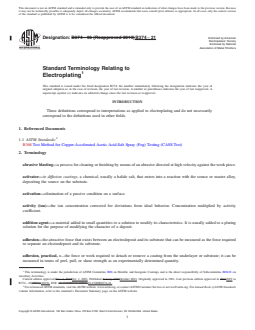
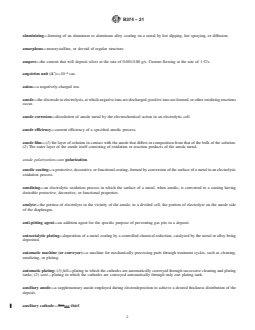
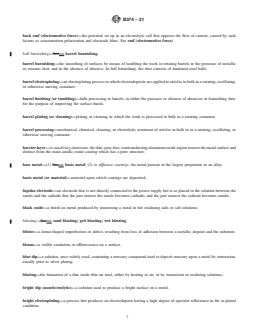
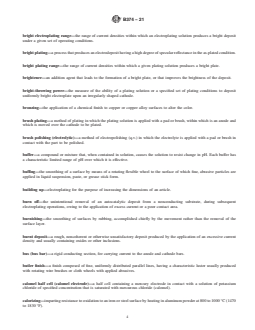
(Terminology)Standard Terminology Relating to Electroplating
General Information
- Abstract
- Status
- Published
- Publication Date
- 30-Sep-2021
- Technical Committee
- B08 - Metallic and Inorganic Coatings
- Drafting Committee
- B08.01 - Ancillary Activities
Overview
ASTM B374-21: Standard Terminology Relating to Electroplating provides essential definitions and explanations for terms used in the field of electroplating and metal finishing. Endorsed by key industry organizations, including the American Electroplaters’ Society and the National Association of Metal Finishers, this standard assists professionals with consistent, industry-accepted terminology when working with electroplated coatings and processes.
This document supports the accurate use of technical language in the development, testing, evaluation, and specification of electroplating processes. By adhering to the standardized terms, users improve communication and efficiency across the global supply chain, manufacturing, and quality control operations.
Key Topics
ASTM B374-21 covers a broad and practical range of terms relevant to electroplating technology and adjacent practices. The terminology outlined includes, but is not limited to:
- Processes: Definitions for electroplating, autocatalytic plating (also known as electroless plating), anodizing, mechanical plating, and diffusion coatings.
- Materials: Explanations of base metal, substrate, auxiliary anode, composite coatings, and addition agents such as brighteners and dispersing agents.
- Equipment & Tools: Terms for plating racks, bus bars, barrel plating machines, Hull cell, and rectifiers.
- Coating Characteristics: Vocabulary surrounding adhesion (practical adhesion, peel strength), burning, nodulation, porosity, ductility, and leveling action.
- Testing & Quality: References to test methods such as the CASS (copper-accelerated acetic acid salt spray) test, and terms relating to corrosion, embrittlement, crazing, and conversion coatings.
- Cleaning & Preparation: Methods and terms for mechanical cleaning, alkaline cleaning, emulsion cleaning, pickling, and degreasing.
Applications
The terminology defined in ASTM B374-21 is widely used in a variety of sectors and contexts involving electroplated and metal finished components, such as:
- Manufacturing and Production: Consistent language ensures clear specifications and quality standards for parts and assemblies, especially in automotive, aerospace, electronics, and decorative hardware.
- Testing and Quality Assurance: Accurate definitions support standardized test methods and evaluation criteria for coating thickness, adhesion, and corrosion resistance.
- Technical Documentation: Specification sheets, work instructions, and training materials rely on standardized terms to minimize confusion and ensure regulatory compliance.
- Process Design and Troubleshooting: Understanding terms for equipment setup and process variables helps engineers and operators optimize performance and address defects like blistering, pitting, or poor covering power.
- Supply Chain Communication: Facilitates clear and concise communication between suppliers, manufacturers, and customers globally.
Related Standards
ASTM B374-21 references and complements several other important industry standards, including:
- ASTM B368: Test Method for Copper-Accelerated Acetic Acid-Salt Spray (CASS Test)
- ASTM B380: For specialized corrosion testing
- Other ASTM B08 Committee Standards: Covering metallic and inorganic coatings
For comprehensive information and the most current details, consult the official ASTM publications and related standard documentation at www.astm.org.
Maintaining up-to-date terminology is crucial to ensuring clarity, reducing misunderstandings, and supporting quality and safety across the electroplating industry. ASTM B374-21 remains the authoritative resource for defining and communicating technical concepts relating to electroplating and allied processes.
Relations
- Effective Date
- 15-Apr-2009
- Effective Date
- 10-May-2003
- Effective Date
- 01-Jan-1997
Get Certified
Connect with accredited certification bodies for this standard

DVS-ZERT GmbH
German welding certification society.
CARES (UK Certification Authority for Reinforcing Steels)
UK certification for reinforcing steels and construction.
EWF/IIW (European/International Welding Federation)
International welding personnel certification.
Sponsored listings
Frequently Asked Questions
ASTM B374-21 is a standard published by ASTM International. Its full title is "Standard Terminology Relating to Electroplating". This standard covers: Standard Terminology Relating to Electroplating
Standard Terminology Relating to Electroplating
ASTM B374-21 is classified under the following ICS (International Classification for Standards) categories: 01.040.25 - Manufacturing engineering (Vocabularies); 25.220.01 - Surface treatment and coating in general. The ICS classification helps identify the subject area and facilitates finding related standards.
ASTM B374-21 has the following relationships with other standards: It is inter standard links to ASTM B368-09, ASTM B368-97(2003)e1, ASTM B368-97. Understanding these relationships helps ensure you are using the most current and applicable version of the standard.
ASTM B374-21 is available in PDF format for immediate download after purchase. The document can be added to your cart and obtained through the secure checkout process. Digital delivery ensures instant access to the complete standard document.
Standards Content (Sample)
This international standard was developed in accordance with internationally recognized principles on standardization established in the Decision on Principles for the
Development of International Standards, Guides and Recommendations issued by the World Trade Organization Technical Barriers to Trade (TBT) Committee.
Designation: B374 − 21 Endorsed by American
Electroplaters’ Society
Endorsed by National
Association of Metal Finishers
Standard Terminology Relating to
Electroplating
This standard is issued under the fixed designation B374; the number immediately following the designation indicates the year of
original adoption or, in the case of revision, the year of last revision. A number in parentheses indicates the year of last reapproval. A
superscript epsilon (´) indicates an editorial change since the last revision or reapproval.
INTRODUCTION
These definitions correspond to interpretations as applied to electroplating and do not necessarily
correspond to the definitions used in other fields.
1. Referenced Documents adhesion, practical, n—theforceorworkrequiredtodetachor
remove a coating from the underlayer or substrate; it can be
1.1 ASTM Standards:
measured in terms of peel, pull, or shear strength as an
B368Test Method for Copper-Accelerated Acetic Acid-Salt
experimentally determined quantity.
Spray (Fog) Testing (CASS Test)
aluminizing—forming of an aluminum or aluminum alloy
2. Terminology
coatingonametalbyhotdipping,hotspraying,ordiffusion.
abrasive blasting—a process for cleaning or finishing by
amorphous—noncrystalline, or devoid of regular structure.
means of an abrasive directed at high velocity against the
work piece. ampere—the current that will deposit silver at the rate of
0.0011180 g/s. Current flowing at the rate of 1 C/s.
activator—in diffusion coatings, a chemical, usually a halide
−8
˚
salt, that enters into a reaction with the source or master angström unit (A)—10 cm.
alloy, depositing the source on the substrate.
anion—a negatively-charged ion.
activation—elimination of a passive condition on a surface.
anode—the electrode in electrolysis, at which negative ions
activity (ion)—the ion concentration corrected for deviations
are discharged, positive ions are formed, or other oxidizing
from ideal behavior. Concentration multiplied by activity
reactions occur.
coefficient.
anode corrosion—dissolution of anode metal by the electro-
addition agent—a material added in small quantities to a
chemical action in an electrolytic cell.
solution to modify its characteristics. It is usually added to a
anode efficiency—current efficiency of a specified anodic
platingsolutionforthepurposeofmodifyingthecharacterof
process.
a deposit.
anode film—(1)thelayerofsolutionincontactwiththeanode
adhesion—the attractive force that exists between an elec-
trodeposit and its substrate that can be measured as the force that differs in composition from that of the bulk of the
solution. (2)The outer layer of the anode itself consisting of
required to separate an electrodeposit and its substrate.
oxidation or reaction products of the anode metal.
anode polarization—see polarization.
This terminology is under the jurisdiction of ASTM Committee B08 on
anodic coating—a protective, decorative, or functional
Metallic and Inorganic Coatings and is the direct responsibility of Subcommittee
coating,formedbyconversionofthesurfaceofametalinan
B08.01 on Ancillary Activities.
Current edition approved Oct. 1, 2021. Published October 2021. Originally
electrolytic oxidation process.
approvedin1961.Lastpreviouseditionapprovedin2019asB374–06(2019).DOI:
10.1520/B0374-21.
anodizing—an electrolytic oxidation process in which the
For referenced ASTM standards, visit the ASTM website, www.astm.org, or
surface of a metal, when anodic, is converted to a coating
contact ASTM Customer Service at service@astm.org. For Annual Book of ASTM
having desirable protective, decorative, or functional prop-
Standards volume information, refer to the standard’s Document Summary page on
the ASTM website. erties.
Copyright © ASTM International, 100 Barr Harbor Drive, PO Box C700, West Conshohocken, PA 19428-2959. United States
B374 − 21
anolyte—theportionofelectrolyteinthevicinityoftheanode; the anode and the cathode that the part nearest the anode
in a divided cell, the portion of electrolyte on the anode side becomes cathodic and the part nearest the cathode becomes
of the diaphragm. anodic.
black oxide—afinishonmetalproducedbyimmersingametal
anti-pitting agent—an addition agent for the specific purpose
of preventing gas pits in a deposit. in hot oxidizing salts or salt solutions.
blasting—see sand blasting; grit blasting; wet blasting.
autocatalytic plating—deposition of a metal coating by a
controlled chemical reduction, catalyzed by the metal or blister—a dome-shaped imperfection or defect, resulting from
loss of adhesion between a metallic deposit and the sub-
alloy being deposited.
strate.
automatic machine (or conveyor)—a machine for mechani-
bloom—a visible exudation or efflorescence on a surface.
cally processing parts through treatment cycles, such as
cleaning, anodizing, or plating.
blue dip—a solution, once widely used, containing a mercury
compound used to deposit mercury upon a metal by
automatic plating: (1) full—plating in which the cathodes are
immersion, usually prior to silver plating.
automatically conveyed through successive cleaning and
plating tanks; (2) semi—plating in which the cathodes are
blueing—the formation of a thin oxide film on steel, either by
conveyed automatically through only one plating tank.
heating in air, or by immersion in oxidizing solutions.
auxiliary anode—a supplementary anode employed during
bright dip (nonelectrolytic)—a solution used to produce a
electrodeposition to achieve a desired thickness distribution
bright surface on a metal.
of the deposit.
bright electroplating—a process that produces an electrode-
auxiliary cathode—see thief.
posit having a high degree of specular reflectance in the
as-plated condition.
back emf (electromotive force)—the potential set up in an
electrolytic cell that opposes the flow of current, caused by
bright electroplating range—the range of current densities
such factors as concentration polarization and electrode
within which an electroplating solution produces a bright
films. See emf (electromotive force).
deposit under a given set of operating conditions.
ball burnishing—see barrel burnishing.
bright plating—a process that produces an electrodeposit
barrel burnishing—the smoothing of surfaces by means of
having a high degree of specular reflectance in the as-plated
tumbling the work in rotating barrels in the presence of
condition.
metallic or ceramic shot, and in the absence of abrasive. In
bright plating range—the range of current densities within
ball burnishing, the shot consists of hardened steel balls.
which a given plating solution produces a bright plate.
barrel electroplating—an electroplating process in which
brightener—an addition agent that leads to the formation of a
electrodeposits are applied to articles in bulk in a rotating,
bright plate, or that improves the brightness of the deposit.
oscillating, or otherwise moving container.
bright-throwing power—the measure of the ability of a
barrel finishing (or tumbling)—bulk processing in barrels, in
plating solution or a specified set of plating conditions to
either the presence or absence of abrasives or burnishing
deposit uniformly bright electroplate upon an irregularly
shot, for the purpose of improving the surface finish.
shaped cathode.
barrel plating (or cleaning)—platingorcleaninginwhichthe
bronzing—the application of a chemical finish to copper or
work is processed in bulk in a rotating container.
copper alloy surfaces to alter the color.
barrel processing—mechanical, chemical, cleaning, or elec-
brush plating—a method of plating in which the plating
trolytic treatment of articles in bulk or in a rotating,
solution is applied with a pad or brush, within which is an
oscillating, or otherwise moving container.
anode and which is moved over the cathode to be plated.
barrier layer—in anodizing aluminum, the thin, pore-free,
brush polishing (electrolytic)—a method of electropolishing
semiconducting aluminum oxide region nearest the metal
(q.v.) in which the electrolyte is applied with a pad or brush
surface and distinct from the main anodic oxide coating
in contact with the part to be polished.
which has a pore structure.
buffer—a compound or mixture that, when contained in
base metal—(1) see basis metal;(2) in diffusion coatings, the
solution, causes the solution to resist change in pH. Each
metal present in the largest proportion in an alloy.
buffer has a characteristic limited range of pH over which it
basis metal (or material)—material upon which coatings are is effective.
deposited.
buffing—the smoothing of a surface by means of a rotating
bipolar electrode—an electrode that is not directly connected flexiblewheeltothesurfaceofwhichfine,abrasiveparticles
to the power supply but is so placed in the solution between are applied in liquid suspension, paste, or grease stick form.
B374 − 21
building up—electroplating for the purpose of increasing the chelating agent—a compound capable of forming a chelate
dimensions of an article. compound with a metal ion. See chelate compound.
burn off—the unintentional removal of an autocatalytic de- chemical milling—the shaping of a work piece by immersion
in an etchant employing a resist for selective removal of
posit from a nonconducting substrate, during subsequent
electroplating operations, owing to the application of excess material.
current or a poor contact area.
chemical plating—deposition of a metal coating by chemical,
non-electrolytic methods. See also immersion plate, con-
burnishing—the smoothing of surfaces by rubbing, accom-
tact plating.
plished chiefly by the movement rather than the removal of
the surface layer.
chemical polishing—the improvement in surface smoothing
of a metal by simple immersion in a suitable solution. See
burnt deposit—a rough, noncoherent or otherwise unsatisfac-
bright dip (nonelectrolytic).
tory deposit produced by the application of an excessive
current density and usually containing oxides or other
chromating—a process for producing a conversion coating
inclusions.
containing chromium compounds.
bus (bus bar)—arigidconductingsection,forcarryingcurrent
chromizing—a surface treatment at elevated temperatures,
to the anode and cathode bars.
generally carried out in pack, vapor, or salt baths, in which
an alloy is formed by the inward diffusion of chromium into
butler finish—afinishcomposedoffine,uniformlydistributed
the base metal.
parallel lines, having a characteristic luster usually produced
with rotating wire brushes or cloth wheels with applied
cleaning—the removal of grease, oxides, or other foreign
abrasives.
material from a surface.
alkaline cleaning—cleaning by means of alkaline solutions.
calomel half cell (calomel electrode)—ahalfcellcontaininga
mercury electrode in contact with a solution of potassium
anodic or reverse cleaning—electrolytic cleaning in which
chloride of specified concentration that is saturated with
the work is the anode.
mercurous chloride (calomel).
cathodic or direct cleaning—electrolytic cleaning in which
the work is the cathode.
calorizing—imparting resistance to oxidation to an iron or
steel surface by heating in aluminum powder at 800 to
diphase cleaning—cleaning by means of solutions that
1000°C (1470 to 1830°F).
contain a solvent layer and an aqueous layer. Cleaning is
effected both by solvent and emulsifying action.
CASS test (copper accelerated salt spray)—an accelerated
direct current cleaning—See cathodic or direct cleaning.
corrosion test for some electrodeposits and for anodic
coatings on aluminum (see Test Method B368). electrolytic cleaning—alkalinecleaninginwhichacurrentis
passed through the solution, the work being one of the
cataphoresis—see electrophoresis.
electrodes.
cathode—the electrode in electrolysis at which positive ions
emulsion cleaning—cleaning by means of solutions contain-
are discharged, negative ions are formed, or other reducing
ing organic solvents, water, and emulsifying agents.
actions occur.
immersion—see soak cleaning.
cathode efficiency—the current efficiency of a specified ca-
reverse current cleaning—see anodic or reverse cleaning.
thodic process.
soak cleaning—cleaning by immersion without the use of
cathode film—thelayerofsolutionincontactwiththecathode
current, usually in alkaline solution.
that differs in composition from that of the bulk of the
solvent cleaning—cleaning by means of organic solvents.
solution.
spray cleaning—cleaning by means of spraying.
cathode polarization—see polarization.
ultrasonic cleaning—cleaning by any chemical means aided
catholyte—the portion of the electrolyte in the vicinity of the
by ultrasonic energy.
cathode; in a divided cell, the portion of the cathode side of
cleaning-emulsifiable solvent—two-stage cleaning system
the diaphragm.
wherein a concentrate containing organic solvents and
cation—a positively-charged ion.
surface-active agents is applied to a surface, subsequently
emulsified, and removed along with the soil, by water
caustic dip—in diffusion coatings, a strongly alkaline treat-
rinsing.
ment applied by dip or spray for neutralizing acid residues.
coating cycle—specific time and temperature to achieve de-
cementation—see pack cementation.
sired depth of diffusion.
chelate compound—a compound in which the metal is con-
tainedasanintegralpartofaringstructureandisnotreadily coating, diffusion—an alloy coating produced by applying
ionized. heat to one or more coatings deposited on a metal substrate.
B374 − 21
colloidal particle—an electrically-charged particle, generally Corrodkote test—an accelerated corrosion test for electrode-
smaller in size than 200 mµ, dispersed in a second continu- posits (see Method B380 ).
ous phase.
corrosion—(1) gradual solution or oxidation of a metal; (2)
solution of anode metal by the electrochemical action in the
color anodizing—in anodizing aluminum, formation of a
colored coating on aluminum where the colored compound, plating cell.
pigment, or dye is incorporated after the coating has been
coulomb—the quantity of electricity that is transmitted
formed.
through an electric circuit in 1 s when the current in the
circuit is 1 A. The quantity of electricity that will deposit
coloring—(1) the production of desired colors on metal
0.0011180 g of silver.
surfaces by appropriate chemical or electrochemical action;
(2) light buffing of metal surfaces for the purpose of
coulometer—an electrolytic cell arranged to measure the
producing a high luster. Called “color buffing.”
quantity of electricity by the chemical action produced in
accordance with Faraday’s law.
complex ion—an ion composed of two or more ions or
radicals,bothofwhicharecapableofindependentexistence,
covering power—the ability of a plating solution under a
=
for example, cuprocyanide (Cu(CN) ) .
specified set of plating conditions to deposit metal on the
surfacesofrecessesordeepholes.(Tobedistinguishedfrom
complexing agent—a compound that will combine with me-
throwing power.)
tallic ions to form complex ions. See complex ion.
crazing—a network of fine hairline cracks in a coating.
composite coating—a coating consisting of deposits incorpo-
rating particles of another material. See also dispersion
critical current density—acurrentdensityabovewhichanew
coating.
and sometimes undesirable reaction occurs.
composite plate—an electrodeposit consisting of two or more
current density (cd)—current per unit area.
layers of metal deposited successively.
current efficiency—the proportion, usually expressed as a
concentration polarization—thatpartofthetotalpolarization
percentage, of the current that is effective in carrying out a
that is caused by changes in the activity of the potential-
specified process in accordance with Faraday’s law.
determining components of the electrolyte.
cut wire blasting—blasting with short, cut lengths of metal
conductance—the capacity of a medium, usually expressed in wire. See abrasive blasting.
mhos, for transmitting electric current. The reciprocal of
cutting down—polishing or buffing for the purpose of remov-
resistance.
ing roughness or irregularities.
conducting salt—a salt added to the solution in order to
deburring—the removal of burrs, sharp edges, or fins by
increase its conductivity.
mechanical, chemical, or electrochemical means.
conductivity—specific conductance—the current transferred
decarburization—loss of carbon from the surface layer of a
across unit area per unit potential gradient. In the metric
carbon containing alloy due to reaction with one or more
system, K=amperes per square centimetre divided by volts
chemical substances in a medium that contacts the surface.
per centimetre. The reciprocal of resistivity.
decomposition potential—the minimum potential, exclusive
contact plating—deposition of a metal by the use of an
of IR drop, at which an electrochemical process can take
internal source of current by immersion of the work in
place at an appreciable rate.
solution in contact with another metal.
degreasing—the removal of grease and oils from a surface.
contact potential—the potential difference at the junction of
solvent degreasing—degreasing by immersion in liquid or-
two dissimilar substances.
ganic solvent.
conversion coating—the conversion of the surface of a metal
vapor degreasing—degreasingbysolventvaporscondensing
into a superficial coating that more readily accepts applied
on the parts being cleaned.
coatings or provides for a more corrosion-resistant surface
deionization—the removal of ions from a solution by ion
by a chemical or electrochemical process in which com-
pounds of the metal in question become part of the coating, exchange.
or both. For example, zinc phosphate coatings from phos-
depolarization—a decrease in the polarization of an electrode
phoric acid-based treatment of zinc or aluminum oxide/
at a specified current density.
chromium oxide coatings from the treatment of aluminum
with chromium compounds in the plus six oxidation state.
depolarizer—a substance or a means that produces depolar-
ization.
conversion treatment—achemicalorelectrochemicalprocess
producing a superficial layer containing a compound of the detergent—a surface-active agent that possesses the ability to
metal. clean soiled surfaces.
B374 − 21
anionic detergent—a detergent that produces aggregates of electrode—a conductor through which current enters or leaves
negatively-charged ions with colloidal properties. an electrolytic cell, at which there is a change from conduc-
tion by electrons to conduction by charged particles of
cationic detergent—a detergent that produces aggregates of
matter, or vice versa.
positively-charged ions with colloidal properties.
electrode potential—the difference in potential between an
nonionic detergent—a detergent that produces aggregates of
electrode and the immediately adjacent electrolyte referred
electrically-neutral molecules with colloidal properties.
to some standard electrode potential as zero.
diaphragm—a porous or permeable membrane separating
dynamic E.P.—the electrode potential measured when cur-
anodeandcathodecompartmentsofanelectrolyticcellfrom
rent is passing between the electrode and the electrolyte.
each other or from an intermediate compartment.
equilibrium E.P.—a static electrode potential when the elec-
trode and the electrolyte are in equilibrium with respect to a
diffusion—(1) spreading of a constituent in a gas, liquid, or
specified electrochemical reaction.
solid tending to make the composition of all parts uniform;
(2)thespontaneousmovementofatomsormoleculestonew
standard E.P.—an equilibrium electrode potential for an
sites within a material.
electrode in contact with an electrolyte in which all of the
components of a specified chemical reaction are in their
diffusion coating—analloycoatingproducedbyapplyingheat
standard states. The standard state for an ionic constituent is
to one or more coatings deposited on a basis metal.
unit ion activity.
diffusion cycle—specific time and temperature to acquire a
static E.P.—the electrode potential measured when no net
depth of diffusion and composition.
current is flowing between the electrode and the electrolyte.
electrodeposition—theprocessofdepositingasubstanceupon
diffusion treatment (or coating)—(1) process of producing a
an electrode by electrolysis. See electroforming,
surface layer (diffusion layer) by diffusion of another metal
electroplating, electrorefining, and electrowinning.
or non-metal into the surface of the basis material; (2)in
electroplating, heat treatment applied to a work piece to
electroforming—the production or reproduction of articles by
achieve alloying or intermetallic compound formation be-
electrodeposition upon a mandrel or mold that is subse-
tween two or more coatings on a basis material.
quently separated from the deposit.
dispersing agent—a material that increases the stability of a
electrogalvanizing—electrodeposition of zinc coatings.
suspension of particles in a liquid medium.
electroless plating—term in use but not recommended. See
dispersion coating—a coating consisting of particles of one
autocatalytic plating.
material contained in a matrix of another metal or nonmetal.
electrolysis—production of chemical changes by the passage
of current through an electrolyte.
divided cell—acellcontainingadiaphragmorothermeansfor
physically separating the anolyte from the catholyte.
electrolyte—(1) a conducting medium in which the flow of
current is accompanied by movement of matter. Most often
double salt—a compound of two salts that crystallize together
an aqueous solution of acids, bases, or salts, but includes
in a definite proportion.
many other media, such as fused salts, ionized gases, some
drag-in—the water or solution that adheres to the objects solids, etc.; (2) a substance that is capable of forming a
introduced into a bath.
conducting liquid medium when dissolved or melted.
electrolytic cell—a unit apparatus in which electrochemical
drag-out—the solution that adheres to the objects removed
reactions are produced by applying electrical energy, or
from a bath.
which supplies electrical energy as a result of chemical
ductility—the ability of a material to deform plastically
reactionsandwhichincludestwoormoreelectrodesandone
without fracturing.
or more electrolytes contained in a suitable vessel.
dummy (or dummy cathode)—acathodeinaplatingsolution electromotive series—a table that lists in order the standard
that is not to be made use of after plating. Often used for electrode potentials of specified electrochemical reactions.
removal or decomposition of impurities.
electrophoresis—the movement of colloidal particles pro-
duced by the application of an electric potential.
duplex coating—see composite plate.
electrochemical equivalent—the weight of an element,
electroplating—the electrodeposition of an adherent metallic
compound, radical, or ion involved in a specified electro-
coating upon an electrode for the purpose of securing a
chemical reaction during the passage of unit quantity of
surfacewithpropertiesordimensionsdifferentfromthoseof
electricity, such as a Faraday, ampere-hour, or coulomb.
the basis metal.
electrochemistry—the branch of science and technology electropolishing—the improvement in surface finish of a
which deals with transformations between chemical and metal effected by making it anodic in an appropriate solu-
electrical energy. tion.
B374 − 21
NOTE 1—The true value of free cyanide is rarely known with ce
...
This document is not an ASTM standard and is intended only to provide the user of an ASTM standard an indication of what changes have been made to the previous version. Because
it may not be technically possible to adequately depict all changes accurately, ASTM recommends that users consult prior editions as appropriate. In all cases only the current version
of the standard as published by ASTM is to be considered the official document.
Designation: B374 − 06 (Reapproved 2019) B374 − 21 Endorsed by American
Electroplaters’ Society
Endorsed by National
Association of Metal Finishers
Standard Terminology Relating to
Electroplating
This standard is issued under the fixed designation B374; the number immediately following the designation indicates the year of
original adoption or, in the case of revision, the year of last revision. A number in parentheses indicates the year of last reapproval. A
superscript epsilon (´) indicates an editorial change since the last revision or reapproval.
INTRODUCTION
These definitions correspond to interpretations as applied to electroplating and do not necessarily
correspond to the definitions used in other fields.
1. Referenced Documents
1.1 ASTM Standards:
B368 Test Method for Copper-Accelerated Acetic Acid-Salt Spray (Fog) Testing (CASS Test)
2. Terminology
abrasive blasting—a process for cleaning or finishing by means of an abrasive directed at high velocity against the work piece.
activator—in diffusion coatings, a chemical, usually a halide salt, that enters into a reaction with the source or master alloy,
depositing the source on the substrate.
activation—elimination of a passive condition on a surface.
activity (ion)—the ion concentration corrected for deviations from ideal behavior. Concentration multiplied by activity
coefficient.
addition agent—a material added in small quantities to a solution to modify its characteristics. It is usually added to a plating
solution for the purpose of modifying the character of a deposit.
adhesion—the attractive force that exists between an electrodeposit and its substrate that can be measured as the force required
to separate an electrodeposit and its substrate.
adhesion, practical, n—the force or work required to detach or remove a coating from the underlayer or substrate; it can be
measured in terms of peel, pull, or shear strength as an experimentally determined quantity.
This terminology is under the jurisdiction of ASTM Committee B08 on Metallic and Inorganic Coatings and is the direct responsibility of Subcommittee B08.01 on
Ancillary Activities.
Current edition approved Dec. 1, 2019Oct. 1, 2021. Published January 2020October 2021. Originally approved in 1961. Last previous edition approved in 20112019 as
B374 – 06(2011).(2019). DOI: 10.1520/B0374-06R19.10.1520/B0374-21.
For referenced ASTM standards, visit the ASTM website, www.astm.org, or contact ASTM Customer Service at service@astm.org. For Annual Book of ASTM Standards
volume information, refer to the standard’s Document Summary page on the ASTM website.
Copyright © ASTM International, 100 Barr Harbor Drive, PO Box C700, West Conshohocken, PA 19428-2959. United States
B374 − 21
aluminizing—forming of an aluminum or aluminum alloy coating on a metal by hot dipping, hot spraying, or diffusion.
amorphous—noncrystalline, or devoid of regular structure.
ampere—the current that will deposit silver at the rate of 0.0011180 g/s. Current flowing at the rate of 1 C/s.
−8
angström unit (A˚)—10 cm.
anion—a negatively-charged ion.
anode—the electrode in electrolysis, at which negative ions are discharged, positive ions are formed, or other oxidizing reactions
occur.
anode corrosion—dissolution of anode metal by the electrochemical action in an electrolytic cell.
anode efficiency—current efficiency of a specified anodic process.
anode film—(1) the layer of solution in contact with the anode that differs in composition from that of the bulk of the solution.
(2) The outer layer of the anode itself consisting of oxidation or reaction products of the anode metal.
anode polarization—see polarization.
anodic coating—a protective, decorative, or functional coating, formed by conversion of the surface of a metal in an electrolytic
oxidation process.
anodizing—an electrolytic oxidation process in which the surface of a metal, when anodic, is converted to a coating having
desirable protective, decorative, or functional properties.
anolyte—the portion of electrolyte in the vicinity of the anode; in a divided cell, the portion of electrolyte on the anode side
of the diaphragm.
anti-pitting agent—an addition agent for the specific purpose of preventing gas pits in a deposit.
autocatalytic plating—deposition of a metal coating by a controlled chemical reduction, catalyzed by the metal or alloy being
deposited.
automatic machine (or conveyor)—a machine for mechanically processing parts through treatment cycles, such as cleaning,
anodizing, or plating.
automatic plating: (1) full—plating in which the cathodes are automatically conveyed through successive cleaning and plating
tanks; (2) semi—plating in which the cathodes are conveyed automatically through only one plating tank.
auxiliary anode—a supplementary anode employed during electrodeposition to achieve a desired thickness distribution of the
deposit.
auxiliary cathode—Seesee thief.
B374 − 21
back emf (electromotive force)—the potential set up in an electrolytic cell that opposes the flow of current, caused by such
factors as concentration polarization and electrode films. See emf (electromotive force).
ball burnishing—Seesee barrel burnishing.
barrel burnishing—the smoothing of surfaces by means of tumbling the work in rotating barrels in the presence of metallic
or ceramic shot, and in the absence of abrasive. In ball burnishing, the shot consists of hardened steel balls.
barrel electroplating—an electroplating process in which electrodeposits are applied to articles in bulk in a rotating, oscillating,
or otherwise moving container.
barrel finishing (or tumbling)—bulk processing in barrels, in either the presence or absence of abrasives or burnishing shot,
for the purpose of improving the surface finish.
barrel plating (or cleaning)—plating or cleaning in which the work is processed in bulk in a rotating container.
barrel processing—mechanical, chemical, cleaning, or electrolytic treatment of articles in bulk or in a rotating, oscillating, or
otherwise moving container.
barrier layer—in anodizing aluminum, the thin, pore-free, semiconducting aluminum oxide region nearest the metal surface and
distinct from the main anodic oxide coating which has a pore structure.
base metal—(1) Seesee basis metal; (2) in diffusion coatings, the metal present in the largest proportion in an alloy.
basis metal (or material)—material upon which coatings are deposited.
bipolar electrode—an electrode that is not directly connected to the power supply but is so placed in the solution between the
anode and the cathode that the part nearest the anode becomes cathodic and the part nearest the cathode becomes anodic.
black oxide—a finish on metal produced by immersing a metal in hot oxidizing salts or salt solutions.
blasting—Seesee sand blasting; grit blasting; wet blasting.
blister—a dome-shaped imperfection or defect, resulting from loss of adhesion between a metallic deposit and the substrate.
bloom—a visible exudation or efflorescence on a surface.
blue dip—a solution, once widely used, containing a mercury compound used to deposit mercury upon a metal by immersion,
usually prior to silver plating.
blueing—the formation of a thin oxide film on steel, either by heating in air, or by immersion in oxidizing solutions.
bright dip (nonelectrolytic)—a solution used to produce a bright surface on a metal.
bright electroplating—a process that produces an electrodeposit having a high degree of specular reflectance in the as-plated
condition.
B374 − 21
bright electroplating range—the range of current densities within which an electroplating solution produces a bright deposit
under a given set of operating conditions.
bright plating—a process that produces an electrodeposit having a high degree of specular reflectance in the as-plated condition.
bright plating range—the range of current densities within which a given plating solution produces a bright plate.
brightener—an addition agent that leads to the formation of a bright plate, or that improves the brightness of the deposit.
bright-throwing power—the measure of the ability of a plating solution or a specified set of plating conditions to deposit
uniformly bright electroplate upon an irregularly shaped cathode.
bronzing—the application of a chemical finish to copper or copper alloy surfaces to alter the color.
brush plating—a method of plating in which the plating solution is applied with a pad or brush, within which is an anode and
which is moved over the cathode to be plated.
brush polishing (electrolytic)—a method of electropolishing (q.v.) in which the electrolyte is applied with a pad or brush in
contact with the part to be polished.
buffer—a compound or mixture that, when contained in solution, causes the solution to resist change in pH. Each buffer has
a characteristic limited range of pH over which it is effective.
buffing—the smoothing of a surface by means of a rotating flexible wheel to the surface of which fine, abrasive particles are
applied in liquid suspension, paste, or grease stick form.
building up—electroplating for the purpose of increasing the dimensions of an article.
burn off—the unintentional removal of an autocatalytic deposit from a nonconducting substrate, during subsequent
electroplating operations, owing to the application of excess current or a poor contact area.
burnishing—the smoothing of surfaces by rubbing, accomplished chiefly by the movement rather than the removal of the
surface layer.
burnt deposit—a rough, noncoherent or otherwise unsatisfactory deposit produced by the application of an excessive current
density and usually containing oxides or other inclusions.
bus (bus bar)—a rigid conducting section, for carrying current to the anode and cathode bars.
butler finish—a finish composed of fine, uniformly distributed parallel lines, having a characteristic luster usually produced
with rotating wire brushes or cloth wheels with applied abrasives.
calomel half cell (calomel electrode)—a half cell containing a mercury electrode in contact with a solution of potassium
chloride of specified concentration that is saturated with mercurous chloride (calomel).
calorizing—imparting resistance to oxidation to an iron or steel surface by heating in aluminum powder at 800 to 1000 °C (1470
to 1830 °F).
B374 − 21
CASS test (copper accelerated salt spray)—an accelerated corrosion test for some electrodeposits and for anodic coatings on
aluminum (see Test Method B368).
cataphoresis—Seesee electrophoresis.
cathode—the electrode in electrolysis at which positive ions are discharged, negative ions are formed, or other reducing actions
occur.
cathode efficiency—the current efficiency of a specified cathodic process.
cathode film—the layer of solution in contact with the cathode that differs in composition from that of the bulk of the solution.
cathode polarization—see polarization.
catholyte—the portion of the electrolyte in the vicinity of the cathode; in a divided cell, the portion of the cathode side of the
diaphragm.
cation—a positively-charged ion.
caustic dip—in diffusion coatings, a strongly alkaline treatment applied by dip or spray for neutralizing acid residues.
cementation—Seesee pack cementation.
chelate compound—a compound in which the metal is contained as an integral part of a ring structure and is not readily ionized.
chelating agent—a compound capable of forming a chelate compound with a metal ion. See chelate compound.
chemical milling—the shaping of a work piece by immersion in an etchant employing a resist for selective removal of material.
chemical plating—deposition of a metal coating by chemical, non-electrolytic methods. See also immersion plate,contact
plating.
chemical polishing—the improvement in surface smoothing of a metal by simple immersion in a suitable solution. See bright
dip (nonelectrolytic).
chromating—a process for producing a conversion coating containing chromium compounds.
chromizing—a surface treatment at elevated temperatures, generally carried out in pack, vapor, or salt baths, in which an alloy
is formed by the inward diffusion of chromium into the base metal.
cleaning—the removal of grease, oxides, or other foreign material from a surface.
alkaline cleaning—cleaning by means of alkaline solutions.
anodic or reverse cleaning—electrolytic cleaning in which the work is the anode.
cathodic or direct cleaning—electrolytic cleaning in which the work is the cathode.
diphase cleaning—cleaning by means of solutions that contain a solvent layer and an aqueous layer. Cleaning is effected both
by solvent and emulsifying action.
direct current cleaning—See cathodic or direct cleaning.
electrolytic cleaning—alkaline cleaning in which a current is passed through the solution, the work being one of the electrodes.
B374 − 21
emulsion cleaning—cleaning by means of solutions containing organic solvents, water, and emulsifying agents.
immersion—Seesee soak cleaning.
reverse current cleaning—Seesee anodic or reverse cleaning.
soak cleaning—cleaning by immersion without the use of current, usually in alkaline solution.
solvent cleaning—cleaning by means of organic solvents.
spray cleaning—cleaning by means of spraying.
ultrasonic cleaning—cleaning by any chemical means aided by ultrasonic energy.
cleaning-emulsifiable solvent—two-stage cleaning system wherein a concentrate containing organic solvents and surface-
active agents is applied to a surface, subsequently emulsified, and removed along with the soil, by water rinsing.
coating cycle—specific time and temperature to achieve desired depth of diffusion.
coating, diffusion—an alloy coating produced by applying heat to one or more coatings deposited on a metal substrate.
colloidal particle—an electrically-charged particle, generally smaller in size than 200 mμ, dispersed in a second continuous
phase.
color anodizing—in anodizing aluminum, formation of a colored coating on aluminum where the colored compound, pigment,
or dye is incorporated after the coating has been formed.
coloring—(1) the production of desired colors on metal surfaces by appropriate chemical or electrochemical action; (2) light
buffing of metal surfaces for the purpose of producing a high luster. Called “color buffing.”
complex ion—an ion composed of two or more ions or radicals, both of which are capable of independent existence, for
=
example, cuprocyanide (Cu(CN) ) .
complexing agent—a compound that will combine with metallic ions to form complex ions. See complex ion.
composite coating—a coating consisting of deposits incorporating particles of another material. See also dispersion coating.
composite plate—an electrodeposit consisting of two or more layers of metal deposited successively.
concentration polarization—that part of the total polarization that is caused by changes in the activity of the potential-
determining components of the electrolyte.
conductance—the capacity of a medium, usually expressed in mhos, for transmitting electric current. The reciprocal of
resistance.
conducting salt—a salt added to the solution in order to increase its conductivity.
conductivity—specific conductance—the current transferred across unit area per unit potential gradient. In the metric system,
K = amperes per square centimetre divided by volts per centimetre. The reciprocal of resistivity.
contact plating—deposition of a metal by the use of an internal source of current by immersion of the work in solution in
contact with another metal.
contact potential—the potential difference at the junction of two dissimilar substances.
B374 − 21
conversion coating—the conversion of the surface of a metal into a superficial coating that more readily accepts applied
coatings or provides for a more corrosion-resistant surface by a chemical or electrochemical process in which compounds of the
metal in question become part of the coating, or both. For example, zinc phosphate coatings from phosphoric acid-based
treatment of zinc or aluminum oxide/chromium oxide coatings from the treatment of aluminum with chromium compounds in
the plus six oxidation state.
conversion treatment—a chemical or electrochemical process producing a superficial layer containing a compound of the
metal.
Corrodkote test—an accelerated corrosion test for electrodeposits (see Method B380 ).
corrosion—(1) gradual solution or oxidation of a metal; (2) solution of anode metal by the electrochemical action in the plating
cell.
coulomb—the quantity of electricity that is transmitted through an electric circuit in 1 s when the current in the circuit is 1 A.
The quantity of electricity that will deposit 0.0011180 g of silver.
coulometer—an electrolytic cell arranged to measure the quantity of electricity by the chemical action produced in accordance
with Faraday’s law.
covering power—the ability of a plating solution under a specified set of plating conditions to deposit metal on the surfaces
of recesses or deep holes. (To be distinguished from throwing power.)
crazing—a network of fine hairline cracks in a coating.
critical current density—a current density above which a new and sometimes undesirable reaction occurs.
current density (cd)—current per unit area.
current efficiency—the proportion, usually expressed as a percentage, of the current that is effective in carrying out a specified
process in accordance with Faraday’s law.
cut wire blasting—blasting with short, cut lengths of metal wire. See abrasive blasting.
cutting down—polishing or buffing for the purpose of removing roughness or irregularities.
deburring—the removal of burrs, sharp edges, or fins by mechanical, chemical, or electrochemical means.
decarburization—loss of carbon from the surface layer of a carbon containing alloy due to reaction with one or more chemical
substances in a medium that contacts the surface.
decomposition potential—the minimum potential, exclusive of IR drop, at which an electrochemical process can take place at
an appreciable rate.
degreasing—the removal of grease and oils from a surface.
solvent degreasing—degreasing by immersion in liquid organic solvent.
vapor degreasing—degreasing by solvent vapors condensing on the parts being cleaned.
B374 − 21
deionization—the removal of ions from a solution by ion exchange.
depolarization—a decrease in the polarization of an electrode at a specified current density.
depolarizer—a substance or a means that produces depolarization.
detergent—a surface-active agent that possesses the ability to clean soiled surfaces.
anionic detergent—a detergent that produces aggregates of negatively-charged ions with colloidal properties.
cationic detergent—a detergent that produces aggregates of positively-charged ions with colloidal properties.
nonionic detergent—a detergent that produces aggregates of electrically-neutral molecules with colloidal properties.
diaphragm—a porous or permeable membrane separating anode and cathode compartments of an electrolytic cell from each
other or from an intermediate compartment.
diffusion—(1) spreading of a constituent in a gas, liquid, or solid tending to make the composition of all parts uniform; (2) the
spontaneous movement of atoms or molecules to new sites within a material.
diffusion coating—an alloy coating produced by applying heat to one or more coatings deposited on a basis metal.
diffusion cycle—specific time and temperature to acquire a depth of diffusion and composition.
diffusion treatment (or coating)—(1) process of producing a surface layer (diffusion layer) by diffusion of another metal or
non-metal into the surface of the basis material; (2) in electroplating, heat treatment applied to a work piece to achieve alloying
or intermetallic compound formation between two or more coatings on a basis material.
dispersing agent—a material that increases the stability of a suspension of particles in a liquid medium.
dispersion coating—a coating consisting of particles of one material contained in a matrix of another metal or nonmetal.
divided cell—a cell containing a diaphragm or other means for physically separating the anolyte from the catholyte.
double salt—a compound of two salts that crystallize together in a definite proportion.
drag-in—the water or solution that adheres to the objects introduced into a bath.
drag-out—the solution that adheres to the objects removed from a bath.
ductility—the ability of a material to deform plastically without fracturing.
dummy (or dummy cathode)—a cathode in a plating solution that is not to be made use of after plating. Often used for removal
or decomposition of impurities.
duplex coating—Seesee composite plate.
electrochemical equivalent—the weight of an element, compound, radical, or ion involved in a specified electrochemical
reaction during the passage of unit quantity of electricity, such as a Faraday, ampere-hour, or coulomb.
B374 − 21
electrochemistry—the branch of science and technology which deals with transformations between chemical and electrical
energy.
electrode—a conductor through which current enters or leaves an electrolytic cell, at which there is a change from conduction
by electrons to conduction by charged particles of matter, or vice versa.
electrode potential—the difference in potential between an electrode and the immediately adjacent electrolyte referred to some
standard electrode potential as zero.
dynamic E.P.—the electrode potential measured when current is passing between the electrode and the electrolyte.
equilibrium E.P.—a static electrode potential when the electrode and the electrolyte are in equilibrium with respect to a specified
electrochemical reaction.
standard E.P.—an equilibrium electrode potential for an electrode in contact with an electrolyte in which all of the components
of a specified chemical reaction are in their standard states. The standard state for an ionic constituent is unit ion activity.
static E.P.—the electrode potential measured when no net current is flowing between the electrode and the electrolyte.
electrodeposition—the process of depositing a substance upon an electrode by electrolysis. See electroforming, electroplating,
electrorefining, and electrowinning.
electroforming—the production or reproduction of articles by electrodeposition upon a mandrel or mold that is subsequently
separated from the deposit.
electrogalvanizing—electrodeposition of zinc coatings.
electroless plating—term in use but not recommended. See autocatalytic plating.
electrolysis—production of chemical changes by the passage of current through an electrolyte.
electrolyte—(1) a conducting medium in which the flow of current is accompanied by movement of matter. Most often an
aqueous solution of acids, bases, or salts, but includes many other media, such as fused salts, ionized gases, some solids, etc.;
(2) a substance that is capable of forming a conducting liquid medium when dissolved or melted.
electrolytic cell—a unit apparatus in which electrochemical reactions are produced by applying electrical energy, or which
supplies electrical energy as a result of chemical reactions and which includes two or more electrodes and one or more
electrolytes contained in a suitable vessel.
electromotive series—a table that lists in order the standard electrode potentials of specified electrochemical reactions.
electrophoresis—the movement of colloidal particles produced by the application of an electric potential.
electroplating—the electrodeposition of an adherent metallic coating upon an electrode for the purpose of securing a surface
with properties or dimensions different from those of the basis metal.
electropolishing—the improvement in surface finish of a metal effected by making it anodic in an appropriate solution.
electrorefining—the process of anodically dissolving a metal from an impure anode and
...