

ASTM E2631-20
(Practice)Standard Practice for Physical Placement of an Entity-Controlled Supplemental Identification Label
General Information
- Abstract
SIGNIFICANCE AND USE
5.1 There is no consistent method for the physical placement of an identifying label on equipment in the possession of an entity.
5.2 This practice is intended to expedite and improve the physical inventory and self-assessment processes and other occasions in which the instant identification of equipment is needed for purposes of control, management, or determining ownership, or a combination thereof.
5.3 The further intent of this practice is to reduce the administrative costs associated with activities requiring equipment identification, that is, physical inventory, self-assessments, and audits and to supplement Practice E2279, Practice E2452, and MIL STD 130.
SCOPE
1.1 This practice is for supplemental identification labels assigned by an entity and affixed to equipment to permit control.
1.2 Identifying labels include, but are not limited to, removable tags, bands, and plates.
1.3 This practice is not intended for material or manufacturer’s warranties.
1.4 This practice is not intended for markings of original equipment manufacturers (OEMs).
1.5 The values stated in SI units are to be regarded as standard. No other units of measurement are included in this standard.
1.6 This standard does not purport to address all of the safety concerns, if any, associated with its use. It is the responsibility of the user of this standard to establish appropriate safety, health, and environmental practices and determine the applicability of regulatory limitations prior to use.
1.7 This international standard was developed in accordance with internationally recognized principles on standardization established in the Decision on Principles for the Development of International Standards, Guides and Recommendations issued by the World Trade Organization Technical Barriers to Trade (TBT) Committee.
- Status
- Published
- Publication Date
- 30-Jun-2020
- Technical Committee
- E53 - Asset Management
- Drafting Committee
- E53.01 - Process Management
Buy Documents


ASTM E2631-20 - Standard Practice for Physical Placement of an Entity-Controlled Supplemental Identification Label


REDLINE ASTM E2631-20 - Standard Practice for Physical Placement of an Entity-Controlled Supplemental Identification Label
Overview
ASTM E2631-20 - Standard Practice for Physical Placement of an Entity-Controlled Supplemental Identification Label provides uniform guidance for the application of supplemental identification labels to equipment under the control of an organization or entity. This standard aims to enhance the processes of inventory control, asset management, ownership determination, and operational efficiency by establishing consistent practices for the placement of such labels. It is particularly relevant for asset managers, property administrators, and organizations seeking to streamline equipment tracking, audits, and self-assessments.
Key Topics
- Physical Placement of Labels: The standard defines best practices for placing supplemental identification labels on equipment to ensure immediate visibility and accessibility for users.
- Label Types Covered: Applicable to a range of label types, including removable tags, bands, and plates, but not intended for manufacturer or original equipment markings.
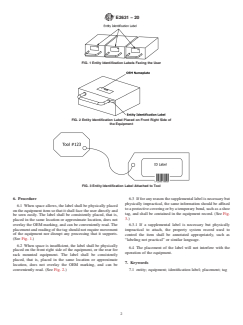
- Consistency and Readability: Labels should be positioned consistently (such as facing the user directly or on the front right side) and must not obscure OEM markings. Placement should allow for easy reading and not disrupt equipment functions or processing.
- Administrative Efficiency: The practice is designed to reduce the cost and complexity of activities such as physical inventory, audits, and self-assessments.
- Impractical Situations: Guidelines are provided for cases where physical labeling is impossible, recommending alternate methods such as attaching the identification information to a protective covering, using a temporary bond, or annotating the equipment records accordingly.
- Safety and Compliance: Users are responsible for implementing appropriate safety, health, and environmental practices, and must ensure compliance with applicable regulations.
Applications
The effective implementation of ASTM E2631-20 supports several practical applications:
- Asset and Property Management: Facilitates control, inventory, and management of assets by making equipment instantly and consistently identifiable.
- Operational Audits and Self-Assessments: Streamlines these processes by ensuring that identification labels are easily located and read.
- Ownership and Responsibility Tracking: Enables quick verification of equipment ownership for accountability and transfer purposes.
- Equipment Maintenance and Control: Promotes efficient equipment servicing, repair, or retirement by providing supplementary identification apart from manufacturer marks.
- Regulatory and Standards Compliance: Assists organizations in aligning with broader asset management practices and regulatory requirements.
Related Standards
ASTM E2631-20 is designed to supplement and be used in conjunction with several other important standards relating to asset and property management:
- ASTM E2279: Practice for Establishing the Guiding Principles of Property Asset Management
- ASTM E2452: Practice for Equipment Management Process Maturity (EMPM) Model
- MIL-STD-130: Standard Practice for Identification Marking of U.S. Military Property
- ASTM E2135: Terminology for Property and Asset Management
Conclusion
Applying the ASTM E2631-20 standard for entity-controlled supplemental identification labels delivers significant benefits in the areas of inventory control, equipment management, and audit readiness. By ensuring consistent label placement and reliable asset identification practices, organizations can improve operational efficiency, reduce costs, and maintain a robust system of control. Adherence to this standard, alongside related asset management practices, supports high standards of accountability and compliance in today’s asset-intensive environments.
Relations
- Effective Date
- 01-Jul-2020
- Refers
ASTM E2452-12(2019) - Standard Practice for Equipment Management Process Maturity (EMPM) Model - Effective Date
- 01-May-2019
- Effective Date
- 01-May-2017
- Effective Date
- 01-Jan-2015
- Effective Date
- 15-Sep-2012
- Effective Date
- 15-Oct-2010
- Effective Date
- 15-Oct-2010
- Effective Date
- 15-Oct-2010
- Effective Date
- 01-Jul-2010
- Effective Date
- 01-Jul-2010
- Refers
ASTM E2279-09 - Standard Practice for Establishing the Guiding Principles of Property Management - Effective Date
- 01-Aug-2009
- Effective Date
- 15-Jun-2007
- Effective Date
- 15-Jun-2007
- Effective Date
- 15-Feb-2006
- Effective Date
- 01-Jul-2005
Buy Documents
ASTM E2631-20 - Standard Practice for Physical Placement of an Entity-Controlled Supplemental Identification Label
REDLINE ASTM E2631-20 - Standard Practice for Physical Placement of an Entity-Controlled Supplemental Identification Label
Get Certified
Connect with accredited certification bodies for this standard

BRCGS (Brand Reputation Compliance Global Standards)
Global food safety and quality standards owner.
Sponsored listings
Frequently Asked Questions
ASTM E2631-20 is a standard published by ASTM International. Its full title is "Standard Practice for Physical Placement of an Entity-Controlled Supplemental Identification Label". This standard covers: SIGNIFICANCE AND USE 5.1 There is no consistent method for the physical placement of an identifying label on equipment in the possession of an entity. 5.2 This practice is intended to expedite and improve the physical inventory and self-assessment processes and other occasions in which the instant identification of equipment is needed for purposes of control, management, or determining ownership, or a combination thereof. 5.3 The further intent of this practice is to reduce the administrative costs associated with activities requiring equipment identification, that is, physical inventory, self-assessments, and audits and to supplement Practice E2279, Practice E2452, and MIL STD 130. SCOPE 1.1 This practice is for supplemental identification labels assigned by an entity and affixed to equipment to permit control. 1.2 Identifying labels include, but are not limited to, removable tags, bands, and plates. 1.3 This practice is not intended for material or manufacturer’s warranties. 1.4 This practice is not intended for markings of original equipment manufacturers (OEMs). 1.5 The values stated in SI units are to be regarded as standard. No other units of measurement are included in this standard. 1.6 This standard does not purport to address all of the safety concerns, if any, associated with its use. It is the responsibility of the user of this standard to establish appropriate safety, health, and environmental practices and determine the applicability of regulatory limitations prior to use. 1.7 This international standard was developed in accordance with internationally recognized principles on standardization established in the Decision on Principles for the Development of International Standards, Guides and Recommendations issued by the World Trade Organization Technical Barriers to Trade (TBT) Committee.
SIGNIFICANCE AND USE 5.1 There is no consistent method for the physical placement of an identifying label on equipment in the possession of an entity. 5.2 This practice is intended to expedite and improve the physical inventory and self-assessment processes and other occasions in which the instant identification of equipment is needed for purposes of control, management, or determining ownership, or a combination thereof. 5.3 The further intent of this practice is to reduce the administrative costs associated with activities requiring equipment identification, that is, physical inventory, self-assessments, and audits and to supplement Practice E2279, Practice E2452, and MIL STD 130. SCOPE 1.1 This practice is for supplemental identification labels assigned by an entity and affixed to equipment to permit control. 1.2 Identifying labels include, but are not limited to, removable tags, bands, and plates. 1.3 This practice is not intended for material or manufacturer’s warranties. 1.4 This practice is not intended for markings of original equipment manufacturers (OEMs). 1.5 The values stated in SI units are to be regarded as standard. No other units of measurement are included in this standard. 1.6 This standard does not purport to address all of the safety concerns, if any, associated with its use. It is the responsibility of the user of this standard to establish appropriate safety, health, and environmental practices and determine the applicability of regulatory limitations prior to use. 1.7 This international standard was developed in accordance with internationally recognized principles on standardization established in the Decision on Principles for the Development of International Standards, Guides and Recommendations issued by the World Trade Organization Technical Barriers to Trade (TBT) Committee.
ASTM E2631-20 is classified under the following ICS (International Classification for Standards) categories: 01.080.99 - Other graphical symbols; 55.020 - Packaging and distribution of goods in general. The ICS classification helps identify the subject area and facilitates finding related standards.
ASTM E2631-20 has the following relationships with other standards: It is inter standard links to ASTM E2279-20, ASTM E2452-12(2019), ASTM E2135-10a(2017), ASTM E2279-15, ASTM E2452-12, ASTM E2135-10a, ASTM E2135-10ae2, ASTM E2135-10ae1, ASTM E2135-10, ASTM E2452-10, ASTM E2279-09, ASTM E2135-07e1, ASTM E2135-07, ASTM E2135-06, ASTM E2452-05. Understanding these relationships helps ensure you are using the most current and applicable version of the standard.
ASTM E2631-20 is available in PDF format for immediate download after purchase. The document can be added to your cart and obtained through the secure checkout process. Digital delivery ensures instant access to the complete standard document.
Standards Content (Sample)
This international standard was developed in accordance with internationally recognized principles on standardization established in the Decision on Principles for the
Development of International Standards, Guides and Recommendations issued by the World Trade Organization Technical Barriers to Trade (TBT) Committee.
Designation:E2631 −20
Standard Practice for
Physical Placement of an Entity-Controlled Supplemental
Identification Label
This standard is issued under the fixed designation E2631; the number immediately following the designation indicates the year of
original adoption or, in the case of revision, the year of last revision. A number in parentheses indicates the year of last reapproval. A
superscript epsilon (´) indicates an editorial change since the last revision or reapproval.
1. Scope E2452 Practice for Equipment Management Process Matu-
rity (EMPM) Model
1.1 This practice is for supplemental identification labels
2.2 Federal Standard:
assigned by an entity and affixed to equipment to permit
MIL STD 130 Standard Practice for Identification Marking
control.
of U.S. Military Property
1.2 Identifying labels include, but are not limited to, remov-
able tags, bands, and plates.
3. Terminology
1.3 This practice is not intended for material or manufac-
3.1 Definitions—See Terminology E2135 for definitions
turer’s warranties.
related to property and asset management.
1.4 This practice is not intended for markings of original 3.1.1 impractical, adj—unwise to implement or maintain in
equipment manufacturers (OEMs). practice.
3.1.2 label, n—an identifying or descriptive marker that is
1.5 The values stated in SI units are to be regarded as
attached to an object.
standard. No other units of measurement are included in this
standard.
3.1.3 placement, n—act of placing, adhering, or affixing a
label in a certain place or location.
1.6 This standard does not purport to address all of the
safety concerns, if any, associated with its use. It is the
3.1.4 supplemental, adv—something added to provide fur-
responsibility of the user of this standard to establish appro-
ther information.
priate safety, health, and environmental practices and deter-
mine the applicability of regulatory limitations prior to use. 4. Summary of Practice
1.7 This international standard was developed in accor-
4.1 The intent of this practice is to provide uniform guid-
dance with internationally recognized principles on standard-
ance for the physical placement of a supplemental label on
ization established in the Decision on Principles for the
equipment in the possession or control of an entity.
Development of International Standards, Guides and Recom-
mendations issued by the World Trade Organization Technical
5. Significance and Use
Barriers to Trade (TBT) Committee.
5.1 There is no consistent method for the physical place-
ment of an identifying label on equipment in the possession of
2. Referenced Documents
an entity.
2.1 ASTM Standards:
5.2 This practice is intended to expedite and improve the
E2135 Terminology for Property and Asset Management
physical inventory and self-assessment processes and other
E2279 Practice for Establishing the Guiding Principles of
occasions in which the instant identification of equipment is
Property Asset Management
needed for purposes of control, management, or determining
ownership, or a combination thereof.
5.3 The further intent of this practice is to reduce the
This practice is under the jurisdiction of ASTM Committee E53 on Asset
administrative costs associated with activities requiring equip-
Management and is the direct responsibility of Subcommittee E53.01 on Process
ment identification, that is, physical inventory, self-
Management.
Current edition approved July 1, 2020. Published July 2020. Originally approved
assessments, and audits and to supplement Practice E2279,
in 2009. Last previous edit
...
This document is not an ASTM standard and is intended only to provide the user of an ASTM standard an indication of what changes have been made to the previous version. Because
it may not be technically possible to adequately depict all changes accurately, ASTM recommends that users consult prior editions as appropriate. In all cases only the current version
of the standard as published by ASTM is to be considered the official document.
Designation: E2631 − 09 (Reapproved 2015) E2631 − 20
Standard Practice for
Physical Placement of an Entity-Controlled Supplemental
Identification Label
This standard is issued under the fixed designation E2631; the number immediately following the designation indicates the year of
original adoption or, in the case of revision, the year of last revision. A number in parentheses indicates the year of last reapproval. A
superscript epsilon (´) indicates an editorial change since the last revision or reapproval.
1. Scope
1.1 This practice is for supplemental identification labels assigned by an entity and affixed to equipment to permit control.
1.2 Identifying labels include, but are not limited to, removable tags, bands, and plates.
1.3 This practice is not intended for material or manufacturer’s warranties.
1.4 This practice is not intended for markings of original equipment manufacturer’s (OEM’s) markings.manufacturers (OEMs).
1.5 The values stated in SI units are to be regarded as standard. No other units of measurement are included in this standard.
1.6 This standard does not purport to address all of the safety concerns, if any, associated with its use. It is the responsibility
of the user of this standard to establish appropriate safety safety, health, and healthenvironmental practices and determine the
applicability of regulatory limitations prior to use.
1.7 This international standard was developed in accordance with internationally recognized principles on standardization
established in the Decision on Principles for the Development of International Standards, Guides and Recommendations issued
by the World Trade Organization Technical Barriers to Trade (TBT) Committee.
2. Referenced Documents
2.1 ASTM Standards:
E2135 Terminology for Property and Asset Management
E2279 Practice for Establishing the Guiding Principles of Property Asset Management
This practice is under the jurisdiction of ASTM Committee E53 on Asset Management and is the direct responsibility of Subcommittee E53.01 on Process Management.
Current edition approved Jan. 1, 2015July 1, 2020. Published January 2015July 2020. Originally approved in 2009. Last previous edition approved in 20092015 as
E2631E2631–09(2015).–09. DOI: 10.1520/E2631-09R15.10.1520/E2631-20.
For referenced ASTM standards, visit the ASTM website, www.astm.org, or contact ASTM Customer Service at service@astm.org. For Annual Book of ASTM Standards
volume information, refer to the standard’sstandard’s Document Summary page on the ASTM website.
Copyright © ASTM International, 100 Barr Harbor Drive, PO Box C700, West Conshohocken, PA 19428-2959. United States
E2631 − 20
E2452 Practice for Equipment Management Process Maturity (EMPM) Model
2.2 Federal Standard:
MIL STD 130 Standard Practice for Identification Marking of U.S. Military Property
3. Terminology
3.1 DefinitionsDefinitions——SeeSee Terminology E2135 for definitions related to property and asset management.
3.1.1 impractical, adj—unwise to implement or maintain in practice.
3.1.2 label, n—an identifying or descriptive marker that is attached to an object.
3.1.3 placement, n—act of placing, adhering, or affixing a label in a certain place or location.
3.1.4 supplemental, adv—something added to provide further information.
4. Summary of Practice
4.1 The intent of this practice is to provide uniform guidance for the physical placement of a supplemental label on equipment
in the possession or control of an entity.
5. Significance and Use
5.1 There is no consistent method for the physical pl
...